Mental Health Risk Assessment

                   Dr Ewen McPhee
How do you feel
   Reported feelings of
       Fear
       Helplessness
       Anxiety
       Anger
   Counter transference
   The ability of clinicians to predict suicide of homicide
    is poor
Suicide
   1.6% of deaths in Australia
   20% of deaths Male 20 – 39
   Men X 4 more likely than Women
   8.9 per 100,000
   Prevalence of 2.3% Suicidal ideation
   45% presented to a GP in the month Prior
   50% Self harm prior
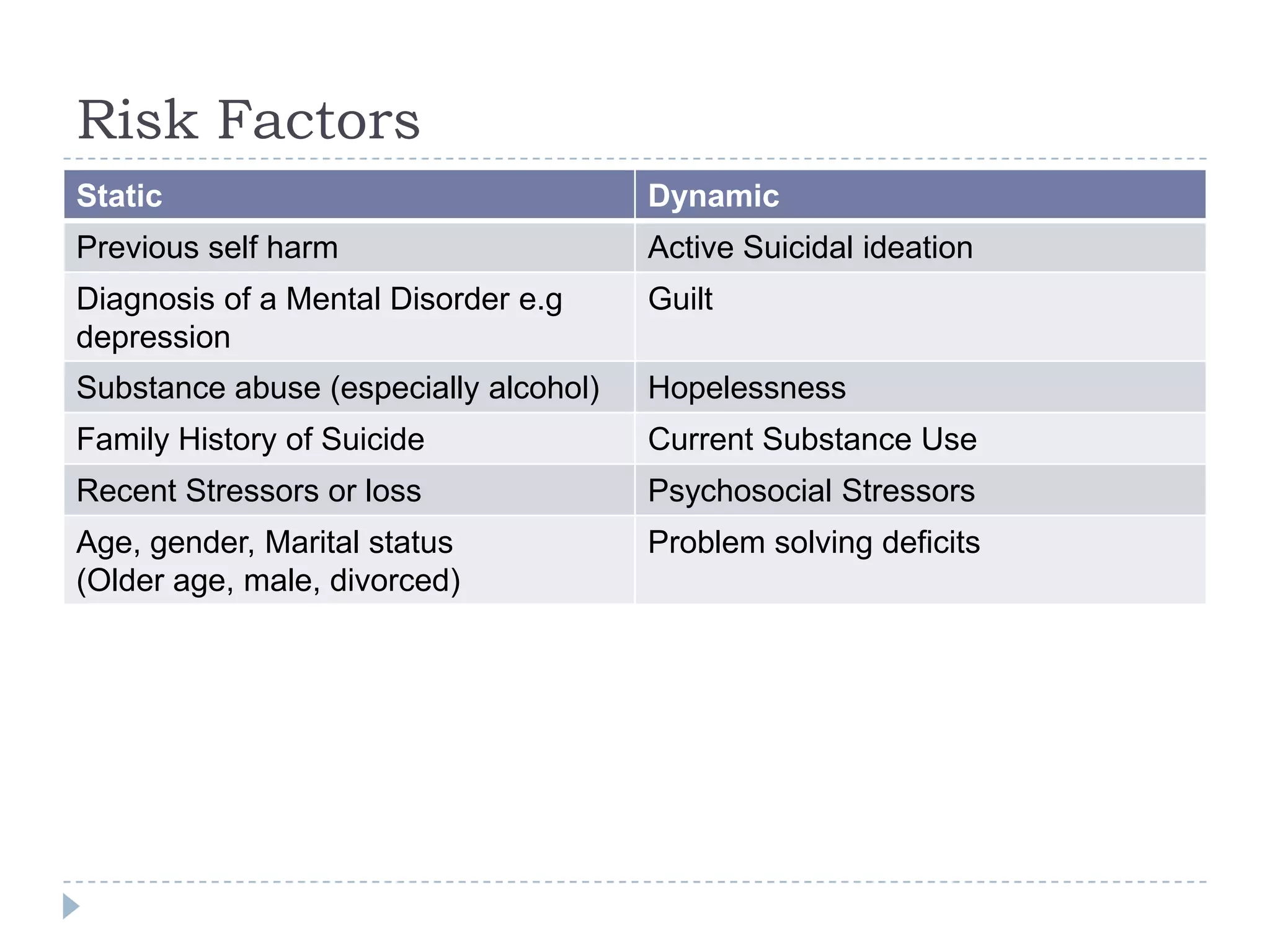
Risk Factors
Static                                 Dynamic
Previous self harm                     Active Suicidal ideation
Diagnosis of a Mental Disorder e.g     Guilt
depression
Substance abuse (especially alcohol)   Hopelessness
Family History of Suicide              Current Substance Use
Recent Stressors or loss               Psychosocial Stressors
Age, gender, Marital status            Problem solving deficits
(Older age, male, divorced)
How to ask about suicide
   Do you ever feel like giving up?
   How does the future seem to you?
   Does your life ever seem so bad that you wish to die
   How severe are the thoughts? How frequent
   Have you made any plans
   How close have you come to doing something
       Access to methods of suicide e.g. Firearms, stockpile of
        medications, chemicals
   What stops you doing something?
       Protective factors e.g. Religeon, love for children/family
        members
Ideation


 Suicidal ideation that includes a plan for suicide or
  evidence that the individual has been engaging in
    preparations for a suicide attempt are signs of
               significant short term risk
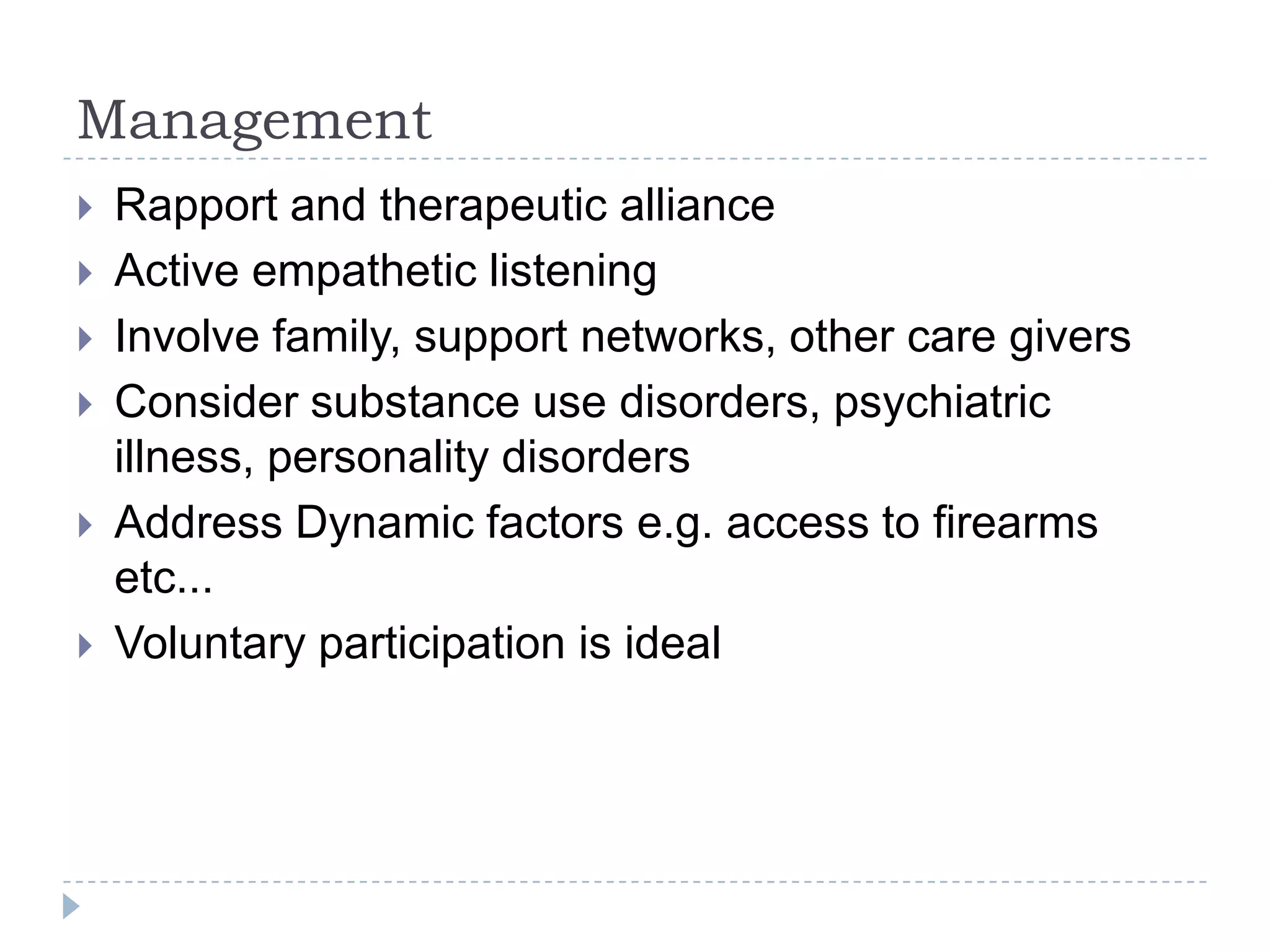
Management
   Rapport and therapeutic alliance
   Active empathetic listening
   Involve family, support networks, other care givers
   Consider substance use disorders, psychiatric
    illness, personality disorders
   Address Dynamic factors e.g. access to firearms
    etc...
   Voluntary participation is ideal
Contracts
   The use of ‘no self harm’ contracts should be
    avoided as they are generally held to be ineffective
    and not supported by evidence.
   Instead, a safety plan for the patient can be drawn
    up and this can include information such as help
    lines (particularly in an emergency out of hours),
    follow up appointments and online resources
Involuntary referral
   Referral may need to be undertaken without the consent
    of the patient using the relevant Mental Health Act
    legislation.
   This would be considered as a last resort and only in
    exceptional circumstances. Although state based Mental
    Health Act legislation may vary, most allow for a referral
    for psychiatric assessment without the consent of the
    patient where:
       the patient appears to be mentally unwell
       there is a risk to life or substantial risk to health of self or
        others,
       And it is reasonable to believe that treatment will reduce those
        risks and that this cannot be provided in a less restrictive
        manner.
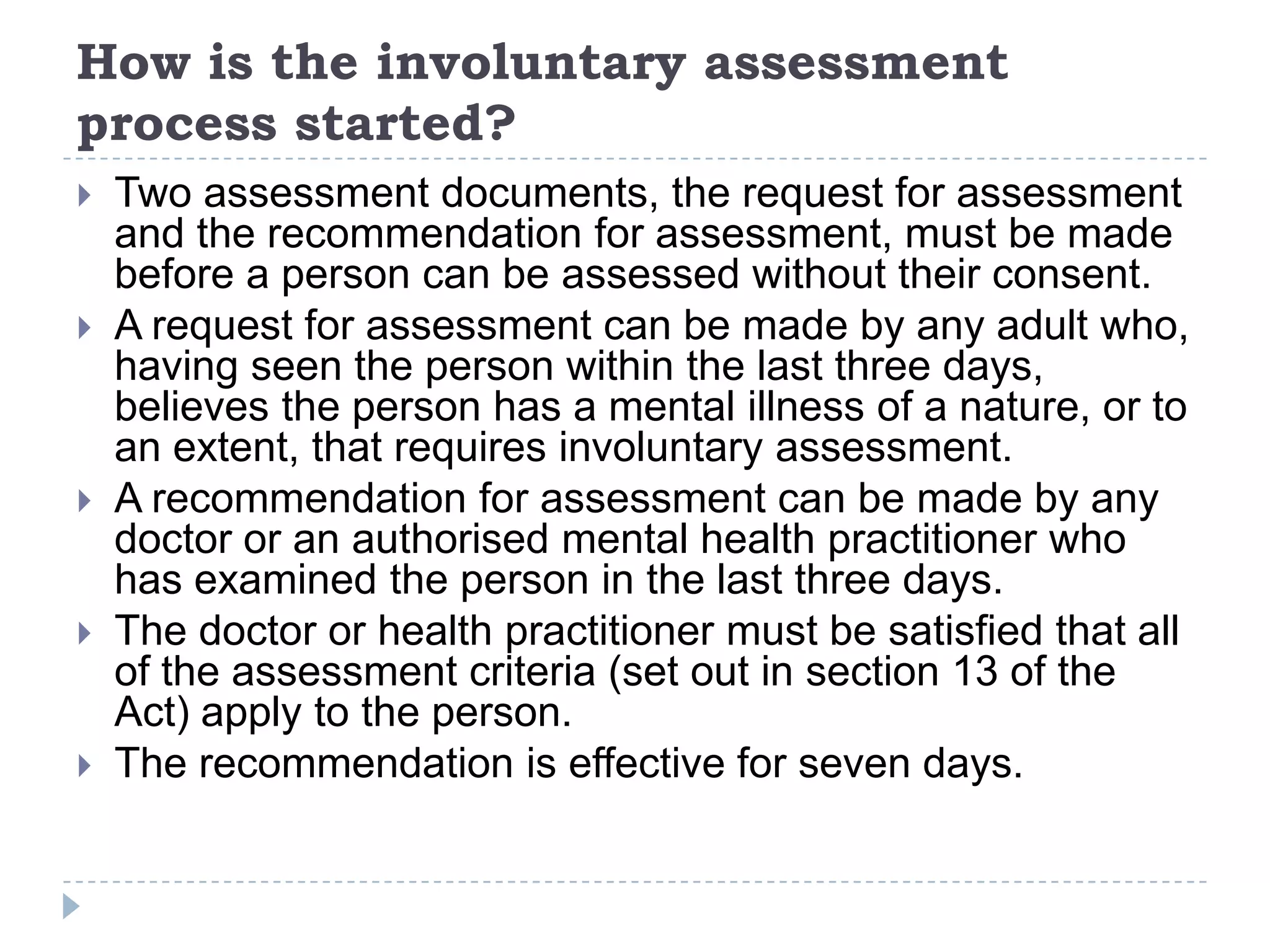
How is the involuntary assessment
process started?
   Two assessment documents, the request for assessment
    and the recommendation for assessment, must be made
    before a person can be assessed without their consent.
   A request for assessment can be made by any adult who,
    having seen the person within the last three days,
    believes the person has a mental illness of a nature, or to
    an extent, that requires involuntary assessment.
   A recommendation for assessment can be made by any
    doctor or an authorised mental health practitioner who
    has examined the person in the last three days.
   The doctor or health practitioner must be satisfied that all
    of the assessment criteria (set out in section 13 of the
    Act) apply to the person.
   The recommendation is effective for seven days.
What safeguards are there in this
process?
   The request and the recommendation for
    assessment must be made by different people.
   In addition, the person making the request cannot be
    a relative or employee of the person making the
    recommendation.
   The Act also applies penalties for providing false or
    misleading information.
What if the assessment documents
cannot be made?
   Two options are available to enable a person to be examined to determine if
    the assessment documents should be made.
   A justices examination order may be made by a justice of the peace
    (qualified) or magistrate. The justices examination order is valid for up to
    seven days. The justices examination order authorises a doctor or
    authorised mental health practitioner to go to the location of the person and
    conduct an examination to decide if a recommendation for assessment
    should be made.
   The person can only be taken to an authorised mental health service if the
    assessment documents are made. An emergency examination order can be
    made by a police officer, ambulance officer or a psychiatrist.
   Strict criteria apply to the making of an order.
   An emergency examination order authorises a person to be taken to an
    authorised mental health service and detained for up to six hours. The
    person must be examined by a doctor or authorised mental health
    practitioner to determine if a recommendation for assessment should be
    made.
   If a recommendation for assessment is not made, arrangements must be
    made for the person to be returned to the place from where they were taken
    or to another place the person reasonably asks to be taken.
What happens once the request and
recommendation have been made?
   The person can be taken to an authorised mental
    health service by a health practitioner or an
    ambulance officer for assessment.
   Police are not automatically involved in this process,
    but must provide assistance if requested.
   http://access.health.qld.gov.au/hid/MentalHealth/Car
    erInformation/involuntaryAssessment_is.asp
Section 13
   What are the assessment criteria
   (1) The assessment criteria for a person, are all of the
    following, based on available information
       (a) the person appears to have a mental illness;
       (b) the person requires immediate assessment;
       (c) the assessment can properly be made at an authorised mental
        health service;
       (d) there is a risk that the person may—
           (i) cause harm to himself or herself or someone else;
           or
           (ii) suffer serious mental or physical deterioration;
       (e) there is no less restrictive way of ensuring the person is
        assessed.
   (2) Also, for chapter 2, the assessment criteria for a person
    include
       (a) lacking the capacity to consent to be assessed; or
       (b) having unreasonably refused to be assessed.[s 14]

Mental Health Risk Assessment

  • 1.
    Mental Health RiskAssessment Dr Ewen McPhee
  • 2.
    How do youfeel  Reported feelings of  Fear  Helplessness  Anxiety  Anger  Counter transference  The ability of clinicians to predict suicide of homicide is poor
  • 3.
    Suicide  1.6% of deaths in Australia  20% of deaths Male 20 – 39  Men X 4 more likely than Women  8.9 per 100,000  Prevalence of 2.3% Suicidal ideation  45% presented to a GP in the month Prior  50% Self harm prior
  • 4.
    Risk Factors Static Dynamic Previous self harm Active Suicidal ideation Diagnosis of a Mental Disorder e.g Guilt depression Substance abuse (especially alcohol) Hopelessness Family History of Suicide Current Substance Use Recent Stressors or loss Psychosocial Stressors Age, gender, Marital status Problem solving deficits (Older age, male, divorced)
  • 5.
    How to askabout suicide  Do you ever feel like giving up?  How does the future seem to you?  Does your life ever seem so bad that you wish to die  How severe are the thoughts? How frequent  Have you made any plans  How close have you come to doing something  Access to methods of suicide e.g. Firearms, stockpile of medications, chemicals  What stops you doing something?  Protective factors e.g. Religeon, love for children/family members
  • 6.
    Ideation Suicidal ideationthat includes a plan for suicide or evidence that the individual has been engaging in preparations for a suicide attempt are signs of significant short term risk
  • 7.
    Management  Rapport and therapeutic alliance  Active empathetic listening  Involve family, support networks, other care givers  Consider substance use disorders, psychiatric illness, personality disorders  Address Dynamic factors e.g. access to firearms etc...  Voluntary participation is ideal
  • 8.
    Contracts  The use of ‘no self harm’ contracts should be avoided as they are generally held to be ineffective and not supported by evidence.  Instead, a safety plan for the patient can be drawn up and this can include information such as help lines (particularly in an emergency out of hours), follow up appointments and online resources
  • 9.
    Involuntary referral  Referral may need to be undertaken without the consent of the patient using the relevant Mental Health Act legislation.  This would be considered as a last resort and only in exceptional circumstances. Although state based Mental Health Act legislation may vary, most allow for a referral for psychiatric assessment without the consent of the patient where:  the patient appears to be mentally unwell  there is a risk to life or substantial risk to health of self or others,  And it is reasonable to believe that treatment will reduce those risks and that this cannot be provided in a less restrictive manner.
  • 10.
    How is theinvoluntary assessment process started?  Two assessment documents, the request for assessment and the recommendation for assessment, must be made before a person can be assessed without their consent.  A request for assessment can be made by any adult who, having seen the person within the last three days, believes the person has a mental illness of a nature, or to an extent, that requires involuntary assessment.  A recommendation for assessment can be made by any doctor or an authorised mental health practitioner who has examined the person in the last three days.  The doctor or health practitioner must be satisfied that all of the assessment criteria (set out in section 13 of the Act) apply to the person.  The recommendation is effective for seven days.
  • 11.
    What safeguards arethere in this process?  The request and the recommendation for assessment must be made by different people.  In addition, the person making the request cannot be a relative or employee of the person making the recommendation.  The Act also applies penalties for providing false or misleading information.
  • 12.
    What if theassessment documents cannot be made?  Two options are available to enable a person to be examined to determine if the assessment documents should be made.  A justices examination order may be made by a justice of the peace (qualified) or magistrate. The justices examination order is valid for up to seven days. The justices examination order authorises a doctor or authorised mental health practitioner to go to the location of the person and conduct an examination to decide if a recommendation for assessment should be made.  The person can only be taken to an authorised mental health service if the assessment documents are made. An emergency examination order can be made by a police officer, ambulance officer or a psychiatrist.  Strict criteria apply to the making of an order.  An emergency examination order authorises a person to be taken to an authorised mental health service and detained for up to six hours. The person must be examined by a doctor or authorised mental health practitioner to determine if a recommendation for assessment should be made.  If a recommendation for assessment is not made, arrangements must be made for the person to be returned to the place from where they were taken or to another place the person reasonably asks to be taken.
  • 13.
    What happens oncethe request and recommendation have been made?  The person can be taken to an authorised mental health service by a health practitioner or an ambulance officer for assessment.  Police are not automatically involved in this process, but must provide assistance if requested.  http://access.health.qld.gov.au/hid/MentalHealth/Car erInformation/involuntaryAssessment_is.asp
  • 14.
    Section 13  What are the assessment criteria  (1) The assessment criteria for a person, are all of the following, based on available information  (a) the person appears to have a mental illness;  (b) the person requires immediate assessment;  (c) the assessment can properly be made at an authorised mental health service;  (d) there is a risk that the person may—  (i) cause harm to himself or herself or someone else;  or  (ii) suffer serious mental or physical deterioration;  (e) there is no less restrictive way of ensuring the person is assessed.  (2) Also, for chapter 2, the assessment criteria for a person include  (a) lacking the capacity to consent to be assessed; or  (b) having unreasonably refused to be assessed.[s 14]