INVESTIGATION
IN
PSYCHIATRY
MR. JAYESH PATIDAR
www.drjayeshpatidar.blogspot.com
INTRODUCTION…
• Investigation are useful to detect alteration
in biologic function & to screen for medical
disorders causing psychiatric symptoms.
• Classification of investigation:
I. Routine Investigation
II. Electrophysiological Tests
III. Brain Imaging Tests
IV. Neuro-endocrine Tests
V. Genetic Tests
www.drjayeshpatidar.blogspot.in
I. Routine Investigation:
• A complete hemogram (total & differential blood
count, hemoglobin, ESR) & urine analysis are basic
routine tests. Leucopenia & agranulocytosis are
associated with certain medications (clozapine).
Treatment with lithium & neuroleptic malignant
syndrome are often associated with leucocytosis.
• Renal function tests: Treatment with lithium.
• Liver function tests: For all alcoholic patients
treatment with carbamazepine, valproate &
benzodiazepines.
www.drjayeshpatidar.blogspot.in
Count…
• Serum electrolytes: Dehydration, treatment with
carbamazepine, antipsychotics, lithium
• Blood glucose: Routine screen above 35 years age
• Thyroid function test: Depression, treatment with
lithium & carbamazepine.
• Electrocardiogram (ECG): Above 35 years of
age, treatment with
lithium, antidepressants, ECT, antipsychotics.
• HIV testing: IV drug users, suggestive sexual
history, AIDS, dementia.
• VDRL: Suggestive sexual history
www.drjayeshpatidar.blogspot.in
Count…
• Serum CPK: Neuroleptic malignant syndrome
(markedly increased levels)
• Chest X-ray: Before treatment with ECT
• Drug level estimation: Drug levels are indicated to
test for therapeutic blood levels, for toxic blood
levels & for testing drug compliance. Examples
are lithium (0.6-1.6 mEq/L), carbamazepine (6-12
mg/ml, valproate (50-100 mg/ml), haloperidol (8-
18 mg/ml), imipramine (200-250mg/ml), etc)
www.drjayeshpatidar.blogspot.in
II. Electrophysiological Tests:
• Electroencephalogram (EEG): Measures
brain electrical activity, identifies
dysrhythmias & asymmetric, used in the
diagnosis of
seizures, dementia, neoplasm, stroke, m
etabolic or degenerative disease.
• Polysomnography/sleep studies: Used in
the diagnosis of sleep disorders &
seizures.
www.drjayeshpatidar.blogspot.in
III. Brain Imaging Tests:
 Computed Tomography (CT) scan: Measures accuracy of
brain structure to detect possible lesions, abscesses, areas
of infarction or aneurysm. CT scan also identifies various
anatomic differences in patients with
schizophrenia, organic mental disorder & bipolar disorder.
 Magnetic Resonance Imaging (MRI) scan: Measures the
anatomic & biochemical status of various segments of the
brain; detects brain
edema, ischemia, infection, neoplasm, trauma & other
changes such as demyelination used in the diagnosis of
dementia, to detect morphological changes in
schizophrenia patients.
www.drjayeshpatidar.blogspot.in
IV. Neuro-endocrine Tests:
• Commonly used neuro-endocrine tests are
dexamethasone suppression test, TRH
stimulation test, serum prolactin levels
serum 17-hydroxycorticosteroid, serum
melatonin levels.
V. Genetic Tests:
• Cytogenetic work-up is advised in some
cases of mental retardation.
www.drjayeshpatidar.blogspot.in
PSYCHOLOGICAL
TESTS
• Psychological testing of patients is
identify conducted by a clinical
psychologist who has been trained in
the administration, scoring &
interpretation of these procedures.
www.drjayeshpatidar.blogspot.in
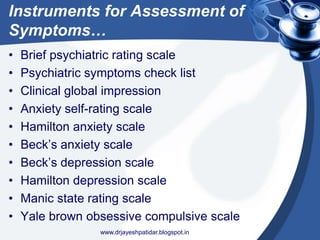
Instruments for Assessment of
Symptoms…
• Brief psychiatric rating scale
• Psychiatric symptoms check list
• Clinical global impression
• Anxiety self-rating scale
• Hamilton anxiety scale
• Beck’s anxiety scale
• Beck’s depression scale
• Hamilton depression scale
• Manic state rating scale
• Yale brown obsessive compulsive scale
www.drjayeshpatidar.blogspot.in
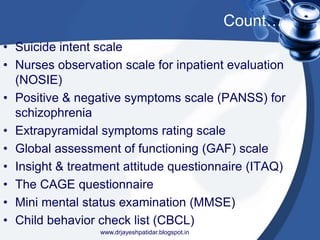
Count…
• Suicide intent scale
• Nurses observation scale for inpatient evaluation
(NOSIE)
• Positive & negative symptoms scale (PANSS) for
schizophrenia
• Extrapyramidal symptoms rating scale
• Global assessment of functioning (GAF) scale
• Insight & treatment attitude questionnaire (ITAQ)
• The CAGE questionnaire
• Mini mental status examination (MMSE)
• Child behavior check list (CBCL)
www.drjayeshpatidar.blogspot.in
Instruments for Assessment of
Personality Traits and Disorders…
• Minnesota multiple personality
inventory
• Cattel’s 16 factors personality inventory
• Eysenck personality inventory
www.drjayeshpatidar.blogspot.in
Instruments for Assessment of
Cognitive Functioning…
• Wechsler adult intelligence scale
(WAIS)
• Sechsler intelligence scale for children
• Binet kamath test of intelligence
• Bhatia battery test for intelligence
• NIMHANS neuropsychological battery
of lobe dysfunction
www.drjayeshpatidar.blogspot.in
Instruments for Assessment of
Environmental Stressors:
• Social adjustment scale
• Marital satisfaction inventory
www.drjayeshpatidar.blogspot.in
Instruments for Assessment of
Psychodynamics:
• Rorschach inkblot test
• Thematic apperception test
www.drjayeshpatidar.blogspot.in
Role of a Nurse in Psychological
Assessment…
Psychological tests have been designed to help
clinicians. They help in:
• Measuring the extent of the patient’s problems
• Making an accurate diagnosis
• Tracking patient progress over time
• Documenting the efficacy of treatment
 Nurses should become familiar with the many
standardized psychological tests that are
available to enhance each stage of the nursing
process.
www.drjayeshpatidar.blogspot.in
Count…
 These tests help in providing care & measurable
indicators for treatment outcome.
 For example, if the nurse is caring for a patient
with depression, it would be helpful to use one of
the depression rating scales with the patient at
the beginning of care/treatment to establish a
baseline profile of the patient’s symptoms & help
confirm the diagnosis. The nurse might then
administer the same scale at various times
during the course of treatment to measure the
patient’s progress.
www.drjayeshpatidar.blogspot.in
Count…
• A nurse should have knowledge about all the
psychological tests, which will enable her to
clarify the patient’s & relative’s doubts
regarding the psychological tests have to
undergo.
• The nurse should reassure the patient about
the safety of the tests & confidentiality of the
observations of the psychologist.
• Psychological tests are another source of data
for the nurse to use in planning care for the
patient.
www.drjayeshpatidar.blogspot.in

Investigation in psychiatry

  • 1.
  • 2.
    INTRODUCTION… • Investigation areuseful to detect alteration in biologic function & to screen for medical disorders causing psychiatric symptoms. • Classification of investigation: I. Routine Investigation II. Electrophysiological Tests III. Brain Imaging Tests IV. Neuro-endocrine Tests V. Genetic Tests www.drjayeshpatidar.blogspot.in
  • 3.
    I. Routine Investigation: •A complete hemogram (total & differential blood count, hemoglobin, ESR) & urine analysis are basic routine tests. Leucopenia & agranulocytosis are associated with certain medications (clozapine). Treatment with lithium & neuroleptic malignant syndrome are often associated with leucocytosis. • Renal function tests: Treatment with lithium. • Liver function tests: For all alcoholic patients treatment with carbamazepine, valproate & benzodiazepines. www.drjayeshpatidar.blogspot.in
  • 4.
    Count… • Serum electrolytes:Dehydration, treatment with carbamazepine, antipsychotics, lithium • Blood glucose: Routine screen above 35 years age • Thyroid function test: Depression, treatment with lithium & carbamazepine. • Electrocardiogram (ECG): Above 35 years of age, treatment with lithium, antidepressants, ECT, antipsychotics. • HIV testing: IV drug users, suggestive sexual history, AIDS, dementia. • VDRL: Suggestive sexual history www.drjayeshpatidar.blogspot.in
  • 5.
    Count… • Serum CPK:Neuroleptic malignant syndrome (markedly increased levels) • Chest X-ray: Before treatment with ECT • Drug level estimation: Drug levels are indicated to test for therapeutic blood levels, for toxic blood levels & for testing drug compliance. Examples are lithium (0.6-1.6 mEq/L), carbamazepine (6-12 mg/ml, valproate (50-100 mg/ml), haloperidol (8- 18 mg/ml), imipramine (200-250mg/ml), etc) www.drjayeshpatidar.blogspot.in
  • 6.
    II. Electrophysiological Tests: •Electroencephalogram (EEG): Measures brain electrical activity, identifies dysrhythmias & asymmetric, used in the diagnosis of seizures, dementia, neoplasm, stroke, m etabolic or degenerative disease. • Polysomnography/sleep studies: Used in the diagnosis of sleep disorders & seizures. www.drjayeshpatidar.blogspot.in
  • 7.
    III. Brain ImagingTests:  Computed Tomography (CT) scan: Measures accuracy of brain structure to detect possible lesions, abscesses, areas of infarction or aneurysm. CT scan also identifies various anatomic differences in patients with schizophrenia, organic mental disorder & bipolar disorder.  Magnetic Resonance Imaging (MRI) scan: Measures the anatomic & biochemical status of various segments of the brain; detects brain edema, ischemia, infection, neoplasm, trauma & other changes such as demyelination used in the diagnosis of dementia, to detect morphological changes in schizophrenia patients. www.drjayeshpatidar.blogspot.in
  • 8.
    IV. Neuro-endocrine Tests: •Commonly used neuro-endocrine tests are dexamethasone suppression test, TRH stimulation test, serum prolactin levels serum 17-hydroxycorticosteroid, serum melatonin levels. V. Genetic Tests: • Cytogenetic work-up is advised in some cases of mental retardation. www.drjayeshpatidar.blogspot.in
  • 9.
    PSYCHOLOGICAL TESTS • Psychological testingof patients is identify conducted by a clinical psychologist who has been trained in the administration, scoring & interpretation of these procedures. www.drjayeshpatidar.blogspot.in
  • 10.
    Instruments for Assessmentof Symptoms… • Brief psychiatric rating scale • Psychiatric symptoms check list • Clinical global impression • Anxiety self-rating scale • Hamilton anxiety scale • Beck’s anxiety scale • Beck’s depression scale • Hamilton depression scale • Manic state rating scale • Yale brown obsessive compulsive scale www.drjayeshpatidar.blogspot.in
  • 11.
    Count… • Suicide intentscale • Nurses observation scale for inpatient evaluation (NOSIE) • Positive & negative symptoms scale (PANSS) for schizophrenia • Extrapyramidal symptoms rating scale • Global assessment of functioning (GAF) scale • Insight & treatment attitude questionnaire (ITAQ) • The CAGE questionnaire • Mini mental status examination (MMSE) • Child behavior check list (CBCL) www.drjayeshpatidar.blogspot.in
  • 12.
    Instruments for Assessmentof Personality Traits and Disorders… • Minnesota multiple personality inventory • Cattel’s 16 factors personality inventory • Eysenck personality inventory www.drjayeshpatidar.blogspot.in
  • 13.
    Instruments for Assessmentof Cognitive Functioning… • Wechsler adult intelligence scale (WAIS) • Sechsler intelligence scale for children • Binet kamath test of intelligence • Bhatia battery test for intelligence • NIMHANS neuropsychological battery of lobe dysfunction www.drjayeshpatidar.blogspot.in
  • 14.
    Instruments for Assessmentof Environmental Stressors: • Social adjustment scale • Marital satisfaction inventory www.drjayeshpatidar.blogspot.in
  • 15.
    Instruments for Assessmentof Psychodynamics: • Rorschach inkblot test • Thematic apperception test www.drjayeshpatidar.blogspot.in
  • 16.
    Role of aNurse in Psychological Assessment… Psychological tests have been designed to help clinicians. They help in: • Measuring the extent of the patient’s problems • Making an accurate diagnosis • Tracking patient progress over time • Documenting the efficacy of treatment  Nurses should become familiar with the many standardized psychological tests that are available to enhance each stage of the nursing process. www.drjayeshpatidar.blogspot.in
  • 17.
    Count…  These testshelp in providing care & measurable indicators for treatment outcome.  For example, if the nurse is caring for a patient with depression, it would be helpful to use one of the depression rating scales with the patient at the beginning of care/treatment to establish a baseline profile of the patient’s symptoms & help confirm the diagnosis. The nurse might then administer the same scale at various times during the course of treatment to measure the patient’s progress. www.drjayeshpatidar.blogspot.in
  • 18.
    Count… • A nurseshould have knowledge about all the psychological tests, which will enable her to clarify the patient’s & relative’s doubts regarding the psychological tests have to undergo. • The nurse should reassure the patient about the safety of the tests & confidentiality of the observations of the psychologist. • Psychological tests are another source of data for the nurse to use in planning care for the patient. www.drjayeshpatidar.blogspot.in
  • 19.