


A Step by Step Guide to
Menopausal Hormone Therapy
Dr. Laxmi Shrikhande
Consultant - Shrikhande Hospital, Nagpur
https://facebook.com/laxmi.shrikhande | https://.linkedin.com/in/dr-laxmi-agrawal-shrikhande
Dr. Laxmi Shrikhande - MD; FICOG; FICMU;FICMCH
• Medical Director-Shrikhande Fertility Clinic, Nagpur
• Chairperson Designate Indian College of OB/GY ICOG
• National Corresponding Editor-The Journal of
Obstetrics &Gynecology of India
• Senior Vice President FOGSI 2012
• Patron & President -Vidarbha Chapter ISOPARB
• Received Nagpur Ratan Award at the hands of Union
Minister Shri Nitinji Gadkari
• Received Bharat excellence Award for women’s health
• Received Mehroo Dara Hansotia award for Best
Committee of FOGSI
• National Governing Council member ICOG 2012-2017
• National Governing Council Member ISAR 2014-2019
• National Governing Council Member IAGE for 3 terms
• Chairperson-HIV/AIDS Committee, FOGSI (2007-09)
• President Nagpur OB/GY Society 2005-06
• Immediate Past President Menopause Society, Nagpur
• Associate member of RCOG & ESHRE
• Member of European Society of Human Reproduction
• Visited 96 FOGSI Societies as invited faculty
• Delivered 11 orations and 450 guest lectures
• Publications-Twenty National & eleven International
• Presented Papers in FIGO, AICOG, SAFOG, AICC-RCOG
conferences
• Conducted adolescent health programme for more
than 15,000 adolescent girls
• Conducted health awareness programme for more
than 10,000 women
U turn in Menopausal Hormone Therapy
 Widespread use of hormone therapy in the 1980s and
1990s came to an abrupt halt in the early 2000s after
initial findings of the Women’s Health Initiative trial
were published and the study was terminated
 Over the next several years, extensive re-analysis and
assessment of the WHI data cast doubt about the
validity of the original conclusions
N Engl J Med 2016; 374(9): 803–806
Menopausal Hormone Therapy
The timing hypothesis
 Timing of initiation of hormone therapy affects the
relation with coronary risk
 Estrogen may provide coronary benefit in early
menopause but harm if started later
 Absolute risks of hormone therapy are lower in early
than late menopause
 Hormone therapy is appropriate for vasomotor
symptom relief in early menopause
 Hormone therapy is not recommended for chronic
disease prevention
Metabolism. 2016 May ; 65(5): 794–803
A Step by Step Guide to MHT = HRT
Steps
Step 1 - Assess if MHT is right for the patient
Step 2 – Hormonal therapy options
Step 3 – Starting MHT treatment
Step 4 – Follow-up
Step 5 – Stopping treatment
Step 1
Assess if MHT is right for the patient
MHT contraindications
(as specified by regulatory authorities)
 Current, past or suspected breast cancer,
 Known or suspected estrogen-dependent malignant tumors (e.g. endometrial
cancer),
 Undiagnosed genital bleeding,
 Untreated endometrial hyperplasia,
 Previous idiopathic or current venous thromboembolism (deep venous
thrombosis, pulmonary embolism),
 Active or recent arterial thromboembolic disease (e.g. angina, myocardial
infarction),
 Untreated hypertension,
 Active liver disease,
 Known hypersensitivity to the active substances or to any of the excipients,
 Porphyria cutanea tarda (an absolute contraindication).
The Journal of The North American Menopause Society 2017
Main risk factors for HT use
 Older age (>60 years)
 Obesity (BMI > 30 kg/m2),
 Insulin resistance
 Increase cardiovascular risk (dyslipidaemia,
hypertension, diabetes mellitus, smoking)
 Personal or family history of venous
thromboembolism (VTE)
The presence of risk factors does not necessarily preclude use of HT
Women’s Health 2019
Step 2
Hormonal therapy options
Basics of MHT
● Estrogen replacement therapy: for
women without a uterus
● Estrogen–progestogen therapy: For
women with intact uterus
Estradiol valerate: Most Trusted form of Estrogen
● Natural estrogen
● Safer than its synthetic counterpart
● Micronized form: Increased dissolution and bioavailability
● Esterified preventing extensive first pass metabolism in liver and GIT
● Convenient oral administration
● Is safe even for long-term use (adherence is good even after 7 yrs. of
therapy)*
*Peter HM. Long term adherence to continuous combined HRT. Seven-year update on the Heikkinen
study. Menopause international. 2003;9:8-9
Dose and route of administration
 Most appropriate dose of HT depends on the woman’s
phase of life, age and general health status
 Useful approach may be to start HT at a low dose, then
titrate upwards to the lowest effective dose that is
consistent with the woman’s treatment goals
Women’s Health 2019
Step 3
Starting MHT treatment
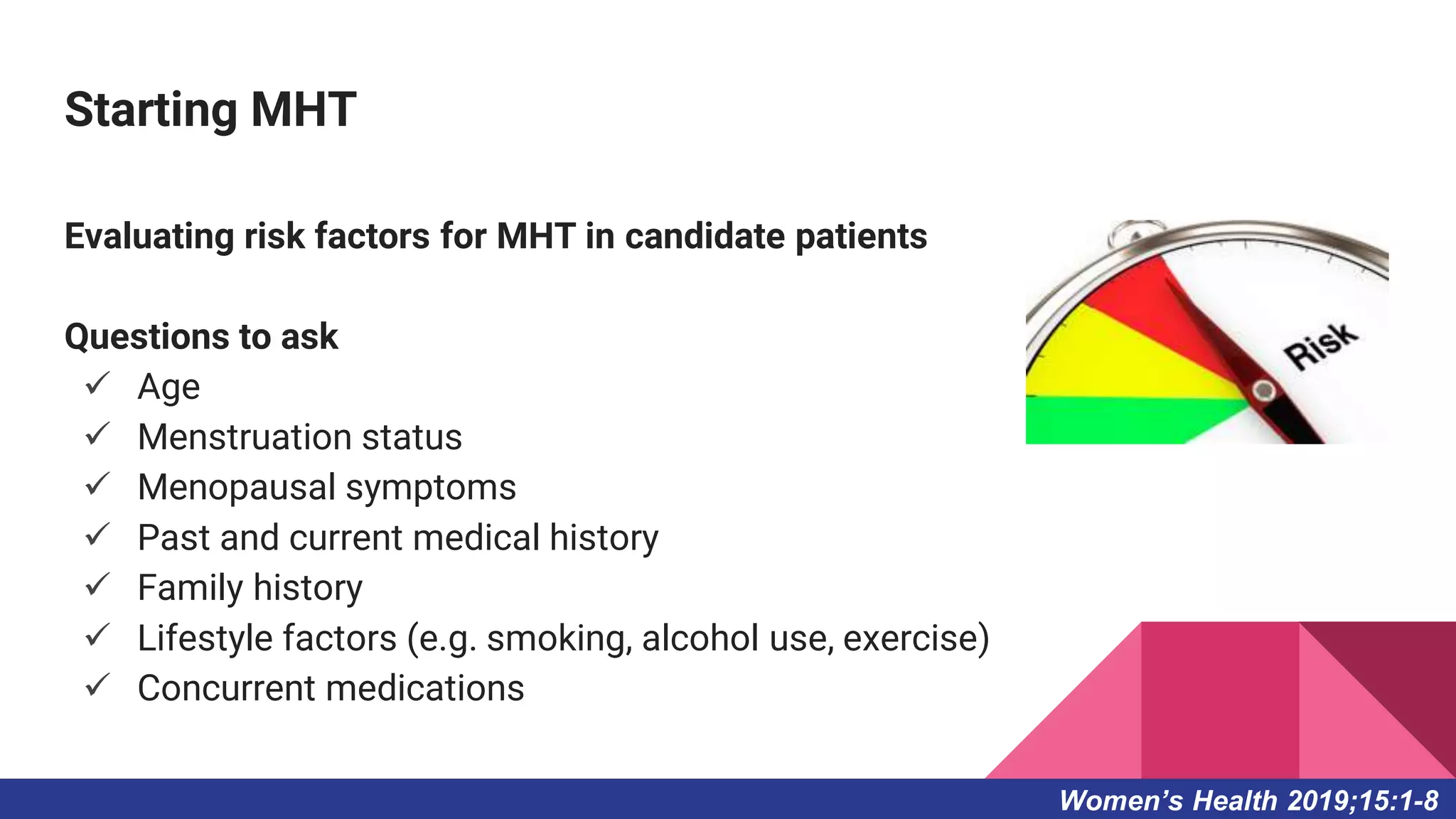
Starting MHT
Evaluating risk factors for MHT in candidate patients
Questions to ask
 Age
 Menstruation status
 Menopausal symptoms
 Past and current medical history
 Family history
 Lifestyle factors (e.g. smoking, alcohol use, exercise)
 Concurrent medications
Women’s Health 2019;15:1-8
Evaluating risk factors for MHT in candidate patients
Examinations/investigations to perform:
 Body weight
 Waist circumference
 Blood pressure
 Blood tests if indicated by responses to questioning
 Imaging (e.g. ultrasound, bone density) if indicated by
responses to questioning
 Mammography if not performed within previous year
 Bone densitometry (dual-energy x-ray absorptiometry) if
patient at risk for osteoporosis
Women’s Health 2019;15:1-8
Starting MHT
Step 4
Follow-up
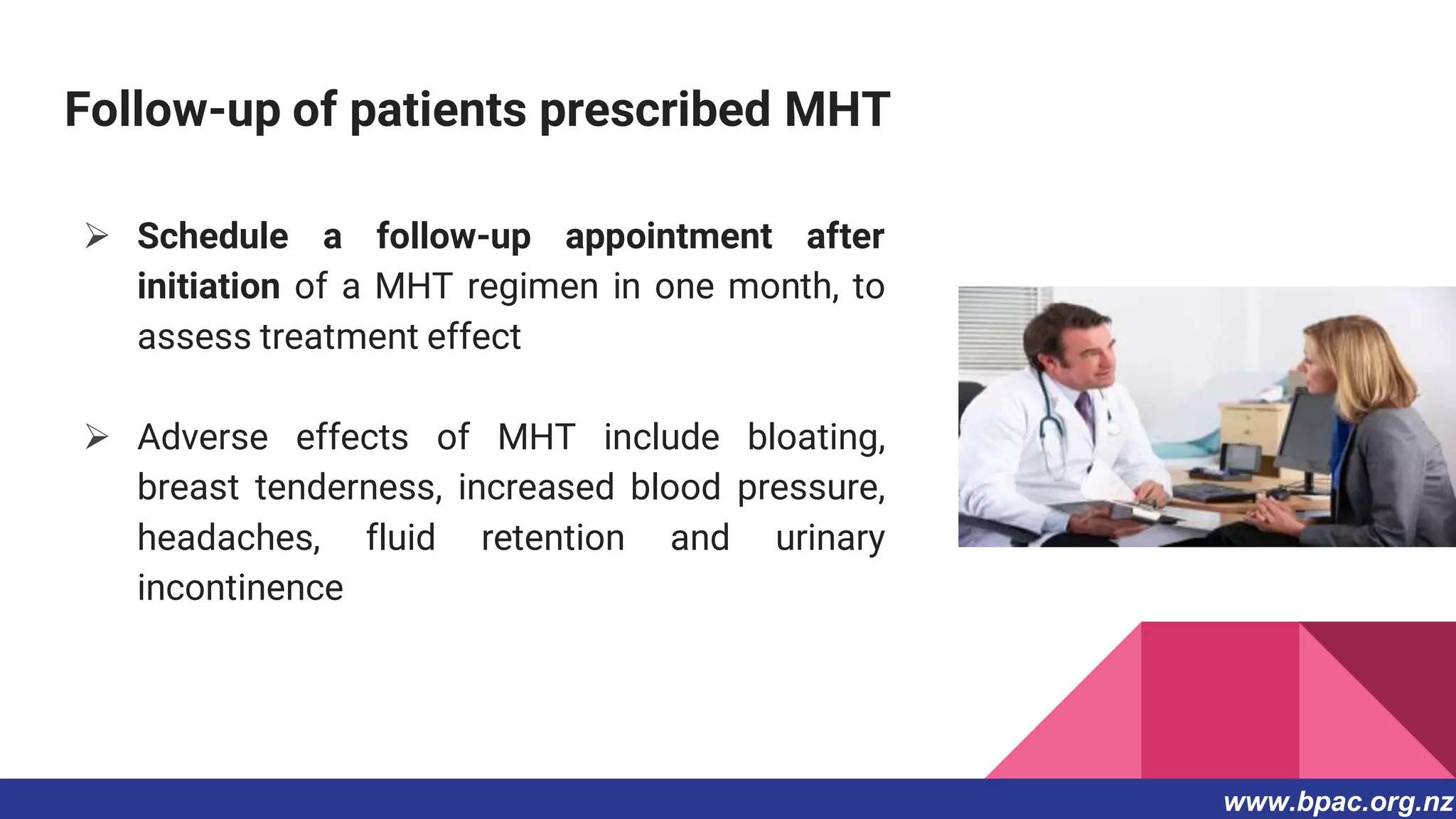
Follow-up of patients prescribed MHT
 Schedule a follow-up appointment after
initiation of a MHT regimen in one month, to
assess treatment effect
 Adverse effects of MHT include bloating,
breast tenderness, increased blood pressure,
headaches, fluid retention and urinary
incontinence
www.bpac.org.nz
Step 5
Stopping Treatment
Stopping HT
 Current users of HT can remain on treatment
indefinitely (lifelong if indicated), or at least until
such time as the patient asks to stop
 Regular monitoring of HT is advised, with
adjustments made to type, dosage and/ or route of
administration according to a patient’s changing
circumstances and treatment goals
Women’s Health 2019;15:1-8
Conclusion
● MHT is a dominant therapeutic modality in climacteric medicine
● The skill lies in the ability to choose the optimal MHT preparation for the
given patient
● Follow the steps when it is decided to start MHT by both patient and doctor.
● The key is individualization, minimum possible dose, and early start of therapy
Questions

step by step guide to menopause hormone therapy (MHT)

  • 1.
    A Step byStep Guide to Menopausal Hormone Therapy Dr. Laxmi Shrikhande Consultant - Shrikhande Hospital, Nagpur https://facebook.com/laxmi.shrikhande | https://.linkedin.com/in/dr-laxmi-agrawal-shrikhande
  • 2.
    Dr. Laxmi Shrikhande- MD; FICOG; FICMU;FICMCH • Medical Director-Shrikhande Fertility Clinic, Nagpur • Chairperson Designate Indian College of OB/GY ICOG • National Corresponding Editor-The Journal of Obstetrics &Gynecology of India • Senior Vice President FOGSI 2012 • Patron & President -Vidarbha Chapter ISOPARB • Received Nagpur Ratan Award at the hands of Union Minister Shri Nitinji Gadkari • Received Bharat excellence Award for women’s health • Received Mehroo Dara Hansotia award for Best Committee of FOGSI • National Governing Council member ICOG 2012-2017 • National Governing Council Member ISAR 2014-2019 • National Governing Council Member IAGE for 3 terms • Chairperson-HIV/AIDS Committee, FOGSI (2007-09) • President Nagpur OB/GY Society 2005-06 • Immediate Past President Menopause Society, Nagpur • Associate member of RCOG & ESHRE • Member of European Society of Human Reproduction • Visited 96 FOGSI Societies as invited faculty • Delivered 11 orations and 450 guest lectures • Publications-Twenty National & eleven International • Presented Papers in FIGO, AICOG, SAFOG, AICC-RCOG conferences • Conducted adolescent health programme for more than 15,000 adolescent girls • Conducted health awareness programme for more than 10,000 women
  • 3.
    U turn inMenopausal Hormone Therapy  Widespread use of hormone therapy in the 1980s and 1990s came to an abrupt halt in the early 2000s after initial findings of the Women’s Health Initiative trial were published and the study was terminated  Over the next several years, extensive re-analysis and assessment of the WHI data cast doubt about the validity of the original conclusions N Engl J Med 2016; 374(9): 803–806
  • 4.
    Menopausal Hormone Therapy Thetiming hypothesis  Timing of initiation of hormone therapy affects the relation with coronary risk  Estrogen may provide coronary benefit in early menopause but harm if started later  Absolute risks of hormone therapy are lower in early than late menopause  Hormone therapy is appropriate for vasomotor symptom relief in early menopause  Hormone therapy is not recommended for chronic disease prevention Metabolism. 2016 May ; 65(5): 794–803
  • 5.
    A Step byStep Guide to MHT = HRT Steps Step 1 - Assess if MHT is right for the patient Step 2 – Hormonal therapy options Step 3 – Starting MHT treatment Step 4 – Follow-up Step 5 – Stopping treatment
  • 6.
    Step 1 Assess ifMHT is right for the patient
  • 7.
    MHT contraindications (as specifiedby regulatory authorities)  Current, past or suspected breast cancer,  Known or suspected estrogen-dependent malignant tumors (e.g. endometrial cancer),  Undiagnosed genital bleeding,  Untreated endometrial hyperplasia,  Previous idiopathic or current venous thromboembolism (deep venous thrombosis, pulmonary embolism),  Active or recent arterial thromboembolic disease (e.g. angina, myocardial infarction),  Untreated hypertension,  Active liver disease,  Known hypersensitivity to the active substances or to any of the excipients,  Porphyria cutanea tarda (an absolute contraindication). The Journal of The North American Menopause Society 2017
  • 8.
    Main risk factorsfor HT use  Older age (>60 years)  Obesity (BMI > 30 kg/m2),  Insulin resistance  Increase cardiovascular risk (dyslipidaemia, hypertension, diabetes mellitus, smoking)  Personal or family history of venous thromboembolism (VTE) The presence of risk factors does not necessarily preclude use of HT Women’s Health 2019
  • 9.
  • 10.
    Basics of MHT ●Estrogen replacement therapy: for women without a uterus ● Estrogen–progestogen therapy: For women with intact uterus
  • 11.
    Estradiol valerate: MostTrusted form of Estrogen ● Natural estrogen ● Safer than its synthetic counterpart ● Micronized form: Increased dissolution and bioavailability ● Esterified preventing extensive first pass metabolism in liver and GIT ● Convenient oral administration ● Is safe even for long-term use (adherence is good even after 7 yrs. of therapy)* *Peter HM. Long term adherence to continuous combined HRT. Seven-year update on the Heikkinen study. Menopause international. 2003;9:8-9
  • 12.
    Dose and routeof administration  Most appropriate dose of HT depends on the woman’s phase of life, age and general health status  Useful approach may be to start HT at a low dose, then titrate upwards to the lowest effective dose that is consistent with the woman’s treatment goals Women’s Health 2019
  • 13.
  • 14.
    Starting MHT Evaluating riskfactors for MHT in candidate patients Questions to ask  Age  Menstruation status  Menopausal symptoms  Past and current medical history  Family history  Lifestyle factors (e.g. smoking, alcohol use, exercise)  Concurrent medications Women’s Health 2019;15:1-8
  • 15.
    Evaluating risk factorsfor MHT in candidate patients Examinations/investigations to perform:  Body weight  Waist circumference  Blood pressure  Blood tests if indicated by responses to questioning  Imaging (e.g. ultrasound, bone density) if indicated by responses to questioning  Mammography if not performed within previous year  Bone densitometry (dual-energy x-ray absorptiometry) if patient at risk for osteoporosis Women’s Health 2019;15:1-8 Starting MHT
  • 16.
  • 17.
    Follow-up of patientsprescribed MHT  Schedule a follow-up appointment after initiation of a MHT regimen in one month, to assess treatment effect  Adverse effects of MHT include bloating, breast tenderness, increased blood pressure, headaches, fluid retention and urinary incontinence www.bpac.org.nz
  • 18.
  • 19.
    Stopping HT  Currentusers of HT can remain on treatment indefinitely (lifelong if indicated), or at least until such time as the patient asks to stop  Regular monitoring of HT is advised, with adjustments made to type, dosage and/ or route of administration according to a patient’s changing circumstances and treatment goals Women’s Health 2019;15:1-8
  • 20.
    Conclusion ● MHT isa dominant therapeutic modality in climacteric medicine ● The skill lies in the ability to choose the optimal MHT preparation for the given patient ● Follow the steps when it is decided to start MHT by both patient and doctor. ● The key is individualization, minimum possible dose, and early start of therapy
  • 21.