PRESENTED BY :- SONALI HARSH RAJ
MENOPAUSE
WHAT IS MENOPAUSE?
• Menopause occurs when a woman hasn’t menstruated in 12
consecutive months and can no longer become pregnant naturally. It
usually begins between the ages of 45 and 55, but can develop before
or after this age range. The average age of women experiencing
their final menstrual period (FMP) is 51.5 years,
• Several environmental, genetic, and surgical
influences may alter ovarian aging
WHY DOES MENOPAUSE OCCUR?
• Menopause is a natural process that occurs as the ovaries age and produce
less reproductive hormones.
• The body begins to undergo several changes in response to lower levels of:
• estrogen
• progesteron
THERE ARE THREE PHASES OF TRANSITION
• Perimenopause
• Menopause
• postmenopause
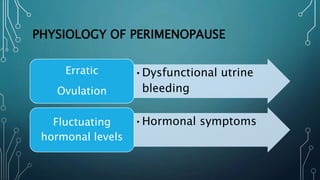
PHYSIOLOGY OF PERIMENOPAUSE
•Dysfunctional utrine
bleeding
Erratic
Ovulation
•Hormonal symptomsFluctuating
hormonal levels
• PREMATURE MENOPAUSE:-
Natural/ induced menopause
Surgical/medical factors
Familial & genetic factors
Cigarette smoking
• LATER AGE OF MENOPAUSE:-
Later age of menarche, longer menstrual cycle length
Oral contraceptive use
SYMPTOMS ASSOCIATED WITH
MENOPAUSAL TRANSITION
• Menstrual pattern:- Shorter cycles (typical) Longer cycles
(possible) Irregular bleeding
• Vasomotor :- Hot flushes, Night sweats, Sleep disturbances
• Psychological/cognitive:- Worsening PMS, Depression,
Irritability, Mood swings, Poor concentration, Poor memory
• Sexual dysfunction:-Vaginal dryness, Decreased libido,
Dyspareunia
• Somatic:- Headache, Dizziness, Palpitations, Breast
pain/enlargement, Joint aches & back pain
• Others:- Urinary incontinence, Dry, itchy skin & Weight gain
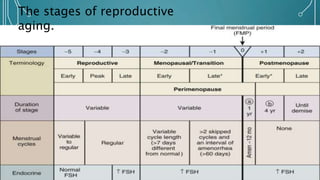
The stages of reproductive
aging.
PHYSIOLOGICAL
CHANGES
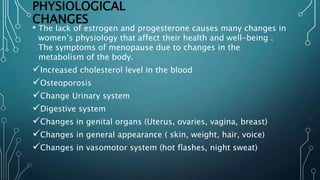
• The lack of estrogen and progesterone causes many changes in
women’s physiology that affect their health and well-being .
The symptoms of menopause due to changes in the
metabolism of the body.
Increased cholesterol level in the blood
Osteoporosis
Change Urinary system
Digestive system
Changes in genital organs (Uterus, ovaries, vagina, breast)
Changes in general appearance ( skin, weight, hair, voice)
Changes in vasomotor system (hot flashes, night sweat)
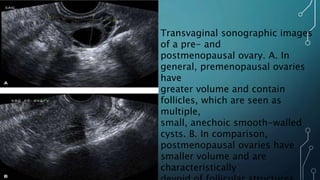
Transvaginal sonographic images
of a pre- and
postmenopausal ovary. A. In
general, premenopausal ovaries
have
greater volume and contain
follicles, which are seen as
multiple,
small, anechoic smooth-walled
cysts. B. In comparison,
postmenopausal ovaries have
smaller volume and are
characteristically
PSYCHOLOGICAL CHANGES
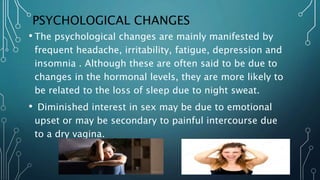
• The psychological changes are mainly manifested by
frequent headache, irritability, fatigue, depression and
insomnia . Although these are often said to be due to
changes in the hormonal levels, they are more likely to
be related to the loss of sleep due to night sweat.
• Diminished interest in sex may be due to emotional
upset or may be secondary to painful intercourse due
to a dry vagina.
DIAGNOSIS
• Tests typically aren't needed to diagnose menopause. But under
certain circumstances, you may recommend blood tests to
check your level of:
• Follicle-stimulating hormone (FSH) and estrogen (estradiol),
because your FSH levels increase and estradiol levels decrease
as menopause occurs
• Thyroid-stimulating hormone (TSH), because an underactive
thyroid (hypothyroidism) can cause symptoms similar to those
of menopause
TREATMENT
S:-
• NON- HORMONAL TREATMENT:-
 LIFESTYLE CHANGES
ALTERNATIVE OR HERBAL THREAPY
VITAMIN E
ANTIDEPRESSANTS
• HORMONE REPLACEMENT THREAPY (HRT):-
is indicated in menopausal women to overcome the short-term
and long-term consequences of estrogen deficiency. HRT can
be administered orally( in pill form),vaginally( as a cream),or
transdermally ( in patch form) because it replaces female
hormones produced by the ovaries, hormone replacement
therapy minimize menopause symptoms. It can be used before,
during and after menopause.
INDICATION FOR
HRT
• 1.Relief of menopausal symptoms
• 2. Prevention of osteoporosis
• 3. To maintain the quality of life in menopausal years. special
group of women to whom HRT should be prescribed.
• 4.Premature ovarian failure
• 5.Surgical or radiation menopause
•TYPES OF HRT:-
Estrogen and progesterone
Estrogen only
Progestin only
RISK OF HRT:-
 ENDOMETRIAL CANCER
 BREAST CANCER
 LIPID METABOLISM
DURATION:-recommend using
HRT for up to four to five years
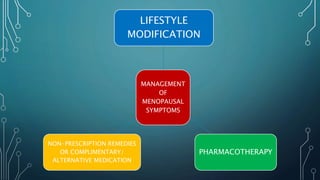
MANAGEMENT
OF
MENOPAUSAL
SYMPTOMS
LIFESTYLE
MODIFICATION
PHARMACOTHERAPY
NON-PRESCRIPTION REMEDIES
OR COMPLIMENTARY/
ALTERNATIVE MEDICATION
Menopause

Menopause

  • 1.
    PRESENTED BY :-SONALI HARSH RAJ MENOPAUSE
  • 2.
    WHAT IS MENOPAUSE? •Menopause occurs when a woman hasn’t menstruated in 12 consecutive months and can no longer become pregnant naturally. It usually begins between the ages of 45 and 55, but can develop before or after this age range. The average age of women experiencing their final menstrual period (FMP) is 51.5 years, • Several environmental, genetic, and surgical influences may alter ovarian aging
  • 3.
    WHY DOES MENOPAUSEOCCUR? • Menopause is a natural process that occurs as the ovaries age and produce less reproductive hormones. • The body begins to undergo several changes in response to lower levels of: • estrogen • progesteron
  • 4.
    THERE ARE THREEPHASES OF TRANSITION • Perimenopause • Menopause • postmenopause
  • 5.
    PHYSIOLOGY OF PERIMENOPAUSE •Dysfunctionalutrine bleeding Erratic Ovulation •Hormonal symptomsFluctuating hormonal levels
  • 6.
    • PREMATURE MENOPAUSE:- Natural/induced menopause Surgical/medical factors Familial & genetic factors Cigarette smoking • LATER AGE OF MENOPAUSE:- Later age of menarche, longer menstrual cycle length Oral contraceptive use
  • 7.
    SYMPTOMS ASSOCIATED WITH MENOPAUSALTRANSITION • Menstrual pattern:- Shorter cycles (typical) Longer cycles (possible) Irregular bleeding • Vasomotor :- Hot flushes, Night sweats, Sleep disturbances • Psychological/cognitive:- Worsening PMS, Depression, Irritability, Mood swings, Poor concentration, Poor memory • Sexual dysfunction:-Vaginal dryness, Decreased libido, Dyspareunia • Somatic:- Headache, Dizziness, Palpitations, Breast pain/enlargement, Joint aches & back pain • Others:- Urinary incontinence, Dry, itchy skin & Weight gain
  • 8.
    The stages ofreproductive aging.
  • 9.
    PHYSIOLOGICAL CHANGES • The lackof estrogen and progesterone causes many changes in women’s physiology that affect their health and well-being . The symptoms of menopause due to changes in the metabolism of the body. Increased cholesterol level in the blood Osteoporosis Change Urinary system Digestive system Changes in genital organs (Uterus, ovaries, vagina, breast) Changes in general appearance ( skin, weight, hair, voice) Changes in vasomotor system (hot flashes, night sweat)
  • 10.
    Transvaginal sonographic images ofa pre- and postmenopausal ovary. A. In general, premenopausal ovaries have greater volume and contain follicles, which are seen as multiple, small, anechoic smooth-walled cysts. B. In comparison, postmenopausal ovaries have smaller volume and are characteristically
  • 11.
    PSYCHOLOGICAL CHANGES • Thepsychological changes are mainly manifested by frequent headache, irritability, fatigue, depression and insomnia . Although these are often said to be due to changes in the hormonal levels, they are more likely to be related to the loss of sleep due to night sweat. • Diminished interest in sex may be due to emotional upset or may be secondary to painful intercourse due to a dry vagina.
  • 12.
    DIAGNOSIS • Tests typicallyaren't needed to diagnose menopause. But under certain circumstances, you may recommend blood tests to check your level of: • Follicle-stimulating hormone (FSH) and estrogen (estradiol), because your FSH levels increase and estradiol levels decrease as menopause occurs • Thyroid-stimulating hormone (TSH), because an underactive thyroid (hypothyroidism) can cause symptoms similar to those of menopause
  • 13.
    TREATMENT S:- • NON- HORMONALTREATMENT:-  LIFESTYLE CHANGES ALTERNATIVE OR HERBAL THREAPY VITAMIN E ANTIDEPRESSANTS • HORMONE REPLACEMENT THREAPY (HRT):- is indicated in menopausal women to overcome the short-term and long-term consequences of estrogen deficiency. HRT can be administered orally( in pill form),vaginally( as a cream),or transdermally ( in patch form) because it replaces female hormones produced by the ovaries, hormone replacement therapy minimize menopause symptoms. It can be used before, during and after menopause.
  • 14.
    INDICATION FOR HRT • 1.Reliefof menopausal symptoms • 2. Prevention of osteoporosis • 3. To maintain the quality of life in menopausal years. special group of women to whom HRT should be prescribed. • 4.Premature ovarian failure • 5.Surgical or radiation menopause •TYPES OF HRT:- Estrogen and progesterone Estrogen only Progestin only RISK OF HRT:-  ENDOMETRIAL CANCER  BREAST CANCER  LIPID METABOLISM DURATION:-recommend using HRT for up to four to five years
  • 15.