Osteoporosis
Michael C. Joseph, MD, MPH
12 October 2016
(Peer Learning)
Outline
 OSTEOPOROSIS
─ Definition
─ Epidemiology
─ Symptoms
─ Treatment
─ Research
 RESOURCES
 CREDITS
Osteoporosis - Definition
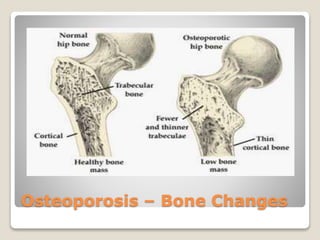
 Metabolic bone disorder causing:
─decreased bone mass
─porous, brittle bones
─increased risk of bone fractures
─stooped posture
─loss of height
─chronic pain
─reduction in mobility.
Epidemiology
 Whites and Asians are at greater risk.
 More common with age:
─15% of Whites in their 50’s, and 70% of those
over 80 affected.
 More common in women (4-5x):
─In the U.S. in 2010, about 8 million women
and 2 million men affected.
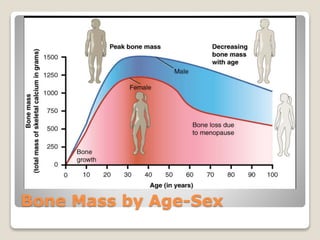
Bone Mass by Age-Sex
Peak Bone Mass
 The risk of developing osteoporosis
depends on how much bone mass is
attained between ages 25 and 35 (peak
bone mass).
 The higher the peak bone mass the more
“bones in the bank” and the lower the
likelihood of later osteoporosis.
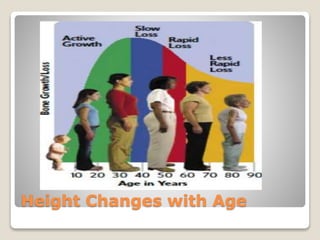
Height Changes with Age
Osteoporosis – Bone Changes
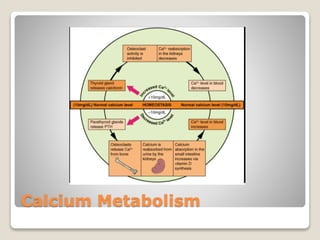
Calcium Metabolism
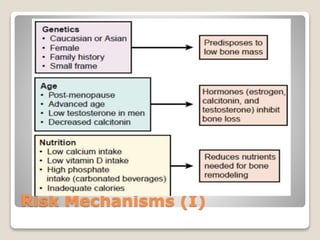
Risk Mechanisms (I)
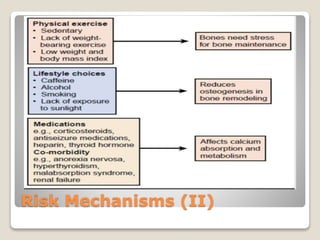
Risk Mechanisms (II)
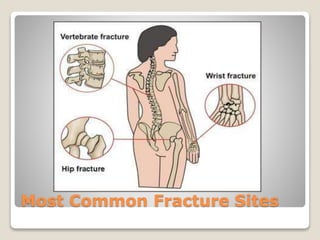
Most Common Fracture Sites
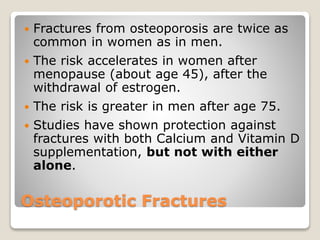
Osteoporotic Fractures
 Fractures from osteoporosis are twice as
common in women as in men.
 The risk accelerates in women after
menopause (about age 45), after the
withdrawal of estrogen.
 The risk is greater in men after age 75.
 Studies have shown protection against
fractures with both Calcium and Vitamin D
supplementation, but not with either
alone.
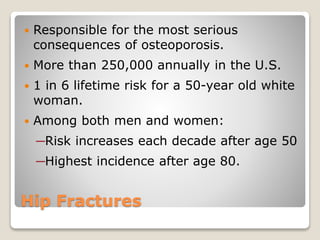
Hip Fractures
 Responsible for the most serious
consequences of osteoporosis.
 More than 250,000 annually in the U.S.
 1 in 6 lifetime risk for a 50-year old white
woman.
 Among both men and women:
─Risk increases each decade after age 50
─Highest incidence after age 80.
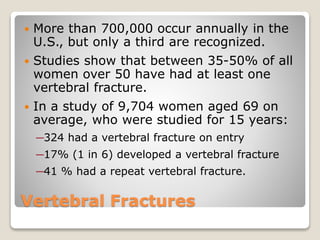
Vertebral Fractures
 More than 700,000 occur annually in the
U.S., but only a third are recognized.
 Studies show that between 35-50% of all
women over 50 have had at least one
vertebral fracture.
 In a study of 9,704 women aged 69 on
average, who were studied for 15 years:
─324 had a vertebral fracture on entry
─17% (1 in 6) developed a vertebral fracture
─41 % had a repeat vertebral fracture.
Other Osteoporotic Fractures
 Wrist:
─250,000 cases annually in the U.S.
─1 in 6 lifetime risk for white women
─20% of women have had at least one wrist fracture by
age 70
 Ribs:
─Common in men as young as 35
─Often overlooked
─Occur most often during physical activity
─“Fragility” considered the main cause
─Lab testing can rule out low testosterone levels and
indicate replacement therapy
Diagnosis of Osteoporosis (I)
 Symptoms are usually vague:
─stiffness, pain, weakness.
 Must rule out other diseases of bone,
especially the spine (such as metastatic
carcinoma, advanced multiple
myeloma).
 X-rays show changes only after 30% to
60% loss of bone.
Diagnosis of Osteoporosis (II)
 DEXA (Dual energy X-ray absorptiometry):
of the spine, hip, and wrist:
─the “gold standard” for diagnosing and monitoring
bone mineral density (BMD);
─A T-score of -2.5, or less (meaning that BMD is less
than 2.5 standard deviations below that of a 30-40
year old healthy female reference population) is
decisive for osteoporosis.
Indications for DEXA
 Older than 65, regardless of risk factors.
 Postmenopausal, with at least one risk factor
 Vertebral abnormality…
 Use of medications such as prednisone (SIOP
–> Steroid Induced Osteoporosis).
 Type I diabetes, liver disease, kidney disease,
or a family history of osteoporosis
 Early menopause (hysterectomy).
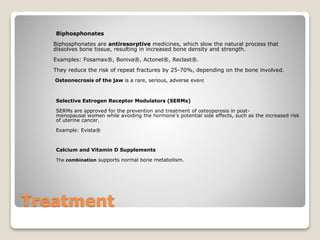
Treatment
Biphosphonates
Biphosphonates are antiresorptive medicines, which slow the natural process that
dissolves bone tissue, resulting in increased bone density and strength.
Examples: Fosamax®, Boniva®, Actonel®, Reclast®.
They reduce the risk of repeat fractures by 25-70%, depending on the bone involved.
Osteonecrosis of the jaw is a rare, serious, adverse event
Selective Estrogen Receptor Modulators (SERMs)
SERMs are approved for the prevention and treatment of osteoporosis in post-
menopausal women while avoiding the hormone’s potential side effects, such as the increased risk
of uterine cancer.
Example: Evista®
Calcium and Vitamin D Supplements
The combination supports normal bone metabolism.
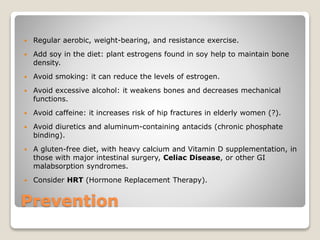
Prevention
 Regular aerobic, weight-bearing, and resistance exercise.
 Add soy in the diet: plant estrogens found in soy help to maintain bone
density.
 Avoid smoking: it can reduce the levels of estrogen.
 Avoid excessive alcohol: it weakens bones and decreases mechanical
functions.
 Avoid caffeine: it increases risk of hip fractures in elderly women (?).
 Avoid diuretics and aluminum-containing antacids (chronic phosphate
binding).
 A gluten-free diet, with heavy calcium and Vitamin D supplementation, in
those with major intestinal surgery, Celiac Disease, or other GI
malabsorption syndromes.
 Consider HRT (Hormone Replacement Therapy).
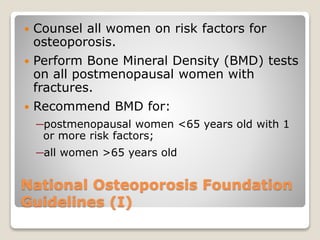
National Osteoporosis Foundation
Guidelines (I)
 Counsel all women on risk factors for
osteoporosis.
 Perform Bone Mineral Density (BMD) tests
on all postmenopausal women with
fractures.
 Recommend BMD for:
─postmenopausal women <65 years old with 1
or more risk factors;
─all women >65 years old
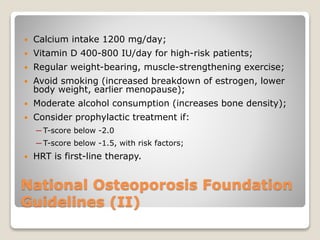
National Osteoporosis Foundation
Guidelines (II)
 Calcium intake 1200 mg/day;
 Vitamin D 400-800 IU/day for high-risk patients;
 Regular weight-bearing, muscle-strengthening exercise;
 Avoid smoking (increased breakdown of estrogen, lower
body weight, earlier menopause);
 Moderate alcohol consumption (increases bone density);
 Consider prophylactic treatment if:
─ T-score below -2.0
─ T-score below -1.5, with risk factors;
 HRT is first-line therapy.
RESOURCES
 Arthritis Foundation:
─ http://www.arthritis.org/about-arthritis/types/osteoporosis/
 National Institute of Arthritis and Musculoskeletal
and Skin Diseases (NIAMS) (NIH):
─ www.niams.nih.gov
─ National Osteoporosis Foundation:
─ https://www.nof.org/
 World Health Organization Collaborating Centre for
Metabolic Bone Diseases, University of Sheffield, UK
(FRAX Tool)
CREDITS
 Arthritis Foundation:
─ http://www.arthritis.org/about-arthrosis
 National Institute of Arthritis and Musculoskeletal and
Skin Diseases (NIAMS) (NIH):
─ http://www.niams.nih.gov/Health_Info//Osteoporosis/default.asp
─ https://en.wikipedia.org/wiki/Osteoporosis
 SLIDESHARE.NET:
─ http://www.slideshare.net/reynel89/osteoporosis-
7146795?utm_source=slideshow02&utm_medium=ssemail&utm_campaign
=share_slideshow
─ http://www.slideshare.net/drshama65/osteoporosis-
edited?utm_source=slideshow02&utm_medium=ssemail&utm_campaign=s
hare_slideshow
 World Health Organization Collaborating Centre for
Metabolic Bone Diseases, University of Sheffield, UK
─ https://www.shef.ac.uk/FRAX/tool.jsp
Osteoporosis

Osteoporosis

  • 1.
    Osteoporosis Michael C. Joseph,MD, MPH 12 October 2016 (Peer Learning)
  • 2.
    Outline  OSTEOPOROSIS ─ Definition ─Epidemiology ─ Symptoms ─ Treatment ─ Research  RESOURCES  CREDITS
  • 3.
    Osteoporosis - Definition Metabolic bone disorder causing: ─decreased bone mass ─porous, brittle bones ─increased risk of bone fractures ─stooped posture ─loss of height ─chronic pain ─reduction in mobility.
  • 4.
    Epidemiology  Whites andAsians are at greater risk.  More common with age: ─15% of Whites in their 50’s, and 70% of those over 80 affected.  More common in women (4-5x): ─In the U.S. in 2010, about 8 million women and 2 million men affected.
  • 5.
    Bone Mass byAge-Sex
  • 6.
    Peak Bone Mass The risk of developing osteoporosis depends on how much bone mass is attained between ages 25 and 35 (peak bone mass).  The higher the peak bone mass the more “bones in the bank” and the lower the likelihood of later osteoporosis.
  • 7.
  • 8.
  • 9.
  • 10.
  • 11.
  • 12.
  • 13.
    Osteoporotic Fractures  Fracturesfrom osteoporosis are twice as common in women as in men.  The risk accelerates in women after menopause (about age 45), after the withdrawal of estrogen.  The risk is greater in men after age 75.  Studies have shown protection against fractures with both Calcium and Vitamin D supplementation, but not with either alone.
  • 14.
    Hip Fractures  Responsiblefor the most serious consequences of osteoporosis.  More than 250,000 annually in the U.S.  1 in 6 lifetime risk for a 50-year old white woman.  Among both men and women: ─Risk increases each decade after age 50 ─Highest incidence after age 80.
  • 15.
    Vertebral Fractures  Morethan 700,000 occur annually in the U.S., but only a third are recognized.  Studies show that between 35-50% of all women over 50 have had at least one vertebral fracture.  In a study of 9,704 women aged 69 on average, who were studied for 15 years: ─324 had a vertebral fracture on entry ─17% (1 in 6) developed a vertebral fracture ─41 % had a repeat vertebral fracture.
  • 16.
    Other Osteoporotic Fractures Wrist: ─250,000 cases annually in the U.S. ─1 in 6 lifetime risk for white women ─20% of women have had at least one wrist fracture by age 70  Ribs: ─Common in men as young as 35 ─Often overlooked ─Occur most often during physical activity ─“Fragility” considered the main cause ─Lab testing can rule out low testosterone levels and indicate replacement therapy
  • 17.
    Diagnosis of Osteoporosis(I)  Symptoms are usually vague: ─stiffness, pain, weakness.  Must rule out other diseases of bone, especially the spine (such as metastatic carcinoma, advanced multiple myeloma).  X-rays show changes only after 30% to 60% loss of bone.
  • 18.
    Diagnosis of Osteoporosis(II)  DEXA (Dual energy X-ray absorptiometry): of the spine, hip, and wrist: ─the “gold standard” for diagnosing and monitoring bone mineral density (BMD); ─A T-score of -2.5, or less (meaning that BMD is less than 2.5 standard deviations below that of a 30-40 year old healthy female reference population) is decisive for osteoporosis.
  • 19.
    Indications for DEXA Older than 65, regardless of risk factors.  Postmenopausal, with at least one risk factor  Vertebral abnormality…  Use of medications such as prednisone (SIOP –> Steroid Induced Osteoporosis).  Type I diabetes, liver disease, kidney disease, or a family history of osteoporosis  Early menopause (hysterectomy).
  • 20.
    Treatment Biphosphonates Biphosphonates are antiresorptivemedicines, which slow the natural process that dissolves bone tissue, resulting in increased bone density and strength. Examples: Fosamax®, Boniva®, Actonel®, Reclast®. They reduce the risk of repeat fractures by 25-70%, depending on the bone involved. Osteonecrosis of the jaw is a rare, serious, adverse event Selective Estrogen Receptor Modulators (SERMs) SERMs are approved for the prevention and treatment of osteoporosis in post- menopausal women while avoiding the hormone’s potential side effects, such as the increased risk of uterine cancer. Example: Evista® Calcium and Vitamin D Supplements The combination supports normal bone metabolism.
  • 21.
    Prevention  Regular aerobic,weight-bearing, and resistance exercise.  Add soy in the diet: plant estrogens found in soy help to maintain bone density.  Avoid smoking: it can reduce the levels of estrogen.  Avoid excessive alcohol: it weakens bones and decreases mechanical functions.  Avoid caffeine: it increases risk of hip fractures in elderly women (?).  Avoid diuretics and aluminum-containing antacids (chronic phosphate binding).  A gluten-free diet, with heavy calcium and Vitamin D supplementation, in those with major intestinal surgery, Celiac Disease, or other GI malabsorption syndromes.  Consider HRT (Hormone Replacement Therapy).
  • 22.
    National Osteoporosis Foundation Guidelines(I)  Counsel all women on risk factors for osteoporosis.  Perform Bone Mineral Density (BMD) tests on all postmenopausal women with fractures.  Recommend BMD for: ─postmenopausal women <65 years old with 1 or more risk factors; ─all women >65 years old
  • 23.
    National Osteoporosis Foundation Guidelines(II)  Calcium intake 1200 mg/day;  Vitamin D 400-800 IU/day for high-risk patients;  Regular weight-bearing, muscle-strengthening exercise;  Avoid smoking (increased breakdown of estrogen, lower body weight, earlier menopause);  Moderate alcohol consumption (increases bone density);  Consider prophylactic treatment if: ─ T-score below -2.0 ─ T-score below -1.5, with risk factors;  HRT is first-line therapy.
  • 24.
    RESOURCES  Arthritis Foundation: ─http://www.arthritis.org/about-arthritis/types/osteoporosis/  National Institute of Arthritis and Musculoskeletal and Skin Diseases (NIAMS) (NIH): ─ www.niams.nih.gov ─ National Osteoporosis Foundation: ─ https://www.nof.org/  World Health Organization Collaborating Centre for Metabolic Bone Diseases, University of Sheffield, UK (FRAX Tool)
  • 25.
    CREDITS  Arthritis Foundation: ─http://www.arthritis.org/about-arthrosis  National Institute of Arthritis and Musculoskeletal and Skin Diseases (NIAMS) (NIH): ─ http://www.niams.nih.gov/Health_Info//Osteoporosis/default.asp ─ https://en.wikipedia.org/wiki/Osteoporosis  SLIDESHARE.NET: ─ http://www.slideshare.net/reynel89/osteoporosis- 7146795?utm_source=slideshow02&utm_medium=ssemail&utm_campaign =share_slideshow ─ http://www.slideshare.net/drshama65/osteoporosis- edited?utm_source=slideshow02&utm_medium=ssemail&utm_campaign=s hare_slideshow  World Health Organization Collaborating Centre for Metabolic Bone Diseases, University of Sheffield, UK ─ https://www.shef.ac.uk/FRAX/tool.jsp