Brain Aneurysm Coiling
(Endovascular treatment of brain Aneurysms)
Dr. Avinash KM
MS, MRCS Ed(UK), Mch (KEM, Mumbai), FINR(Switzerland), FMINS(Germany),
• Interventional & Neurovascular surgeon and Stroke specialist,
• Endoscopic Neuro and Spine surgeon,
• Minimally invasive Neuro and Spine surgeon (FMINS).
mob: 9740866228, E mail: doc_avin@hotmail.com
Consultant Neurosurgeon and Neurointerventionist
Columbia Asia Hospital, Bangalore.
What is brain Aneurysm?
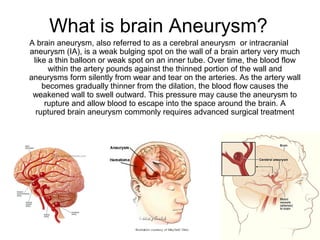
A brain aneurysm, also referred to as a cerebral aneurysm or intracranial
aneurysm (IA), is a weak bulging spot on the wall of a brain artery very much
like a thin balloon or weak spot on an inner tube. Over time, the blood flow
within the artery pounds against the thinned portion of the wall and
aneurysms form silently from wear and tear on the arteries. As the artery wall
becomes gradually thinner from the dilation, the blood flow causes the
weakened wall to swell outward. This pressure may cause the aneurysm to
rupture and allow blood to escape into the space around the brain. A
ruptured brain aneurysm commonly requires advanced surgical treatment
Treatment options for Brain Aneurysms:
• Surgical clipping :
• Endovascular coiling
• Parent artery sacrifice with or with out bypass surgery.
• Conservative management (no treatment)
Endovascular treatment for Brain aneurysms:
• Coiling of aneurysm:
• Stent assisted coiling:
• Balloon assisted coiling:
• Flow diverters:
Coiling of aneurysm:
Endovascular (meaning within the blood vessel)
embolization, or coiling, uses the natural
access to the brain through the
bloodstream via arteries to diagnosis and
treat brain aneurysms. The goal of the
treatment is to safely seal off the aneurysm
and stop further blood from entering into
the aneurysm and increasing the risk of
rupture or possibly rebleeding.
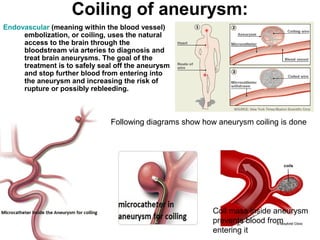
Following diagrams show how aneurysm coiling is done
Coil mass inside aneurysm
prevents blood from
entering it
Watch videos to know more about coiling:
Following videos demonstrate the procedure of
aneurysmal coiling.
http://www.youtube.com/watch?v=-dYC1gyqomM
http://www.youtube.com/watch?v=eLIPCvT49yI
http://www.youtube.com/watch?v=5Ss-IOmFyeA
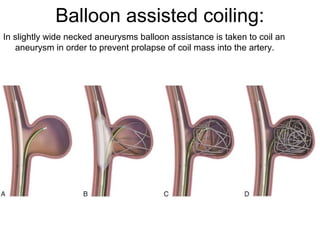
Balloon assisted coiling:
In slightly wide necked aneurysms balloon assistance is taken to coil an
aneurysm in order to prevent prolapse of coil mass into the artery.
Stent assisted coiling:
For wide necked aneurysms stent can be placed to hold coil mass
inside the aneurysm.
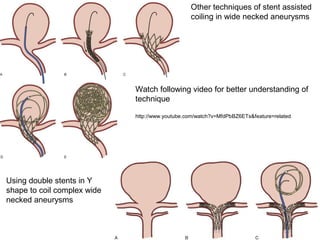
Other techniques of stent assisted
coiling in wide necked aneurysms
Using double stents in Y
shape to coil complex wide
necked aneurysms
Watch following video for better understanding of
technique
http://www.youtube.com/watch?v=MfdPbBZ6ETs&feature=related
Flow diverter:
Flow diverter is a kind of stent which can be used with out
use of coils.
Watch following video for better understanding
http://www.youtube.com/watch?v=jd5VQTS096E&feature=related
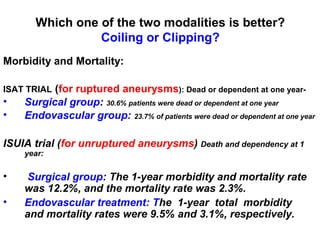
Which one of the two modalities is better?
Coiling or Clipping?
Morbidity and Mortality:
ISAT TRIAL (for ruptured aneurysms): Dead or dependent at one year-
• Surgical group: 30.6% patients were dead or dependent at one year
• Endovascular group: 23.7% of patients were dead or dependent at one year
ISUIA trial (for unruptured aneurysms) Death and dependency at 1
year:
• Surgical group: The 1-year morbidity and mortality rate
was 12.2%, and the mortality rate was 2.3%.
• Endovascular treatment: The 1-year total morbidity
and mortality rates were 9.5% and 3.1%, respectively.

Brain aneurysm coiling

  • 1.
    Brain Aneurysm Coiling (Endovasculartreatment of brain Aneurysms) Dr. Avinash KM MS, MRCS Ed(UK), Mch (KEM, Mumbai), FINR(Switzerland), FMINS(Germany), • Interventional & Neurovascular surgeon and Stroke specialist, • Endoscopic Neuro and Spine surgeon, • Minimally invasive Neuro and Spine surgeon (FMINS). mob: 9740866228, E mail: doc_avin@hotmail.com Consultant Neurosurgeon and Neurointerventionist Columbia Asia Hospital, Bangalore.
  • 2.
    What is brainAneurysm? A brain aneurysm, also referred to as a cerebral aneurysm or intracranial aneurysm (IA), is a weak bulging spot on the wall of a brain artery very much like a thin balloon or weak spot on an inner tube. Over time, the blood flow within the artery pounds against the thinned portion of the wall and aneurysms form silently from wear and tear on the arteries. As the artery wall becomes gradually thinner from the dilation, the blood flow causes the weakened wall to swell outward. This pressure may cause the aneurysm to rupture and allow blood to escape into the space around the brain. A ruptured brain aneurysm commonly requires advanced surgical treatment
  • 3.
    Treatment options forBrain Aneurysms: • Surgical clipping : • Endovascular coiling • Parent artery sacrifice with or with out bypass surgery. • Conservative management (no treatment) Endovascular treatment for Brain aneurysms: • Coiling of aneurysm: • Stent assisted coiling: • Balloon assisted coiling: • Flow diverters:
  • 4.
    Coiling of aneurysm: Endovascular(meaning within the blood vessel) embolization, or coiling, uses the natural access to the brain through the bloodstream via arteries to diagnosis and treat brain aneurysms. The goal of the treatment is to safely seal off the aneurysm and stop further blood from entering into the aneurysm and increasing the risk of rupture or possibly rebleeding. Following diagrams show how aneurysm coiling is done Coil mass inside aneurysm prevents blood from entering it
  • 5.
    Watch videos toknow more about coiling: Following videos demonstrate the procedure of aneurysmal coiling. http://www.youtube.com/watch?v=-dYC1gyqomM http://www.youtube.com/watch?v=eLIPCvT49yI http://www.youtube.com/watch?v=5Ss-IOmFyeA
  • 6.
    Balloon assisted coiling: Inslightly wide necked aneurysms balloon assistance is taken to coil an aneurysm in order to prevent prolapse of coil mass into the artery.
  • 7.
    Stent assisted coiling: Forwide necked aneurysms stent can be placed to hold coil mass inside the aneurysm.
  • 8.
    Other techniques ofstent assisted coiling in wide necked aneurysms Using double stents in Y shape to coil complex wide necked aneurysms Watch following video for better understanding of technique http://www.youtube.com/watch?v=MfdPbBZ6ETs&feature=related
  • 9.
    Flow diverter: Flow diverteris a kind of stent which can be used with out use of coils. Watch following video for better understanding http://www.youtube.com/watch?v=jd5VQTS096E&feature=related
  • 10.
    Which one ofthe two modalities is better? Coiling or Clipping? Morbidity and Mortality: ISAT TRIAL (for ruptured aneurysms): Dead or dependent at one year- • Surgical group: 30.6% patients were dead or dependent at one year • Endovascular group: 23.7% of patients were dead or dependent at one year ISUIA trial (for unruptured aneurysms) Death and dependency at 1 year: • Surgical group: The 1-year morbidity and mortality rate was 12.2%, and the mortality rate was 2.3%. • Endovascular treatment: The 1-year total morbidity and mortality rates were 9.5% and 3.1%, respectively.