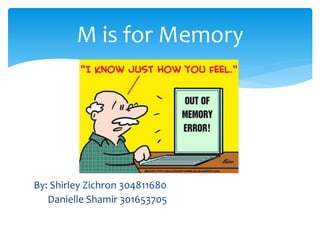
M is for Memory
 Memory in L2 acquisition
 Sensory memory
 Working memory
 Long-term memory
 Memorization
Today’s presentation:
“There is no learning without
memory, and language learning
in particular.”
Thornbury, S. (2006). An A-Z of ELT. Macmillan books for
teachers series.
Memory in L2 acquisition
Learning a language = learning a large amount of
vocabulary
Learning is, in most cases, a memory task
Memory in L2 acquisition
 Having a good memory improves memory
acquisition and increases aptitude to languages
in general.
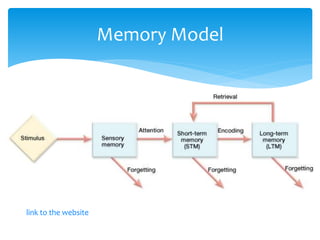
 There are currently models of memory; sensory
memory, working memory and long-term
memory.
Memory in L2 acquisition
 the shortest one, i.e. lasts only for seconds.
 triggered by echo and visual impressions.
Sensory memory
Working memory (short-term memory)
 responsible for holding and processing information
for only a short period of time.
 information can come from an external source or it
can be retrieved from long-term memory.
 plays an important role in language acquisition
(vocabulary, chunks, locating information from
texts, etc.)
 The capacity is limited; it can process a limited
amount of information at one time
 Most cognitive tasks depend on working
memory.
Working memory (short-term memory)
 responsible for storing information in a more
permanent way
 has enormous capacity and durability
 can be described as ‘storage units of information’
Long-Term Memory
 Information from working memory is stored in
long term memory but can revert back to
working memory when needed
 Repetition is crucial in order to maintain
information and prevent it from being lost.
 One of the ways to maintain information is
memorization.
Long-Term Memory
Memory Model
link to the website
“…The memorization of meaningful words and
even sentences is now considered to be an
essential ingredient of language learning.”
Thornbury, S. (2006). An A-Z of ELT. Macmillan books for teachers series.
Memorization
 Elaboration- in order to remember a word
more effectively, one should process
information more elaborately.
Forms of Memorization
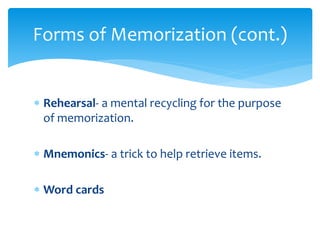
 Rehearsal- a mental recycling for the purpose
of memorization.
 Mnemonics- a trick to help retrieve items.
 Word cards
Forms of Memorization (cont.)
 Memory model website
 The role of working memory in SLA
 Thornbury, S. (2006). An A-Z of ELT. Macmillan books
for teachers series.
References

Memory ppt

  • 1.
    M is forMemory
  • 2.
     Memory inL2 acquisition  Sensory memory  Working memory  Long-term memory  Memorization Today’s presentation:
  • 3.
    “There is nolearning without memory, and language learning in particular.” Thornbury, S. (2006). An A-Z of ELT. Macmillan books for teachers series. Memory in L2 acquisition
  • 4.
    Learning a language= learning a large amount of vocabulary Learning is, in most cases, a memory task Memory in L2 acquisition
  • 5.
     Having agood memory improves memory acquisition and increases aptitude to languages in general.  There are currently models of memory; sensory memory, working memory and long-term memory. Memory in L2 acquisition
  • 6.
     the shortestone, i.e. lasts only for seconds.  triggered by echo and visual impressions. Sensory memory
  • 7.
    Working memory (short-termmemory)  responsible for holding and processing information for only a short period of time.  information can come from an external source or it can be retrieved from long-term memory.  plays an important role in language acquisition (vocabulary, chunks, locating information from texts, etc.)
  • 8.
     The capacityis limited; it can process a limited amount of information at one time  Most cognitive tasks depend on working memory. Working memory (short-term memory)
  • 9.
     responsible forstoring information in a more permanent way  has enormous capacity and durability  can be described as ‘storage units of information’ Long-Term Memory
  • 10.
     Information fromworking memory is stored in long term memory but can revert back to working memory when needed  Repetition is crucial in order to maintain information and prevent it from being lost.  One of the ways to maintain information is memorization. Long-Term Memory
  • 11.
  • 12.
    “…The memorization ofmeaningful words and even sentences is now considered to be an essential ingredient of language learning.” Thornbury, S. (2006). An A-Z of ELT. Macmillan books for teachers series. Memorization
  • 13.
     Elaboration- inorder to remember a word more effectively, one should process information more elaborately. Forms of Memorization
  • 14.
     Rehearsal- amental recycling for the purpose of memorization.  Mnemonics- a trick to help retrieve items.  Word cards Forms of Memorization (cont.)
  • 15.
     Memory modelwebsite  The role of working memory in SLA  Thornbury, S. (2006). An A-Z of ELT. Macmillan books for teachers series. References