1
Painting
1
For many, “art” means painting
Drawing and painting are related
Overlapping processes
Drawing often a prelude to painting
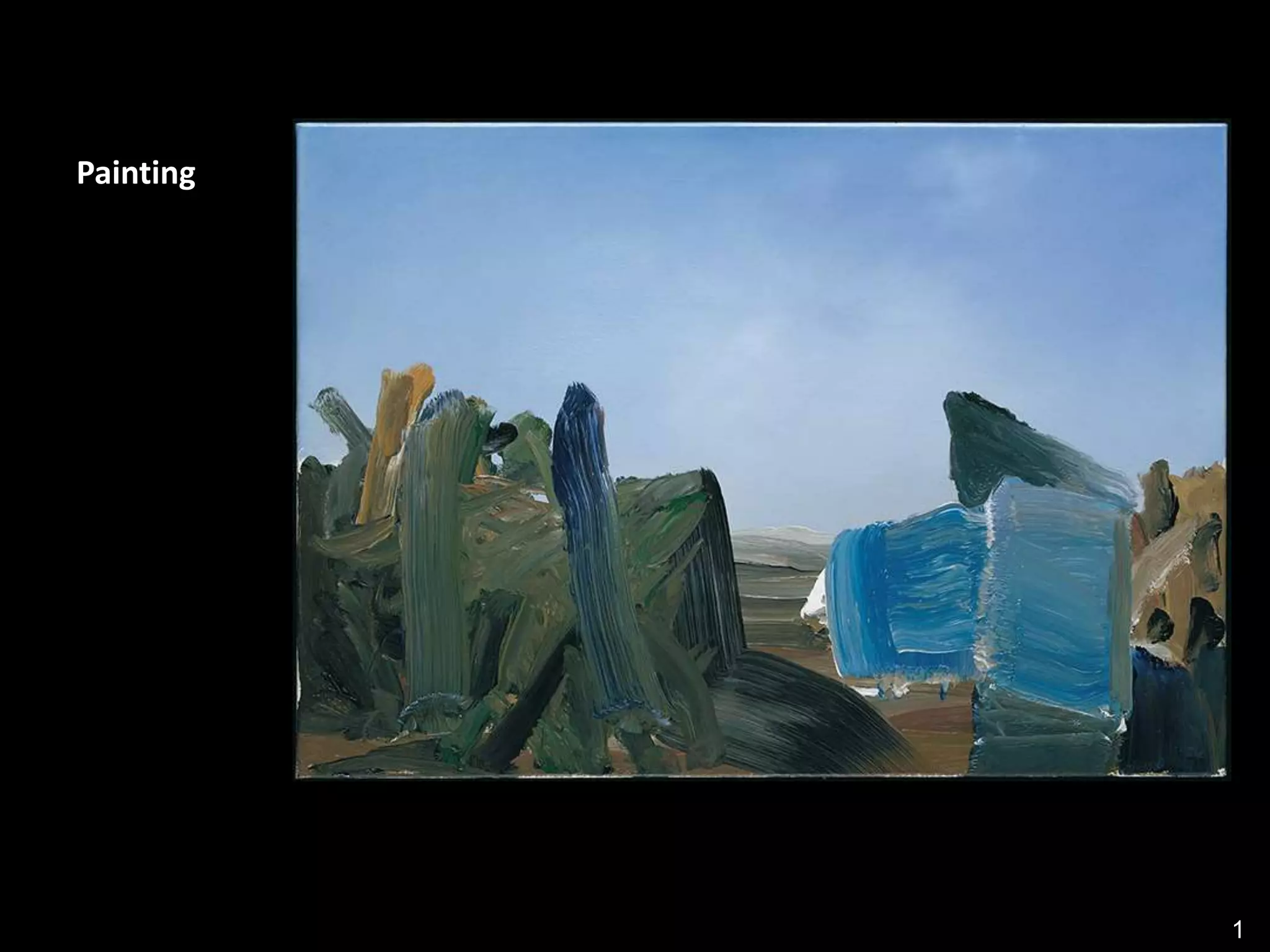
Gerhard Richter, Abstract Painting
Medium and process of application
part of the message
Gerhard Richter. Abstract Painting.
1984.
Oil on canvas. 17" × 23-5/8".
1
Ingredients and Surfaces
Three ingredients of all paint
Pigment
• provide color.
Usually in the form of fine powder
Must be stable while drying
Must resist fading over time
Advances in chemical industry in 19th
and 20th centuries allowed for synthetic
pigments in a range of stable colors.
Binders
• hold pigment particles together.
• Oil paint contains linseed oil.
• Tempera paint contains egg yolk.
Vehicles
• make paint a liquid and can be further
added for thinning. Turpentine in oils
and water in watercolors
Support
Structure underneath the painting
1
Watercolor
•
Water-based paint media used for
thousands of years
Pigments mixed with water as a
vehicle and gum arabic as a binder
White rag paper most common
support
• Requires neither sizing nor priming
A staining technique
• Paint applied in thin, translucent
washes
Highlights obtained by leaving
areas of white paper unpainted
Opaque (nontranslucent) detailing
• Fluid spontaneity suited for
outdoor impressions
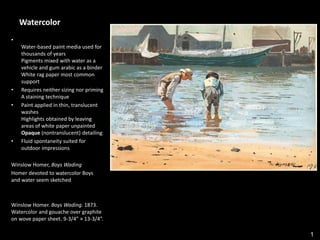
Winslow Homer, Boys Wading
Homer devoted to watercolor Boys
and water seem sketched
Winslow Homer. Boys Wading. 1873.
Watercolor and gouache over graphite
on wove paper sheet. 9-3/4” × 13-3/4”.
1
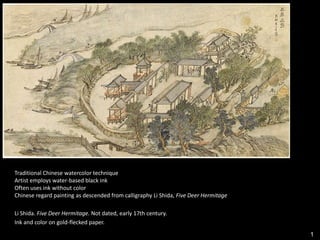
Traditional Chinese watercolor technique
Artist employs water-based black ink
Often uses ink without color
Chinese regard painting as descended from calligraphy Li Shida, Five Deer Hermitage
Li Shida. Five Deer Hermitage. Not dated, early 17th century.
Ink and color on gold-flecked paper.
1
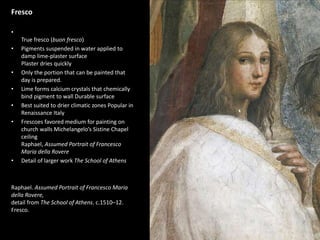
Fresco
•
True fresco (buon fresco)
• Pigments suspended in water applied to
damp lime-plaster surface
Plaster dries quickly
• Only the portion that can be painted that
day is prepared.
• Lime forms calcium crystals that chemically
bind pigment to wall Durable surface
• Best suited to drier climatic zones Popular in
Renaissance Italy
• Frescoes favored medium for painting on
church walls Michelangelo’s Sistine Chapel
ceiling
Raphael, Assumed Portrait of Francesco
Maria della Rovere
• Detail of larger work The School of Athens
Raphael. Assumed Portrait of Francesco Maria
della Rovere,
detail from The School of Athens. c.1510–12.
Fresco.
1
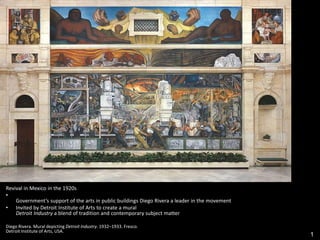
Revival in Mexico in the 1920s
•
Government’s support of the arts in public buildings Diego Rivera a leader in the movement
• Invited by Detroit Institute of Arts to create a mural
Detroit Industry a blend of tradition and contemporary subject matter
Diego Rivera. Mural depicting Detroit Industry. 1932–1933. Fresco.
Detroit Institute of Arts, USA.
1
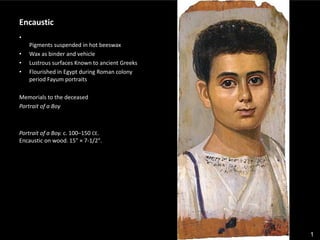
Encaustic
•
Pigments suspended in hot beeswax
• Wax as binder and vehicle
• Lustrous surfaces Known to ancient Greeks
• Flourished in Egypt during Roman colony
period Fayum portraits
Memorials to the deceased
Portrait of a Boy
Portrait of a Boy. c. 100–150 CE.
Encaustic on wood. 15" × 7-1/2".
1
Encaustic
Temperature control necessary
Less commonly used today,
despite modern devices making
temperature control easier
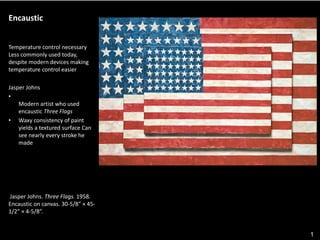
Jasper Johns
•
Modern artist who used
encaustic Three Flags
• Waxy consistency of paint
yields a textured surface Can
see nearly every stroke he
made
Jasper Johns. Three Flags. 1958.
Encaustic on canvas. 30-5/8” × 45-
1/2” × 4-5/8”.
Tempera
Tempera known to Greeks and Romans
• Highly developed during Middle Ages
Egg yolk (binder) mixed equally with
pigment and thinned with water Matte
(not shiny) surface when dry
• Gesso-Preferred ground for egg
tempera
• Advantages
• Achieving sharp lines and precise
details
• Does not darken with age
• Disadvantages
• Colors change during drying Difficult to
rework and not flexible Requires pale
underpainting
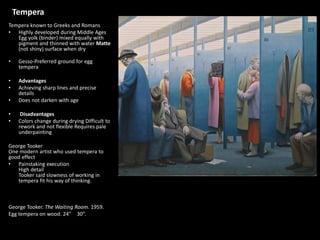
George Tooker
One modern artist who used tempera to
good effect
• Painstaking execution
High detail
Tooker said slowness of working in
tempera fit his way of thinking.
George Tooker. The Waiting Room. 1959.
Egg tempera on wood. 24” × 30”.
Oil
A favorite medium of Western art for
five centuries
•
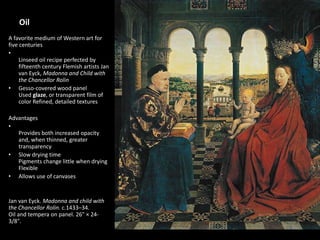
Linseed oil recipe perfected by
fifteenth century Flemish artists Jan
van Eyck, Madonna and Child with
the Chancellor Rolin
• Gesso-covered wood panel
Used glaze, or transparent film of
color Refined, detailed textures
Advantages
•
Provides both increased opacity
and, when thinned, greater
transparency
• Slow drying time
Pigments change little when drying
Flexible
• Allows use of canvases
Jan van Eyck. Madonna and child with
the Chancellor Rolin. c.1433–34.
Oil and tempera on panel. 26" × 24-
3/8".
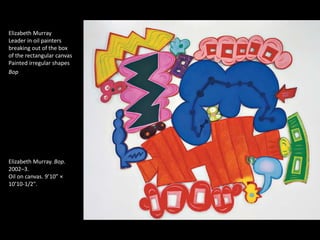
Elizabeth Murray
Leader in oil painters
breaking out of the box
of the rectangular canvas
Painted irregular shapes
Bop
Elizabeth Murray. Bop.
2002–3.
Oil on canvas. 9’10” ×
10’10-1/2".
1
Acrylic
•
Invented mid-twentieth century
• Binder is acrylic polymer (synthetic)
• Vehicle, water, more convenient than
toxic turpentine Relatively permanent
paints
• Rarely darken or yellow with age Rapid
drying time
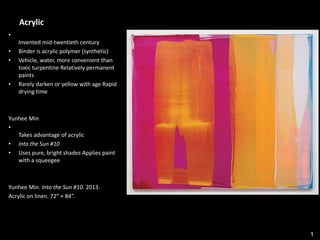
Yunhee Min
•
Takes advantage of acrylic
• Into the Sun #10
• Uses pure, bright shades Applies paint
with a squeegee
Yunhee Min. Into the Sun #10. 2013.
Acrylic on linen. 72” × 84”.
1
Contemporary Approaches
Painting continues through “near-death
experiences”
Times when some have wondered whether
it might become obsolete Flourishes as
artists discover new types of paints
And methods of applying it
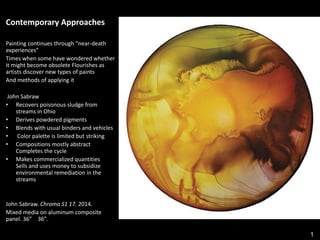
John Sabraw
• Recovers poisonous sludge from
streams in Ohio
• Derives powdered pigments
• Blends with usual binders and vehicles
• Color palette is limited but striking
• Compositions mostly abstract
Completes the cycle
• Makes commercialized quantities
Sells and uses money to subsidize
environmental remediation in the
streams
John Sabraw. Chroma S1 17. 2014.
Mixed media on aluminum composite
panel. 36” × 36”.
1
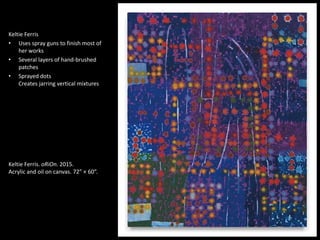
Keltie Ferris
• Uses spray guns to finish most of
her works
• Several layers of hand-brushed
patches
• Sprayed dots
Creates jarring vertical mixtures
Keltie Ferris. oRiOn. 2015.
Acrylic and oil on canvas. 72” × 60”.

de Beaufort AA ch7

  • 1.
  • 2.
    1 For many, “art”means painting Drawing and painting are related Overlapping processes Drawing often a prelude to painting Gerhard Richter, Abstract Painting Medium and process of application part of the message Gerhard Richter. Abstract Painting. 1984. Oil on canvas. 17" × 23-5/8".
  • 3.
    1 Ingredients and Surfaces Threeingredients of all paint Pigment • provide color. Usually in the form of fine powder Must be stable while drying Must resist fading over time Advances in chemical industry in 19th and 20th centuries allowed for synthetic pigments in a range of stable colors. Binders • hold pigment particles together. • Oil paint contains linseed oil. • Tempera paint contains egg yolk. Vehicles • make paint a liquid and can be further added for thinning. Turpentine in oils and water in watercolors Support Structure underneath the painting
  • 4.
    1 Watercolor • Water-based paint mediaused for thousands of years Pigments mixed with water as a vehicle and gum arabic as a binder White rag paper most common support • Requires neither sizing nor priming A staining technique • Paint applied in thin, translucent washes Highlights obtained by leaving areas of white paper unpainted Opaque (nontranslucent) detailing • Fluid spontaneity suited for outdoor impressions Winslow Homer, Boys Wading Homer devoted to watercolor Boys and water seem sketched Winslow Homer. Boys Wading. 1873. Watercolor and gouache over graphite on wove paper sheet. 9-3/4” × 13-3/4”.
  • 5.
    1 Traditional Chinese watercolortechnique Artist employs water-based black ink Often uses ink without color Chinese regard painting as descended from calligraphy Li Shida, Five Deer Hermitage Li Shida. Five Deer Hermitage. Not dated, early 17th century. Ink and color on gold-flecked paper.
  • 6.
    1 Fresco • True fresco (buonfresco) • Pigments suspended in water applied to damp lime-plaster surface Plaster dries quickly • Only the portion that can be painted that day is prepared. • Lime forms calcium crystals that chemically bind pigment to wall Durable surface • Best suited to drier climatic zones Popular in Renaissance Italy • Frescoes favored medium for painting on church walls Michelangelo’s Sistine Chapel ceiling Raphael, Assumed Portrait of Francesco Maria della Rovere • Detail of larger work The School of Athens Raphael. Assumed Portrait of Francesco Maria della Rovere, detail from The School of Athens. c.1510–12. Fresco.
  • 7.
    1 Revival in Mexicoin the 1920s • Government’s support of the arts in public buildings Diego Rivera a leader in the movement • Invited by Detroit Institute of Arts to create a mural Detroit Industry a blend of tradition and contemporary subject matter Diego Rivera. Mural depicting Detroit Industry. 1932–1933. Fresco. Detroit Institute of Arts, USA.
  • 8.
    1 Encaustic • Pigments suspended inhot beeswax • Wax as binder and vehicle • Lustrous surfaces Known to ancient Greeks • Flourished in Egypt during Roman colony period Fayum portraits Memorials to the deceased Portrait of a Boy Portrait of a Boy. c. 100–150 CE. Encaustic on wood. 15" × 7-1/2".
  • 9.
    1 Encaustic Temperature control necessary Lesscommonly used today, despite modern devices making temperature control easier Jasper Johns • Modern artist who used encaustic Three Flags • Waxy consistency of paint yields a textured surface Can see nearly every stroke he made Jasper Johns. Three Flags. 1958. Encaustic on canvas. 30-5/8” × 45- 1/2” × 4-5/8”.
  • 10.
    Tempera Tempera known toGreeks and Romans • Highly developed during Middle Ages Egg yolk (binder) mixed equally with pigment and thinned with water Matte (not shiny) surface when dry • Gesso-Preferred ground for egg tempera • Advantages • Achieving sharp lines and precise details • Does not darken with age • Disadvantages • Colors change during drying Difficult to rework and not flexible Requires pale underpainting George Tooker One modern artist who used tempera to good effect • Painstaking execution High detail Tooker said slowness of working in tempera fit his way of thinking. George Tooker. The Waiting Room. 1959. Egg tempera on wood. 24” × 30”.
  • 11.
    Oil A favorite mediumof Western art for five centuries • Linseed oil recipe perfected by fifteenth century Flemish artists Jan van Eyck, Madonna and Child with the Chancellor Rolin • Gesso-covered wood panel Used glaze, or transparent film of color Refined, detailed textures Advantages • Provides both increased opacity and, when thinned, greater transparency • Slow drying time Pigments change little when drying Flexible • Allows use of canvases Jan van Eyck. Madonna and child with the Chancellor Rolin. c.1433–34. Oil and tempera on panel. 26" × 24- 3/8".
  • 12.
    Elizabeth Murray Leader inoil painters breaking out of the box of the rectangular canvas Painted irregular shapes Bop Elizabeth Murray. Bop. 2002–3. Oil on canvas. 9’10” × 10’10-1/2".
  • 13.
    1 Acrylic • Invented mid-twentieth century •Binder is acrylic polymer (synthetic) • Vehicle, water, more convenient than toxic turpentine Relatively permanent paints • Rarely darken or yellow with age Rapid drying time Yunhee Min • Takes advantage of acrylic • Into the Sun #10 • Uses pure, bright shades Applies paint with a squeegee Yunhee Min. Into the Sun #10. 2013. Acrylic on linen. 72” × 84”.
  • 14.
    1 Contemporary Approaches Painting continuesthrough “near-death experiences” Times when some have wondered whether it might become obsolete Flourishes as artists discover new types of paints And methods of applying it John Sabraw • Recovers poisonous sludge from streams in Ohio • Derives powdered pigments • Blends with usual binders and vehicles • Color palette is limited but striking • Compositions mostly abstract Completes the cycle • Makes commercialized quantities Sells and uses money to subsidize environmental remediation in the streams John Sabraw. Chroma S1 17. 2014. Mixed media on aluminum composite panel. 36” × 36”.
  • 15.
    1 Keltie Ferris • Usesspray guns to finish most of her works • Several layers of hand-brushed patches • Sprayed dots Creates jarring vertical mixtures Keltie Ferris. oRiOn. 2015. Acrylic and oil on canvas. 72” × 60”.