Presented byBren Codie BelenGabryellRicafrenteAnthony TranJames VuongJay XiongArt Resource GuidePages 28 – 47
ASIAN ART
Chinese ArtSome findings date back to fourth millennium B.C.EGreat Wall of China Originally had a utilitarian functionNow really just for showTerracotta ArmyMonument to the first emperorEmperor of QinClay buried as part of his tomb
Terracotta Army
Chinese ArtTang Dynasty618 – 907 C.E.Ink drawingsCeramic sculpturesModern Chinese ArtPropaganda during communist revolutionLess political today
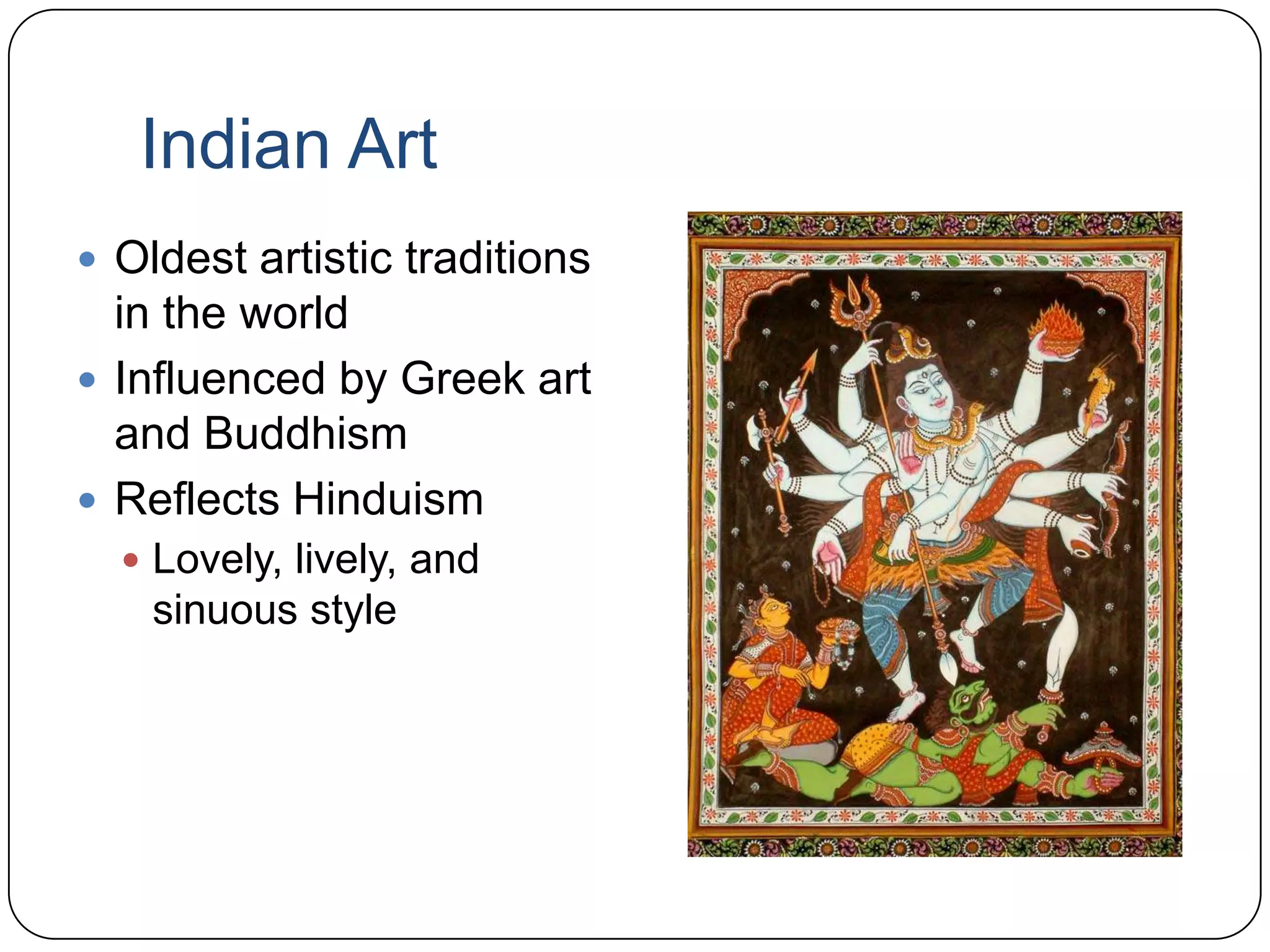
Indian ArtOldest artistic traditions in the worldInfluenced by Greek art and BuddhismReflects HinduismLovely, lively, and sinuous style
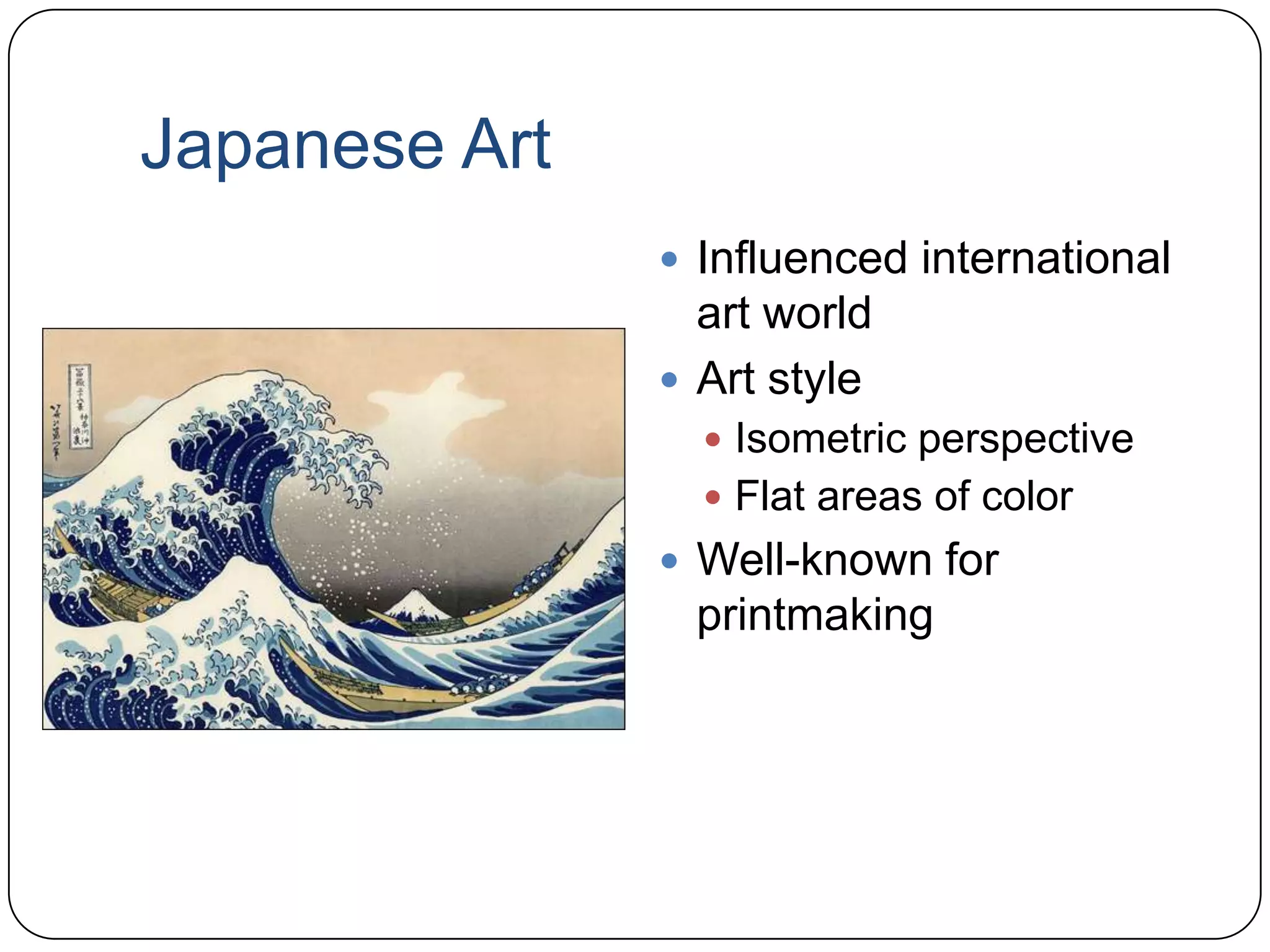
Japanese ArtInfluenced international art worldArt styleIsometric perspectiveFlat areas of colorWell-known for printmaking
AFRICAN AND OCEANIC ART
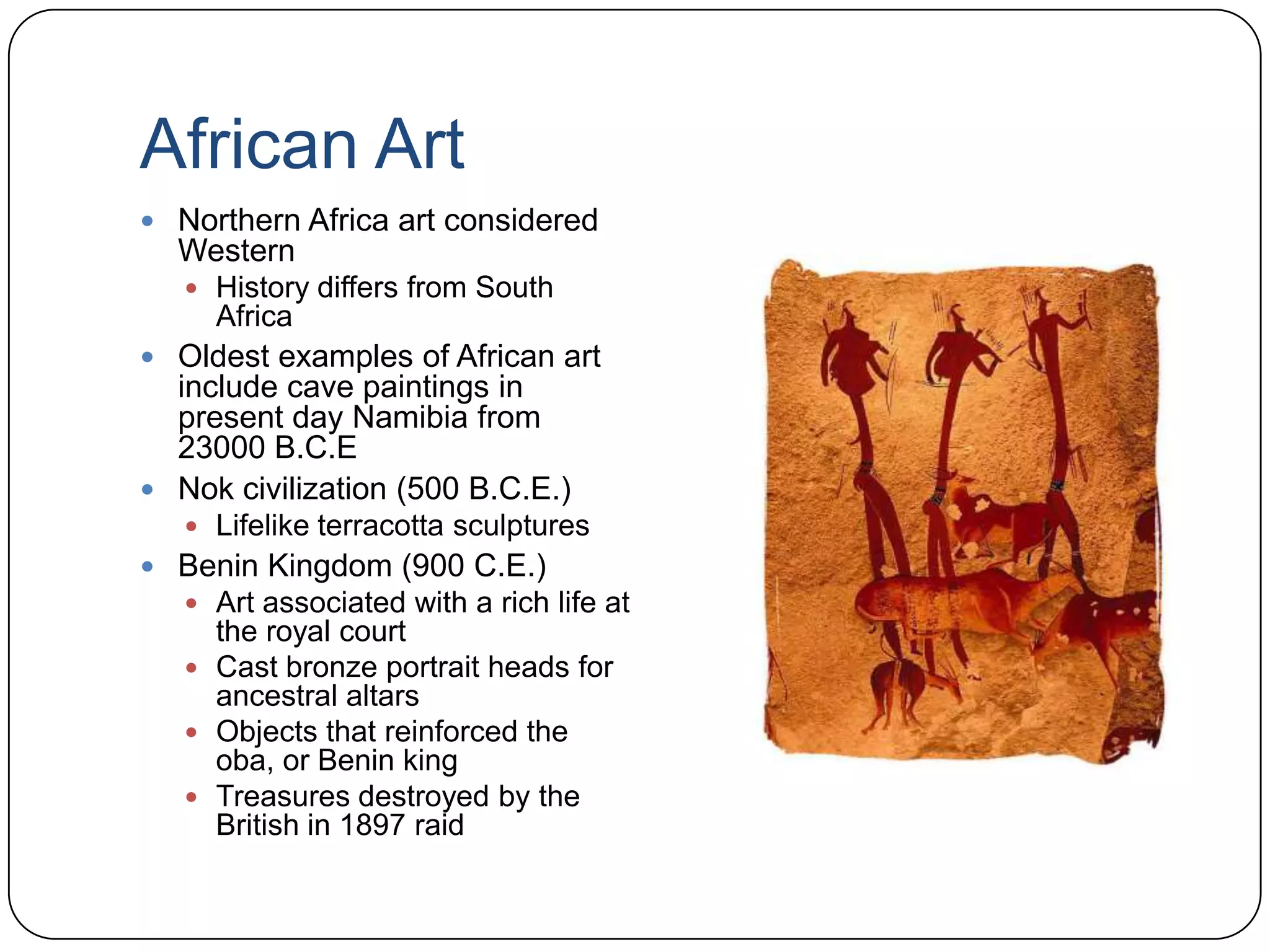
African ArtNorthern Africa art considered WesternHistory differs from South AfricaOldest examples of African art include cave paintings in present day Namibia from 23000 B.C.ENok civilization (500 B.C.E.)Lifelike terracotta sculpturesBenin Kingdom (900 C.E.)Art associated with a rich life at the royal courtCast bronze portrait heads for ancestral altarsObjects that reinforced the oba, or Benin kingTreasures destroyed by the British in 1897 raid
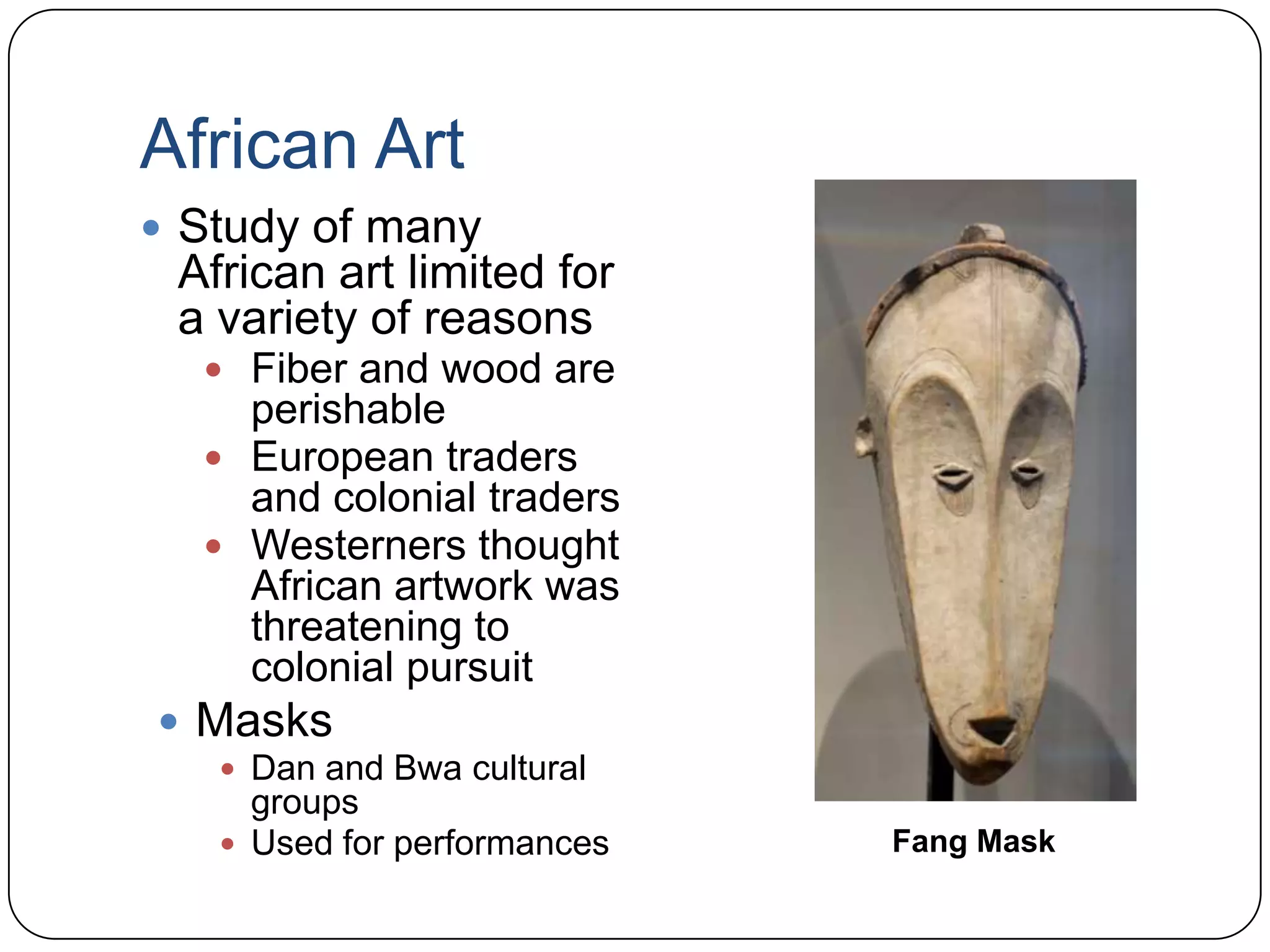
African ArtStudy of many African art limited for a variety of reasonsFiber and wood are perishableEuropean traders and colonial tradersWesterners thought African artwork was threatening to colonial pursuitMasksDan and Bwa cultural groupsUsed for performancesFang Mask
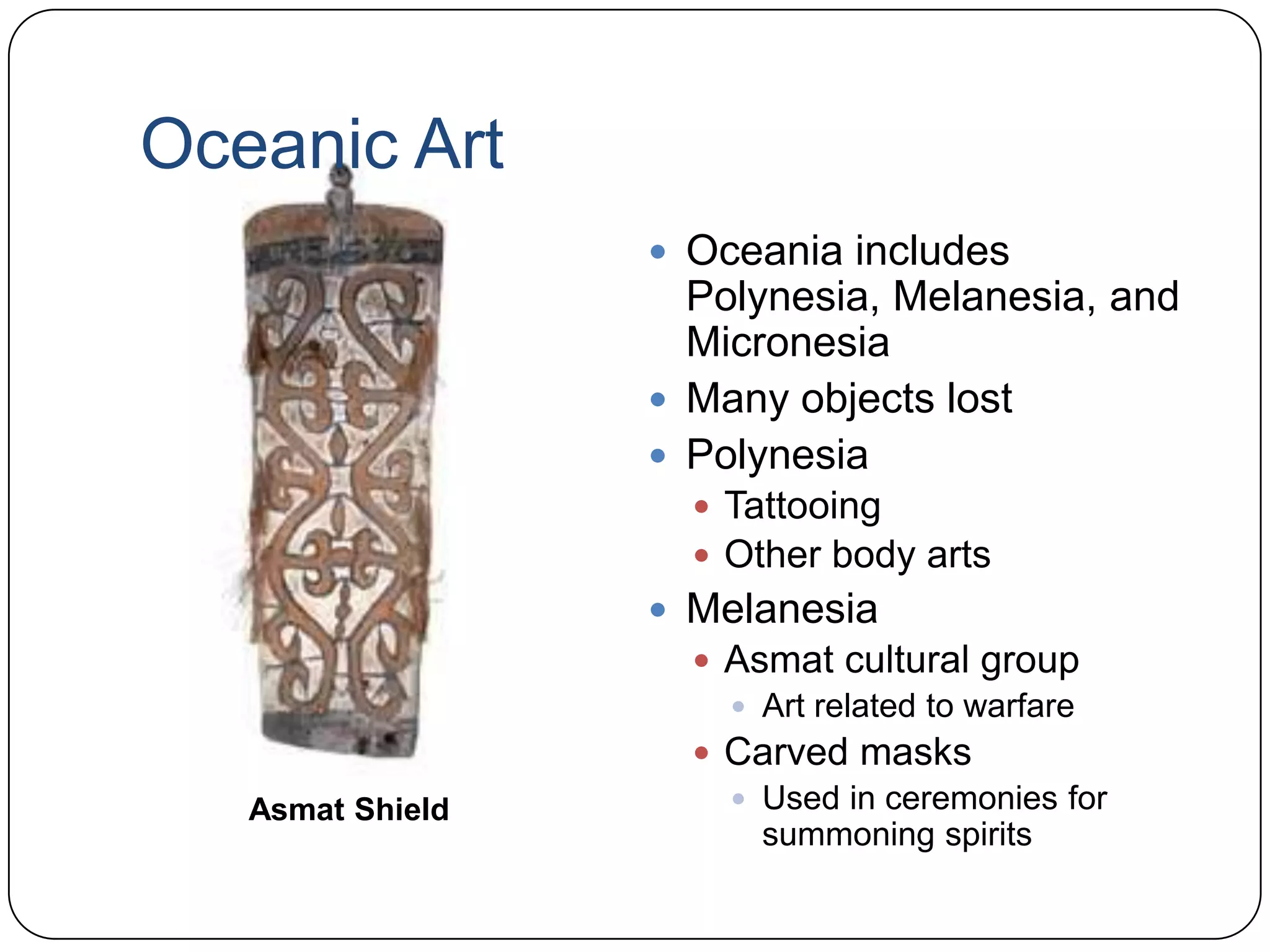
Oceanic ArtOceania includes Polynesia, Melanesia, and MicronesiaMany objects lostPolynesiaTattooingOther body artsMelanesiaAsmat cultural groupArt related to warfareCarved masksUsed in ceremonies for summoning spiritsAsmat Shield
ISLAMIC ART
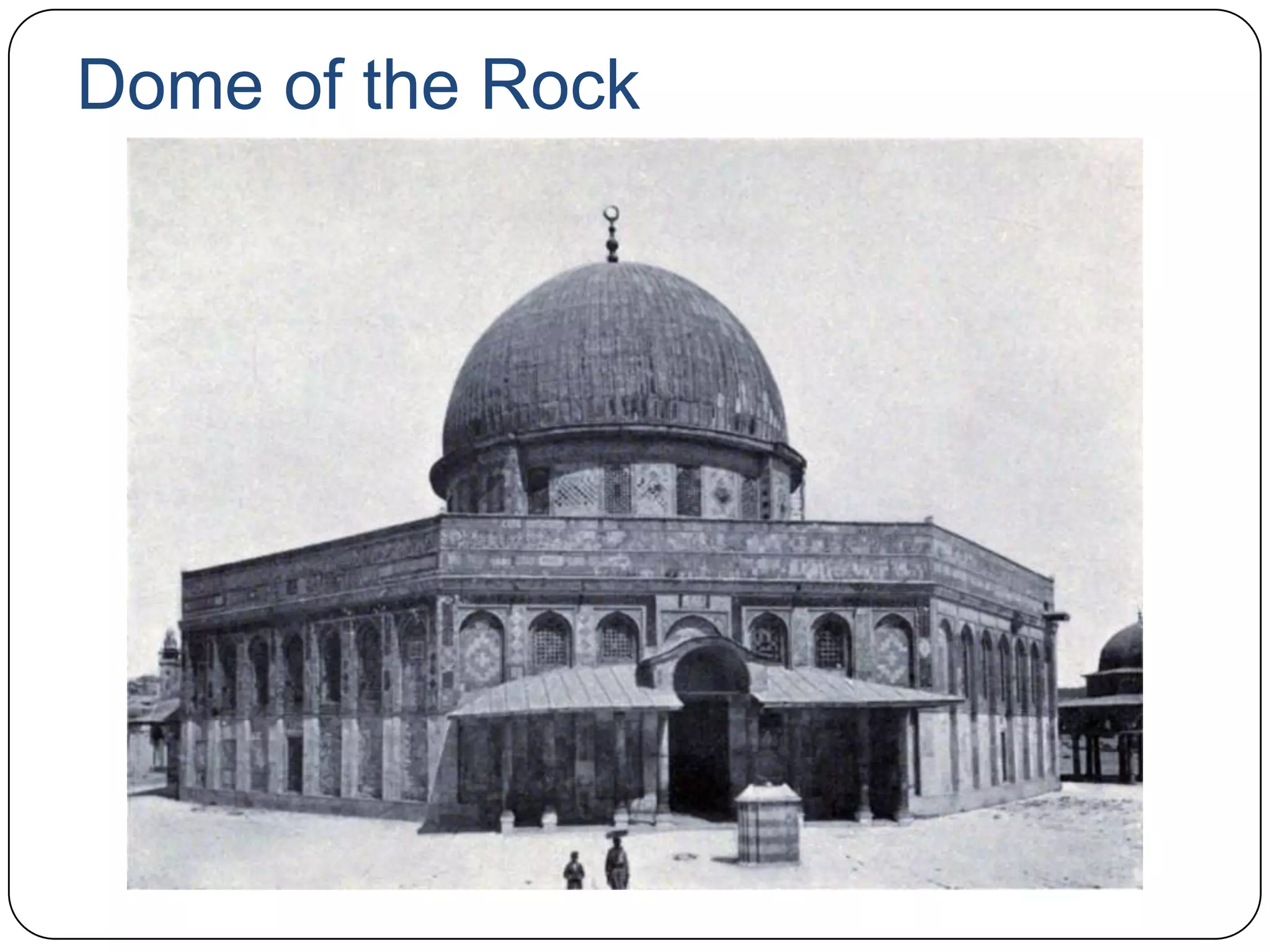
Islamic ArtIslam is a major religionValued art objects include copies of the Quran or containers that hold itIslamic artNon-figurativeAbstract or calligraphic decoration on most Islamic art objectsDome of the Rock in Jerusalem687 – 692 C.E.Old example of Islamic architecture
Dome of the Rock
THE AMERICAS
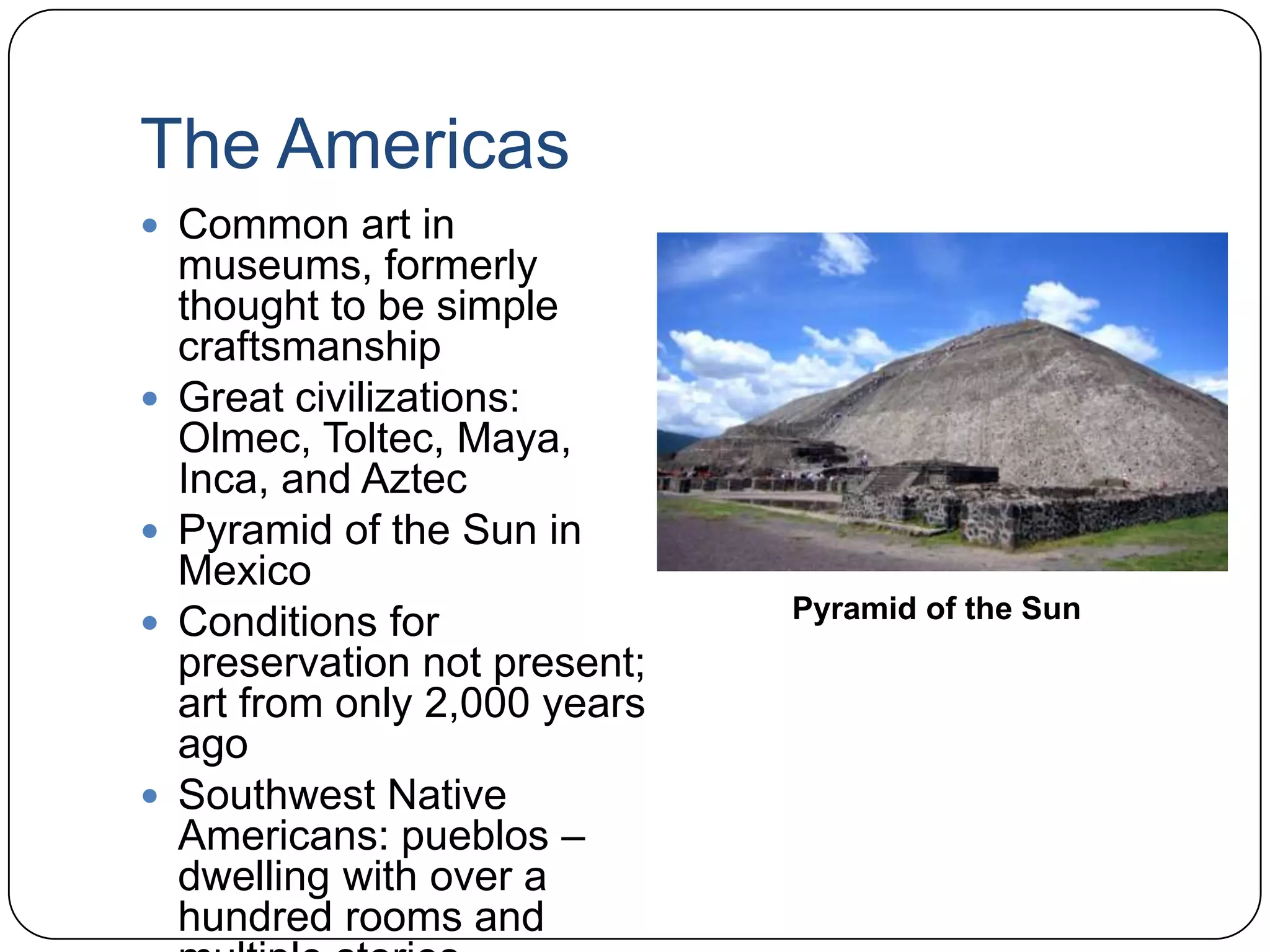
The AmericasCommon art in museums, formerly thought to be simple craftsmanshipGreat civilizations: Olmec, Toltec, Maya, Inca, and AztecPyramid of the Sun in MexicoConditions for preservation not present; art from only 2,000 years agoSouthwest Native Americans: pueblos – dwelling with over a hundred rooms and multiple stories Pyramid of the Sun
THE ELEMENTS OF ARTFORMAL QUALITIES OF ART
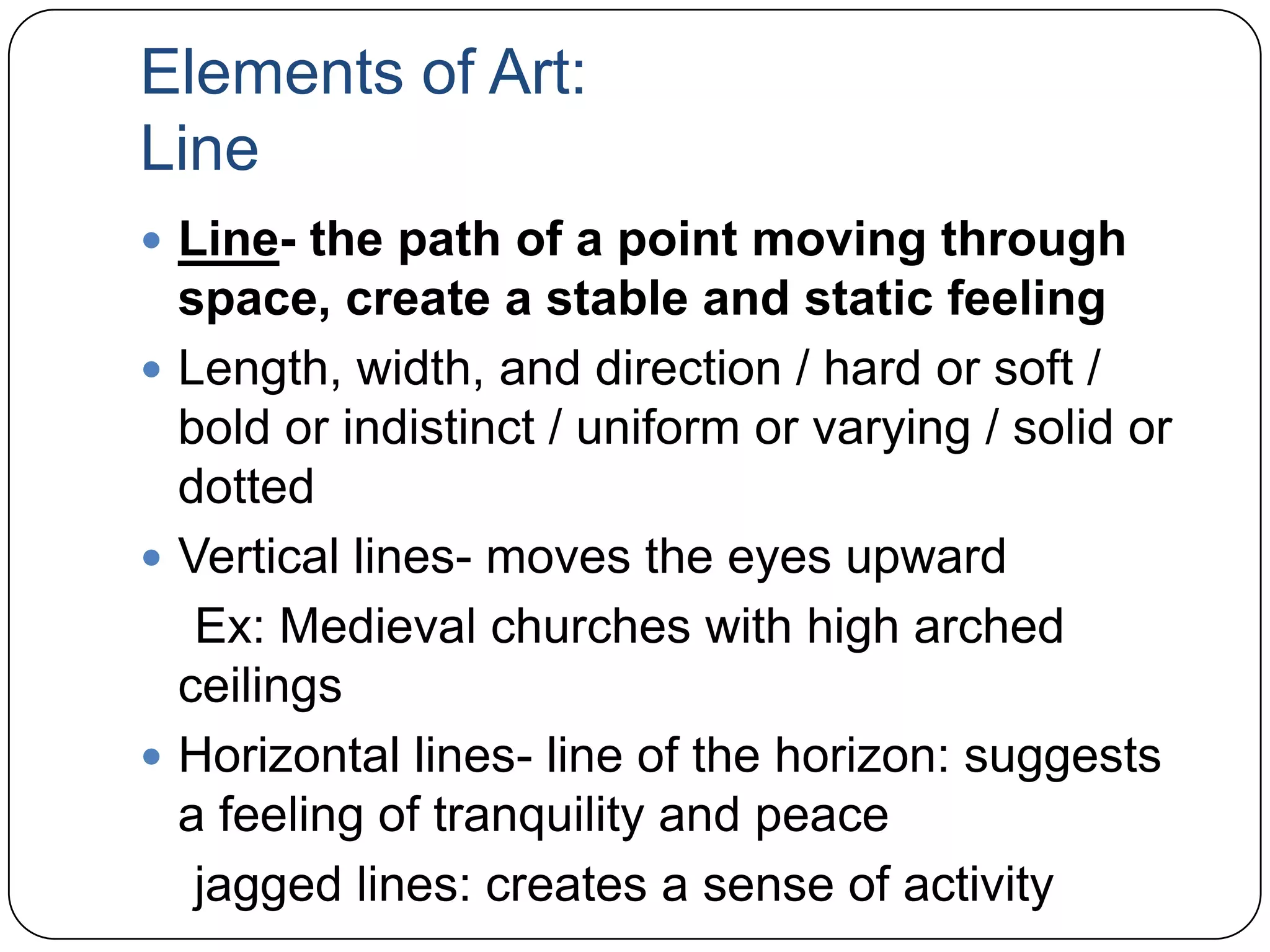
Elements of Art: LineLine- the path of a point moving through space, create a stable and static feelingLength, width, and direction / hard or soft / bold or indistinct / uniform or varying / solid or dottedVertical lines- moves the eyes upward    Ex: Medieval churches with high arched ceilingsHorizontal lines- line of the horizon: suggests a feeling of tranquility and peace    jagged lines: creates a sense of activity
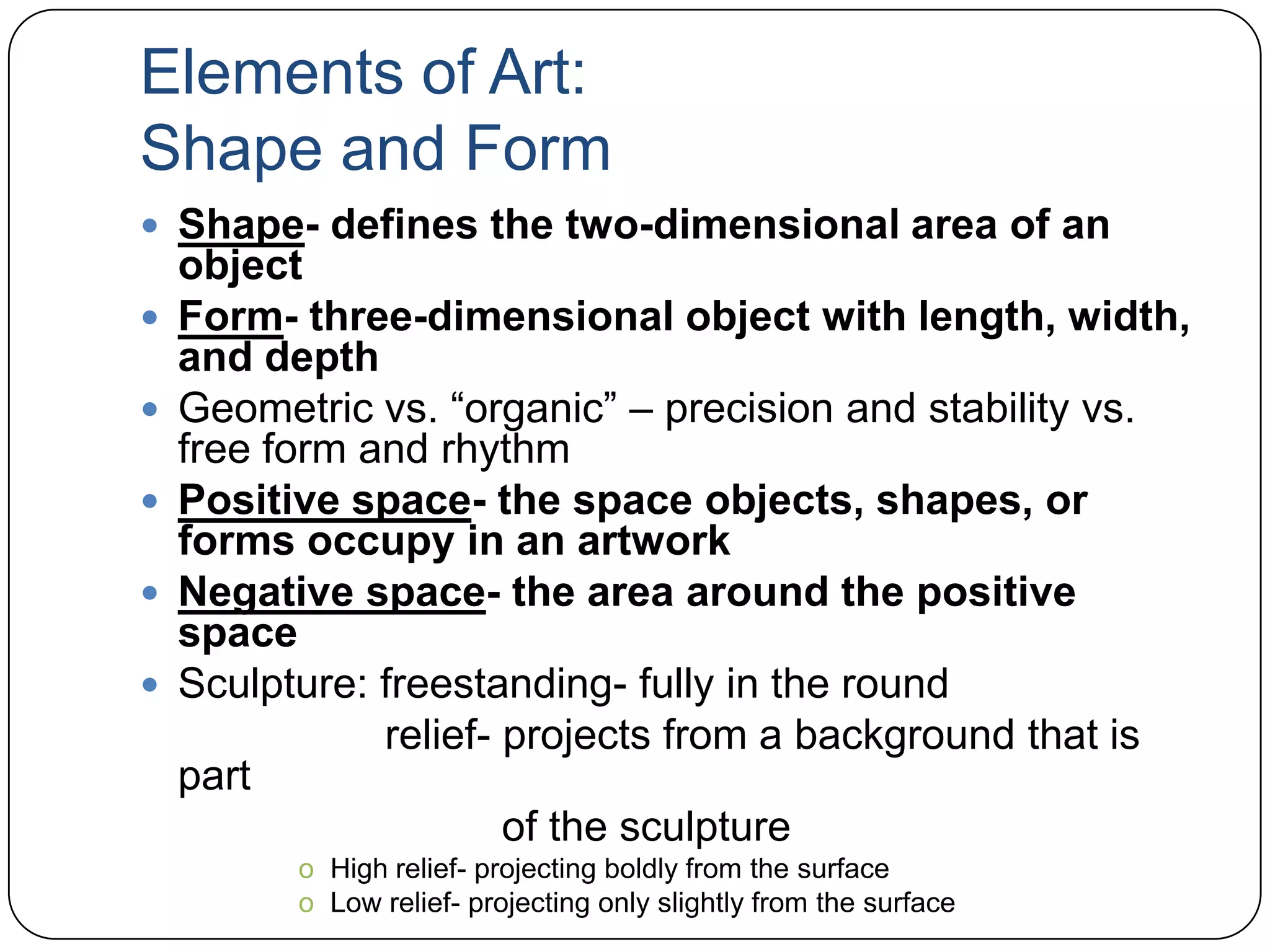
Elements of Art:Shape and FormShape- defines the two-dimensional area of an objectForm- three-dimensional object with length, width, and depthGeometric vs. “organic” – precision and stability vs. free form and rhythmPositive space- the space objects, shapes, or forms occupy in an artworkNegative space- the area around the positive spaceSculpture: freestanding- fully in the round                     relief- projects from a background that is part                                of the sculptureHigh relief- projecting boldly from the surfaceLow relief- projecting only slightly from the surface
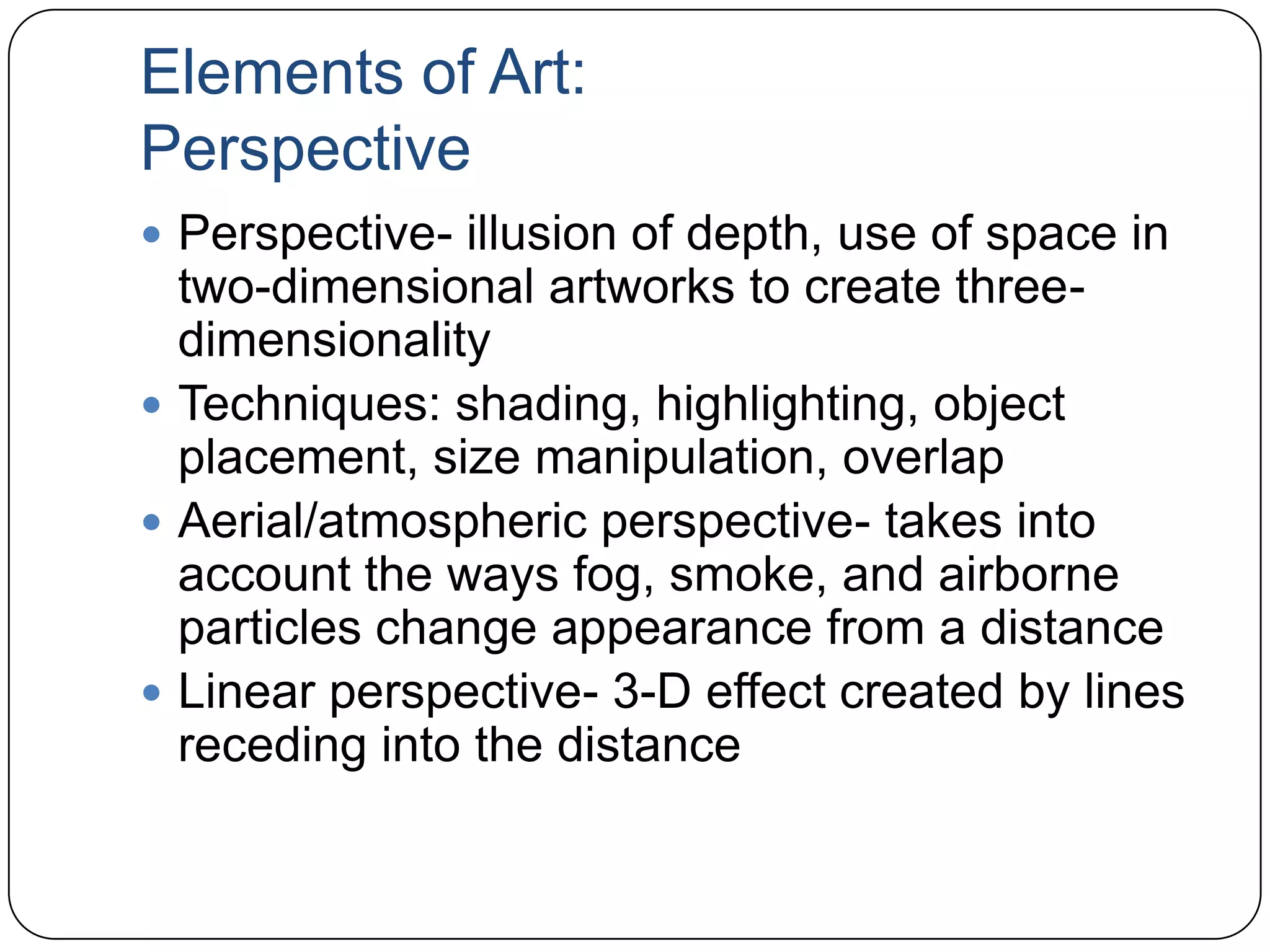
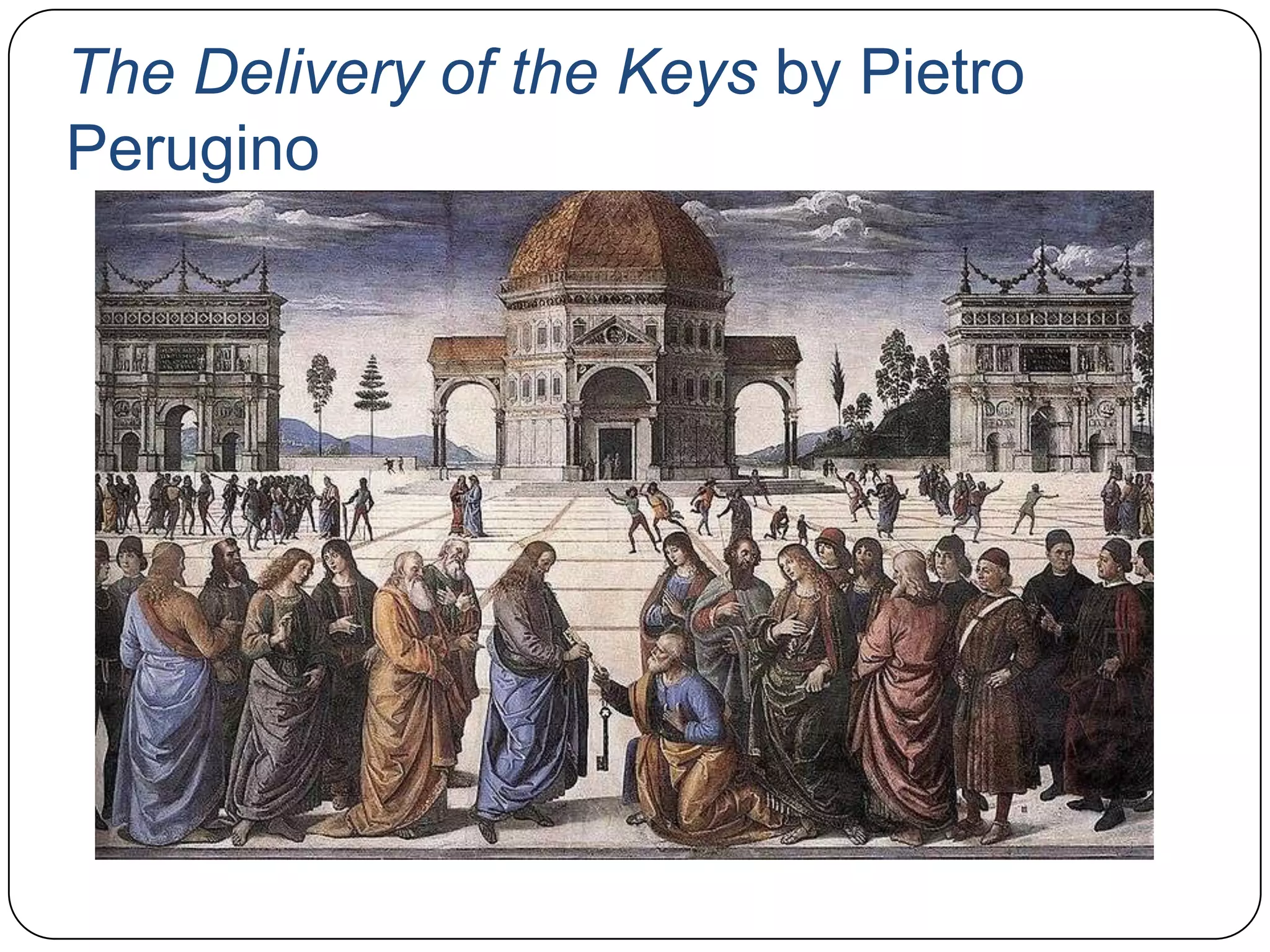
Elements of Art:PerspectivePerspective- illusion of depth, use of space in two-dimensional artworks to create three-dimensionalityTechniques: shading, highlighting, object placement, size manipulation, overlapAerial/atmospheric perspective- takes into account the ways fog, smoke, and airborne particles change appearance from a distanceLinear perspective- 3-D effect created by lines receding into the distance
The Delivery of the Keys by Pietro Perugino
Elements of Art:ColorHue- name of the colorColor wheel- organization of hues into a visual scheme, concepts developed by Sir Isaac NewtonPrimary colors: red, blue, and yellowSecondary colors: formed from the mixture of  two primary colors (orange, green, violet)Tertiary colors: formed from a primary and an adjacent secondary color (yellow-green, red-violet)Value- lightness or darkness of a color, can change by adding white or blackNeutrals- black and white
Elements of Art:Color (pt. 2)Intensity- brightness or purity of a color, can be lowered by mixing or adding colors19th century: discovered the use of color schemes (red- brighter or darker depending on surrounding colors)Western art: Warm colors- red, orange, yellow; Cool colors- green, blue, violetLocal color- “true” color of an object or area in normal daylightOptical color- the effect special lighting has on colorsArbitrary color- colors chosen for emotional or aesthetic appeal
Elements of Art:TextureTexture- how things feel or how we think they feel if touchedActual texture- ceramics, string, stone, etc.Visual texture- patterns of lines or shape that suggest texture (e.g. contrast of light and dark to make surface look rough)
Elements of Art:CompositionComposition- artist’s organization of the elements of artRhythm- the principle that we associate movement or pattern, uses repeated elementsAspects of repetition: Motif and PatternMotif- a single element of a pattern (quilt design)Pattern- use of multiple motifs (checkerboard)Balance- the equal distribution of visual weight in a work of art, can use symmetryApproximate symmetry- shapes or objects are slightly varied on either side of the central axisAsymmetrical balance- visual balance achieved through organization of unlike objects
Elements of Art:Composition (pt. 2)Focal point- an element that contrasts with the rest of the composition, more dominantProportion- the size relationships amongst parts of the compositionScale- the dimensional relation of the parts of a work to the work in its entirety, the overall size of an artworkAttracts attention and creates awe (Sistine Chapel)2500 years ago: Classical Period of Greek sculptureAimed for accurate proportions for humanHad rules: 7 ½ heads high, bottom of the nose falls halfway between the chin and the corner of the eyes, ect.
THE ELEMENTS OF ARTPROCESSES AND TECHNIQUES
Processes and TechniquesForms of two dimensional art processes-Have height and width, but no significant depthDrawingPrintmakingPaintingPhotographyForms of three dimensional art processesSculptureEnvironmental Art-Note: Mixed media falls into both categories
DrawingThe most basicVariety of drawing media (i.e. pencil, ink, charcoal, etc.) and surfaces (paper, walls, etc.)Primarily based on the use of line, with each drawing tool having unique qualitiesShading: values of light and darkness; can be changed with pressureHatching/Cross-hatching: line techniques used to shade objects and create the illusion of 3-DStrippling: creating different values with dots (more distance between dots = less shading)
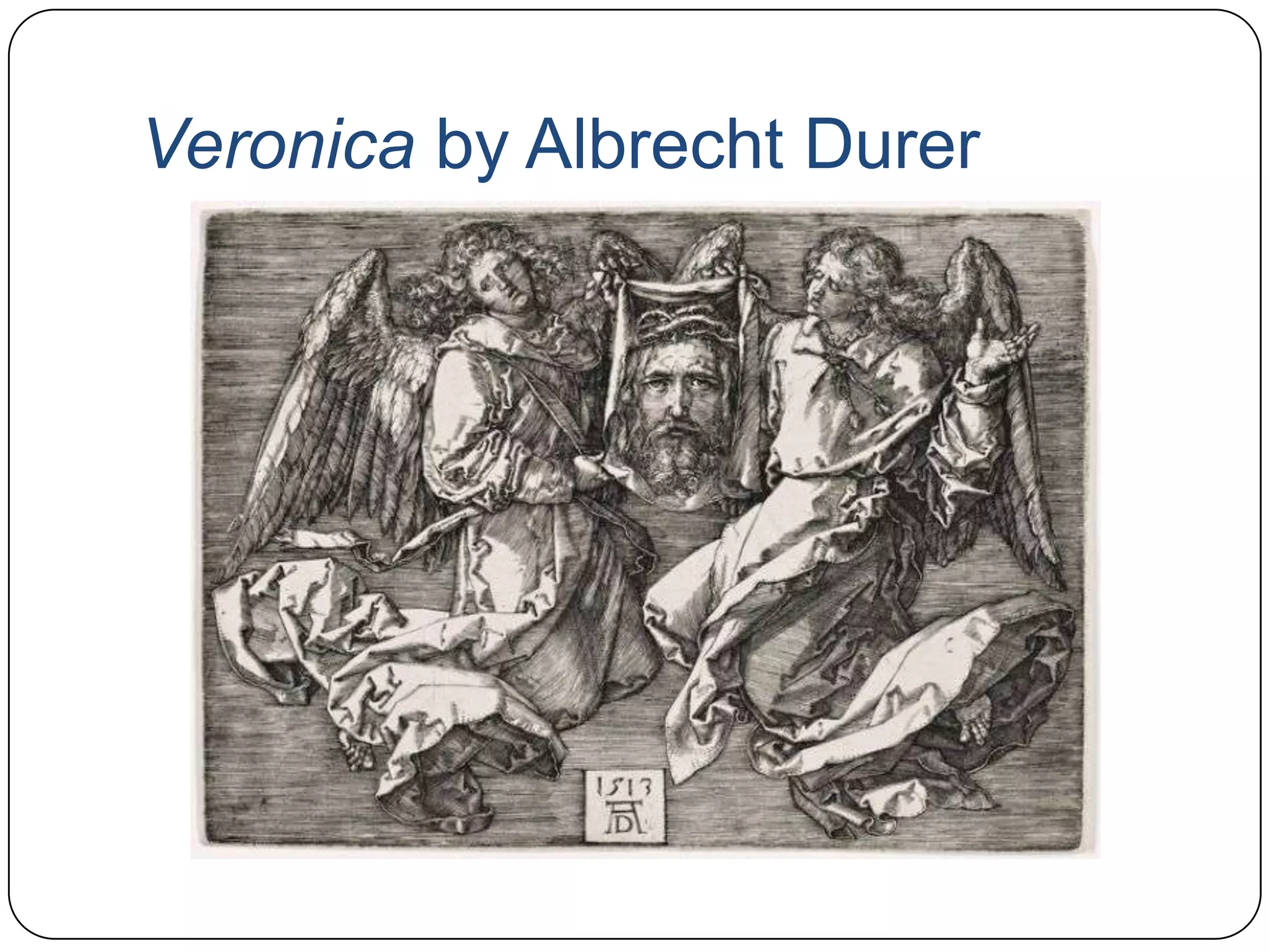
Veronica by Albrecht Durer
Drawing (Continued)Ink can be thinned down with water to whatever  shade value is desiredColored pencils and pastels can be used for coloring a drawing, but must consider their effects on an artworkPastels are popular, as they can be blended to create many delicate tints and shades, but very fragile.
PrintmakingA group of mechanically aided two-dimensional processes that permit the production of multiple original artworksAll of these processes use a printing plate that applies ink on a surface.Relief printmaking: involves cutting away parts of the wood/linoleum plate’s surface. The remaining part will stand out in relief, ranging from thin lines to broad sections. These parts will be inked and will be pressed/rolled onto the surface.Intaglio printmaking: works oppositely from relief. Lines are incised on the wood/soft metal plate. Carving tools engrave the lines, or cutting into a surface. Etching is also used, which is the process of incising a design through a layer of wax/varnish applied to the surface of a metal plate, which is then immersed in acid to eat away exposed metal. The wax /varnish is removed after, revealing the etched design.
Printmaking (continued)Lithography: The process of drawing an image with a waxy pencil/crayon on a stone, zinc, or aluminum plate. The greasy image hardens and the plate is saturated in water. The ink will adhere to the greasy image, then the plate is moved through a press.Lithography is complex and demanding, but no professional training is needed.Screen prints: a process in which a photograph or other image is adhered to a silk/synthetic fabric stretched onto a frame, serving as a stencil for added on colored ink. Used for printing T-shirtsThrough printmaking, multiple originals can be made, lessening costs.
PaintingCovers a wide variety of media and techniquesComposed of three different materials:Pigments: finely ground materials that are natural or synthetic.Binders: the substance that holds the grains together, allowing the paint to adhere to the surface (egg yolk, wax, etc.)Solvents: a substance (water/oil) added to change the consistency of the paint or alter drying timefresco: a technique used to paint on walls/ceilings; pure powdered pigments are mixed with water and are applied to a wet plaster ground. The paint is permanently bound, so careful planning is needed (buon fresco)fresco secco:  applying paints to dry plaster instead of wet plaster
Painting (continued)Oil paints not widely used until 1440s; tempera was used throughout historyTempera: water-based paint; traditional tempera use egg yolk as binderRequires great skillLimitations: dries quickly, narrow tonal range, cannot achieve a close imitation of natural effectsOil paints more versatile than temperaCan be easily mixed and thinned to build up layers of glazes: thin transparent/semi-transparent layers applied over another color  for alterationCan be applied thickly and heavily for impasto surfaceDries very slowly
Painting (continued)Egyptian grave markers used encausticpaints, wax-based paints fused with the surface by hot irons. Very durable.Gouache: water-based opaque paint similar to school-based tempera, but higher quality.Good medium for bright colors and detailsWatercolor: the most common water-based paint, which is transparent (shows white of paper)Lightest colors applied first, then darker colorsCareful planning is needed; cannot make any mistakesAcrylics are alternatives to oil paints. Composed of synthetic material, versatile, but unable to achieve subtleties of oil paints.
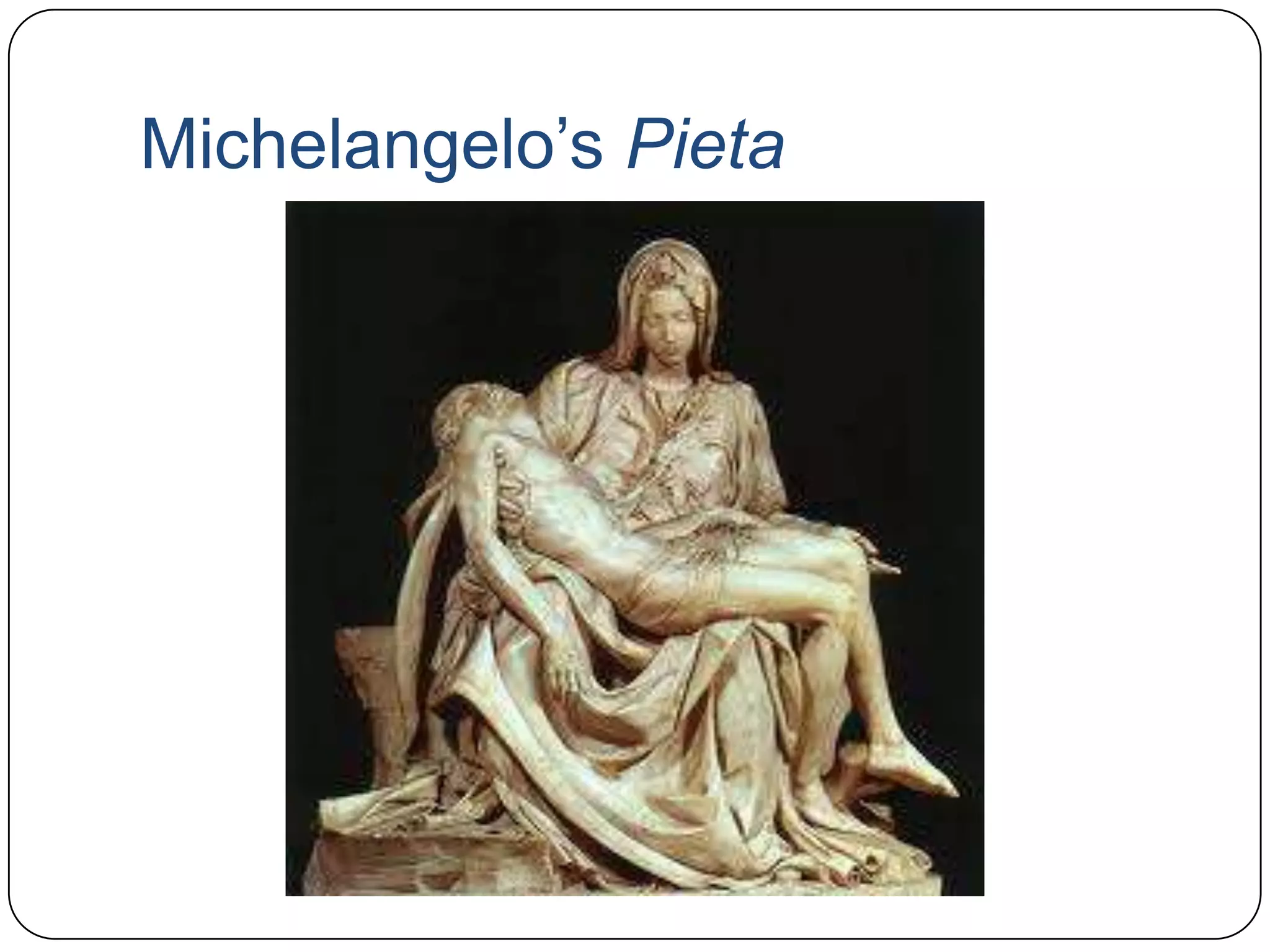
SculptureCreated in four ways: carving, modeling, casting, and constructionCan be freestanding, (Michelangelo’s Pieta) or attached to surfaces such as doors or wallsCarving is the process of removing the original material. Stone or wood can be chiseled or gouged with tools to form a physical figureModeling  is an additive process, using soft material like clay or papier-macheadded on to the surface to shape the strucure
Michelangelo’s Pieta
Structures (continued)Unfired clay. Wax sculptures can be used for a basis for a cast. They are molded by plaster; the mold is then filled in with material.Other methods include metal welding, paper adjoining, and even movement sculpturesEnvironmental art (Earthworks) emerged in 1960s as a newer category of art formMany of its works are classified as sculpturesUsually large-scale and constructed on-site; redefines the space installedNot permanent; usually preserved through photography
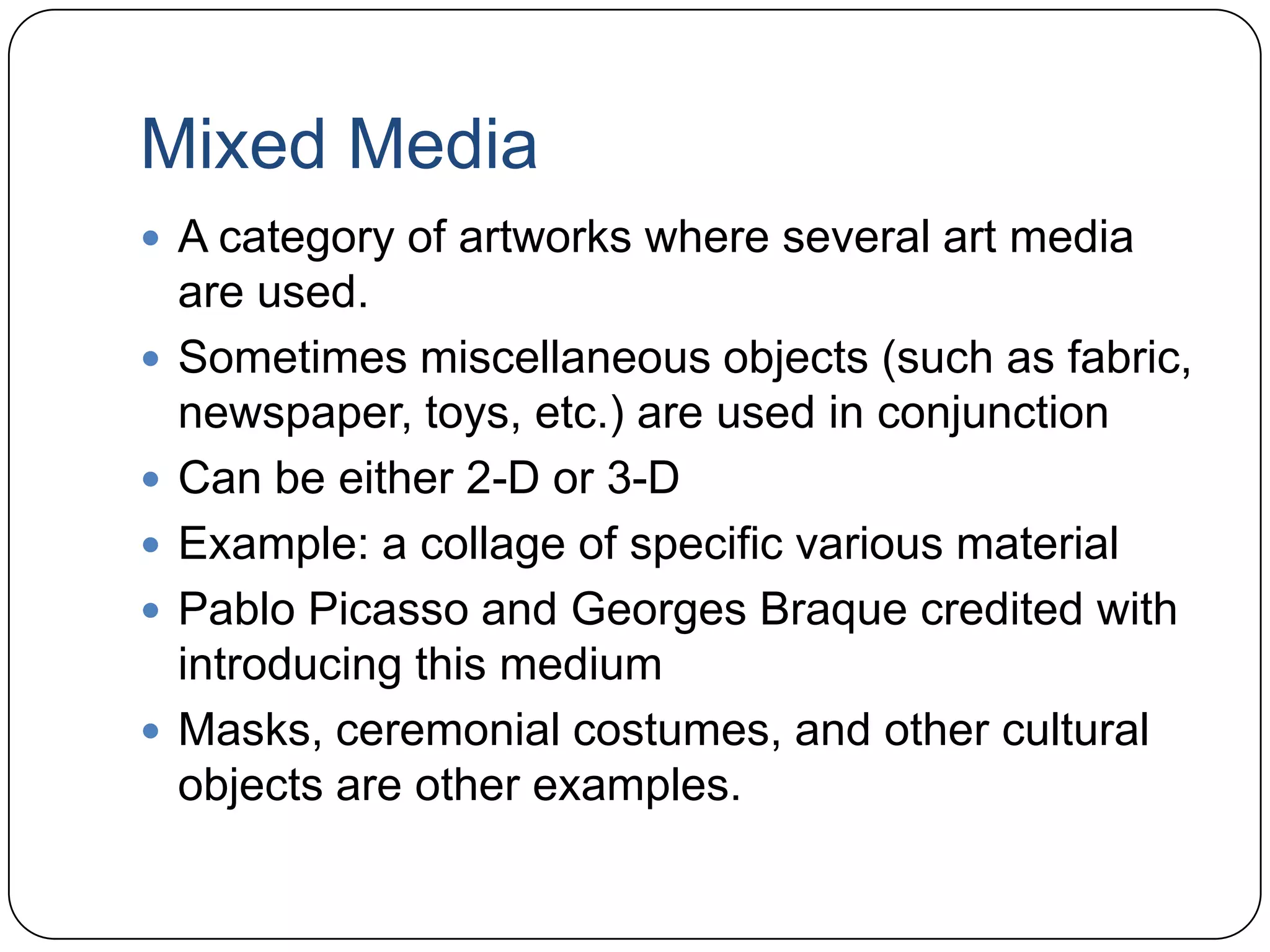
Mixed MediaA category of artworks where several art media are used.Sometimes miscellaneous objects (such as fabric, newspaper, toys, etc.) are used in conjunctionCan be either 2-D or 3-DExample: a collage of specific various materialPablo Picasso and Georges Braque credited with introducing this mediumMasks, ceremonial costumes, and other cultural objects are other examples.
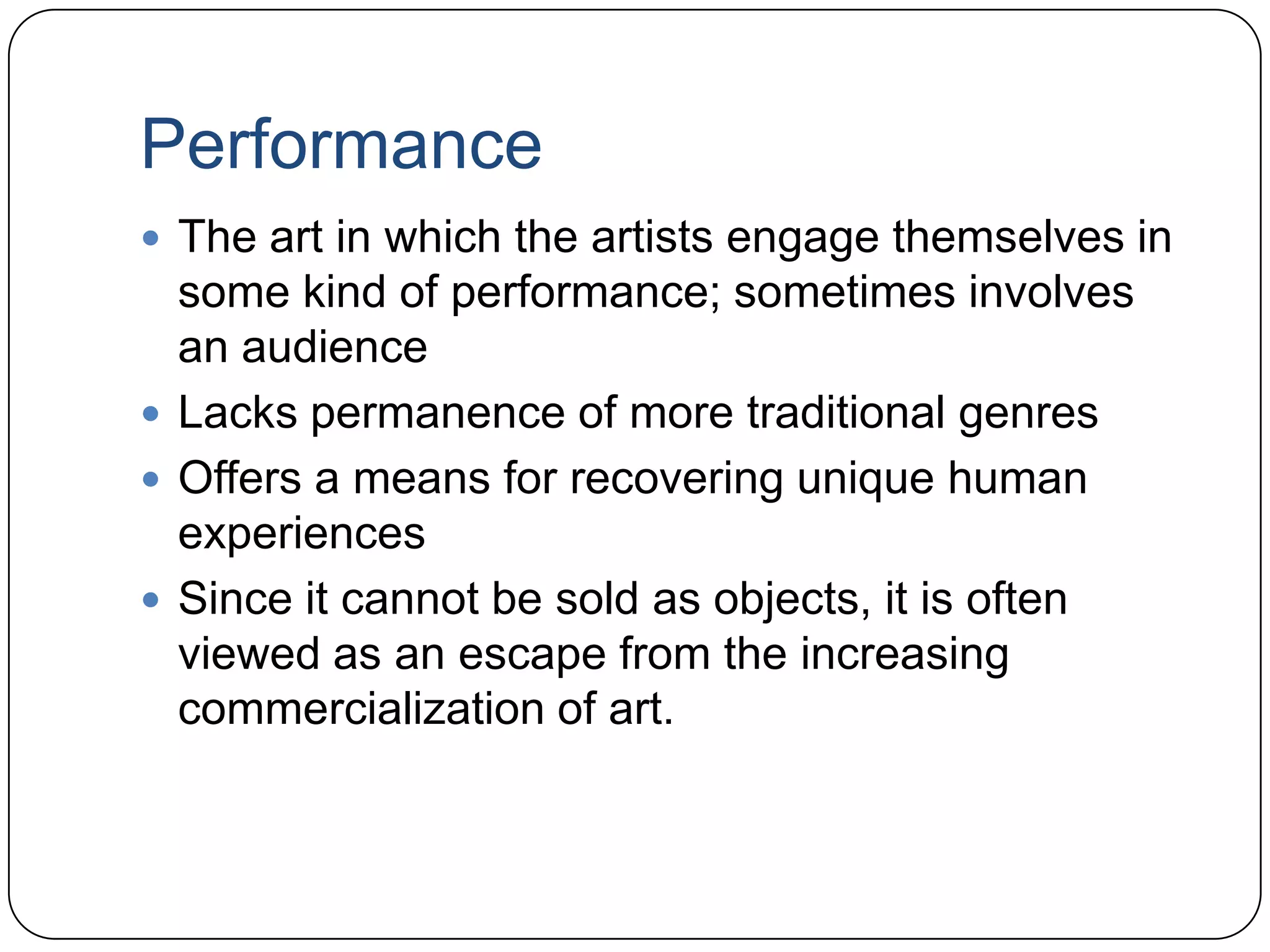
PerformanceThe art in which the artists engage themselves in some kind of performance; sometimes involves an audienceLacks permanence of more traditional genresOffers a means for recovering unique human experiencesSince it cannot be sold as objects, it is often viewed as an escape from the increasing commercialization of art.
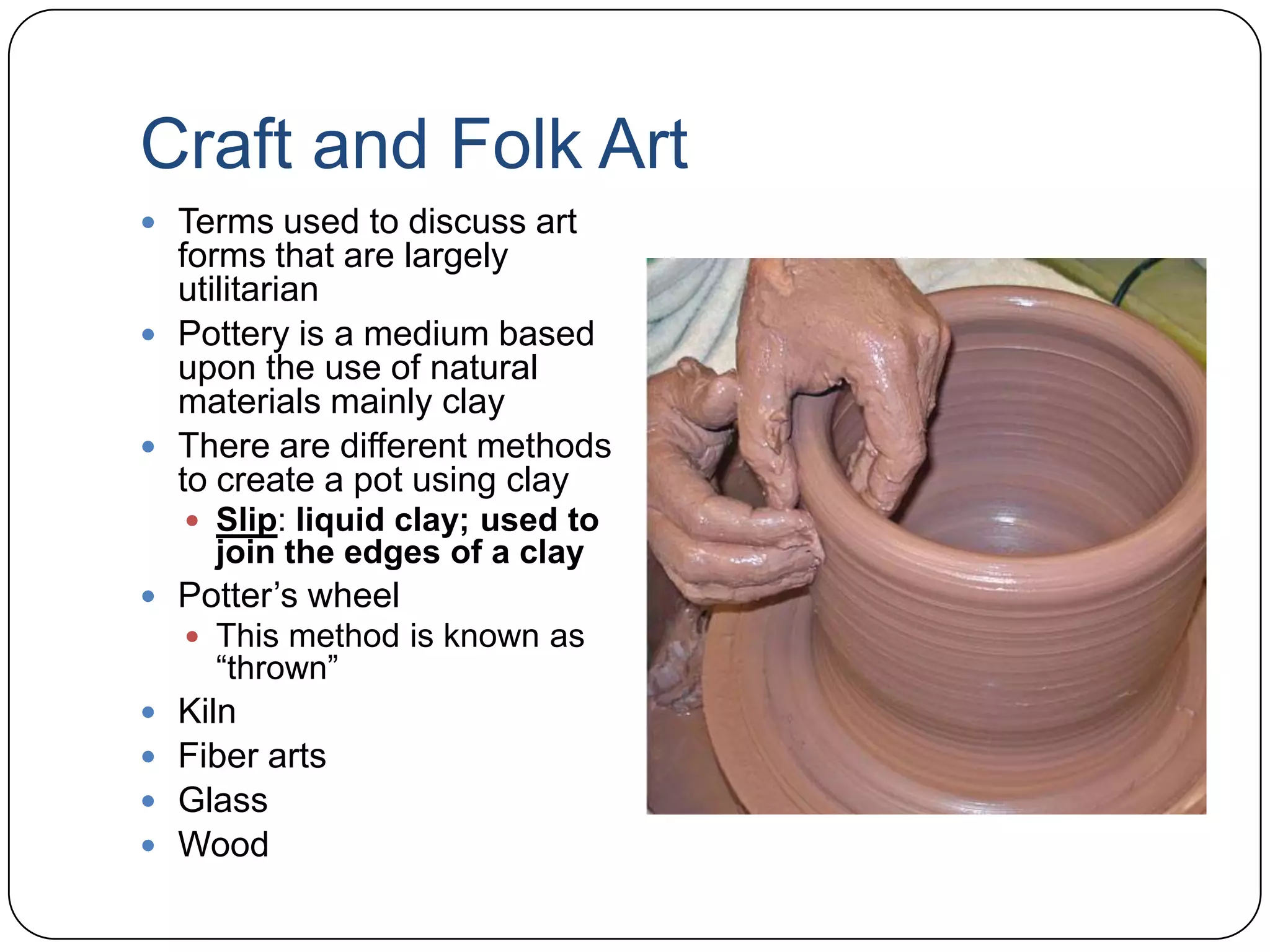
Craft and Folk ArtTerms used to discuss art forms that are largely utilitarianPottery is a medium based upon the use of natural materials mainly clayThere are different methods to create a pot using claySlip: liquid clay; used to join the edges of a clayPotter’s wheelThis method is known as “thrown”KilnFiber artsGlassWood
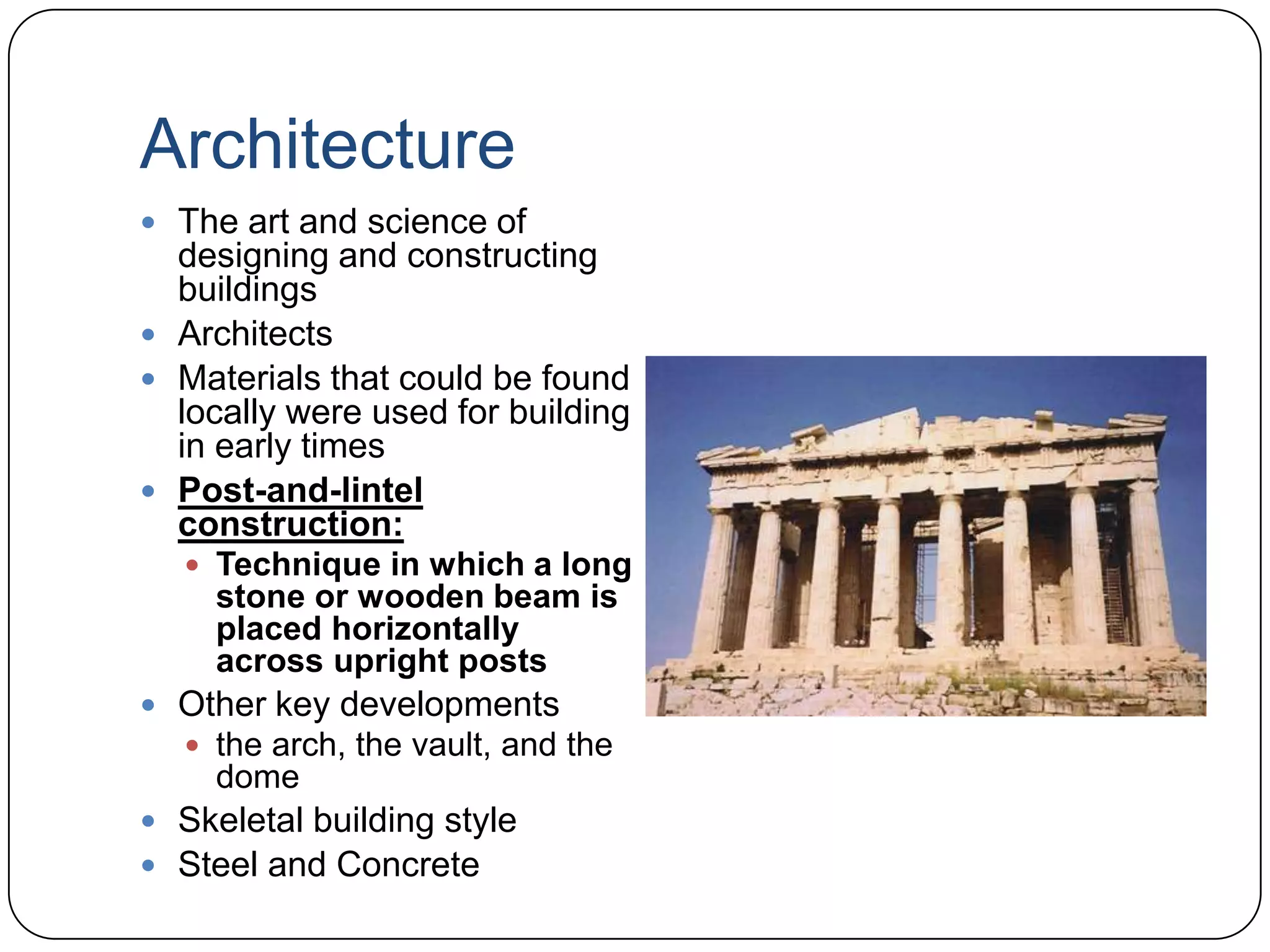
ArchitectureThe art and science of designing and constructing buildingsArchitectsMaterials that could be found locally were used for building in early timesPost-and-lintel construction:Technique in which a long stone or wooden beam is placed horizontally across upright postsOther key developmentsthe arch, the vault, and the domeSkeletal building styleSteel and Concrete
EUROPEANS IN AFRICA
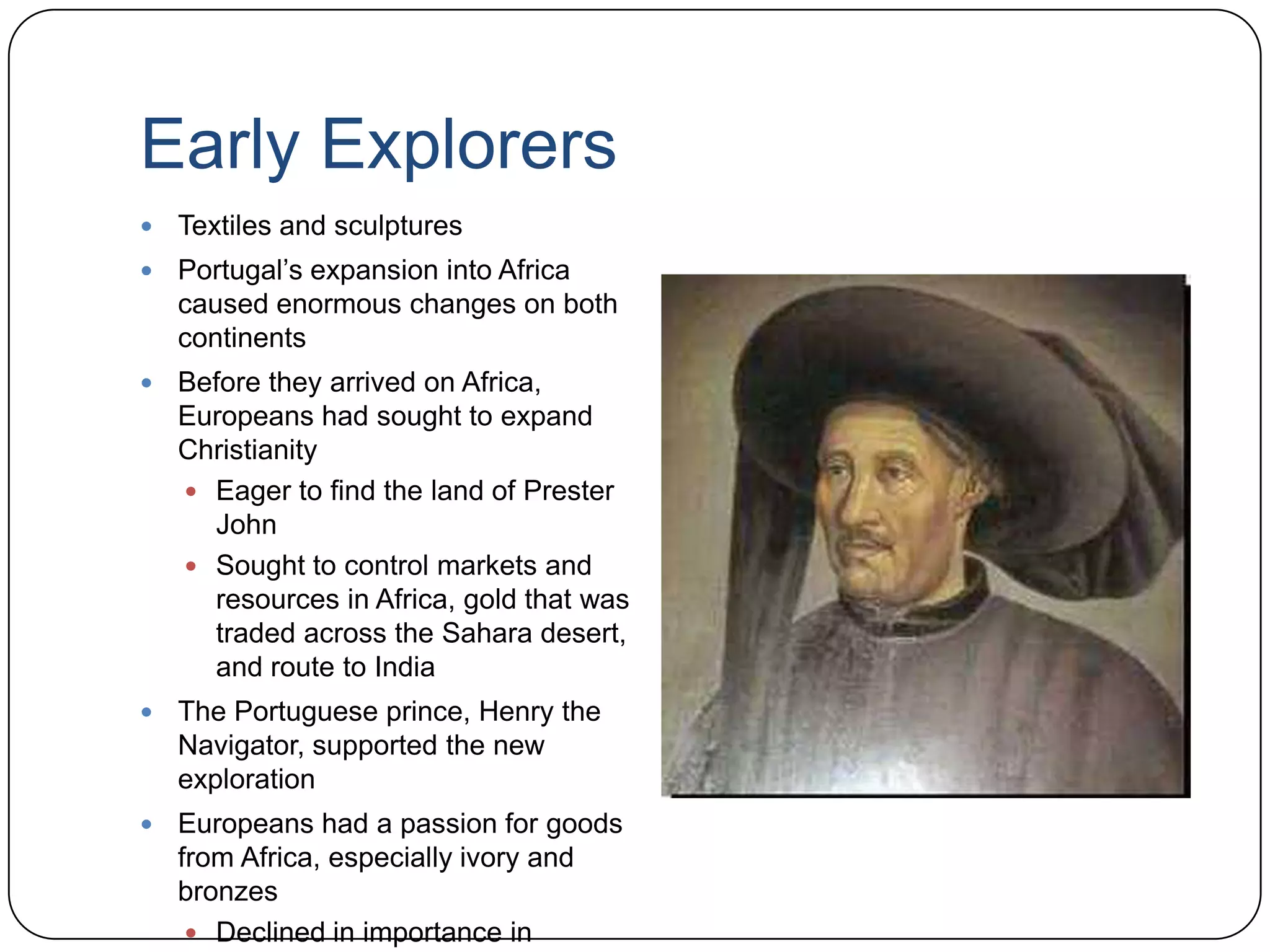
Early ExplorersTextiles and sculpturesPortugal’s expansion into Africa caused enormous changes on both continentsBefore they arrived on Africa, Europeans had sought to expand ChristianityEager to find the land of Prester JohnSought to control markets and resources in Africa, gold that was traded across the Sahara desert, and route to IndiaThe Portuguese prince, Henry the Navigator, supported the new explorationEuropeans had a passion for goods from Africa, especially ivory and bronzesDeclined in importance in comparison to slaves
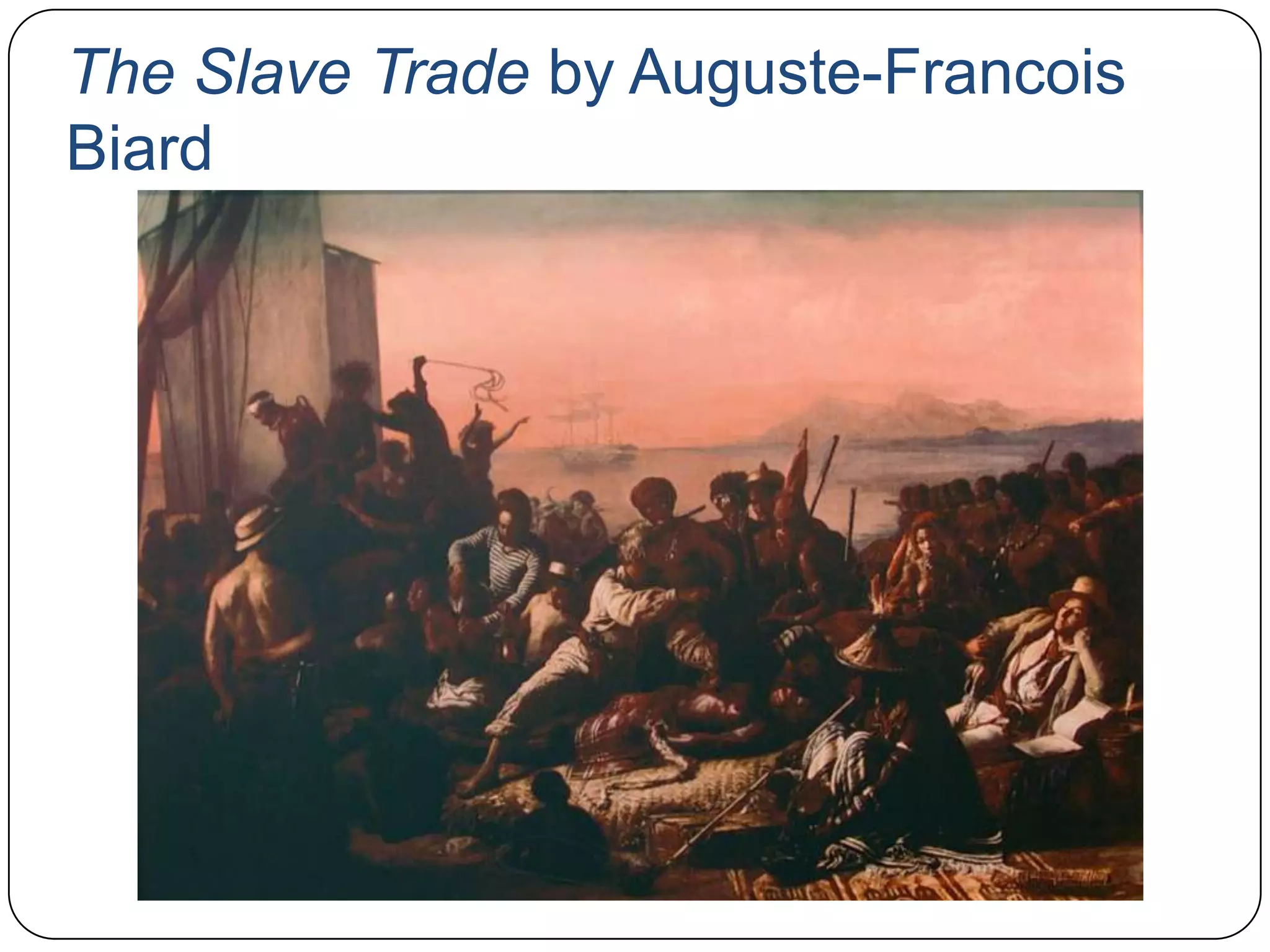
Europe and Slave TradingBegan in early 1440s by the Portuguese.Due to the rise of large-scale sugar production.Holland and Great Britain grew powerful. Key labor force in the AmericasBritish, Dutch, Spanish, and Portuguese grew wealthy.
The Slave Trade by Auguste-Francois Biard
Africa and SlaveryAlready in AfricaAfrican slaves had more rightsAsanti, Benin, and Kongo Kingdoms supplied slaves and other things for luxury goods.Slavery was opposed from the beginning1807, Slave Trade Act abolishes trading of slaves1833, slavery abolished throughout the British empire
African ExpansionBegan in the 1880s after the decline of slave tradeEuropeans had control over most of Africa resulting in political shift of rule over African coloniesFew countries were not under European ruleEthiopia,  and Libera both maintained independence. France, England, Belgium, Italy, and Germany.Portugal plays a minor role in this time
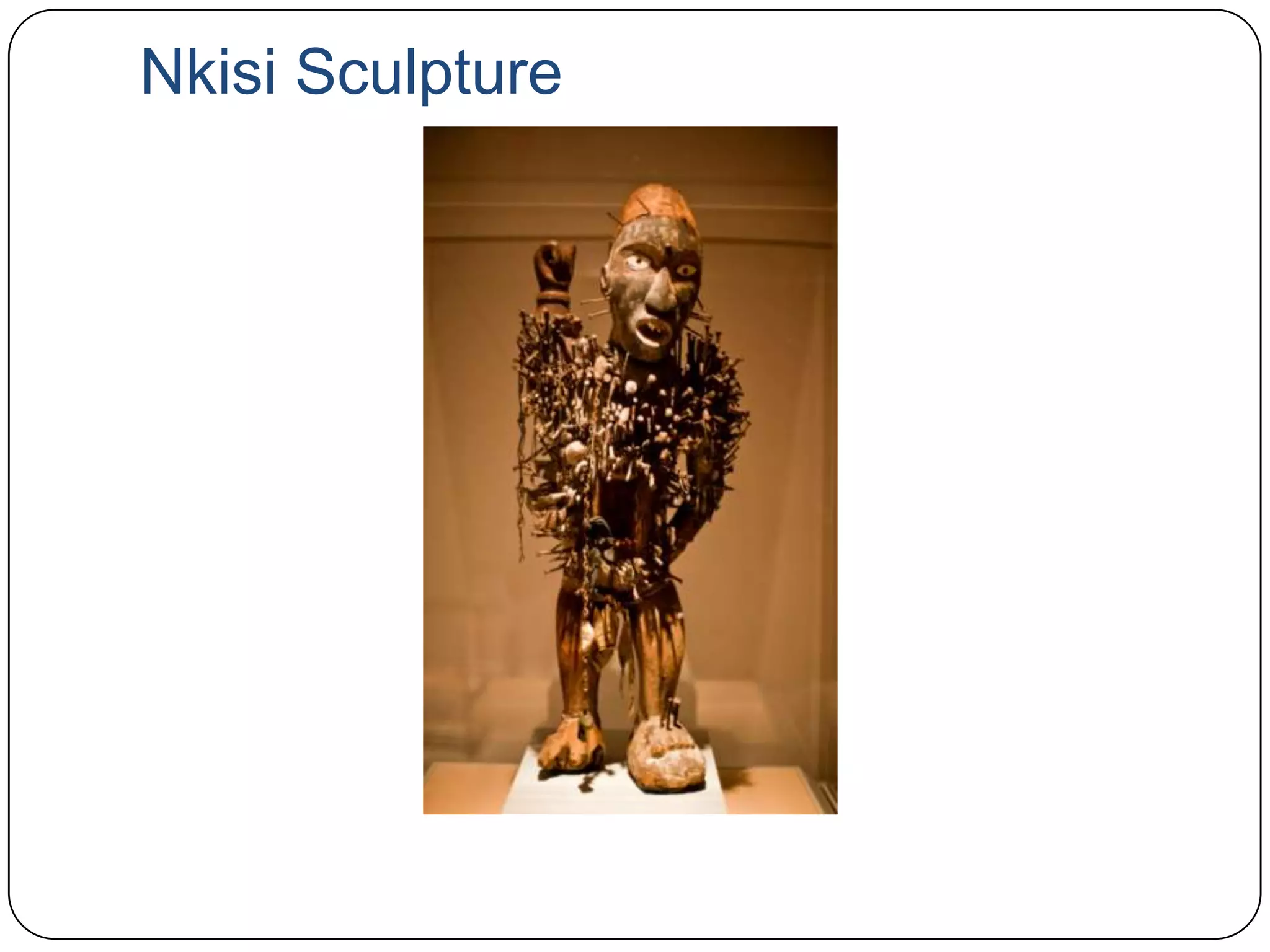
European ChangesAssimilation of West African coloniesForced to speak French in official dealingsAfrican leaders were exiled and status symbols destroyedArt production greatly impactedNkisi, an empowered sculpture created and used by the Kongo groups
Nkisi Sculpture
African ChangesAfrican countries win independenceGhana, followed by other West African nations including Nigeria, Cote d’Ivoire, and Sierra LeoneDue to educated African leaders from abroadVarious barriers in the push for independenceAfrican Artist face challengesAfrican Art seen as primitive, tribal and native of outside influenceContemporary artists follow the path of European modernism
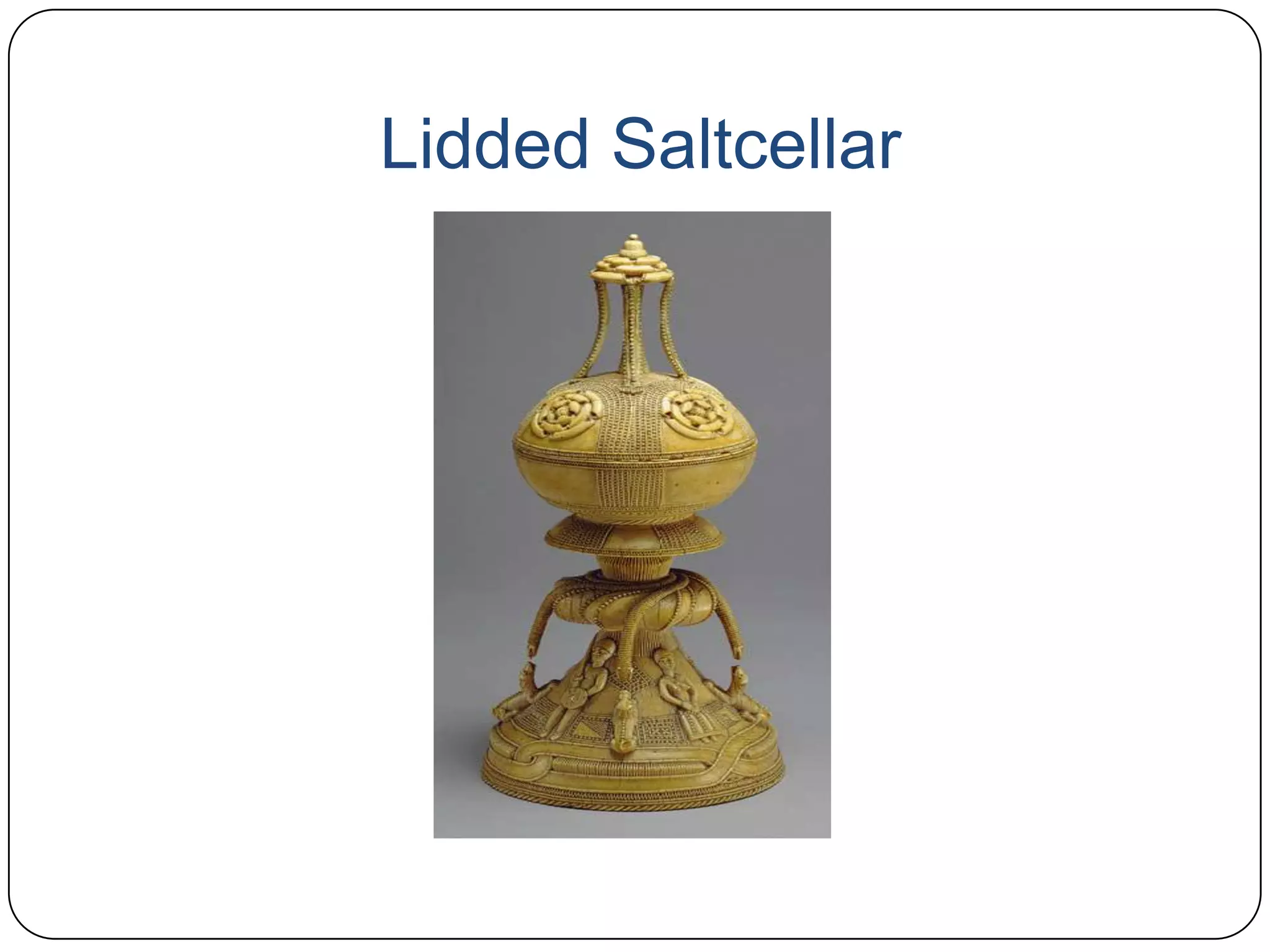
Selected WorkLidded Saltcellar – “Sapi-Portuguese”[sierra leone, fifteenth-sixteenth century]
Lidded SaltcellarAppealed to foreign visitorsIdentified as “Sapi-Portuguese”Sapiproduced a great number of items for the PortugueseSaltcellar is delicately carved in ivory to form a lidded bowl supported by a conical baseSaltcellar provides evidence of masterful carving of the Sapi artists
Lidded Saltcellar
QUESTIONS
Question #1The perspective that the Japanese art style primarily uses is:A. Isometric perspectiveB. Linear perspectiveC. Aerial perspectiveD. Parallel perspective
Question #2True or False: Hue is the name of the color.
Question #2True or False: Hue is the name of the color.True
Question #3Slip is:A. Another term for inkB. A type of art styleC. An aspect of printmakingD. Liquid clay used to join the edges of clay
Question #4True or False: Lithography is the process in which a photograph or other image is adhered to a silk/synthetic fabric stretched onto a frame, serving as a stencil for added on colored ink.
Question #4	True or False: Lithography is the process in which a photographor other image is adhered to a silk/synthetic fabric stretched onto a frame, serving as a stencil for added on colored ink. 	FALSE	Lithography is the process of drawing an image with a waxy pencil/crayon on a stone, zinc, or aluminum plate. The greasy image hardens and the plate is saturated in water. The ink will adhere to the greasy image, then the plate is moved through a press.
Question #5The lidded saltcellar is identified as:A. Sapi-FrenchB. Sapi-PortugueseC. Sapi-GermanD. Sapi-British
END

Acadec Art Presentation Group 2

  • 1.
    Presented byBren CodieBelenGabryellRicafrenteAnthony TranJames VuongJay XiongArt Resource GuidePages 28 – 47
  • 2.
  • 3.
    Chinese ArtSome findingsdate back to fourth millennium B.C.EGreat Wall of China Originally had a utilitarian functionNow really just for showTerracotta ArmyMonument to the first emperorEmperor of QinClay buried as part of his tomb
  • 4.
  • 5.
    Chinese ArtTang Dynasty618– 907 C.E.Ink drawingsCeramic sculpturesModern Chinese ArtPropaganda during communist revolutionLess political today
  • 6.
    Indian ArtOldest artistictraditions in the worldInfluenced by Greek art and BuddhismReflects HinduismLovely, lively, and sinuous style
  • 7.
    Japanese ArtInfluenced internationalart worldArt styleIsometric perspectiveFlat areas of colorWell-known for printmaking
  • 8.
  • 9.
    African ArtNorthern Africaart considered WesternHistory differs from South AfricaOldest examples of African art include cave paintings in present day Namibia from 23000 B.C.ENok civilization (500 B.C.E.)Lifelike terracotta sculpturesBenin Kingdom (900 C.E.)Art associated with a rich life at the royal courtCast bronze portrait heads for ancestral altarsObjects that reinforced the oba, or Benin kingTreasures destroyed by the British in 1897 raid
  • 10.
    African ArtStudy ofmany African art limited for a variety of reasonsFiber and wood are perishableEuropean traders and colonial tradersWesterners thought African artwork was threatening to colonial pursuitMasksDan and Bwa cultural groupsUsed for performancesFang Mask
  • 11.
    Oceanic ArtOceania includesPolynesia, Melanesia, and MicronesiaMany objects lostPolynesiaTattooingOther body artsMelanesiaAsmat cultural groupArt related to warfareCarved masksUsed in ceremonies for summoning spiritsAsmat Shield
  • 12.
  • 13.
    Islamic ArtIslam isa major religionValued art objects include copies of the Quran or containers that hold itIslamic artNon-figurativeAbstract or calligraphic decoration on most Islamic art objectsDome of the Rock in Jerusalem687 – 692 C.E.Old example of Islamic architecture
  • 14.
  • 15.
  • 16.
    The AmericasCommon artin museums, formerly thought to be simple craftsmanshipGreat civilizations: Olmec, Toltec, Maya, Inca, and AztecPyramid of the Sun in MexicoConditions for preservation not present; art from only 2,000 years agoSouthwest Native Americans: pueblos – dwelling with over a hundred rooms and multiple stories Pyramid of the Sun
  • 17.
    THE ELEMENTS OFARTFORMAL QUALITIES OF ART
  • 18.
    Elements of Art:LineLine- the path of a point moving through space, create a stable and static feelingLength, width, and direction / hard or soft / bold or indistinct / uniform or varying / solid or dottedVertical lines- moves the eyes upward Ex: Medieval churches with high arched ceilingsHorizontal lines- line of the horizon: suggests a feeling of tranquility and peace jagged lines: creates a sense of activity
  • 19.
    Elements of Art:Shapeand FormShape- defines the two-dimensional area of an objectForm- three-dimensional object with length, width, and depthGeometric vs. “organic” – precision and stability vs. free form and rhythmPositive space- the space objects, shapes, or forms occupy in an artworkNegative space- the area around the positive spaceSculpture: freestanding- fully in the round relief- projects from a background that is part of the sculptureHigh relief- projecting boldly from the surfaceLow relief- projecting only slightly from the surface
  • 20.
    Elements of Art:PerspectivePerspective-illusion of depth, use of space in two-dimensional artworks to create three-dimensionalityTechniques: shading, highlighting, object placement, size manipulation, overlapAerial/atmospheric perspective- takes into account the ways fog, smoke, and airborne particles change appearance from a distanceLinear perspective- 3-D effect created by lines receding into the distance
  • 21.
    The Delivery ofthe Keys by Pietro Perugino
  • 22.
    Elements of Art:ColorHue-name of the colorColor wheel- organization of hues into a visual scheme, concepts developed by Sir Isaac NewtonPrimary colors: red, blue, and yellowSecondary colors: formed from the mixture of two primary colors (orange, green, violet)Tertiary colors: formed from a primary and an adjacent secondary color (yellow-green, red-violet)Value- lightness or darkness of a color, can change by adding white or blackNeutrals- black and white
  • 23.
    Elements of Art:Color(pt. 2)Intensity- brightness or purity of a color, can be lowered by mixing or adding colors19th century: discovered the use of color schemes (red- brighter or darker depending on surrounding colors)Western art: Warm colors- red, orange, yellow; Cool colors- green, blue, violetLocal color- “true” color of an object or area in normal daylightOptical color- the effect special lighting has on colorsArbitrary color- colors chosen for emotional or aesthetic appeal
  • 24.
    Elements of Art:TextureTexture-how things feel or how we think they feel if touchedActual texture- ceramics, string, stone, etc.Visual texture- patterns of lines or shape that suggest texture (e.g. contrast of light and dark to make surface look rough)
  • 25.
    Elements of Art:CompositionComposition-artist’s organization of the elements of artRhythm- the principle that we associate movement or pattern, uses repeated elementsAspects of repetition: Motif and PatternMotif- a single element of a pattern (quilt design)Pattern- use of multiple motifs (checkerboard)Balance- the equal distribution of visual weight in a work of art, can use symmetryApproximate symmetry- shapes or objects are slightly varied on either side of the central axisAsymmetrical balance- visual balance achieved through organization of unlike objects
  • 26.
    Elements of Art:Composition(pt. 2)Focal point- an element that contrasts with the rest of the composition, more dominantProportion- the size relationships amongst parts of the compositionScale- the dimensional relation of the parts of a work to the work in its entirety, the overall size of an artworkAttracts attention and creates awe (Sistine Chapel)2500 years ago: Classical Period of Greek sculptureAimed for accurate proportions for humanHad rules: 7 ½ heads high, bottom of the nose falls halfway between the chin and the corner of the eyes, ect.
  • 27.
    THE ELEMENTS OFARTPROCESSES AND TECHNIQUES
  • 28.
    Processes and TechniquesFormsof two dimensional art processes-Have height and width, but no significant depthDrawingPrintmakingPaintingPhotographyForms of three dimensional art processesSculptureEnvironmental Art-Note: Mixed media falls into both categories
  • 29.
    DrawingThe most basicVarietyof drawing media (i.e. pencil, ink, charcoal, etc.) and surfaces (paper, walls, etc.)Primarily based on the use of line, with each drawing tool having unique qualitiesShading: values of light and darkness; can be changed with pressureHatching/Cross-hatching: line techniques used to shade objects and create the illusion of 3-DStrippling: creating different values with dots (more distance between dots = less shading)
  • 30.
  • 31.
    Drawing (Continued)Ink canbe thinned down with water to whatever shade value is desiredColored pencils and pastels can be used for coloring a drawing, but must consider their effects on an artworkPastels are popular, as they can be blended to create many delicate tints and shades, but very fragile.
  • 32.
    PrintmakingA group ofmechanically aided two-dimensional processes that permit the production of multiple original artworksAll of these processes use a printing plate that applies ink on a surface.Relief printmaking: involves cutting away parts of the wood/linoleum plate’s surface. The remaining part will stand out in relief, ranging from thin lines to broad sections. These parts will be inked and will be pressed/rolled onto the surface.Intaglio printmaking: works oppositely from relief. Lines are incised on the wood/soft metal plate. Carving tools engrave the lines, or cutting into a surface. Etching is also used, which is the process of incising a design through a layer of wax/varnish applied to the surface of a metal plate, which is then immersed in acid to eat away exposed metal. The wax /varnish is removed after, revealing the etched design.
  • 33.
    Printmaking (continued)Lithography: Theprocess of drawing an image with a waxy pencil/crayon on a stone, zinc, or aluminum plate. The greasy image hardens and the plate is saturated in water. The ink will adhere to the greasy image, then the plate is moved through a press.Lithography is complex and demanding, but no professional training is needed.Screen prints: a process in which a photograph or other image is adhered to a silk/synthetic fabric stretched onto a frame, serving as a stencil for added on colored ink. Used for printing T-shirtsThrough printmaking, multiple originals can be made, lessening costs.
  • 34.
    PaintingCovers a widevariety of media and techniquesComposed of three different materials:Pigments: finely ground materials that are natural or synthetic.Binders: the substance that holds the grains together, allowing the paint to adhere to the surface (egg yolk, wax, etc.)Solvents: a substance (water/oil) added to change the consistency of the paint or alter drying timefresco: a technique used to paint on walls/ceilings; pure powdered pigments are mixed with water and are applied to a wet plaster ground. The paint is permanently bound, so careful planning is needed (buon fresco)fresco secco: applying paints to dry plaster instead of wet plaster
  • 35.
    Painting (continued)Oil paintsnot widely used until 1440s; tempera was used throughout historyTempera: water-based paint; traditional tempera use egg yolk as binderRequires great skillLimitations: dries quickly, narrow tonal range, cannot achieve a close imitation of natural effectsOil paints more versatile than temperaCan be easily mixed and thinned to build up layers of glazes: thin transparent/semi-transparent layers applied over another color for alterationCan be applied thickly and heavily for impasto surfaceDries very slowly
  • 36.
    Painting (continued)Egyptian gravemarkers used encausticpaints, wax-based paints fused with the surface by hot irons. Very durable.Gouache: water-based opaque paint similar to school-based tempera, but higher quality.Good medium for bright colors and detailsWatercolor: the most common water-based paint, which is transparent (shows white of paper)Lightest colors applied first, then darker colorsCareful planning is needed; cannot make any mistakesAcrylics are alternatives to oil paints. Composed of synthetic material, versatile, but unable to achieve subtleties of oil paints.
  • 37.
    SculptureCreated in fourways: carving, modeling, casting, and constructionCan be freestanding, (Michelangelo’s Pieta) or attached to surfaces such as doors or wallsCarving is the process of removing the original material. Stone or wood can be chiseled or gouged with tools to form a physical figureModeling is an additive process, using soft material like clay or papier-macheadded on to the surface to shape the strucure
  • 38.
  • 39.
    Structures (continued)Unfired clay.Wax sculptures can be used for a basis for a cast. They are molded by plaster; the mold is then filled in with material.Other methods include metal welding, paper adjoining, and even movement sculpturesEnvironmental art (Earthworks) emerged in 1960s as a newer category of art formMany of its works are classified as sculpturesUsually large-scale and constructed on-site; redefines the space installedNot permanent; usually preserved through photography
  • 40.
    Mixed MediaA categoryof artworks where several art media are used.Sometimes miscellaneous objects (such as fabric, newspaper, toys, etc.) are used in conjunctionCan be either 2-D or 3-DExample: a collage of specific various materialPablo Picasso and Georges Braque credited with introducing this mediumMasks, ceremonial costumes, and other cultural objects are other examples.
  • 41.
    PerformanceThe art inwhich the artists engage themselves in some kind of performance; sometimes involves an audienceLacks permanence of more traditional genresOffers a means for recovering unique human experiencesSince it cannot be sold as objects, it is often viewed as an escape from the increasing commercialization of art.
  • 42.
    Craft and FolkArtTerms used to discuss art forms that are largely utilitarianPottery is a medium based upon the use of natural materials mainly clayThere are different methods to create a pot using claySlip: liquid clay; used to join the edges of a clayPotter’s wheelThis method is known as “thrown”KilnFiber artsGlassWood
  • 43.
    ArchitectureThe art andscience of designing and constructing buildingsArchitectsMaterials that could be found locally were used for building in early timesPost-and-lintel construction:Technique in which a long stone or wooden beam is placed horizontally across upright postsOther key developmentsthe arch, the vault, and the domeSkeletal building styleSteel and Concrete
  • 44.
  • 45.
    Early ExplorersTextiles andsculpturesPortugal’s expansion into Africa caused enormous changes on both continentsBefore they arrived on Africa, Europeans had sought to expand ChristianityEager to find the land of Prester JohnSought to control markets and resources in Africa, gold that was traded across the Sahara desert, and route to IndiaThe Portuguese prince, Henry the Navigator, supported the new explorationEuropeans had a passion for goods from Africa, especially ivory and bronzesDeclined in importance in comparison to slaves
  • 46.
    Europe and SlaveTradingBegan in early 1440s by the Portuguese.Due to the rise of large-scale sugar production.Holland and Great Britain grew powerful. Key labor force in the AmericasBritish, Dutch, Spanish, and Portuguese grew wealthy.
  • 47.
    The Slave Tradeby Auguste-Francois Biard
  • 48.
    Africa and SlaveryAlreadyin AfricaAfrican slaves had more rightsAsanti, Benin, and Kongo Kingdoms supplied slaves and other things for luxury goods.Slavery was opposed from the beginning1807, Slave Trade Act abolishes trading of slaves1833, slavery abolished throughout the British empire
  • 49.
    African ExpansionBegan inthe 1880s after the decline of slave tradeEuropeans had control over most of Africa resulting in political shift of rule over African coloniesFew countries were not under European ruleEthiopia, and Libera both maintained independence. France, England, Belgium, Italy, and Germany.Portugal plays a minor role in this time
  • 50.
    European ChangesAssimilation ofWest African coloniesForced to speak French in official dealingsAfrican leaders were exiled and status symbols destroyedArt production greatly impactedNkisi, an empowered sculpture created and used by the Kongo groups
  • 51.
  • 52.
    African ChangesAfrican countrieswin independenceGhana, followed by other West African nations including Nigeria, Cote d’Ivoire, and Sierra LeoneDue to educated African leaders from abroadVarious barriers in the push for independenceAfrican Artist face challengesAfrican Art seen as primitive, tribal and native of outside influenceContemporary artists follow the path of European modernism
  • 53.
    Selected WorkLidded Saltcellar– “Sapi-Portuguese”[sierra leone, fifteenth-sixteenth century]
  • 54.
    Lidded SaltcellarAppealed toforeign visitorsIdentified as “Sapi-Portuguese”Sapiproduced a great number of items for the PortugueseSaltcellar is delicately carved in ivory to form a lidded bowl supported by a conical baseSaltcellar provides evidence of masterful carving of the Sapi artists
  • 55.
  • 56.
  • 57.
    Question #1The perspectivethat the Japanese art style primarily uses is:A. Isometric perspectiveB. Linear perspectiveC. Aerial perspectiveD. Parallel perspective
  • 58.
    Question #1The perspectivethat the Japanese art style primarily uses is:A. Isometric perspectiveB. Linear perspectiveC. Aerial perspectiveD. Parallel perspective
  • 59.
    Question #2True orFalse: Hue is the name of the color.
  • 60.
    Question #2True orFalse: Hue is the name of the color.True
  • 61.
    Question #3Slip is:A.Another term for inkB. A type of art styleC. An aspect of printmakingD. Liquid clay used to join the edges of clay
  • 62.
    Question #3Slip is:A.Another term for inkB. A type of art styleC. An aspect of printmakingD. Liquid clay used to join the edges of clay
  • 63.
    Question #4True orFalse: Lithography is the process in which a photograph or other image is adhered to a silk/synthetic fabric stretched onto a frame, serving as a stencil for added on colored ink.
  • 64.
    Question #4 True orFalse: Lithography is the process in which a photographor other image is adhered to a silk/synthetic fabric stretched onto a frame, serving as a stencil for added on colored ink. FALSE Lithography is the process of drawing an image with a waxy pencil/crayon on a stone, zinc, or aluminum plate. The greasy image hardens and the plate is saturated in water. The ink will adhere to the greasy image, then the plate is moved through a press.
  • 65.
    Question #5The liddedsaltcellar is identified as:A. Sapi-FrenchB. Sapi-PortugueseC. Sapi-GermanD. Sapi-British
  • 66.
    Question #5The liddedsaltcellar is identified as:A. Sapi-FrenchB. Sapi-PortugueseC. Sapi-GermanD. Sapi-British
  • 67.