Chivalry Jason Carrasco Alvin Aneke
Ten Commandments of Chivalry Thou shalt believe all that the Church teaches, and shalt observe all its directions.  Thou shalt defend the Church.  Thou shalt respect all weaknesses, and shalt constitute thyself the defender of them.  Thou shalt love the country in the which thou wast born.  Thou shalt not recoil before the enemy.  Thou shalt make war against the Infidel without cessation, and without mercy.  Thou shalt perform scrupulously thy feudal duties, if they be not contrary to the laws of God.  Thou shalt never lie, and shalt remain faithful to thy pledged word.  Thou shalt be generous, and give largesse to everyone.  Thou shalt be everywhere and always the champion of the Right and the Good against Injustice and Evil. Excalibur Bernard Cornwell
How it Started Chivalry set a high  standard to the nobles of medieval times. It is a code that medieval knights had to  follow.  This code meant that knights had to protect women and the poor. They should also respect Christianity and the church. The poor and women cannot protect themselves, so they   needed knights to protect them. <http://astro.umd.edu/~marshall/Chivalry.html>.
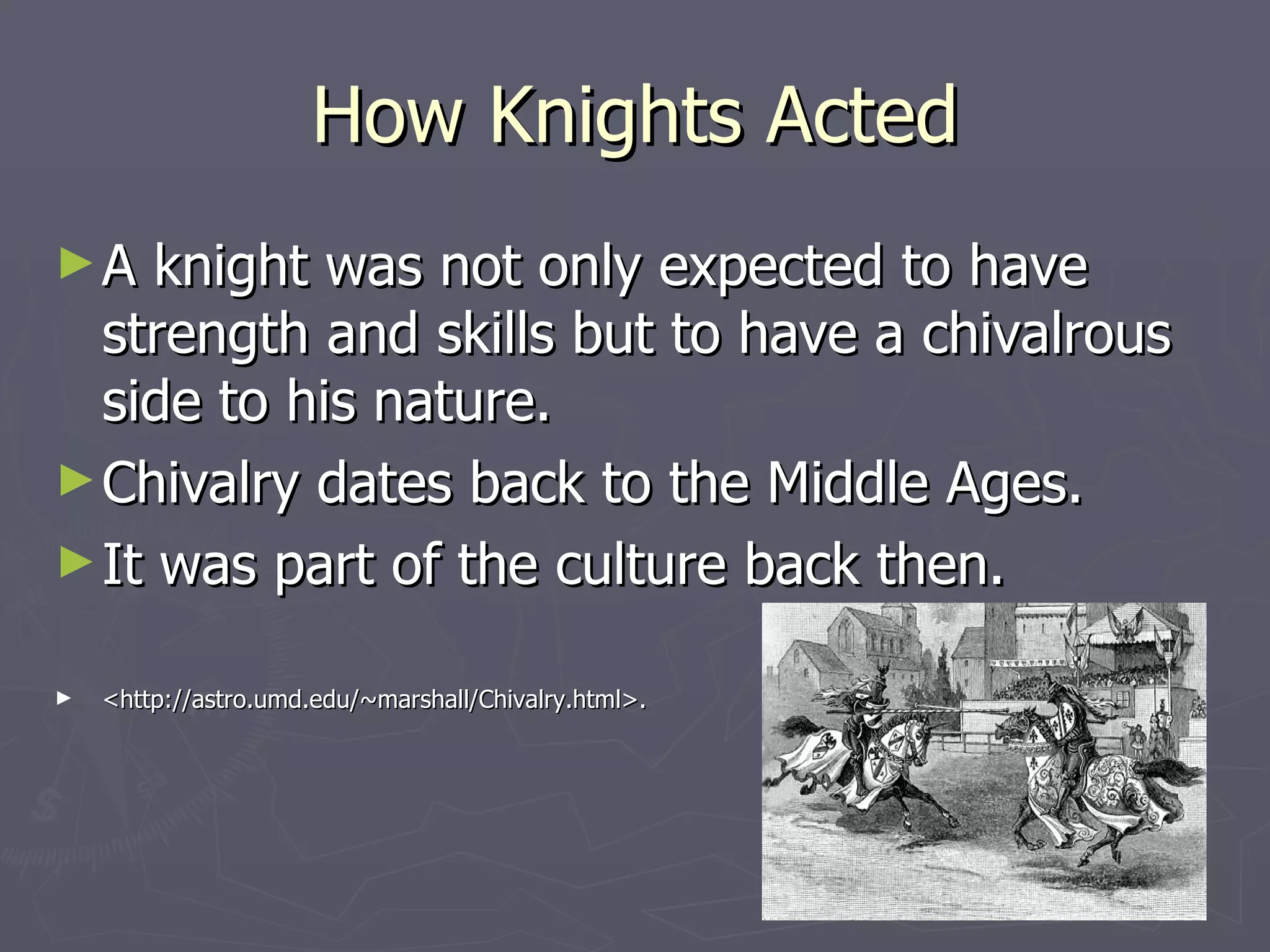
How Knights Acted A knight was not only expected to have strength and skills but to have a chivalrous side to his nature. Chivalry dates back to the Middle Ages. It was part of the culture back then. <http://astro.umd.edu/~marshall/Chivalry.html>.
How Long Was it Used Chivalry was poplar during the 12 th  and 13 th  centuries. Then it deteriorated at the end of the middle ages. The Middle Ages were a very chaotic time in Europe, but it created a long period of renewed stability. http:// www.essorment.com/all/chivalric code_rmf.htm
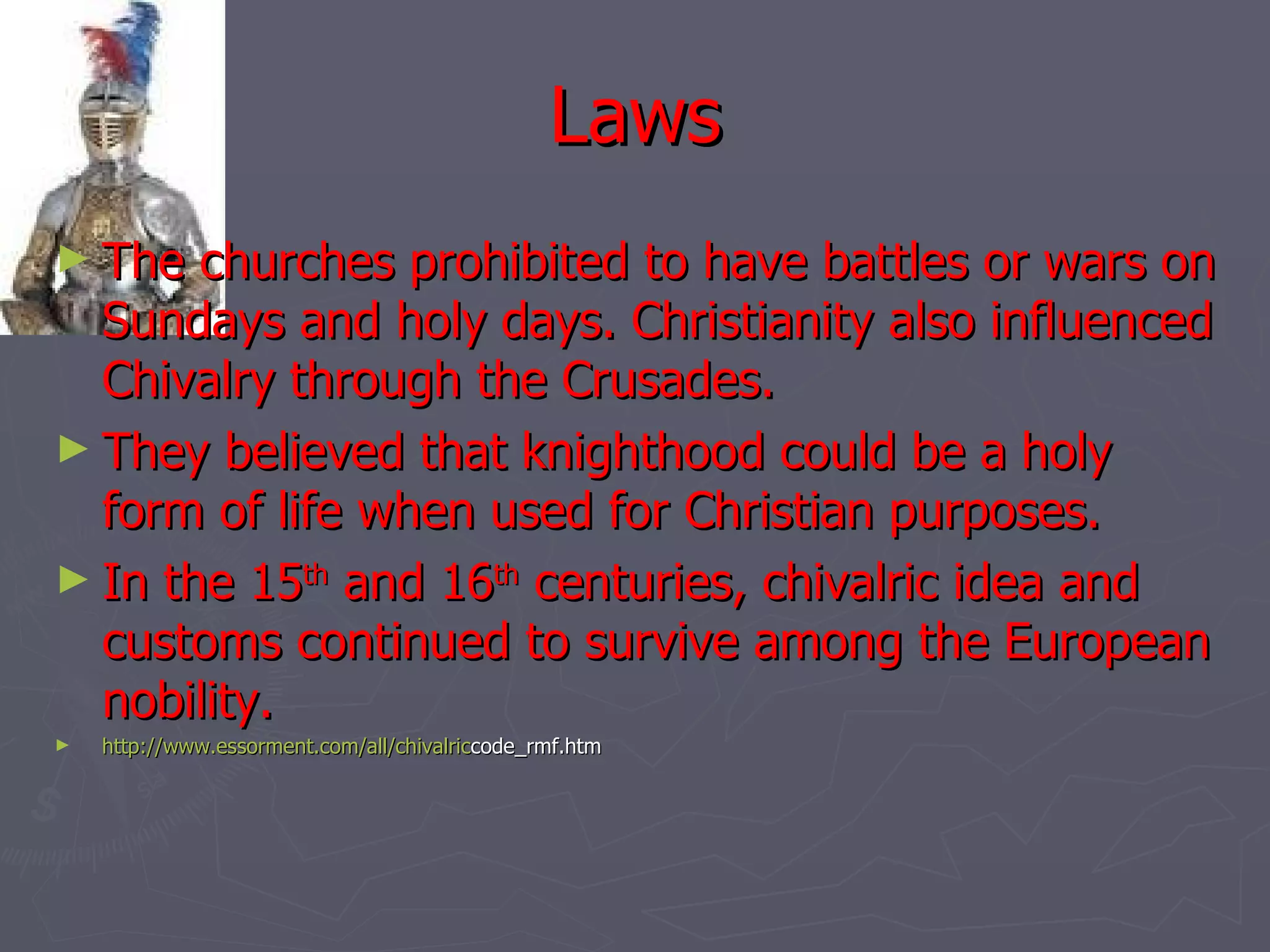
Laws The churches prohibited to have battles or wars on Sundays and holy days. Christianity also influenced Chivalry through the Crusades. They believed that knighthood could be a holy form of life when used for Christian purposes.  In the 15 th  and 16 th  centuries, chivalric idea and customs continued to survive among the European nobility.  http:// www.essorment.com/all/chivalric code_rmf.htm
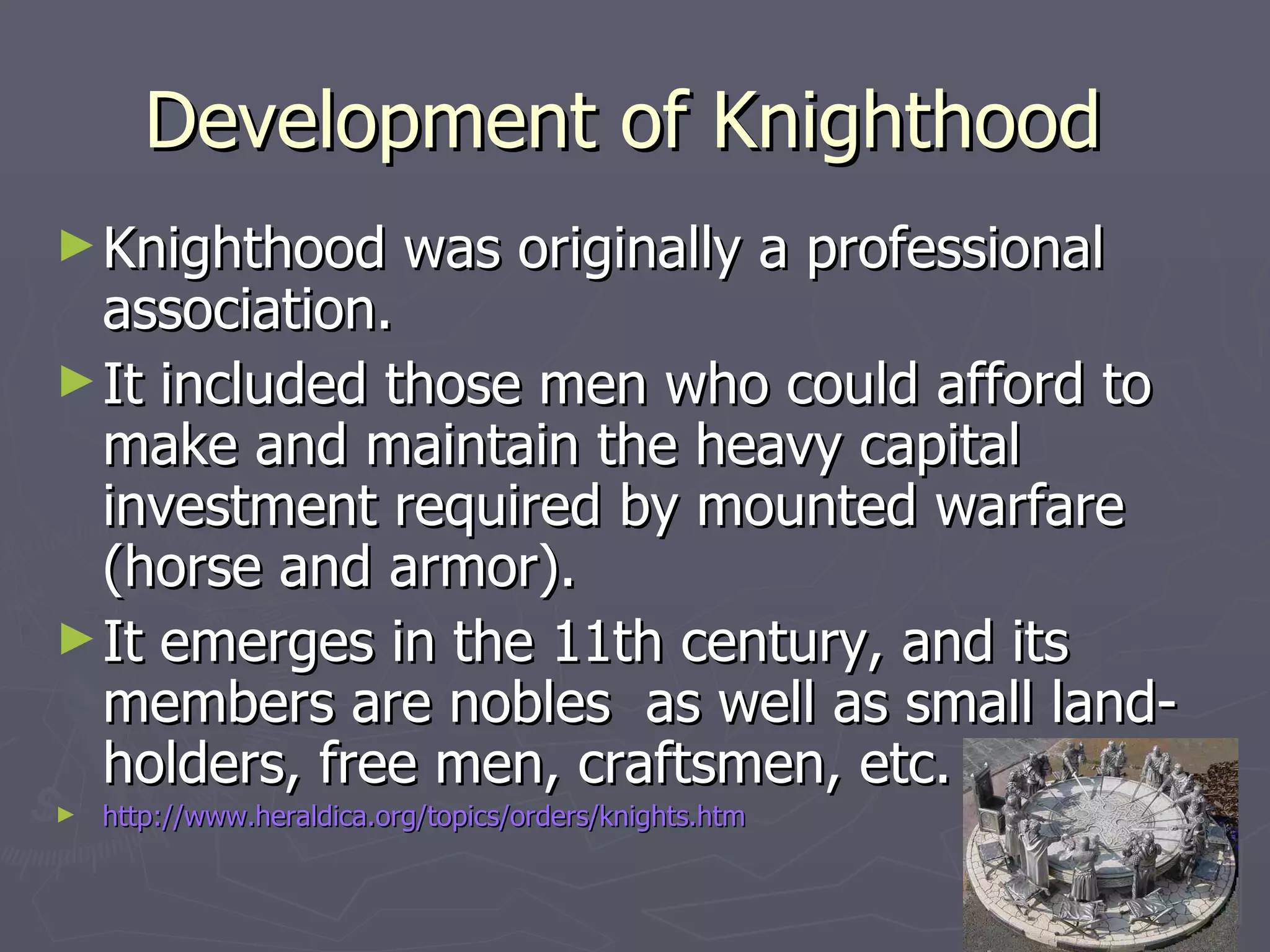
Development of Knighthood  Knighthood was originally a professional association.  It included those men who could afford to make and maintain the heavy capital investment required by mounted warfare (horse and armor).  It emerges in the 11th century, and its members are nobles  as well as small land-holders, free men, craftsmen, etc.  http://www.heraldica.org/topics/orders/knights.htm
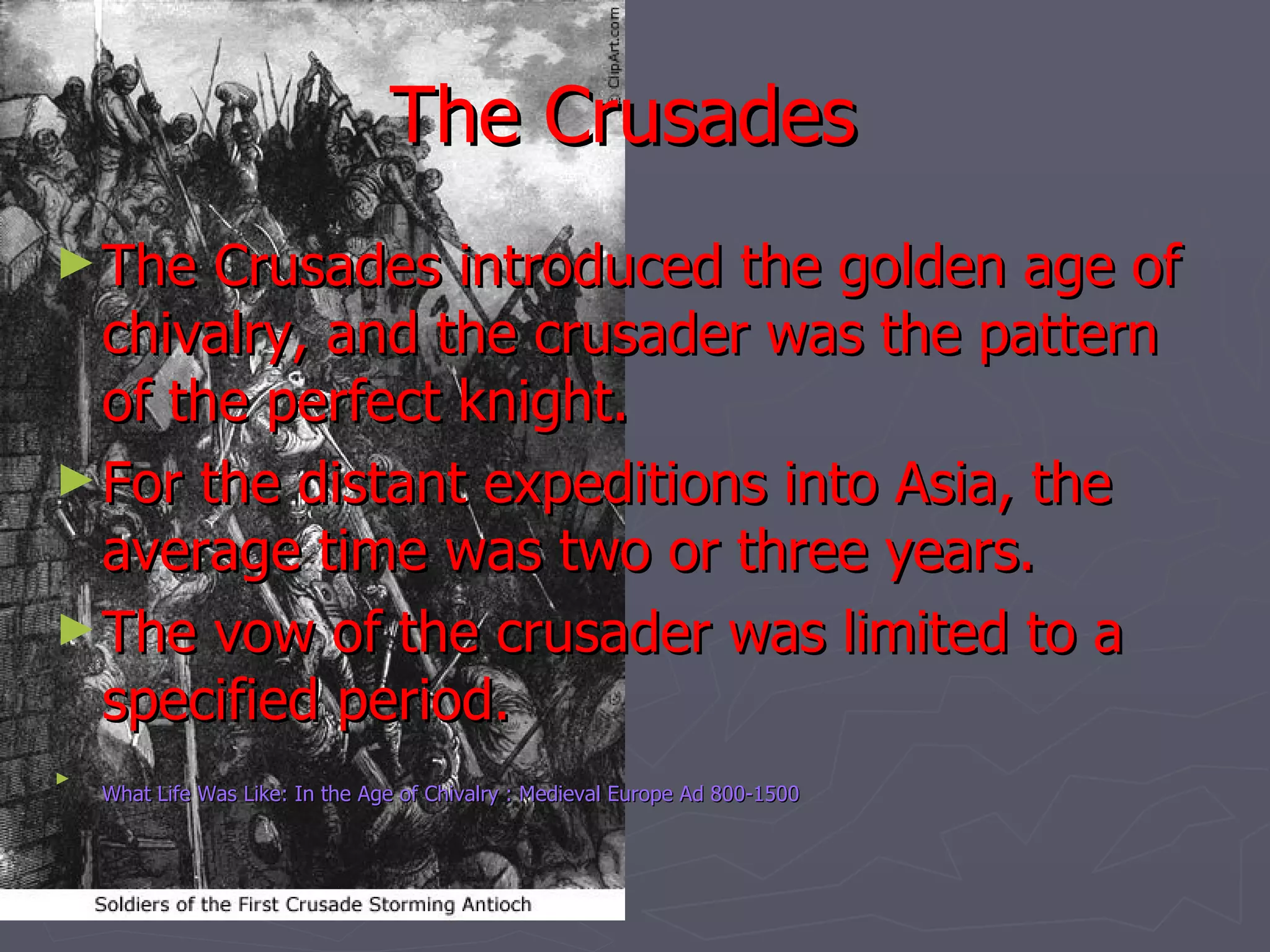
The Crusades   The Crusades introduced the golden age of chivalry, and the crusader was the pattern of the perfect knight.  For the distant expeditions into Asia, the average time was two or three years.  The vow of the crusader was limited to a specified period. What Life Was Like: In the Age of Chivalry : Medieval Europe Ad 800-1500
Court Chivalry  In its last stages, chivalry became a mere court service . Literature, which had in the past so greatly contributed to the exaltation of chivalry, now reacted against its extravagances. However, earlier it was the English longbow that for the first time enabled the peasant to kill a amoured knight. The lowly peasant was now as powerful as a mounted knight, thus his equal and the rise in citizenship.  Encyclopedia of The Renaissance
Works Cited Cornwell, Bernard .  Excalibur . N.p.: Penguin Group, 1997. N. pag. Print.  Encylopedia of The Renissance  . Ed. David Rundle. N.p.: n.p., n.d. Print.  What Life Was Like: In the Age of Chivalry : Medieval Europe Ad 800-1500  <http://astro.umd.edu/~marshall/Chivalry.html>. http://www.essorment.com/all/chivalriccode_rmf.htm http://www.heraldica.org/topics/orders/knights.htm

Chivalry

  • 1.
  • 2.
    Ten Commandments ofChivalry Thou shalt believe all that the Church teaches, and shalt observe all its directions. Thou shalt defend the Church. Thou shalt respect all weaknesses, and shalt constitute thyself the defender of them. Thou shalt love the country in the which thou wast born. Thou shalt not recoil before the enemy. Thou shalt make war against the Infidel without cessation, and without mercy. Thou shalt perform scrupulously thy feudal duties, if they be not contrary to the laws of God. Thou shalt never lie, and shalt remain faithful to thy pledged word. Thou shalt be generous, and give largesse to everyone. Thou shalt be everywhere and always the champion of the Right and the Good against Injustice and Evil. Excalibur Bernard Cornwell
  • 3.
    How it StartedChivalry set a high  standard to the nobles of medieval times. It is a code that medieval knights had to  follow. This code meant that knights had to protect women and the poor. They should also respect Christianity and the church. The poor and women cannot protect themselves, so they needed knights to protect them. <http://astro.umd.edu/~marshall/Chivalry.html>.
  • 4.
    How Knights ActedA knight was not only expected to have strength and skills but to have a chivalrous side to his nature. Chivalry dates back to the Middle Ages. It was part of the culture back then. <http://astro.umd.edu/~marshall/Chivalry.html>.
  • 5.
    How Long Wasit Used Chivalry was poplar during the 12 th and 13 th centuries. Then it deteriorated at the end of the middle ages. The Middle Ages were a very chaotic time in Europe, but it created a long period of renewed stability. http:// www.essorment.com/all/chivalric code_rmf.htm
  • 6.
    Laws The churchesprohibited to have battles or wars on Sundays and holy days. Christianity also influenced Chivalry through the Crusades. They believed that knighthood could be a holy form of life when used for Christian purposes. In the 15 th and 16 th centuries, chivalric idea and customs continued to survive among the European nobility. http:// www.essorment.com/all/chivalric code_rmf.htm
  • 7.
    Development of Knighthood Knighthood was originally a professional association. It included those men who could afford to make and maintain the heavy capital investment required by mounted warfare (horse and armor). It emerges in the 11th century, and its members are nobles as well as small land-holders, free men, craftsmen, etc. http://www.heraldica.org/topics/orders/knights.htm
  • 8.
    The Crusades The Crusades introduced the golden age of chivalry, and the crusader was the pattern of the perfect knight. For the distant expeditions into Asia, the average time was two or three years. The vow of the crusader was limited to a specified period. What Life Was Like: In the Age of Chivalry : Medieval Europe Ad 800-1500
  • 9.
    Court Chivalry In its last stages, chivalry became a mere court service . Literature, which had in the past so greatly contributed to the exaltation of chivalry, now reacted against its extravagances. However, earlier it was the English longbow that for the first time enabled the peasant to kill a amoured knight. The lowly peasant was now as powerful as a mounted knight, thus his equal and the rise in citizenship. Encyclopedia of The Renaissance
  • 10.
    Works Cited Cornwell,Bernard . Excalibur . N.p.: Penguin Group, 1997. N. pag. Print. Encylopedia of The Renissance . Ed. David Rundle. N.p.: n.p., n.d. Print. What Life Was Like: In the Age of Chivalry : Medieval Europe Ad 800-1500 <http://astro.umd.edu/~marshall/Chivalry.html>. http://www.essorment.com/all/chivalriccode_rmf.htm http://www.heraldica.org/topics/orders/knights.htm