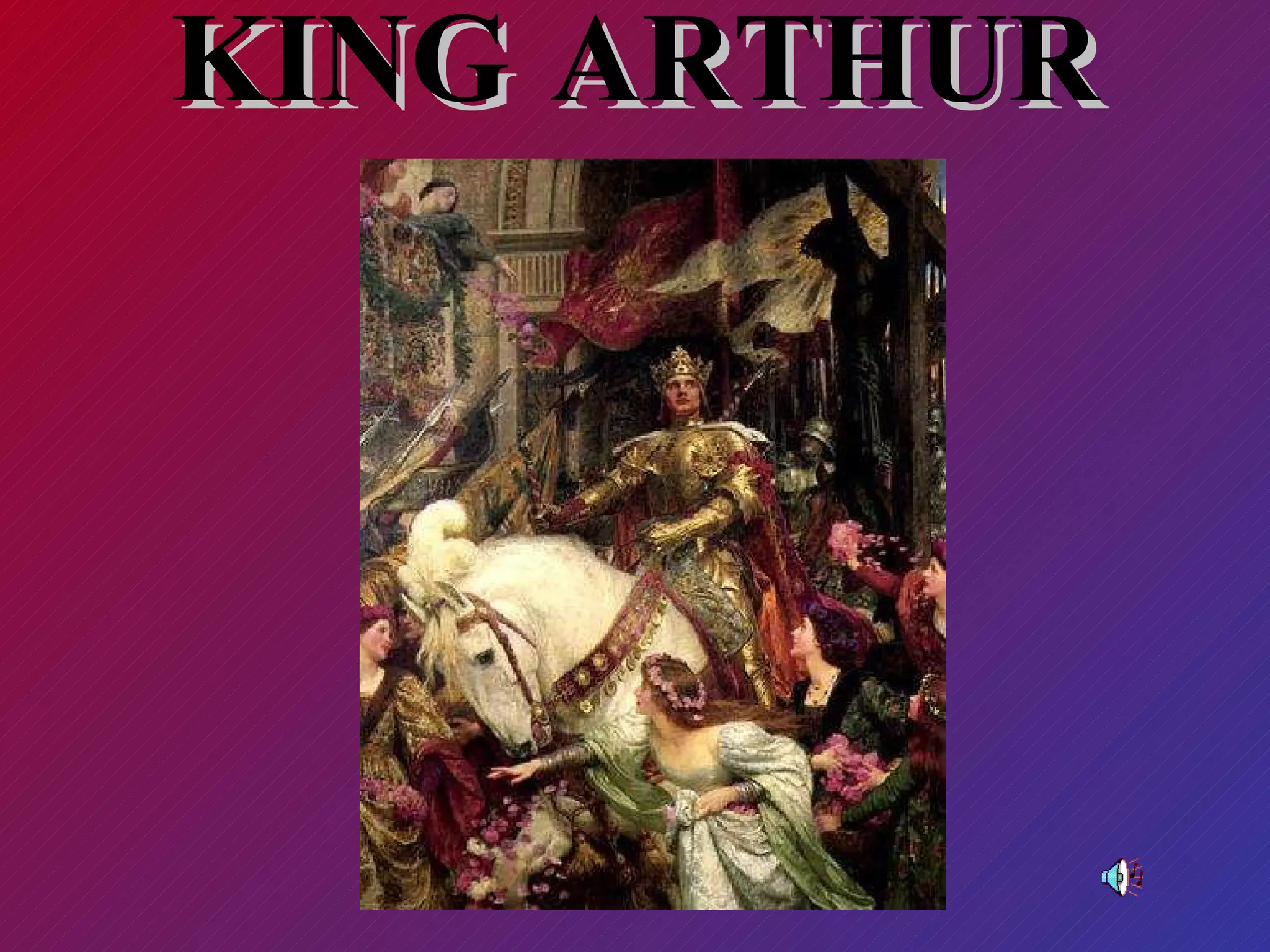
KING ARTHUR
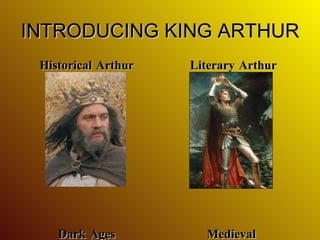
INTRODUCING KING ARTHUR Historical Arthur Dark Ages Literary Arthur Medieval
Arthur as presented in the legends was NOT a real person.  There was, however, a chieftan named Arthur.  Historical Arthur lived in the Dark Ages, at the end of the 5 th  and beginning of the 6 th  centuries. Literary Arthur comes from medieval times, during the 12 th  century.
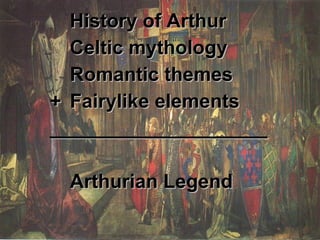
History of Arthur Celtic mythology Romantic themes + Fairylike elements ____________________ Arthurian Legend
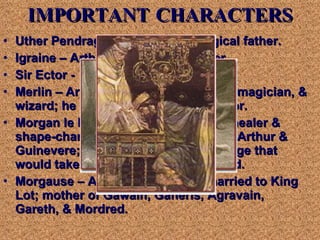
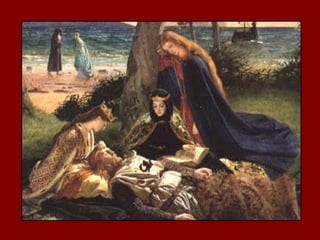
IMPORTANT CHARACTERS Uther Pendragon – Arthur’s biological father. Igraine – Arthur’s biological mother Sir Ector -  Arthur’s adoptive father Merlin – Arthur’s counselor, prophet, magician, & wizard; he placed Arthur with Sir Ector. Morgan le Fay – Arthur’s half sister; healer & shape-changer; an adversary of both Arthur & Guinevere; she took Arthur to the barge that would take him to Avalon to be healed. Morgause – Arthur’s half sister; married to King Lot; mother of Gawain, Gaheris, Agravain, Gareth, & Mordred.
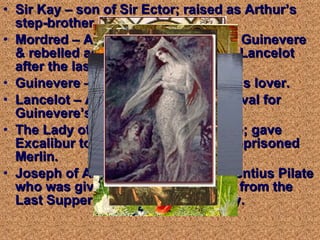
Sir Kay – son of Sir Ector; raised as Arthur’s step-brother. Mordred – Arthur’s nephew; seized Guinevere & rebelled against Arthur; killed by Lancelot after the last battle. Guinevere – Arthur’s wife; Lancelot’s lover.  Lancelot – Arthur’s chief knight & rival for Guinevere’s love. The Lady of the Lake – aka Vivienne; gave Excalibur to Arthur; enchanted & imprisoned Merlin. Joseph of Arimathea – soldier of Pontius Pilate who was given the cup (Holy Grail) from the Last Supper; settled in Glastonbury.
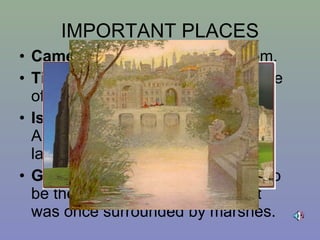
IMPORTANT PLACES Camelot  – King Arthur’s  kingdom. Tintagel Castle  – conception place of Arthur. Isle of Avalon  – island to which Arthur is sent to recover from the last battle. Glastonbury  – claimed by some to be the actual Isle of Avalon, as it was once surrounded by marshes.
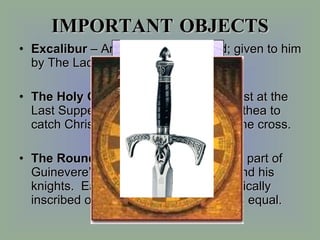
IMPORTANT OBJECTS Excalibur  – Arthur’s magical sword; given to him by The Lady of the Lake. The Holy Grail  – the cup used by Christ at the Last Supper; used by Joseph of Arimathea to catch Christ’s blood when he was on the cross. The Round Table  – the table given as part of Guinevere’s dowry & used by Arthur and his knights.  Each knight’s name was magically inscribed on the table.  Everybody was equal.
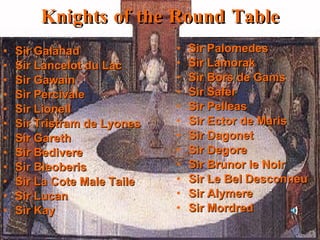
Knights of the Round Table Sir Galahad  Sir Lancelot du Lac Sir Gawain  Sir Percivale  Sir Lionell Sir Tristram de Lyones Sir Gareth Sir Bedivere Sir Bleoberis Sir La Cote Male Taile Sir Lucan Sir Kay Sir Palomedes Sir Lamorak Sir Bors de Ganis Sir Safer Sir Pelleas Sir Ector de Maris Sir Dagonet Sir Degore Sir Brunor le Noir Sir Le Bel Desconneu Sir Alymere Sir Mordred
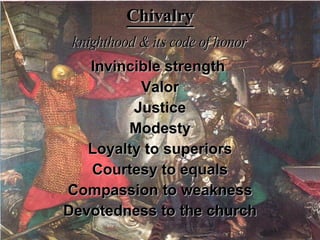
Chivalry knighthood & its code of honor Invincible strength  Valor Justice Modesty Loyalty to superiors Courtesy to equals Compassion to weakness Devotedness to the church
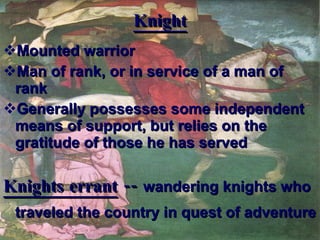
Knight Mounted warrior Man of rank, or in service of a man of rank Generally possesses some independent means of support, but relies on the gratitude of those he has served Knights errant  --  wandering knights who traveled the country in quest of adventure
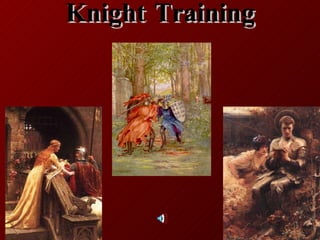
Knight Training
AGE 7    Become a page or varlet   Taken from home to the court or castle Taught first articles of religion, respect, and reverence for their lords Initiated in ceremonies of the court Carve, wait at table, and perform menial tasks Taught falconry, dancing, harp playing, hunting, fishing, wrestling, tilting with spears, & performing military exercises on horseback
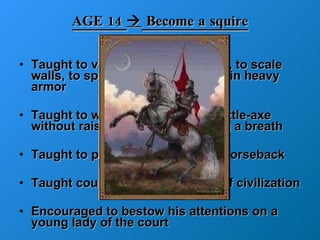
AGE 14    Become a squire Taught to vault on a horse, to run, to scale walls, to spring over ditches – all in heavy armor Taught to wrestle, to wield the battle-axe without raising the visor or taking a breath Taught to perform gracefully on horseback Taught courtesy or refinements of civilization Encouraged to bestow his attentions on a young lady of the court
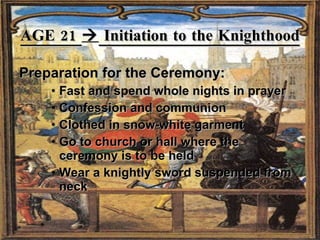
AGE 21    Initiation to the Knighthood Preparation for the Ceremony: Fast and spend whole nights in prayer Confession and communion Clothed in snow-white garment Go to church or hall where the ceremony is to be held Wear a knightly sword suspended from neck
Ceremony: Officiating priest takes the sword, blesses it, and returns it Candidate folds arms, kneels before presiding knight and answers questions about motives for becoming a knight Takes an oath Receives armor and sword Kneels before presiding knight who administers the accolade (3 strokes of a flat sword on the neck or shoulder) and says, “In the name of God, of St. Michael, and of St. George, I make thee a knight; be valiant, courteous, and loyal.” Receives helmet, shield, and spear
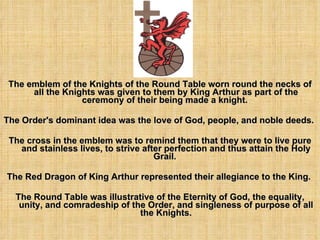
The emblem of the Knights of the Round Table worn round the necks of all the Knights was given to them by King Arthur as part of the ceremony of their being made a knight.  The Order's dominant idea was the love of God, people, and noble deeds.  The cross in the emblem was to remind them that they were to live pure and stainless lives, to strive after perfection and thus attain the Holy Grail.  The Red Dragon of King Arthur represented their allegiance to the King.  The Round Table was illustrative of the Eternity of God, the equality, unity, and comradeship of the Order, and singleness of purpose of all the Knights.
RULES/CODES for KNIGHTS To never do outrage nor murder  Always to flee treason  To by no means be cruel but to give mercy unto him who asks for mercy  To always do ladies, gentlewomen and widows succor  (to go to the aid of one in distress; to help) To never force ladies, gentlewomen or widows  Not to take up battles in wrongful quarrels for love or worldly goods  To never lay down arms  To seek after wonders
When called upon, to defend the rights of the weak with all one's strength  To injure no one  Not to attack one another  To fight for the safety of one's country  To give one's life for one's country  To seek nothing before honour  Never to break faith for any reason  To practice religion most diligently  To grant hospitality to anyone, each according to his ability  Whether in honour or disgrace, to make a report with the greatest fidelity to truth to those who keep the annals
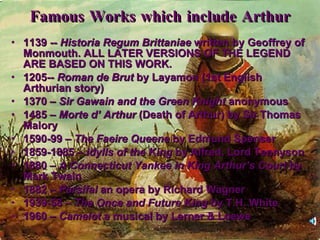
Famous Works which include Arthur 1139 --  Historia Regum Brittaniae  written by Geoffrey of Monmouth. ALL LATER VERSIONS OF THE LEGEND ARE BASED ON THIS WORK. 1205--  Roman de Brut  by Layamon (1st English Arthurian story) 1370 –  Sir Gawain and the Green Knight  anonymous 1485 –  Morte d’ Arthur  (Death of Arthur) by Sir Thomas Malory 1590-99 –  The Faeire Queene  by Edmund Spenser 1859-1885 –  Idylls of the King  by Alfred, Lord Tennyson 1880 –  A Connecticut Yankee in King Arthur’s Court  by Mark Twain 1882 –  Parsifal  an opera by Richard Wagner 1939-58 –  The Once and Future King  by T.H. White 1960 –  Camelot  a musical by Lerner & Loewe
 

Kingarthur

  • 1.
  • 2.
    INTRODUCING KING ARTHURHistorical Arthur Dark Ages Literary Arthur Medieval
  • 3.
    Arthur as presentedin the legends was NOT a real person. There was, however, a chieftan named Arthur. Historical Arthur lived in the Dark Ages, at the end of the 5 th and beginning of the 6 th centuries. Literary Arthur comes from medieval times, during the 12 th century.
  • 4.
    History of ArthurCeltic mythology Romantic themes + Fairylike elements ____________________ Arthurian Legend
  • 5.
    IMPORTANT CHARACTERS UtherPendragon – Arthur’s biological father. Igraine – Arthur’s biological mother Sir Ector - Arthur’s adoptive father Merlin – Arthur’s counselor, prophet, magician, & wizard; he placed Arthur with Sir Ector. Morgan le Fay – Arthur’s half sister; healer & shape-changer; an adversary of both Arthur & Guinevere; she took Arthur to the barge that would take him to Avalon to be healed. Morgause – Arthur’s half sister; married to King Lot; mother of Gawain, Gaheris, Agravain, Gareth, & Mordred.
  • 6.
    Sir Kay –son of Sir Ector; raised as Arthur’s step-brother. Mordred – Arthur’s nephew; seized Guinevere & rebelled against Arthur; killed by Lancelot after the last battle. Guinevere – Arthur’s wife; Lancelot’s lover. Lancelot – Arthur’s chief knight & rival for Guinevere’s love. The Lady of the Lake – aka Vivienne; gave Excalibur to Arthur; enchanted & imprisoned Merlin. Joseph of Arimathea – soldier of Pontius Pilate who was given the cup (Holy Grail) from the Last Supper; settled in Glastonbury.
  • 7.
    IMPORTANT PLACES Camelot – King Arthur’s kingdom. Tintagel Castle – conception place of Arthur. Isle of Avalon – island to which Arthur is sent to recover from the last battle. Glastonbury – claimed by some to be the actual Isle of Avalon, as it was once surrounded by marshes.
  • 8.
    IMPORTANT OBJECTS Excalibur – Arthur’s magical sword; given to him by The Lady of the Lake. The Holy Grail – the cup used by Christ at the Last Supper; used by Joseph of Arimathea to catch Christ’s blood when he was on the cross. The Round Table – the table given as part of Guinevere’s dowry & used by Arthur and his knights. Each knight’s name was magically inscribed on the table. Everybody was equal.
  • 9.
    Knights of theRound Table Sir Galahad Sir Lancelot du Lac Sir Gawain Sir Percivale Sir Lionell Sir Tristram de Lyones Sir Gareth Sir Bedivere Sir Bleoberis Sir La Cote Male Taile Sir Lucan Sir Kay Sir Palomedes Sir Lamorak Sir Bors de Ganis Sir Safer Sir Pelleas Sir Ector de Maris Sir Dagonet Sir Degore Sir Brunor le Noir Sir Le Bel Desconneu Sir Alymere Sir Mordred
  • 10.
    Chivalry knighthood &its code of honor Invincible strength Valor Justice Modesty Loyalty to superiors Courtesy to equals Compassion to weakness Devotedness to the church
  • 11.
    Knight Mounted warriorMan of rank, or in service of a man of rank Generally possesses some independent means of support, but relies on the gratitude of those he has served Knights errant -- wandering knights who traveled the country in quest of adventure
  • 12.
  • 13.
    AGE 7  Become a page or varlet Taken from home to the court or castle Taught first articles of religion, respect, and reverence for their lords Initiated in ceremonies of the court Carve, wait at table, and perform menial tasks Taught falconry, dancing, harp playing, hunting, fishing, wrestling, tilting with spears, & performing military exercises on horseback
  • 14.
    AGE 14  Become a squire Taught to vault on a horse, to run, to scale walls, to spring over ditches – all in heavy armor Taught to wrestle, to wield the battle-axe without raising the visor or taking a breath Taught to perform gracefully on horseback Taught courtesy or refinements of civilization Encouraged to bestow his attentions on a young lady of the court
  • 15.
    AGE 21  Initiation to the Knighthood Preparation for the Ceremony: Fast and spend whole nights in prayer Confession and communion Clothed in snow-white garment Go to church or hall where the ceremony is to be held Wear a knightly sword suspended from neck
  • 16.
    Ceremony: Officiating priesttakes the sword, blesses it, and returns it Candidate folds arms, kneels before presiding knight and answers questions about motives for becoming a knight Takes an oath Receives armor and sword Kneels before presiding knight who administers the accolade (3 strokes of a flat sword on the neck or shoulder) and says, “In the name of God, of St. Michael, and of St. George, I make thee a knight; be valiant, courteous, and loyal.” Receives helmet, shield, and spear
  • 17.
    The emblem ofthe Knights of the Round Table worn round the necks of all the Knights was given to them by King Arthur as part of the ceremony of their being made a knight. The Order's dominant idea was the love of God, people, and noble deeds. The cross in the emblem was to remind them that they were to live pure and stainless lives, to strive after perfection and thus attain the Holy Grail. The Red Dragon of King Arthur represented their allegiance to the King. The Round Table was illustrative of the Eternity of God, the equality, unity, and comradeship of the Order, and singleness of purpose of all the Knights.
  • 18.
    RULES/CODES for KNIGHTSTo never do outrage nor murder Always to flee treason To by no means be cruel but to give mercy unto him who asks for mercy To always do ladies, gentlewomen and widows succor (to go to the aid of one in distress; to help) To never force ladies, gentlewomen or widows Not to take up battles in wrongful quarrels for love or worldly goods To never lay down arms To seek after wonders
  • 19.
    When called upon,to defend the rights of the weak with all one's strength To injure no one Not to attack one another To fight for the safety of one's country To give one's life for one's country To seek nothing before honour Never to break faith for any reason To practice religion most diligently To grant hospitality to anyone, each according to his ability Whether in honour or disgrace, to make a report with the greatest fidelity to truth to those who keep the annals
  • 20.
    Famous Works whichinclude Arthur 1139 -- Historia Regum Brittaniae written by Geoffrey of Monmouth. ALL LATER VERSIONS OF THE LEGEND ARE BASED ON THIS WORK. 1205-- Roman de Brut by Layamon (1st English Arthurian story) 1370 – Sir Gawain and the Green Knight anonymous 1485 – Morte d’ Arthur (Death of Arthur) by Sir Thomas Malory 1590-99 – The Faeire Queene by Edmund Spenser 1859-1885 – Idylls of the King by Alfred, Lord Tennyson 1880 – A Connecticut Yankee in King Arthur’s Court by Mark Twain 1882 – Parsifal an opera by Richard Wagner 1939-58 – The Once and Future King by T.H. White 1960 – Camelot a musical by Lerner & Loewe
  • 21.