Race Walking
PREPARED BY:
Imelda C. Grado
What is
Race Walking?
History
of
Racewalking
History of Racewalking
✵1880-Racewalking developed as one of the original track and field events of the first
meeting of the English Amateur Athletics Association
✵ 19th century, first racewalking codes came from an attempt to regulate rules events
✵ Pedestrianism-distance competitive walking events
✵Pedestrianism had developed, like footraces and horse racing, as a popular working class
British and American pastime, and a venue for wagering
✵ 1866 -Walkers organized the first English amateur walking championship
✵ 1880-code was the basis for the rules codified at the first Championships Meeting. the
Amateur Athletics Association in England, the birth of modern Athletics
✵ 19th century-football (soccer), cricket, and other sports codified. the transition from
professional Pedestrianism to amateur racewalking was, while relatively late, part of a process of
regularization occurring in most modern sports at this time.
Racewalking or Race walking
❋ Is a long distance athletic event. Although it is a
foot race it is different from running in that one foot
must appear to be in contact with the ground at all
times.
❋ Is an Olympic athletics ( track and field) event with
distance of 20 km( 912.4) mi kilometers race walk for both
men and women and 50 km(31 mi) race walk for (men only)
50mile80.5 km) events are also held
The objective in race walking
is to walk as fast as possible the
duration of the race without
losing the technique.
You will need
•race walking shoes
•comforable clothing
•Correct technic
Distances
Distances
✍ Race Walking Distance vary from 1500m to 50km, depending
on the age and gender of the athlete.
✍Races have been walked at distances as short
as 3 kilometres (1.9 mi)—at the 1920 Summer
Olympics—and as long as 100 km (62.1 mi).
✍Records are noted for the 50 miles (80.5 km the men's
world record for the 50-mile race walk is held by Israeli
Shaul Ladany, through his race of 7:23:50 in 1972 in New
Jersey, shattering the world mark that had stood since 1935.
✍The modern Olympic events are the 20 km (12.4 mi) race walk
(men and women) and 50 km (31 mi) race walk (men only).
Two Rules of Racewalking
1. The athlete's back toe cannot leave
the ground until the heel of the front
foot has touched. Violation of this
rule is known as loss of contact.
2.Requires that the supporting leg must straighten
from the point of contact with the ground and remain
straightened until the body passes directly over it.
These rules are judged by the unaided human eye.
Athletes regularly lose contact for a few milliseconds
per stride, which can be caught on film, but such a
short flight phase is said to be undetectable to the
human eye
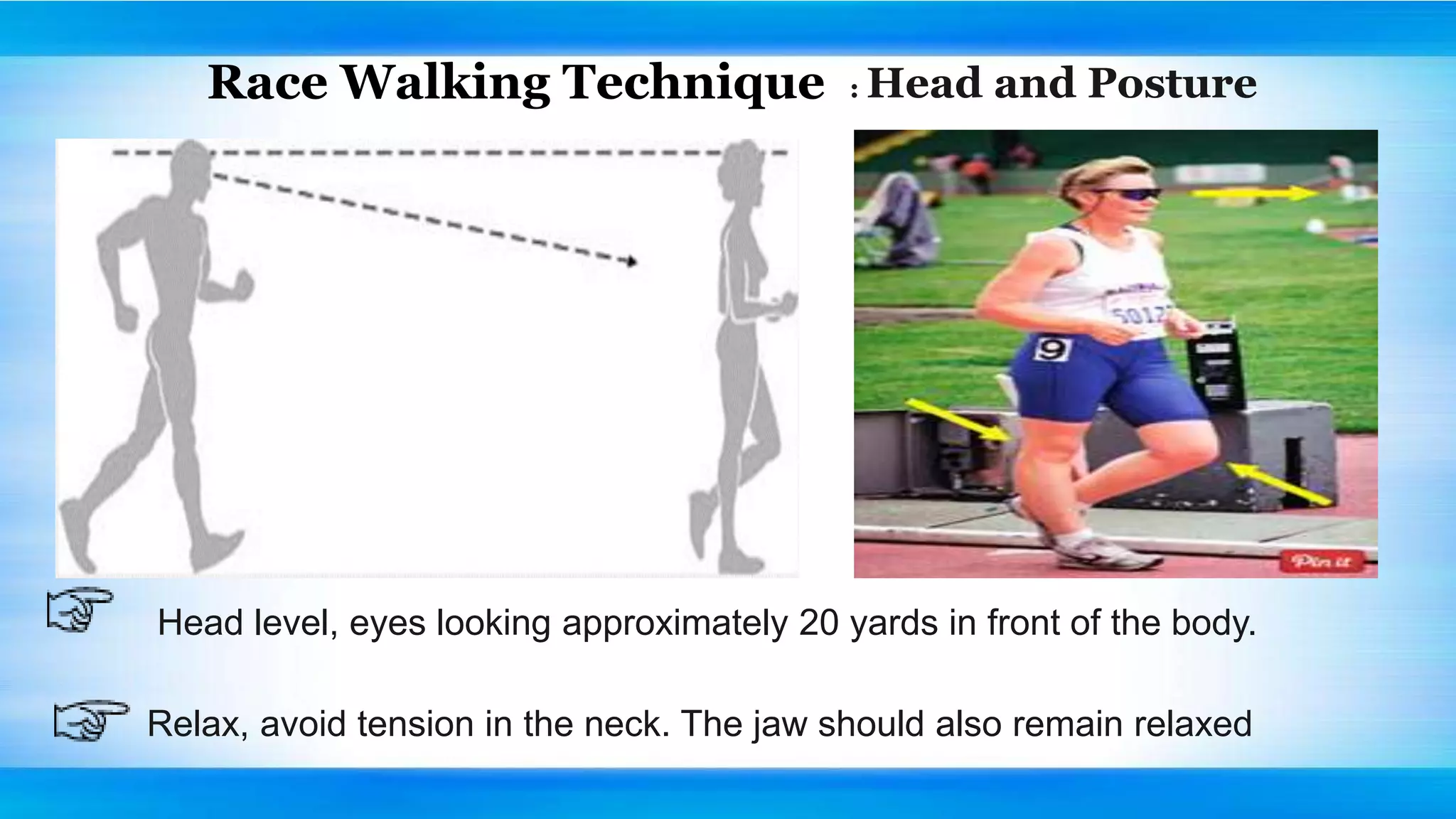
Race Walking Technique : Head and Posture
Head level, eyes looking approximately 20 yards in front of the body.
Relax, avoid tension in the neck. The jaw should also remain relaxed
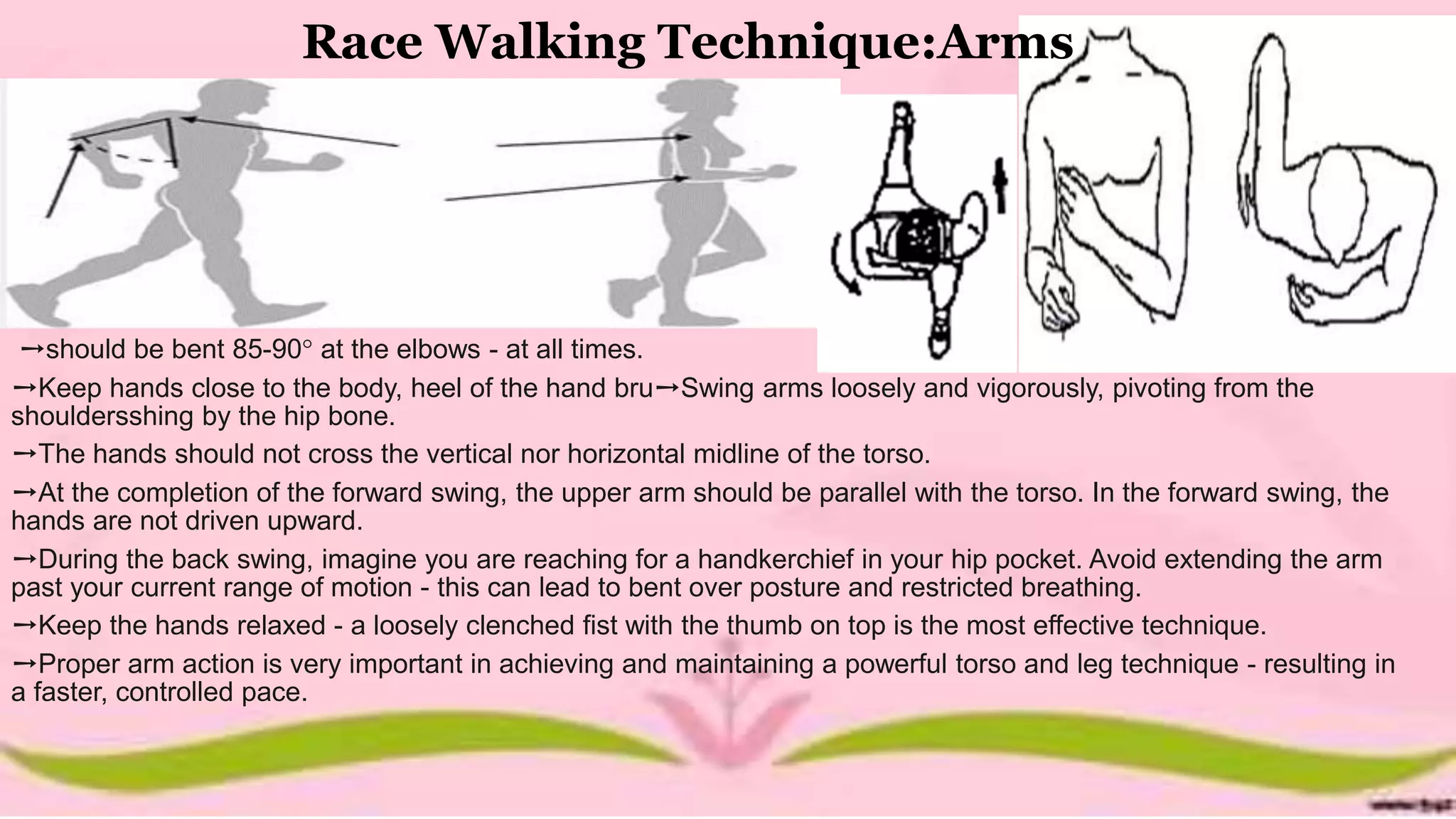
➙should be bent 85-90° at the elbows - at all times.
➙Keep hands close to the body, heel of the hand bru➙Swing arms loosely and vigorously, pivoting from the
shouldersshing by the hip bone.
➙The hands should not cross the vertical nor horizontal midline of the torso.
➙At the completion of the forward swing, the upper arm should be parallel with the torso. In the forward swing, the
hands are not driven upward.
➙During the back swing, imagine you are reaching for a handkerchief in your hip pocket. Avoid extending the arm
past your current range of motion - this can lead to bent over posture and restricted breathing.
➙Keep the hands relaxed - a loosely clenched fist with the thumb on top is the most effective technique.
➙Proper arm action is very important in achieving and maintaining a powerful torso and leg technique - resulting in
a faster, controlled pace.
Race Walking Technique:Arms
Racewalking Technique: Torso
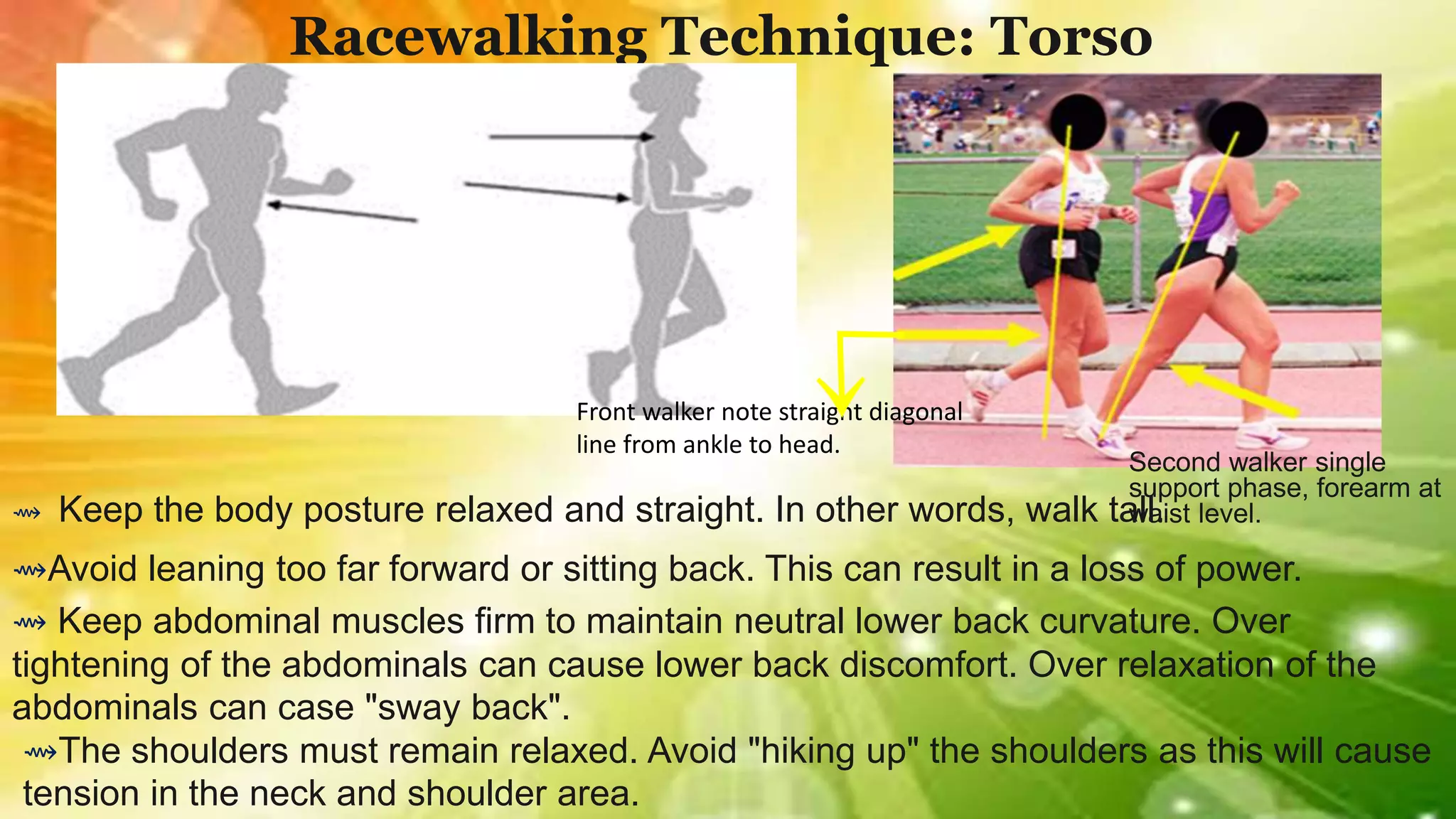
⇝ Keep the body posture relaxed and straight. In other words, walk tall.
⇝Avoid leaning too far forward or sitting back. This can result in a loss of power.
⇝ Keep abdominal muscles firm to maintain neutral lower back curvature. Over
tightening of the abdominals can cause lower back discomfort. Over relaxation of the
abdominals can case "sway back".
⇝The shoulders must remain relaxed. Avoid "hiking up" the shoulders as this will cause
tension in the neck and shoulder area.
Front walker note straight diagonal
line from ankle to head.
Second walker single
support phase, forearm at
waist level.
Race Walking Technique : Feet
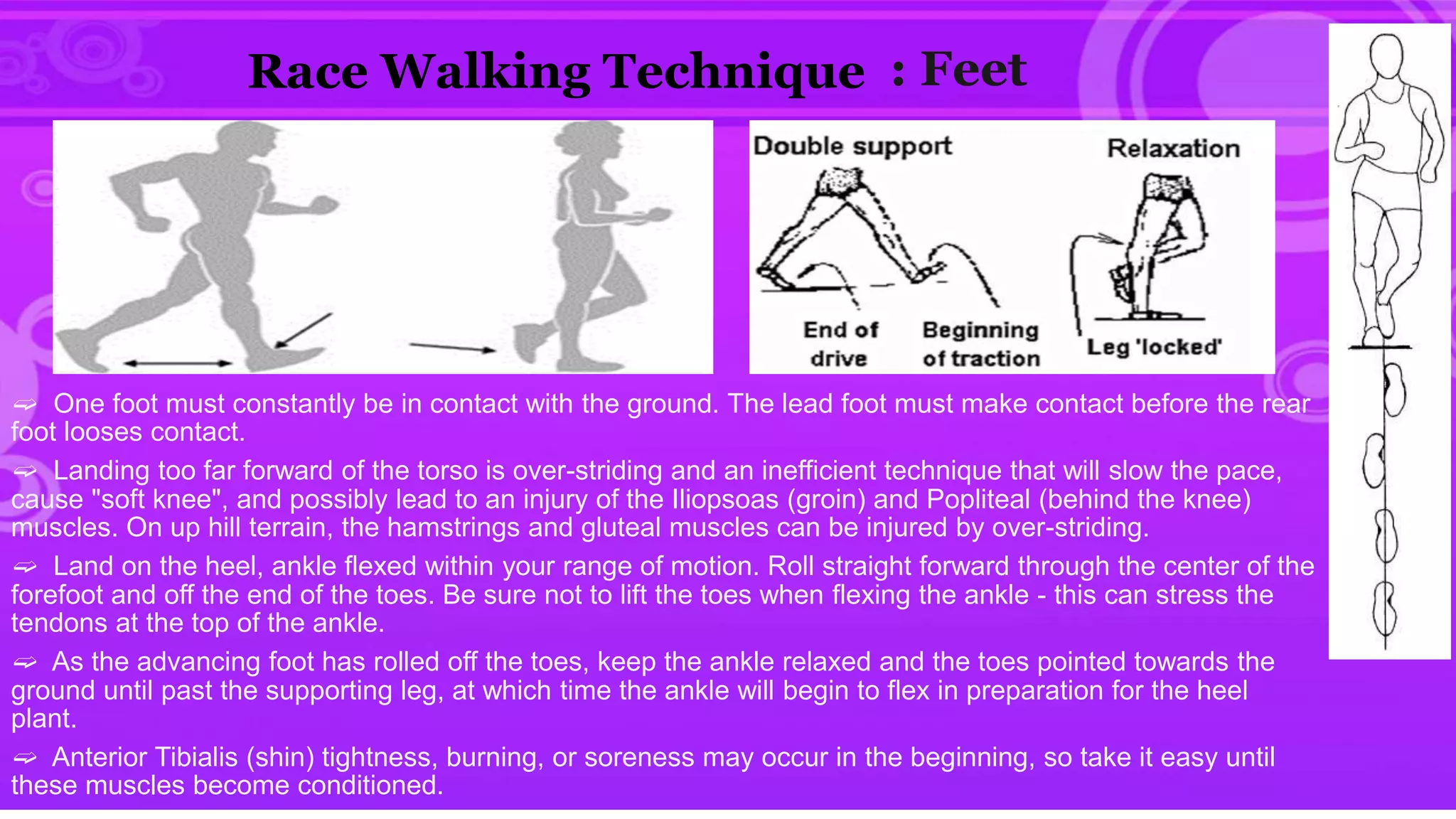
➫ One foot must constantly be in contact with the ground. The lead foot must make contact before the rear
foot looses contact.
➫ Landing too far forward of the torso is over-striding and an inefficient technique that will slow the pace,
cause "soft knee", and possibly lead to an injury of the Iliopsoas (groin) and Popliteal (behind the knee)
muscles. On up hill terrain, the hamstrings and gluteal muscles can be injured by over-striding.
➫ Land on the heel, ankle flexed within your range of motion. Roll straight forward through the center of the
forefoot and off the end of the toes. Be sure not to lift the toes when flexing the ankle - this can stress the
tendons at the top of the ankle.
➫ As the advancing foot has rolled off the toes, keep the ankle relaxed and the toes pointed towards the
ground until past the supporting leg, at which time the ankle will begin to flex in preparation for the heel
plant.
➫ Anterior Tibialis (shin) tightness, burning, or soreness may occur in the beginning, so take it easy until
these muscles become conditioned.
:hips
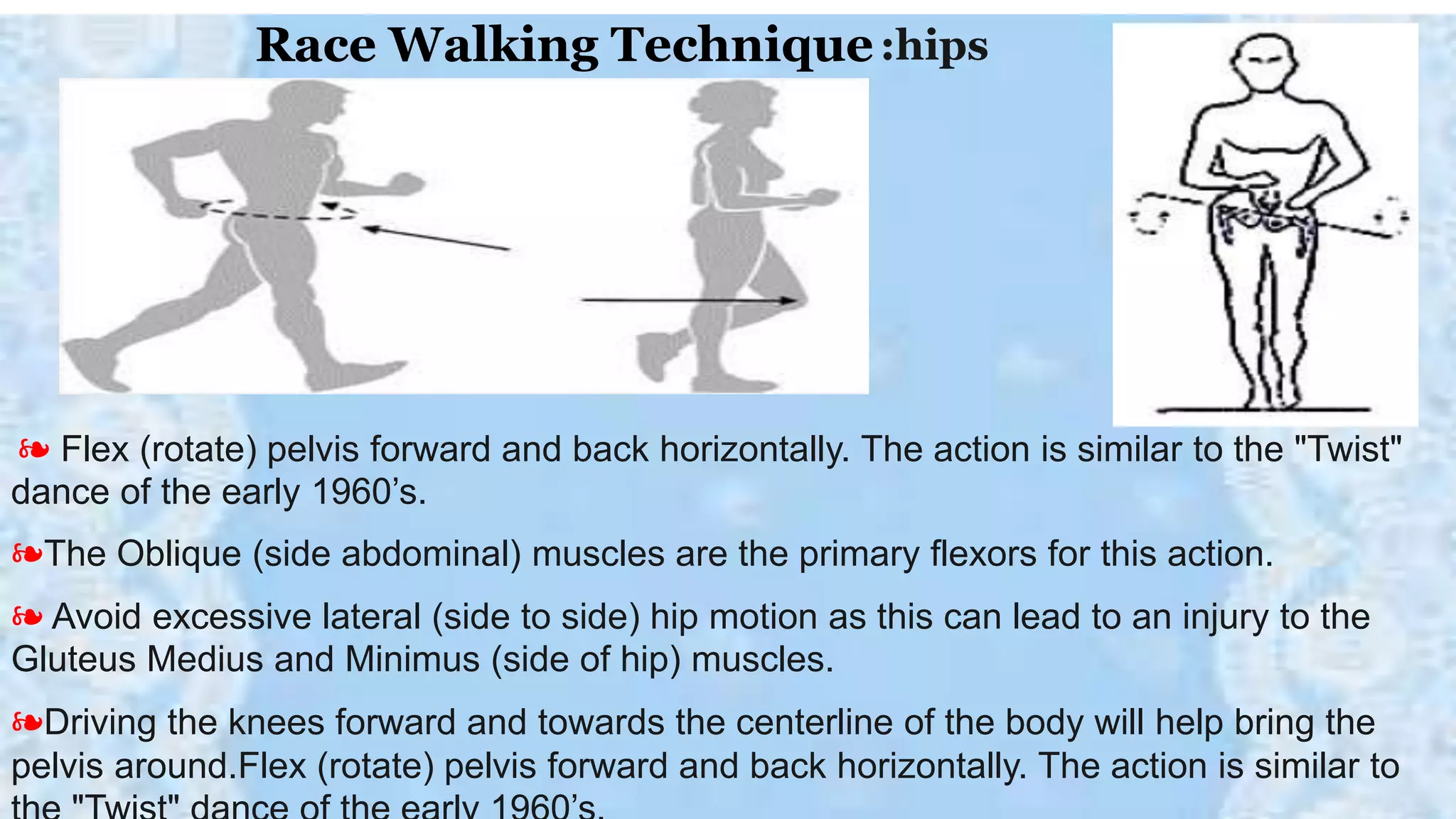
❧ Flex (rotate) pelvis forward and back horizontally. The action is similar to the "Twist"
dance of the early 1960’s.
❧The Oblique (side abdominal) muscles are the primary flexors for this action.
❧ Avoid excessive lateral (side to side) hip motion as this can lead to an injury to the
Gluteus Medius and Minimus (side of hip) muscles.
❧Driving the knees forward and towards the centerline of the body will help bring the
pelvis around.Flex (rotate) pelvis forward and back horizontally. The action is similar to
Race Walking Technique
Racewalking Technique:Legs and Stride
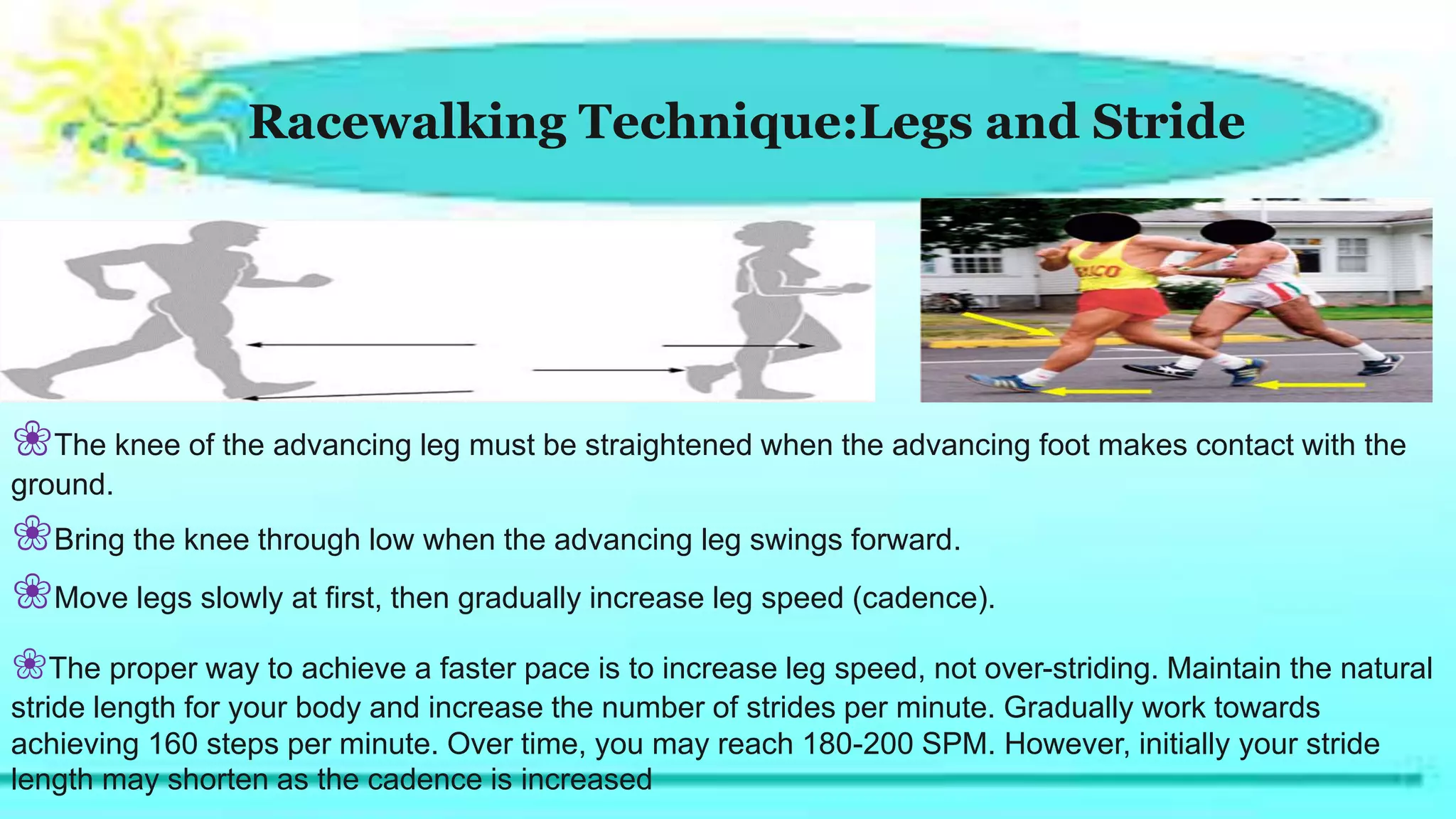
❀The knee of the advancing leg must be straightened when the advancing foot makes contact with the
ground.
❀Bring the knee through low when the advancing leg swings forward.
❀Move legs slowly at first, then gradually increase leg speed (cadence).
❀The proper way to achieve a faster pace is to increase leg speed, not over-striding. Maintain the natural
stride length for your body and increase the number of strides per minute. Gradually work towards
achieving 160 steps per minute. Over time, you may reach 180-200 SPM. However, initially your stride
length may shorten as the cadence is increased
Video
Judging
➦As the rear foot begins to come forward, the body weight is
transferred onto the front foot until the single support phase
is completed.
➦At this point the full weight of the body is supported by
one leg, and the whole momentum of the walker comes
from pushing strongly off the rear foot.
➦ The leg should remain straight for as long as possible.
➦The rear foot should be brought forward as close to the
ground as possible, landing with the foot at approximately
45º to the ground.
➦At this point the weight of the body is equally distributed
between the two points of contact in the double support
phase.
Judging
All judging decisions are made as seen by the unaided eye
(glasses are fine). No camera or video equipment may be
used for judging during or after a race. Even though the
human eye is not 100 per cent perfect to judge a race
walker's contact with the ground, this is the method the
sport has decided to use over the years. It has proven to be
the fairest way to control the event.
Judging
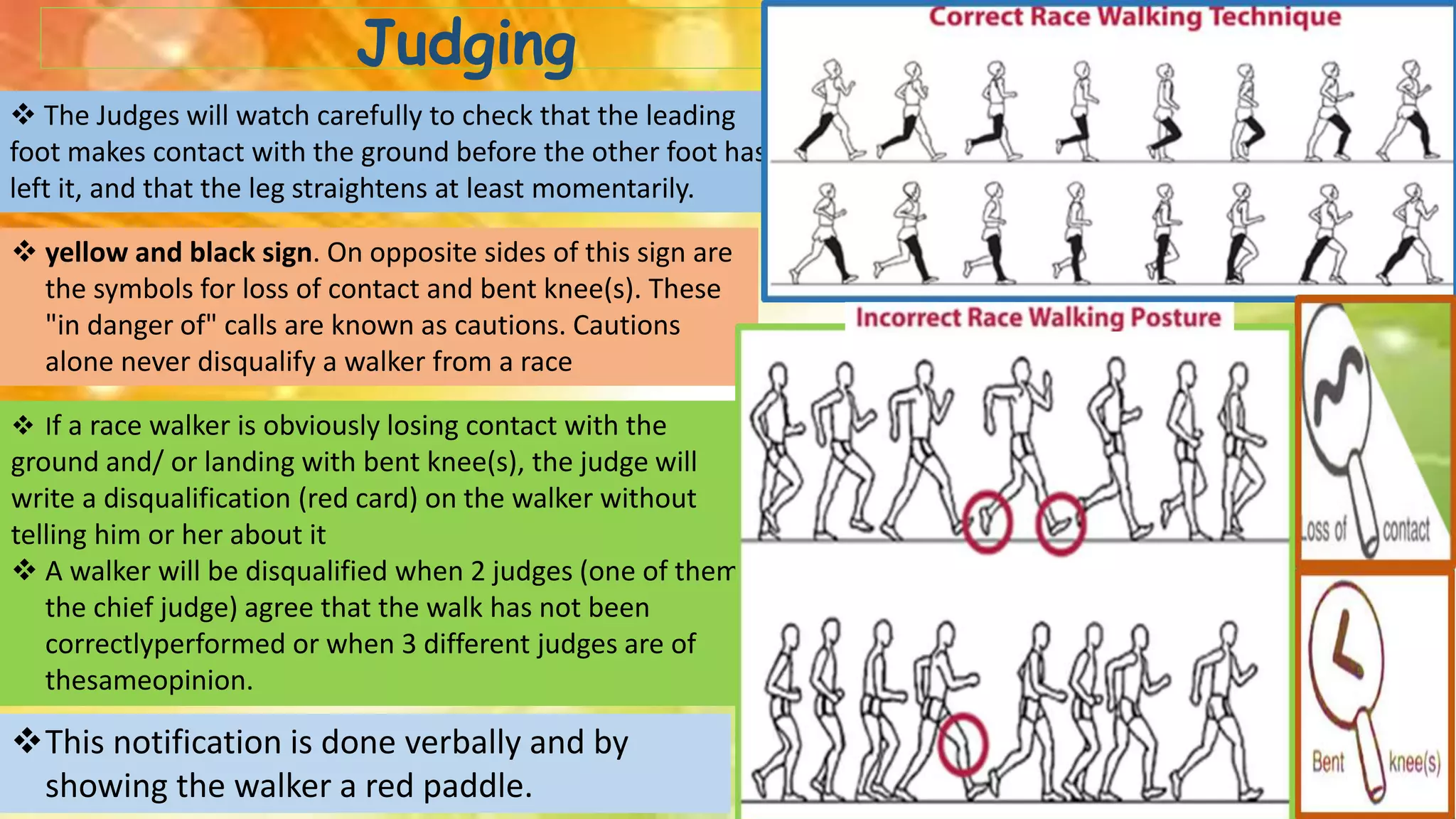
 The Judges will watch carefully to check that the leading
foot makes contact with the ground before the other foot has
left it, and that the leg straightens at least momentarily.
 yellow and black sign. On opposite sides of this sign are
the symbols for loss of contact and bent knee(s). These
"in danger of" calls are known as cautions. Cautions
alone never disqualify a walker from a race
 If a race walker is obviously losing contact with the
ground and/ or landing with bent knee(s), the judge will
write a disqualification (red card) on the walker without
telling him or her about it
 A walker will be disqualified when 2 judges (one of them
the chief judge) agree that the walk has not been
correctlyperformed or when 3 different judges are of
thesameopinion.
This notification is done verbally and by
showing the walker a red paddle.
Race walker
should avoid
Losing contact with the ground
Excessive inclination forward or back.
Raising and lowering of the centre of gravity.
Propelling the centre of gravity
along a zig-zag path.
Too short a stride.
Race walker
should aim to
Keep the knee straight in the
supporting phase.
Strengthen the dorsal and abdominal
muscles
Prevent the shoulders and arms
lifting too much.
Move the feet along a straight line
Gain a complete drive, use flexible arm
action, and a good movement of the
hip.
END
Thank you
God bless
ADD ME UP : MEG GRADO

Race walking

  • 1.
  • 2.
  • 3.
  • 5.
    History of Racewalking ✵1880-Racewalkingdeveloped as one of the original track and field events of the first meeting of the English Amateur Athletics Association ✵ 19th century, first racewalking codes came from an attempt to regulate rules events ✵ Pedestrianism-distance competitive walking events ✵Pedestrianism had developed, like footraces and horse racing, as a popular working class British and American pastime, and a venue for wagering ✵ 1866 -Walkers organized the first English amateur walking championship ✵ 1880-code was the basis for the rules codified at the first Championships Meeting. the Amateur Athletics Association in England, the birth of modern Athletics ✵ 19th century-football (soccer), cricket, and other sports codified. the transition from professional Pedestrianism to amateur racewalking was, while relatively late, part of a process of regularization occurring in most modern sports at this time.
  • 7.
    Racewalking or Racewalking ❋ Is a long distance athletic event. Although it is a foot race it is different from running in that one foot must appear to be in contact with the ground at all times. ❋ Is an Olympic athletics ( track and field) event with distance of 20 km( 912.4) mi kilometers race walk for both men and women and 50 km(31 mi) race walk for (men only) 50mile80.5 km) events are also held
  • 8.
    The objective inrace walking is to walk as fast as possible the duration of the race without losing the technique.
  • 9.
    You will need •racewalking shoes •comforable clothing •Correct technic
  • 10.
  • 11.
    Distances ✍ Race WalkingDistance vary from 1500m to 50km, depending on the age and gender of the athlete. ✍Races have been walked at distances as short as 3 kilometres (1.9 mi)—at the 1920 Summer Olympics—and as long as 100 km (62.1 mi). ✍Records are noted for the 50 miles (80.5 km the men's world record for the 50-mile race walk is held by Israeli Shaul Ladany, through his race of 7:23:50 in 1972 in New Jersey, shattering the world mark that had stood since 1935. ✍The modern Olympic events are the 20 km (12.4 mi) race walk (men and women) and 50 km (31 mi) race walk (men only).
  • 13.
    Two Rules ofRacewalking 1. The athlete's back toe cannot leave the ground until the heel of the front foot has touched. Violation of this rule is known as loss of contact. 2.Requires that the supporting leg must straighten from the point of contact with the ground and remain straightened until the body passes directly over it. These rules are judged by the unaided human eye. Athletes regularly lose contact for a few milliseconds per stride, which can be caught on film, but such a short flight phase is said to be undetectable to the human eye
  • 14.
    Race Walking Technique: Head and Posture Head level, eyes looking approximately 20 yards in front of the body. Relax, avoid tension in the neck. The jaw should also remain relaxed
  • 15.
    ➙should be bent85-90° at the elbows - at all times. ➙Keep hands close to the body, heel of the hand bru➙Swing arms loosely and vigorously, pivoting from the shouldersshing by the hip bone. ➙The hands should not cross the vertical nor horizontal midline of the torso. ➙At the completion of the forward swing, the upper arm should be parallel with the torso. In the forward swing, the hands are not driven upward. ➙During the back swing, imagine you are reaching for a handkerchief in your hip pocket. Avoid extending the arm past your current range of motion - this can lead to bent over posture and restricted breathing. ➙Keep the hands relaxed - a loosely clenched fist with the thumb on top is the most effective technique. ➙Proper arm action is very important in achieving and maintaining a powerful torso and leg technique - resulting in a faster, controlled pace. Race Walking Technique:Arms
  • 16.
    Racewalking Technique: Torso ⇝Keep the body posture relaxed and straight. In other words, walk tall. ⇝Avoid leaning too far forward or sitting back. This can result in a loss of power. ⇝ Keep abdominal muscles firm to maintain neutral lower back curvature. Over tightening of the abdominals can cause lower back discomfort. Over relaxation of the abdominals can case "sway back". ⇝The shoulders must remain relaxed. Avoid "hiking up" the shoulders as this will cause tension in the neck and shoulder area. Front walker note straight diagonal line from ankle to head. Second walker single support phase, forearm at waist level.
  • 17.
    Race Walking Technique: Feet ➫ One foot must constantly be in contact with the ground. The lead foot must make contact before the rear foot looses contact. ➫ Landing too far forward of the torso is over-striding and an inefficient technique that will slow the pace, cause "soft knee", and possibly lead to an injury of the Iliopsoas (groin) and Popliteal (behind the knee) muscles. On up hill terrain, the hamstrings and gluteal muscles can be injured by over-striding. ➫ Land on the heel, ankle flexed within your range of motion. Roll straight forward through the center of the forefoot and off the end of the toes. Be sure not to lift the toes when flexing the ankle - this can stress the tendons at the top of the ankle. ➫ As the advancing foot has rolled off the toes, keep the ankle relaxed and the toes pointed towards the ground until past the supporting leg, at which time the ankle will begin to flex in preparation for the heel plant. ➫ Anterior Tibialis (shin) tightness, burning, or soreness may occur in the beginning, so take it easy until these muscles become conditioned.
  • 18.
    :hips ❧ Flex (rotate)pelvis forward and back horizontally. The action is similar to the "Twist" dance of the early 1960’s. ❧The Oblique (side abdominal) muscles are the primary flexors for this action. ❧ Avoid excessive lateral (side to side) hip motion as this can lead to an injury to the Gluteus Medius and Minimus (side of hip) muscles. ❧Driving the knees forward and towards the centerline of the body will help bring the pelvis around.Flex (rotate) pelvis forward and back horizontally. The action is similar to Race Walking Technique
  • 19.
    Racewalking Technique:Legs andStride ❀The knee of the advancing leg must be straightened when the advancing foot makes contact with the ground. ❀Bring the knee through low when the advancing leg swings forward. ❀Move legs slowly at first, then gradually increase leg speed (cadence). ❀The proper way to achieve a faster pace is to increase leg speed, not over-striding. Maintain the natural stride length for your body and increase the number of strides per minute. Gradually work towards achieving 160 steps per minute. Over time, you may reach 180-200 SPM. However, initially your stride length may shorten as the cadence is increased
  • 20.
  • 22.
  • 23.
    ➦As the rearfoot begins to come forward, the body weight is transferred onto the front foot until the single support phase is completed. ➦At this point the full weight of the body is supported by one leg, and the whole momentum of the walker comes from pushing strongly off the rear foot. ➦ The leg should remain straight for as long as possible. ➦The rear foot should be brought forward as close to the ground as possible, landing with the foot at approximately 45º to the ground. ➦At this point the weight of the body is equally distributed between the two points of contact in the double support phase. Judging
  • 24.
    All judging decisionsare made as seen by the unaided eye (glasses are fine). No camera or video equipment may be used for judging during or after a race. Even though the human eye is not 100 per cent perfect to judge a race walker's contact with the ground, this is the method the sport has decided to use over the years. It has proven to be the fairest way to control the event.
  • 25.
    Judging  The Judgeswill watch carefully to check that the leading foot makes contact with the ground before the other foot has left it, and that the leg straightens at least momentarily.  yellow and black sign. On opposite sides of this sign are the symbols for loss of contact and bent knee(s). These "in danger of" calls are known as cautions. Cautions alone never disqualify a walker from a race  If a race walker is obviously losing contact with the ground and/ or landing with bent knee(s), the judge will write a disqualification (red card) on the walker without telling him or her about it  A walker will be disqualified when 2 judges (one of them the chief judge) agree that the walk has not been correctlyperformed or when 3 different judges are of thesameopinion. This notification is done verbally and by showing the walker a red paddle.
  • 26.
    Race walker should avoid Losingcontact with the ground Excessive inclination forward or back. Raising and lowering of the centre of gravity. Propelling the centre of gravity along a zig-zag path. Too short a stride. Race walker should aim to Keep the knee straight in the supporting phase. Strengthen the dorsal and abdominal muscles Prevent the shoulders and arms lifting too much. Move the feet along a straight line Gain a complete drive, use flexible arm action, and a good movement of the hip.
  • 27.
    END Thank you God bless ADDME UP : MEG GRADO

Editor's Notes

  • #25 All judging decisions are made as seen by the unaided eye (glasses are fine). No camera or video equipment may be used for judging during or after a race. Even though the human eye is not 100 per cent perfect to judge a race walker's contact with the ground, this is the method the sport has decided to use over the years. It has proven to be the fairest way to control the event.