The Age of ChivalryThe Age of Chivalry
The code of chivalry for
knights glorified combat and
romantic love.
Chivalry has shaped modern
ideas of romance in Western
cultures.
Terms to knowTerms to know
chivalry
tournament
troubadour
Where you’ve heard these termsWhere you’ve heard these terms
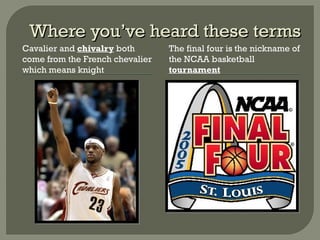
Cavalier and chivalry both
come from the French chevalier
which means knight
The final four is the nickname of
the NCAA basketball
tournament
Knights become an importantKnights become an important
part of battlepart of battle
 Charles Martel
organized the
Frankish army into
troops of armored
horsemen, knights.
 The development
of the saddle and
stirrups made it
easier to fight on
horseback.
The knight is still
seen as a symbol of
war and battle 1000
years later
Feudal lords raise private armiesFeudal lords raise private armies
 Knights were given fiefs in order to
protect feudal lords from other nobles
trying to take their land.
 By granting the knights fiefs, the
knights were able to use the wealth of
the land to buy weapons, armor and
warhorses
 A knight typically served in 40 days of
battle per year
ChivalryChivalry
 Chivalry is a complex set of ideas
which demanded that a knight
fight bravely in defense of three
masters.
• His earthly feudal lord
• His heavenly lord
• His chosen lady
ChivalryChivalry
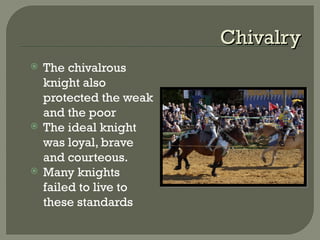
 The chivalrous
knight also
protected the weak
and the poor
 The ideal knight
was loyal, brave
and courteous.
 Many knights
failed to live to
these standards
TournamentsTournaments
 Sons of nobles
began training for
knighthood at a
young age.
 After a year or two
of training, they
entered mock
battles called
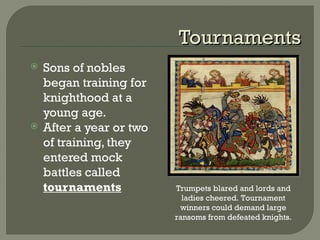
tournaments Trumpets blared and lords and
ladies cheered. Tournament
winners could demand large
ransoms from defeated knights.
Bloody BattlesBloody Battles
 Unlike
tournaments,
actual battles were
quite violent and
bloody.
 Castle battles are
among the most
bloody.
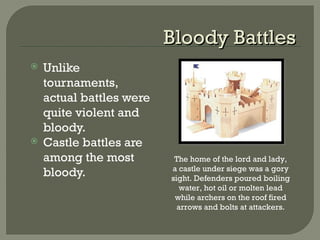
The home of the lord and lady,
a castle under siege was a gory
sight. Defenders poured boiling
water, hot oil or molten lead
while archers on the roof fired
arrows and bolts at attackers.
Castle WeaponsCastle Weapons
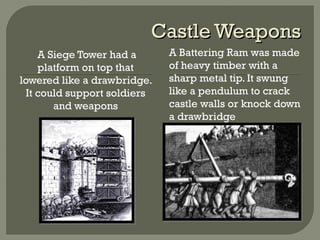
A Siege Tower had a
platform on top that
lowered like a drawbridge.
It could support soldiers
and weapons
A Battering Ram was made
of heavy timber with a
sharp metal tip. It swung
like a pendulum to crack
castle walls or knock down
a drawbridge
TrebuchetTrebuchet
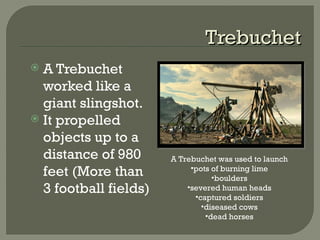
 A Trebuchet
worked like a
giant slingshot.
 It propelled
objects up to a
distance of 980
feet (More than
3 football fields)
A Trebuchet was used to launch
•pots of burning lime
•boulders
•severed human heads
•captured soldiers
•diseased cows
•dead horses
Castle and Siege WeaponsCastle and Siege Weapons
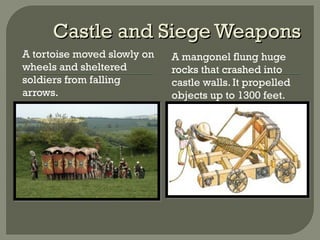
A tortoise moved slowly on
wheels and sheltered
soldiers from falling
arrows.
A mangonel flung huge
rocks that crashed into
castle walls. It propelled
objects up to 1300 feet.
Epic PoetryEpic Poetry
The Song of Roland is one of the
most famous medieval poems.
It praises a band of French
soldiers who dies in a battle
under Charlemagne.
TroubadoursTroubadours
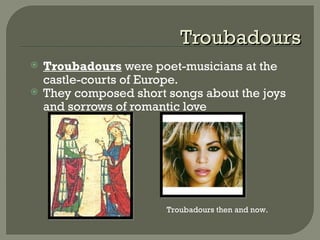
 Troubadours were poet-musicians at the
castle-courts of Europe.
 They composed short songs about the joys
and sorrows of romantic love
Troubadours then and now.
Shifting Role of WomenShifting Role of Women
 The Church viewed women as inferior
to men.
 Romantic love placed women on a
pedestal
 As Middle Ages progress, noblewomen
possess less power than they had in
earlier years.
The Age Of Chivalry

The Age Of Chivalry

  • 1.
    The Age ofChivalryThe Age of Chivalry
  • 2.
    The Age ofChivalryThe Age of Chivalry The code of chivalry for knights glorified combat and romantic love. Chivalry has shaped modern ideas of romance in Western cultures.
  • 3.
    Terms to knowTermsto know chivalry tournament troubadour
  • 4.
    Where you’ve heardthese termsWhere you’ve heard these terms Cavalier and chivalry both come from the French chevalier which means knight The final four is the nickname of the NCAA basketball tournament
  • 5.
    Knights become animportantKnights become an important part of battlepart of battle  Charles Martel organized the Frankish army into troops of armored horsemen, knights.  The development of the saddle and stirrups made it easier to fight on horseback. The knight is still seen as a symbol of war and battle 1000 years later
  • 6.
    Feudal lords raiseprivate armiesFeudal lords raise private armies  Knights were given fiefs in order to protect feudal lords from other nobles trying to take their land.  By granting the knights fiefs, the knights were able to use the wealth of the land to buy weapons, armor and warhorses  A knight typically served in 40 days of battle per year
  • 7.
    ChivalryChivalry  Chivalry isa complex set of ideas which demanded that a knight fight bravely in defense of three masters. • His earthly feudal lord • His heavenly lord • His chosen lady
  • 8.
    ChivalryChivalry  The chivalrous knightalso protected the weak and the poor  The ideal knight was loyal, brave and courteous.  Many knights failed to live to these standards
  • 9.
    TournamentsTournaments  Sons ofnobles began training for knighthood at a young age.  After a year or two of training, they entered mock battles called tournaments Trumpets blared and lords and ladies cheered. Tournament winners could demand large ransoms from defeated knights.
  • 10.
    Bloody BattlesBloody Battles Unlike tournaments, actual battles were quite violent and bloody.  Castle battles are among the most bloody. The home of the lord and lady, a castle under siege was a gory sight. Defenders poured boiling water, hot oil or molten lead while archers on the roof fired arrows and bolts at attackers.
  • 11.
    Castle WeaponsCastle Weapons ASiege Tower had a platform on top that lowered like a drawbridge. It could support soldiers and weapons A Battering Ram was made of heavy timber with a sharp metal tip. It swung like a pendulum to crack castle walls or knock down a drawbridge
  • 12.
    TrebuchetTrebuchet  A Trebuchet workedlike a giant slingshot.  It propelled objects up to a distance of 980 feet (More than 3 football fields) A Trebuchet was used to launch •pots of burning lime •boulders •severed human heads •captured soldiers •diseased cows •dead horses
  • 13.
    Castle and SiegeWeaponsCastle and Siege Weapons A tortoise moved slowly on wheels and sheltered soldiers from falling arrows. A mangonel flung huge rocks that crashed into castle walls. It propelled objects up to 1300 feet.
  • 14.
    Epic PoetryEpic Poetry TheSong of Roland is one of the most famous medieval poems. It praises a band of French soldiers who dies in a battle under Charlemagne.
  • 15.
    TroubadoursTroubadours  Troubadours werepoet-musicians at the castle-courts of Europe.  They composed short songs about the joys and sorrows of romantic love Troubadours then and now.
  • 16.
    Shifting Role ofWomenShifting Role of Women  The Church viewed women as inferior to men.  Romantic love placed women on a pedestal  As Middle Ages progress, noblewomen possess less power than they had in earlier years.