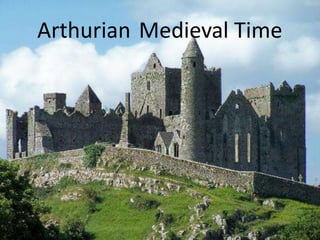
Arthurian Medieval Time
Code of Chivalry
•   The Arthurian Code of Chivalry was how the knights of the Round Table were
    expected to conduct themselves in public.
•   The 12 points in the Code of Conduct are as follows:
•   Faith
•   Charity
•   Justice
•   Sagacity
•   Prudence
•   Temperance
•   Resolution
•   Truth
•   Liberality
•   Diligence
•   Hope
•   Valour
•   Honor, Honesty and Loyalty were also unlisted but very important aspects.
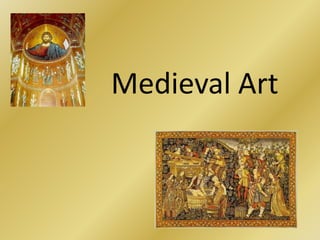
Medieval Art
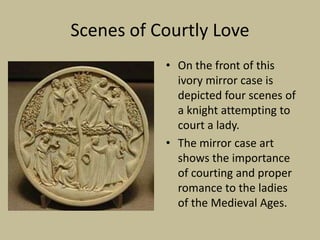
Scenes of Courtly Love
           • On the front of this
             ivory mirror case is
             depicted four scenes of
             a knight attempting to
             court a lady.
           • The mirror case art
             shows the importance
             of courting and proper
             romance to the ladies
             of the Medieval Ages.
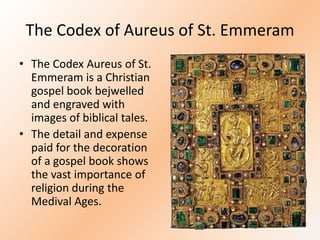
The Codex of Aureus of St. Emmeram
• The Codex Aureus of St.
  Emmeram is a Christian
  gospel book bejwelled
  and engraved with
  images of biblical tales.
• The detail and expense
  paid for the decoration
  of a gospel book shows
  the vast importance of
  religion during the
  Medival Ages.
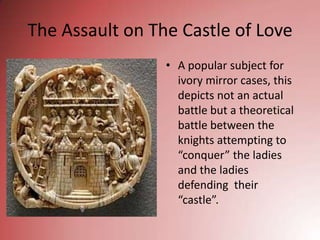
The Assault on The Castle of Love
                 • A popular subject for
                   ivory mirror cases, this
                   depicts not an actual
                   battle but a theoretical
                   battle between the
                   knights attempting to
                   “conquer” the ladies
                   and the ladies
                   defending their
                   “castle”.
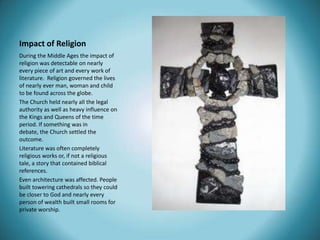
Impact of Religion
During the Middle Ages the impact of
religion was detectable on nearly
every piece of art and every work of
literature. Religion governed the lives
of nearly ever man, woman and child
to be found across the globe.
The Church held nearly all the legal
authority as well as heavy influence on
the Kings and Queens of the time
period. If something was in
debate, the Church settled the
outcome.
Literature was often completely
religious works or, if not a religious
tale, a story that contained biblical
references.
Even architecture was affected. People
built towering cathedrals so they could
be closer to God and nearly every
person of wealth built small rooms for
private worship.
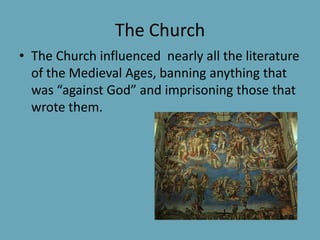
The Church
• The Church influenced nearly all the literature
  of the Medieval Ages, banning anything that
  was “against God” and imprisoning those that
  wrote them.
King Arthur


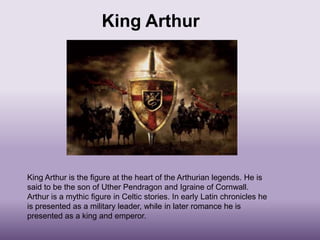
King Arthur is the figure at the heart of the Arthurian legends. He is
said to be the son of Uther Pendragon and Igraine of Cornwall.
Arthur is a mythic figure in Celtic stories. In early Latin chronicles he
is presented as a military leader, while in later romance he is
presented as a king and emperor.
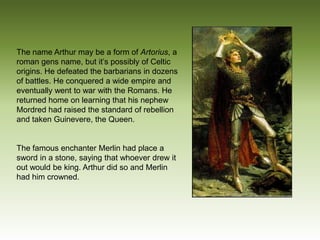
The name Arthur may be a form of Artorius, a
roman gens name, but it’s possibly of Celtic
origins. He defeated the barbarians in dozens
of battles. He conquered a wide empire and
eventually went to war with the Romans. He
returned home on learning that his nephew
Mordred had raised the standard of rebellion
and taken Guinevere, the Queen.


The famous enchanter Merlin had place a
sword in a stone, saying that whoever drew it
out would be king. Arthur did so and Merlin
had him crowned.
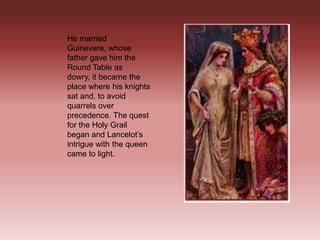
He married
Guinevere, whose
father gave him the
Round Table as
dowry, it became the
place where his knights
sat and, to avoid
quarrels over
precedence. The quest
for the Holy Grail
began and Lancelot’s
intrigue with the queen
came to light.
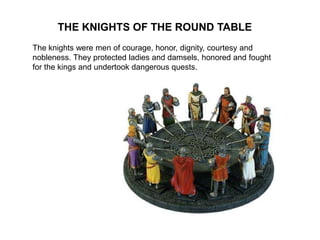
THE KNIGHTS OF THE ROUND TABLE
The knights were men of courage, honor, dignity, courtesy and
nobleness. They protected ladies and damsels, honored and fought
for the kings and undertook dangerous quests.
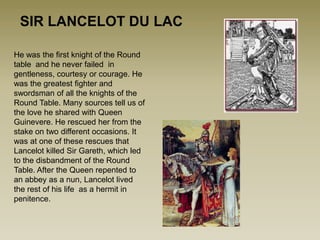
SIR LANCELOT DU LAC

He was the first knight of the Round
table and he never failed in
gentleness, courtesy or courage. He
was the greatest fighter and
swordsman of all the knights of the
Round Table. Many sources tell us of
the love he shared with Queen
Guinevere. He rescued her from the
stake on two different occasions. It
was at one of these rescues that
Lancelot killed Sir Gareth, which led
to the disbandment of the Round
Table. After the Queen repented to
an abbey as a nun, Lancelot lived
the rest of his life as a hermit in
penitence.
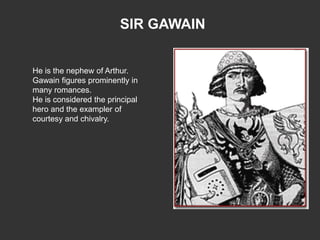
SIR GAWAIN


He is the nephew of Arthur.
Gawain figures prominently in
many romances.
He is considered the principal
hero and the exampler of
courtesy and chivalry.
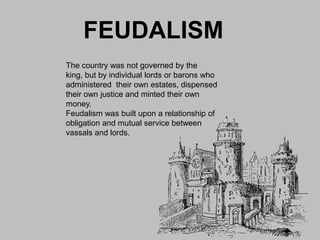
FEUDALISM
The country was not governed by the
king, but by individual lords or barons who
administered their own estates, dispensed
their own justice and minted their own
money.
Feudalism was built upon a relationship of
obligation and mutual service between
vassals and lords.
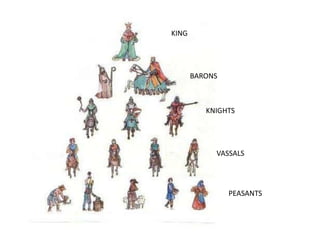
KING


       BARONS


          KNIGHTS


            VASSALS


                PEASANTS
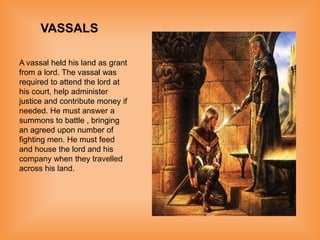
VASSALS

A vassal held his land as grant
from a lord. The vassal was
required to attend the lord at
his court, help administer
justice and contribute money if
needed. He must answer a
summons to battle , bringing
an agreed upon number of
fighting men. He must feed
and house the lord and his
company when they travelled
across his land.
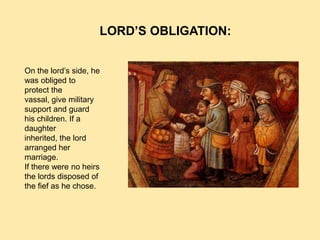
LORD’S OBLIGATION:


On the lord’s side, he
was obliged to
protect the
vassal, give military
support and guard
his children. If a
daughter
inherited, the lord
arranged her
marriage.
If there were no heirs
the lords disposed of
the fief as he chose.
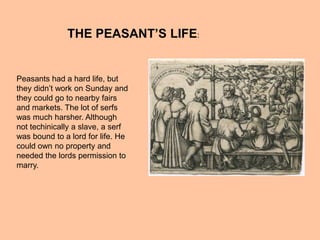
THE PEASANT’S LIFE:


Peasants had a hard life, but
they didn’t work on Sunday and
they could go to nearby fairs
and markets. The lot of serfs
was much harsher. Although
not techinically a slave, a serf
was bound to a lord for life. He
could own no property and
needed the lords permission to
marry.

Medieval presentation

  • 1.
  • 2.
    Code of Chivalry • The Arthurian Code of Chivalry was how the knights of the Round Table were expected to conduct themselves in public. • The 12 points in the Code of Conduct are as follows: • Faith • Charity • Justice • Sagacity • Prudence • Temperance • Resolution • Truth • Liberality • Diligence • Hope • Valour • Honor, Honesty and Loyalty were also unlisted but very important aspects.
  • 3.
  • 4.
    Scenes of CourtlyLove • On the front of this ivory mirror case is depicted four scenes of a knight attempting to court a lady. • The mirror case art shows the importance of courting and proper romance to the ladies of the Medieval Ages.
  • 5.
    The Codex ofAureus of St. Emmeram • The Codex Aureus of St. Emmeram is a Christian gospel book bejwelled and engraved with images of biblical tales. • The detail and expense paid for the decoration of a gospel book shows the vast importance of religion during the Medival Ages.
  • 6.
    The Assault onThe Castle of Love • A popular subject for ivory mirror cases, this depicts not an actual battle but a theoretical battle between the knights attempting to “conquer” the ladies and the ladies defending their “castle”.
  • 7.
    Impact of Religion Duringthe Middle Ages the impact of religion was detectable on nearly every piece of art and every work of literature. Religion governed the lives of nearly ever man, woman and child to be found across the globe. The Church held nearly all the legal authority as well as heavy influence on the Kings and Queens of the time period. If something was in debate, the Church settled the outcome. Literature was often completely religious works or, if not a religious tale, a story that contained biblical references. Even architecture was affected. People built towering cathedrals so they could be closer to God and nearly every person of wealth built small rooms for private worship.
  • 8.
    The Church • TheChurch influenced nearly all the literature of the Medieval Ages, banning anything that was “against God” and imprisoning those that wrote them.
  • 9.
    King Arthur King Arthuris the figure at the heart of the Arthurian legends. He is said to be the son of Uther Pendragon and Igraine of Cornwall. Arthur is a mythic figure in Celtic stories. In early Latin chronicles he is presented as a military leader, while in later romance he is presented as a king and emperor.
  • 10.
    The name Arthurmay be a form of Artorius, a roman gens name, but it’s possibly of Celtic origins. He defeated the barbarians in dozens of battles. He conquered a wide empire and eventually went to war with the Romans. He returned home on learning that his nephew Mordred had raised the standard of rebellion and taken Guinevere, the Queen. The famous enchanter Merlin had place a sword in a stone, saying that whoever drew it out would be king. Arthur did so and Merlin had him crowned.
  • 11.
    He married Guinevere, whose fathergave him the Round Table as dowry, it became the place where his knights sat and, to avoid quarrels over precedence. The quest for the Holy Grail began and Lancelot’s intrigue with the queen came to light.
  • 12.
    THE KNIGHTS OFTHE ROUND TABLE The knights were men of courage, honor, dignity, courtesy and nobleness. They protected ladies and damsels, honored and fought for the kings and undertook dangerous quests.
  • 13.
    SIR LANCELOT DULAC He was the first knight of the Round table and he never failed in gentleness, courtesy or courage. He was the greatest fighter and swordsman of all the knights of the Round Table. Many sources tell us of the love he shared with Queen Guinevere. He rescued her from the stake on two different occasions. It was at one of these rescues that Lancelot killed Sir Gareth, which led to the disbandment of the Round Table. After the Queen repented to an abbey as a nun, Lancelot lived the rest of his life as a hermit in penitence.
  • 14.
    SIR GAWAIN He isthe nephew of Arthur. Gawain figures prominently in many romances. He is considered the principal hero and the exampler of courtesy and chivalry.
  • 15.
    FEUDALISM The country wasnot governed by the king, but by individual lords or barons who administered their own estates, dispensed their own justice and minted their own money. Feudalism was built upon a relationship of obligation and mutual service between vassals and lords.
  • 16.
    KING BARONS KNIGHTS VASSALS PEASANTS
  • 17.
    VASSALS A vassal heldhis land as grant from a lord. The vassal was required to attend the lord at his court, help administer justice and contribute money if needed. He must answer a summons to battle , bringing an agreed upon number of fighting men. He must feed and house the lord and his company when they travelled across his land.
  • 18.
    LORD’S OBLIGATION: On thelord’s side, he was obliged to protect the vassal, give military support and guard his children. If a daughter inherited, the lord arranged her marriage. If there were no heirs the lords disposed of the fief as he chose.
  • 19.
    THE PEASANT’S LIFE: Peasantshad a hard life, but they didn’t work on Sunday and they could go to nearby fairs and markets. The lot of serfs was much harsher. Although not techinically a slave, a serf was bound to a lord for life. He could own no property and needed the lords permission to marry.