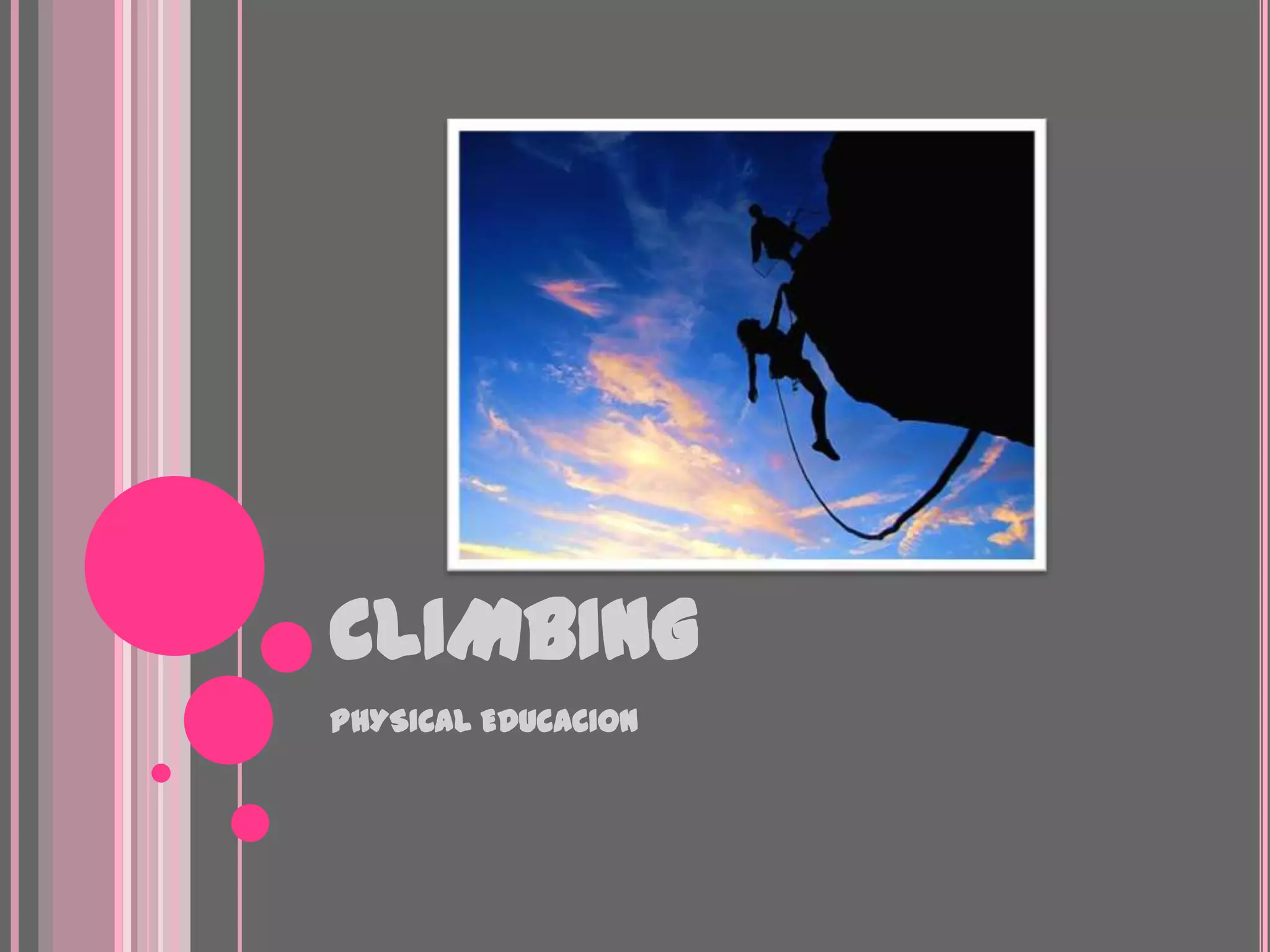
CLIMBINGPHYSICAL EDUCACION
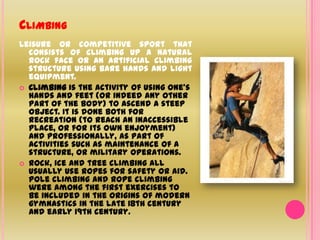
ClimbingLeisure or competitive sport that consists of climbing up a natural rock face or an artificial climbing structure using bare hands and light equipment.Climbing is the activity of using one's hands and feet (or indeed any other part of the body) to ascend a steep object. It is done both for recreation (to reach an inaccessible place, or for its own enjoyment) and professionally, as part of activities such as maintenance of a structure, or military operations.Rock, ice and tree climbing all usually use ropes for safety or aid. Pole climbing and rope climbing were among the first exercises to be included in the origins of modern gymnastics in the late 18th century and early 19th century.
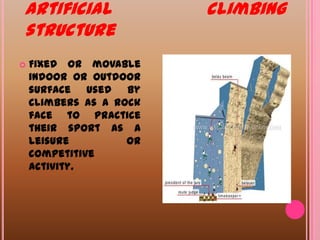
Fixed or movable indoor or outdoor surface used by climbers as a rock face to practice their sport as a leisure or competitive activity. Artificial climbing structure
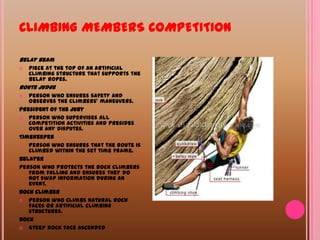
CLIMBING MEMBERS COMPETITIONBelay beamPiece at the top of an artificial climbing structure that supports the belay ropes. Route judge Person who ensures safety and observes the climbers’ maneuvers. President of the jury Person who supervises all competition activities and presides over any disputes. Timekeeper Person who ensures that the route is climbed within the set time frame. BelayerPerson who protects the rock climbers from falling and ensures they do not swap information during an event.Rock climberPerson who climbs natural rock faces or artificial climbing structures. Rock Steep rock face ascended
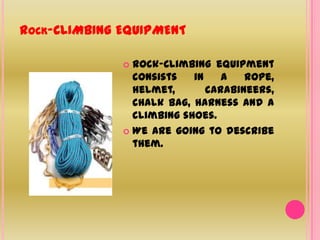
Rock-CLIMBING EQUIPMENTRock-Climbing equipment consists in a rope, helmet, carabineers, chalk bag, harness and a climbing shoes. We are going to describe them.
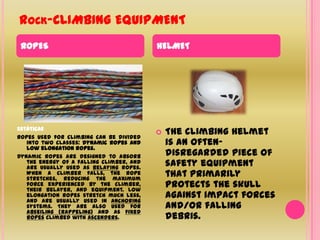
Rock-CLIMBING EQUIPMENTROPESHELMETEstáticasRopes used for climbing can be divided into two classes: dynamic ropes and low elongation ropes. Dynamic ropes are designed to absorb the energy of a falling climber, and are usually used as Belaying ropes. When a climber falls, the rope stretches, reducing the maximum force experienced by the climber, their belayer, and equipment. Low elongation ropes stretch much less, and are usually used in anchoring systems. They are also used for abseiling (rappeling) and as fixed ropes climbed with ascenders.The climbing helmet is an often-disregarded piece of safety equipment that primarily protects the skull against impact forces and/or falling debris.
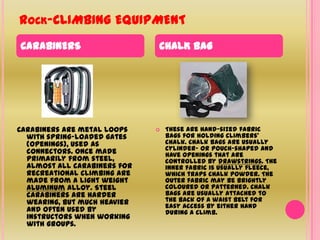
Rock-CLIMBING EQUIPMENTCARABINERSCHALK BAGCarabiners are metal loops with spring-loaded gates (openings), used as connectors. Once made primarily from steel, almost all carabiners for recreational climbing are made from a light weight aluminum alloy. Steel carabiners are harder wearing, but much heavier and often used by instructors when working with groups.These are hand-sized fabric bags for holding climbers' chalk. Chalk bags are usually cylinder- or pouch-shaped and have openings that are controlled by drawstrings. The inner fabric is usually fleece, which traps chalk powder. The outer fabric may be brightly coloured or patterned. Chalk bags are usually attached to the back of a waist belt for easy access by either hand during a climb.
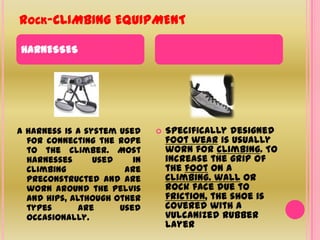
Rock-CLIMBING EQUIPMENTHARNESSESA harness is a system used for connecting the rope to the climber. Most harnesses used in climbing are preconstructed and are worn around the pelvis and hips, although other types are used occasionally.Specifically designed foot wear is usually worn for climbing. To increase the grip of the foot on a climbing. wall or rock face due to friction, the shoe is covered with a vulcanized rubber layer
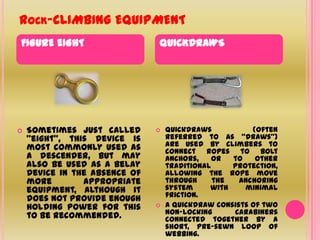
Rock-CLIMBING EQUIPMENTFIGURE EIGHTQUICKDRAWSSometimes just called "eight", this device is most commonly used as a descender, but may also be used as a belay device in the absence of more appropriate equipment, although it does not provide enough holding power for this to be recommended.Quickdraws (often referred to as "draws") are used by climbers to connect ropes to bolt anchors, or to other traditional protection, allowing the rope move through the anchoring system with minimal friction. A quickdraw consists of two non-locking carabiners connected together by a short, pre-sewn loop of webbing.
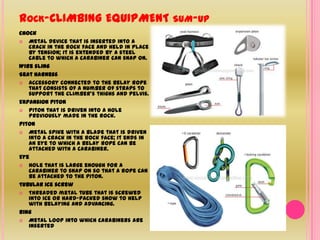
Rock-CLIMBING EQUIPMENT sum-upChock Metal device that is inserted into a crack in the rock face and held in place by tension; it is extended by a steel cable to which a carabiner can snap on. Wire sling Seat harnessAccessory connected to the belay rope that consists of a number of straps to support the climber’s thighs and pelvis. Expansion pitonPiton that is driven into a hole previously made in the rock. PitonMetal spike with a blade that is driven into a crack in the rock face; it ends in an eye to which a belay rope can be attached with a carabiner. EyeHole that is large enough for a carabiner to snap on so that a rope can be attached to the piton. Tubular ice screwThreaded metal tube that is screwed into ice or hard-packed snow to help with belaying and advancing. RingMetal loop into which carabiners are inserted
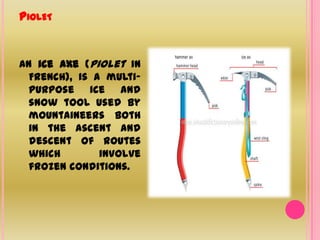
PioletAn ice axe (piolet in French), is a multi-purpose ice and snow tool used by mountaineers both in the ascent and descent of routes which involve frozen conditions.
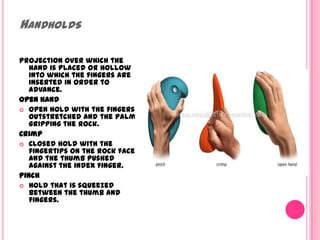
HandholdsProjection over which the hand is placed or hollow into which the fingers are inserted in order to advance. Open handOpen hold with the fingers outstretched and the palm gripping the rock. CrimpClosed hold with the fingertips on the rock face and the thumb pushed against the index finger. Pinch Hold that is squeezed between the thumb and fingers.
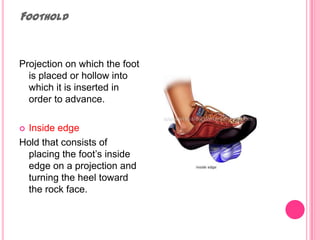
FootholdProjection on which the foot is placed or hollow into which it is inserted in order to advance. Inside edge Hold that consists of placing the foot’s inside edge on a projection and turning the heel toward the rock face.
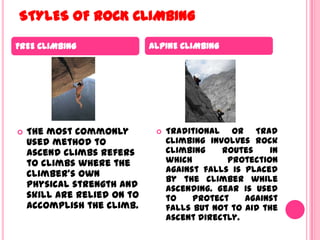
STYLES OF ROCK CLIMBINGFREE CLIMBINGALPINE CLIMBINGThe most commonly used method to ascend climbs refers to climbs where the climber's own physical strength and skill are relied on to accomplish the climb. Traditional or Trad Climbing involves rock climbing routes in which protection against falls is placed by the climber while ascending. Gear is used to protect against falls but not to aid the ascent directly.
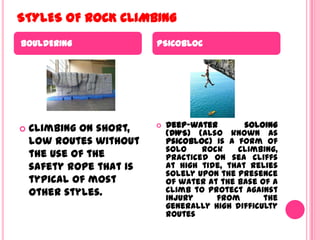
STYLES OF ROCK CLIMBINGBOULDERINGPSICOBLOCClimbing on short, low routes without the use of the safety rope that is typical of most other styles.Deep-water soloing (DWS) (also known as psicobloc) is a form of solo rock climbing, practiced on sea cliffs at high tide, that relies solely upon the presence of water at the base of a climb to protect against injury from the generally high difficulty routes
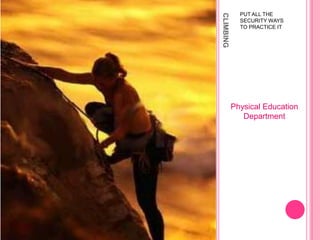
climbingPUT ALL THE SECURITY WAYS TO PRACTICE ITPhysical Education Department

CLIMBING Power Point

  • 1.
  • 2.
    ClimbingLeisure or competitivesport that consists of climbing up a natural rock face or an artificial climbing structure using bare hands and light equipment.Climbing is the activity of using one's hands and feet (or indeed any other part of the body) to ascend a steep object. It is done both for recreation (to reach an inaccessible place, or for its own enjoyment) and professionally, as part of activities such as maintenance of a structure, or military operations.Rock, ice and tree climbing all usually use ropes for safety or aid. Pole climbing and rope climbing were among the first exercises to be included in the origins of modern gymnastics in the late 18th century and early 19th century.
  • 3.
    Fixed or movableindoor or outdoor surface used by climbers as a rock face to practice their sport as a leisure or competitive activity. Artificial climbing structure
  • 4.
    CLIMBING MEMBERS COMPETITIONBelaybeamPiece at the top of an artificial climbing structure that supports the belay ropes. Route judge Person who ensures safety and observes the climbers’ maneuvers. President of the jury Person who supervises all competition activities and presides over any disputes. Timekeeper Person who ensures that the route is climbed within the set time frame. BelayerPerson who protects the rock climbers from falling and ensures they do not swap information during an event.Rock climberPerson who climbs natural rock faces or artificial climbing structures. Rock Steep rock face ascended
  • 5.
    Rock-CLIMBING EQUIPMENTRock-Climbing equipmentconsists in a rope, helmet, carabineers, chalk bag, harness and a climbing shoes. We are going to describe them.
  • 6.
    Rock-CLIMBING EQUIPMENTROPESHELMETEstáticasRopes usedfor climbing can be divided into two classes: dynamic ropes and low elongation ropes. Dynamic ropes are designed to absorb the energy of a falling climber, and are usually used as Belaying ropes. When a climber falls, the rope stretches, reducing the maximum force experienced by the climber, their belayer, and equipment. Low elongation ropes stretch much less, and are usually used in anchoring systems. They are also used for abseiling (rappeling) and as fixed ropes climbed with ascenders.The climbing helmet is an often-disregarded piece of safety equipment that primarily protects the skull against impact forces and/or falling debris.
  • 7.
    Rock-CLIMBING EQUIPMENTCARABINERSCHALK BAGCarabinersare metal loops with spring-loaded gates (openings), used as connectors. Once made primarily from steel, almost all carabiners for recreational climbing are made from a light weight aluminum alloy. Steel carabiners are harder wearing, but much heavier and often used by instructors when working with groups.These are hand-sized fabric bags for holding climbers' chalk. Chalk bags are usually cylinder- or pouch-shaped and have openings that are controlled by drawstrings. The inner fabric is usually fleece, which traps chalk powder. The outer fabric may be brightly coloured or patterned. Chalk bags are usually attached to the back of a waist belt for easy access by either hand during a climb.
  • 8.
    Rock-CLIMBING EQUIPMENTHARNESSESA harnessis a system used for connecting the rope to the climber. Most harnesses used in climbing are preconstructed and are worn around the pelvis and hips, although other types are used occasionally.Specifically designed foot wear is usually worn for climbing. To increase the grip of the foot on a climbing. wall or rock face due to friction, the shoe is covered with a vulcanized rubber layer
  • 9.
    Rock-CLIMBING EQUIPMENTFIGURE EIGHTQUICKDRAWSSometimesjust called "eight", this device is most commonly used as a descender, but may also be used as a belay device in the absence of more appropriate equipment, although it does not provide enough holding power for this to be recommended.Quickdraws (often referred to as "draws") are used by climbers to connect ropes to bolt anchors, or to other traditional protection, allowing the rope move through the anchoring system with minimal friction. A quickdraw consists of two non-locking carabiners connected together by a short, pre-sewn loop of webbing.
  • 10.
    Rock-CLIMBING EQUIPMENT sum-upChockMetal device that is inserted into a crack in the rock face and held in place by tension; it is extended by a steel cable to which a carabiner can snap on. Wire sling Seat harnessAccessory connected to the belay rope that consists of a number of straps to support the climber’s thighs and pelvis. Expansion pitonPiton that is driven into a hole previously made in the rock. PitonMetal spike with a blade that is driven into a crack in the rock face; it ends in an eye to which a belay rope can be attached with a carabiner. EyeHole that is large enough for a carabiner to snap on so that a rope can be attached to the piton. Tubular ice screwThreaded metal tube that is screwed into ice or hard-packed snow to help with belaying and advancing. RingMetal loop into which carabiners are inserted
  • 11.
    PioletAn ice axe(piolet in French), is a multi-purpose ice and snow tool used by mountaineers both in the ascent and descent of routes which involve frozen conditions.
  • 12.
    HandholdsProjection over whichthe hand is placed or hollow into which the fingers are inserted in order to advance. Open handOpen hold with the fingers outstretched and the palm gripping the rock. CrimpClosed hold with the fingertips on the rock face and the thumb pushed against the index finger. Pinch Hold that is squeezed between the thumb and fingers.
  • 13.
    FootholdProjection on whichthe foot is placed or hollow into which it is inserted in order to advance. Inside edge Hold that consists of placing the foot’s inside edge on a projection and turning the heel toward the rock face.
  • 14.
    STYLES OF ROCKCLIMBINGFREE CLIMBINGALPINE CLIMBINGThe most commonly used method to ascend climbs refers to climbs where the climber's own physical strength and skill are relied on to accomplish the climb. Traditional or Trad Climbing involves rock climbing routes in which protection against falls is placed by the climber while ascending. Gear is used to protect against falls but not to aid the ascent directly.
  • 15.
    STYLES OF ROCKCLIMBINGBOULDERINGPSICOBLOCClimbing on short, low routes without the use of the safety rope that is typical of most other styles.Deep-water soloing (DWS) (also known as psicobloc) is a form of solo rock climbing, practiced on sea cliffs at high tide, that relies solely upon the presence of water at the base of a climb to protect against injury from the generally high difficulty routes
  • 16.
    climbingPUT ALL THESECURITY WAYS TO PRACTICE ITPhysical Education Department