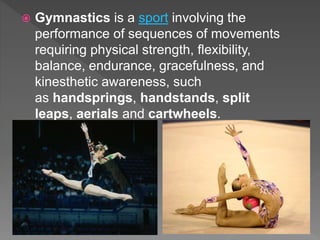
 Gymnastics is a sport involving the
performance of sequences of movements
requiring physical strength, flexibility,
balance, endurance, gracefulness, and
kinesthetic awareness, such
as handsprings, handstands, split
leaps, aerials and cartwheels.
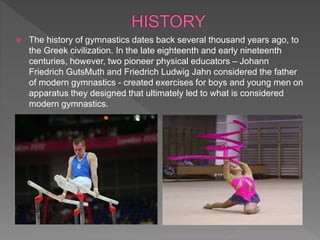
 The history of gymnastics dates back several thousand years ago, to
the Greek civilization. In the late eighteenth and early nineteenth
centuries, however, two pioneer physical educators – Johann
Friedrich GutsMuth and Friedrich Ludwig Jahn considered the father
of modern gymnastics - created exercises for boys and young men on
apparatus they designed that ultimately led to what is considered
modern gymnastics.
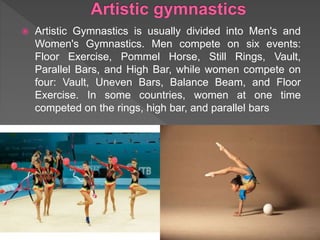
 Artistic Gymnastics is usually divided into Men's and
Women's Gymnastics. Men compete on six events:
Floor Exercise, Pommel Horse, Still Rings, Vault,
Parallel Bars, and High Bar, while women compete on
four: Vault, Uneven Bars, Balance Beam, and Floor
Exercise. In some countries, women at one time
competed on the rings, high bar, and parallel bars
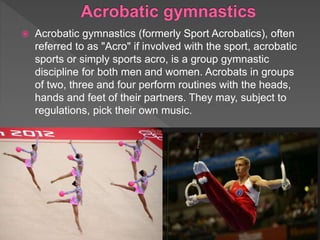
 Acrobatic gymnastics (formerly Sport Acrobatics), often
referred to as "Acro" if involved with the sport, acrobatic
sports or simply sports acro, is a group gymnastic
discipline for both men and women. Acrobats in groups
of two, three and four perform routines with the heads,
hands and feet of their partners. They may, subject to
regulations, pick their own music.
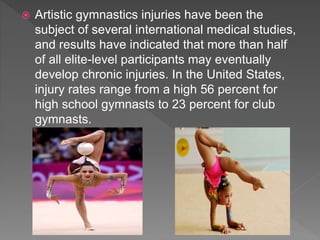
 Artistic gymnastics injuries have been the
subject of several international medical studies,
and results have indicated that more than half
of all elite-level participants may eventually
develop chronic injuries. In the United States,
injury rates range from a high 56 percent for
high school gymnasts to 23 percent for club
gymnasts.
 Artistic gymnastics injuries have been the
subject of several international medical studies,
and results have indicated that more than half
of all elite-level participants may eventually
develop chronic injuries. In the United States,
injury rates range from a high 56 percent for
high school gymnasts to 23 percent for club
gymnasts.
 Other types of gymnastics include
aerobic, rhythmic, acrobatic and
trampoline. Aerobic gymnastic routines
take place on the floor and combine
music, dancing and movements requiring
great strength. Gymnasts perform in
pairs, in groups, in trios and individually.
The patterns borrow from traditional
aerobics.
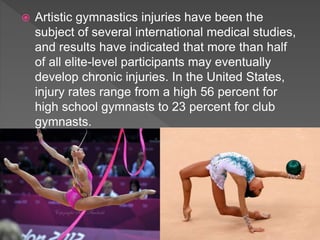
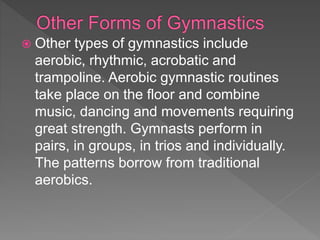
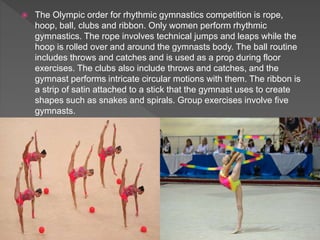
 The Olympic order for rhythmic gymnastics competition is rope,
hoop, ball, clubs and ribbon. Only women perform rhythmic
gymnastics. The rope involves technical jumps and leaps while the
hoop is rolled over and around the gymnasts body. The ball routine
includes throws and catches and is used as a prop during floor
exercises. The clubs also include throws and catches, and the
gymnast performs intricate circular motions with them. The ribbon is
a strip of satin attached to a stick that the gymnast uses to create
shapes such as snakes and spirals. Group exercises involve five
gymnasts.
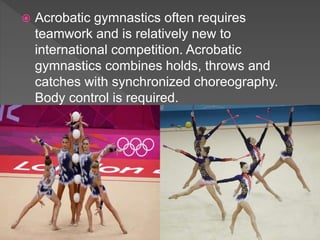
 Acrobatic gymnastics often requires
teamwork and is relatively new to
international competition. Acrobatic
gymnastics combines holds, throws and
catches with synchronized choreography.
Body control is required.
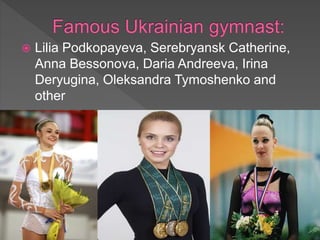
 Lilia Podkopayeva, Serebryansk Catherine,
Anna Bessonova, Daria Andreeva, Irina
Deryugina, Oleksandra Tymoshenko and
other

Gymnastics

  • 2.
     Gymnastics isa sport involving the performance of sequences of movements requiring physical strength, flexibility, balance, endurance, gracefulness, and kinesthetic awareness, such as handsprings, handstands, split leaps, aerials and cartwheels.
  • 3.
     The historyof gymnastics dates back several thousand years ago, to the Greek civilization. In the late eighteenth and early nineteenth centuries, however, two pioneer physical educators – Johann Friedrich GutsMuth and Friedrich Ludwig Jahn considered the father of modern gymnastics - created exercises for boys and young men on apparatus they designed that ultimately led to what is considered modern gymnastics.
  • 4.
     Artistic Gymnasticsis usually divided into Men's and Women's Gymnastics. Men compete on six events: Floor Exercise, Pommel Horse, Still Rings, Vault, Parallel Bars, and High Bar, while women compete on four: Vault, Uneven Bars, Balance Beam, and Floor Exercise. In some countries, women at one time competed on the rings, high bar, and parallel bars
  • 5.
     Acrobatic gymnastics(formerly Sport Acrobatics), often referred to as "Acro" if involved with the sport, acrobatic sports or simply sports acro, is a group gymnastic discipline for both men and women. Acrobats in groups of two, three and four perform routines with the heads, hands and feet of their partners. They may, subject to regulations, pick their own music.
  • 6.
     Artistic gymnasticsinjuries have been the subject of several international medical studies, and results have indicated that more than half of all elite-level participants may eventually develop chronic injuries. In the United States, injury rates range from a high 56 percent for high school gymnasts to 23 percent for club gymnasts.
  • 7.
     Artistic gymnasticsinjuries have been the subject of several international medical studies, and results have indicated that more than half of all elite-level participants may eventually develop chronic injuries. In the United States, injury rates range from a high 56 percent for high school gymnasts to 23 percent for club gymnasts.
  • 8.
     Other typesof gymnastics include aerobic, rhythmic, acrobatic and trampoline. Aerobic gymnastic routines take place on the floor and combine music, dancing and movements requiring great strength. Gymnasts perform in pairs, in groups, in trios and individually. The patterns borrow from traditional aerobics.
  • 9.
     The Olympicorder for rhythmic gymnastics competition is rope, hoop, ball, clubs and ribbon. Only women perform rhythmic gymnastics. The rope involves technical jumps and leaps while the hoop is rolled over and around the gymnasts body. The ball routine includes throws and catches and is used as a prop during floor exercises. The clubs also include throws and catches, and the gymnast performs intricate circular motions with them. The ribbon is a strip of satin attached to a stick that the gymnast uses to create shapes such as snakes and spirals. Group exercises involve five gymnasts.
  • 10.
     Acrobatic gymnasticsoften requires teamwork and is relatively new to international competition. Acrobatic gymnastics combines holds, throws and catches with synchronized choreography. Body control is required.
  • 11.
     Lilia Podkopayeva,Serebryansk Catherine, Anna Bessonova, Daria Andreeva, Irina Deryugina, Oleksandra Tymoshenko and other