?WHAT IS A
COMBAT SPORT
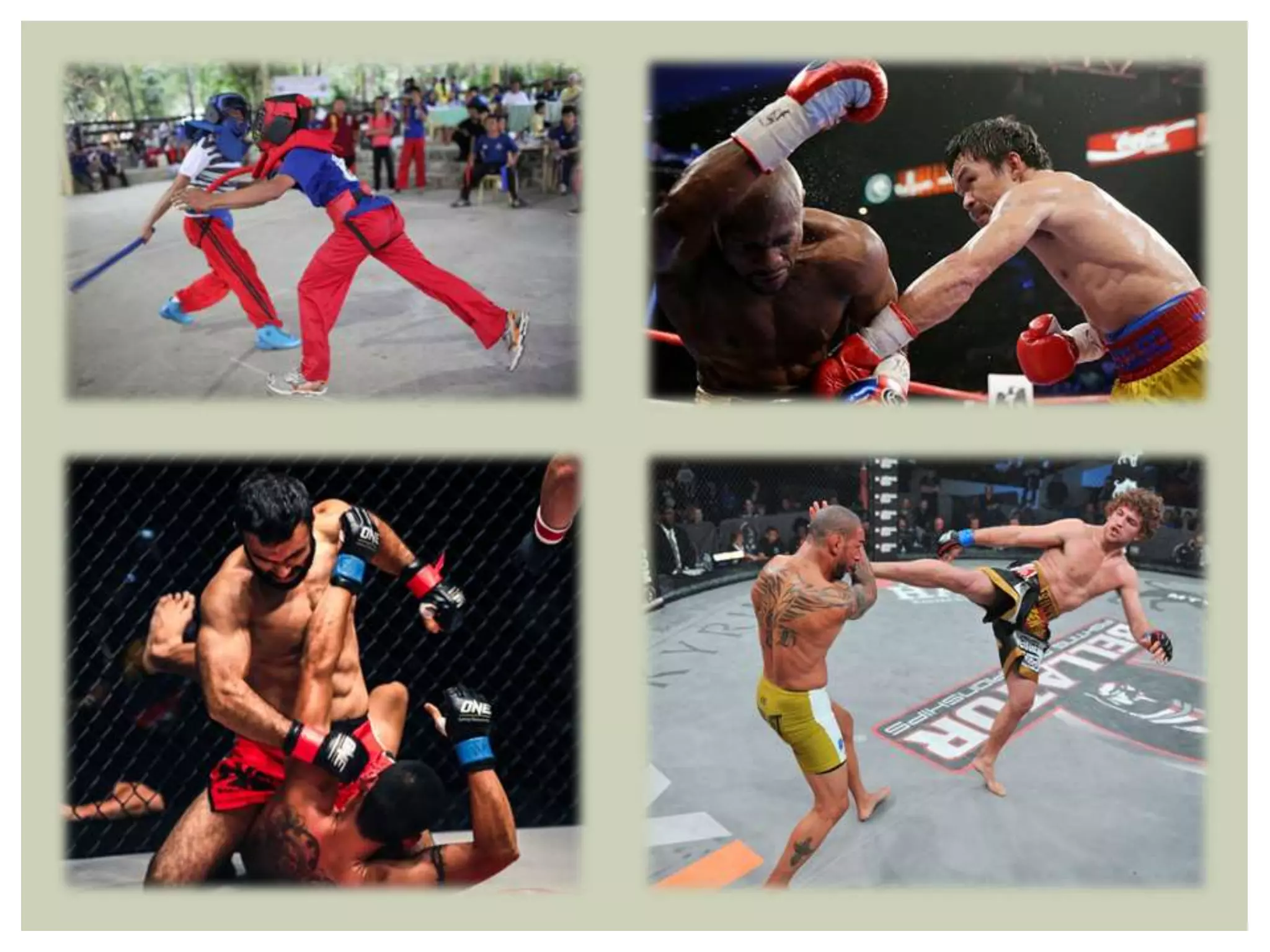
A combat sport, or fighting
sport, is a competitive contact
sport with one-on-one combat.
Determining the winner depends
on the particular contest's rules.
In many fighting sports, a
contestant wins by scoring more
points than the opponent or by
disabling the
opponent. Boxing, wrestling, Mua
y Thai, Tae Kwon
Do, Judo, Brazilian Jiu-
jitsu, Sambo, and Mixed Martial
Arts are examples of combat
sports.
 Folk wrestling exists in many forms and in most cultures, and can
be considered a cultural universal. The Ancient Olympic
Games were largely composed of sports that tested skills related
to combat, such as armored foot
races, boxing, wrestling, pankration and chariot racing, amongst
others. Combat sports are first recorded during the Olympic
games of 648 B.C. with pankration. Pankration allowed
competitors to use all striking and grappling techniques. The only
rules for this sport in its origin were no biting and no eye
gouging. A winner was decided by submission, unconsciousness,
or even death of an opponent. It is a common occurrence for
matches to last for hours. Pankration grew in popularity during
the Hellenic Period. Matches were in small square arenas to
promote engagement. This tradition of combat sports was taken
even further by the Romans with gladiators who would fight with
weapons, sometimes to the death.
HISTORY OF COMBAT SPORTS
 Through the Middle-
ages and Renaissance the tournament became popular,
with jousting as a main event. While the tournament was
popular amongst aristocrats, combative sports were practiced
by all levels of society. The German school of late medieval
martial arts distinguished sportive combat (schimpf) from
serious combat (ernst). In the German Renaissance, sportive
combat competitions were known as Fechtschulen,
corresponding to the Prize Playing in Tudor England. Out of
these Prize Playing events developed the
English boxing (or prizefighting) of the 18th century, which
evolved into modern boxing with the introduction of
the Marquess of Queensberry rules in 1867.
 Amateur boxing was part of the modern Olympic Games since
their introduction in 1904. Professional boxing became popular
in the United States in the 1920s and experienced a "golden
age" after World War II.
HISTORY OF COMBAT SPORTS
 The creation of Brazilian Jiu-Jitsu is attributed to
the Gracie family of Brazil in 1925 after Asian martial arts
were introduced to Brazil. Vale-tudo, wrestling, muay
thai kickboxing and luta livre gained popularity.
Modern Muay Thai was developed in the 1920s to
1930s. Sambo was introduced in the Soviet Union.
Modern Taekwondo also emerged after the Japanese
occupation of Korea and became an Olympic sport in
2000. Sanshou as part of modern wush was developed in
the People's Republic of China since the
1950s. Kickboxing and full contact karate were developed in
the 1960s and became popular in Japan and the West during
the 1980s and 1990s.
HISTORY OF COMBAT SPORTS
 Modern Mixed Martial Arts developed out of the interconnected
subcultures of Brazilian Jiu-Jitsu and shoot wrestling. It was
introduced in Japan in the form of Shooto in 1985, and in the
United States as Ultimate Fighting Championship [UFC] in
1993. Unified Rules of Mixed Martial Arts were introduced in 2000,
and the sport experienced a peak of popularity in the 2000s. With
the popularity of MMA hitting its peak in the 2000s it allowed for
multiple brands and promotions to become established and form
legitimate businesses. The most well-known promotion for MMA is
UFC as of 2016, this is due to being able to purchase most of the
other competitors such as Strikeforce on March 11, 2011 and
World Extreme Cagefighting (WEC) in late 2006 and later merged
with the Ultimate Fighting Championship (UFC) after its final fight
on December 16, 2010. There are still other promotions working,
such as Bellator MMA, ONE Championship and many others.
HISTORY OF COMBAT SPORTS
 Combat sporting events are now held internationally all
around the world due to the increase in popularity however
the violent nature of certain combat sports has led to some
governments having to change rules. The New South Wales
government in Australia has now created a Combat Sports
Authority of New South Wales. They have enforced a
registration policy where competitors have to register
before being permitted to fight in a scheduled contest. The
Combat Sports Authority has also lifted the prohibition of
women as boxers as this is seen as discrimination and all
cage fighting within New South Wales has been banned.
HISTORY OF COMBAT SPORTS
Today athletes usually fight one-on-one, but may
still use various skill sets such
as strikes in boxing that only
allows punching, taekwondo where punches
and kicks are the focus or muay thai and burmese
boxing that also allow the use
of elbows and knees. There are
also grappling based sports that
may concentrate on obtaining a superior
position as in freestyle or Collegiate
wrestling using throws such as
in judo and Greco-Roman wrestling the use of
submissions as in Brazilian jiu-jitsu.
Modern mixed martial arts competitions are
similar to the historic Greek Olympic sport
of pankration and allow a wide range of
both striking and grappling techniques.
Combat sports may also be armed and the
athletes compete using weapons, such as types
of sword in
western fencing (the foil, épée and saber)
and kendo (shinai). Modern combat sports may
also wear complex armour, like SCA Heavy
Combat and kendo. In Gatka and Modern
Arnis sticks are used, sometimes representing
knives and swords.
MODERN
SPORTS
:LIST OF
COMBAT SPORTS
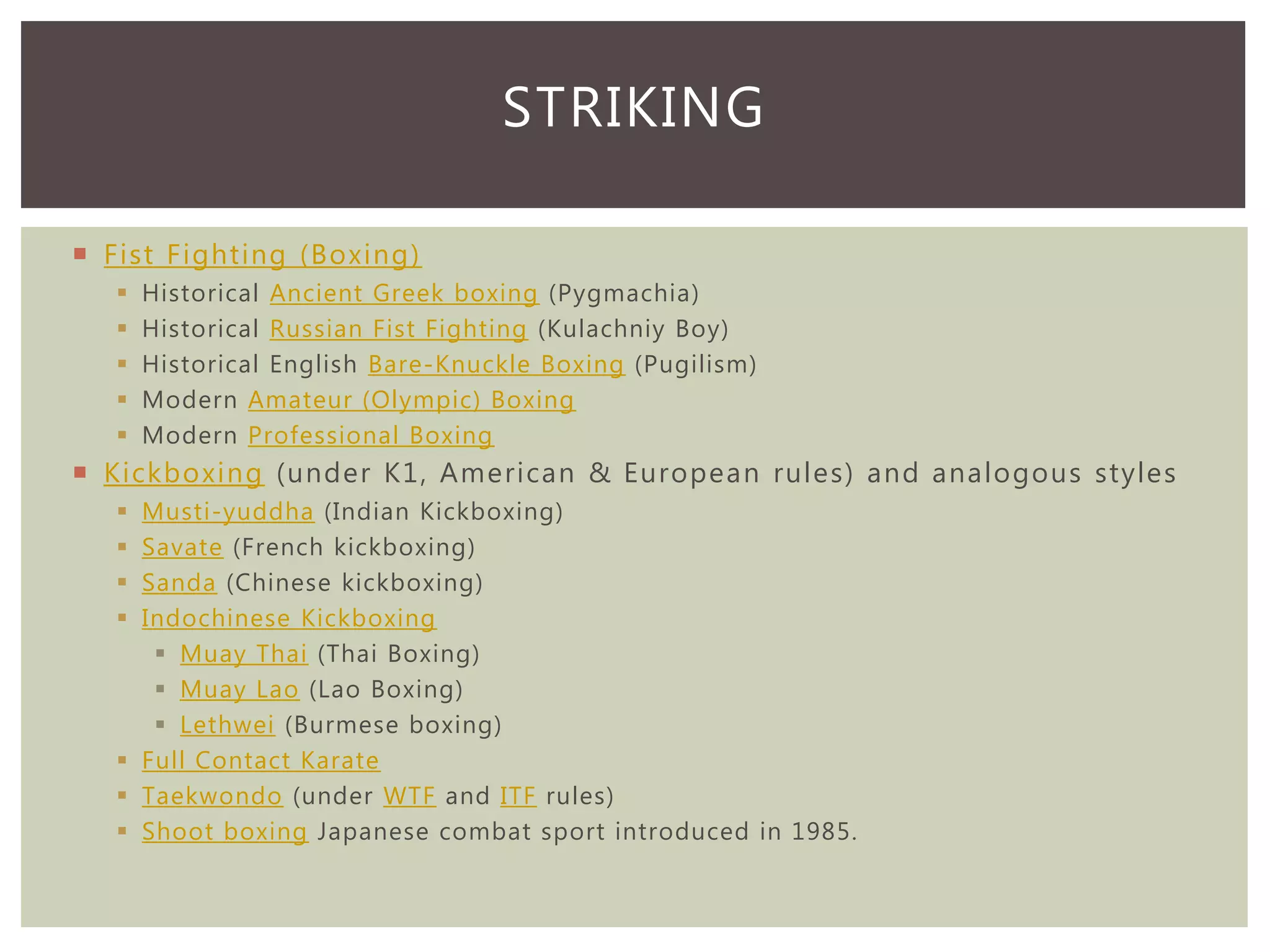
 Fist Fighting (Boxing)
 Historical Ancient Greek boxing (Pygmachia)
 Historical Russian Fist Fighting (Kulachniy Boy)
 Historical English Bare-Knuckle Boxing (Pugilism)
 Modern Amateur (Olympic) Boxing
 Modern Professional Boxing
 Kickboxing (under K1, American & European rules) and analogous styles
 Musti-yuddha (Indian Kickboxing)
 Savate (French kickboxing)
 Sanda (Chinese kickboxing)
 Indochinese Kickboxing
 Muay Thai (Thai Boxing)
 Muay Lao (Lao Boxing)
 Lethwei (Burmese boxing)
 Full Contact Karate
 Taekwondo (under WTF and ITF rules)
 Shoot boxing Japanese combat sport introduced in 1985.
STRIKING
 Pinning, clinching and takedown oriented wrestling
 Ancient Greek wrestling (Pale)
 Beach wrestling
 Belt wrestling
 Judo (Olympic Judo)
 Freestyle wrestling
 Greco-Roman wrestling (French Wrestling[6])
 Scholastic wrestling (American Folkstyle)
 Sport Sambo
 Sumo
 Submission grappling:
 Brazilian Jiu-Jitsu (under Gi & no Gi rules)
 FILA Grappling
 Folk wrestling (Numerous Regional Styles Worldwide)
 shuai jiao (chinese jacket wrestling)
 Catch wrestling (Western Submission Wrestling)
GRAPPLING
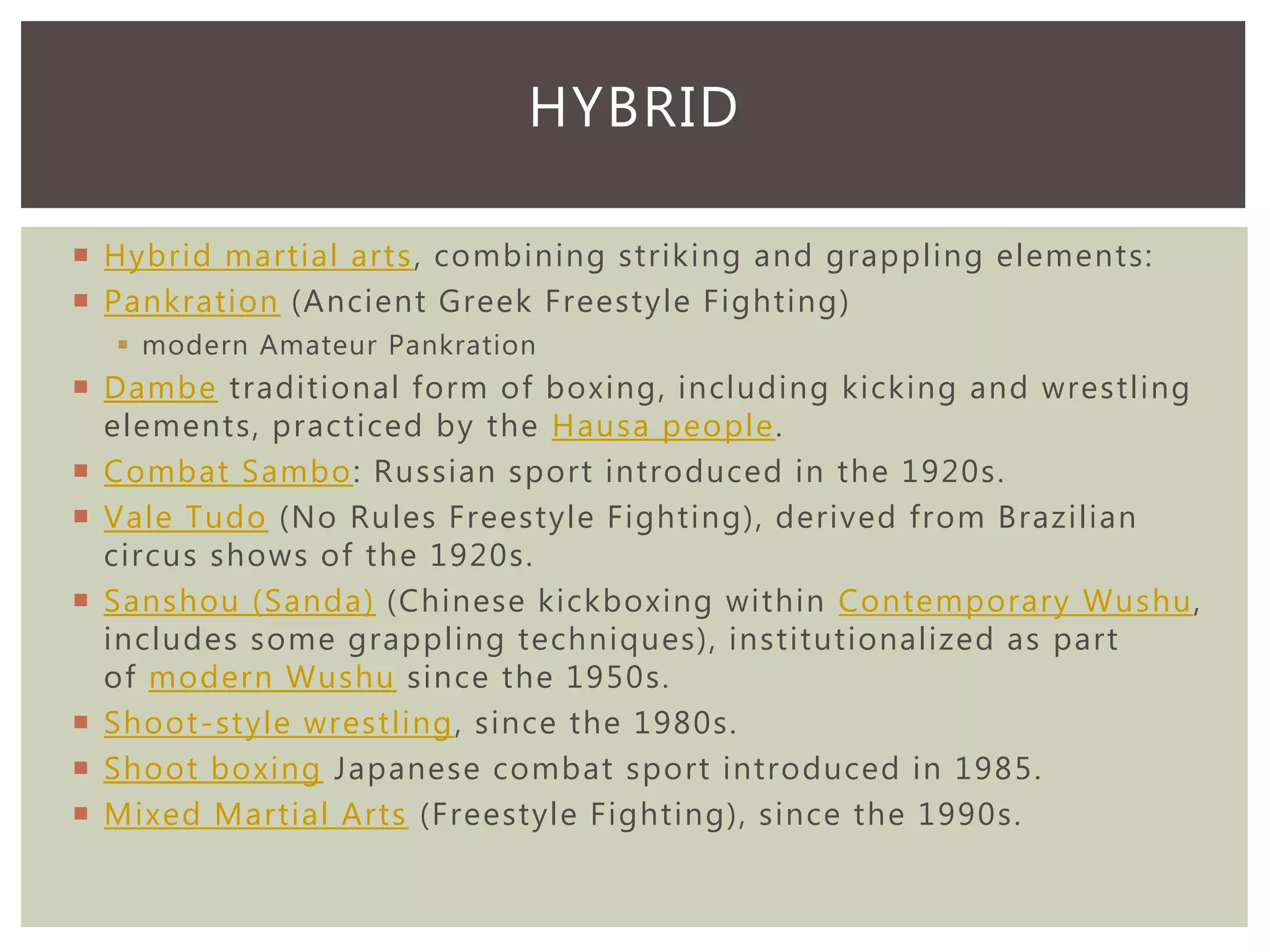
 Hybrid martial arts, combining striking and grappling elements:
 Pankration (Ancient Greek Freestyle Fighting)
 modern Amateur Pankration
 Dambe traditional form of boxing, including kicking and wrestling
elements, practiced by the Hausa people.
 Combat Sambo: Russian sport introduced in the 1920s.
 Vale Tudo (No Rules Freestyle Fighting), derived from Brazilian
circus shows of the 1920s.
 Sanshou (Sanda) (Chinese kickboxing within Contemporary Wushu,
includes some grappling techniques), institutionalized as part
of modern Wushu since the 1950s.
 Shoot-style wrestling, since the 1980s.
 Shoot boxing Japanese combat sport introduced in 1985.
 Mixed Martial Arts (Freestyle Fighting), since the 1990s.
HYBRID
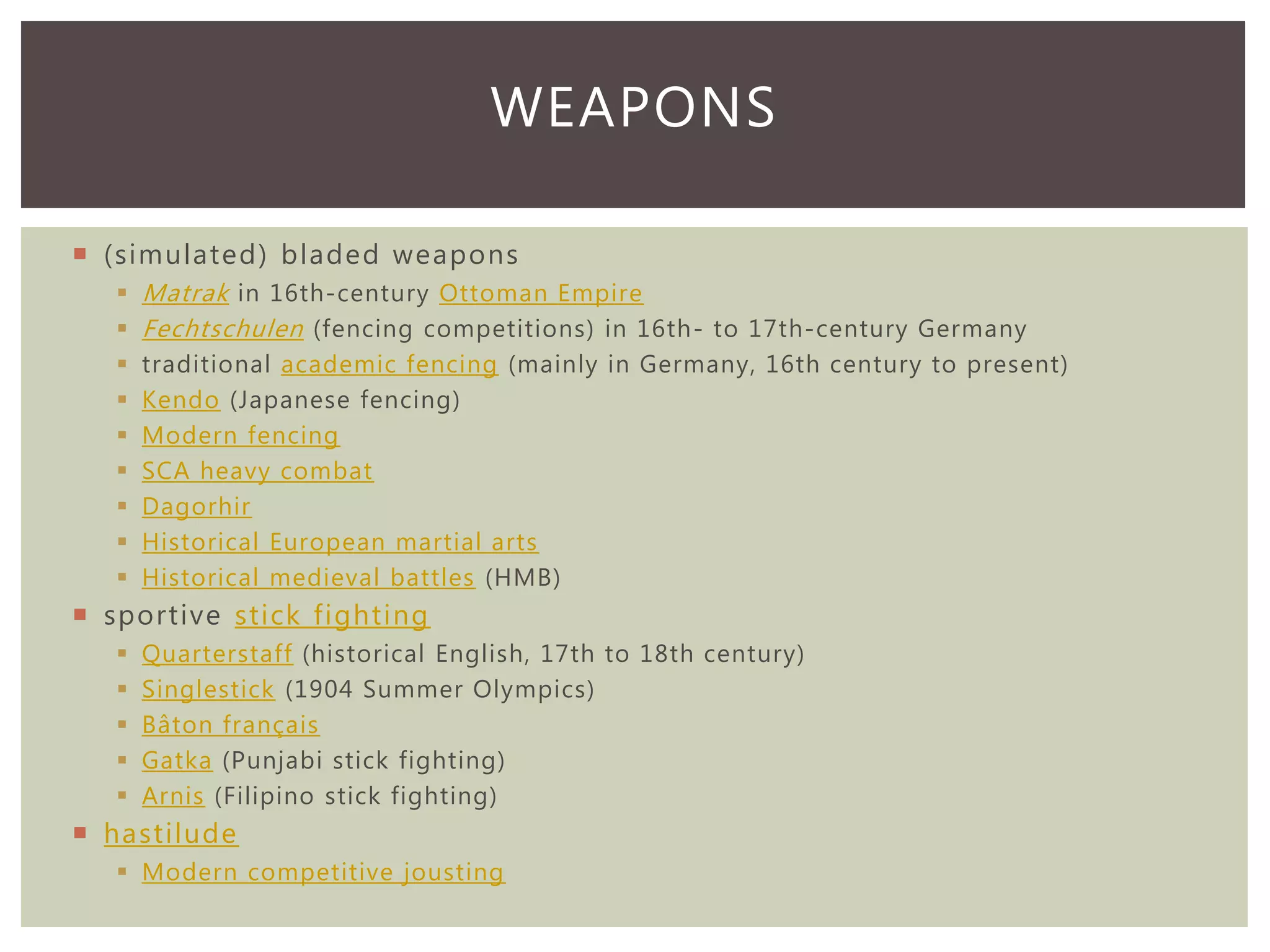
 (simulated) bladed weapons
 Matrak in 16th-century Ottoman Empire
 Fechtschulen (fencing competitions) in 16th- to 17th-century Germany
 traditional academic fencing (mainly in Germany, 16th century to present)
 Kendo (Japanese fencing)
 Modern fencing
 SCA heavy combat
 Dagorhir
 Historical European martial arts
 Historical medieval battles (HMB)
 sportive stick fighting
 Quarterstaff (historical English, 17th to 18th century)
 Singlestick (1904 Summer Olympics)
 Bâton français
 Gatka (Punjabi stick fighting)
 Arnis (Filipino stick fighting)
 hastilude
 Modern competitive jousting
WEAPONS
 The techniques used can be categorized into
three domains: striking, grappling,
and weapon usage, with some hybrid rule-
sets combining striking and grappling. In
combat sports the use of these various
techniques are highly regulated to minimize
permanent or severe physical damage to
each participant though means of organized
officiating by a single or multiple referees
that can distribute penalties or interrupt the
actions of the competitors during the
competition. In weapon based sports, the
weapons used are made to be non-lethal by
means of modifying the striking portions of
the weapon and requiring participants to
wear protective clothing/armor.
TECHNIQUES
Gloves
Head gear
Mouthguard
Shin Guards
Arm Guards
Groin Guard
Trunk Protector
Wraps (Material wrapped
around the hand that
provides added protection
and support)
PROTECTIVE
GEAR
 Angeles, Jann Audrey
 Armesa, Lalaine
 Dioso, Mary Joyce
 Natural, Elaiza
 Nunez, Maria Farrah
 Sinsay, Loura Mae
 Tapalla, Janne
 Taylor, Cherrylyn
 Moreno, Peter
 Rota, John Darell
 Sarabia, Jan Ry
 Villanueva, Adrian
G11 – F. BALTAZAR GROUP 3

[Bltzr] Group 3 - Combat Sports

  • 3.
  • 4.
    A combat sport,or fighting sport, is a competitive contact sport with one-on-one combat. Determining the winner depends on the particular contest's rules. In many fighting sports, a contestant wins by scoring more points than the opponent or by disabling the opponent. Boxing, wrestling, Mua y Thai, Tae Kwon Do, Judo, Brazilian Jiu- jitsu, Sambo, and Mixed Martial Arts are examples of combat sports.
  • 5.
     Folk wrestlingexists in many forms and in most cultures, and can be considered a cultural universal. The Ancient Olympic Games were largely composed of sports that tested skills related to combat, such as armored foot races, boxing, wrestling, pankration and chariot racing, amongst others. Combat sports are first recorded during the Olympic games of 648 B.C. with pankration. Pankration allowed competitors to use all striking and grappling techniques. The only rules for this sport in its origin were no biting and no eye gouging. A winner was decided by submission, unconsciousness, or even death of an opponent. It is a common occurrence for matches to last for hours. Pankration grew in popularity during the Hellenic Period. Matches were in small square arenas to promote engagement. This tradition of combat sports was taken even further by the Romans with gladiators who would fight with weapons, sometimes to the death. HISTORY OF COMBAT SPORTS
  • 6.
     Through theMiddle- ages and Renaissance the tournament became popular, with jousting as a main event. While the tournament was popular amongst aristocrats, combative sports were practiced by all levels of society. The German school of late medieval martial arts distinguished sportive combat (schimpf) from serious combat (ernst). In the German Renaissance, sportive combat competitions were known as Fechtschulen, corresponding to the Prize Playing in Tudor England. Out of these Prize Playing events developed the English boxing (or prizefighting) of the 18th century, which evolved into modern boxing with the introduction of the Marquess of Queensberry rules in 1867.  Amateur boxing was part of the modern Olympic Games since their introduction in 1904. Professional boxing became popular in the United States in the 1920s and experienced a "golden age" after World War II. HISTORY OF COMBAT SPORTS
  • 7.
     The creationof Brazilian Jiu-Jitsu is attributed to the Gracie family of Brazil in 1925 after Asian martial arts were introduced to Brazil. Vale-tudo, wrestling, muay thai kickboxing and luta livre gained popularity. Modern Muay Thai was developed in the 1920s to 1930s. Sambo was introduced in the Soviet Union. Modern Taekwondo also emerged after the Japanese occupation of Korea and became an Olympic sport in 2000. Sanshou as part of modern wush was developed in the People's Republic of China since the 1950s. Kickboxing and full contact karate were developed in the 1960s and became popular in Japan and the West during the 1980s and 1990s. HISTORY OF COMBAT SPORTS
  • 8.
     Modern MixedMartial Arts developed out of the interconnected subcultures of Brazilian Jiu-Jitsu and shoot wrestling. It was introduced in Japan in the form of Shooto in 1985, and in the United States as Ultimate Fighting Championship [UFC] in 1993. Unified Rules of Mixed Martial Arts were introduced in 2000, and the sport experienced a peak of popularity in the 2000s. With the popularity of MMA hitting its peak in the 2000s it allowed for multiple brands and promotions to become established and form legitimate businesses. The most well-known promotion for MMA is UFC as of 2016, this is due to being able to purchase most of the other competitors such as Strikeforce on March 11, 2011 and World Extreme Cagefighting (WEC) in late 2006 and later merged with the Ultimate Fighting Championship (UFC) after its final fight on December 16, 2010. There are still other promotions working, such as Bellator MMA, ONE Championship and many others. HISTORY OF COMBAT SPORTS
  • 9.
     Combat sportingevents are now held internationally all around the world due to the increase in popularity however the violent nature of certain combat sports has led to some governments having to change rules. The New South Wales government in Australia has now created a Combat Sports Authority of New South Wales. They have enforced a registration policy where competitors have to register before being permitted to fight in a scheduled contest. The Combat Sports Authority has also lifted the prohibition of women as boxers as this is seen as discrimination and all cage fighting within New South Wales has been banned. HISTORY OF COMBAT SPORTS
  • 10.
    Today athletes usuallyfight one-on-one, but may still use various skill sets such as strikes in boxing that only allows punching, taekwondo where punches and kicks are the focus or muay thai and burmese boxing that also allow the use of elbows and knees. There are also grappling based sports that may concentrate on obtaining a superior position as in freestyle or Collegiate wrestling using throws such as in judo and Greco-Roman wrestling the use of submissions as in Brazilian jiu-jitsu. Modern mixed martial arts competitions are similar to the historic Greek Olympic sport of pankration and allow a wide range of both striking and grappling techniques. Combat sports may also be armed and the athletes compete using weapons, such as types of sword in western fencing (the foil, épée and saber) and kendo (shinai). Modern combat sports may also wear complex armour, like SCA Heavy Combat and kendo. In Gatka and Modern Arnis sticks are used, sometimes representing knives and swords. MODERN SPORTS
  • 11.
  • 12.
     Fist Fighting(Boxing)  Historical Ancient Greek boxing (Pygmachia)  Historical Russian Fist Fighting (Kulachniy Boy)  Historical English Bare-Knuckle Boxing (Pugilism)  Modern Amateur (Olympic) Boxing  Modern Professional Boxing  Kickboxing (under K1, American & European rules) and analogous styles  Musti-yuddha (Indian Kickboxing)  Savate (French kickboxing)  Sanda (Chinese kickboxing)  Indochinese Kickboxing  Muay Thai (Thai Boxing)  Muay Lao (Lao Boxing)  Lethwei (Burmese boxing)  Full Contact Karate  Taekwondo (under WTF and ITF rules)  Shoot boxing Japanese combat sport introduced in 1985. STRIKING
  • 13.
     Pinning, clinchingand takedown oriented wrestling  Ancient Greek wrestling (Pale)  Beach wrestling  Belt wrestling  Judo (Olympic Judo)  Freestyle wrestling  Greco-Roman wrestling (French Wrestling[6])  Scholastic wrestling (American Folkstyle)  Sport Sambo  Sumo  Submission grappling:  Brazilian Jiu-Jitsu (under Gi & no Gi rules)  FILA Grappling  Folk wrestling (Numerous Regional Styles Worldwide)  shuai jiao (chinese jacket wrestling)  Catch wrestling (Western Submission Wrestling) GRAPPLING
  • 14.
     Hybrid martialarts, combining striking and grappling elements:  Pankration (Ancient Greek Freestyle Fighting)  modern Amateur Pankration  Dambe traditional form of boxing, including kicking and wrestling elements, practiced by the Hausa people.  Combat Sambo: Russian sport introduced in the 1920s.  Vale Tudo (No Rules Freestyle Fighting), derived from Brazilian circus shows of the 1920s.  Sanshou (Sanda) (Chinese kickboxing within Contemporary Wushu, includes some grappling techniques), institutionalized as part of modern Wushu since the 1950s.  Shoot-style wrestling, since the 1980s.  Shoot boxing Japanese combat sport introduced in 1985.  Mixed Martial Arts (Freestyle Fighting), since the 1990s. HYBRID
  • 15.
     (simulated) bladedweapons  Matrak in 16th-century Ottoman Empire  Fechtschulen (fencing competitions) in 16th- to 17th-century Germany  traditional academic fencing (mainly in Germany, 16th century to present)  Kendo (Japanese fencing)  Modern fencing  SCA heavy combat  Dagorhir  Historical European martial arts  Historical medieval battles (HMB)  sportive stick fighting  Quarterstaff (historical English, 17th to 18th century)  Singlestick (1904 Summer Olympics)  Bâton français  Gatka (Punjabi stick fighting)  Arnis (Filipino stick fighting)  hastilude  Modern competitive jousting WEAPONS
  • 16.
     The techniquesused can be categorized into three domains: striking, grappling, and weapon usage, with some hybrid rule- sets combining striking and grappling. In combat sports the use of these various techniques are highly regulated to minimize permanent or severe physical damage to each participant though means of organized officiating by a single or multiple referees that can distribute penalties or interrupt the actions of the competitors during the competition. In weapon based sports, the weapons used are made to be non-lethal by means of modifying the striking portions of the weapon and requiring participants to wear protective clothing/armor. TECHNIQUES
  • 17.
    Gloves Head gear Mouthguard Shin Guards ArmGuards Groin Guard Trunk Protector Wraps (Material wrapped around the hand that provides added protection and support) PROTECTIVE GEAR
  • 18.
     Angeles, JannAudrey  Armesa, Lalaine  Dioso, Mary Joyce  Natural, Elaiza  Nunez, Maria Farrah  Sinsay, Loura Mae  Tapalla, Janne  Taylor, Cherrylyn  Moreno, Peter  Rota, John Darell  Sarabia, Jan Ry  Villanueva, Adrian G11 – F. BALTAZAR GROUP 3