Modified by: Prof. KARTHIK
JCT COLLEGE OF ENGINEERING AND TECHNOLOGY
What is Mechatronics?
Education,Research& Development
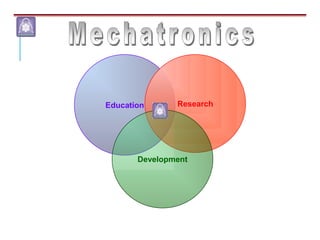
Education Research
Development
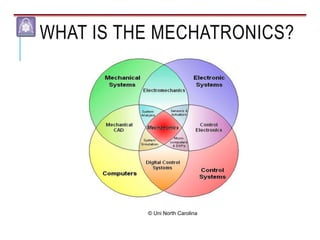
WHAT IS THE
MECHATRONICS?
Mechatronics basically refers to mechanical electrical systems
and is centered on mechanics, electronics, computing and
control which, combined, make possible the generation of
simpler, more economical, reliable and versatile systems.
WHAT IS THE MECHATRONICS?
© Uni North Carolina
MECHATRONICS CURRICULA
Introduction to engineering (Eng. math, physics, chemistry, mechanical
systems, Eng. drawing, etc.),
Engineering software; Basic Language at MSU for SSE 120
Fundamental of mechanical system design and analysis
Electronic devices, circuits and systems
Digital systems, computer architecture and computer interface
Robotics (sensors, actuators, control, vision, AI, etc.)
Instrumentation and measurements
SolidWorks CAD Design
Embedded systems, sensors, actuators and software
Integrated mechanical/electrical systems
MECHATRONICS LABS
۩ Computer software
۩ Embedded systems
۩ CAD
۩ Digital electronics
۩ Electronics
۩ Electrical/mechanical applications
 Embedded Systems
A combination of hardware and software
which together form a component of a
Mechatronics systems. An embedded
system is designed to run on its own
without human intervention, and may be
required to respond to events in real time.
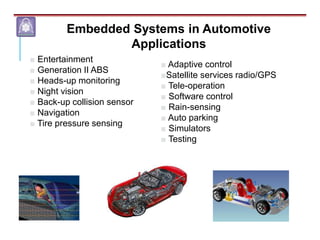
■ Adaptive control
■Satellite services radio/GPS
■ Tele-operation
■ Software control
■ Rain-sensing
■ Auto parking
■ Simulators
■ Testing
■ Entertainment
■ Generation II ABS
■ Heads-up monitoring
■ Night vision
■ Back-up collision sensor
■ Navigation
■ Tire pressure sensing
Embedded Systems in Automotive
Applications
HARDWARE, SOFTWARE, AND
FIRMWARE
Hardware is the name given to the physical devices and circuitry
of the computer.
Software refers to the programs written for the computer.
Firmware is the term given to programs stored in ROMs or in
Programmable devices which permanently keep their stored
information.
ROBOTICS CURRICULA
Introduction to Robotics: Different types of robot platforms (humanoid, Car-
like, miniature, manipulators, animators, indoor, outdoor, space robots, medical
robots, under water robots, locomotion, areal robots, educational robots, legged
robots, mobile robots, robot simulators etc.)
Path Planning: objectives and methods (Voronoi, Bug, potential field, visibility,
reactive, road map).
Environment modeling: the general meaning and the applied techniques
(occupancy grid, topological graphs, integrated, 3D modeling)
.
Distributed sensors: IR, laser, sonar, E-nose, vision, artificial skin, artificial ear
etc.
Robot actuators: Hydraulic, pneumatic and electric drives (DC, Ac, servo, and
stepper motors)
Self localization: Introduction and techniques (SLAM, Markov, Bayes network,
expectation maximizing, maximum likelihood).
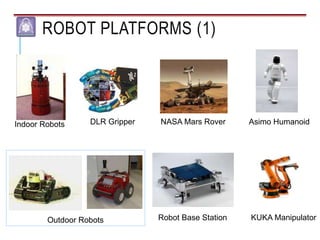
ROBOT PLATFORMS (1)
Indoor Robots DLR Gripper NASA Mars Rover Asimo Humanoid
Outdoor Robots Robot Base Station KUKA Manipulator
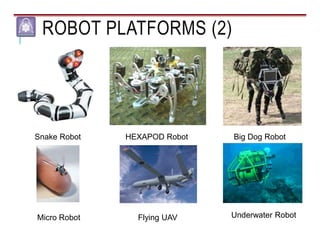
ROBOT PLATFORMS (2)
Big Dog Robot
HEXAPOD Robot
Snake Robot
Underwater Robot
Flying UAV
Micro Robot
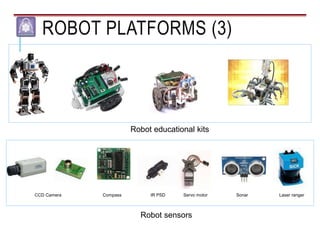
ROBOT PLATFORMS (3)
Robot educational kits
Robot sensors
CCD Camera Compass IR PSD Sonar Laser ranger
Servo motor
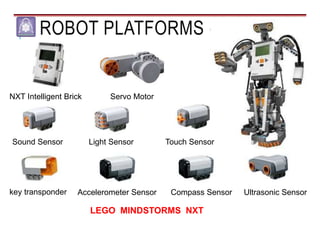
ROBOT PLATFORMS (4)
Light Sensor
Sound Sensor
Ultrasonic Sensor
Compass Sensor
Accelerometer Sensor
key transponder
NXT Intelligent Brick Servo Motor
LEGO MINDSTORMS NXT
Touch Sensor
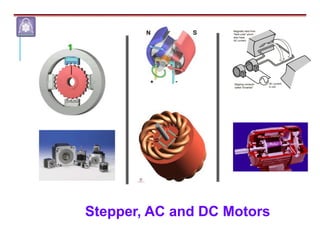
Stepper, AC and DC Motors
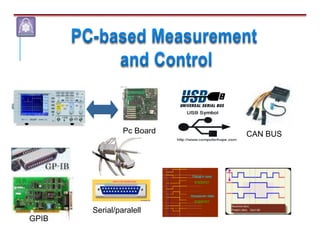
Pc Board
GPIB
Serial/paralell
CAN BUS
BUSES: USB
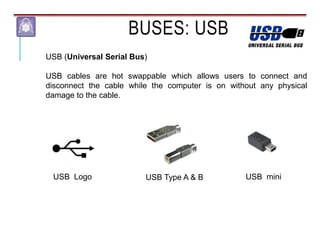
USB (Universal Serial Bus)
USB cables are hot swappable which allows users to connect and
disconnect the cable while the computer is on without any physical
damage to the cable.
USB Type A & B
USB Logo USB mini
BUSES: USB
USB Specifications:
 A unique connector
 Hub topology
 Auto detection and configuration
 Low power
 High Performance
 Supports up to 127 external devices
 Provides power
 BW:USB 1.1: 12 Mb/s, USB 2.0: 480 Mb/s
BUSES: USB
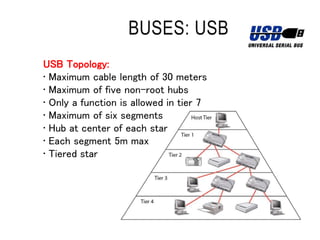
USB Topology:
• Maximum cable length of 30 meters
• Maximum of five non-root hubs
• Only a function is allowed in tier 7
• Maximum of six segments
• Hub at center of each star
• Each segment 5m max
• Tiered star
BUSES: USB
USB Devices:
 HUB
◦ Simplifies USB Connectivity
◦ Detect attach and detach
 Functions
◦ USB devices that transmit or receive data
BUSES: CAN
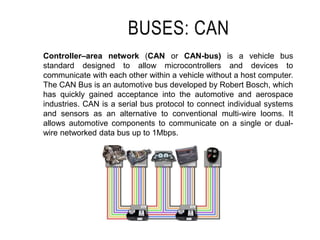
Controller–area network (CAN or CAN-bus) is a vehicle bus
standard designed to allow microcontrollers and devices to
communicate with each other within a vehicle without a host computer.
The CAN Bus is an automotive bus developed by Robert Bosch, which
has quickly gained acceptance into the automotive and aerospace
industries. CAN is a serial bus protocol to connect individual systems
and sensors as an alternative to conventional multi-wire looms. It
allows automotive components to communicate on a single or dual-
wire networked data bus up to 1Mbps.
BUSES: CAN
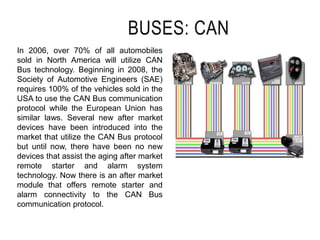
In 2006, over 70% of all automobiles
sold in North America will utilize CAN
Bus technology. Beginning in 2008, the
Society of Automotive Engineers (SAE)
requires 100% of the vehicles sold in the
USA to use the CAN Bus communication
protocol while the European Union has
similar laws. Several new after market
devices have been introduced into the
market that utilize the CAN Bus protocol
but until now, there have been no new
devices that assist the aging after market
remote starter and alarm system
technology. Now there is an after market
module that offers remote starter and
alarm connectivity to the CAN Bus
communication protocol.
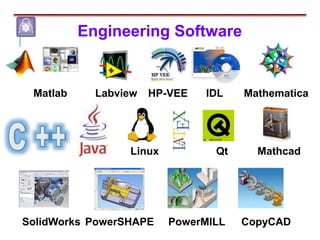
Engineering Software
IDL
Matlab Labview HP-VEE
Linux Qt
Mathematica
Mathcad
SolidWorks PowerSHAPE PowerMILL CopyCAD
END

What is mechatronics ppt

  • 1.
    Modified by: Prof.KARTHIK JCT COLLEGE OF ENGINEERING AND TECHNOLOGY What is Mechatronics? Education,Research& Development
  • 2.
  • 3.
    WHAT IS THE MECHATRONICS? Mechatronicsbasically refers to mechanical electrical systems and is centered on mechanics, electronics, computing and control which, combined, make possible the generation of simpler, more economical, reliable and versatile systems.
  • 4.
    WHAT IS THEMECHATRONICS? © Uni North Carolina
  • 5.
    MECHATRONICS CURRICULA Introduction toengineering (Eng. math, physics, chemistry, mechanical systems, Eng. drawing, etc.), Engineering software; Basic Language at MSU for SSE 120 Fundamental of mechanical system design and analysis Electronic devices, circuits and systems Digital systems, computer architecture and computer interface Robotics (sensors, actuators, control, vision, AI, etc.) Instrumentation and measurements SolidWorks CAD Design Embedded systems, sensors, actuators and software Integrated mechanical/electrical systems
  • 6.
    MECHATRONICS LABS ۩ Computersoftware ۩ Embedded systems ۩ CAD ۩ Digital electronics ۩ Electronics ۩ Electrical/mechanical applications
  • 7.
     Embedded Systems Acombination of hardware and software which together form a component of a Mechatronics systems. An embedded system is designed to run on its own without human intervention, and may be required to respond to events in real time.
  • 8.
    ■ Adaptive control ■Satelliteservices radio/GPS ■ Tele-operation ■ Software control ■ Rain-sensing ■ Auto parking ■ Simulators ■ Testing ■ Entertainment ■ Generation II ABS ■ Heads-up monitoring ■ Night vision ■ Back-up collision sensor ■ Navigation ■ Tire pressure sensing Embedded Systems in Automotive Applications
  • 9.
    HARDWARE, SOFTWARE, AND FIRMWARE Hardwareis the name given to the physical devices and circuitry of the computer. Software refers to the programs written for the computer. Firmware is the term given to programs stored in ROMs or in Programmable devices which permanently keep their stored information.
  • 10.
    ROBOTICS CURRICULA Introduction toRobotics: Different types of robot platforms (humanoid, Car- like, miniature, manipulators, animators, indoor, outdoor, space robots, medical robots, under water robots, locomotion, areal robots, educational robots, legged robots, mobile robots, robot simulators etc.) Path Planning: objectives and methods (Voronoi, Bug, potential field, visibility, reactive, road map). Environment modeling: the general meaning and the applied techniques (occupancy grid, topological graphs, integrated, 3D modeling) . Distributed sensors: IR, laser, sonar, E-nose, vision, artificial skin, artificial ear etc. Robot actuators: Hydraulic, pneumatic and electric drives (DC, Ac, servo, and stepper motors) Self localization: Introduction and techniques (SLAM, Markov, Bayes network, expectation maximizing, maximum likelihood).
  • 11.
    ROBOT PLATFORMS (1) IndoorRobots DLR Gripper NASA Mars Rover Asimo Humanoid Outdoor Robots Robot Base Station KUKA Manipulator
  • 12.
    ROBOT PLATFORMS (2) BigDog Robot HEXAPOD Robot Snake Robot Underwater Robot Flying UAV Micro Robot
  • 13.
    ROBOT PLATFORMS (3) Roboteducational kits Robot sensors CCD Camera Compass IR PSD Sonar Laser ranger Servo motor
  • 14.
    ROBOT PLATFORMS (4) LightSensor Sound Sensor Ultrasonic Sensor Compass Sensor Accelerometer Sensor key transponder NXT Intelligent Brick Servo Motor LEGO MINDSTORMS NXT Touch Sensor
  • 15.
    Stepper, AC andDC Motors
  • 16.
  • 17.
    BUSES: USB USB (UniversalSerial Bus) USB cables are hot swappable which allows users to connect and disconnect the cable while the computer is on without any physical damage to the cable. USB Type A & B USB Logo USB mini
  • 18.
    BUSES: USB USB Specifications: A unique connector  Hub topology  Auto detection and configuration  Low power  High Performance  Supports up to 127 external devices  Provides power  BW:USB 1.1: 12 Mb/s, USB 2.0: 480 Mb/s
  • 19.
    BUSES: USB USB Topology: •Maximum cable length of 30 meters • Maximum of five non-root hubs • Only a function is allowed in tier 7 • Maximum of six segments • Hub at center of each star • Each segment 5m max • Tiered star
  • 20.
    BUSES: USB USB Devices: HUB ◦ Simplifies USB Connectivity ◦ Detect attach and detach  Functions ◦ USB devices that transmit or receive data
  • 21.
    BUSES: CAN Controller–area network(CAN or CAN-bus) is a vehicle bus standard designed to allow microcontrollers and devices to communicate with each other within a vehicle without a host computer. The CAN Bus is an automotive bus developed by Robert Bosch, which has quickly gained acceptance into the automotive and aerospace industries. CAN is a serial bus protocol to connect individual systems and sensors as an alternative to conventional multi-wire looms. It allows automotive components to communicate on a single or dual- wire networked data bus up to 1Mbps.
  • 22.
    BUSES: CAN In 2006,over 70% of all automobiles sold in North America will utilize CAN Bus technology. Beginning in 2008, the Society of Automotive Engineers (SAE) requires 100% of the vehicles sold in the USA to use the CAN Bus communication protocol while the European Union has similar laws. Several new after market devices have been introduced into the market that utilize the CAN Bus protocol but until now, there have been no new devices that assist the aging after market remote starter and alarm system technology. Now there is an after market module that offers remote starter and alarm connectivity to the CAN Bus communication protocol.
  • 23.
    Engineering Software IDL Matlab LabviewHP-VEE Linux Qt Mathematica Mathcad SolidWorks PowerSHAPE PowerMILL CopyCAD
  • 24.