Program (B.Tech) – Semester (V)
Course ( Name of the course)
Session No (2020-21)
Introduction to Mechatronics
By
Prof. Kumar Kanishka
Disclaimer: This PPT is the property of the ICFAI University, Jharkhand and can be used only for the educational purpose of the students of the University
• Introduction to Mechatronics.
• Definition of Mechatronics.
• Importance of Mechatronics in automation.
• Mechatronics system.
• Disciplinary Foundations of Mechatronics.
• Levels of Mechatronic Systems’ Integration.
• Mechatronics Systems in our daily life.
• Mechatronics Systems in Manufacturing Applications.
• Mechatronics Systems in Transportation Applications.
• Smart RoboticsApplication.
Table of Contents
1
2
After this session the learner will be able to:
• To study the definition and elements of
mechatronics system.
• To learn how to apply the principles of mechatronics
and automation for the development of systems.
Learning Objectives
Introduction
Introduction to Mechatronics
• Mechatronics can also be termed as replacement of mechanics with electronics or enhance
mechanics with electronics.
• For example, in modern automobiles, mechanical fuel injection systems are now replaced with
electronic fuel injection systems.
• This replacement made the automobiles more efficient and less pollutant.
• With the help of microelectronics and sensor technology, mechatronics systems are providing high
levels of precision and reliability.
• By employment of reprogrammable microcontrollers or PLC, it is now easy to add new functions
and capabilities to a product or a system.
• Today’s domestic washing machines are “intelligent” and four- wheel passenger automobiles are
equipped with safety installations such as air-bags, parking (proximity) sensors, antitheft
electronic keys etc.
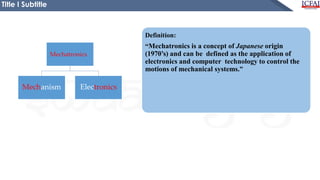
Definition:
“Mechatronics is a concept of Japanese origin
(1970’s) and can be defined as the application of
electronics and computer technology to control the
motions of mechanical systems.”
Title I Subtitle
Mechanism Electronics
Mechatronics
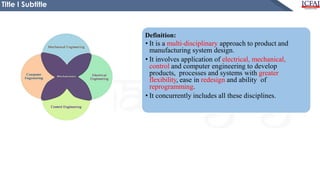
Definition:
• It is a multi-disciplinary approach to product and
manufacturing system design.
• It involves application of electrical, mechanical,
control and computer engineering to develop
products, processes and systems with greater
flexibility, ease in redesign and ability of
reprogramming.
• It concurrently includes all these disciplines.
Title I Subtitle
Title I Subtitle
Importance of Mechatronics in automation
• Today’s customers are demanding more variety and higher levels of flexibility in the products.
• Due to these demands and competition in the market, manufacturers launch new/modified
products to survive.
• It is reducing the product life as well as lead-time to manufacture a product.
• It is therefore essential to automate the manufacturing and assembly operations of a product.
• There are various activities involved in the product manufacturing process.
Title I Learning Title
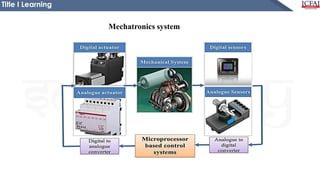
Mechatronics system
• A Mechatronics system integrates various technologies involving.
• Sensors & Measurement systems,
• Drives & Actuation systems (Mechanical / Pneumatics /Hydraulics),
• Controlling system (microprocessor / microcontroller / PLC) and
software engineering.
Title I Learning
Mechatronics system
Title I Learning Title
Disciplinary Foundations of Mechatronics
• Mechanical Engineering
• Electrical Engineering
• Electronics Engineering
• Computer Engineering
• Information & Technology Engineering
Title I Learning Title
Levels of Mechatronic Systems’ Integration
• conveyors,
• rotary tables,
• auxiliary manipulators
The First Level
Title I Learning Title
Levels of Mechatronic Systems’ Integration
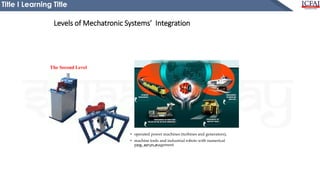
The Second Level
• operated power machines (turbines and generators),
• machine tools and industrial robots with numerical
p
B
ra
o
s
i
gcM
r
a
e
c
m
h
a
t
m
r
o
n
a
i
c
n
sagement
Title I Learning Title
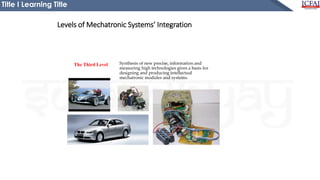
Levels of Mechatronic Systems’ Integration
Synthesis of new precise, information and
measuring high technologies gives a basis for
designing and producing intellectual
mechatronic modules and systems.
The Third Level
Title I Learning Title I Subtitle I Example
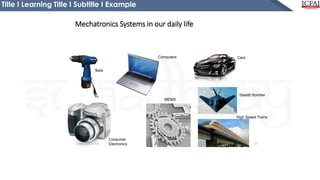
Mechatronics Systems in our daily life
MEMS
T
ools
Computers Cars
Consumer
Electronics
Stealth Bomber
High Speed Trains
Friday, April 1, 2016 Basic Mechatronics 26
Title I Learning Title I Subtitle I Example
Mechatronics Systems in Manufacturing Applications
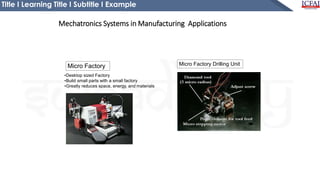
•Desktop sized Factory
•Build small parts with a small factory
•Greatly reduces space, energy, and materials
Micro Factory Micro Factory Drilling Unit
Title I Learning Title I Subtitle I Example
Mechatronics Systems in Manufacturing Applications
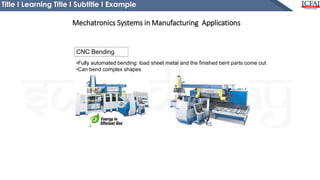
CNC Bending
•Fully automated bending: load sheet metal and the finished bent parts come out
•Can bend complex shapes
Title I Learning Title I Subtitle I Example
Mechatronics Systems in Transportation Applications
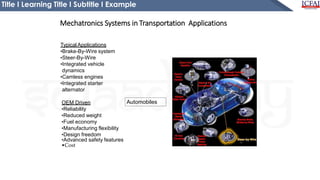
TypicalApplications
•Brake-By-Wire system
•Steer-By-Wire
•Integrated vehicle
dynamics
•Camless engines
•Integrated starter
alternator
Automobiles
OEM Driven
•Reliability
•Reduced weight
•Fuel economy
•Manufacturing flexibility
•Design freedom
•Advanced safety features
•Cost
29
Title I Learning Title I Subtitle I Example
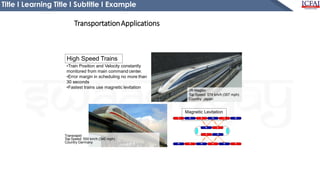
•Train Position and Velocity constantly
monitored from main command center.
•Error margin in scheduling no more than
30 seconds
•Fastest trains use magnetic levitation
High Speed Trains
JR-Maglev
Top Speed: 574 km/h (357 mph)
Country: Japan
Magnetic Levitation
TransportationApplications
Transrapid
Top Speed: 550 km/h (340 mph)
Country Germany
Title I Learning Title I Subtitle I Example
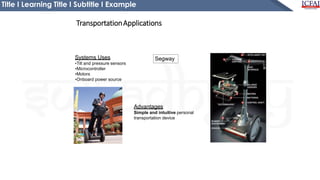
Advantages
Simple and intuitive personal
transportation device
Systems Uses
•Tilt and pressure sensors
•Microcontroller
•Motors
•Onboard power source
Segway
TransportationApplications
Title I Learning Title I Subtitle I Example
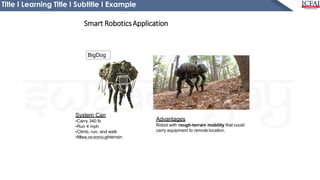
BigDog
Advantages
Robot with rough-terrain mobility that could
carry equipment to remote location.
Smart RoboticsApplication
System Can
•Carry 340 lb
•Run 4 mph
•Climb, run, and walk
•MovF
er
i
d
a
oy
,
vA
ep
rr
i
l
r1
o,
2
u0
1
g6
hterrain
• This complete slides deals with the study of Mechatronics system and its application.
• Mechatronics play a vital role in forming the platform for advancements in emerging
technologies.
• Mechatronic engineering is a mix of accuracy, mechanical engineering, electronics and
computer systems.
Conclusion

Introduction to Mechatronics.pdf

  • 1.
    Program (B.Tech) –Semester (V) Course ( Name of the course) Session No (2020-21) Introduction to Mechatronics By Prof. Kumar Kanishka Disclaimer: This PPT is the property of the ICFAI University, Jharkhand and can be used only for the educational purpose of the students of the University
  • 2.
    • Introduction toMechatronics. • Definition of Mechatronics. • Importance of Mechatronics in automation. • Mechatronics system. • Disciplinary Foundations of Mechatronics. • Levels of Mechatronic Systems’ Integration. • Mechatronics Systems in our daily life. • Mechatronics Systems in Manufacturing Applications. • Mechatronics Systems in Transportation Applications. • Smart RoboticsApplication. Table of Contents
  • 3.
    1 2 After this sessionthe learner will be able to: • To study the definition and elements of mechatronics system. • To learn how to apply the principles of mechatronics and automation for the development of systems. Learning Objectives
  • 4.
    Introduction Introduction to Mechatronics •Mechatronics can also be termed as replacement of mechanics with electronics or enhance mechanics with electronics. • For example, in modern automobiles, mechanical fuel injection systems are now replaced with electronic fuel injection systems. • This replacement made the automobiles more efficient and less pollutant. • With the help of microelectronics and sensor technology, mechatronics systems are providing high levels of precision and reliability. • By employment of reprogrammable microcontrollers or PLC, it is now easy to add new functions and capabilities to a product or a system. • Today’s domestic washing machines are “intelligent” and four- wheel passenger automobiles are equipped with safety installations such as air-bags, parking (proximity) sensors, antitheft electronic keys etc.
  • 5.
    Definition: “Mechatronics is aconcept of Japanese origin (1970’s) and can be defined as the application of electronics and computer technology to control the motions of mechanical systems.” Title I Subtitle Mechanism Electronics Mechatronics
  • 6.
    Definition: • It isa multi-disciplinary approach to product and manufacturing system design. • It involves application of electrical, mechanical, control and computer engineering to develop products, processes and systems with greater flexibility, ease in redesign and ability of reprogramming. • It concurrently includes all these disciplines. Title I Subtitle
  • 7.
    Title I Subtitle Importanceof Mechatronics in automation • Today’s customers are demanding more variety and higher levels of flexibility in the products. • Due to these demands and competition in the market, manufacturers launch new/modified products to survive. • It is reducing the product life as well as lead-time to manufacture a product. • It is therefore essential to automate the manufacturing and assembly operations of a product. • There are various activities involved in the product manufacturing process.
  • 8.
    Title I LearningTitle Mechatronics system • A Mechatronics system integrates various technologies involving. • Sensors & Measurement systems, • Drives & Actuation systems (Mechanical / Pneumatics /Hydraulics), • Controlling system (microprocessor / microcontroller / PLC) and software engineering.
  • 9.
  • 10.
    Title I LearningTitle Disciplinary Foundations of Mechatronics • Mechanical Engineering • Electrical Engineering • Electronics Engineering • Computer Engineering • Information & Technology Engineering
  • 11.
    Title I LearningTitle Levels of Mechatronic Systems’ Integration • conveyors, • rotary tables, • auxiliary manipulators The First Level
  • 12.
    Title I LearningTitle Levels of Mechatronic Systems’ Integration The Second Level • operated power machines (turbines and generators), • machine tools and industrial robots with numerical p B ra o s i gcM r a e c m h a t m r o n a i c n sagement
  • 13.
    Title I LearningTitle Levels of Mechatronic Systems’ Integration Synthesis of new precise, information and measuring high technologies gives a basis for designing and producing intellectual mechatronic modules and systems. The Third Level
  • 14.
    Title I LearningTitle I Subtitle I Example Mechatronics Systems in our daily life MEMS T ools Computers Cars Consumer Electronics Stealth Bomber High Speed Trains Friday, April 1, 2016 Basic Mechatronics 26
  • 15.
    Title I LearningTitle I Subtitle I Example Mechatronics Systems in Manufacturing Applications •Desktop sized Factory •Build small parts with a small factory •Greatly reduces space, energy, and materials Micro Factory Micro Factory Drilling Unit
  • 16.
    Title I LearningTitle I Subtitle I Example Mechatronics Systems in Manufacturing Applications CNC Bending •Fully automated bending: load sheet metal and the finished bent parts come out •Can bend complex shapes
  • 17.
    Title I LearningTitle I Subtitle I Example Mechatronics Systems in Transportation Applications TypicalApplications •Brake-By-Wire system •Steer-By-Wire •Integrated vehicle dynamics •Camless engines •Integrated starter alternator Automobiles OEM Driven •Reliability •Reduced weight •Fuel economy •Manufacturing flexibility •Design freedom •Advanced safety features •Cost 29
  • 18.
    Title I LearningTitle I Subtitle I Example •Train Position and Velocity constantly monitored from main command center. •Error margin in scheduling no more than 30 seconds •Fastest trains use magnetic levitation High Speed Trains JR-Maglev Top Speed: 574 km/h (357 mph) Country: Japan Magnetic Levitation TransportationApplications Transrapid Top Speed: 550 km/h (340 mph) Country Germany
  • 19.
    Title I LearningTitle I Subtitle I Example Advantages Simple and intuitive personal transportation device Systems Uses •Tilt and pressure sensors •Microcontroller •Motors •Onboard power source Segway TransportationApplications
  • 20.
    Title I LearningTitle I Subtitle I Example BigDog Advantages Robot with rough-terrain mobility that could carry equipment to remote location. Smart RoboticsApplication System Can •Carry 340 lb •Run 4 mph •Climb, run, and walk •MovF er i d a oy , vA ep rr i l r1 o, 2 u0 1 g6 hterrain
  • 21.
    • This completeslides deals with the study of Mechatronics system and its application. • Mechatronics play a vital role in forming the platform for advancements in emerging technologies. • Mechatronic engineering is a mix of accuracy, mechanical engineering, electronics and computer systems. Conclusion