Click to edit Master title style
Shenggen Fan, April 2015
Measuring Infant and Young Child Complementary
Feeding Practices: Indicators, Current Practice and
Research Gaps
Marie Ruel
Director | Poverty, Health and Nutrition | IFPRI
87th Nestle Nutrition Institute Workshop | Singapore May 8-11, 2016
Click to edit Master title style
Shenggen Fan, April 2015
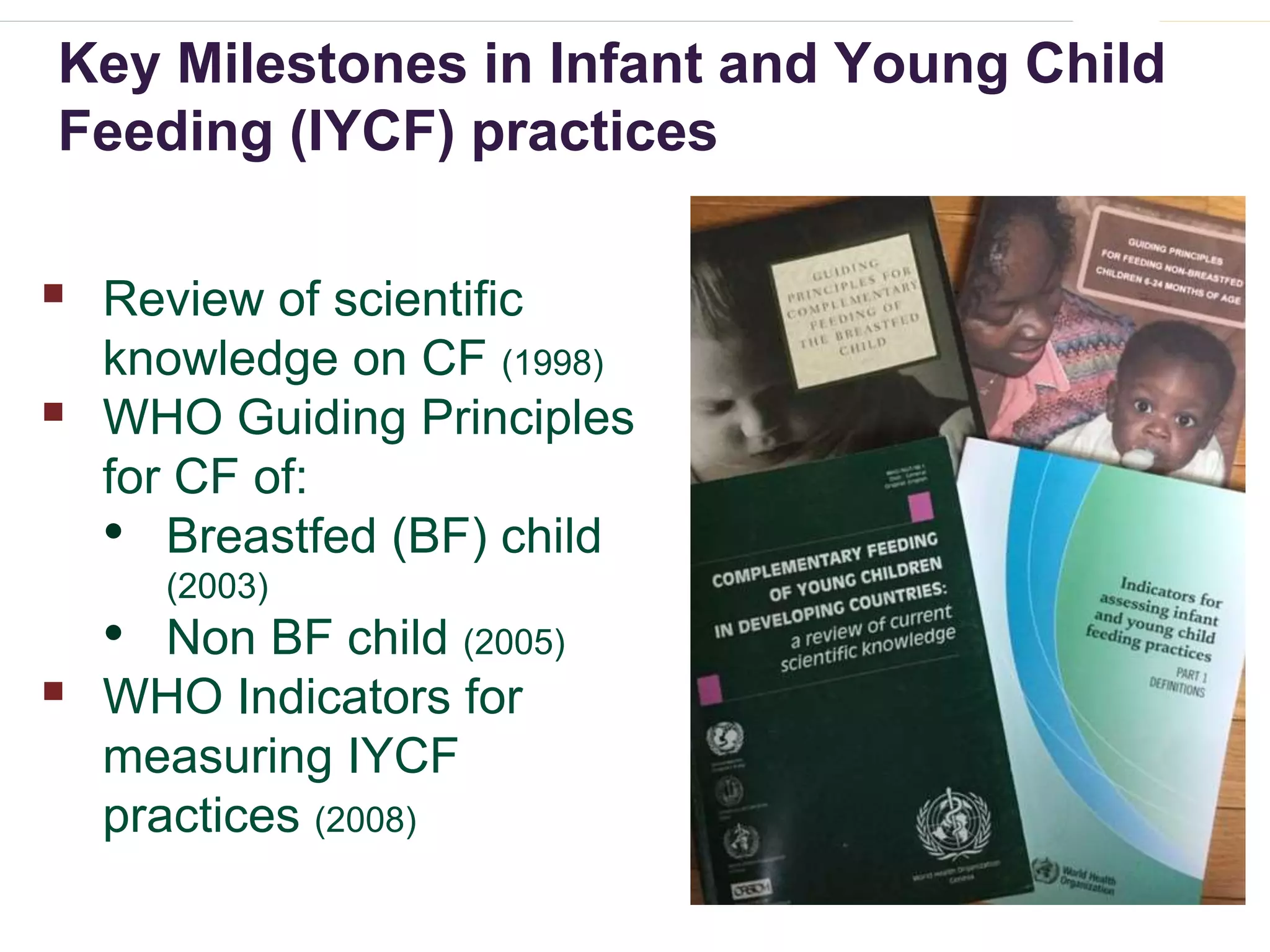
Key Milestones in Infant and Young Child
Feeding (IYCF) practices
 Review of scientific
knowledge on CF (1998)
 WHO Guiding Principles
for CF of:
• Breastfed (BF) child
(2003)
• Non BF child (2005)
 WHO Indicators for
measuring IYCF
practices (2008)
Click to edit Master title style
Shenggen Fan, April 2015
Taking Stock on Indicators of CF
practices
 What is the status of CF
indicators?
 How have they been
used so far and what
are some of the key
findings?
 What are the strengths
and weaknesses of the
indicators?
 Suggestions for way forward
Click to edit Master title style
Background on IYCF
and related indicators
Click to edit Master title style
Shenggen Fan, April 2015
10 Guiding Principles for Complementary
Feeding of the Breastfed Child
1. Duration of exclusive
BF & age of
introduction of CF
2. Continued BF
3. Responsive feeding
4. Safe preparation &
storage of CF
5. Amount of CF needed
6. Food consistency
7. Meal frequency energy
density
8. Nutrient content of CF
9. Use of supplements or
fortified products
10. Feeding during & after
illness
WHO 2003
Click to edit Master title style
Shenggen Fan, April 2015
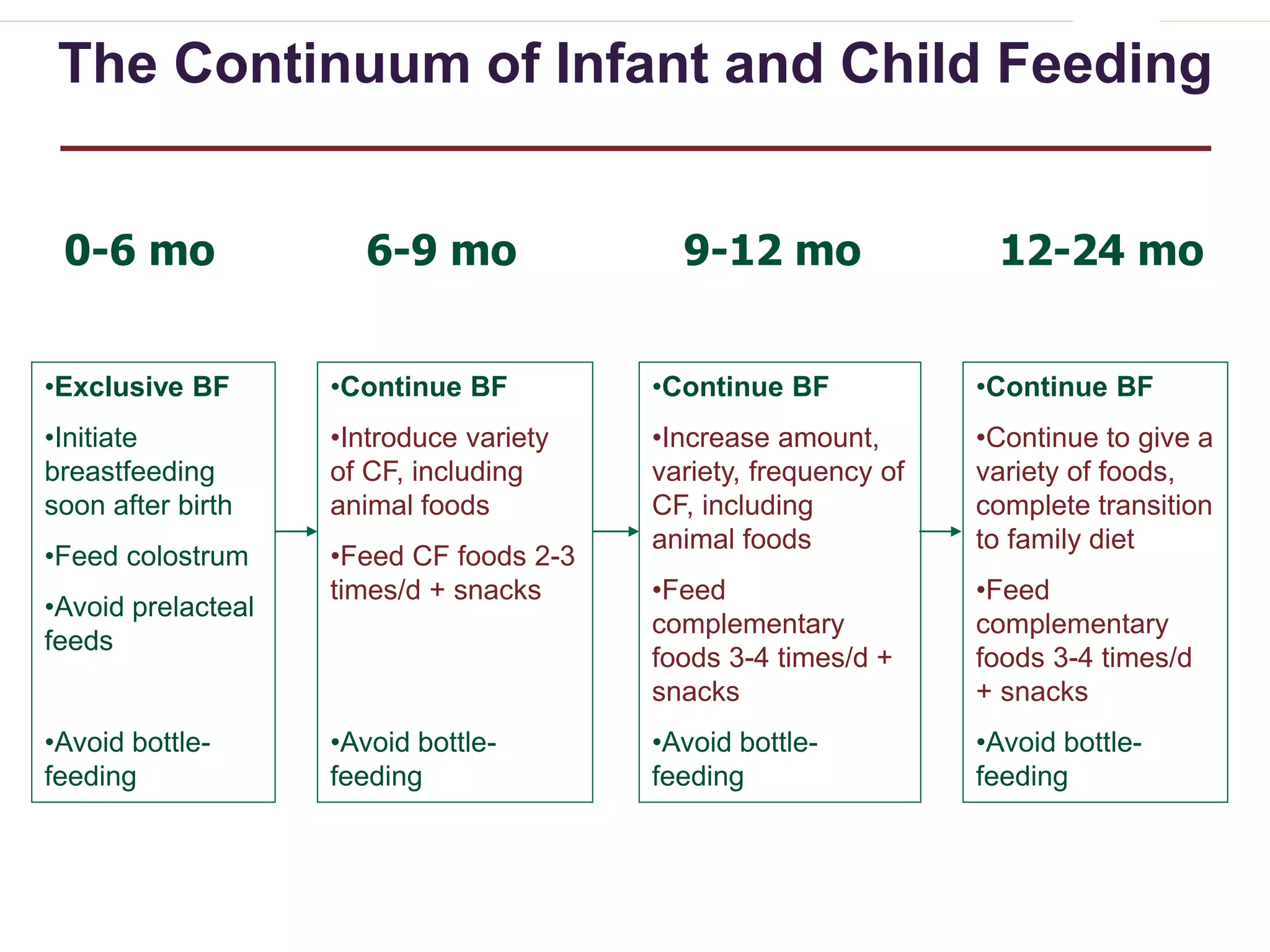
The Continuum of Infant and Child Feeding
0-6 mo 6-9 mo 9-12 mo 12-24 mo
•Exclusive BF
•Initiate
breastfeeding
soon after birth
•Feed colostrum
•Avoid prelacteal
feeds
•Avoid bottle-
feeding
•Continue BF
•Introduce variety
of CF, including
animal foods
•Feed CF foods 2-3
times/d + snacks
•Avoid bottle-
feeding
•Continue BF
•Increase amount,
variety, frequency of
CF, including
animal foods
•Feed
complementary
foods 3-4 times/d +
snacks
•Avoid bottle-
feeding
•Continue BF
•Continue to give a
variety of foods,
complete transition
to family diet
•Feed
complementary
foods 3-4 times/d
+ snacks
•Avoid bottle-
feeding
Click to edit Master title style
Shenggen Fan, April 2015
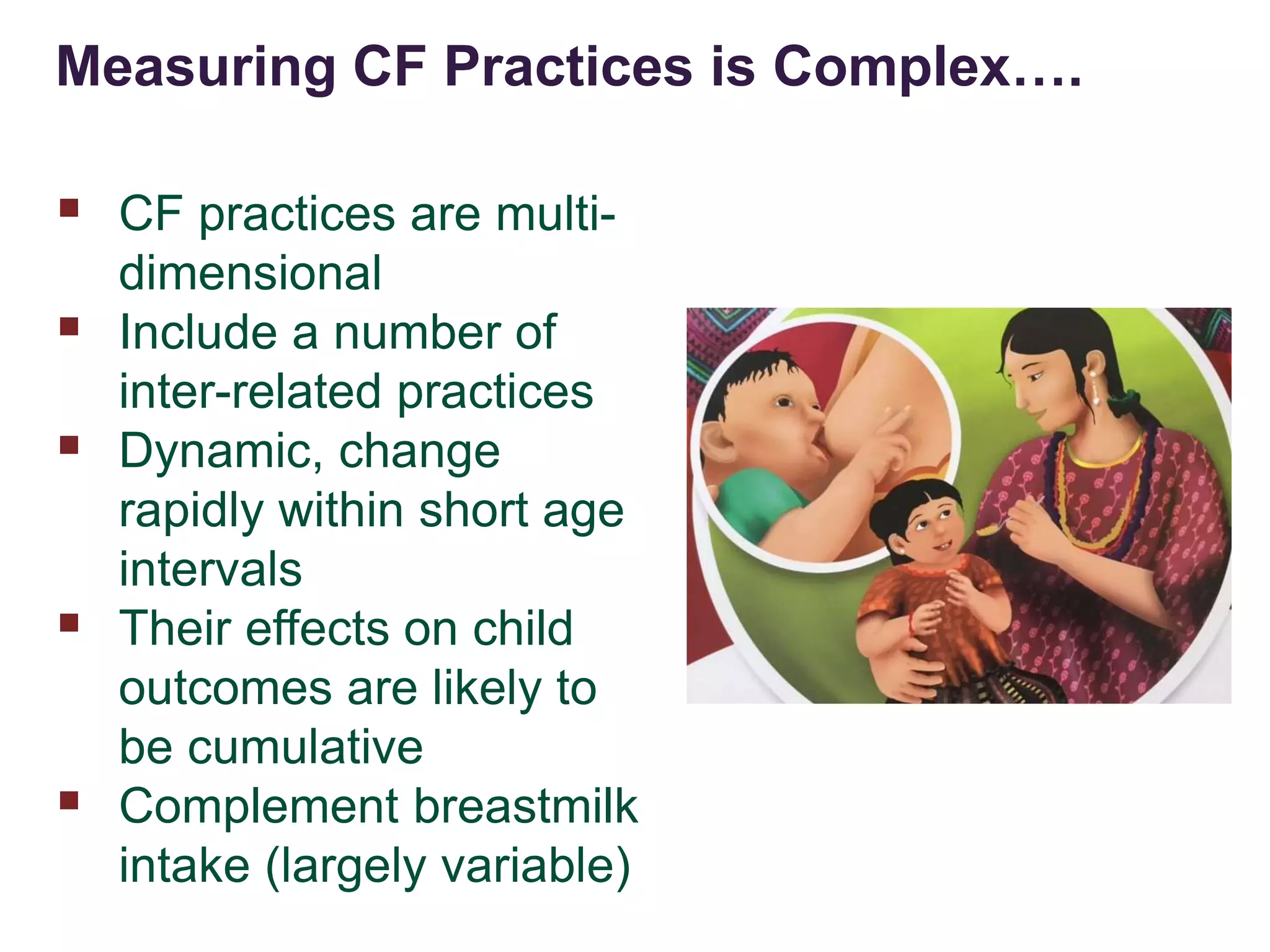
Measuring CF Practices is Complex….
 CF practices are multi-
dimensional
 Include a number of
inter-related practices
 Dynamic, change
rapidly within short age
intervals
 Their effects on child
outcomes are likely to
be cumulative
 Complement breastmilk
intake (largely variable)
Click to edit Master title style
Shenggen Fan, April 2015
WHO IYCF Indicators for Breastfed
Child
 8 core indicators:
• 3 BF practices
• 5 CF practices
 7 optional indicators
(all focused on BF
practices)
Click to edit Master title style
Shenggen Fan, April 2015WHO 2008
5 WHO CF Indicators for Breastfed
Child
INDICATOR
 Timing of introduction of
solid semi-solid and soft
foods
 Minimum dietary diversity
(MDD)
 Minimum meal frequency
(MMF)
 Minimum acceptable diet
(MAD)
 Consumption of iron-rich/
iron-fortified foods
MEASURES
 Optimal timing of
introduction of CF
foods
 Micronutrient
adequacy of diet
 Energy adequacy of
diet
 Composite indicator
(BF + MDD + MMF)
 Adequacy of iron
intake
Click to edit Master title style
Shenggen Fan, April 2015
 For use in large surveys for:
• Population-level assessments
• Population targeting
• Monitoring & evaluation
 Had to be simple and practical, yet valid and
reliable
 This limits dimensions of CF practices that
can be captured
 Were meant to be used as a full set to
reflect multi-dimensional nature of IYCF
Purpose of 2008 WHO Indicators
Click to edit Master title style
Shenggen Fan, April 2015
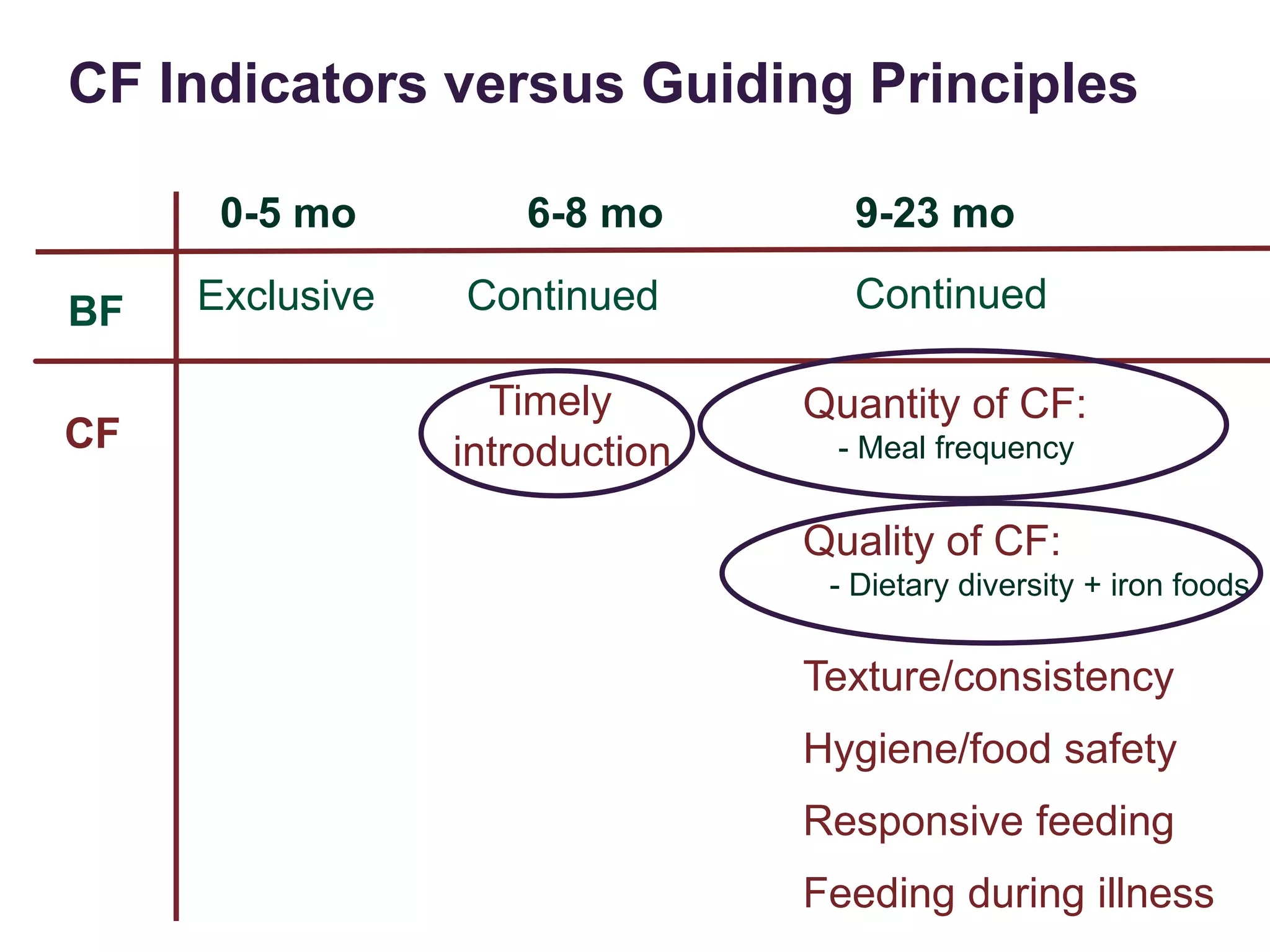
BF
CF
0-5 mo 6-8 mo 9-23 mo
Continued Continued
Timely
introduction
Quantity of CF:
- Meal frequency
Quality of CF:
- Dietary diversity + iron foods
Hygiene/food safety
Responsive feeding
Feeding during illness
Texture/consistency
Exclusive
CF Indicators versus Guiding Principles
Click to edit Master title style
How have the WHO CF indicators
been used so far?
Click to edit Master title style
Shenggen Fan, April 2015
For Population-Level Assessments
and Country Comparisons
 Reveals grossly inadequate
CF practices, esp. SS-Africa,
South Asia
• < 30% MAD
• Few countries with > 30% MDD
• Poorer practices (younger, rural,
less educated mothers, poorer)
 Pooled analysis (46DHS):
• < 33% MDD
• ~50% meeting MMF
• 21% MAD
• Africa & Asia fare worst than LA
Indicators have helped unveil the severe problem of
poor IYCF practices globally
WHO 2010 Country Profiles
Click to edit Master title style
Shenggen Fan, April 2015
For Monitoring & Evaluation of
Programs
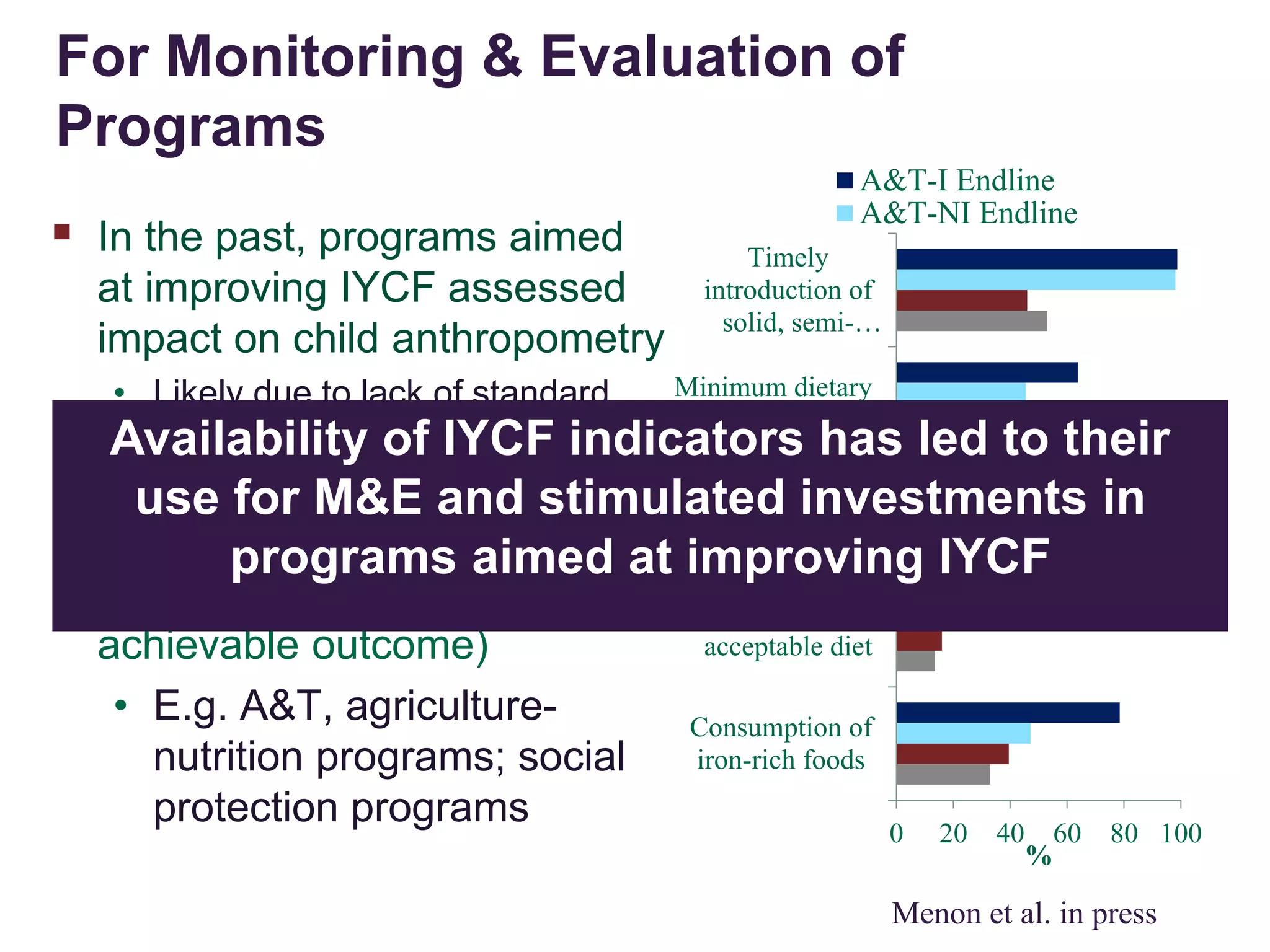
 In the past, programs aimed
at improving IYCF assessed
impact on child anthropometry
• Likely due to lack of standard
IYCF indicators
 Indicators helped measure &
document impacts on
practices (often more
achievable outcome)
• E.g. A&T, agriculture-
nutrition programs; social
protection programs 0 20 40 60 80 100
Consumption of
iron-rich foods
Minimum
acceptable diet
Minimum meal
frequency
Minimum dietary
diversity
Timely
introduction of
solid, semi-…
%
A&T-I Endline
A&T-NI Endline
Availability of IYCF indicators has led to their
use for M&E and stimulated investments in
programs aimed at improving IYCF
Menon et al. in press
Click to edit Master title style
Shenggen Fan, April 2015
 Extensive analysis of association between dietary diversity
and child antropometry
• Robust results – strong DD, consistent associations with linear growh, controlling for
energy intake and SES
 New studies looking at associations between broader set
of IYCF and child anthropometry
• Pooled analysis (14 DHS) – associations between MDD, iron rich foods and
stunting; between MMF and underweight
• Country analyses (8 studies) confirmed association between DD and HAZ (3
countries); MAD and stunting in 4 countries.
 New studies look at determinants of CF practices (e.g.
special issue of MCN on patterns and determinants of CF
practices in South Asia)
For Research on Determinants and
Consequences of Poor IYCF Practices
IYCF indicators have been used extensively to
address important gaps in knowledge and
understand patterns, determinants and
consequences of poor IYCF practices
Click to edit Master title style
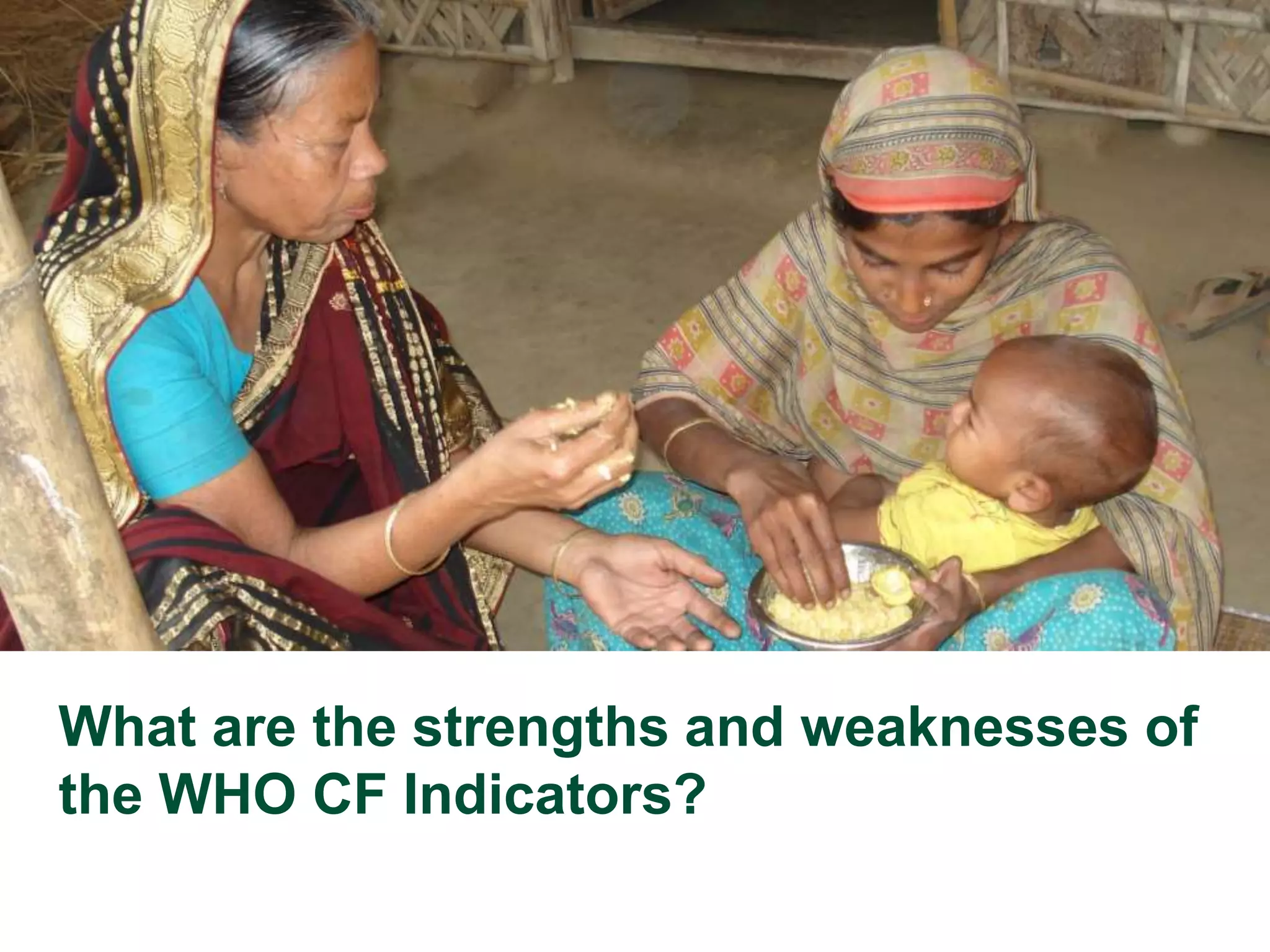
What are the strengths and weaknesses of
the WHO CF Indicators?
Click to edit Master title style
Shenggen Fan, April 2015
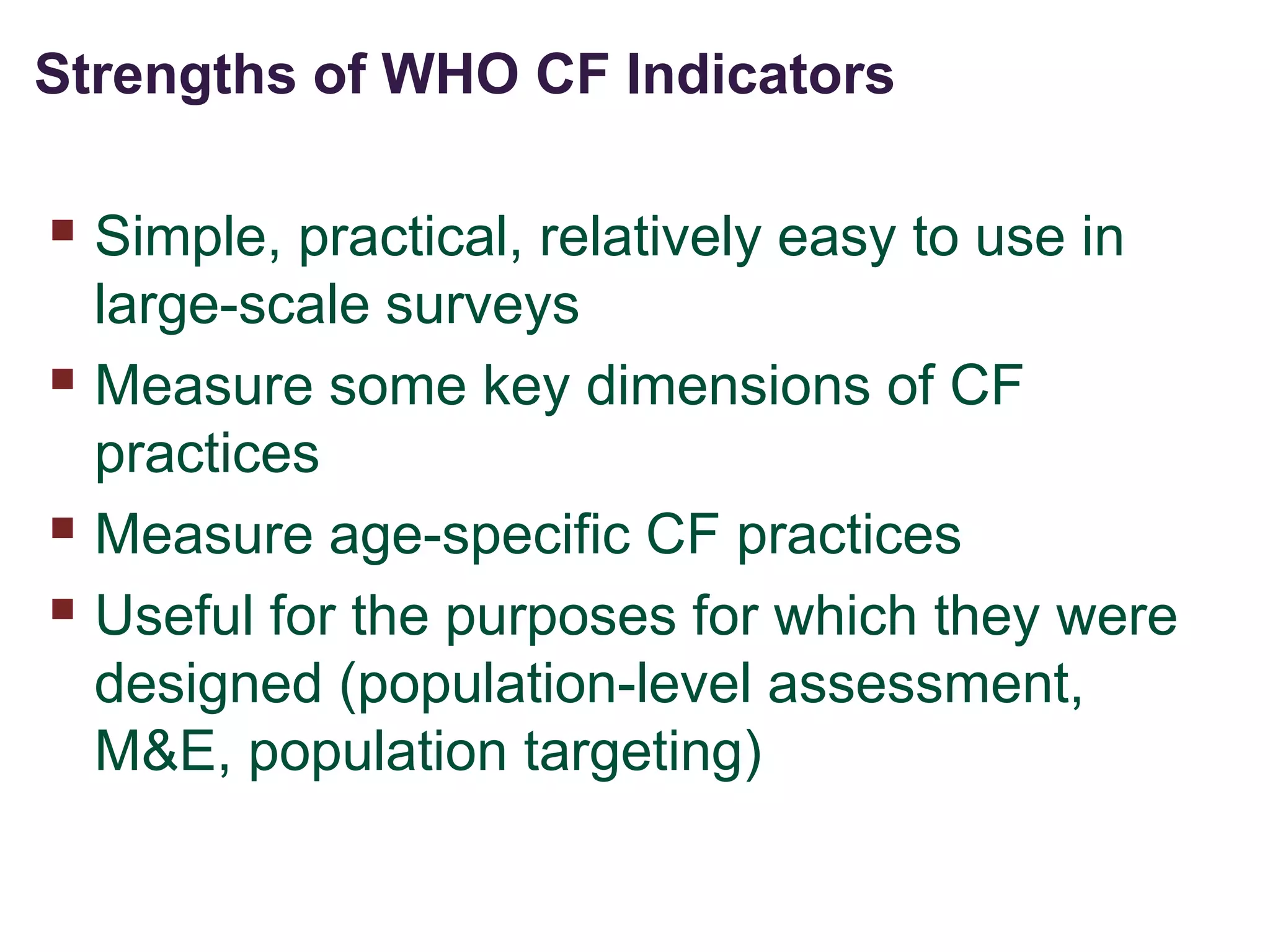
 Simple, practical, relatively easy to use in
large-scale surveys
 Measure some key dimensions of CF
practices
 Measure age-specific CF practices
 Useful for the purposes for which they were
designed (population-level assessment,
M&E, population targeting)
Strengths of WHO CF Indicators
Click to edit Master title style
Shenggen Fan, April 2015
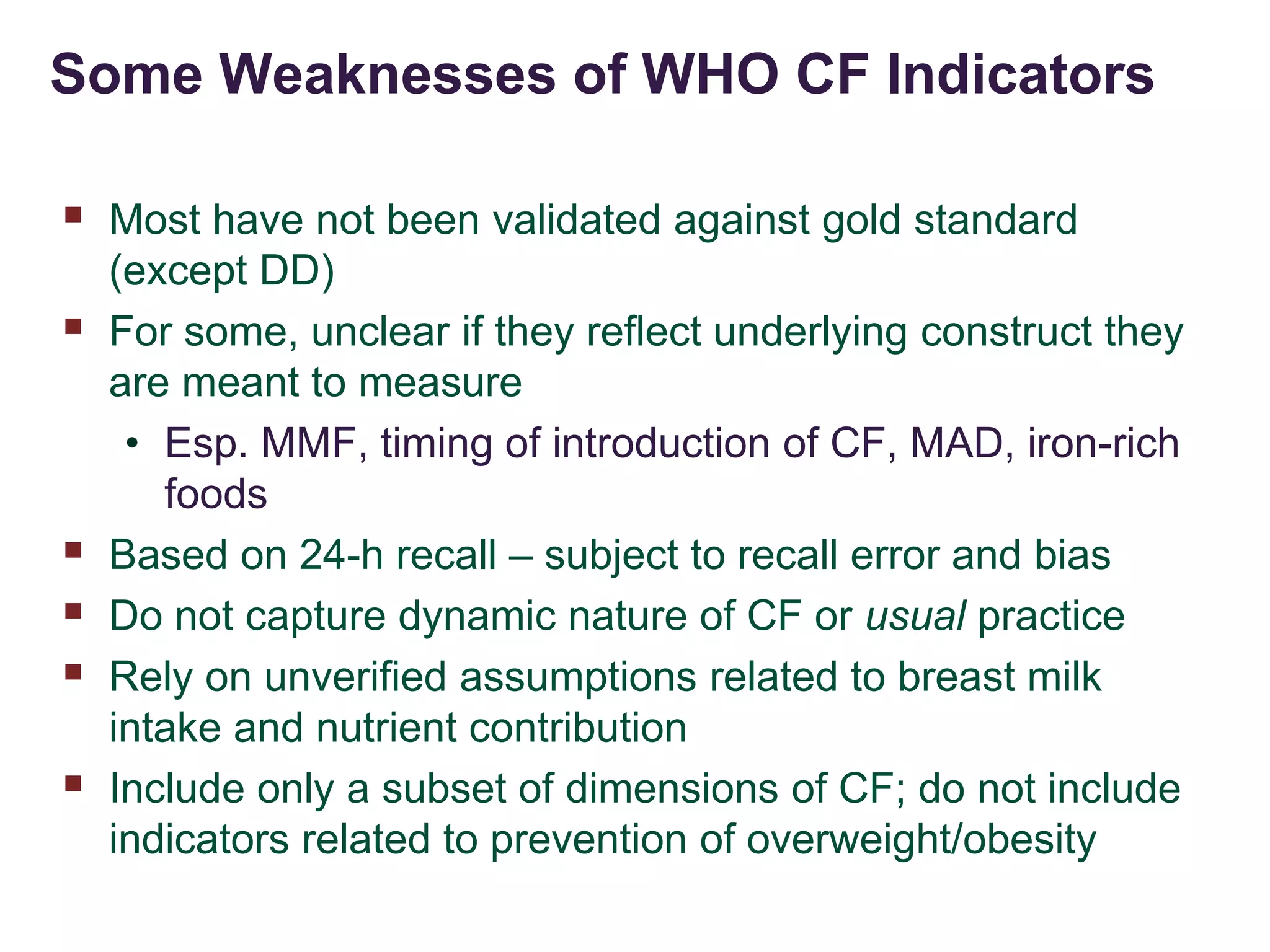
 Most have not been validated against gold standard
(except DD)
 For some, unclear if they reflect underlying construct they
are meant to measure
• Esp. MMF, timing of introduction of CF, MAD, iron-rich
foods
 Based on 24-h recall – subject to recall error and bias
 Do not capture dynamic nature of CF or usual practice
 Rely on unverified assumptions related to breast milk
intake and nutrient contribution
 Include only a subset of dimensions of CF; do not include
indicators related to prevention of overweight/obesity
Some Weaknesses of WHO CF Indicators
Click to edit Master title style
The Way Forward
Click to edit Master title style
Shenggen Fan, April 2015
 Need to revisit existing set of indicators and carry out
relevant validation studies
 Verify underlying assumptions and adjust indicators:
• Energy density (for MMF)
• Differentiation of snacks and meals (for MMF)
• Food consumed in small amounts (for MDD)
 Assess magnitude of error/bias due to recall
 Revisit missing indicators/dimensions of CF, including
overweight/obesity prevention
 Develop simplified, technology-smart 24-h dietary
assessment method to quantify nutrient intake from
CF
Time to Revisit our Set of CF Indicators
Click to edit Master title style
Shenggen Fan, April 2015
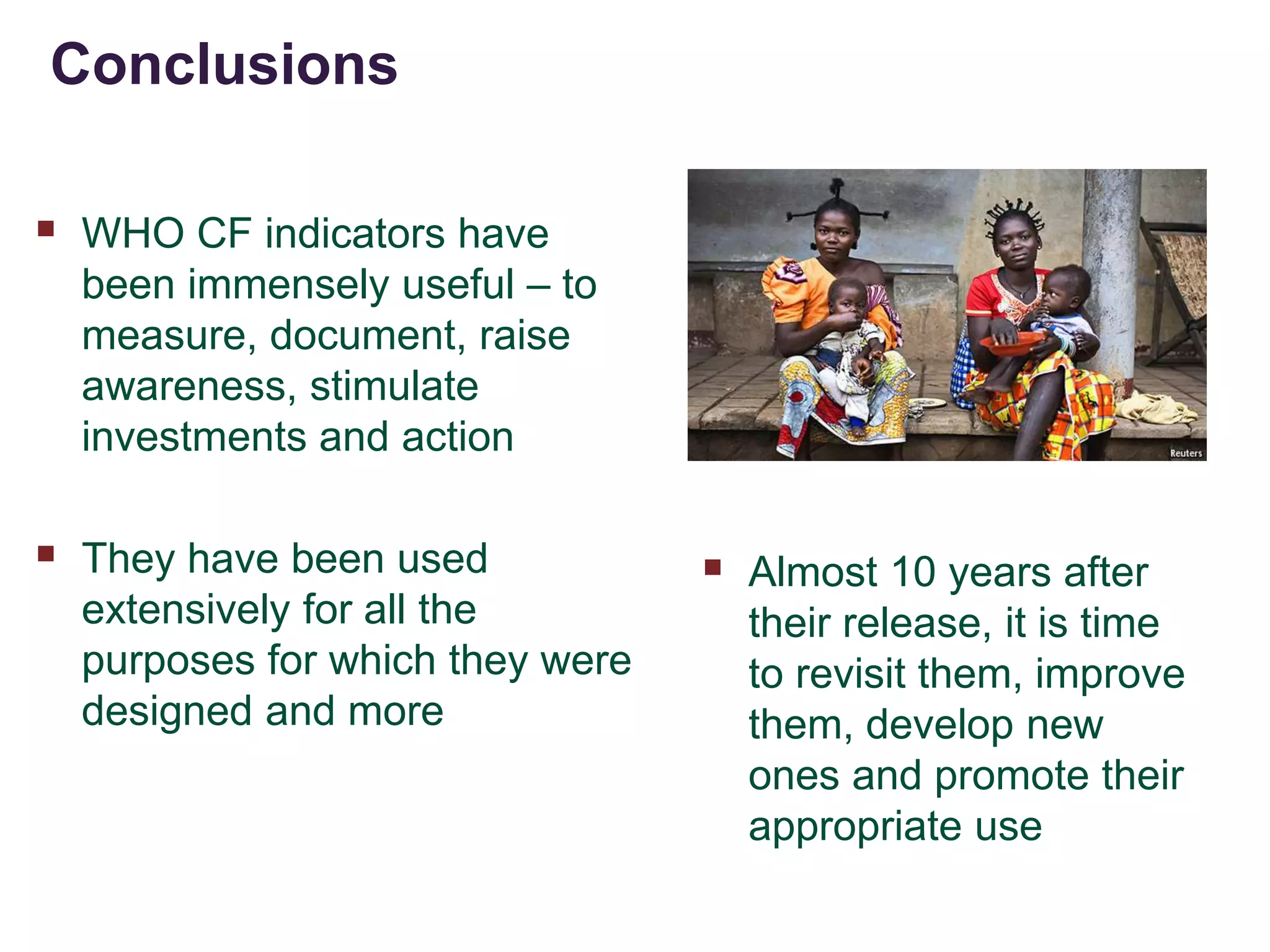
Conclusions
 WHO CF indicators have
been immensely useful – to
measure, document, raise
awareness, stimulate
investments and action
 They have been used
extensively for all the
purposes for which they were
designed and more
 Almost 10 years after
their release, it is time
to revisit them, improve
them, develop new
ones and promote their
appropriate use

Measuring Infant and Young Child Complementary Feeding Practices

  • 1.
    Click to editMaster title style Shenggen Fan, April 2015 Measuring Infant and Young Child Complementary Feeding Practices: Indicators, Current Practice and Research Gaps Marie Ruel Director | Poverty, Health and Nutrition | IFPRI 87th Nestle Nutrition Institute Workshop | Singapore May 8-11, 2016
  • 2.
    Click to editMaster title style Shenggen Fan, April 2015 Key Milestones in Infant and Young Child Feeding (IYCF) practices  Review of scientific knowledge on CF (1998)  WHO Guiding Principles for CF of: • Breastfed (BF) child (2003) • Non BF child (2005)  WHO Indicators for measuring IYCF practices (2008)
  • 3.
    Click to editMaster title style Shenggen Fan, April 2015 Taking Stock on Indicators of CF practices  What is the status of CF indicators?  How have they been used so far and what are some of the key findings?  What are the strengths and weaknesses of the indicators?  Suggestions for way forward
  • 4.
    Click to editMaster title style Background on IYCF and related indicators
  • 5.
    Click to editMaster title style Shenggen Fan, April 2015 10 Guiding Principles for Complementary Feeding of the Breastfed Child 1. Duration of exclusive BF & age of introduction of CF 2. Continued BF 3. Responsive feeding 4. Safe preparation & storage of CF 5. Amount of CF needed 6. Food consistency 7. Meal frequency energy density 8. Nutrient content of CF 9. Use of supplements or fortified products 10. Feeding during & after illness WHO 2003
  • 6.
    Click to editMaster title style Shenggen Fan, April 2015 The Continuum of Infant and Child Feeding 0-6 mo 6-9 mo 9-12 mo 12-24 mo •Exclusive BF •Initiate breastfeeding soon after birth •Feed colostrum •Avoid prelacteal feeds •Avoid bottle- feeding •Continue BF •Introduce variety of CF, including animal foods •Feed CF foods 2-3 times/d + snacks •Avoid bottle- feeding •Continue BF •Increase amount, variety, frequency of CF, including animal foods •Feed complementary foods 3-4 times/d + snacks •Avoid bottle- feeding •Continue BF •Continue to give a variety of foods, complete transition to family diet •Feed complementary foods 3-4 times/d + snacks •Avoid bottle- feeding
  • 7.
    Click to editMaster title style Shenggen Fan, April 2015 Measuring CF Practices is Complex….  CF practices are multi- dimensional  Include a number of inter-related practices  Dynamic, change rapidly within short age intervals  Their effects on child outcomes are likely to be cumulative  Complement breastmilk intake (largely variable)
  • 8.
    Click to editMaster title style Shenggen Fan, April 2015 WHO IYCF Indicators for Breastfed Child  8 core indicators: • 3 BF practices • 5 CF practices  7 optional indicators (all focused on BF practices)
  • 9.
    Click to editMaster title style Shenggen Fan, April 2015WHO 2008 5 WHO CF Indicators for Breastfed Child INDICATOR  Timing of introduction of solid semi-solid and soft foods  Minimum dietary diversity (MDD)  Minimum meal frequency (MMF)  Minimum acceptable diet (MAD)  Consumption of iron-rich/ iron-fortified foods MEASURES  Optimal timing of introduction of CF foods  Micronutrient adequacy of diet  Energy adequacy of diet  Composite indicator (BF + MDD + MMF)  Adequacy of iron intake
  • 10.
    Click to editMaster title style Shenggen Fan, April 2015  For use in large surveys for: • Population-level assessments • Population targeting • Monitoring & evaluation  Had to be simple and practical, yet valid and reliable  This limits dimensions of CF practices that can be captured  Were meant to be used as a full set to reflect multi-dimensional nature of IYCF Purpose of 2008 WHO Indicators
  • 11.
    Click to editMaster title style Shenggen Fan, April 2015 BF CF 0-5 mo 6-8 mo 9-23 mo Continued Continued Timely introduction Quantity of CF: - Meal frequency Quality of CF: - Dietary diversity + iron foods Hygiene/food safety Responsive feeding Feeding during illness Texture/consistency Exclusive CF Indicators versus Guiding Principles
  • 12.
    Click to editMaster title style How have the WHO CF indicators been used so far?
  • 13.
    Click to editMaster title style Shenggen Fan, April 2015 For Population-Level Assessments and Country Comparisons  Reveals grossly inadequate CF practices, esp. SS-Africa, South Asia • < 30% MAD • Few countries with > 30% MDD • Poorer practices (younger, rural, less educated mothers, poorer)  Pooled analysis (46DHS): • < 33% MDD • ~50% meeting MMF • 21% MAD • Africa & Asia fare worst than LA Indicators have helped unveil the severe problem of poor IYCF practices globally WHO 2010 Country Profiles
  • 14.
    Click to editMaster title style Shenggen Fan, April 2015 For Monitoring & Evaluation of Programs  In the past, programs aimed at improving IYCF assessed impact on child anthropometry • Likely due to lack of standard IYCF indicators  Indicators helped measure & document impacts on practices (often more achievable outcome) • E.g. A&T, agriculture- nutrition programs; social protection programs 0 20 40 60 80 100 Consumption of iron-rich foods Minimum acceptable diet Minimum meal frequency Minimum dietary diversity Timely introduction of solid, semi-… % A&T-I Endline A&T-NI Endline Availability of IYCF indicators has led to their use for M&E and stimulated investments in programs aimed at improving IYCF Menon et al. in press
  • 15.
    Click to editMaster title style Shenggen Fan, April 2015  Extensive analysis of association between dietary diversity and child antropometry • Robust results – strong DD, consistent associations with linear growh, controlling for energy intake and SES  New studies looking at associations between broader set of IYCF and child anthropometry • Pooled analysis (14 DHS) – associations between MDD, iron rich foods and stunting; between MMF and underweight • Country analyses (8 studies) confirmed association between DD and HAZ (3 countries); MAD and stunting in 4 countries.  New studies look at determinants of CF practices (e.g. special issue of MCN on patterns and determinants of CF practices in South Asia) For Research on Determinants and Consequences of Poor IYCF Practices IYCF indicators have been used extensively to address important gaps in knowledge and understand patterns, determinants and consequences of poor IYCF practices
  • 16.
    Click to editMaster title style What are the strengths and weaknesses of the WHO CF Indicators?
  • 17.
    Click to editMaster title style Shenggen Fan, April 2015  Simple, practical, relatively easy to use in large-scale surveys  Measure some key dimensions of CF practices  Measure age-specific CF practices  Useful for the purposes for which they were designed (population-level assessment, M&E, population targeting) Strengths of WHO CF Indicators
  • 18.
    Click to editMaster title style Shenggen Fan, April 2015  Most have not been validated against gold standard (except DD)  For some, unclear if they reflect underlying construct they are meant to measure • Esp. MMF, timing of introduction of CF, MAD, iron-rich foods  Based on 24-h recall – subject to recall error and bias  Do not capture dynamic nature of CF or usual practice  Rely on unverified assumptions related to breast milk intake and nutrient contribution  Include only a subset of dimensions of CF; do not include indicators related to prevention of overweight/obesity Some Weaknesses of WHO CF Indicators
  • 19.
    Click to editMaster title style The Way Forward
  • 20.
    Click to editMaster title style Shenggen Fan, April 2015  Need to revisit existing set of indicators and carry out relevant validation studies  Verify underlying assumptions and adjust indicators: • Energy density (for MMF) • Differentiation of snacks and meals (for MMF) • Food consumed in small amounts (for MDD)  Assess magnitude of error/bias due to recall  Revisit missing indicators/dimensions of CF, including overweight/obesity prevention  Develop simplified, technology-smart 24-h dietary assessment method to quantify nutrient intake from CF Time to Revisit our Set of CF Indicators
  • 21.
    Click to editMaster title style Shenggen Fan, April 2015 Conclusions  WHO CF indicators have been immensely useful – to measure, document, raise awareness, stimulate investments and action  They have been used extensively for all the purposes for which they were designed and more  Almost 10 years after their release, it is time to revisit them, improve them, develop new ones and promote their appropriate use