Adapting the WEAI to 
a Project-specific Index 
A 4NH GENDE R -NUTR ITION METHODS WORKSHOP I I 
DE C EMB E R 2 - 4 , 2 0 1 4 – 
B IOVE R S ITY INTE RNATIONA L – ROME , ITA LY 
Laurie Starr 
TANGO International 
Senior Technical Advisor 
Contact: laurie@tangointernational
Overview 
 Designing CARE’s aggregate index for 
empowerment 
 Relevance of baseline and midterm findings to 
project implementation 
 Lessons learned
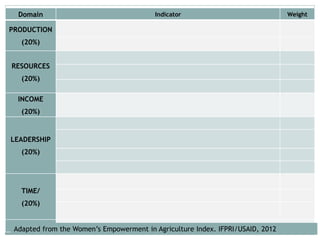
Domain Indicator Weight 
PRODUCTION 
(20%) 
RESOURCES 
(20%) 
INCOME 
(20%) 
LEADERSHIP 
(20%) 
TIME/ 
(20%) 
Adapted from the Women’s Empowerment in Agriculture Index. IFPRI/USAID, 2012
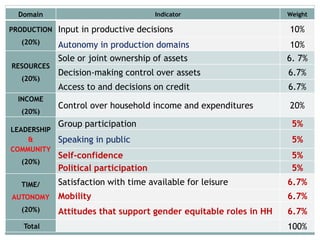
Domain Indicator Weight 
PRODUCTION 
(20%) 
Input in productive decisions 10% 
Autonomy in production domains 10% 
RESOURCES 
(20%) 
Sole or joint ownership of assets 6. 7% 
Decision-making control over assets 6.7% 
Access to and decisions on credit 6.7% 
INCOME 
(20%) 
Control over household income and expenditures 20% 
LEADERSHIP 
& 
COMMUNITY 
(20%) 
Group participation 5% 
Speaking in public 5% 
Self-confidence 5% 
Political participation 5% 
TIME/ 
AUTONOMY 
(20%) 
Satisfaction with time available for leisure 6.7% 
Mobility 6.7% 
Attitudes that support gender equitable roles in HH 6.7% 
Total 100%
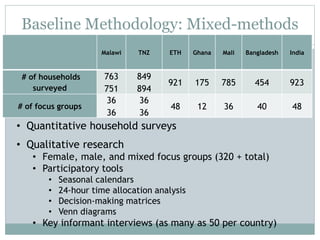
Baseline Methodology: Mixed-methods 
Malawi TNZ ETH Ghana Mali Bangladesh India 
# of households 
surveyed 
763 
751 
849 
894 
921 175 785 454 923 
# of focus groups 
36 
36 
36 
36 
48 12 36 40 48 
• Quantitative household surveys 
• Qualitative research 
• Female, male, and mixed focus groups (320 + total) 
• Participatory tools 
• Seasonal calendars 
• 24-hour time allocation analysis 
• Decision-making matrices 
• Venn diagrams 
• Key informant interviews (as many as 50 per country)
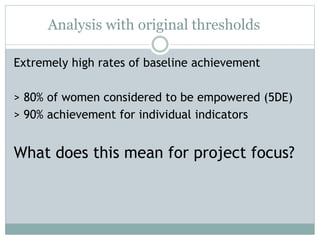
Analysis with original thresholds 
Extremely high rates of baseline achievement 
> 80% of women considered to be empowered (5DE) 
> 90% achievement for individual indicators 
What does this mean for project focus?
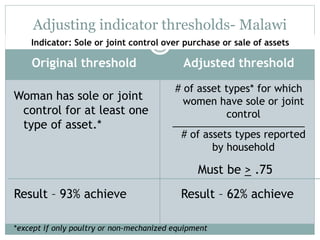
Adjusting indicator thresholds- Malawi 
Indicator: Sole or joint control over purchase or sale of assets 
Original threshold Adjusted threshold 
Woman has sole or joint 
control for at least one 
type of asset.* 
# of asset types* for which 
women have sole or joint 
control 
____________________________________ 
# of assets types reported 
by household 
Must be > .75 
Result – 93% achieve Result – 62% achieve 
*except if only poultry or non-mechanized equipment
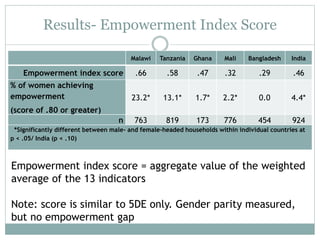
Results- Empowerment Index Score 
Malawi Tanzania Ghana Mali Bangladesh India 
Empowerment index score .66 .58 .47 .32 .29 .46 
% of women achieving 
empowerment 
(score of .80 or greater) 
23.2* 13.1* 1.7* 2.2* 0.0 4.4* 
n 763 819 173 776 454 924 
*Significantly different between male- and female-headed households within individual countries at 
p < .05/ India (p < .10) 
Empowerment index score = aggregate value of the weighted 
average of the 13 indicators 
Note: score is similar to 5DE only. Gender parity measured, 
but no empowerment gap
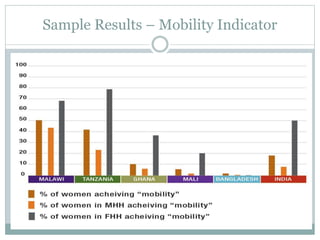
Sample Results – Mobility Indicator
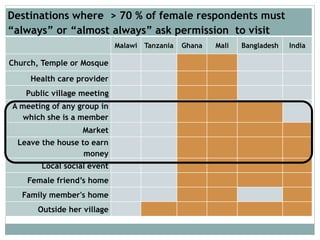
Destinations where > 70 % of female respondents must 
“always” or “almost always” ask permission to visit 
Malawi Tanzania Ghana Mali Bangladesh India 
Church, Temple or Mosque 
Health care provider 
Public village meeting 
A meeting of any group in 
which she is a member 
Market 
Leave the house to earn 
money 
Local social event 
Female friend’s home 
Family member's home 
Outside her village
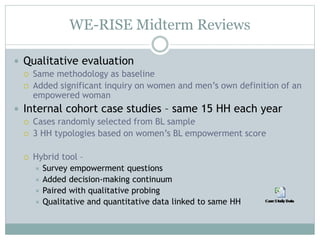
WE-RISE Midterm Reviews 
 Qualitative evaluation 
 Same methodology as baseline 
 Added significant inquiry on women and men’s own definition of an 
empowered woman 
 Internal cohort case studies – same 15 HH each year 
 Cases randomly selected from BL sample 
 3 HH typologies based on women’s BL empowerment score 
 Hybrid tool – 
 Survey empowerment questions 
 Added decision-making continuum 
 Paired with qualitative probing 
 Qualitative and quantitative data linked to same HH
Key Malawi Midterm Lessons 
 Women and Men’s own definition of empowerment 
 Can economically contribute to the household 
 Has no mobility restrictions 
 Does not have to rely on her husband for all decisions. 
 Is literate 
Declines in empowerment scores. 
External reasons 
Trade-offs 
Refine achievement criteria for decision-making
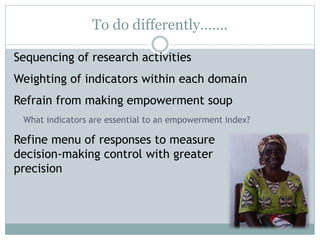
To do differently……. 
Sequencing of research activities 
Weighting of indicators within each domain 
Refrain from making empowerment soup 
What indicators are essential to an empowerment index? 
Refine menu of responses to measure 
decision-making control with greater 
precision
QUESTIONS ? 
Thank you 
LAURIE STARR: laur ie@tangointernat ional
Food for Thought 
 What is indispensable? 
 What is challenging and needs to be adapted to 
local contexts? 
 What is “allowed”? 
 Are results statistically valid, following changes to 
index? 
 When? 
 Why not?

Training Session 3 – Starr – CARE Modifications to the WEAI

  • 1.
    Adapting the WEAIto a Project-specific Index A 4NH GENDE R -NUTR ITION METHODS WORKSHOP I I DE C EMB E R 2 - 4 , 2 0 1 4 – B IOVE R S ITY INTE RNATIONA L – ROME , ITA LY Laurie Starr TANGO International Senior Technical Advisor Contact: laurie@tangointernational
  • 2.
    Overview  DesigningCARE’s aggregate index for empowerment  Relevance of baseline and midterm findings to project implementation  Lessons learned
  • 4.
    Domain Indicator Weight PRODUCTION (20%) RESOURCES (20%) INCOME (20%) LEADERSHIP (20%) TIME/ (20%) Adapted from the Women’s Empowerment in Agriculture Index. IFPRI/USAID, 2012
  • 5.
    Domain Indicator Weight PRODUCTION (20%) Input in productive decisions 10% Autonomy in production domains 10% RESOURCES (20%) Sole or joint ownership of assets 6. 7% Decision-making control over assets 6.7% Access to and decisions on credit 6.7% INCOME (20%) Control over household income and expenditures 20% LEADERSHIP & COMMUNITY (20%) Group participation 5% Speaking in public 5% Self-confidence 5% Political participation 5% TIME/ AUTONOMY (20%) Satisfaction with time available for leisure 6.7% Mobility 6.7% Attitudes that support gender equitable roles in HH 6.7% Total 100%
  • 6.
    Baseline Methodology: Mixed-methods Malawi TNZ ETH Ghana Mali Bangladesh India # of households surveyed 763 751 849 894 921 175 785 454 923 # of focus groups 36 36 36 36 48 12 36 40 48 • Quantitative household surveys • Qualitative research • Female, male, and mixed focus groups (320 + total) • Participatory tools • Seasonal calendars • 24-hour time allocation analysis • Decision-making matrices • Venn diagrams • Key informant interviews (as many as 50 per country)
  • 7.
    Analysis with originalthresholds Extremely high rates of baseline achievement > 80% of women considered to be empowered (5DE) > 90% achievement for individual indicators What does this mean for project focus?
  • 8.
    Adjusting indicator thresholds-Malawi Indicator: Sole or joint control over purchase or sale of assets Original threshold Adjusted threshold Woman has sole or joint control for at least one type of asset.* # of asset types* for which women have sole or joint control ____________________________________ # of assets types reported by household Must be > .75 Result – 93% achieve Result – 62% achieve *except if only poultry or non-mechanized equipment
  • 9.
    Results- Empowerment IndexScore Malawi Tanzania Ghana Mali Bangladesh India Empowerment index score .66 .58 .47 .32 .29 .46 % of women achieving empowerment (score of .80 or greater) 23.2* 13.1* 1.7* 2.2* 0.0 4.4* n 763 819 173 776 454 924 *Significantly different between male- and female-headed households within individual countries at p < .05/ India (p < .10) Empowerment index score = aggregate value of the weighted average of the 13 indicators Note: score is similar to 5DE only. Gender parity measured, but no empowerment gap
  • 10.
    Sample Results –Mobility Indicator
  • 11.
    Destinations where >70 % of female respondents must “always” or “almost always” ask permission to visit Malawi Tanzania Ghana Mali Bangladesh India Church, Temple or Mosque Health care provider Public village meeting A meeting of any group in which she is a member Market Leave the house to earn money Local social event Female friend’s home Family member's home Outside her village
  • 12.
    WE-RISE Midterm Reviews  Qualitative evaluation  Same methodology as baseline  Added significant inquiry on women and men’s own definition of an empowered woman  Internal cohort case studies – same 15 HH each year  Cases randomly selected from BL sample  3 HH typologies based on women’s BL empowerment score  Hybrid tool –  Survey empowerment questions  Added decision-making continuum  Paired with qualitative probing  Qualitative and quantitative data linked to same HH
  • 13.
    Key Malawi MidtermLessons  Women and Men’s own definition of empowerment  Can economically contribute to the household  Has no mobility restrictions  Does not have to rely on her husband for all decisions.  Is literate Declines in empowerment scores. External reasons Trade-offs Refine achievement criteria for decision-making
  • 14.
    To do differently……. Sequencing of research activities Weighting of indicators within each domain Refrain from making empowerment soup What indicators are essential to an empowerment index? Refine menu of responses to measure decision-making control with greater precision
  • 15.
    QUESTIONS ? Thankyou LAURIE STARR: laur ie@tangointernat ional
  • 16.
    Food for Thought  What is indispensable?  What is challenging and needs to be adapted to local contexts?  What is “allowed”?  Are results statistically valid, following changes to index?  When?  Why not?

Editor's Notes

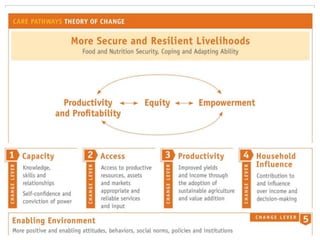
  • #4 The programme theorizes that marginalized food insecure rural women will be more productive, and their families more food secure when: Women have increased capacity (skills, knowledge, resources), capabilities (confidence, bargaining power, collective voice), and support Local governance and institutions have in place and are implementing gender-sensitive policies and programming that are responsive to the rights and needs of poor women farmers Agricultural service, value chain, and market environments of relevance to women are more competitive, gender-inclusive, and environmentally sustainable CARE requested that the M&E framework for the two projects include a high-level impact indicator that could measure progress in multiple key areas of women’s empowerment represented in their Theory of Change. Best start—WEAI – unreleased but past pilot stage.
  • #6 Original indicators and weights in black type; new in red. self-confidence: Pathways/ We-Rise focus on women’s increased confidence/ bargaining power Political participation: link to engagement in the political process attitudes supporting gender equitable roles : TOC, key lever of change is shifts in intra-household gender relations. mobility -critical to the achievement of other desired project outcomes Modeled WEAI set aggregate threshold of achievement at .80. All indicators were also outcome indicators for specific Strategic Objectives.
  • #7 Non-beneficiaries included in qualitative research. Quantitative- longitudinal beneficiary only sample. Not RCT. Budget limitations.
  • #8 Leaves little room for improvement over time. beneficiary based panel study. Were women who self-selected for CARE’s project already empowered? Qualitative data informed decisions to raise thresholds of achievement for individual indicators.
  • #10 Calibration of thresholds possibly too high. Reason ability to measure GPI was compromised.
  • #11 All are statistically significant …. exception of Bangladesh.
  • #12 Highlights importance of sequencing project activities. destinations are key to achieving improved market access or income generation both of which are CARE’s levers of Change . Indication that project efforts in Ghana, Mali, Bangladesh and India will need to be designed and sequenced such that they can help women overcome barriers to mobility.
  • #13 Example of qualitative probing added to survey: In what types of settings are you comfortable speaking up? What subjects do people speak out about relating to community decisions/challenges? On what topics are you comfortable speaking up about in public? Why? Has this changed in the past 2 years? How? Why? Are there topics you wish you could speak up about in public, but are not able to? Constraints to speaking up (personally and community wide) ? Differences between men and women speaking out? Probe for details. Are there women in the community who have an easier time speaking up about public issues? What conditions help them to speak up in public? Has this changed in the past 2 years? How? Why?
  • #14 Declines in empowerment scores. External reasons - public speaking example Trade-offs – time example
  • #15 Greater value if project had done preliminary study before determining indicators. Must include aspects of empowerment important to women.