Chapter 13 Forces in Motion
You Will Discover: How motion is measured. How force affect motion, work, power. What Newton’s laws of motion are. How simple machines make work easier.
Chapter 13 Vocabulary Velocity:  the speed and direction of an object’s motion Force:  a push or pull that acts on an object Work:  energy used when a force moves on an object Power:  the rate at which work is done Equilibrium :  the state in which the net force is zero Inertia:  the tendency of an object to resist a change in motion Acceleration:  the rate at which the velocity of an object changes over time. Machine:  a device that changes the direction or the amount of effort needed to do work.
Lesson 1: How can you describe motion? Types of Motion Steady or Constant -  the Earth has steady motion as it moves around the Sun. Variable -  cars, trucks, and buses because they move in many directions and at many speeds. Periodic -  a pendulum, swings back and forth Circular -  wheels   Vibrational -  a rubber band when you pluck it
Examples of Motion Steady or Constant Periodic Variable Vibrational Circular
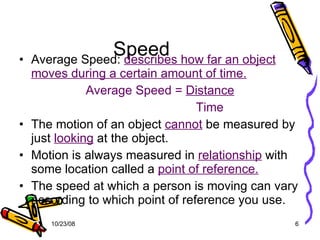
Speed  Average Speed:  describes how far an object moves during a certain amount of time. Average Speed =  Distance   Time The motion of an object  cannot  be measured by just  looking  at the object. Motion is always measured in  relationship  with some location called a  point of reference. The speed at which a person is moving can vary according to which point of reference you use.
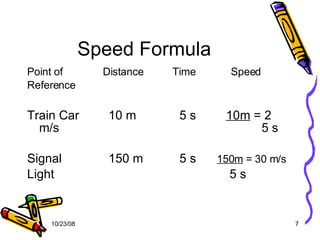
Speed Formula Point of    Distance   Time   Speed Reference Train Car   10 m    5 s    10m  = 2 m/s   5 s Signal    150 m   5 s  150m  = 30 m/s Light   5 s
Velocity Speed and Velocity are not the same! Velocity describes  the speed and the direction of an object’s motion. Example: the speed of the train might be    described as 30 meters per    second, but its velocity is 30    meters per second North.
Questions to Discuss What are five types of motion?  Give an example for each one. What do you need to know to find an objects velocity? What is a point of reference? If you were riding a bicycle, is your motion constant, variable, or periodic? Explain.
Lesson 2 - What are forces? Pushes and Pulls A  Force  is a  push or pull  that acts on an object. When one object pushes or pulls another object, the first object is exerting a force on the second one. Forces can make a moving object  speed up, slow down, or change direction. Forces have both  magnitude  and  direction. Magnitude is measured in newtons (N). The direction of a force can be described by telling which way the force is acting.
Gravity Every object in the universe  exerts  a gravitational  pull  on every other object. An object’s  weight  is the  amount  of gravitational  force  between it and Earth. -This depends on the object’s mass and Earth’s mass.
Magnetism Magnetism is a force that  pushes or pulls  on other  objects . Magnets will strongly pull on objects made of iron, cobalt, nickel, and gadolinium. The  north and south  poles of  two magnets will push  away   from each other.
Electricity Electric forces act between objects that are electrically charged. Objects get  electrically  charged when they  gain or lose  electrons. All atoms have negative  electrons  and positive  protons. If an object gains  electrons , the object will be  negatively  charged. If an object  loses  electrons, it will be  positively  charged.
Electricity Electrons move from one  object  to another when: The  objects  are  rubbed  together. Objects that are electrically charged will exert forces on each other. Oppositely  charged objects are  attracted  to each other. Objects with the  same  charge are  repelled  from each other.
Friction Friction  is the force that results when two materials  rub  against each other. Friction acts to  slow down  the motion of an object or  keep it  from starting to move. Friction depends on the qualities of the object involved. The  shape, speed, or texture  of one object can affect the  amount  of friction.
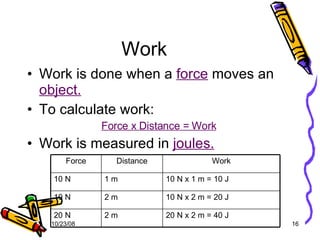
Work Work is done when a  force  moves an  object. To calculate work: Force x Distance = Work Work is measured in  joules. 20 N x 2 m = 40 J 2 m 20 N 10 N x 2 m = 20 J 2 m 10 N 10 N x 1 m = 10 J 1 m 10 N Work Distance Force
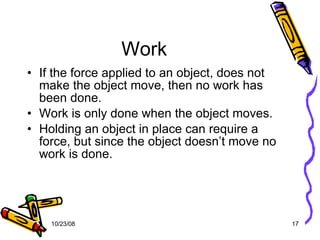
Work If the force applied to an object, does not make the object move, then no work has been done. Work is only done when the object moves. Holding an object in place can require a force, but since the object doesn’t move no work is done.
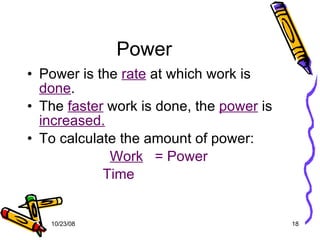
Power Power is the  rate  at which work is  done . The  faster  work is done, the  power  is  increased. To calculate the amount of power: Work   = Power Time
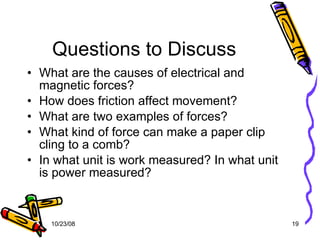
Questions to Discuss What are the causes of electrical and magnetic forces? How does friction affect movement? What are two examples of forces? What kind of force can make a paper clip cling to a comb? In what unit is work measured? In what unit is power measured?
Lesson 3 - What are Newton’s laws of motion? NET FORCES Different  forces  can act on an  object  at the same time. They may act in the  same  direction,  different  directions, and some may be  stronger  than others. The combination of  all  these forces is the  NET FORCE! The net force determines whether the object start or stop moving or change direction.
Net Forces Equal forces  working  in  opposite  directions,  balance  those forces.  The  net  force is  zero . This is called  equilibrium. A stationary object will remain motionless. A moving object in will continue to move at a constant speed in a straight line. Unbalanced forces acting on an object causes it to change motion.
Newton’s First Law Unless a  net  force acts on an  object , the  object  will remain in  constant  motion. An object at  rest  stays at rest until a  net  force acts  upon  it. An object moving at a  constant  speed will continue to move in a  straight  line and at a  constant  speed.
Newton’s Second Law Acceleration  is the rate at which the  velocity  of an object  changes  over time. The  net  forces acting on an  object  can change an object’s  velocity  by causing it to  speed up, slow down, or change directions. The formula that describes the relationship between force, mass, and acceleration is: Force = Mass x Acceleration The stronger the force the more that object will accelerate.
Newton’s Third Law When one object  exerts  a force on a second object, the second object  exerts  a force on the first object. This is sometimes called the  action-reaction  law of motion. Action-reaction forces are  always  equal and  opposite , and they occur in  pairs .
Questions to Discuss What is the net force on an object? What does an object look like that is in equilibrium? What does Newton’s first law of motion state? The second law? The third law? How does force affect acceleration? Why do action-reaction forces always occur in pairs?
Lesson 4 - What are simple machines? Machines and Work: Work  is done when a  force  causes an object to move. A  machine  is a device that  changes  the direction or the amount of  force  needed to do  work . Machines do not  reduce  the amount of work that needs to be  done , it just makes it  easier . There are four types of simple machines:  pulley, wheel and axle, lever, inclined plane
Pulley A  pulley  consists of a  rope  or cable that runs through a  grooved  wheel. *Examples: flag pole drapery rods
Wheel and Axle A  wheel and axle  is made up of a  circular  object and a  shaft. *Examples: steering wheel door knob
Lever A  lever  is made up of a  stiff  bar that  rotates  around a fixed point called a  fulcrum .   *Examples: tongs clothes pins pliers
Inclined Planes An  inclined plane  consists of a  flat  surface with one end  higher  than the other.   *Examples: screws, wedge, doorstop ramps,
Complex Machines A  complex  machine uses  two  or more simple machines put  together . Many complex machines use  electricity, gravity, burning fuel, human force, or magnetism  to operate Examples:   washing machine   go cart   car   s ailboat
Questions to Discuss Why is a screw considered a simple machine? What is a complex machine? How is the movement of rolling a weight up an inclined plane different from climbing stairs? What is a machine? List the four simple machines.  What is one example of each simple machine?

Chapter 13 Lessons

  • 1.
  • 2.
    You Will Discover:How motion is measured. How force affect motion, work, power. What Newton’s laws of motion are. How simple machines make work easier.
  • 3.
    Chapter 13 VocabularyVelocity: the speed and direction of an object’s motion Force: a push or pull that acts on an object Work: energy used when a force moves on an object Power: the rate at which work is done Equilibrium : the state in which the net force is zero Inertia: the tendency of an object to resist a change in motion Acceleration: the rate at which the velocity of an object changes over time. Machine: a device that changes the direction or the amount of effort needed to do work.
  • 4.
    Lesson 1: Howcan you describe motion? Types of Motion Steady or Constant - the Earth has steady motion as it moves around the Sun. Variable - cars, trucks, and buses because they move in many directions and at many speeds. Periodic - a pendulum, swings back and forth Circular - wheels Vibrational - a rubber band when you pluck it
  • 5.
    Examples of MotionSteady or Constant Periodic Variable Vibrational Circular
  • 6.
    Speed AverageSpeed: describes how far an object moves during a certain amount of time. Average Speed = Distance Time The motion of an object cannot be measured by just looking at the object. Motion is always measured in relationship with some location called a point of reference. The speed at which a person is moving can vary according to which point of reference you use.
  • 7.
    Speed Formula Pointof Distance Time Speed Reference Train Car 10 m 5 s 10m = 2 m/s 5 s Signal 150 m 5 s 150m = 30 m/s Light 5 s
  • 8.
    Velocity Speed andVelocity are not the same! Velocity describes the speed and the direction of an object’s motion. Example: the speed of the train might be described as 30 meters per second, but its velocity is 30 meters per second North.
  • 9.
    Questions to DiscussWhat are five types of motion? Give an example for each one. What do you need to know to find an objects velocity? What is a point of reference? If you were riding a bicycle, is your motion constant, variable, or periodic? Explain.
  • 10.
    Lesson 2 -What are forces? Pushes and Pulls A Force is a push or pull that acts on an object. When one object pushes or pulls another object, the first object is exerting a force on the second one. Forces can make a moving object speed up, slow down, or change direction. Forces have both magnitude and direction. Magnitude is measured in newtons (N). The direction of a force can be described by telling which way the force is acting.
  • 11.
    Gravity Every objectin the universe exerts a gravitational pull on every other object. An object’s weight is the amount of gravitational force between it and Earth. -This depends on the object’s mass and Earth’s mass.
  • 12.
    Magnetism Magnetism isa force that pushes or pulls on other objects . Magnets will strongly pull on objects made of iron, cobalt, nickel, and gadolinium. The north and south poles of two magnets will push away from each other.
  • 13.
    Electricity Electric forcesact between objects that are electrically charged. Objects get electrically charged when they gain or lose electrons. All atoms have negative electrons and positive protons. If an object gains electrons , the object will be negatively charged. If an object loses electrons, it will be positively charged.
  • 14.
    Electricity Electrons movefrom one object to another when: The objects are rubbed together. Objects that are electrically charged will exert forces on each other. Oppositely charged objects are attracted to each other. Objects with the same charge are repelled from each other.
  • 15.
    Friction Friction is the force that results when two materials rub against each other. Friction acts to slow down the motion of an object or keep it from starting to move. Friction depends on the qualities of the object involved. The shape, speed, or texture of one object can affect the amount of friction.
  • 16.
    Work Work isdone when a force moves an object. To calculate work: Force x Distance = Work Work is measured in joules. 20 N x 2 m = 40 J 2 m 20 N 10 N x 2 m = 20 J 2 m 10 N 10 N x 1 m = 10 J 1 m 10 N Work Distance Force
  • 17.
    Work If theforce applied to an object, does not make the object move, then no work has been done. Work is only done when the object moves. Holding an object in place can require a force, but since the object doesn’t move no work is done.
  • 18.
    Power Power isthe rate at which work is done . The faster work is done, the power is increased. To calculate the amount of power: Work = Power Time
  • 19.
    Questions to DiscussWhat are the causes of electrical and magnetic forces? How does friction affect movement? What are two examples of forces? What kind of force can make a paper clip cling to a comb? In what unit is work measured? In what unit is power measured?
  • 20.
    Lesson 3 -What are Newton’s laws of motion? NET FORCES Different forces can act on an object at the same time. They may act in the same direction, different directions, and some may be stronger than others. The combination of all these forces is the NET FORCE! The net force determines whether the object start or stop moving or change direction.
  • 21.
    Net Forces Equalforces working in opposite directions, balance those forces. The net force is zero . This is called equilibrium. A stationary object will remain motionless. A moving object in will continue to move at a constant speed in a straight line. Unbalanced forces acting on an object causes it to change motion.
  • 22.
    Newton’s First LawUnless a net force acts on an object , the object will remain in constant motion. An object at rest stays at rest until a net force acts upon it. An object moving at a constant speed will continue to move in a straight line and at a constant speed.
  • 23.
    Newton’s Second LawAcceleration is the rate at which the velocity of an object changes over time. The net forces acting on an object can change an object’s velocity by causing it to speed up, slow down, or change directions. The formula that describes the relationship between force, mass, and acceleration is: Force = Mass x Acceleration The stronger the force the more that object will accelerate.
  • 24.
    Newton’s Third LawWhen one object exerts a force on a second object, the second object exerts a force on the first object. This is sometimes called the action-reaction law of motion. Action-reaction forces are always equal and opposite , and they occur in pairs .
  • 25.
    Questions to DiscussWhat is the net force on an object? What does an object look like that is in equilibrium? What does Newton’s first law of motion state? The second law? The third law? How does force affect acceleration? Why do action-reaction forces always occur in pairs?
  • 26.
    Lesson 4 -What are simple machines? Machines and Work: Work is done when a force causes an object to move. A machine is a device that changes the direction or the amount of force needed to do work . Machines do not reduce the amount of work that needs to be done , it just makes it easier . There are four types of simple machines: pulley, wheel and axle, lever, inclined plane
  • 27.
    Pulley A pulley consists of a rope or cable that runs through a grooved wheel. *Examples: flag pole drapery rods
  • 28.
    Wheel and AxleA wheel and axle is made up of a circular object and a shaft. *Examples: steering wheel door knob
  • 29.
    Lever A lever is made up of a stiff bar that rotates around a fixed point called a fulcrum . *Examples: tongs clothes pins pliers
  • 30.
    Inclined Planes An inclined plane consists of a flat surface with one end higher than the other. *Examples: screws, wedge, doorstop ramps,
  • 31.
    Complex Machines A complex machine uses two or more simple machines put together . Many complex machines use electricity, gravity, burning fuel, human force, or magnetism to operate Examples: washing machine go cart car s ailboat
  • 32.
    Questions to DiscussWhy is a screw considered a simple machine? What is a complex machine? How is the movement of rolling a weight up an inclined plane different from climbing stairs? What is a machine? List the four simple machines. What is one example of each simple machine?