What is education?
Education can be defined as the process of
socialization of individuals. When educating, a
person assimilates and learns knowledge.
Education also implies a cultural and behavioral
awareness, where the new generations acquire
the ways of being of previous generations.
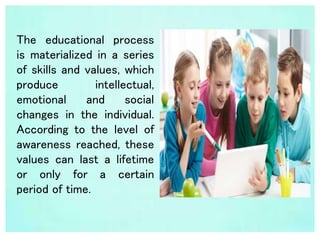
The educational process
is materialized in a series
of skills and values, which
produce intellectual,
emotional and social
changes in the individual.
According to the level of
awareness reached, these
values ​​can last a lifetime
or only for a certain
period of time.
In the case of children,
education seeks to promote the
process of structuring thought
and forms of expression. It helps
in the sensory-motor maturation
process and stimulates group
integration and coexistence.
Education is one of the factors that most
influences the advancement and progress of
people and societies. In addition to providing
knowledge, knowledge and learning; education
enriches culture, spirit, values ​​and everything
that characterizes us as human beings.
Formal Education
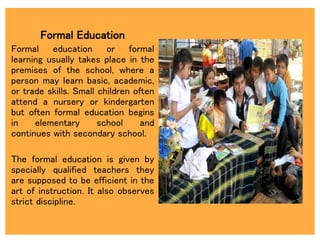
Formal education or formal
learning usually takes place in the
premises of the school, where a
person may learn basic, academic,
or trade skills. Small children often
attend a nursery or kindergarten
but often formal education begins
in elementary school and
continues with secondary school.
The formal education is given by
specially qualified teachers they
are supposed to be efficient in the
art of instruction. It also observes
strict discipline.
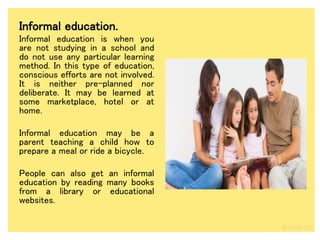
Informal education.
Informal education is when you
are not studying in a school and
do not use any particular learning
method. In this type of education,
conscious efforts are not involved.
It is neither pre-planned nor
deliberate. It may be learned at
some marketplace, hotel or at
home.
Informal education may be a
parent teaching a child how to
prepare a meal or ride a bicycle.
People can also get an informal
education by reading many books
from a library or educational
websites.
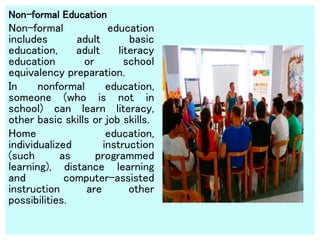
Non-formal Education
Non-formal education
includes adult basic
education, adult literacy
education or school
equivalency preparation.
In nonformal education,
someone (who is not in
school) can learn literacy,
other basic skills or job skills.
Home education,
individualized instruction
(such as programmed
learning), distance learning
and computer-assisted
instruction are other
possibilities.
Education

Education

  • 3.
    What is education? Educationcan be defined as the process of socialization of individuals. When educating, a person assimilates and learns knowledge. Education also implies a cultural and behavioral awareness, where the new generations acquire the ways of being of previous generations.
  • 4.
    The educational process ismaterialized in a series of skills and values, which produce intellectual, emotional and social changes in the individual. According to the level of awareness reached, these values ​​can last a lifetime or only for a certain period of time.
  • 5.
    In the caseof children, education seeks to promote the process of structuring thought and forms of expression. It helps in the sensory-motor maturation process and stimulates group integration and coexistence.
  • 7.
    Education is oneof the factors that most influences the advancement and progress of people and societies. In addition to providing knowledge, knowledge and learning; education enriches culture, spirit, values ​​and everything that characterizes us as human beings.
  • 9.
    Formal Education Formal educationor formal learning usually takes place in the premises of the school, where a person may learn basic, academic, or trade skills. Small children often attend a nursery or kindergarten but often formal education begins in elementary school and continues with secondary school. The formal education is given by specially qualified teachers they are supposed to be efficient in the art of instruction. It also observes strict discipline.
  • 10.
    Informal education. Informal educationis when you are not studying in a school and do not use any particular learning method. In this type of education, conscious efforts are not involved. It is neither pre-planned nor deliberate. It may be learned at some marketplace, hotel or at home. Informal education may be a parent teaching a child how to prepare a meal or ride a bicycle. People can also get an informal education by reading many books from a library or educational websites.
  • 11.
    Non-formal Education Non-formal education includesadult basic education, adult literacy education or school equivalency preparation. In nonformal education, someone (who is not in school) can learn literacy, other basic skills or job skills. Home education, individualized instruction (such as programmed learning), distance learning and computer-assisted instruction are other possibilities.