UNIT II - COMPRESSION IGNITION ENGINES
UNIT II COMPRESSION IGNITION ENGINES 9
 Diesel Fuel Injection Systems - Stages of combustion – Knocking – Factors
affecting knock – Direct and Indirect injection systems – Combustion
chambers – Fuel Spray behaviour – Spray structure and spray penetration – Air
motion - Introduction to Turbocharging.
26 December 2017 ME 6016 ADVANCED IC ENGINES 2
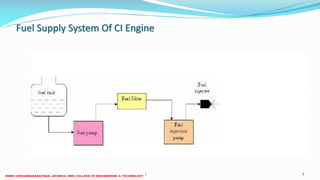
Fuel Supply System Of CI Engine
26 December 2017 3ME 6016 ADVANCED IC ENGINES
 In diesel engine only air is injected during the suction stroke and it is compressed
during compression stroke.
 Fuel is injected into the combustion chamber in the form of fine spray at the end of
compression stroke.
 A fuel injection system in a diesel engine has to satisfy the following requirements:
1. To inject the fuel at the right time in the cycle.
2. The fuel should be properly atomized.
3. The correct quantity of fuel should be injected depending upon the load.
 Fuel pump takes the fuel from fuel tank and delivers it to the fuel filter.
 When the pressure is developed in the injection pump the fuel flows from injection
pump to the fuel injector under pressure.
 The fuel injector is either a single hole nozzle or multi-hole nozzle.
26 December 2017 4ME 6016 ADVANCED IC ENGINES
Diesel Engine Fuel Injection Systems
Functions of a Fuel injection system:
 Filter the fuel
 Measure the correct quantity of fuel to be injected
 Time the fuel injection
 Control the rate of fuel injection
 Atomize the fuel
 Distribute the fuel in the combustion chamber
26 December 2017 5ME 6016 ADVANCED IC ENGINES
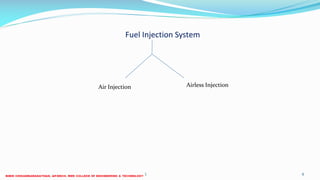
Fuel Injection System
Air Injection Airless Injection
26 December 2017 6ME 6016 ADVANCED IC ENGINES
Air Injection:
In this method of fuel injection air is compressed in a compressor to high
pressure and injected into the fuel
Nozzle. The rate of fuel admission can be controlled by varying the pressure of
injection air.
Adv:
It provides better atomization and distribution of the fuel
As the combustion is more complete the BMEP is higher
Inferior fuels can be used
Dis Adv:
It requires high pressure multi stage compression
A separate mechanical linkage is required to time the operation of fuel valve
Due to compression and linkage the size of the engine increases
Since the fuel burns very near to the nozzle it is overheated
26 December 2017 7ME 6016 ADVANCED IC ENGINES
Types of modern fuel injection system:
1. Common Rail Injection System
2. Individual Pump Injection System
3. Distributor System
 Atomisation of the fuel is done by either ‘airblast’ or ‘pressure spray’
Solid injection at about 100 and 200 bars pressure has reduced the need of
having compressor .
26 December 2017 8ME 6016 ADVANCED IC ENGINES
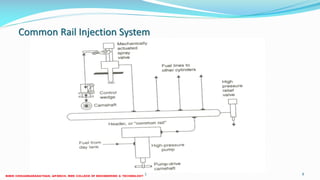
Common Rail Injection System
26 December 2017 9ME 6016 ADVANCED IC ENGINES
A single pump supplies high pressure fuel to header, a relief valve holds the
pressure constant. The control wedge adjusts the lift of mechanically operated
valve to set amount and time of injection.
Adv:
1. System is simple and less maintenance cost
2. Only one pump is sufficient for multi cylinder engine
3. It fulfills requirements of either constant load with variable speeds or
variable loads with constant speed
4. Variation in pump supply pressure effects all the cylinders equally
Dis adv:
1. Leaks in the injection valve
2. Accurate design and work manship is required
26 December 2017 10ME 6016 ADVANCED IC ENGINES
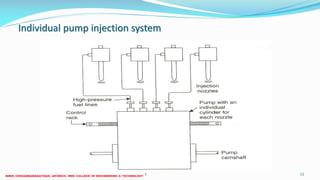
Individual pump injection system
26 December 2017 11ME 6016 ADVANCED IC ENGINES
In this system an individual pump or pump cylinder connects directly to each
fuel nozzle. Pump meters charge and control injection timing. Nozzles contain
a delivery valve actuated by the fuel oil pressure.
Dis adv:
This system has to be designed accurately to pump small quantity of fuel
26 December 2017 12ME 6016 ADVANCED IC ENGINES
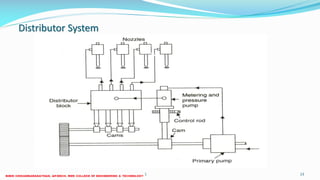
Distributor System
26 December 2017 13ME 6016 ADVANCED IC ENGINES
 In this system the fuel metered at a central point; a pump pressurizes, meters
the fuel and times the injection. From here fuel is distributed to cylinders in
correct firing order by cam operated poppet valves which open to admit fuel
to nozzles.
26 December 2017 14ME 6016 ADVANCED IC ENGINES
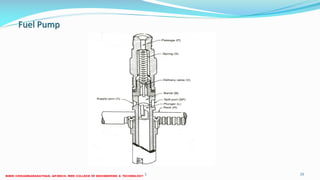
Fuel Pump
26 December 2017 15ME 6016 ADVANCED IC ENGINES
L is the plunger driven by a cam and tappet mechanism at the bottom . B is the barrel
in which plunger reciprocates. There is a rectangular vertical groove in the plunger
which extends from top to another helical groove. V is the delivery valve which lifts
off its seat under the liquid fuel pressure and spring force. The fuel pump is
connected to the fuel atomiser through passage P. SP and Y are the spill and the
supply port respectively. When the plunger is at he bottom both ports SP and Y are
uncovered by the plunger and fuel enters from the port SP into the barrel. On further
upward movement of the plunger both the ports are closed and fuel is compressed
and delivered through passage P to the atomiser as delivery valve lifts off from its
seat. With further rise of the Plunger at certain moment, the port SP is connected
to the fuel in the upper part of the plunger through rectangular vertical groove
through helical groove , as a result of which sudden fall in pressure occurs and
delivery valve occupies seat against the spring force. The plunger is rotated by the
Rack R which is moved in or out by the governor. By changing the Angular position of
the helical groove according to the load and speed of the vehicle amount of fuel
delivered can be varied.
26 December 2017 16ME 6016 ADVANCED IC ENGINES
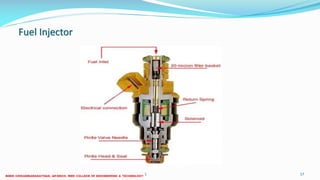
Fuel Injector
26 December 2017 17ME 6016 ADVANCED IC ENGINES
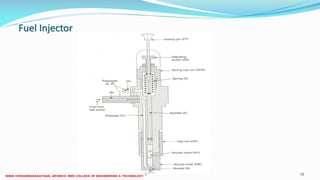
Fuel Injector
26 December 2017 18ME 6016 ADVANCED IC ENGINES
It consist of a nozzle valve(NV) fitted in the nozzle body (NB). The nozzle valve
is held on its seat by a spring ‘S’ which exerts pressure through spindle E. ‘AS’
is the adjusting screw by which nozzle valve lift can be adjusted. Usually the
nozzle valve is set to lift at 135 to 175 bars pressure. FP is the feeling pin which
indicates whether valve is working properly or not
The fuel under pressure from the fuel pump enters the injector through the
passages B and C and lifts the nozzle valve. The fuel travels down nozzle N
and injected into the engine cylinder in the form of fine spray. Then the
pressure of the oil falls, the nozzle valve occupies its seat under the spring
force and fuel supply is cut off. Any leakage of fuel accumulated above the
valve is led to the fuel tank through passage A. The leakage occurs when the
nozzle valve is worn out
26 December 2017 19ME 6016 ADVANCED IC ENGINES
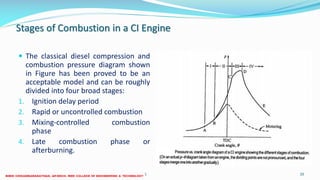
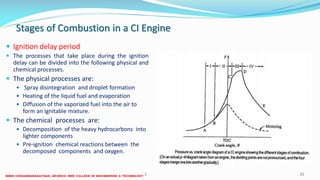
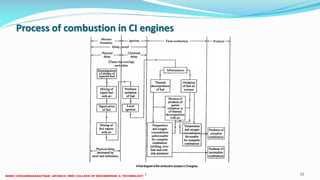
Stages of Combustion in a CI Engine
 The classical diesel compression and
combustion pressure diagram shown
in Figure has been proved to be an
acceptable model and can be roughly
divided into four broad stages:
1. Ignition delay period
2. Rapid or uncontrolled combustion
3. Mixing-controlled combustion
phase
4. Late combustion phase or
afterburning.
26 December 2017 ME 6016 ADVANCED IC ENGINES 20
Stages of Combustion in a CI Engine
 Ignition delay period
 The processes that take place during the ignition
delay can be divided into the following physical and
chemical processes.
 The physical processes are:
 Spray disintegration and droplet formation
 Heating of the liquid fuel and evaporation
 Diffusion of the vaporized fuel into the air to
form an ignitable mixture.
 The chemical processes are:
 Decomposition of the heavy hydrocarbons into
lighter components
 Pre-ignition chemical reactions between the
decomposed components and oxygen.
26 December 2017 ME 6016 ADVANCED IC ENGINES 21
Stages of Combustion in a CI Engine
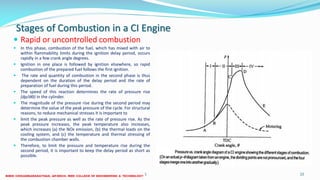
 Rapid or uncontrolled combustion
 In this phase, combustion of the fuel, which has mixed with air to
within flammability limits during the ignition delay period, occurs
rapidly in a few crank angle degrees.
 Ignition in one place is followed by ignition elsewhere, so rapid
combustion of the prepared fuel follows the first ignition.
 The rate and quantity of combustion in the second phase is thus
dependent on the duration of the delay period and the rate of
preparation of fuel during this period.
 The speed of this reaction determines the rate of pressure rise
(dp/dϴ) in the cylinder.
 The magnitude of the pressure rise during the second period may
determine the value of the peak pressure of the cycle. For structural
reasons, to reduce mechanical stresses it is important to
 limit the peak pressure as well as the rate of pressure rise. As the
peak pressure increases, the peak temperature also increases,
which increases (a) the NOx emission, (b) the thermal loads on the
cooling system, and (c) the temperature and thermal stressing of
the combustion chamber walls.
 Therefore, to limit the pressure and temperature rise during the
second period, it is important to keep the delay period as short as
possible.
26 December 2017 ME 6016 ADVANCED IC ENGINES 22
Stages of Combustion in a CI Engine
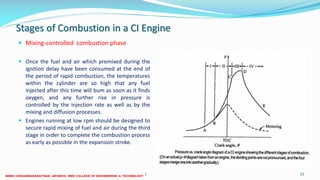
 Mixing-controlled combustion phase
 Once the fuel and air which premixed during the
ignition delay have been consumed at the end of
the period of rapid combustion, the temperatures
within the cylinder are so high that any fuel
injected after this time will bum as soon as it finds
oxygen, and any further rise in pressure is
controlled by the injection rate as well as by the
mixing and diffusion processes.
 Engines running at low rpm should be designed to
secure rapid mixing of fuel and air during the third
stage in order to complete the combustion process
as early as possible in the expansion stroke.
26 December 2017 ME 6016 ADVANCED IC ENGINES 23
Stages of Combustion in a CI Engine
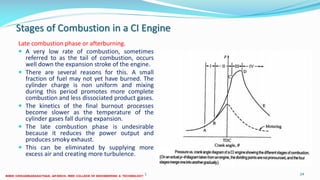
Late combustion phase or afterburning.
 A very low rate of combustion, sometimes
referred to as the tail of combustion, occurs
well down the expansion stroke of the engine.
 There are several reasons for this. A small
fraction of fuel may not yet have burned. The
cylinder charge is non uniform and mixing
during this period promotes more complete
combustion and less dissociated product gases.
 The kinetics of the final burnout processes
become slower as the temperature of the
cylinder gases fall during expansion.
 The late combustion phase is undesirable
because it reduces the power output and
produces smoky exhaust.
 This can be eliminated by supplying more
excess air and creating more turbulence.
26 December 2017 ME 6016 ADVANCED IC ENGINES 24
Process of combustion in CI engines
26 December 2017 ME 6016 ADVANCED IC ENGINES 25
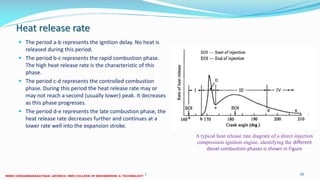
Heat release rate
 The period a-b represents the ignition delay. No heat is
released during this period.
 The period b-c represents the rapid combustion phase.
The high heat release rate is the characteristic of this
phase.
 The period c-d represents the controlled combustion
phase. During this period the heat release rate may or
may not reach a second (usually lower) peak. It decreases
as this phase progresses.
 The period d-e represents the late combustion phase, the
heat release rate decreases further and continues at a
lower rate well into the expansion stroke.
26 December 2017 ME 6016 ADVANCED IC ENGINES 26
A typical heat release rate diagram of a direct injection
compression ignition engine, identifying the different
diesel combustion phases is shown in Figure
AIR/FUEL ratio in CI engines
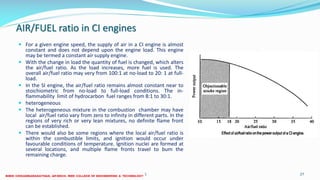
 For a given engine speed, the supply of air in a CI engine is almost
constant and does not depend upon the engine load. This engine
may be termed a constant air supply engine.
 With the change in load the quantity of fuel is changed, which alters
the air/fuel ratio. As the load increases, more fuel is used. The
overall air/fuel ratio may very from 100:1 at no-load to 20: 1 at full-
load.
 In the SI engine, the air/fuel ratio remains almost constant near to
stoichiometric from no-load to full-load conditions. The in-
flammability limit of hydrocarbon fuel ranges from 8:1 to 30:1.
 heterogeneous
 The heterogeneous mixture in the combustion chamber may have
local air/fuel ratio vary from zero to infinity in different parts. In the
regions of very rich or very lean mixtures, no definite flame front
can be established.
 There would also be some regions where the local air/fuel ratio is
within the combustible limits, and ignition would occur under
favourable conditions of temperature. Ignition nuclei are formed at
several locations, and multiple flame fronts travel to bum the
remaining charge.
26 December 2017 ME 6016 ADVANCED IC ENGINES 27
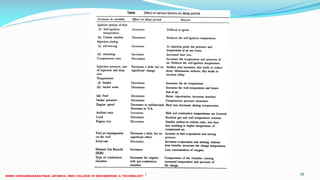
Influence of various factors on delay period
The factors described in the following affect the delay period.
1. Ignition quality of fuel
2. Compression ratio
3. Injection timing
4. Injection pressure, rate of injection and drop size
5. Intake, jacket water and fuel temperatures
6. Intake pressure
7. Engine speed
8. Air/fuel ratio
9. Load
10. Engine size
11. Combustion chamber wall effects
12. Swirl rate
13. Exhaust gas recirculation (EGA)
14. Type of combustion chamber
26 December 2017 ME 6016 ADVANCED IC ENGINES 28
Influence of various factors on delay period
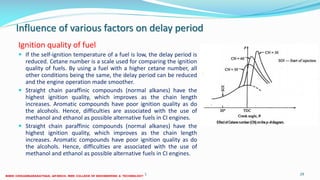
Ignition quality of fuel
 If the self-ignition temperature of a fuel is low, the delay period is
reduced. Cetane number is a scale used for comparing the ignition
quality of fuels. By using a fuel with a higher cetane number, all
other conditions being the same, the delay period can be reduced
and the engine operation made smoother.
 Straight chain paraffinic compounds (normal alkanes) have the
highest ignition quality, which improves as the chain length
increases. Aromatic compounds have poor ignition quality as do
the alcohols. Hence, difficulties are associated with the use of
methanol and ethanol as possible alternative fuels in CI engines.
 Straight chain paraffinic compounds (normal alkanes) have the
highest ignition quality, which improves as the chain length
increases. Aromatic compounds have poor ignition quality as do
the alcohols. Hence, difficulties are associated with the use of
methanol and ethanol as possible alternative fuels in CI engines.
26 December 2017 ME 6016 ADVANCED IC ENGINES 29
Influence of various factors on delay period
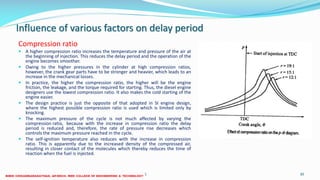
Compression ratio
 A higher compression ratio increases the temperature and pressure of the air at
the beginning of injection. This reduces the delay period and the operation of the
engine becomes smoother.
 Owing to the higher pressures in the cylinder at high compression ratios,
however, the crank gear parts have to be stronger and heavier, which leads to an
increase in the mechanical losses.
 In practice, the higher the compression ratio, the higher will be the engine
friction, the leakage, and the torque required for starting. Thus, the diesel engine
designers use the lowest compression ratio. It also makes the cold starting of the
engine easier.
 The design practice is just the opposite of that adopted in SI engine design,
where the highest possible compression ratio is used which is limited only by
knocking.
 The maximum pressure of the cycle is not much affected by varying the
compression ratio, because with the increase in compression ratio the delay
period is reduced and, therefore, the rate of pressure rise decreases which
controls the maximum pressure reached in the cycle.
 The self-ignition temperature also reduces with the increase in compression
ratio. This is apparently due to the increased density of the compressed air,
resulting in closer contact of the molecules which thereby reduces the time of
reaction when the fuel is injected.
26 December 2017 ME 6016 ADVANCED IC ENGINES 30
Influence of various factors on delay period
Injection timing
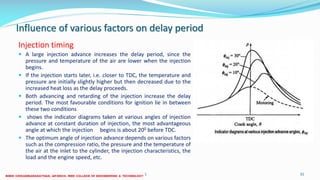
 A large injection advance increases the delay period, since the
pressure and temperature of the air are lower when the injection
begins.
 If the injection starts later, i.e. closer to TDC, the temperature and
pressure are initially slightly higher but then decreased due to the
increased heat loss as the delay proceeds.
 Both advancing and retarding of the injection increase the delay
period. The most favourable conditions for ignition lie in between
these two conditions
 shows the indicator diagrams taken at various angles of injection
advance at constant duration of injection, the most advantageous
angle at which the injection begins is about 200 before TDC.
 The optimum angle of injection advance depends on various factors
such as the compression ratio, the pressure and the temperature of
the air at the inlet to the cylinder, the injection characteristics, the
load and the engine speed, etc.
26 December 2017 ME 6016 ADVANCED IC ENGINES 31
Influence of various factors on delay period
Injection pressure, rate of injection and drop size
 None of these factors has a significant effect on the delay period. At normal operating conditions,
increasing the injection pressure produces only a modest decrease in the delay period.
 Increasing the nozzle hole diameter at constant injection pressure to increase the rate of fuel
injection and drop size have no significant effect on the delay period. These can be explained as
follows:
 It appears that in order to reduce the delay period, the fuel should be injected in small droplets to
increase the surface area of inflammation but the rate of combustion mainly depends upon the
relative motion between the fuel droplets and the swirling air.
 The smaller droplets will have less momentum and travel in air with less relative velocity resulting
in partial suffocation by its own products of combustion, and thus giving rise to a larger delay
period. As these two reasons contradict each other, practically, the injection pressure, the rate of
injection and the drop size do not significantly affect the delay period.
26 December 2017 ME 6016 ADVANCED IC ENGINES 32
Influence of various factors on delay period
Intake, jacket water and fuel temperatures
 Any increase in the inlet temperature, the cooling water temperature or the fuel
temperature results in an increase in the temperature of the charge at the moment of
injection and this causes a decrease in the delay period.
 Increasing the inlet temperature by preheating the air is undesirable as it reduces the
density of air and hence reduces the volumetric efficiency and power output.
Intake pressure
 Any increase in the intake air pressure or supercharging reduces the delay period. The rate of
pressure rise during combustion also decreases and gives smooth operation of the engine.
 Since the compression pressure will increase with the inlet pressure, the peak pressure will
be higher. As the cylinder will contain more air, it will be possible to inject more fuel to
obtain more power.
 The supercharged CI engines run smoother compared to the un-supercharged engines.
26 December 2017 ME 6016 ADVANCED IC ENGINES 33
Influence of various factors on delay period
Engine speed
 As the engine speed increases the loss of heat during compression decreases,
resulting in increased temperature and pressure of the compressed air. Thus the
delay period in milliseconds reduces but its value in degrees of crank travel
increases.
 The amount of fuel injected during the delay period depends on crank degrees and
not on the absolute time because the fuel pump is geared to the engine.
 At high speeds, there will be more fuel present in the cylinder to take part in the
second stage of uncontrolled combustion, resulting in higher rates of pressure rise
and higher maximum pressure.
 This factor has caused difficulties in the development of high speed CI engines. Very
high speed CI engines, therefore, require a greater angle of injection advance, high
ignition quality and a special design for the combustion chamber.
26 December 2017 ME 6016 ADVANCED IC ENGINES 34
Influence of various factors on delay period
Air/fuel ratio
 As the air/fuel ratio is increased, the cylinder wall temperature and combustion temperatures are lowered and
hence the delay period is increased. There is very little reduction in the maximum rate of pressure rise except at
the very high air/fuel ratios.
 On the other hand, the maximum pressure falls steadily with increasing air/fuel ratios. A practical limit on the
minimum air/fuel ratio, how ever, is set by incomplete combustion accompanied by a smoky exhaust-called the
smoke limit.
Load
 As the load is increased, the residual gas temperature and the wall temperature increase. This results in a higher
charge temperature at injection, thus shortening the delay period.
Engine size
 Large engines operate at low rpm because of inertia stress limitations. Large engines have smaller surface-to-
volume ratios which causes less heat loss during compression, resulting in higher temperatures of the
compressed air. It shortens the delay period and improves the combustion conditions.
 The design of a CI engine of larger size operating at a lower speed is therefore less difficult.
26 December 2017 ME 6016 ADVANCED IC ENGINES 35
Influence of various factors on delay period
Combustion chamber wall effects
 The impingement of the fuel jet on the combustion chamber wall affects the
fuel evaporation and mixing processes. The impingement occurs almost in all
smaller size and higher speed engines.
 If the pressure and temperature inside he cylinder are low, the presence of
wall reduces the delay period, but most diesel engines running under normal
operating conditions have higher pressure and temperature inside the cylinder
and the fuel jet impingement on the wall surface has no significant effect on
the delay period.
 However, the initial rate of burning increases because of increased vaporation
and fuel-air mixing rates.
26 December 2017 ME 6016 ADVANCED IC ENGINES 36
Influence of various factors on delay period
Swirl rate
 The air swirl rate affects fuel evaporation, the fuel-air mixing processes and the wall heat transfer during
compression and hence the charge temperature at injection.
 Under engine starting condition ,engine speed and compression temperature are low and a good air swirl would
reduce the ignition delay.
 At normal operating engine speeds, the air swirl rate has very little effect on delay period.
Exhaust gas recirculation (EGA)
 The oxygen concentration in the charge into which the fuel is injected, influences the delay period.
 The oxygen concentration is changed when the exhaust gas is recycled to the intake for the control of oxides of
nitrogen emissions. As the oxygen concentration is decreased, the ignition delay period becomes longer.
 Type of combustion chamber
 The pre-combustion chamber because of its compactness, produces a shorter delay period compared to an open
type of combustion chamber.
26 December 2017 ME 6016 ADVANCED IC ENGINES 37
26 December 2017 ME 6016 ADVANCED IC ENGINES 38
COMBUSTION KNOCK IN CI ENGINES
 Combustion knock in CI engines is associated with an extremely high rate of pressure
rise during the second phase of combustion (rapid or uncontrolled combustion) and
also with heavy vibration accompanied by a knocking sound, thus causing
overheating of the piston and the cylinder head, drop in power, damage to bearings
and possible piston seizure.
 The injection process of a fuel takes place over a definite period of time in terms of
degree crank angle. As a result, the first few drops which are injected into the
chamber pass through the ignition delay while the additional droplets are being
injected into the chamber.
 Normally, the fuel Injected period is more than the delay period. If the delay period
of the injected fuel is short, the first few droplets will commence the burning phase
in a relatively short time after injection, and a relatively small amount of fuel will be
accumulated in the chamber when actual burning commences.
26 December 2017 ME 6016 ADVANCED IC ENGINES 39
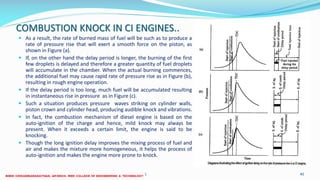
COMBUSTION KNOCK IN CI ENGINES..
 As a result, the rate of burned mass of fuel will be such as to produce a
rate of pressure rise that will exert a smooth force on the piston, as
shown in Figure (a).
 If, on the other hand the delay period is longer, the burning of the first
few droplets is delayed and therefore a greater quantity of fuel droplets
will accumulate in the chamber. When the actual burning commences,
the additional fuel may cause rapid rate of pressure rise as in Figure (b),
resulting in rough engine operation.
 If the delay period is too long, much fuel will be accumulated resulting
in instantaneous rise in pressure as in Figure (c).
 Such a situation produces pressure waves striking on cylinder walls,
piston crown and cylinder head, producing audible knock and vibrations.
 In fact, the combustion mechanism of diesel engine is based on the
auto-ignition of the charge and hence, mild knock may always be
present. When it exceeds a certain limit, the engine is said to be
knocking.
 Though the long ignition delay improves the mixing process of fuel and
air and makes the mixture more homogeneous, it helps the process of
auto-ignition and makes the engine more prone to knock.
26 December 2017 ME 6016 ADVANCED IC ENGINES 40
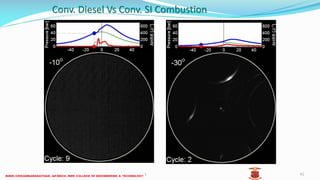
Conv. Diesel Vs Conv. SI Combustion
26 December 2017 ME 6016 ADVANCED IC ENGINES 41
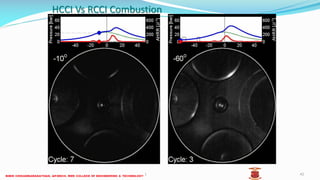
HCCI Vs RCCI Combustion
26 December 2017 ME 6016 ADVANCED IC ENGINES 42
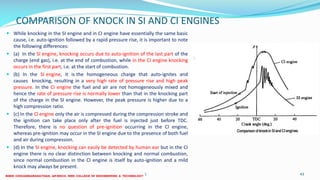
COMPARISON OF KNOCK IN SI AND CI ENGINES
 While knocking in the SI engine and in CI engine have essentially the same basic
cause, i.e. auto-ignition followed by a rapid pressure rise, it is important to note
the following differences:
 (a) In the SI engine, knocking occurs due to auto-ignition of the last part of the
charge (end gas), i.e. at the end of combustion, while in the CI engine knocking
occurs in the first part, i.e. at the start of combustion.
 (b) In the SI engine, it is the homogeneous charge that auto-ignites and
causes knocking, resulting in a very high rate of pressure rise and high peak
pressure. In the CI engine the fuel and air are not homogeneously mixed and
hence the rate of pressure rise is normally lower than that in the knocking part
of the charge in the SI engine. However, the peak pressure is higher due to a
high compression ratio.
 (c) In the Cl engine only the air is compressed during the compression stroke and
the ignition can take place only after the fuel is injected just before TDC.
Therefore, there is no question of pre-ignition occurring in the CI engine,
whereas pre-ignition may occur in the SI engine due to the presence of both fuel
and air during compression.
 (d) In the SI engine, knocking can easily be detected by human ear but in the CI
engine there is no clear distinction between knocking and normal combustion,
since normal combustion in the CI engine is itself by auto-ignition and a mild
knock may always be present.
26 December 2017 ME 6016 ADVANCED IC ENGINES 43
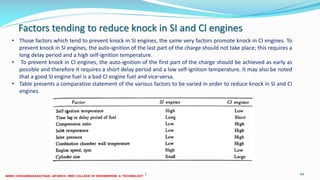
Factors tending to reduce knock in SI and Cl engines
26 December 2017 ME 6016 ADVANCED IC ENGINES 44
• Those factors which tend to prevent knock in SI engines, the same very factors promote knock in CI engines. To
prevent knock in SI engines, the auto-ignition of the last part of the charge should not take place; this requires a
long delay period and a high self-ignition temperature.
• To prevent knock in CI engines, the auto-ignition of the first part of the charge should be achieved as early as
possible and therefore it requires a short delay period and a low self-ignition temperature. It may also be noted
that a good SI engine fuel is a bad CI engine fuel and vice-versa.
• Table presents a comparative statement of the various factors to be varied in order to reduce knock in SI and CI
engines.
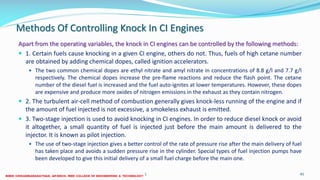
Methods Of Controlling Knock In CI Engines
Apart from the operating variables, the knock in CI engines can be controlled by the following methods:
 1. Certain fuels cause knocking in a given CI engine, others do not. Thus, fuels of high cetane number
are obtained by adding chemical dopes, called ignition accelerators.
 The two common chemical dopes are ethyl nitrate and amyl nitrate in concentrations of 8.8 g/l and 7.7 g/l
respectively. The chemical dopes increase the pre-flame reactions and reduce the flash point. The cetane
number of the diesel fuel is increased and the fuel auto-ignites at lower temperatures. However, these dopes
are expensive and produce more oxides of nitrogen emissions in the exhaust as they contain nitrogen.
 2. The turbulent air-cell method of combustion generally gives knock-less running of the engine and if
the amount of fuel injected is not excessive, a smokeless exhaust is emitted.
 3. Two-stage injection is used to avoid knocking in CI engines. In order to reduce diesel knock or avoid
it altogether, a small quantity of fuel is injected just before the main amount is delivered to the
injector. It is known as pilot injection.
 The use of two-stage injection gives a better control of the rate of pressure rise after the main delivery of fuel
has taken place and avoids a sudden pressure rise in the cylinder. Special types of fuel injection pumps have
been developed to give this initial delivery of a small fuel charge before the main one.
26 December 2017 ME 6016 ADVANCED IC ENGINES 45
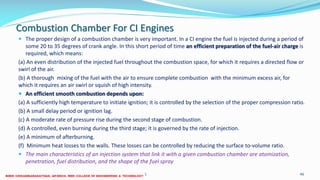
Combustion Chamber For CI Engines
 The proper design of a combustion chamber is very important. In a CI engine the fuel is injected during a period of
some 20 to 35 degrees of crank angle. In this short period of time an efficient preparation of the fuel-air charge is
required, which means:
(a) An even distribution of the injected fuel throughout the combustion space, for which it requires a directed flow or
swirl of the air.
(b) A thorough mixing of the fuel with the air to ensure complete combustion with the minimum excess air, for
which it requires an air swirl or squish of high intensity.
 An efficient smooth combustion depends upon:
(a) A sufficiently high temperature to initiate ignition; it is controlled by the selection of the proper compression ratio.
(b) A small delay period or ignition lag.
(c) A moderate rate of pressure rise during the second stage of combustion.
(d) A controlled, even burning during the third stage; it is governed by the rate of injection.
(e) A minimum of afterburning.
(f) Minimum heat losses to the walls. These losses can be controlled by reducing the surface to-volume ratio.
 The main characteristics of an injection system that link it with a given combustion chamber are atomization,
penetration, fuel distribution, and the shape of the fuel spray
26 December 2017 ME 6016 ADVANCED IC ENGINES 46
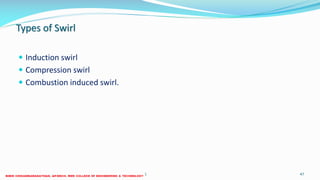
Types of Swirl
 Induction swirl
 Compression swirl
 Combustion induced swirl.
26 December 2017 ME 6016 ADVANCED IC ENGINES 47
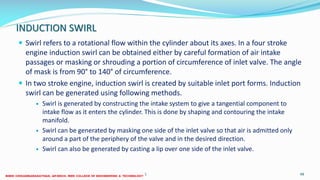
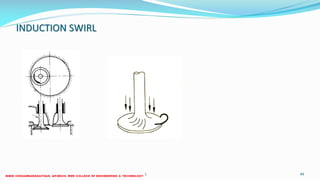
INDUCTION SWIRL
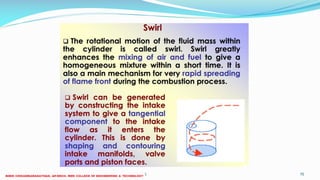
 Swirl refers to a rotational flow within the cylinder about its axes. In a four stroke
engine induction swirl can be obtained either by careful formation of air intake
passages or masking or shrouding a portion of circumference of inlet valve. The angle
of mask is from 90° to 140° of circumference.
 In two stroke engine, induction swirl is created by suitable inlet port forms. Induction
swirl can be generated using following methods.
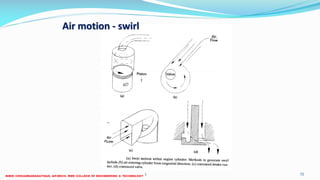
 Swirl is generated by constructing the intake system to give a tangential component to
intake flow as it enters the cylinder. This is done by shaping and contouring the intake
manifold.
 Swirl can be generated by masking one side of the inlet valve so that air is admitted only
around a part of the periphery of the valve and in the desired direction.
 Swirl can also be generated by casting a lip over one side of the inlet valve.
26 December 2017 ME 6016 ADVANCED IC ENGINES 48
INDUCTION SWIRL
26 December 2017 ME 6016 ADVANCED IC ENGINES 49
 Swirl generated by induction is very weak. Thus single orifice injection cannot
provide the desired air fuel mixing. Therefore, with Induction swirl, it is advisable to
use a multiple orifice injector.
 Advantages of Induction swirl
o Easier starting (due to low intensity of swirl).
o High excess air (low temperature), low turbulence (less heat loss), therefore indicated thermal
efficiency is high.
o Production of swirl requires no additional work.
o Used with low speeds, therefore low quality fuel can be used.
 Disadvantages of induction swirl:
o Shrouded valves, smaller valves, low volumetric efficiency.
o Weak swirl, low air utilisation (60%), lower M.E.P and large size (costly) engine.
o Weak swirl, multi orifice nozzle, high induction pressure; clogging of holes, high maintenance.
o Swirl not proportional to speed; efficiency not maintained at variable speed engine.
o Influence minimum quantity of fuel. Complication at high loads and idling.
26 December 2017 ME 6016 ADVANCED IC ENGINES 50
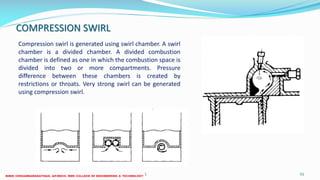
COMPRESSION SWIRL
Compression swirl is generated using swirl chamber. A swirl
chamber is a divided chamber. A divided combustion
chamber is defined as one in which the combustion space is
divided into two or more compartments. Pressure
difference between these chambers is created by
restrictions or throats. Very strong swirl can be generated
using compression swirl.
26 December 2017 ME 6016 ADVANCED IC ENGINES 51
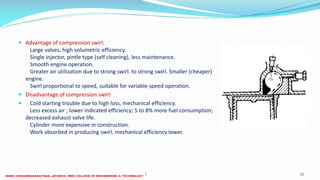
 Advantage of compression swirl:
Large valves, high volumetric efficiency.
Single injector, pintle type (self cleaning), less maintenance.
Smooth engine operation.
Greater air utilization due to strong swirl. to strong swirl. Smaller (cheaper)
engine.
Swirl proportional to speed, suitable for variable speed operation.
 Disadvantage of compression swirl:
 Cold starting trouble due to high loss, mechanical efficiency.
Less excess air ; lower indicated efficiency; 5 to 8% more fuel consumption;
decreased exhaust valve life.
Cylinder more expensive in construction.
Work absorbed in producing swirl, mechanical efficiency lower.
26 December 2017 ME 6016 ADVANCED IC ENGINES 52
COMBUSTION INDUCED SWIRL
 This is created due to partial combustion, therefore known as combustion
induced swirl.
 This method is used only in pre combustion chamber. In this method, upward
movement of piston during compression forces the air tangentially and fuel is
injected in a pre-combustion chamber.
 When the combustion of the accumulated fuel during delay period burns
rapidly in pre-combustion chamber as A:F mixture is rich and forces the gases
at a very high velocity in the main combustion chamber. This creates a good
swirl and provides better combustion.
26 December 2017 ME 6016 ADVANCED IC ENGINES 53
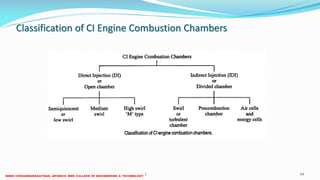
Classification of CI Engine Combustion Chambers
26 December 2017 ME 6016 ADVANCED IC ENGINES 54
Direct injection (DI) engines or open combustion chamber engines
 An open chamber has the entire compression volume in which the combustion takes place in one
chamber formed between the piston and the cylinder head. The shape of the combustion chamber
may create swirl or turbulence to assist fuel and air.
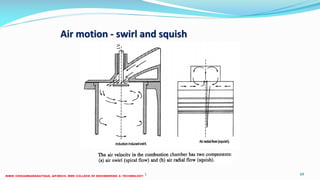
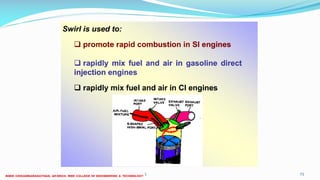
 Swirl denotes a rotary motion of the gases in the chamber more or less about the chamber axis.
Turbulence denotes a haphazard motion of the gases.
 In this combustion chamber, the mixing of fuel and air depends entirely on the spray characteristic
and on air motion, and it is not essentially affected by the combustion process.
 In this type of engine, the spray characteristics must be carefully arranged to obtain rapid mixing. Fuel
is injected a high injection pressure and mixing is usually assisted by a swirl, induced by directing the
inlet air tangentially, or by a squish which is the air motion caused by a small clearance space over
part of the piston. The open chamber design can be classified as follows:
(a) Semi-quiescent or low swirl open chamber
(b) Medium swirl open chamber
(c) High swirl open chamber ('M' type).
26 December 2017 ME 6016 ADVANCED IC ENGINES 55
Direct injection (DI) engines or open combustion chamber engines
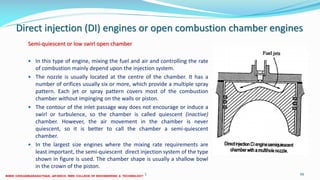
Semi-quiescent or low swirl open chamber
 In this type of engine, mixing the fuel and air and controlling the rate
of combustion mainly depend upon the injection system.
 The nozzle is usually located at the centre of the chamber. It has a
number of orifices usually six or more, which provide a multiple spray
pattern. Each jet or spray pattern covers most of the combustion
chamber without impinging on the walls or piston.
 The contour of the inlet passage way does not encourage or induce a
swirl or turbulence, so the chamber is called quiescent (inactive)
chamber. However, the air movement in the chamber is never
quiescent, so it is better to call the chamber a semi-quiescent
chamber.
 In the largest size engines where the mixing rate requirements are
least important, the semi-quiescent direct injection system of the type
shown in figure is used. The chamber shape is usually a shallow bowl
in the crown of the piston.
26 December 2017 ME 6016 ADVANCED IC ENGINES 56
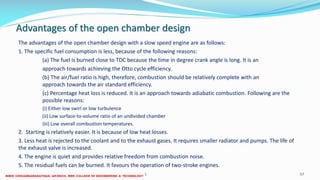
Advantages of the open chamber design
The advantages of the open chamber design with a slow speed engine are as follows:
1. The specific fuel consumption is less, because of the following reasons:
(a) The fuel is burned close to TDC because the time in degree crank angle is long. It is an
approach towards achieving the Otto cycle efficiency.
(b) The air/fuel ratio is high, therefore, combustion should be relatively complete with an
approach towards the air standard efficiency.
(c) Percentage heat loss is reduced. It is an approach towards adiabatic combustion. Following are the
possible reasons:
(i) Either low swirl or low turbulence
(ii) Low surface-to-volume ratio of an undivided chamber
(iii) Low overall combustion temperatures.
2. Starting is relatively easier. It is because of low heat losses.
3. Less heat is rejected to the coolant and to the exhaust gases. It requires smaller radiator and pumps. The life of
the exhaust valve is increased.
4. The engine is quiet and provides relative freedom from combustion noise.
5. The residual fuels can be burned. It favours the operation of two-stroke engines.
26 December 2017 ME 6016 ADVANCED IC ENGINES 57
Direct injection (DI) engines or open combustion chamber engines
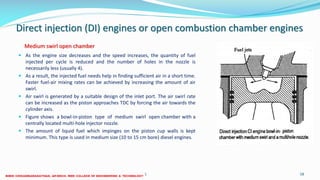
 As the engine size decreases and the speed increases, the quantity of fuel
injected per cycle is reduced and the number of holes in the nozzle is
necessarily less (usually 4).
 As a result, the injected fuel needs help in finding sufficient air in a short time.
Faster fuel-air mixing rates can be achieved by increasing the amount of air
swirl.
 Air swirl is generated by a suitable design of the inlet port. The air swirl rate
can be increased as the piston approaches TDC by forcing the air towards the
cylinder axis.
 Figure shows a bowl-in-piston type of medium swirl open chamber with a
centrally located multi-hole injector nozzle.
 The amount of liquid fuel which impinges on the piston cup walls is kept
minimum. This type is used in medium size (10 to 15 cm bore) diesel engines.
26 December 2017 ME 6016 ADVANCED IC ENGINES 58
Medium swirl open chamber
Direct injection (DI) engines or open combustion chamber engines
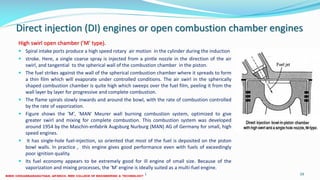
High swirl open chamber ('M' type).
 Spiral intake ports produce a high speed rotary air motion in the cylinder during the induction
 stroke. Here, a single coarse spray is injected from a pintle nozzle in the direction of the air
swirl, and tangential to the spherical wall of the combustion chamber in the piston.
 The fuel strikes against the wall of the spherical combustion chamber where it spreads to form
a thin film which will evaporate under controlled conditions. The air swirl in the spherically
shaped combustion chamber is quite high which sweeps over the fuel film, peeling it from the
wall layer by layer for progressive and complete combustion.
 The flame spirals slowly inwards and around the bowl, with the rate of combustion controlled
by the rate of vaporization.
 Figure shows the 'M', 'MAN' Meurer wall burning combustion system, optimized to give
greater swirl and mixing for complete combustion. This combustion system was developed
around 1954 by the Maschin-enfabrik Augsburg Nurburg (MAN) AG of Germany for small, high
speed engines.
 It has single-hole fuel-injection, so oriented that most of the fuel is deposited on the piston
bowl walls. In practice , this engine gives good performance even with fuels of exceedingly
poor ignition quality.
 Its fuel economy appears to be extremely good for ill engine of small size. Because of the
vaporization and mixing processes, the 'M' engine is ideally suited as a multi-fuel engine.
26 December 2017 ME 6016 ADVANCED IC ENGINES 59
Indirect-injection (IDI) engines or divided combustion chamber engines
 For small high speed diesel engines such as those used in automobiles, the
inlet generated air swirl for high fuel-air mixing rate is not sufficient.
 Indirect injection (IDI) or divided chamber engine systems have been used to
generate vigorous charge motion during the compression stroke.
 The divided combustion chamber can be classified as:
(a) Swirl or turbulent chamber
(b) Pre-combustion chamber
(c) Air and energy cells
26 December 2017 ME 6016 ADVANCED IC ENGINES 60
Indirect-injection (IDI) engines or divided combustion chamber engines
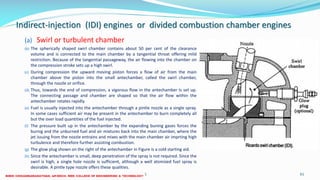
(a) Swirl or turbulent chamber
(b) The spherically shaped swirl chamber contains about 50 per cent of the clearance
volume and is connected to the main chamber by a tangential throat offering mild
restriction. Because of the tangential passageway, the air flowing into the chamber on
the compression stroke sets up a high swirl.
(c) During compression the upward moving piston forces a flow of air from the main
chamber above the piston into the small antechamber, called the swirl chamber,
through the nozzle or orifice.
(d) Thus, towards the end of compression, a vigorous flow in the antechamber Is set up.
The connecting passage and chamber are shaped so that the air flow within the
antechamber rotates rapidly.
(e) Fuel is usually injected into the antechamber through a pintle nozzle as a single spray.
In some cases sufficient air may be present in the antechamber to burn completely all
but the over load quantities of the fuel injected.
(f) The pressure built up in the antechamber by the expanding buning gases forces the
burnig and the unburned fuel and air mixtures back into the main chamber, where the
jet issuing from the nozzle entrains and mixes with the main chamber air imprting high
turbulence and therefore further assisting combustion.
(g) The glow plug shown on the right of the antechamber in Figure is a cold starting aid.
(h) Since the antechamber is small, deep penetration of the spray is not required. Since the
swirl is high, a single hole nozzle is sufficient, although a well atomized fuel spray is
desirable. A pintle type nozzle offers these qualities.
26 December 2017 ME 6016 ADVANCED IC ENGINES 61
Advantages of the indirect injection swirl chamber over the open chamber
1. Higher speed, brake mean effective pressure and power with less smoke are feasible. It is because of:
(a) Higher volumetric efficiency-since the nozzle is at the side, there is more room for the larger intake and
exhaust valves.
(b) Shorter delay period-since the antechamber is compact and the air swirl in the chamber is very high.
2. Less mechanical stress and noise. It is because of the lower rate of pressure rise and the lower
maximum pressure in the main chamber due to the throttling effect of throat.
3. Less maintenance-since the pintle nozzle is self-cleaning and the mechanical stress is less.
4. Wider range of fuels can be used. It can serve as a multi-fuel engine with minimal changes.
5. Smoother and quieter idling-since matching of small air supply with the small fuel supply is possible.
6. Cleaner exhaust resulting in less air pollution.
26 December 2017 ME 6016 ADVANCED IC ENGINES 62
Disadvantages of the IDI swirl chamber over the open chamber
The disadvantages of the IDI swirl chamber over the open chamber are as follows:
1. Higher specific fuel consumption resulting in poorer fuel economy. It is because of greater heat
losses and pressure losses through the throat which result in lower thermal efficiency and higher
pumping losses.
2. The flow of combustion gases through the throat leads to thermal cracks in the cylinder head and
creates sealing problems.
3. Cylinder construction is more expensive.
4. More thermal energy is lost to the exhaust gases. It may decrease the life of the exhaust valve which
will run hotter and increase cracking and sealing problems of the exhaust manifold.
5. Higher secondary swirl decreases the lube-oil life, and piston and ring life.
6. Cold starting is more difficult because of greater heat loss through the throat.
26 December 2017 ME 6016 ADVANCED IC ENGINES 63
Indirect-injection (IDI) engines or divided combustion chamber engines
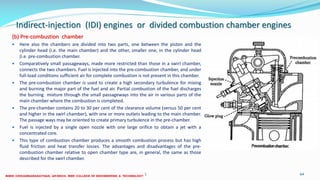
(b) Pre-combustion chamber
 Here also the chambers are divided into two parts, one between the piston and the
cylinder head (i.e. the main chamber) and the other, smaller one, in the cylinder head
(i.e. pre-combustion chamber.
 Comparatively small passageways, made more restricted than those in a swirl chamber,
connects the two chambers. Fuel is injected into the pre-combustion chamber, and under
full-load conditions sufficient air for complete combustion is not present in this chamber.
 The pre-combustion chamber is used to create a high secondary turbulence for mixing
and burning the major part of the fuel and air. Partial combustion of the fuel discharges
the burning mixture through the small passageways into the air in various parts of the
main chamber where the combustion is completed.
 The pre-chamber contains 20 to 30 per cent of the clearance volume (versus 50 per cent
and higher in the swirl chamber), with one or more outlets leading to the main chamber.
The passage ways may be oriented to create primary turbulence in the pre-chamber.
 Fuel is injected by a single open nozzle with one large orifice to obtain a jet with a
concentrated core.
 This type of combustion chamber produces a smooth combustion process but has high
fluid friction and heat transfer losses. The advantages and disadvantages of the pre-
combustion chamber relative to open chamber type are, in general, the same as those
described for the swirl chamber.
26 December 2017 ME 6016 ADVANCED IC ENGINES 64
Indirect-injection (IDI) engines or divided combustion chamber engines
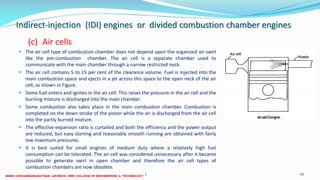
(c) Air cells
 The air cell type of combustion chamber does not depend upon the organized air-swirl
like the pre-combustion chamber. The air cell is a separate chamber used to
communicate with the main chamber through a narrow restricted neck.
 The air cell contains 5 to 15 per cent of the clearance volume. Fuel is injected into the
main combustion space and ejects in a jet across this space to the open neck of the air
cell, as shown in Figure.
 Some fuel enters and ignites in the air cell. This raises the pressure in the air cell and the
burning mixture is discharged into the main chamber.
 Some combustion also takes place in the main combustion chamber. Combustion is
completed on the down stroke of the piston while the air is discharged from the air cell
into the partly burned mixture.
 The effective expansion ratio is curtailed and both the efficiency and the power output
are reduced, but easy starting and reasonably smooth running are obtained with fairly
low maximum pressures.
 It is best suited for small engines of medium duty where a relatively high fuel
consumption can be tolerated. The air cell was considered unnecessary after it became
possible to generate swirl in open chamber and therefore the air cell types of
combustion chambers are now obsolete.
26 December 2017 ME 6016 ADVANCED IC ENGINES 65
Indirect-injection (IDI) engines or divided combustion chamber engines
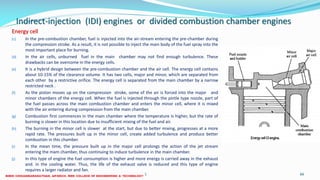
Energy cell
(c) In the pre-combustion chamber, fuel is injected into the air-stream entering the pre-chamber during
the compression stroke. As a result, it is not possible to inject the main body of the fuel spray into the
most important place for burning.
(d) In the air cells, unburned fuel in the main chamber may not find enough turbulence. These
drawbacks can be overcome in the energy cells.
(e) It is a hybrid design between the pre-combustion chamber and the air cell. The energy cell contains
about 10-15% of the clearance volume. It has two cells, major and minor, which are separated from
each other by a restrictive orifice. The energy cell is separated from the main chamber by a narrow
restricted neck .
(f) As the piston moves up on the compression stroke, some of the air is forced into the major and
minor chambers of the energy cell. When the fuel is injected through the pintle type nozzle, part of
the fuel passes across the main combustion chamber and enters the minor cell, where it is mixed
with the air entering during compression from the main chamber.
(g) Combustion first commences in the main chamber where the temperature is higher, but the rate of
burning is slower in this location due to insufficient mixing of the fuel and air.
(h) The burning in the minor cell is slower at the start, but due to better mixing, progresses at a more
rapid rate. The pressures built up in the minor cell, create added turbulence and produce better
combustion in this chamber.
(i) In the mean time, the pressure built up in the major cell prolongs the action of the jet stream
entering the mam chamber, thus continuing to induce turbulence in the main chamber.
(j) In this type of engine the fuel consumption is higher and more energy is carried away in the exhaust
and. in the cooling water. Thus, the life of the exhaust valve is reduced and this type of engine
requires a larger radiator and fan.
26 December 2017 ME 6016 ADVANCED IC ENGINES 66
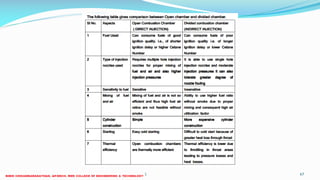
26 December 2017 ME 6016 ADVANCED IC ENGINES 67
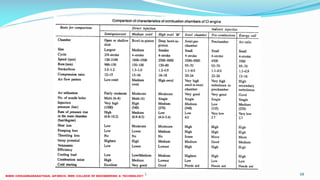
26 December 2017 ME 6016 ADVANCED IC ENGINES 68
26 December 2017 ME 6016 ADVANCED IC ENGINES 69
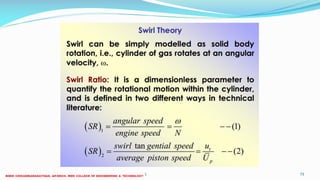
Air motion - swirl and squish
26 December 2017 ME 6016 ADVANCED IC ENGINES 70
26 December 2017 ME 6016 ADVANCED IC ENGINES 71
26 December 2017 ME 6016 ADVANCED IC ENGINES 72
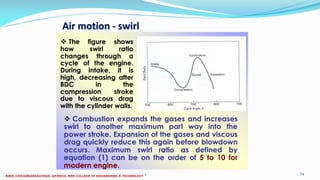
Air motion - swirl
26 December 2017 ME 6016 ADVANCED IC ENGINES 73
26 December 2017 ME 6016 ADVANCED IC ENGINES 74
Air motion - swirl
26 December 2017 ME 6016 ADVANCED IC ENGINES 75
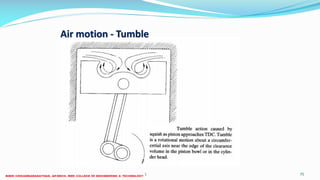
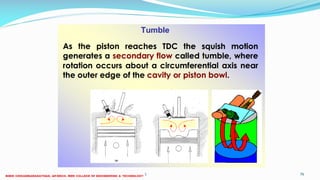
Air motion - Tumble
26 December 2017 ME 6016 ADVANCED IC ENGINES 76
26 December 2017 ME 6016 ADVANCED IC ENGINES 77
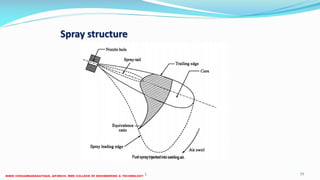
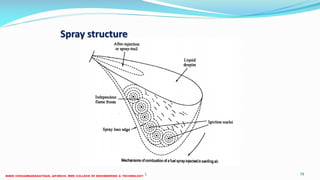
Spray structure
26 December 2017 ME 6016 ADVANCED IC ENGINES 78
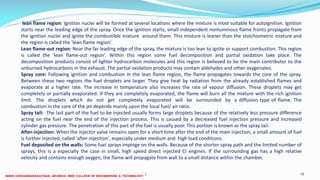
lean flame region: Ignition nuclei will be formed at several locations where the mixture is most suitable for autoignition. Ignition
starts near the leading edge of the spray. Once the ignition starts, small independent nonluminous flame fronts propagate from
the ignition nuclei and ignite the combustible mixture around them. This mixture is leaner than the stoichiometric mixture and
the region is called the 'lean flame region'.
Lean flame-out region: Near the far leading edge of the spray, the mixture is too lean to ignite or support combustion. This region
is called the 'lean flame-out region'. Within this region some fuel decomposition and partial oxidation take place. The
decomposition products consist of lighter hydrocarbon molecules and this region is believed to be the main contributor to the
unburned hydrocarbons in the exhaust. The partial oxidation products may contain aldehydes and other oxygenates.
Spray core: Following ignition and combustion in the lean flame region, the flame propagates towards the core of the spray.
Between these two regions the fuel droplets are larger. They give heat by radiation from the already established flames and
evaporate at a higher rate. The increase in temperature also increases the rate of vapour diffusion. These droplets may get
completely or partially evaporated. If they are completely evaporated, the flame will burn all the mixture with the rich ignition
limit. The droplets which do not get completely evaporated will be surrounded by a diffusion type of flame. The
combustion in the core of the jet depends mainly upon the local fuel/ air ratio.
Spray tail: The last part of the fuel to be injected usually forms large droplets because of the relatively less pressure difference
acting on the fuel near the end of the injection process. This is caused by a decreased fuel injection pressure and increased
cylinder gas pressure. The penetration of this part of the fuel is usually poor. This portion is known as the spray tail.
After-injection: When the injector valve remains open for a short time after the end of the main injection, a small amount of fuel
is further injected, called 'after-injection', especially under medium and high load conditions.
Fuel deposited on the walls: Some fuel sprays impinge on the walls. Because of the shorter spray path and the limited number of
sprays, this is a especially the case in small, high speed direct injected CI engines. If the surrounding gas has a high relative
velocity and contains enough oxygen, the flame will propagate from wall to a small distance within the chamber.
26 December 2017 ME 6016 ADVANCED IC ENGINES 79
Spray structure

ME6016 ADVANCED I.C ENGINES UNIT II

  • 1.
    UNIT II -COMPRESSION IGNITION ENGINES
  • 2.
    UNIT II COMPRESSIONIGNITION ENGINES 9  Diesel Fuel Injection Systems - Stages of combustion – Knocking – Factors affecting knock – Direct and Indirect injection systems – Combustion chambers – Fuel Spray behaviour – Spray structure and spray penetration – Air motion - Introduction to Turbocharging. 26 December 2017 ME 6016 ADVANCED IC ENGINES 2
  • 3.
    Fuel Supply SystemOf CI Engine 26 December 2017 3ME 6016 ADVANCED IC ENGINES
  • 4.
     In dieselengine only air is injected during the suction stroke and it is compressed during compression stroke.  Fuel is injected into the combustion chamber in the form of fine spray at the end of compression stroke.  A fuel injection system in a diesel engine has to satisfy the following requirements: 1. To inject the fuel at the right time in the cycle. 2. The fuel should be properly atomized. 3. The correct quantity of fuel should be injected depending upon the load.  Fuel pump takes the fuel from fuel tank and delivers it to the fuel filter.  When the pressure is developed in the injection pump the fuel flows from injection pump to the fuel injector under pressure.  The fuel injector is either a single hole nozzle or multi-hole nozzle. 26 December 2017 4ME 6016 ADVANCED IC ENGINES
  • 5.
    Diesel Engine FuelInjection Systems Functions of a Fuel injection system:  Filter the fuel  Measure the correct quantity of fuel to be injected  Time the fuel injection  Control the rate of fuel injection  Atomize the fuel  Distribute the fuel in the combustion chamber 26 December 2017 5ME 6016 ADVANCED IC ENGINES
  • 6.
    Fuel Injection System AirInjection Airless Injection 26 December 2017 6ME 6016 ADVANCED IC ENGINES
  • 7.
    Air Injection: In thismethod of fuel injection air is compressed in a compressor to high pressure and injected into the fuel Nozzle. The rate of fuel admission can be controlled by varying the pressure of injection air. Adv: It provides better atomization and distribution of the fuel As the combustion is more complete the BMEP is higher Inferior fuels can be used Dis Adv: It requires high pressure multi stage compression A separate mechanical linkage is required to time the operation of fuel valve Due to compression and linkage the size of the engine increases Since the fuel burns very near to the nozzle it is overheated 26 December 2017 7ME 6016 ADVANCED IC ENGINES
  • 8.
    Types of modernfuel injection system: 1. Common Rail Injection System 2. Individual Pump Injection System 3. Distributor System  Atomisation of the fuel is done by either ‘airblast’ or ‘pressure spray’ Solid injection at about 100 and 200 bars pressure has reduced the need of having compressor . 26 December 2017 8ME 6016 ADVANCED IC ENGINES
  • 9.
    Common Rail InjectionSystem 26 December 2017 9ME 6016 ADVANCED IC ENGINES
  • 10.
    A single pumpsupplies high pressure fuel to header, a relief valve holds the pressure constant. The control wedge adjusts the lift of mechanically operated valve to set amount and time of injection. Adv: 1. System is simple and less maintenance cost 2. Only one pump is sufficient for multi cylinder engine 3. It fulfills requirements of either constant load with variable speeds or variable loads with constant speed 4. Variation in pump supply pressure effects all the cylinders equally Dis adv: 1. Leaks in the injection valve 2. Accurate design and work manship is required 26 December 2017 10ME 6016 ADVANCED IC ENGINES
  • 11.
    Individual pump injectionsystem 26 December 2017 11ME 6016 ADVANCED IC ENGINES
  • 12.
    In this systeman individual pump or pump cylinder connects directly to each fuel nozzle. Pump meters charge and control injection timing. Nozzles contain a delivery valve actuated by the fuel oil pressure. Dis adv: This system has to be designed accurately to pump small quantity of fuel 26 December 2017 12ME 6016 ADVANCED IC ENGINES
  • 13.
    Distributor System 26 December2017 13ME 6016 ADVANCED IC ENGINES
  • 14.
     In thissystem the fuel metered at a central point; a pump pressurizes, meters the fuel and times the injection. From here fuel is distributed to cylinders in correct firing order by cam operated poppet valves which open to admit fuel to nozzles. 26 December 2017 14ME 6016 ADVANCED IC ENGINES
  • 15.
    Fuel Pump 26 December2017 15ME 6016 ADVANCED IC ENGINES
  • 16.
    L is theplunger driven by a cam and tappet mechanism at the bottom . B is the barrel in which plunger reciprocates. There is a rectangular vertical groove in the plunger which extends from top to another helical groove. V is the delivery valve which lifts off its seat under the liquid fuel pressure and spring force. The fuel pump is connected to the fuel atomiser through passage P. SP and Y are the spill and the supply port respectively. When the plunger is at he bottom both ports SP and Y are uncovered by the plunger and fuel enters from the port SP into the barrel. On further upward movement of the plunger both the ports are closed and fuel is compressed and delivered through passage P to the atomiser as delivery valve lifts off from its seat. With further rise of the Plunger at certain moment, the port SP is connected to the fuel in the upper part of the plunger through rectangular vertical groove through helical groove , as a result of which sudden fall in pressure occurs and delivery valve occupies seat against the spring force. The plunger is rotated by the Rack R which is moved in or out by the governor. By changing the Angular position of the helical groove according to the load and speed of the vehicle amount of fuel delivered can be varied. 26 December 2017 16ME 6016 ADVANCED IC ENGINES
  • 17.
    Fuel Injector 26 December2017 17ME 6016 ADVANCED IC ENGINES
  • 18.
    Fuel Injector 26 December2017 18ME 6016 ADVANCED IC ENGINES
  • 19.
    It consist ofa nozzle valve(NV) fitted in the nozzle body (NB). The nozzle valve is held on its seat by a spring ‘S’ which exerts pressure through spindle E. ‘AS’ is the adjusting screw by which nozzle valve lift can be adjusted. Usually the nozzle valve is set to lift at 135 to 175 bars pressure. FP is the feeling pin which indicates whether valve is working properly or not The fuel under pressure from the fuel pump enters the injector through the passages B and C and lifts the nozzle valve. The fuel travels down nozzle N and injected into the engine cylinder in the form of fine spray. Then the pressure of the oil falls, the nozzle valve occupies its seat under the spring force and fuel supply is cut off. Any leakage of fuel accumulated above the valve is led to the fuel tank through passage A. The leakage occurs when the nozzle valve is worn out 26 December 2017 19ME 6016 ADVANCED IC ENGINES
  • 20.
    Stages of Combustionin a CI Engine  The classical diesel compression and combustion pressure diagram shown in Figure has been proved to be an acceptable model and can be roughly divided into four broad stages: 1. Ignition delay period 2. Rapid or uncontrolled combustion 3. Mixing-controlled combustion phase 4. Late combustion phase or afterburning. 26 December 2017 ME 6016 ADVANCED IC ENGINES 20
  • 21.
    Stages of Combustionin a CI Engine  Ignition delay period  The processes that take place during the ignition delay can be divided into the following physical and chemical processes.  The physical processes are:  Spray disintegration and droplet formation  Heating of the liquid fuel and evaporation  Diffusion of the vaporized fuel into the air to form an ignitable mixture.  The chemical processes are:  Decomposition of the heavy hydrocarbons into lighter components  Pre-ignition chemical reactions between the decomposed components and oxygen. 26 December 2017 ME 6016 ADVANCED IC ENGINES 21
  • 22.
    Stages of Combustionin a CI Engine  Rapid or uncontrolled combustion  In this phase, combustion of the fuel, which has mixed with air to within flammability limits during the ignition delay period, occurs rapidly in a few crank angle degrees.  Ignition in one place is followed by ignition elsewhere, so rapid combustion of the prepared fuel follows the first ignition.  The rate and quantity of combustion in the second phase is thus dependent on the duration of the delay period and the rate of preparation of fuel during this period.  The speed of this reaction determines the rate of pressure rise (dp/dϴ) in the cylinder.  The magnitude of the pressure rise during the second period may determine the value of the peak pressure of the cycle. For structural reasons, to reduce mechanical stresses it is important to  limit the peak pressure as well as the rate of pressure rise. As the peak pressure increases, the peak temperature also increases, which increases (a) the NOx emission, (b) the thermal loads on the cooling system, and (c) the temperature and thermal stressing of the combustion chamber walls.  Therefore, to limit the pressure and temperature rise during the second period, it is important to keep the delay period as short as possible. 26 December 2017 ME 6016 ADVANCED IC ENGINES 22
  • 23.
    Stages of Combustionin a CI Engine  Mixing-controlled combustion phase  Once the fuel and air which premixed during the ignition delay have been consumed at the end of the period of rapid combustion, the temperatures within the cylinder are so high that any fuel injected after this time will bum as soon as it finds oxygen, and any further rise in pressure is controlled by the injection rate as well as by the mixing and diffusion processes.  Engines running at low rpm should be designed to secure rapid mixing of fuel and air during the third stage in order to complete the combustion process as early as possible in the expansion stroke. 26 December 2017 ME 6016 ADVANCED IC ENGINES 23
  • 24.
    Stages of Combustionin a CI Engine Late combustion phase or afterburning.  A very low rate of combustion, sometimes referred to as the tail of combustion, occurs well down the expansion stroke of the engine.  There are several reasons for this. A small fraction of fuel may not yet have burned. The cylinder charge is non uniform and mixing during this period promotes more complete combustion and less dissociated product gases.  The kinetics of the final burnout processes become slower as the temperature of the cylinder gases fall during expansion.  The late combustion phase is undesirable because it reduces the power output and produces smoky exhaust.  This can be eliminated by supplying more excess air and creating more turbulence. 26 December 2017 ME 6016 ADVANCED IC ENGINES 24
  • 25.
    Process of combustionin CI engines 26 December 2017 ME 6016 ADVANCED IC ENGINES 25
  • 26.
    Heat release rate The period a-b represents the ignition delay. No heat is released during this period.  The period b-c represents the rapid combustion phase. The high heat release rate is the characteristic of this phase.  The period c-d represents the controlled combustion phase. During this period the heat release rate may or may not reach a second (usually lower) peak. It decreases as this phase progresses.  The period d-e represents the late combustion phase, the heat release rate decreases further and continues at a lower rate well into the expansion stroke. 26 December 2017 ME 6016 ADVANCED IC ENGINES 26 A typical heat release rate diagram of a direct injection compression ignition engine, identifying the different diesel combustion phases is shown in Figure
  • 27.
    AIR/FUEL ratio inCI engines  For a given engine speed, the supply of air in a CI engine is almost constant and does not depend upon the engine load. This engine may be termed a constant air supply engine.  With the change in load the quantity of fuel is changed, which alters the air/fuel ratio. As the load increases, more fuel is used. The overall air/fuel ratio may very from 100:1 at no-load to 20: 1 at full- load.  In the SI engine, the air/fuel ratio remains almost constant near to stoichiometric from no-load to full-load conditions. The in- flammability limit of hydrocarbon fuel ranges from 8:1 to 30:1.  heterogeneous  The heterogeneous mixture in the combustion chamber may have local air/fuel ratio vary from zero to infinity in different parts. In the regions of very rich or very lean mixtures, no definite flame front can be established.  There would also be some regions where the local air/fuel ratio is within the combustible limits, and ignition would occur under favourable conditions of temperature. Ignition nuclei are formed at several locations, and multiple flame fronts travel to bum the remaining charge. 26 December 2017 ME 6016 ADVANCED IC ENGINES 27
  • 28.
    Influence of variousfactors on delay period The factors described in the following affect the delay period. 1. Ignition quality of fuel 2. Compression ratio 3. Injection timing 4. Injection pressure, rate of injection and drop size 5. Intake, jacket water and fuel temperatures 6. Intake pressure 7. Engine speed 8. Air/fuel ratio 9. Load 10. Engine size 11. Combustion chamber wall effects 12. Swirl rate 13. Exhaust gas recirculation (EGA) 14. Type of combustion chamber 26 December 2017 ME 6016 ADVANCED IC ENGINES 28
  • 29.
    Influence of variousfactors on delay period Ignition quality of fuel  If the self-ignition temperature of a fuel is low, the delay period is reduced. Cetane number is a scale used for comparing the ignition quality of fuels. By using a fuel with a higher cetane number, all other conditions being the same, the delay period can be reduced and the engine operation made smoother.  Straight chain paraffinic compounds (normal alkanes) have the highest ignition quality, which improves as the chain length increases. Aromatic compounds have poor ignition quality as do the alcohols. Hence, difficulties are associated with the use of methanol and ethanol as possible alternative fuels in CI engines.  Straight chain paraffinic compounds (normal alkanes) have the highest ignition quality, which improves as the chain length increases. Aromatic compounds have poor ignition quality as do the alcohols. Hence, difficulties are associated with the use of methanol and ethanol as possible alternative fuels in CI engines. 26 December 2017 ME 6016 ADVANCED IC ENGINES 29
  • 30.
    Influence of variousfactors on delay period Compression ratio  A higher compression ratio increases the temperature and pressure of the air at the beginning of injection. This reduces the delay period and the operation of the engine becomes smoother.  Owing to the higher pressures in the cylinder at high compression ratios, however, the crank gear parts have to be stronger and heavier, which leads to an increase in the mechanical losses.  In practice, the higher the compression ratio, the higher will be the engine friction, the leakage, and the torque required for starting. Thus, the diesel engine designers use the lowest compression ratio. It also makes the cold starting of the engine easier.  The design practice is just the opposite of that adopted in SI engine design, where the highest possible compression ratio is used which is limited only by knocking.  The maximum pressure of the cycle is not much affected by varying the compression ratio, because with the increase in compression ratio the delay period is reduced and, therefore, the rate of pressure rise decreases which controls the maximum pressure reached in the cycle.  The self-ignition temperature also reduces with the increase in compression ratio. This is apparently due to the increased density of the compressed air, resulting in closer contact of the molecules which thereby reduces the time of reaction when the fuel is injected. 26 December 2017 ME 6016 ADVANCED IC ENGINES 30
  • 31.
    Influence of variousfactors on delay period Injection timing  A large injection advance increases the delay period, since the pressure and temperature of the air are lower when the injection begins.  If the injection starts later, i.e. closer to TDC, the temperature and pressure are initially slightly higher but then decreased due to the increased heat loss as the delay proceeds.  Both advancing and retarding of the injection increase the delay period. The most favourable conditions for ignition lie in between these two conditions  shows the indicator diagrams taken at various angles of injection advance at constant duration of injection, the most advantageous angle at which the injection begins is about 200 before TDC.  The optimum angle of injection advance depends on various factors such as the compression ratio, the pressure and the temperature of the air at the inlet to the cylinder, the injection characteristics, the load and the engine speed, etc. 26 December 2017 ME 6016 ADVANCED IC ENGINES 31
  • 32.
    Influence of variousfactors on delay period Injection pressure, rate of injection and drop size  None of these factors has a significant effect on the delay period. At normal operating conditions, increasing the injection pressure produces only a modest decrease in the delay period.  Increasing the nozzle hole diameter at constant injection pressure to increase the rate of fuel injection and drop size have no significant effect on the delay period. These can be explained as follows:  It appears that in order to reduce the delay period, the fuel should be injected in small droplets to increase the surface area of inflammation but the rate of combustion mainly depends upon the relative motion between the fuel droplets and the swirling air.  The smaller droplets will have less momentum and travel in air with less relative velocity resulting in partial suffocation by its own products of combustion, and thus giving rise to a larger delay period. As these two reasons contradict each other, practically, the injection pressure, the rate of injection and the drop size do not significantly affect the delay period. 26 December 2017 ME 6016 ADVANCED IC ENGINES 32
  • 33.
    Influence of variousfactors on delay period Intake, jacket water and fuel temperatures  Any increase in the inlet temperature, the cooling water temperature or the fuel temperature results in an increase in the temperature of the charge at the moment of injection and this causes a decrease in the delay period.  Increasing the inlet temperature by preheating the air is undesirable as it reduces the density of air and hence reduces the volumetric efficiency and power output. Intake pressure  Any increase in the intake air pressure or supercharging reduces the delay period. The rate of pressure rise during combustion also decreases and gives smooth operation of the engine.  Since the compression pressure will increase with the inlet pressure, the peak pressure will be higher. As the cylinder will contain more air, it will be possible to inject more fuel to obtain more power.  The supercharged CI engines run smoother compared to the un-supercharged engines. 26 December 2017 ME 6016 ADVANCED IC ENGINES 33
  • 34.
    Influence of variousfactors on delay period Engine speed  As the engine speed increases the loss of heat during compression decreases, resulting in increased temperature and pressure of the compressed air. Thus the delay period in milliseconds reduces but its value in degrees of crank travel increases.  The amount of fuel injected during the delay period depends on crank degrees and not on the absolute time because the fuel pump is geared to the engine.  At high speeds, there will be more fuel present in the cylinder to take part in the second stage of uncontrolled combustion, resulting in higher rates of pressure rise and higher maximum pressure.  This factor has caused difficulties in the development of high speed CI engines. Very high speed CI engines, therefore, require a greater angle of injection advance, high ignition quality and a special design for the combustion chamber. 26 December 2017 ME 6016 ADVANCED IC ENGINES 34
  • 35.
    Influence of variousfactors on delay period Air/fuel ratio  As the air/fuel ratio is increased, the cylinder wall temperature and combustion temperatures are lowered and hence the delay period is increased. There is very little reduction in the maximum rate of pressure rise except at the very high air/fuel ratios.  On the other hand, the maximum pressure falls steadily with increasing air/fuel ratios. A practical limit on the minimum air/fuel ratio, how ever, is set by incomplete combustion accompanied by a smoky exhaust-called the smoke limit. Load  As the load is increased, the residual gas temperature and the wall temperature increase. This results in a higher charge temperature at injection, thus shortening the delay period. Engine size  Large engines operate at low rpm because of inertia stress limitations. Large engines have smaller surface-to- volume ratios which causes less heat loss during compression, resulting in higher temperatures of the compressed air. It shortens the delay period and improves the combustion conditions.  The design of a CI engine of larger size operating at a lower speed is therefore less difficult. 26 December 2017 ME 6016 ADVANCED IC ENGINES 35
  • 36.
    Influence of variousfactors on delay period Combustion chamber wall effects  The impingement of the fuel jet on the combustion chamber wall affects the fuel evaporation and mixing processes. The impingement occurs almost in all smaller size and higher speed engines.  If the pressure and temperature inside he cylinder are low, the presence of wall reduces the delay period, but most diesel engines running under normal operating conditions have higher pressure and temperature inside the cylinder and the fuel jet impingement on the wall surface has no significant effect on the delay period.  However, the initial rate of burning increases because of increased vaporation and fuel-air mixing rates. 26 December 2017 ME 6016 ADVANCED IC ENGINES 36
  • 37.
    Influence of variousfactors on delay period Swirl rate  The air swirl rate affects fuel evaporation, the fuel-air mixing processes and the wall heat transfer during compression and hence the charge temperature at injection.  Under engine starting condition ,engine speed and compression temperature are low and a good air swirl would reduce the ignition delay.  At normal operating engine speeds, the air swirl rate has very little effect on delay period. Exhaust gas recirculation (EGA)  The oxygen concentration in the charge into which the fuel is injected, influences the delay period.  The oxygen concentration is changed when the exhaust gas is recycled to the intake for the control of oxides of nitrogen emissions. As the oxygen concentration is decreased, the ignition delay period becomes longer.  Type of combustion chamber  The pre-combustion chamber because of its compactness, produces a shorter delay period compared to an open type of combustion chamber. 26 December 2017 ME 6016 ADVANCED IC ENGINES 37
  • 38.
    26 December 2017ME 6016 ADVANCED IC ENGINES 38
  • 39.
    COMBUSTION KNOCK INCI ENGINES  Combustion knock in CI engines is associated with an extremely high rate of pressure rise during the second phase of combustion (rapid or uncontrolled combustion) and also with heavy vibration accompanied by a knocking sound, thus causing overheating of the piston and the cylinder head, drop in power, damage to bearings and possible piston seizure.  The injection process of a fuel takes place over a definite period of time in terms of degree crank angle. As a result, the first few drops which are injected into the chamber pass through the ignition delay while the additional droplets are being injected into the chamber.  Normally, the fuel Injected period is more than the delay period. If the delay period of the injected fuel is short, the first few droplets will commence the burning phase in a relatively short time after injection, and a relatively small amount of fuel will be accumulated in the chamber when actual burning commences. 26 December 2017 ME 6016 ADVANCED IC ENGINES 39
  • 40.
    COMBUSTION KNOCK INCI ENGINES..  As a result, the rate of burned mass of fuel will be such as to produce a rate of pressure rise that will exert a smooth force on the piston, as shown in Figure (a).  If, on the other hand the delay period is longer, the burning of the first few droplets is delayed and therefore a greater quantity of fuel droplets will accumulate in the chamber. When the actual burning commences, the additional fuel may cause rapid rate of pressure rise as in Figure (b), resulting in rough engine operation.  If the delay period is too long, much fuel will be accumulated resulting in instantaneous rise in pressure as in Figure (c).  Such a situation produces pressure waves striking on cylinder walls, piston crown and cylinder head, producing audible knock and vibrations.  In fact, the combustion mechanism of diesel engine is based on the auto-ignition of the charge and hence, mild knock may always be present. When it exceeds a certain limit, the engine is said to be knocking.  Though the long ignition delay improves the mixing process of fuel and air and makes the mixture more homogeneous, it helps the process of auto-ignition and makes the engine more prone to knock. 26 December 2017 ME 6016 ADVANCED IC ENGINES 40
  • 41.
    Conv. Diesel VsConv. SI Combustion 26 December 2017 ME 6016 ADVANCED IC ENGINES 41
  • 42.
    HCCI Vs RCCICombustion 26 December 2017 ME 6016 ADVANCED IC ENGINES 42
  • 43.
    COMPARISON OF KNOCKIN SI AND CI ENGINES  While knocking in the SI engine and in CI engine have essentially the same basic cause, i.e. auto-ignition followed by a rapid pressure rise, it is important to note the following differences:  (a) In the SI engine, knocking occurs due to auto-ignition of the last part of the charge (end gas), i.e. at the end of combustion, while in the CI engine knocking occurs in the first part, i.e. at the start of combustion.  (b) In the SI engine, it is the homogeneous charge that auto-ignites and causes knocking, resulting in a very high rate of pressure rise and high peak pressure. In the CI engine the fuel and air are not homogeneously mixed and hence the rate of pressure rise is normally lower than that in the knocking part of the charge in the SI engine. However, the peak pressure is higher due to a high compression ratio.  (c) In the Cl engine only the air is compressed during the compression stroke and the ignition can take place only after the fuel is injected just before TDC. Therefore, there is no question of pre-ignition occurring in the CI engine, whereas pre-ignition may occur in the SI engine due to the presence of both fuel and air during compression.  (d) In the SI engine, knocking can easily be detected by human ear but in the CI engine there is no clear distinction between knocking and normal combustion, since normal combustion in the CI engine is itself by auto-ignition and a mild knock may always be present. 26 December 2017 ME 6016 ADVANCED IC ENGINES 43
  • 44.
    Factors tending toreduce knock in SI and Cl engines 26 December 2017 ME 6016 ADVANCED IC ENGINES 44 • Those factors which tend to prevent knock in SI engines, the same very factors promote knock in CI engines. To prevent knock in SI engines, the auto-ignition of the last part of the charge should not take place; this requires a long delay period and a high self-ignition temperature. • To prevent knock in CI engines, the auto-ignition of the first part of the charge should be achieved as early as possible and therefore it requires a short delay period and a low self-ignition temperature. It may also be noted that a good SI engine fuel is a bad CI engine fuel and vice-versa. • Table presents a comparative statement of the various factors to be varied in order to reduce knock in SI and CI engines.
  • 45.
    Methods Of ControllingKnock In CI Engines Apart from the operating variables, the knock in CI engines can be controlled by the following methods:  1. Certain fuels cause knocking in a given CI engine, others do not. Thus, fuels of high cetane number are obtained by adding chemical dopes, called ignition accelerators.  The two common chemical dopes are ethyl nitrate and amyl nitrate in concentrations of 8.8 g/l and 7.7 g/l respectively. The chemical dopes increase the pre-flame reactions and reduce the flash point. The cetane number of the diesel fuel is increased and the fuel auto-ignites at lower temperatures. However, these dopes are expensive and produce more oxides of nitrogen emissions in the exhaust as they contain nitrogen.  2. The turbulent air-cell method of combustion generally gives knock-less running of the engine and if the amount of fuel injected is not excessive, a smokeless exhaust is emitted.  3. Two-stage injection is used to avoid knocking in CI engines. In order to reduce diesel knock or avoid it altogether, a small quantity of fuel is injected just before the main amount is delivered to the injector. It is known as pilot injection.  The use of two-stage injection gives a better control of the rate of pressure rise after the main delivery of fuel has taken place and avoids a sudden pressure rise in the cylinder. Special types of fuel injection pumps have been developed to give this initial delivery of a small fuel charge before the main one. 26 December 2017 ME 6016 ADVANCED IC ENGINES 45
  • 46.
    Combustion Chamber ForCI Engines  The proper design of a combustion chamber is very important. In a CI engine the fuel is injected during a period of some 20 to 35 degrees of crank angle. In this short period of time an efficient preparation of the fuel-air charge is required, which means: (a) An even distribution of the injected fuel throughout the combustion space, for which it requires a directed flow or swirl of the air. (b) A thorough mixing of the fuel with the air to ensure complete combustion with the minimum excess air, for which it requires an air swirl or squish of high intensity.  An efficient smooth combustion depends upon: (a) A sufficiently high temperature to initiate ignition; it is controlled by the selection of the proper compression ratio. (b) A small delay period or ignition lag. (c) A moderate rate of pressure rise during the second stage of combustion. (d) A controlled, even burning during the third stage; it is governed by the rate of injection. (e) A minimum of afterburning. (f) Minimum heat losses to the walls. These losses can be controlled by reducing the surface to-volume ratio.  The main characteristics of an injection system that link it with a given combustion chamber are atomization, penetration, fuel distribution, and the shape of the fuel spray 26 December 2017 ME 6016 ADVANCED IC ENGINES 46
  • 47.
    Types of Swirl Induction swirl  Compression swirl  Combustion induced swirl. 26 December 2017 ME 6016 ADVANCED IC ENGINES 47
  • 48.
    INDUCTION SWIRL  Swirlrefers to a rotational flow within the cylinder about its axes. In a four stroke engine induction swirl can be obtained either by careful formation of air intake passages or masking or shrouding a portion of circumference of inlet valve. The angle of mask is from 90° to 140° of circumference.  In two stroke engine, induction swirl is created by suitable inlet port forms. Induction swirl can be generated using following methods.  Swirl is generated by constructing the intake system to give a tangential component to intake flow as it enters the cylinder. This is done by shaping and contouring the intake manifold.  Swirl can be generated by masking one side of the inlet valve so that air is admitted only around a part of the periphery of the valve and in the desired direction.  Swirl can also be generated by casting a lip over one side of the inlet valve. 26 December 2017 ME 6016 ADVANCED IC ENGINES 48
  • 49.
    INDUCTION SWIRL 26 December2017 ME 6016 ADVANCED IC ENGINES 49
  • 50.
     Swirl generatedby induction is very weak. Thus single orifice injection cannot provide the desired air fuel mixing. Therefore, with Induction swirl, it is advisable to use a multiple orifice injector.  Advantages of Induction swirl o Easier starting (due to low intensity of swirl). o High excess air (low temperature), low turbulence (less heat loss), therefore indicated thermal efficiency is high. o Production of swirl requires no additional work. o Used with low speeds, therefore low quality fuel can be used.  Disadvantages of induction swirl: o Shrouded valves, smaller valves, low volumetric efficiency. o Weak swirl, low air utilisation (60%), lower M.E.P and large size (costly) engine. o Weak swirl, multi orifice nozzle, high induction pressure; clogging of holes, high maintenance. o Swirl not proportional to speed; efficiency not maintained at variable speed engine. o Influence minimum quantity of fuel. Complication at high loads and idling. 26 December 2017 ME 6016 ADVANCED IC ENGINES 50
  • 51.
    COMPRESSION SWIRL Compression swirlis generated using swirl chamber. A swirl chamber is a divided chamber. A divided combustion chamber is defined as one in which the combustion space is divided into two or more compartments. Pressure difference between these chambers is created by restrictions or throats. Very strong swirl can be generated using compression swirl. 26 December 2017 ME 6016 ADVANCED IC ENGINES 51
  • 52.
     Advantage ofcompression swirl: Large valves, high volumetric efficiency. Single injector, pintle type (self cleaning), less maintenance. Smooth engine operation. Greater air utilization due to strong swirl. to strong swirl. Smaller (cheaper) engine. Swirl proportional to speed, suitable for variable speed operation.  Disadvantage of compression swirl:  Cold starting trouble due to high loss, mechanical efficiency. Less excess air ; lower indicated efficiency; 5 to 8% more fuel consumption; decreased exhaust valve life. Cylinder more expensive in construction. Work absorbed in producing swirl, mechanical efficiency lower. 26 December 2017 ME 6016 ADVANCED IC ENGINES 52
  • 53.
    COMBUSTION INDUCED SWIRL This is created due to partial combustion, therefore known as combustion induced swirl.  This method is used only in pre combustion chamber. In this method, upward movement of piston during compression forces the air tangentially and fuel is injected in a pre-combustion chamber.  When the combustion of the accumulated fuel during delay period burns rapidly in pre-combustion chamber as A:F mixture is rich and forces the gases at a very high velocity in the main combustion chamber. This creates a good swirl and provides better combustion. 26 December 2017 ME 6016 ADVANCED IC ENGINES 53
  • 54.
    Classification of CIEngine Combustion Chambers 26 December 2017 ME 6016 ADVANCED IC ENGINES 54
  • 55.
    Direct injection (DI)engines or open combustion chamber engines  An open chamber has the entire compression volume in which the combustion takes place in one chamber formed between the piston and the cylinder head. The shape of the combustion chamber may create swirl or turbulence to assist fuel and air.  Swirl denotes a rotary motion of the gases in the chamber more or less about the chamber axis. Turbulence denotes a haphazard motion of the gases.  In this combustion chamber, the mixing of fuel and air depends entirely on the spray characteristic and on air motion, and it is not essentially affected by the combustion process.  In this type of engine, the spray characteristics must be carefully arranged to obtain rapid mixing. Fuel is injected a high injection pressure and mixing is usually assisted by a swirl, induced by directing the inlet air tangentially, or by a squish which is the air motion caused by a small clearance space over part of the piston. The open chamber design can be classified as follows: (a) Semi-quiescent or low swirl open chamber (b) Medium swirl open chamber (c) High swirl open chamber ('M' type). 26 December 2017 ME 6016 ADVANCED IC ENGINES 55
  • 56.
    Direct injection (DI)engines or open combustion chamber engines Semi-quiescent or low swirl open chamber  In this type of engine, mixing the fuel and air and controlling the rate of combustion mainly depend upon the injection system.  The nozzle is usually located at the centre of the chamber. It has a number of orifices usually six or more, which provide a multiple spray pattern. Each jet or spray pattern covers most of the combustion chamber without impinging on the walls or piston.  The contour of the inlet passage way does not encourage or induce a swirl or turbulence, so the chamber is called quiescent (inactive) chamber. However, the air movement in the chamber is never quiescent, so it is better to call the chamber a semi-quiescent chamber.  In the largest size engines where the mixing rate requirements are least important, the semi-quiescent direct injection system of the type shown in figure is used. The chamber shape is usually a shallow bowl in the crown of the piston. 26 December 2017 ME 6016 ADVANCED IC ENGINES 56
  • 57.
    Advantages of theopen chamber design The advantages of the open chamber design with a slow speed engine are as follows: 1. The specific fuel consumption is less, because of the following reasons: (a) The fuel is burned close to TDC because the time in degree crank angle is long. It is an approach towards achieving the Otto cycle efficiency. (b) The air/fuel ratio is high, therefore, combustion should be relatively complete with an approach towards the air standard efficiency. (c) Percentage heat loss is reduced. It is an approach towards adiabatic combustion. Following are the possible reasons: (i) Either low swirl or low turbulence (ii) Low surface-to-volume ratio of an undivided chamber (iii) Low overall combustion temperatures. 2. Starting is relatively easier. It is because of low heat losses. 3. Less heat is rejected to the coolant and to the exhaust gases. It requires smaller radiator and pumps. The life of the exhaust valve is increased. 4. The engine is quiet and provides relative freedom from combustion noise. 5. The residual fuels can be burned. It favours the operation of two-stroke engines. 26 December 2017 ME 6016 ADVANCED IC ENGINES 57
  • 58.
    Direct injection (DI)engines or open combustion chamber engines  As the engine size decreases and the speed increases, the quantity of fuel injected per cycle is reduced and the number of holes in the nozzle is necessarily less (usually 4).  As a result, the injected fuel needs help in finding sufficient air in a short time. Faster fuel-air mixing rates can be achieved by increasing the amount of air swirl.  Air swirl is generated by a suitable design of the inlet port. The air swirl rate can be increased as the piston approaches TDC by forcing the air towards the cylinder axis.  Figure shows a bowl-in-piston type of medium swirl open chamber with a centrally located multi-hole injector nozzle.  The amount of liquid fuel which impinges on the piston cup walls is kept minimum. This type is used in medium size (10 to 15 cm bore) diesel engines. 26 December 2017 ME 6016 ADVANCED IC ENGINES 58 Medium swirl open chamber
  • 59.
    Direct injection (DI)engines or open combustion chamber engines High swirl open chamber ('M' type).  Spiral intake ports produce a high speed rotary air motion in the cylinder during the induction  stroke. Here, a single coarse spray is injected from a pintle nozzle in the direction of the air swirl, and tangential to the spherical wall of the combustion chamber in the piston.  The fuel strikes against the wall of the spherical combustion chamber where it spreads to form a thin film which will evaporate under controlled conditions. The air swirl in the spherically shaped combustion chamber is quite high which sweeps over the fuel film, peeling it from the wall layer by layer for progressive and complete combustion.  The flame spirals slowly inwards and around the bowl, with the rate of combustion controlled by the rate of vaporization.  Figure shows the 'M', 'MAN' Meurer wall burning combustion system, optimized to give greater swirl and mixing for complete combustion. This combustion system was developed around 1954 by the Maschin-enfabrik Augsburg Nurburg (MAN) AG of Germany for small, high speed engines.  It has single-hole fuel-injection, so oriented that most of the fuel is deposited on the piston bowl walls. In practice , this engine gives good performance even with fuels of exceedingly poor ignition quality.  Its fuel economy appears to be extremely good for ill engine of small size. Because of the vaporization and mixing processes, the 'M' engine is ideally suited as a multi-fuel engine. 26 December 2017 ME 6016 ADVANCED IC ENGINES 59
  • 60.
    Indirect-injection (IDI) enginesor divided combustion chamber engines  For small high speed diesel engines such as those used in automobiles, the inlet generated air swirl for high fuel-air mixing rate is not sufficient.  Indirect injection (IDI) or divided chamber engine systems have been used to generate vigorous charge motion during the compression stroke.  The divided combustion chamber can be classified as: (a) Swirl or turbulent chamber (b) Pre-combustion chamber (c) Air and energy cells 26 December 2017 ME 6016 ADVANCED IC ENGINES 60
  • 61.
    Indirect-injection (IDI) enginesor divided combustion chamber engines (a) Swirl or turbulent chamber (b) The spherically shaped swirl chamber contains about 50 per cent of the clearance volume and is connected to the main chamber by a tangential throat offering mild restriction. Because of the tangential passageway, the air flowing into the chamber on the compression stroke sets up a high swirl. (c) During compression the upward moving piston forces a flow of air from the main chamber above the piston into the small antechamber, called the swirl chamber, through the nozzle or orifice. (d) Thus, towards the end of compression, a vigorous flow in the antechamber Is set up. The connecting passage and chamber are shaped so that the air flow within the antechamber rotates rapidly. (e) Fuel is usually injected into the antechamber through a pintle nozzle as a single spray. In some cases sufficient air may be present in the antechamber to burn completely all but the over load quantities of the fuel injected. (f) The pressure built up in the antechamber by the expanding buning gases forces the burnig and the unburned fuel and air mixtures back into the main chamber, where the jet issuing from the nozzle entrains and mixes with the main chamber air imprting high turbulence and therefore further assisting combustion. (g) The glow plug shown on the right of the antechamber in Figure is a cold starting aid. (h) Since the antechamber is small, deep penetration of the spray is not required. Since the swirl is high, a single hole nozzle is sufficient, although a well atomized fuel spray is desirable. A pintle type nozzle offers these qualities. 26 December 2017 ME 6016 ADVANCED IC ENGINES 61
  • 62.
    Advantages of theindirect injection swirl chamber over the open chamber 1. Higher speed, brake mean effective pressure and power with less smoke are feasible. It is because of: (a) Higher volumetric efficiency-since the nozzle is at the side, there is more room for the larger intake and exhaust valves. (b) Shorter delay period-since the antechamber is compact and the air swirl in the chamber is very high. 2. Less mechanical stress and noise. It is because of the lower rate of pressure rise and the lower maximum pressure in the main chamber due to the throttling effect of throat. 3. Less maintenance-since the pintle nozzle is self-cleaning and the mechanical stress is less. 4. Wider range of fuels can be used. It can serve as a multi-fuel engine with minimal changes. 5. Smoother and quieter idling-since matching of small air supply with the small fuel supply is possible. 6. Cleaner exhaust resulting in less air pollution. 26 December 2017 ME 6016 ADVANCED IC ENGINES 62
  • 63.
    Disadvantages of theIDI swirl chamber over the open chamber The disadvantages of the IDI swirl chamber over the open chamber are as follows: 1. Higher specific fuel consumption resulting in poorer fuel economy. It is because of greater heat losses and pressure losses through the throat which result in lower thermal efficiency and higher pumping losses. 2. The flow of combustion gases through the throat leads to thermal cracks in the cylinder head and creates sealing problems. 3. Cylinder construction is more expensive. 4. More thermal energy is lost to the exhaust gases. It may decrease the life of the exhaust valve which will run hotter and increase cracking and sealing problems of the exhaust manifold. 5. Higher secondary swirl decreases the lube-oil life, and piston and ring life. 6. Cold starting is more difficult because of greater heat loss through the throat. 26 December 2017 ME 6016 ADVANCED IC ENGINES 63
  • 64.
    Indirect-injection (IDI) enginesor divided combustion chamber engines (b) Pre-combustion chamber  Here also the chambers are divided into two parts, one between the piston and the cylinder head (i.e. the main chamber) and the other, smaller one, in the cylinder head (i.e. pre-combustion chamber.  Comparatively small passageways, made more restricted than those in a swirl chamber, connects the two chambers. Fuel is injected into the pre-combustion chamber, and under full-load conditions sufficient air for complete combustion is not present in this chamber.  The pre-combustion chamber is used to create a high secondary turbulence for mixing and burning the major part of the fuel and air. Partial combustion of the fuel discharges the burning mixture through the small passageways into the air in various parts of the main chamber where the combustion is completed.  The pre-chamber contains 20 to 30 per cent of the clearance volume (versus 50 per cent and higher in the swirl chamber), with one or more outlets leading to the main chamber. The passage ways may be oriented to create primary turbulence in the pre-chamber.  Fuel is injected by a single open nozzle with one large orifice to obtain a jet with a concentrated core.  This type of combustion chamber produces a smooth combustion process but has high fluid friction and heat transfer losses. The advantages and disadvantages of the pre- combustion chamber relative to open chamber type are, in general, the same as those described for the swirl chamber. 26 December 2017 ME 6016 ADVANCED IC ENGINES 64
  • 65.
    Indirect-injection (IDI) enginesor divided combustion chamber engines (c) Air cells  The air cell type of combustion chamber does not depend upon the organized air-swirl like the pre-combustion chamber. The air cell is a separate chamber used to communicate with the main chamber through a narrow restricted neck.  The air cell contains 5 to 15 per cent of the clearance volume. Fuel is injected into the main combustion space and ejects in a jet across this space to the open neck of the air cell, as shown in Figure.  Some fuel enters and ignites in the air cell. This raises the pressure in the air cell and the burning mixture is discharged into the main chamber.  Some combustion also takes place in the main combustion chamber. Combustion is completed on the down stroke of the piston while the air is discharged from the air cell into the partly burned mixture.  The effective expansion ratio is curtailed and both the efficiency and the power output are reduced, but easy starting and reasonably smooth running are obtained with fairly low maximum pressures.  It is best suited for small engines of medium duty where a relatively high fuel consumption can be tolerated. The air cell was considered unnecessary after it became possible to generate swirl in open chamber and therefore the air cell types of combustion chambers are now obsolete. 26 December 2017 ME 6016 ADVANCED IC ENGINES 65
  • 66.
    Indirect-injection (IDI) enginesor divided combustion chamber engines Energy cell (c) In the pre-combustion chamber, fuel is injected into the air-stream entering the pre-chamber during the compression stroke. As a result, it is not possible to inject the main body of the fuel spray into the most important place for burning. (d) In the air cells, unburned fuel in the main chamber may not find enough turbulence. These drawbacks can be overcome in the energy cells. (e) It is a hybrid design between the pre-combustion chamber and the air cell. The energy cell contains about 10-15% of the clearance volume. It has two cells, major and minor, which are separated from each other by a restrictive orifice. The energy cell is separated from the main chamber by a narrow restricted neck . (f) As the piston moves up on the compression stroke, some of the air is forced into the major and minor chambers of the energy cell. When the fuel is injected through the pintle type nozzle, part of the fuel passes across the main combustion chamber and enters the minor cell, where it is mixed with the air entering during compression from the main chamber. (g) Combustion first commences in the main chamber where the temperature is higher, but the rate of burning is slower in this location due to insufficient mixing of the fuel and air. (h) The burning in the minor cell is slower at the start, but due to better mixing, progresses at a more rapid rate. The pressures built up in the minor cell, create added turbulence and produce better combustion in this chamber. (i) In the mean time, the pressure built up in the major cell prolongs the action of the jet stream entering the mam chamber, thus continuing to induce turbulence in the main chamber. (j) In this type of engine the fuel consumption is higher and more energy is carried away in the exhaust and. in the cooling water. Thus, the life of the exhaust valve is reduced and this type of engine requires a larger radiator and fan. 26 December 2017 ME 6016 ADVANCED IC ENGINES 66
  • 67.
    26 December 2017ME 6016 ADVANCED IC ENGINES 67
  • 68.
    26 December 2017ME 6016 ADVANCED IC ENGINES 68
  • 69.
    26 December 2017ME 6016 ADVANCED IC ENGINES 69 Air motion - swirl and squish
  • 70.
    26 December 2017ME 6016 ADVANCED IC ENGINES 70
  • 71.
    26 December 2017ME 6016 ADVANCED IC ENGINES 71
  • 72.
    26 December 2017ME 6016 ADVANCED IC ENGINES 72 Air motion - swirl
  • 73.
    26 December 2017ME 6016 ADVANCED IC ENGINES 73
  • 74.
    26 December 2017ME 6016 ADVANCED IC ENGINES 74 Air motion - swirl
  • 75.
    26 December 2017ME 6016 ADVANCED IC ENGINES 75 Air motion - Tumble
  • 76.
    26 December 2017ME 6016 ADVANCED IC ENGINES 76
  • 77.
    26 December 2017ME 6016 ADVANCED IC ENGINES 77 Spray structure
  • 78.
    26 December 2017ME 6016 ADVANCED IC ENGINES 78 lean flame region: Ignition nuclei will be formed at several locations where the mixture is most suitable for autoignition. Ignition starts near the leading edge of the spray. Once the ignition starts, small independent nonluminous flame fronts propagate from the ignition nuclei and ignite the combustible mixture around them. This mixture is leaner than the stoichiometric mixture and the region is called the 'lean flame region'. Lean flame-out region: Near the far leading edge of the spray, the mixture is too lean to ignite or support combustion. This region is called the 'lean flame-out region'. Within this region some fuel decomposition and partial oxidation take place. The decomposition products consist of lighter hydrocarbon molecules and this region is believed to be the main contributor to the unburned hydrocarbons in the exhaust. The partial oxidation products may contain aldehydes and other oxygenates. Spray core: Following ignition and combustion in the lean flame region, the flame propagates towards the core of the spray. Between these two regions the fuel droplets are larger. They give heat by radiation from the already established flames and evaporate at a higher rate. The increase in temperature also increases the rate of vapour diffusion. These droplets may get completely or partially evaporated. If they are completely evaporated, the flame will burn all the mixture with the rich ignition limit. The droplets which do not get completely evaporated will be surrounded by a diffusion type of flame. The combustion in the core of the jet depends mainly upon the local fuel/ air ratio. Spray tail: The last part of the fuel to be injected usually forms large droplets because of the relatively less pressure difference acting on the fuel near the end of the injection process. This is caused by a decreased fuel injection pressure and increased cylinder gas pressure. The penetration of this part of the fuel is usually poor. This portion is known as the spray tail. After-injection: When the injector valve remains open for a short time after the end of the main injection, a small amount of fuel is further injected, called 'after-injection', especially under medium and high load conditions. Fuel deposited on the walls: Some fuel sprays impinge on the walls. Because of the shorter spray path and the limited number of sprays, this is a especially the case in small, high speed direct injected CI engines. If the surrounding gas has a high relative velocity and contains enough oxygen, the flame will propagate from wall to a small distance within the chamber.
  • 79.
    26 December 2017ME 6016 ADVANCED IC ENGINES 79 Spray structure