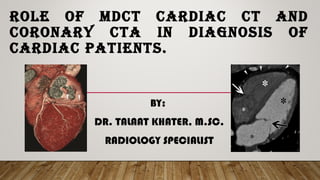

ROLE OF MDCT CARDIAC CT AND
CORONARY CTA IN DIAGNOSIS OF
CARDIAC PATIENTS.
BY:
DR. TALAAT KHATER, M.SC.
RADIOLOGY SPECIALIST
A PIECE OF WISDOM.
•The coronary CTA is used to rule out
rather than to rule in the presence of
obstructive coronary artery disease.
CARDIAC CTA VS CARDIAC CATH.
Better strategies rather than cardiac cath. are needed for
risk stratification in routine clinical practice.
Prof. Patel, et al. NEJM march 2010.
Better strategies rather than cardiac cath. are needed for
risk stratification in routine clinical practice.
Prof. Patel, et al. NEJM march 2010.
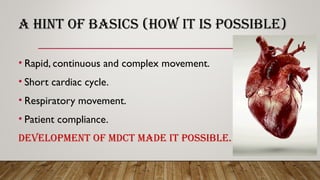
A HINT OF BASICS (HOW IT IS POSSIBLE)
• Rapid, continuous and complex movement.
• Short cardiac cycle.
• Respiratory movement.
• Patient compliance.
DEVELOPMENT OF MDCT MADE IT POSSIBLE.
SINGLE SLICE VS MULTISLICE CT SCANNERS
AVAILABLE MULTISLICE CT SCANNERS
• 4 MDCT.
• 16 MDCT.
• 40 MDCT.
• 64 MDCT (Minimum).
• 64 MDCT HR.
• 128 MDCT
• 128 dual source scanners.
• 256 and 320 MDCT.
Scantime
ECG GATING
• Intermediate risk.
• Negative predictive value (95-99%).
• Positive predictive value (80-85%).
• Patient factors: -
• Cooperative.
• HR.
• Rhythm.
CRITERIA OF PATIENT SELECTION
PATIENT PREPARATION
• Creatinine level.
• No exercise.
• Beta blockers.
• Nitroglycerine.
• Fasting.
• Proper training.
• Stop drugs of erectile dysfunction and caffeine.
APPLICATIONS OF CTA
• Calcium scoring (risk stratification).
• Obstructive coronary lesions.
• Stent evaluation.
• CABG (graft evaluation).
• Others.
• TAVI.
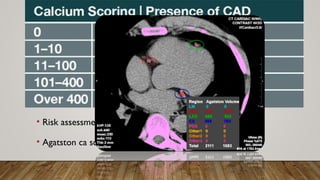
CALCIUM SCORING
• Atherosclerosis and CAC.
• Negative predictive value.
• Correlated to age and gender.
• Risk assessment (risk stratification).
• Agatston ca score and volume score.
NORMAL CTA CORONARY
OBSTRUCTIVE CORONARY DISEASE
STENT AND GRAFT SURVEILLANCE
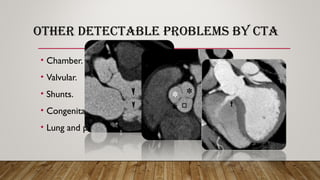
OTHER DETECTABLE PROBLEMS BY CTA
• Chamber.
• Valvular.
• Shunts.
• Congenital anomalies.
• Lung and pulmonary vessels.
TO CONCLUDE
Mdct coronary

Mdct coronary

  • 1.
    ROLE OF MDCTCARDIAC CT AND CORONARY CTA IN DIAGNOSIS OF CARDIAC PATIENTS. BY: DR. TALAAT KHATER, M.SC. RADIOLOGY SPECIALIST
  • 2.
    A PIECE OFWISDOM. •The coronary CTA is used to rule out rather than to rule in the presence of obstructive coronary artery disease.
  • 3.
    CARDIAC CTA VSCARDIAC CATH. Better strategies rather than cardiac cath. are needed for risk stratification in routine clinical practice. Prof. Patel, et al. NEJM march 2010. Better strategies rather than cardiac cath. are needed for risk stratification in routine clinical practice. Prof. Patel, et al. NEJM march 2010.
  • 4.
    A HINT OFBASICS (HOW IT IS POSSIBLE) • Rapid, continuous and complex movement. • Short cardiac cycle. • Respiratory movement. • Patient compliance. DEVELOPMENT OF MDCT MADE IT POSSIBLE.
  • 5.
    SINGLE SLICE VSMULTISLICE CT SCANNERS
  • 6.
    AVAILABLE MULTISLICE CTSCANNERS • 4 MDCT. • 16 MDCT. • 40 MDCT. • 64 MDCT (Minimum). • 64 MDCT HR. • 128 MDCT • 128 dual source scanners. • 256 and 320 MDCT. Scantime
  • 7.
  • 8.
    • Intermediate risk. •Negative predictive value (95-99%). • Positive predictive value (80-85%). • Patient factors: - • Cooperative. • HR. • Rhythm. CRITERIA OF PATIENT SELECTION
  • 9.
    PATIENT PREPARATION • Creatininelevel. • No exercise. • Beta blockers. • Nitroglycerine. • Fasting. • Proper training. • Stop drugs of erectile dysfunction and caffeine.
  • 10.
    APPLICATIONS OF CTA •Calcium scoring (risk stratification). • Obstructive coronary lesions. • Stent evaluation. • CABG (graft evaluation). • Others. • TAVI.
  • 11.
    CALCIUM SCORING • Atherosclerosisand CAC. • Negative predictive value. • Correlated to age and gender. • Risk assessment (risk stratification). • Agatston ca score and volume score.
  • 12.
  • 13.
  • 14.
    STENT AND GRAFTSURVEILLANCE
  • 15.
    OTHER DETECTABLE PROBLEMSBY CTA • Chamber. • Valvular. • Shunts. • Congenital anomalies. • Lung and pulmonary vessels.
  • 16.