MULTIPLE CHOICE QUESTIONS
Theoretical Base of English Education EDU -04.2
(Answers in bold) By: Anoop Abraham
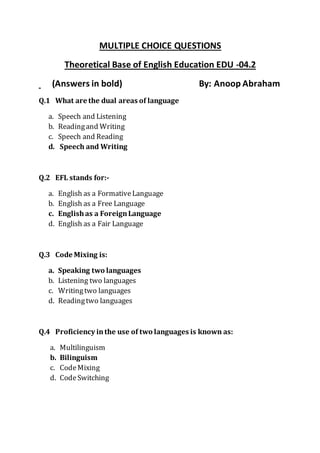
Q.1 What are the dual areas of language
a. Speech and Listening
b. Readingand Writing
c. Speech and Reading
d. Speech and Writing
Q.2 EFL stands for:-
a. English as a FormativeLanguage
b. English as a Free Language
c. Englishas a ForeignLanguage
d. English as a Fair Language
Q.3 Code Mixing is:
a. Speaking two languages
b. Listening two languages
c. Writingtwo languages
d. Readingtwo languages
Q.4 Proficiency inthe use of two languages is known as:
a. Multilinguism
b. Bilinguism
c. CodeMixing
d. CodeSwitching
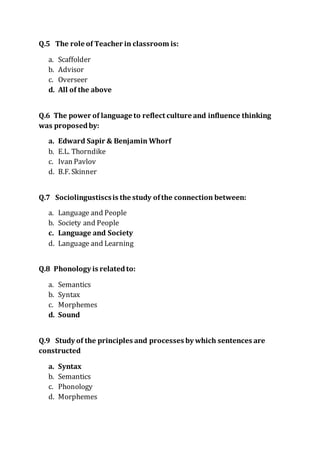
Q.5 The role of Teacher in classroom is:
a. Scaffolder
b. Advisor
c. Overseer
d. All of the above
Q.6 The power of language to reflect culture and influence thinking
was proposedby:
a. Edward Sapir & Benjamin Whorf
b. E.L. Thorndike
c. Ivan Pavlov
d. B.F. Skinner
Q.7 Sociolingustiscsis the study ofthe connection between:
a. Language and People
b. Society and People
c. Language and Society
d. Language and Learning
Q.8 Phonology is relatedto:
a. Semantics
b. Syntax
c. Morphemes
d. Sound
Q.9 Study of the principles and processes by which sentences are
constructed
a. Syntax
b. Semantics
c. Phonology
d. Morphemes
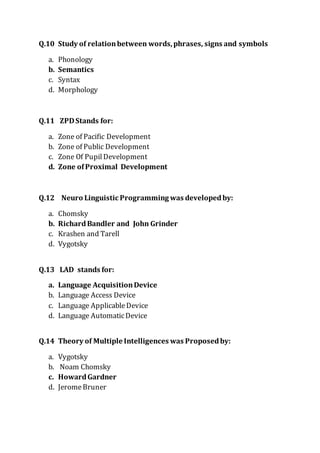
Q.10 Study of relationbetween words,phrases, signs and symbols
a. Phonology
b. Semantics
c. Syntax
d. Morphology
Q.11 ZPDStands for:
a. Zone of Pacific Development
b. Zone of Public Development
c. Zone Of PupilDevelopment
d. Zone ofProximal Development
Q.12 Neuro Linguistic Programming was developedby:
a. Chomsky
b. RichardBandler and John Grinder
c. Krashen and Tarell
d. Vygotsky
Q.13 LAD stands for:
a. Language AcquisitionDevice
b. Language Access Device
c. Language ApplicableDevice
d. Language AutomaticDevice
Q.14 Theory of Multiple Intelligences was Proposedby:
a. Vygotsky
b. Noam Chomsky
c. HowardGardner
d. JeromeBruner
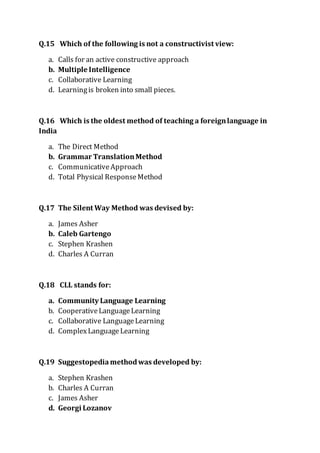
Q.15 Which of the following is not a constructivist view:
a. Calls for an active constructive approach
b. Multiple Intelligence
c. Collaborative Learning
d. Learningis broken into small pieces.
Q.16 Which is the oldest method of teaching a foreignlanguage in
India
a. The Direct Method
b. Grammar TranslationMethod
c. CommunicativeApproach
d. Total Physical ResponseMethod
Q.17 The Silent Way Method was devised by:
a. James Asher
b. Caleb Gartengo
c. Stephen Krashen
d. Charles A Curran
Q.18 CLL stands for:
a. Community Language Learning
b. CooperativeLanguageLearning
c. Collaborative LanguageLearning
d. ComplexLanguageLearning
Q.19 Suggestopedia methodwas developed by:
a. Stephen Krashen
b. Charles A Curran
c. James Asher
d. Georgi Lozanov
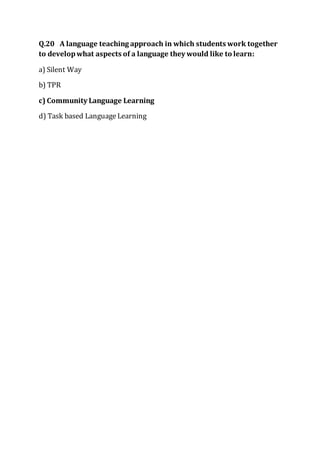
Q.20 A language teaching approach in which students work together
to developwhat aspects of a language they would like to learn:
a) Silent Way
b) TPR
c) Community Language Learning
d) Task based Language Learning
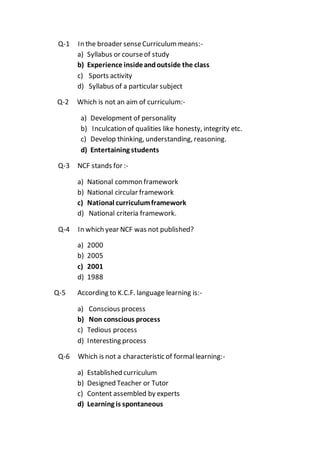
Q-1 In the broader senseCurriculum means:-
a) Syllabus or courseof study
b) Experience insideandoutside the class
c) Sports activity
d) Syllabus of a particular subject
Q-2 Which is not an aim of curriculum:-
a) Development of personality
b) Inculcation of qualities like honesty, integrity etc.
c) Develop thinking, understanding, reasoning.
d) Entertaining students
Q-3 NCF stands for :-
a) National common framework
b) National circular framework
c) National curriculumframework
d) National criteria framework.
Q-4 In which year NCF was not published?
a) 2000
b) 2005
c) 2001
d) 1988
Q-5 According to K.C.F. language learning is:-
a) Conscious process
b) Non conscious process
c) Tedious process
d) Interesting process
Q-6 Which is not a characteristic of formallearning:-
a) Established curriculum
b) Designed Teacher or Tutor
c) Content assembled by experts
d) Learning is spontaneous
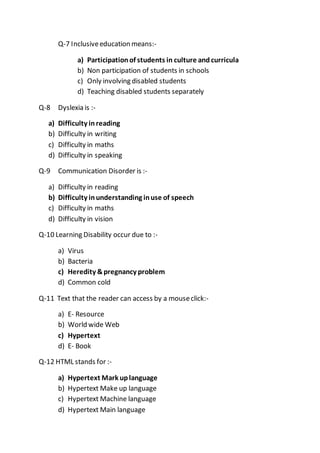
Q-7 Inclusiveeducation means:-
a) Participationof students in culture andcurricula
b) Non participation of students in schools
c) Only involving disabled students
d) Teaching disabled students separately
Q-8 Dyslexia is :-
a) Difficulty inreading
b) Difficulty in writing
c) Difficulty in maths
d) Difficulty in speaking
Q-9 Communication Disorder is :-
a) Difficulty in reading
b) Difficulty inunderstanding inuse of speech
c) Difficulty in maths
d) Difficulty in vision
Q-10 Learning Disability occur due to :-
a) Virus
b) Bacteria
c) Heredity &pregnancy problem
d) Common cold
Q-11 Text that the reader can access by a mouseclick:-
a) E- Resource
b) World wide Web
c) Hypertext
d) E- Book
Q-12 HTML stands for :-
a) Hypertext Mark uplanguage
b) Hypertext Make up language
c) Hypertext Machine language
d) Hypertext Main language
Q. 13 Publishing of Audio via Internetis known as :-
a) Blog
b) E-mail
c) Website
d) Podcast
Q-14 The Daily Idiomis an example of :-
a) Authentic Podcasts
b) Student Podcasts
c) Teacher Podcasts
d) Educator Podcasts
Q-15
b) E-mail
c)
e)
f)

Mcq 4.2

  • 1.
    MULTIPLE CHOICE QUESTIONS TheoreticalBase of English Education EDU -04.2 (Answers in bold) By: Anoop Abraham Q.1 What are the dual areas of language a. Speech and Listening b. Readingand Writing c. Speech and Reading d. Speech and Writing Q.2 EFL stands for:- a. English as a FormativeLanguage b. English as a Free Language c. Englishas a ForeignLanguage d. English as a Fair Language Q.3 Code Mixing is: a. Speaking two languages b. Listening two languages c. Writingtwo languages d. Readingtwo languages Q.4 Proficiency inthe use of two languages is known as: a. Multilinguism b. Bilinguism c. CodeMixing d. CodeSwitching
  • 2.
    Q.5 The roleof Teacher in classroom is: a. Scaffolder b. Advisor c. Overseer d. All of the above Q.6 The power of language to reflect culture and influence thinking was proposedby: a. Edward Sapir & Benjamin Whorf b. E.L. Thorndike c. Ivan Pavlov d. B.F. Skinner Q.7 Sociolingustiscsis the study ofthe connection between: a. Language and People b. Society and People c. Language and Society d. Language and Learning Q.8 Phonology is relatedto: a. Semantics b. Syntax c. Morphemes d. Sound Q.9 Study of the principles and processes by which sentences are constructed a. Syntax b. Semantics c. Phonology d. Morphemes
  • 3.
    Q.10 Study ofrelationbetween words,phrases, signs and symbols a. Phonology b. Semantics c. Syntax d. Morphology Q.11 ZPDStands for: a. Zone of Pacific Development b. Zone of Public Development c. Zone Of PupilDevelopment d. Zone ofProximal Development Q.12 Neuro Linguistic Programming was developedby: a. Chomsky b. RichardBandler and John Grinder c. Krashen and Tarell d. Vygotsky Q.13 LAD stands for: a. Language AcquisitionDevice b. Language Access Device c. Language ApplicableDevice d. Language AutomaticDevice Q.14 Theory of Multiple Intelligences was Proposedby: a. Vygotsky b. Noam Chomsky c. HowardGardner d. JeromeBruner
  • 4.
    Q.15 Which ofthe following is not a constructivist view: a. Calls for an active constructive approach b. Multiple Intelligence c. Collaborative Learning d. Learningis broken into small pieces. Q.16 Which is the oldest method of teaching a foreignlanguage in India a. The Direct Method b. Grammar TranslationMethod c. CommunicativeApproach d. Total Physical ResponseMethod Q.17 The Silent Way Method was devised by: a. James Asher b. Caleb Gartengo c. Stephen Krashen d. Charles A Curran Q.18 CLL stands for: a. Community Language Learning b. CooperativeLanguageLearning c. Collaborative LanguageLearning d. ComplexLanguageLearning Q.19 Suggestopedia methodwas developed by: a. Stephen Krashen b. Charles A Curran c. James Asher d. Georgi Lozanov
  • 5.
    Q.20 A languageteaching approach in which students work together to developwhat aspects of a language they would like to learn: a) Silent Way b) TPR c) Community Language Learning d) Task based Language Learning
  • 6.
    Q-1 In thebroader senseCurriculum means:- a) Syllabus or courseof study b) Experience insideandoutside the class c) Sports activity d) Syllabus of a particular subject Q-2 Which is not an aim of curriculum:- a) Development of personality b) Inculcation of qualities like honesty, integrity etc. c) Develop thinking, understanding, reasoning. d) Entertaining students Q-3 NCF stands for :- a) National common framework b) National circular framework c) National curriculumframework d) National criteria framework. Q-4 In which year NCF was not published? a) 2000 b) 2005 c) 2001 d) 1988 Q-5 According to K.C.F. language learning is:- a) Conscious process b) Non conscious process c) Tedious process d) Interesting process Q-6 Which is not a characteristic of formallearning:- a) Established curriculum b) Designed Teacher or Tutor c) Content assembled by experts d) Learning is spontaneous
  • 7.
    Q-7 Inclusiveeducation means:- a)Participationof students in culture andcurricula b) Non participation of students in schools c) Only involving disabled students d) Teaching disabled students separately Q-8 Dyslexia is :- a) Difficulty inreading b) Difficulty in writing c) Difficulty in maths d) Difficulty in speaking Q-9 Communication Disorder is :- a) Difficulty in reading b) Difficulty inunderstanding inuse of speech c) Difficulty in maths d) Difficulty in vision Q-10 Learning Disability occur due to :- a) Virus b) Bacteria c) Heredity &pregnancy problem d) Common cold Q-11 Text that the reader can access by a mouseclick:- a) E- Resource b) World wide Web c) Hypertext d) E- Book Q-12 HTML stands for :- a) Hypertext Mark uplanguage b) Hypertext Make up language c) Hypertext Machine language d) Hypertext Main language
  • 8.
    Q. 13 Publishingof Audio via Internetis known as :- a) Blog b) E-mail c) Website d) Podcast Q-14 The Daily Idiomis an example of :- a) Authentic Podcasts b) Student Podcasts c) Teacher Podcasts d) Educator Podcasts Q-15 b) E-mail c) e) f)