ASSIGNMENT ON
MULTIPLE CHOICE QUESTIONS
SEMESTER-III
Paper Name: Emerging Trends and Practices
in English Language Education
Register No.: 16519303004
Date of Submission: 24th October 2020
Submitted by: Submitted To
Anoop Abraham Mr. E.K. Jijan
(Asst. Professor)
MULTIPLE CHOICE QUESTIONS
Emerging Trends and Practices in English Language Education 13.2
(Answers in bold) By: Anoop Abraham
Q.1 Collaborative learning means:
a. Each individual is dependable andaccountable to each other
b. Students work in groups towards academic goal
c. Students learn individually
d. Classroomlearning
Q.2 Cooperative learning means:
a) Organize classroomactivitiesintoacademic and social learning
experience
b) Members actively interact with each other to create knowledge
c) E learning
d) Teacher centred learning
Q.3 Connectivism learning theory is promoted by:
a) Noam Chomsky
b) Lev Vygotsky
c) StephenDownes and George Siemens
d) Jean Piaget
Q.4 MOOC stands for:
a) Major Open Online Course
b) Main Open Online Course
c) Massive OpenOnline Course
d) Mock Open Online Course
Q.5 Which is not an aim of self and peer assessment:
a) Involvestudentin critical reflection
b) To assignmore marks
c) Increasestudent responsibility and accountability
d) Encourages learning
Q.6 CCE stands for:
a) Continuous and Comprehensive Evaluation
b) Clear and Compact Evaluation
c) Continuous and ComprehensiveExamination
d) Cognitive and ComprehensiveEvaluation
Q.7 Which is not a type of standardized test:
a) Aptitude Test
b) Attitude Test
c) Intelligence Test
d) Performance Test
Q.8 Objective type question is:
a) Answers tothese questions are oftensingleworded
b) Answers callfor brevity and precision
c) Long answers
d) Answers in a paragraph
Q.9 Assessmentportfolio demonstrates:
a) Skill and competence inparticular domain
b) Advancement of skill over a period of time rubrics
c) Highlights stellar work in specific area.
d) Collection of electronic evidence assembled and managed by user.
Q.10 Mode of learning in which student partly learns in online mode:
a) Virtual learning
b) E tutoring
c) Blendedlearning
d) MOOC
Q.11 Popular model used for creating instructionalmaterial:
a) ADIDE
b) ADDIE
c) ADEID
d) AEIDD
Q.12 eXe learning is a :
a) Free software tool tocreate educational content
b) Open sourcetools for developers
c) Proprietary software
d) Visualauthoring tool
Q.13 Digital material which is available online:
a) E-Content
b) Virtual Content
c) Digital Content
d) Online Content
Q.14 Learning object is a:
a) Digital content that can be used once
b) Digital content that canbe re- used
c) Digital content that can’t be used.
d) Digital content with access restriction
Q.15 AssessmentRubrics is:
a) Online gaming
b) Anti Virus
c) Evaluative Tool
d) Video Player
Q.16 Remedial Teaching is given to :
a) Gifted Children
b) AverageChildren
c) Specially abled children
d) Slow learners
Q.17 Teaching standards arefor:
a) Enhancing studentperformance
b) Evaluating teacher performance
c) Ensuring students attainlearning goals
d) Examining teacher’s intellectual levels.
Q.18 TQM stands for:
a) Teacher Quality Management
b) Total Quality Management
c) Test Quality Management
d) Text Quality Management
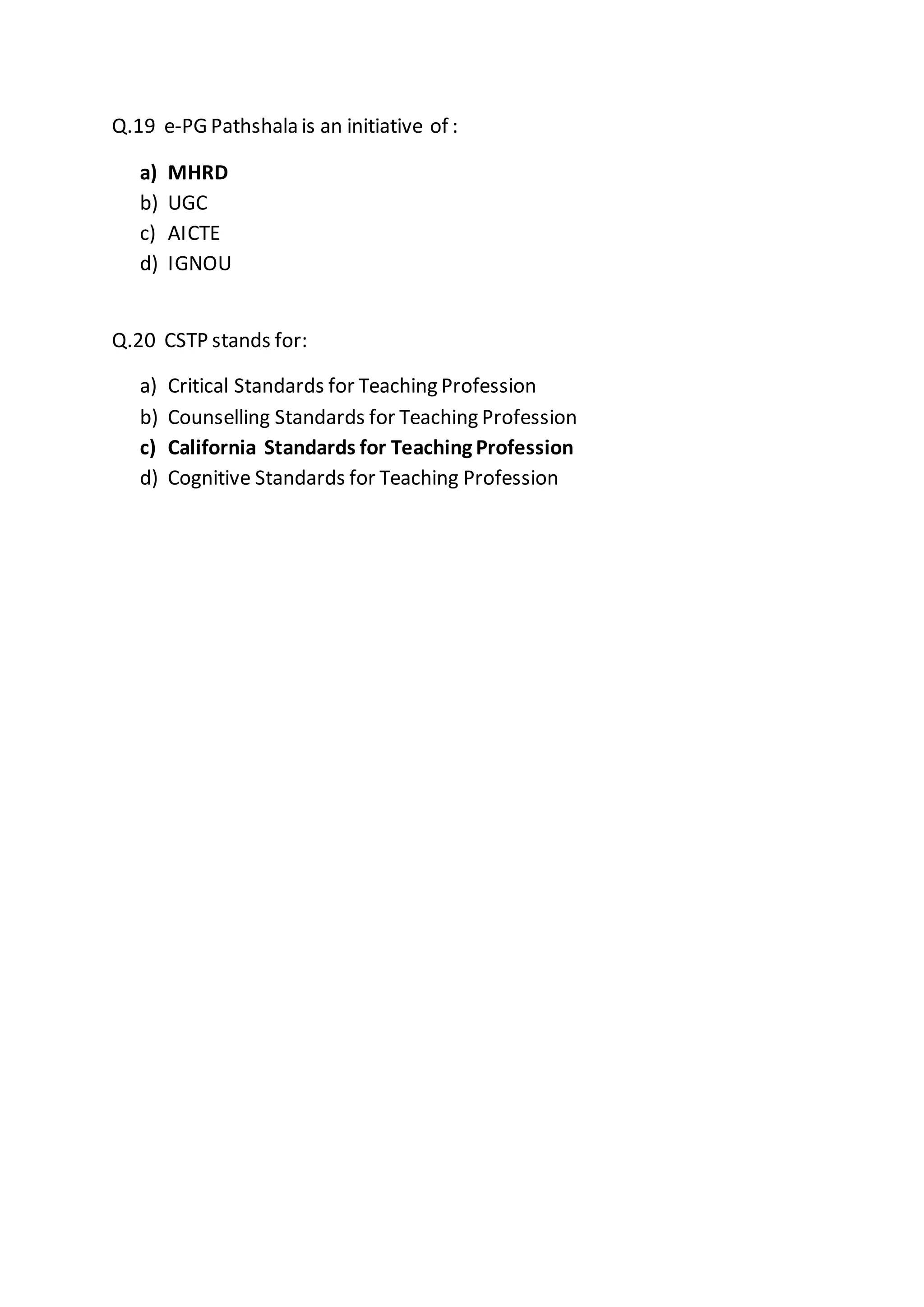
Q.19 e-PG Pathshala is an initiative of :
a) MHRD
b) UGC
c) AICTE
d) IGNOU
Q.20 CSTP stands for:
a) Critical Standards for Teaching Profession
b) Counselling Standards for Teaching Profession
c) California Standards for Teaching Profession
d) Cognitive Standards for Teaching Profession

Mcq 13.2

  • 1.
    ASSIGNMENT ON MULTIPLE CHOICEQUESTIONS SEMESTER-III Paper Name: Emerging Trends and Practices in English Language Education Register No.: 16519303004 Date of Submission: 24th October 2020 Submitted by: Submitted To Anoop Abraham Mr. E.K. Jijan (Asst. Professor)
  • 2.
    MULTIPLE CHOICE QUESTIONS EmergingTrends and Practices in English Language Education 13.2 (Answers in bold) By: Anoop Abraham Q.1 Collaborative learning means: a. Each individual is dependable andaccountable to each other b. Students work in groups towards academic goal c. Students learn individually d. Classroomlearning Q.2 Cooperative learning means: a) Organize classroomactivitiesintoacademic and social learning experience b) Members actively interact with each other to create knowledge c) E learning d) Teacher centred learning Q.3 Connectivism learning theory is promoted by: a) Noam Chomsky b) Lev Vygotsky c) StephenDownes and George Siemens d) Jean Piaget
  • 3.
    Q.4 MOOC standsfor: a) Major Open Online Course b) Main Open Online Course c) Massive OpenOnline Course d) Mock Open Online Course Q.5 Which is not an aim of self and peer assessment: a) Involvestudentin critical reflection b) To assignmore marks c) Increasestudent responsibility and accountability d) Encourages learning Q.6 CCE stands for: a) Continuous and Comprehensive Evaluation b) Clear and Compact Evaluation c) Continuous and ComprehensiveExamination d) Cognitive and ComprehensiveEvaluation Q.7 Which is not a type of standardized test: a) Aptitude Test b) Attitude Test c) Intelligence Test d) Performance Test Q.8 Objective type question is: a) Answers tothese questions are oftensingleworded b) Answers callfor brevity and precision c) Long answers d) Answers in a paragraph
  • 4.
    Q.9 Assessmentportfolio demonstrates: a)Skill and competence inparticular domain b) Advancement of skill over a period of time rubrics c) Highlights stellar work in specific area. d) Collection of electronic evidence assembled and managed by user. Q.10 Mode of learning in which student partly learns in online mode: a) Virtual learning b) E tutoring c) Blendedlearning d) MOOC Q.11 Popular model used for creating instructionalmaterial: a) ADIDE b) ADDIE c) ADEID d) AEIDD Q.12 eXe learning is a : a) Free software tool tocreate educational content b) Open sourcetools for developers c) Proprietary software d) Visualauthoring tool Q.13 Digital material which is available online: a) E-Content b) Virtual Content c) Digital Content d) Online Content
  • 5.
    Q.14 Learning objectis a: a) Digital content that can be used once b) Digital content that canbe re- used c) Digital content that can’t be used. d) Digital content with access restriction Q.15 AssessmentRubrics is: a) Online gaming b) Anti Virus c) Evaluative Tool d) Video Player Q.16 Remedial Teaching is given to : a) Gifted Children b) AverageChildren c) Specially abled children d) Slow learners Q.17 Teaching standards arefor: a) Enhancing studentperformance b) Evaluating teacher performance c) Ensuring students attainlearning goals d) Examining teacher’s intellectual levels. Q.18 TQM stands for: a) Teacher Quality Management b) Total Quality Management c) Test Quality Management d) Text Quality Management
  • 6.
    Q.19 e-PG Pathshalais an initiative of : a) MHRD b) UGC c) AICTE d) IGNOU Q.20 CSTP stands for: a) Critical Standards for Teaching Profession b) Counselling Standards for Teaching Profession c) California Standards for Teaching Profession d) Cognitive Standards for Teaching Profession