ENGLISH FOR GRADUDATE STUDIES
ALICE
HISTORY OF LANGUAGE
TEACHING METHODS
Objective
History of Language Teaching Methods (Nunan,
1998)
 Define methodology
 Explain language teaching methods
2
Lead-in
 Recall your past English learning experiences and
tell how you learned the language
 Do you have a role model teacher?
 If yes, tell why you like him or her.
 Imagine you are a teacher. What kind of teacher will
you be?
3
Defining Teaching Methodology
1. … the study of the practices and procedures
used in teaching, and the principles and
beliefs that underlie them
(Longman Dictionary of Applied Linguistics)
4
Defining Teaching Methodology
Methodology includes…
1) Study of the nature of language skills (R, W, L,
S) and procedures for teaching them
2) Study of the preparation of lessons plans,
materials, and textbooks for teaching language
skills.
3) The evaluation and comparison of language
teaching methods (e.g. the audio-lingual method)
5
Defining Teaching Methodology
2. Such practices, procedures,
principles, and beliefs themselves. One
can, for example criticize or praise the
methodology of a particular language
course.
(Richards et al. 1985)
6
Defining Teaching Methodology
3. “I consider methodology from the
perspective of the classroom. The major
focus is on classroom tasks and
activities and the management of
learning”.
(Nunan, 1991)
7
Methodology = methods?
To find the right method is the goal of many
language teacher. Why?
Little evidence to support one approach
rather than another, or to suggest it is the
method rather than some other variables which
caused learning to occur.
Defining Teaching Methodology
8
Language Teaching Methods
 History of language teaching
 A search for the right method
 There never was and will be a method for all.
 Contributions of disciplines
9
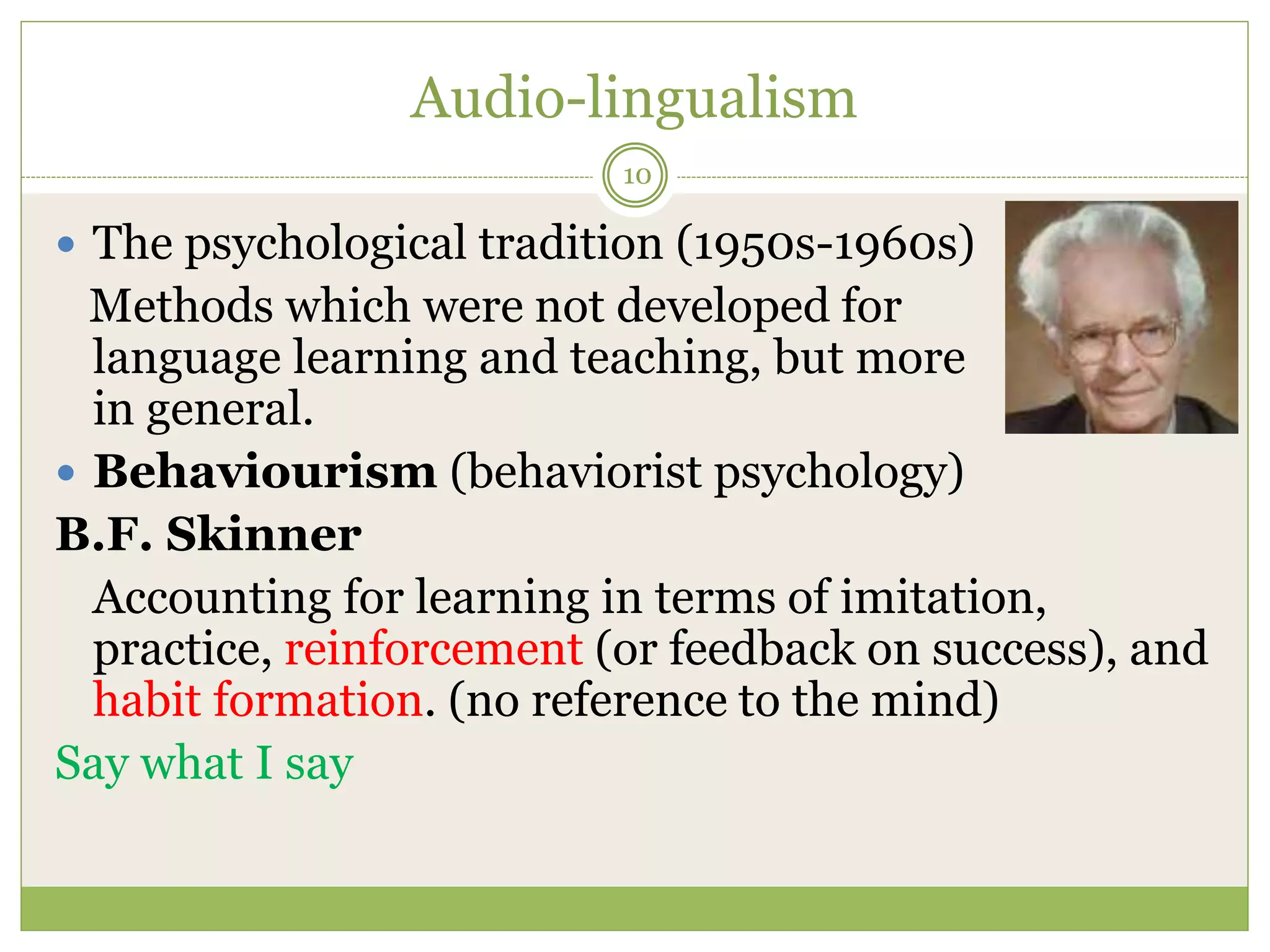
Audio-lingualism
 The psychological tradition (1950s-1960s)
Methods which were not developed for
language learning and teaching, but more
in general.
 Behaviourism (behaviorist psychology)
B.F. Skinner
Accounting for learning in terms of imitation,
practice, reinforcement (or feedback on success), and
habit formation. (no reference to the mind)
Say what I say
10
Audio-lingualism
 The development of patterns and substitution drills
The pen is on the desk.
book under chair.
ruler by table.
Language is speech, not writing.
A language is a set of habits.
Teach the language, not about the language.
 A language is what native speakers say, not what
someone thinks they ought to say.
11
Cognitive code learning
Cognitive process
Is seen in:
 the theories of universal grammar
 Schema theory
 Restructuring
 Explicit and implicit learning
12
Universal grammar
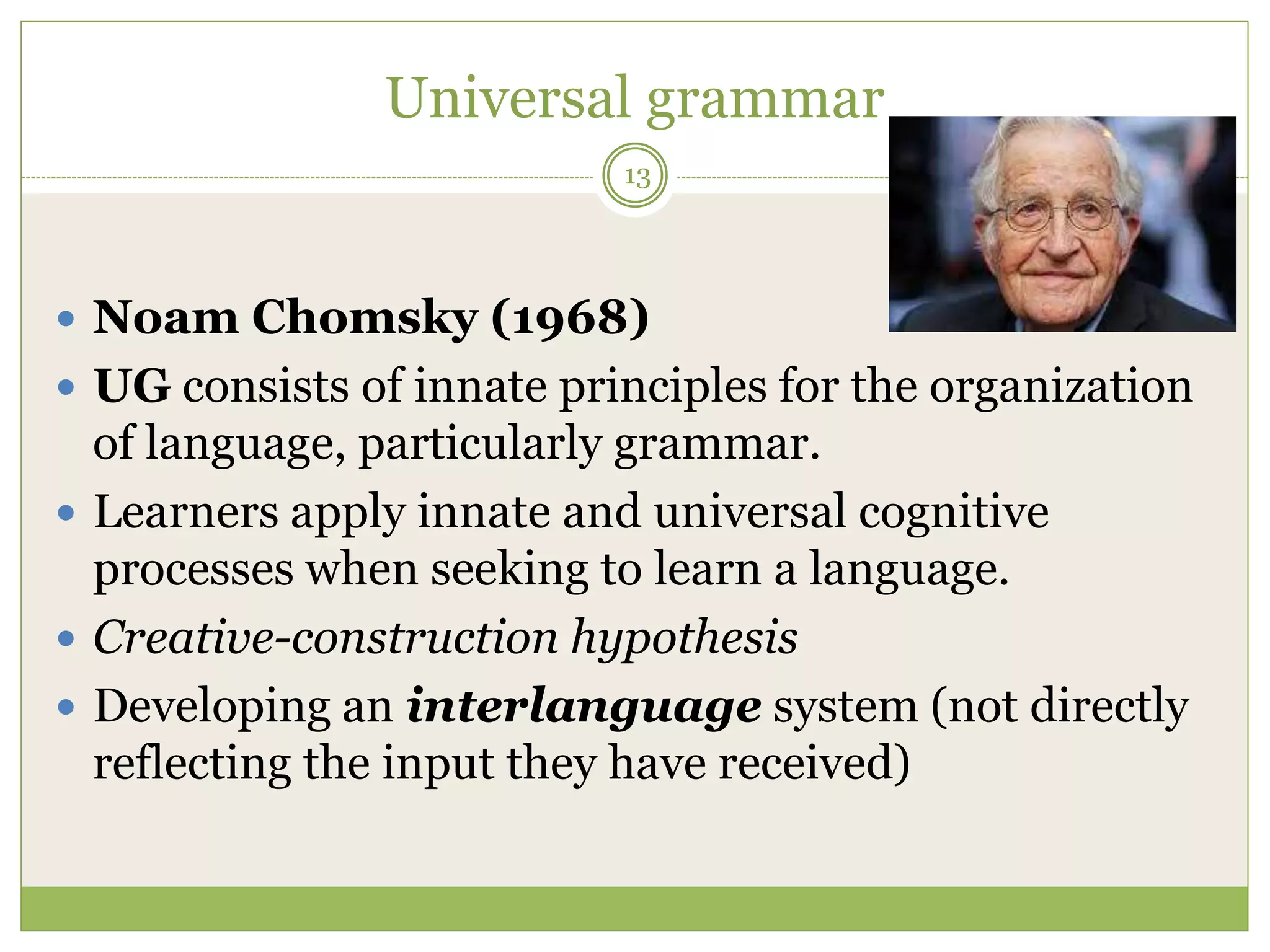
 Noam Chomsky (1968)
 UG consists of innate principles for the organization
of language, particularly grammar.
 Learners apply innate and universal cognitive
processes when seeking to learn a language.
 Creative-construction hypothesis
 Developing an interlanguage system (not directly
reflecting the input they have received)
13
Universal grammar
 Creative-construction hypothesis
 What language learning process do these sentences
illustrate?
1. I don’t know how do I pronounce this word.
2. *Wed-nes-day (Wednesday)
3. Although I studied hard, but I failed.
4. We are usually walk to school.
Teaching implications?
- Less focus on error
- Provide rich and meaningful input for learning
14
Universal grammar
15
an interlanguage system
 Overgeneralization
 Transfer of training
 Language transfer
 Strategies of SL learning
 Strategies of SL communication
Self study
Schema theory
 Mental models or framework
 Organizing information in the mind
 Representing general knowledge about events,
situations, objects, actions and feelings.
 Be part of prior knowledge learners bring to new
experience.
16
Restructuring
 Adjusting what has been learned to accommodate
new information.
I have moved here since 1996.
 Make use of both explicit and implicit knowledge.
17
Explicit-Implicit learning
 Conscious learning and results in knowledge that
can be described and explained.
 Takes place without conscious awareness and
results in knowledge that the learner may not be able
to verbalize or explain.
Explicit learning
Implicit learning
18
Explicit-Implicit learning
Deductive learning vs Inductive learning
A situation is created in which the target item is
embedded in a meaningful context.
Learners are told the rule and then given the
opportunity to apply it to several practice items or
examples.
I have moved here since 1996.
19
Explicit-Implicit learning
Deductive learning vs Inductive learning
The student is given a number of examples and
asked to work out the rule through a process of
guided discovery.
I have moved here since 1996.
I have studied French since I was 20.
My sister has worked on her thesis since yesterday.
20
Cognitive code learning
Making mistakes is an important part of the
language learning process.
Such mistakes provide disconfirming instances
which are important in learning a new concept or
rule.
Teaching implication?
21
The humanistic tradition
 Affective and emotional factors within a
learning process.
 Successful learning will occur if learners can be
encouraged to adopt the right attitudes, interests
and motivation in the TL and culture, and in the
learning environment in which they find
themselves.
22
The humanistic tradition
The Silent Way
 Gattegno (1972)
 makes extensive use of silence
as a teaching method
 The T is silent while teaching.
 SW is not a method.
 Any teaching implications?
23
https://www.youtube.com/watch?v=GUPPGrnrJv4
The humanistic tradition
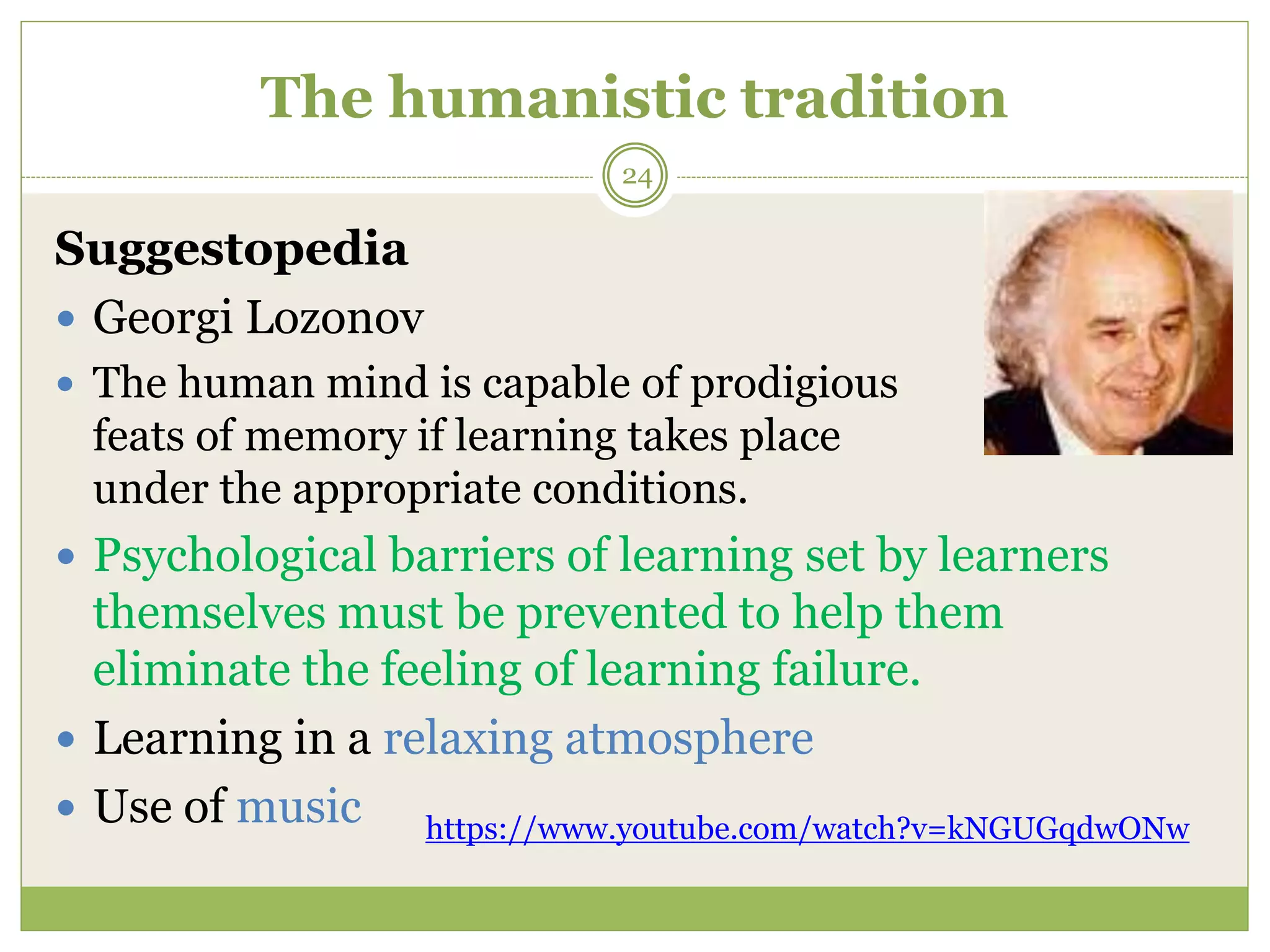
Suggestopedia
 Georgi Lozonov
 The human mind is capable of prodigious
feats of memory if learning takes place
under the appropriate conditions.
 Psychological barriers of learning set by learners
themselves must be prevented to help them
eliminate the feeling of learning failure.
 Learning in a relaxing atmosphere
 Use of music
24
https://www.youtube.com/watch?v=kNGUGqdwONw
The second language acquisition (SLA) tradition
 Language acquisition is very similar to the
process children use in acquiring first and
second languages (L1 and L2)
25
The second language acquisition (SLA) tradition
 The Natural Approach
Krashen
o Comprehensible input is the most important
in language acquisition
i +1 input
o Lower affective filter (an imaginary barrier which
prevents learners from acquiring language from available
input)
o Affect = things such as motives, needs, attitudes, and
emotional states.
o The focus is on meaning rather than form.
26
The second language acquisition (SLA) tradition
 The Total Physical Response (TPR)
Asher
 method developed based on 2 characteristics
of FLA
1. Get comprehensible input before speaking
2. Physical manipulation and action language
accompanying early input (commands)
Comprehension precedes production.
27
https://www.youtube.com/watch?v=bkMQXFOqyQA
The second language acquisition (SLA) tradition
 Sociocultural theory
 the fundamental role of social interaction in
the development of cognition.
 Language learning viewed as a social process in
which meaning and understanding is constructed
through dialogue between a learner and a more
knowledgeable other person.
 Sociocultural means learning takes place in
particular settings (a classroom).
28
The second language acquisition (SLA) tradition
Scaffolding
The process of mediation.
The process of interaction between two or more people
as they carry out a classroom activity, and where one
person has more advanced knowledge than the other.
Do you think scaffolding also occurs between learners
of roughly the same level when they do an activity?
29
The second language acquisition (SLA) tradition
Zone of Proximal Development
 the ZPD form the basis of the scaffolding
component of the cognitive apprenticeship model of
instruction.
 Vygotsky (1978) defines the ZPD as the distance
between the "actual developmental level as
determined by independent problem solving and the
level of potential development as determined
through problem solving under adult guidance or in
collaboration with more capable peers" (p. 86).
30
ZPD
31
ZPD
 Learners must develop interactional competence
 The ability to manage exchanges despite limited
language development.
 Motivation
 Cognitive style
 Openness to social interaction
 Attitudes towards the TL and users of the TL
32
Communicative language teaching (CLT) approach
33
 Communication ability in the TL was questioned!
 Linguistic structure is not enough as language is
fundamentally social (Halliday, 1973).
 Ss may know the rules of linguistic usage, but
unable to use the language.
 To communicate, it requires linguistic competence,
communicative competence (Hymes, 1971), and
interactional competence (Walsh)
 CLT approach
Communicative language teaching (CLT) approach
34
 Goal: enable Ss to communicate in the TL (know
linguistic forms, meanings and functions)
 Communication is a process; knowledge of the
language forms is inadequate.
Know
 Many different forms can be used to perform a function.
 A single form can often serve a variety of functions.
 Able to choose from among these the most appropriate
form, given the social context and the roles of the
interlocutors.
Tasks
35
1. Can you suggest a classroom pronunciation activity
that involves the silent way?
2. Can you suggest a classroom vocabulary and
speaking activity that incorporates TPR?
3. Can you suggest a classroom grammar activity that
involves inductive teaching and TPR?
4. You are going to teach reading on the topic Online
Shopping. Please suggest how you will make use of
the schema theory.
5. Can you design a classroom activity that applies the
audiolingual method and suggestopedia?
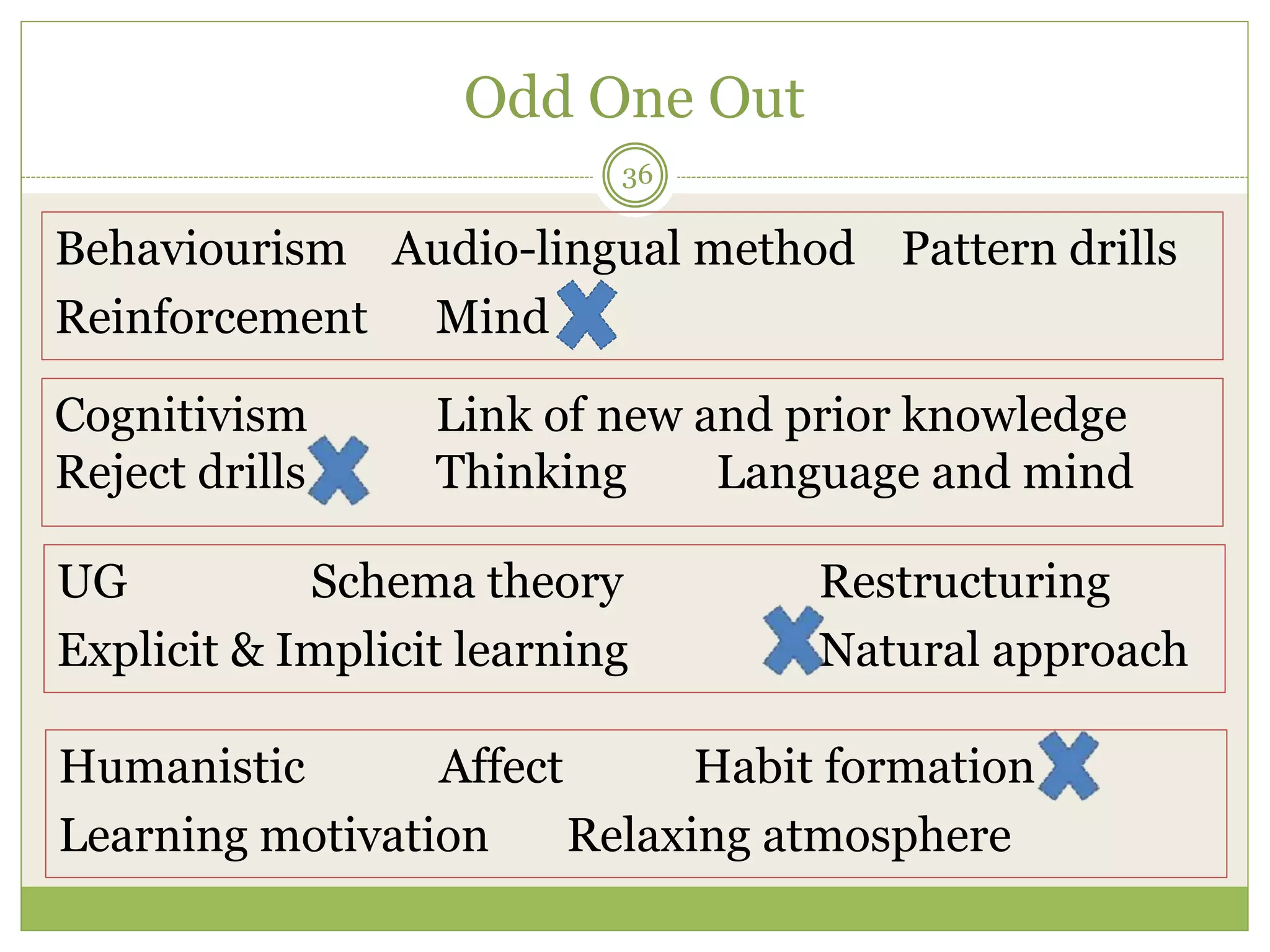
Odd One Out
36
Behaviourism Audio-lingual method Pattern drills
Reinforcement Mind
Cognitivism Link of new and prior knowledge
Reject drills Thinking Language and mind
UG Schema theory Restructuring
Explicit & Implicit learning Natural approach
Humanistic Affect Habit formation
Learning motivation Relaxing atmosphere
Odd One Out
37
Silent way Suggestopedia TPR
Humanistic Emotion
Krashen Natural approach Music
i+1 Comprehensible input
TPR Comprehensible input Action
Production first Focus on meaning

1, History of language teaching methods.pptx

  • 1.
    ENGLISH FOR GRADUDATESTUDIES ALICE HISTORY OF LANGUAGE TEACHING METHODS
  • 2.
    Objective History of LanguageTeaching Methods (Nunan, 1998)  Define methodology  Explain language teaching methods 2
  • 3.
    Lead-in  Recall yourpast English learning experiences and tell how you learned the language  Do you have a role model teacher?  If yes, tell why you like him or her.  Imagine you are a teacher. What kind of teacher will you be? 3
  • 4.
    Defining Teaching Methodology 1.… the study of the practices and procedures used in teaching, and the principles and beliefs that underlie them (Longman Dictionary of Applied Linguistics) 4
  • 5.
    Defining Teaching Methodology Methodologyincludes… 1) Study of the nature of language skills (R, W, L, S) and procedures for teaching them 2) Study of the preparation of lessons plans, materials, and textbooks for teaching language skills. 3) The evaluation and comparison of language teaching methods (e.g. the audio-lingual method) 5
  • 6.
    Defining Teaching Methodology 2.Such practices, procedures, principles, and beliefs themselves. One can, for example criticize or praise the methodology of a particular language course. (Richards et al. 1985) 6
  • 7.
    Defining Teaching Methodology 3.“I consider methodology from the perspective of the classroom. The major focus is on classroom tasks and activities and the management of learning”. (Nunan, 1991) 7
  • 8.
    Methodology = methods? Tofind the right method is the goal of many language teacher. Why? Little evidence to support one approach rather than another, or to suggest it is the method rather than some other variables which caused learning to occur. Defining Teaching Methodology 8
  • 9.
    Language Teaching Methods History of language teaching  A search for the right method  There never was and will be a method for all.  Contributions of disciplines 9
  • 10.
    Audio-lingualism  The psychologicaltradition (1950s-1960s) Methods which were not developed for language learning and teaching, but more in general.  Behaviourism (behaviorist psychology) B.F. Skinner Accounting for learning in terms of imitation, practice, reinforcement (or feedback on success), and habit formation. (no reference to the mind) Say what I say 10
  • 11.
    Audio-lingualism  The developmentof patterns and substitution drills The pen is on the desk. book under chair. ruler by table. Language is speech, not writing. A language is a set of habits. Teach the language, not about the language.  A language is what native speakers say, not what someone thinks they ought to say. 11
  • 12.
    Cognitive code learning Cognitiveprocess Is seen in:  the theories of universal grammar  Schema theory  Restructuring  Explicit and implicit learning 12
  • 13.
    Universal grammar  NoamChomsky (1968)  UG consists of innate principles for the organization of language, particularly grammar.  Learners apply innate and universal cognitive processes when seeking to learn a language.  Creative-construction hypothesis  Developing an interlanguage system (not directly reflecting the input they have received) 13
  • 14.
    Universal grammar  Creative-constructionhypothesis  What language learning process do these sentences illustrate? 1. I don’t know how do I pronounce this word. 2. *Wed-nes-day (Wednesday) 3. Although I studied hard, but I failed. 4. We are usually walk to school. Teaching implications? - Less focus on error - Provide rich and meaningful input for learning 14
  • 15.
    Universal grammar 15 an interlanguagesystem  Overgeneralization  Transfer of training  Language transfer  Strategies of SL learning  Strategies of SL communication Self study
  • 16.
    Schema theory  Mentalmodels or framework  Organizing information in the mind  Representing general knowledge about events, situations, objects, actions and feelings.  Be part of prior knowledge learners bring to new experience. 16
  • 17.
    Restructuring  Adjusting whathas been learned to accommodate new information. I have moved here since 1996.  Make use of both explicit and implicit knowledge. 17
  • 18.
    Explicit-Implicit learning  Consciouslearning and results in knowledge that can be described and explained.  Takes place without conscious awareness and results in knowledge that the learner may not be able to verbalize or explain. Explicit learning Implicit learning 18
  • 19.
    Explicit-Implicit learning Deductive learningvs Inductive learning A situation is created in which the target item is embedded in a meaningful context. Learners are told the rule and then given the opportunity to apply it to several practice items or examples. I have moved here since 1996. 19
  • 20.
    Explicit-Implicit learning Deductive learningvs Inductive learning The student is given a number of examples and asked to work out the rule through a process of guided discovery. I have moved here since 1996. I have studied French since I was 20. My sister has worked on her thesis since yesterday. 20
  • 21.
    Cognitive code learning Makingmistakes is an important part of the language learning process. Such mistakes provide disconfirming instances which are important in learning a new concept or rule. Teaching implication? 21
  • 22.
    The humanistic tradition Affective and emotional factors within a learning process.  Successful learning will occur if learners can be encouraged to adopt the right attitudes, interests and motivation in the TL and culture, and in the learning environment in which they find themselves. 22
  • 23.
    The humanistic tradition TheSilent Way  Gattegno (1972)  makes extensive use of silence as a teaching method  The T is silent while teaching.  SW is not a method.  Any teaching implications? 23 https://www.youtube.com/watch?v=GUPPGrnrJv4
  • 24.
    The humanistic tradition Suggestopedia Georgi Lozonov  The human mind is capable of prodigious feats of memory if learning takes place under the appropriate conditions.  Psychological barriers of learning set by learners themselves must be prevented to help them eliminate the feeling of learning failure.  Learning in a relaxing atmosphere  Use of music 24 https://www.youtube.com/watch?v=kNGUGqdwONw
  • 25.
    The second languageacquisition (SLA) tradition  Language acquisition is very similar to the process children use in acquiring first and second languages (L1 and L2) 25
  • 26.
    The second languageacquisition (SLA) tradition  The Natural Approach Krashen o Comprehensible input is the most important in language acquisition i +1 input o Lower affective filter (an imaginary barrier which prevents learners from acquiring language from available input) o Affect = things such as motives, needs, attitudes, and emotional states. o The focus is on meaning rather than form. 26
  • 27.
    The second languageacquisition (SLA) tradition  The Total Physical Response (TPR) Asher  method developed based on 2 characteristics of FLA 1. Get comprehensible input before speaking 2. Physical manipulation and action language accompanying early input (commands) Comprehension precedes production. 27 https://www.youtube.com/watch?v=bkMQXFOqyQA
  • 28.
    The second languageacquisition (SLA) tradition  Sociocultural theory  the fundamental role of social interaction in the development of cognition.  Language learning viewed as a social process in which meaning and understanding is constructed through dialogue between a learner and a more knowledgeable other person.  Sociocultural means learning takes place in particular settings (a classroom). 28
  • 29.
    The second languageacquisition (SLA) tradition Scaffolding The process of mediation. The process of interaction between two or more people as they carry out a classroom activity, and where one person has more advanced knowledge than the other. Do you think scaffolding also occurs between learners of roughly the same level when they do an activity? 29
  • 30.
    The second languageacquisition (SLA) tradition Zone of Proximal Development  the ZPD form the basis of the scaffolding component of the cognitive apprenticeship model of instruction.  Vygotsky (1978) defines the ZPD as the distance between the "actual developmental level as determined by independent problem solving and the level of potential development as determined through problem solving under adult guidance or in collaboration with more capable peers" (p. 86). 30
  • 31.
  • 32.
    ZPD  Learners mustdevelop interactional competence  The ability to manage exchanges despite limited language development.  Motivation  Cognitive style  Openness to social interaction  Attitudes towards the TL and users of the TL 32
  • 33.
    Communicative language teaching(CLT) approach 33  Communication ability in the TL was questioned!  Linguistic structure is not enough as language is fundamentally social (Halliday, 1973).  Ss may know the rules of linguistic usage, but unable to use the language.  To communicate, it requires linguistic competence, communicative competence (Hymes, 1971), and interactional competence (Walsh)  CLT approach
  • 34.
    Communicative language teaching(CLT) approach 34  Goal: enable Ss to communicate in the TL (know linguistic forms, meanings and functions)  Communication is a process; knowledge of the language forms is inadequate. Know  Many different forms can be used to perform a function.  A single form can often serve a variety of functions.  Able to choose from among these the most appropriate form, given the social context and the roles of the interlocutors.
  • 35.
    Tasks 35 1. Can yousuggest a classroom pronunciation activity that involves the silent way? 2. Can you suggest a classroom vocabulary and speaking activity that incorporates TPR? 3. Can you suggest a classroom grammar activity that involves inductive teaching and TPR? 4. You are going to teach reading on the topic Online Shopping. Please suggest how you will make use of the schema theory. 5. Can you design a classroom activity that applies the audiolingual method and suggestopedia?
  • 36.
    Odd One Out 36 BehaviourismAudio-lingual method Pattern drills Reinforcement Mind Cognitivism Link of new and prior knowledge Reject drills Thinking Language and mind UG Schema theory Restructuring Explicit & Implicit learning Natural approach Humanistic Affect Habit formation Learning motivation Relaxing atmosphere
  • 37.
    Odd One Out 37 Silentway Suggestopedia TPR Humanistic Emotion Krashen Natural approach Music i+1 Comprehensible input TPR Comprehensible input Action Production first Focus on meaning