Biomedical
    Informatics
        1/20/12
John Sharp, MSSA, PMP, FHIMSS
  Manager, Research Informatics
    Quantitative Health Sciences
Outline

1.   What is an EMR/EHR? – components
2.   History and adoption of EMRs
3.   Effectiveness of EMRs
4.   Infrastructure - databases, warehouses
5.   Standards
6.   Meaningful Use
7.   Use of EMR data in Research
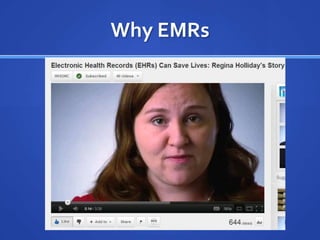
Why EMRs
What is an EHR/EMR
      Components
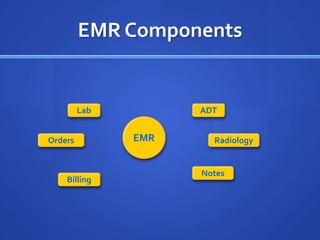
EMR Components


         Lab         ADT


Orders         EMR     Radiology


                     Notes
    Billing
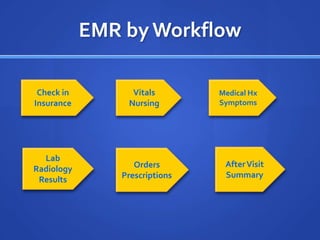
EMR by Workflow

 Check in        Vitals        Medical Hx
Insurance       Nursing        Symptoms


  Lab
                  Orders        After Visit
Radiology
               Prescriptions    Summary
 Results
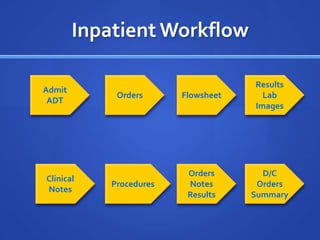
Inpatient Workflow

                                     Results
Admit
             Orders      Flowsheet     Lab
 ADT
                                     Images


                          Orders       D/C
Clinical
            Procedures    Notes       Orders
Notes
                          Results    Summary
Brief History of EMRs
      And Adoption Trends
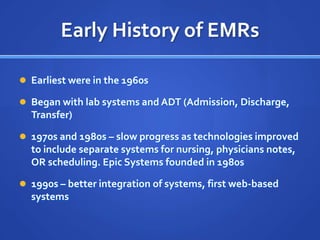
Early History of EMRs

 Earliest were in the 1960s

 Began with lab systems and ADT (Admission, Discharge,
  Transfer)

 1970s and 1980s – slow progress as technologies improved
  to include separate systems for nursing, physicians notes,
  OR scheduling. Epic Systems founded in 1980s

 1990s – better integration of systems, first web-based
  systems
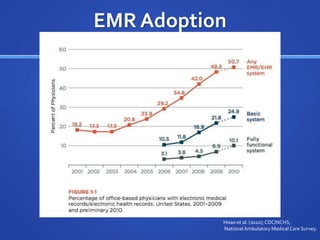
EMR Adoption


           Hsiao et al. (2010); CDC/NCHS,
           National Ambulatory Medical Care Survey.
Wiring the Health System

 Theoretical arguments – better coordination of care
  through information sharing

 Empirical Rationale – Using health information technology
  to improve quality and efficiency of care – VA and Kaiser as
  examples of early EMR adopters

---------------------------------
   David Blumenthal, MD, MPP – former director of the
   Office of the National Coordinator for Health IT in
   NEJM, 12/15/11
Effectiveness of EMRs
EMRsand Quality of Care
EMR and Quality of Care

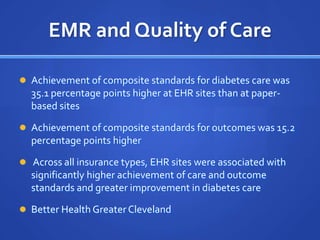
 Achievement of composite standards for diabetes care was
  35.1 percentage points higher at EHR sites than at paper-
  based sites

 Achievement of composite standards for outcomes was 15.2
  percentage points higher

 Across all insurance types, EHR sites were associated with
  significantly higher achievement of care and outcome
  standards and greater improvement in diabetes care
 Better Health Greater Cleveland
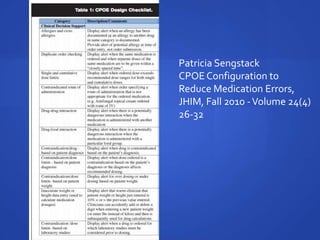
Patricia Sengstack
CPOE Configuration to
Reduce Medication Errors,
JHIM, Fall 2010 - Volume 24(4)
26-32
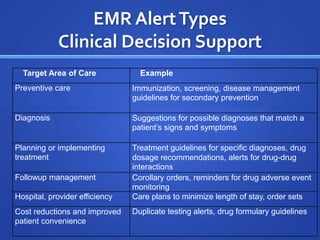
EMR Alert Types
            Clinical Decision Support
  Target Area of Care             Example
Preventive care                 Immunization, screening, disease management
                                guidelines for secondary prevention

Diagnosis                       Suggestions for possible diagnoses that match a
                                patient’s signs and symptoms

Planning or implementing        Treatment guidelines for specific diagnoses, drug
treatment                       dosage recommendations, alerts for drug-drug
                                interactions
Followup management             Corollary orders, reminders for drug adverse event
                                monitoring
Hospital, provider efficiency   Care plans to minimize length of stay, order sets
Cost reductions and improved    Duplicate testing alerts, drug formulary guidelines
patient convenience
Unintended Consequences of
                Health IT
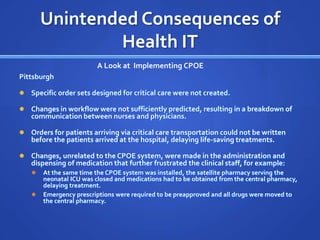
                          A Look at Implementing CPOE
Pittsburgh

   Specific order sets designed for critical care were not created.

   Changes in workflow were not sufficiently predicted, resulting in a breakdown of
    communication between nurses and physicians.

   Orders for patients arriving via critical care transportation could not be written
    before the patients arrived at the hospital, delaying life-saving treatments.

   Changes, unrelated to the CPOE system, were made in the administration and
    dispensing of medication that further frustrated the clinical staff, for example:
       At the same time the CPOE system was installed, the satellite pharmacy serving the
        neonatal ICU was closed and medications had to be obtained from the central pharmacy,
        delaying treatment.
       Emergency prescriptions were required to be preapproved and all drugs were moved to
        the central pharmacy.
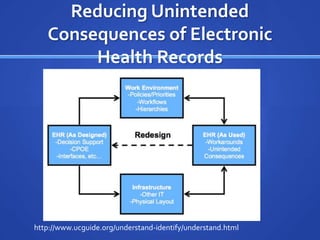
Reducing Unintended
   Consequences of Electronic
        Health Records


http://www.ucguide.org/understand-identify/understand.html
Infrastructure
  databases, warehouses
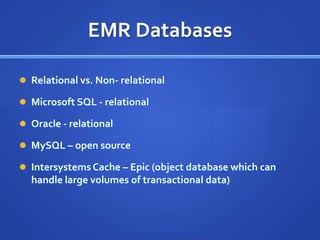
EMR Databases

 Relational vs. Non- relational

 Microsoft SQL - relational

 Oracle - relational

 MySQL – open source

 Intersystems Cache – Epic (object database which can
  handle large volumes of transactional data)
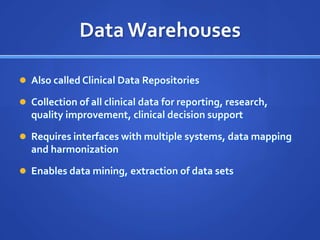
Data Warehouses

 Also called Clinical Data Repositories

 Collection of all clinical data for reporting, research,
  quality improvement, clinical decision support

 Requires interfaces with multiple systems, data mapping
  and harmonization

 Enables data mining, extraction of data sets
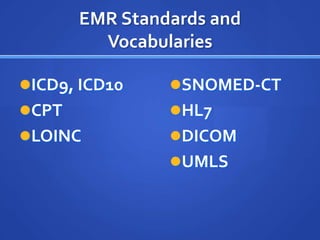
EMR Standards and
         Vocabularies

ICD9, ICD10    SNOMED-CT
CPT            HL7
LOINC          DICOM
                UMLS
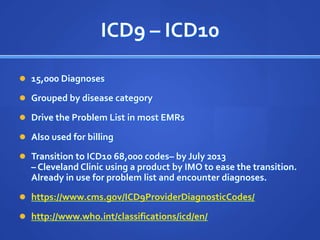
ICD9 – ICD10

 15,000 Diagnoses

 Grouped by disease category

 Drive the Problem List in most EMRs

 Also used for billing

 Transition to ICD10 68,000 codes– by July 2013
  – Cleveland Clinic using a product by IMO to ease the transition.
  Already in use for problem list and encounter diagnoses.
 https://www.cms.gov/ICD9ProviderDiagnosticCodes/

 http://www.who.int/classifications/icd/en/
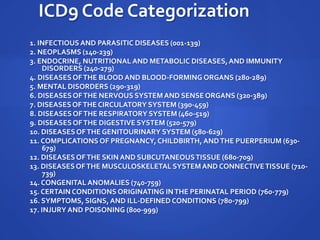
ICD9 Code Categorization
1. INFECTIOUS AND PARASITIC DISEASES (001-139)
2. NEOPLASMS (140-239)
3. ENDOCRINE, NUTRITIONAL AND METABOLIC DISEASES, AND IMMUNITY
    DISORDERS (240-279)
4. DISEASES OF THE BLOOD AND BLOOD-FORMING ORGANS (280-289)
5. MENTAL DISORDERS (290-319)
6. DISEASES OF THE NERVOUS SYSTEM AND SENSE ORGANS (320-389)
7. DISEASES OF THE CIRCULATORY SYSTEM (390-459)
8. DISEASES OF THE RESPIRATORY SYSTEM (460-519)
9. DISEASES OF THE DIGESTIVE SYSTEM (520-579)
10. DISEASES OF THE GENITOURINARY SYSTEM (580-629)
11. COMPLICATIONS OF PREGNANCY, CHILDBIRTH, AND THE PUERPERIUM (630-
    679)
12. DISEASES OF THE SKIN AND SUBCUTANEOUS TISSUE (680-709)
13. DISEASES OF THE MUSCULOSKELETAL SYSTEM AND CONNECTIVE TISSUE (710-
    739)
14. CONGENITAL ANOMALIES (740-759)
15. CERTAIN CONDITIONS ORIGINATING IN THE PERINATAL PERIOD (760-779)
16. SYMPTOMS, SIGNS, AND ILL-DEFINED CONDITIONS (780-799)
17. INJURY AND POISONING (800-999)
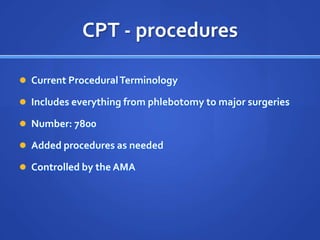
CPT - procedures

 Current Procedural Terminology

 Includes everything from phlebotomy to major surgeries

 Number: 7800

 Added procedures as needed

 Controlled by the AMA
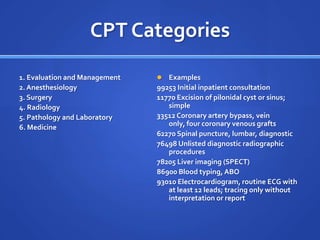
CPT Categories

1. Evaluation and Management     Examples
2. Anesthesiology              99253 Initial inpatient consultation
3. Surgery                     11770 Excision of pilonidal cyst or sinus;
4. Radiology                      simple
5. Pathology and Laboratory    33512 Coronary artery bypass, vein
6. Medicine                       only, four coronary venous grafts
                               62270 Spinal puncture, lumbar, diagnostic
                               76498 Unlisted diagnostic radiographic
                                  procedures
                               78205 Liver imaging (SPECT)
                               86900 Blood typing, ABO
                               93010 Electrocardiogram, routine ECG with
                                  at least 12 leads; tracing only without
                                  interpretation or report
LOINC

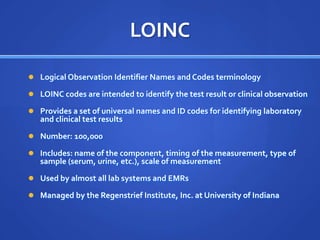
 Logical Observation Identifier Names and Codes terminology

 LOINC codes are intended to identify the test result or clinical observation

 Provides a set of universal names and ID codes for identifying laboratory
   and clinical test results

 Number: 100,000

 Includes: name of the component, timing of the measurement, type of
   sample (serum, urine, etc.), scale of measurement

 Used by almost all lab systems and EMRs

 Managed by the Regenstrief Institute, Inc. at University of Indiana
SNOMED-CT

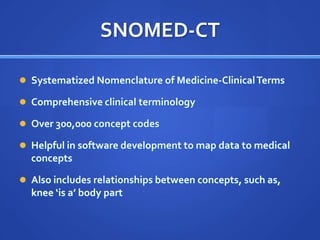
 Systematized Nomenclature of Medicine-Clinical Terms

 Comprehensive clinical terminology

 Over 300,000 concept codes

 Helpful in software development to map data to medical
  concepts

 Also includes relationships between concepts, such as,
  knee ‘is a’ body part
HL7 – Health Level 7

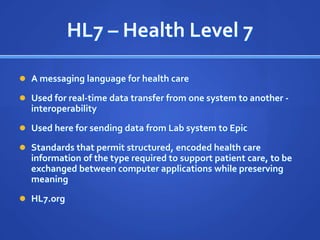
 A messaging language for health care

 Used for real-time data transfer from one system to another -
  interoperability
 Used here for sending data from Lab system to Epic

 Standards that permit structured, encoded health care
  information of the type required to support patient care, to be
  exchanged between computer applications while preserving
  meaning
 HL7.org
HL7 example - ADT
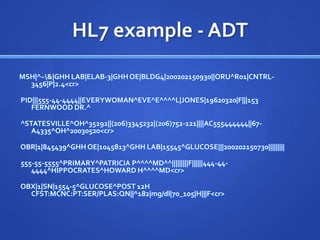
MSH|^~&|GHH LAB|ELAB-3|GHH OE|BLDG4|200202150930||ORU^R01|CNTRL-
  3456|P|2.4<cr>

PID|||555-44-4444||EVERYWOMAN^EVE^E^^^^L|JONES|19620320|F|||153
   FERNWOOD DR.^

^STATESVILLE^OH^35292||(206)3345232|(206)752-121||||AC555444444||67-
   A4335^OH^20030520<cr>

OBR|1|845439^GHH OE|1045813^GHH LAB|15545^GLUCOSE|||200202150730|||||||||

555-55-5555^PRIMARY^PATRICIA P^^^^MD^^|||||||||F||||||444-44-
   4444^HIPPOCRATES^HOWARD H^^^^MD<cr>

OBX|1|SN|1554-5^GLUCOSE^POST 12H
  CFST:MCNC:PT:SER/PLAS:QN||^182|mg/dl|70_105|H|||F<cr>
 For imaging

 Designed to ensure the interoperability of systems

 Used to: Produce, Store, Display, Process, Send,
  Retrieve, Query or Print medical images and derived
  structured documents as well as to manage related
  workflow.

 http://medical.nema.org/
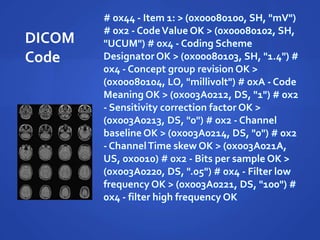
# 0x44 - Item 1: > (0x00080100, SH, "mV")
        # 0x2 - Code Value OK > (0x00080102, SH,
DICOM   "UCUM") # 0x4 - Coding Scheme
Code    Designator OK > (0x00080103, SH, "1.4") #
        0x4 - Concept group revision OK >
        (0x00080104, LO, "millivolt") # 0xA - Code
        Meaning OK > (0x003A0212, DS, "1") # 0x2
        - Sensitivity correction factor OK >
        (0x003A0213, DS, "0") # 0x2 - Channel
        baseline OK > (0x003A0214, DS, "0") # 0x2
        - Channel Time skew OK > (0x003A021A,
        US, 0x0010) # 0x2 - Bits per sample OK >
        (0x003A0220, DS, ".05") # 0x4 - Filter low
        frequency OK > (0x003A0221, DS, "100") #
        0x4 - filter high frequency OK
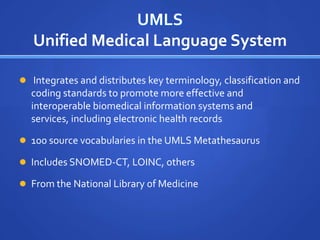
UMLS
   Unified Medical Language System

 Integrates and distributes key terminology, classification and
  coding standards to promote more effective and
  interoperable biomedical information systems and
  services, including electronic health records

 100 source vocabularies in the UMLS Metathesaurus

 Includes SNOMED-CT, LOINC, others

 From the National Library of Medicine
Meaningful Use
    Of EMRs
EMR Incentives
 $44,000 over five years for eligible professionals

 Must show meaningful use

 Must be an approved EMR

 Program to assist small practices -REC

 Most health systems have or are in process
Meaningful
   Use
Meaningful Use

 Eligible Hospital Meaningful Use Table of Contents

 Core and Menu Set Objectives

 https://www.cms.gov/EHRIncentivePrograms/Downloads/
  Hosp_CAH_MU-TOC.pdf
Use of EMRs in Research
Basis for Research

 Integrating research workflow into the EMR
   Clinical trial patient calendar

 A rich source of clinical data – data mining

 Data is from real clinical situations, unlike highly
  controlled clinical trials
 But is messy – not always easy to compare groups, clinical
  events are not in a standard sequence
 Missing data
How to Begin

 Research question

 Define cohort – inclusion, exclusion criteria

 Data elements to be included

 Statistical tests to be utilized – descriptive statistics or
  more

 Modify cohort or data elements

 Analyze results
Retrospective Cohort Studies


 Descriptive

 Typically utilizes discrete data elements in the EHR

 Internal validation recommended – comparing a random
  sample of patients in the database with what is
  documented in the front end of the EHR

 Example: Development and Validation of an Electronic
  Health Record–Based Chronic Kidney Disease Registry
Prospective Cohort Studies


 Prospective in the sense that measurements are taken
  from the EMR at specific time points

 Time points need to be within a given range, for
  instance, 1 year after time zero plus or minus one month

 Missing data may eliminate patients from the cohort

 Example: Underdiagnosis of Hypertension in Children and
  Adolescents
Prospective Studies


 Begin collecting data from the EMR at a specific time point

 May also include manual data collection

 Example – biomarker for infection in the ICU
EMR Data in Research
               Example
 Chronic Kidney Disease Registry

 Established 2009

 60,000 patients from the health system

 Cohort – Adults with two eGFRs less than 60 within 3
  months, outpatient results only, or diagnosis of CKD

 http://www.chrp.org/pdf/HSR_12022011_Slides.pdf
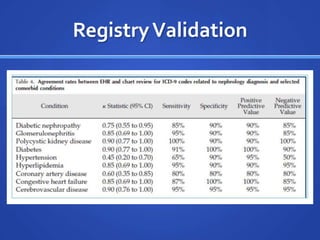
Registry Validation
Validation Results

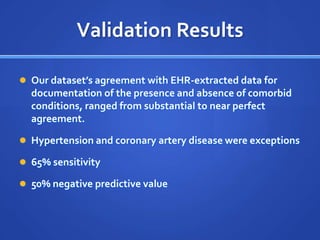
 Our dataset’s agreement with EHR-extracted data for
  documentation of the presence and absence of comorbid
  conditions, ranged from substantial to near perfect
  agreement.

 Hypertension and coronary artery disease were exceptions

 65% sensitivity

 50% negative predictive value
Registry Results

 2011

 5 out of 5 abstracts accepted to American Society of
  Nephrology annual meeting

 Three papers accepted to nephrology journals

 NIH grant

 Partnerships with other research centers
Upcoming Publication

 Book chapter on eResearch

 Editor, Rob Hoyt, University of West Florida

 http://www.uwf.edu/sahls/medicalinformatics/

EMRs: Meaningful Use and Research

  • 1.
    Biomedical Informatics 1/20/12 John Sharp, MSSA, PMP, FHIMSS Manager, Research Informatics Quantitative Health Sciences
  • 2.
    Outline 1. What is an EMR/EHR? – components 2. History and adoption of EMRs 3. Effectiveness of EMRs 4. Infrastructure - databases, warehouses 5. Standards 6. Meaningful Use 7. Use of EMR data in Research
  • 3.
  • 4.
    What is anEHR/EMR Components
  • 5.
    EMR Components Lab ADT Orders EMR Radiology Notes Billing
  • 7.
    EMR by Workflow Check in Vitals Medical Hx Insurance Nursing Symptoms Lab Orders After Visit Radiology Prescriptions Summary Results
  • 8.
    Inpatient Workflow Results Admit Orders Flowsheet Lab ADT Images Orders D/C Clinical Procedures Notes Orders Notes Results Summary
  • 10.
    Brief History ofEMRs And Adoption Trends
  • 11.
    Early History ofEMRs  Earliest were in the 1960s  Began with lab systems and ADT (Admission, Discharge, Transfer)  1970s and 1980s – slow progress as technologies improved to include separate systems for nursing, physicians notes, OR scheduling. Epic Systems founded in 1980s  1990s – better integration of systems, first web-based systems
  • 12.
    EMR Adoption Hsiao et al. (2010); CDC/NCHS, National Ambulatory Medical Care Survey.
  • 13.
    Wiring the HealthSystem  Theoretical arguments – better coordination of care through information sharing  Empirical Rationale – Using health information technology to improve quality and efficiency of care – VA and Kaiser as examples of early EMR adopters --------------------------------- David Blumenthal, MD, MPP – former director of the Office of the National Coordinator for Health IT in NEJM, 12/15/11
  • 15.
  • 16.
  • 17.
    EMR and Qualityof Care  Achievement of composite standards for diabetes care was 35.1 percentage points higher at EHR sites than at paper- based sites  Achievement of composite standards for outcomes was 15.2 percentage points higher  Across all insurance types, EHR sites were associated with significantly higher achievement of care and outcome standards and greater improvement in diabetes care  Better Health Greater Cleveland
  • 18.
    Patricia Sengstack CPOE Configurationto Reduce Medication Errors, JHIM, Fall 2010 - Volume 24(4) 26-32
  • 19.
    EMR Alert Types Clinical Decision Support Target Area of Care Example Preventive care Immunization, screening, disease management guidelines for secondary prevention Diagnosis Suggestions for possible diagnoses that match a patient’s signs and symptoms Planning or implementing Treatment guidelines for specific diagnoses, drug treatment dosage recommendations, alerts for drug-drug interactions Followup management Corollary orders, reminders for drug adverse event monitoring Hospital, provider efficiency Care plans to minimize length of stay, order sets Cost reductions and improved Duplicate testing alerts, drug formulary guidelines patient convenience
  • 20.
    Unintended Consequences of Health IT A Look at Implementing CPOE Pittsburgh  Specific order sets designed for critical care were not created.  Changes in workflow were not sufficiently predicted, resulting in a breakdown of communication between nurses and physicians.  Orders for patients arriving via critical care transportation could not be written before the patients arrived at the hospital, delaying life-saving treatments.  Changes, unrelated to the CPOE system, were made in the administration and dispensing of medication that further frustrated the clinical staff, for example:  At the same time the CPOE system was installed, the satellite pharmacy serving the neonatal ICU was closed and medications had to be obtained from the central pharmacy, delaying treatment.  Emergency prescriptions were required to be preapproved and all drugs were moved to the central pharmacy.
  • 21.
    Reducing Unintended Consequences of Electronic Health Records http://www.ucguide.org/understand-identify/understand.html
  • 22.
  • 23.
    EMR Databases  Relationalvs. Non- relational  Microsoft SQL - relational  Oracle - relational  MySQL – open source  Intersystems Cache – Epic (object database which can handle large volumes of transactional data)
  • 24.
    Data Warehouses  Alsocalled Clinical Data Repositories  Collection of all clinical data for reporting, research, quality improvement, clinical decision support  Requires interfaces with multiple systems, data mapping and harmonization  Enables data mining, extraction of data sets
  • 25.
    EMR Standards and Vocabularies ICD9, ICD10 SNOMED-CT CPT HL7 LOINC DICOM UMLS
  • 26.
    ICD9 – ICD10 15,000 Diagnoses  Grouped by disease category  Drive the Problem List in most EMRs  Also used for billing  Transition to ICD10 68,000 codes– by July 2013 – Cleveland Clinic using a product by IMO to ease the transition. Already in use for problem list and encounter diagnoses.  https://www.cms.gov/ICD9ProviderDiagnosticCodes/  http://www.who.int/classifications/icd/en/
  • 27.
    ICD9 Code Categorization 1.INFECTIOUS AND PARASITIC DISEASES (001-139) 2. NEOPLASMS (140-239) 3. ENDOCRINE, NUTRITIONAL AND METABOLIC DISEASES, AND IMMUNITY DISORDERS (240-279) 4. DISEASES OF THE BLOOD AND BLOOD-FORMING ORGANS (280-289) 5. MENTAL DISORDERS (290-319) 6. DISEASES OF THE NERVOUS SYSTEM AND SENSE ORGANS (320-389) 7. DISEASES OF THE CIRCULATORY SYSTEM (390-459) 8. DISEASES OF THE RESPIRATORY SYSTEM (460-519) 9. DISEASES OF THE DIGESTIVE SYSTEM (520-579) 10. DISEASES OF THE GENITOURINARY SYSTEM (580-629) 11. COMPLICATIONS OF PREGNANCY, CHILDBIRTH, AND THE PUERPERIUM (630- 679) 12. DISEASES OF THE SKIN AND SUBCUTANEOUS TISSUE (680-709) 13. DISEASES OF THE MUSCULOSKELETAL SYSTEM AND CONNECTIVE TISSUE (710- 739) 14. CONGENITAL ANOMALIES (740-759) 15. CERTAIN CONDITIONS ORIGINATING IN THE PERINATAL PERIOD (760-779) 16. SYMPTOMS, SIGNS, AND ILL-DEFINED CONDITIONS (780-799) 17. INJURY AND POISONING (800-999)
  • 28.
    CPT - procedures Current Procedural Terminology  Includes everything from phlebotomy to major surgeries  Number: 7800  Added procedures as needed  Controlled by the AMA
  • 29.
    CPT Categories 1. Evaluationand Management  Examples 2. Anesthesiology 99253 Initial inpatient consultation 3. Surgery 11770 Excision of pilonidal cyst or sinus; 4. Radiology simple 5. Pathology and Laboratory 33512 Coronary artery bypass, vein 6. Medicine only, four coronary venous grafts 62270 Spinal puncture, lumbar, diagnostic 76498 Unlisted diagnostic radiographic procedures 78205 Liver imaging (SPECT) 86900 Blood typing, ABO 93010 Electrocardiogram, routine ECG with at least 12 leads; tracing only without interpretation or report
  • 30.
    LOINC  Logical ObservationIdentifier Names and Codes terminology  LOINC codes are intended to identify the test result or clinical observation  Provides a set of universal names and ID codes for identifying laboratory and clinical test results  Number: 100,000  Includes: name of the component, timing of the measurement, type of sample (serum, urine, etc.), scale of measurement  Used by almost all lab systems and EMRs  Managed by the Regenstrief Institute, Inc. at University of Indiana
  • 31.
    SNOMED-CT  Systematized Nomenclatureof Medicine-Clinical Terms  Comprehensive clinical terminology  Over 300,000 concept codes  Helpful in software development to map data to medical concepts  Also includes relationships between concepts, such as, knee ‘is a’ body part
  • 32.
    HL7 – HealthLevel 7  A messaging language for health care  Used for real-time data transfer from one system to another - interoperability  Used here for sending data from Lab system to Epic  Standards that permit structured, encoded health care information of the type required to support patient care, to be exchanged between computer applications while preserving meaning  HL7.org
  • 33.
    HL7 example -ADT MSH|^~&|GHH LAB|ELAB-3|GHH OE|BLDG4|200202150930||ORU^R01|CNTRL- 3456|P|2.4<cr> PID|||555-44-4444||EVERYWOMAN^EVE^E^^^^L|JONES|19620320|F|||153 FERNWOOD DR.^ ^STATESVILLE^OH^35292||(206)3345232|(206)752-121||||AC555444444||67- A4335^OH^20030520<cr> OBR|1|845439^GHH OE|1045813^GHH LAB|15545^GLUCOSE|||200202150730||||||||| 555-55-5555^PRIMARY^PATRICIA P^^^^MD^^|||||||||F||||||444-44- 4444^HIPPOCRATES^HOWARD H^^^^MD<cr> OBX|1|SN|1554-5^GLUCOSE^POST 12H CFST:MCNC:PT:SER/PLAS:QN||^182|mg/dl|70_105|H|||F<cr>
  • 34.
     For imaging Designed to ensure the interoperability of systems  Used to: Produce, Store, Display, Process, Send, Retrieve, Query or Print medical images and derived structured documents as well as to manage related workflow.  http://medical.nema.org/
  • 35.
    # 0x44 -Item 1: > (0x00080100, SH, "mV") # 0x2 - Code Value OK > (0x00080102, SH, DICOM "UCUM") # 0x4 - Coding Scheme Code Designator OK > (0x00080103, SH, "1.4") # 0x4 - Concept group revision OK > (0x00080104, LO, "millivolt") # 0xA - Code Meaning OK > (0x003A0212, DS, "1") # 0x2 - Sensitivity correction factor OK > (0x003A0213, DS, "0") # 0x2 - Channel baseline OK > (0x003A0214, DS, "0") # 0x2 - Channel Time skew OK > (0x003A021A, US, 0x0010) # 0x2 - Bits per sample OK > (0x003A0220, DS, ".05") # 0x4 - Filter low frequency OK > (0x003A0221, DS, "100") # 0x4 - filter high frequency OK
  • 36.
    UMLS Unified Medical Language System  Integrates and distributes key terminology, classification and coding standards to promote more effective and interoperable biomedical information systems and services, including electronic health records  100 source vocabularies in the UMLS Metathesaurus  Includes SNOMED-CT, LOINC, others  From the National Library of Medicine
  • 37.
  • 38.
    EMR Incentives  $44,000over five years for eligible professionals  Must show meaningful use  Must be an approved EMR  Program to assist small practices -REC  Most health systems have or are in process
  • 39.
  • 40.
    Meaningful Use  EligibleHospital Meaningful Use Table of Contents  Core and Menu Set Objectives  https://www.cms.gov/EHRIncentivePrograms/Downloads/ Hosp_CAH_MU-TOC.pdf
  • 41.
    Use of EMRsin Research
  • 42.
    Basis for Research Integrating research workflow into the EMR  Clinical trial patient calendar  A rich source of clinical data – data mining  Data is from real clinical situations, unlike highly controlled clinical trials  But is messy – not always easy to compare groups, clinical events are not in a standard sequence  Missing data
  • 43.
    How to Begin Research question  Define cohort – inclusion, exclusion criteria  Data elements to be included  Statistical tests to be utilized – descriptive statistics or more  Modify cohort or data elements  Analyze results
  • 44.
    Retrospective Cohort Studies Descriptive  Typically utilizes discrete data elements in the EHR  Internal validation recommended – comparing a random sample of patients in the database with what is documented in the front end of the EHR  Example: Development and Validation of an Electronic Health Record–Based Chronic Kidney Disease Registry
  • 45.
    Prospective Cohort Studies Prospective in the sense that measurements are taken from the EMR at specific time points  Time points need to be within a given range, for instance, 1 year after time zero plus or minus one month  Missing data may eliminate patients from the cohort  Example: Underdiagnosis of Hypertension in Children and Adolescents
  • 46.
    Prospective Studies  Begincollecting data from the EMR at a specific time point  May also include manual data collection  Example – biomarker for infection in the ICU
  • 47.
    EMR Data inResearch Example  Chronic Kidney Disease Registry  Established 2009  60,000 patients from the health system  Cohort – Adults with two eGFRs less than 60 within 3 months, outpatient results only, or diagnosis of CKD  http://www.chrp.org/pdf/HSR_12022011_Slides.pdf
  • 48.
  • 49.
    Validation Results  Ourdataset’s agreement with EHR-extracted data for documentation of the presence and absence of comorbid conditions, ranged from substantial to near perfect agreement.  Hypertension and coronary artery disease were exceptions  65% sensitivity  50% negative predictive value
  • 50.
    Registry Results  2011 5 out of 5 abstracts accepted to American Society of Nephrology annual meeting  Three papers accepted to nephrology journals  NIH grant  Partnerships with other research centers
  • 51.
    Upcoming Publication  Bookchapter on eResearch  Editor, Rob Hoyt, University of West Florida  http://www.uwf.edu/sahls/medicalinformatics/