 
Bethany Kwan, Marion Sills, Barbara Yawn, Brian Sauer, Diane
Fairclough, & Lisa Schilling
AHRQ ARRA OS: Recovery Act 2009
Scalable Architecture for Federated Translational Inquiries Network (SAFTINet;
AHRQ RO1 HS019908 PI: Lisa Schilling, MD, MSPH)
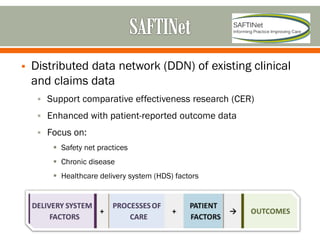
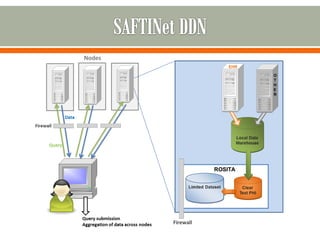
 Distributed data network (DDN) of existing clinical
and claims data
 Support comparative effectiveness research (CER)
 Enhanced with patient-reported outcome data
 Focus on:
 Safety net practices
 Chronic disease
 Healthcare delivery system (HDS) factors
 Observational comparative effectiveness research (OCER) on
healthcare delivery system (HDS) factors on health outcomes
for children and adults with asthma
 HDS factors: Medical home characteristics
 Hypothesis
o There is a positive association between practices’ medical home
characteristics and control of asthma in children and adults
 Presentation objectives
o To describe select methodological challenges and approaches to
addressing these challenges, in the context of SAFTINet OCER
protocol development
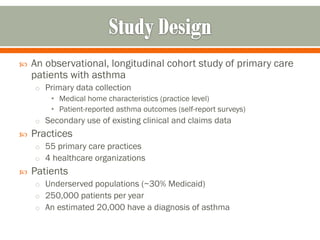
 An observational, longitudinal cohort study of primary care
patients with asthma
o Primary data collection
• Medical home characteristics (practice level)
• Patient-reported asthma outcomes (self-report surveys)
o Secondary use of existing clinical and claims data
 Practices
o 55 primary care practices
o 4 healthcare organizations
 Patients
o Underserved populations (~30% Medicaid)
o 250,000 patients per year
o An estimated 20,000 have a diagnosis of asthma
 Availability of complete data from multiple primary and
secondary sources
o Asthma cohort definitions (inclusion/exclusion criteria)
o Asthma outcomes (asthma control)
 Determining exposure to a practice-level multi-faceted
HDS variable
 Assignment to practice
 Analysis
o Clustered data
o Confounding and bias
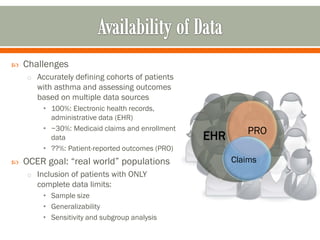
 Challenges
o Accurately defining cohorts of patients
with asthma and assessing outcomes
based on multiple data sources
• 100%: Electronic health records,
administrative data (EHR)
• ~30%: Medicaid claims and enrollment
data
• ??%: Patient-reported outcomes (PRO)
 OCER goal: “real world” populations
o Inclusion of patients with ONLY
complete data limits:
• Sample size
• Generalizability
• Sensitivity and subgroup analysis
EHR PRO
Claims
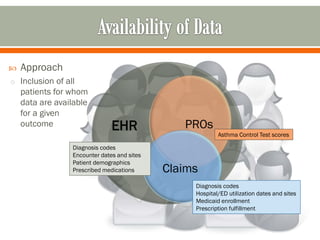
 Approach
o Inclusion of all
patients for whom
data are available
for a given
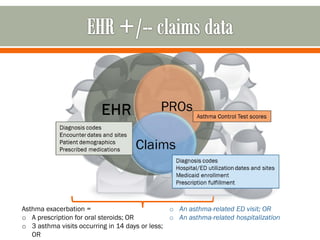
outcome EHR PROs
Claims
Diagnosis codes
Encounter dates and sites
Patient demographics
Prescribed medications
Asthma Control Test scores
Diagnosis codes
Hospital/ED utilization dates and sites
Medicaid enrollment
Prescription fulfillment
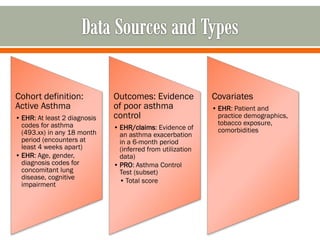
Cohort definition:
Active Asthma
• EHR: At least 2 diagnosis
codes for asthma
(493.xx) in any 18 month
period (encounters at
least 4 weeks apart)
• EHR: Age, gender,
diagnosis codes for
concomitant lung
disease, cognitive
impairment
Outcomes: Evidence
of poor asthma
control
• EHR/claims: Evidence of
an asthma exacerbation
in a 6-month period
(inferred from utilization
data)
• PRO: Asthma Control
Test (subset)
• Total score
Covariates
• EHR: Patient and
practice demographics,
tobacco exposure,
comorbidities
Asthma exacerbation =
o A prescription for oral steroids; OR
o 3 asthma visits occurring in 14 days or less;
OR
o An asthma-related ED visit; OR
o An asthma-related hospitalization
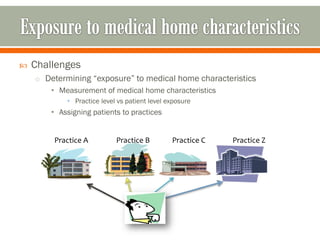
 Challenges
o Determining “exposure” to medical home characteristics
• Measurement of medical home characteristics
• Practice level vs patient level exposure
• Assigning patients to practices
Practice A Practice ZPractice CPractice B
Patient
 Approach
o Practice level medical home characteristics
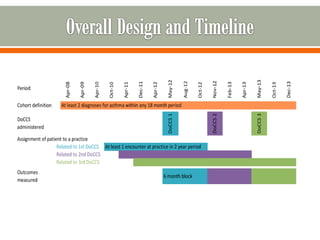
• Medical home survey, assessed every 6 months at the practice level
• Feasibility
o Patient exposure to medical home
• Medical home characteristics of most common/most recent practice
• > 1 encounter 18 months prior to/6 months after measurement of
medical home characteristics
 Challenges
o Clustered data
• Clustering of patients within a practice
o Observational studies  potential confounding
• Practice vs patient level confounders
 Approach
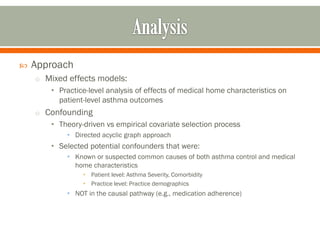
o Mixed effects models:
• Practice-level analysis of effects of medical home characteristics on
patient-level asthma outcomes
o Confounding
• Theory-driven vs empirical covariate selection process
• Directed acyclic graph approach
• Selected potential confounders that were:
• Known or suspected common causes of both asthma control and medical
home characteristics
• Patient level: Asthma Severity, Comorbidity
• Practice level: Practice demographics
• NOT in the causal pathway (e.g., medication adherence)
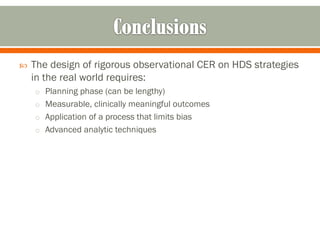
 The design of rigorous observational CER on HDS strategies
in the real world requires:
o Planning phase (can be lengthy)
o Measurable, clinically meaningful outcomes
o Application of a process that limits bias
o Advanced analytic techniques
 Agency for Healthcare Research
and Quality
 SAFTINet collaborating partners
o American Academy of Family
Physicians
o Cherokee Health Systems
o Colorado Community Managed
Care Network
o Denver Health and Hospital
Authority
o Intermountain Healthcare
o Metro Provider Community Network
o QED Clinical, Inc., d/b/a CINA
o Salud Family Health Centers
o University of Colorado Denver
o University of Utah, Center for High
Performance Computing
 SAFTINet Comparative
Effectiveness Research Team
o Marion Sills, MD, MPH (CER Team
Lead)
o Barbara Yawn, MD, MSc
o Benjamin Miller, PsyD
o Bethany Kwan, PhD, MSPH
o Brenda Beaty, MSPH
o Brian Sauer, PhD
o Diane Fairclough, DrPH
o Elizabeth Juarez-Colunga, PhD
o Karl Hammermeister, MD
o Lisa Schilling, MD, MSPH
o Monica Federico, MD
o Robert Valuck, PhD, RPh
o Wilson Pace, MD
 Questions?
 Contact information
o http://www.saftinet.net
o Lisa Schilling, MD, MSPH, Principal Investigator
• Lisa.schilling@ucdenver.edu
o Marion Sills, MD, MPH, Co-investigator, CER team leader
• Marion.sills@childrenscolorado.org
o Bethany Kwan, PhD, MSPH, Project Manager
• Bethany.kwan@ucdenver.edu
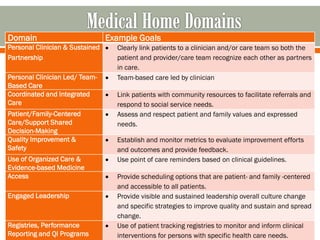
Domain Example Goals
Personal Clinician & Sustained
Partnership
• Clearly link patients to a clinician and/or care team so both the
patient and provider/care team recognize each other as partners
in care.
Personal Clinician Led/ Team-
Based Care
• Team-based care led by clinician
Coordinated and Integrated
Care
• Link patients with community resources to facilitate referrals and
respond to social service needs.
Patient/Family-Centered
Care/Support Shared
Decision-Making
• Assess and respect patient and family values and expressed
needs.
Quality Improvement &
Safety
• Establish and monitor metrics to evaluate improvement efforts
and outcomes and provide feedback.
Use of Organized Care &
Evidence-based Medicine
• Use point of care reminders based on clinical guidelines.
Access • Provide scheduling options that are patient- and family -centered
and accessible to all patients.
Engaged Leadership • Provide visible and sustained leadership overall culture change
and specific strategies to improve quality and sustain and spread
change.
Registries, Performance
Reporting and QI Programs
• Use of patient tracking registries to monitor and inform clinical
interventions for persons with specific health care needs.
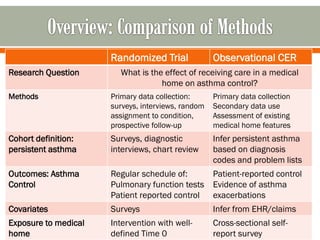
Randomized Trial Observational CER
Research Question What is the effect of receiving care in a medical
home on asthma control?
Methods Primary data collection:
surveys, interviews, random
assignment to condition,
prospective follow-up
Primary data collection
Secondary data use
Assessment of existing
medical home features
Cohort definition:
persistent asthma
Surveys, diagnostic
interviews, chart review
Infer persistent asthma
based on diagnosis
codes and problem lists
Outcomes: Asthma
Control
Regular schedule of:
Pulmonary function tests
Patient reported control
Patient-reported control
Evidence of asthma
exacerbations
Covariates Surveys Infer from EHR/claims
Exposure to medical
home
Intervention with well-
defined Time 0
Cross-sectional self-
report survey
Methods for Observational Comparative Effectiveness Research on Healthcare Delivery System Strategies for Asthma Management: The SAFTINet Project

Methods for Observational Comparative Effectiveness Research on Healthcare Delivery System Strategies for Asthma Management: The SAFTINet Project

  • 1.
      Bethany Kwan,Marion Sills, Barbara Yawn, Brian Sauer, Diane Fairclough, & Lisa Schilling AHRQ ARRA OS: Recovery Act 2009 Scalable Architecture for Federated Translational Inquiries Network (SAFTINet; AHRQ RO1 HS019908 PI: Lisa Schilling, MD, MSPH)
  • 2.
     Distributed datanetwork (DDN) of existing clinical and claims data  Support comparative effectiveness research (CER)  Enhanced with patient-reported outcome data  Focus on:  Safety net practices  Chronic disease  Healthcare delivery system (HDS) factors
  • 3.
     Observational comparativeeffectiveness research (OCER) on healthcare delivery system (HDS) factors on health outcomes for children and adults with asthma  HDS factors: Medical home characteristics  Hypothesis o There is a positive association between practices’ medical home characteristics and control of asthma in children and adults  Presentation objectives o To describe select methodological challenges and approaches to addressing these challenges, in the context of SAFTINet OCER protocol development
  • 4.
     An observational,longitudinal cohort study of primary care patients with asthma o Primary data collection • Medical home characteristics (practice level) • Patient-reported asthma outcomes (self-report surveys) o Secondary use of existing clinical and claims data  Practices o 55 primary care practices o 4 healthcare organizations  Patients o Underserved populations (~30% Medicaid) o 250,000 patients per year o An estimated 20,000 have a diagnosis of asthma
  • 5.
     Availability ofcomplete data from multiple primary and secondary sources o Asthma cohort definitions (inclusion/exclusion criteria) o Asthma outcomes (asthma control)  Determining exposure to a practice-level multi-faceted HDS variable  Assignment to practice  Analysis o Clustered data o Confounding and bias
  • 6.
     Challenges o Accuratelydefining cohorts of patients with asthma and assessing outcomes based on multiple data sources • 100%: Electronic health records, administrative data (EHR) • ~30%: Medicaid claims and enrollment data • ??%: Patient-reported outcomes (PRO)  OCER goal: “real world” populations o Inclusion of patients with ONLY complete data limits: • Sample size • Generalizability • Sensitivity and subgroup analysis EHR PRO Claims
  • 7.
     Approach o Inclusionof all patients for whom data are available for a given outcome EHR PROs Claims Diagnosis codes Encounter dates and sites Patient demographics Prescribed medications Asthma Control Test scores Diagnosis codes Hospital/ED utilization dates and sites Medicaid enrollment Prescription fulfillment
  • 8.
    Cohort definition: Active Asthma •EHR: At least 2 diagnosis codes for asthma (493.xx) in any 18 month period (encounters at least 4 weeks apart) • EHR: Age, gender, diagnosis codes for concomitant lung disease, cognitive impairment Outcomes: Evidence of poor asthma control • EHR/claims: Evidence of an asthma exacerbation in a 6-month period (inferred from utilization data) • PRO: Asthma Control Test (subset) • Total score Covariates • EHR: Patient and practice demographics, tobacco exposure, comorbidities
  • 9.
    Asthma exacerbation = oA prescription for oral steroids; OR o 3 asthma visits occurring in 14 days or less; OR o An asthma-related ED visit; OR o An asthma-related hospitalization
  • 10.
     Challenges o Determining“exposure” to medical home characteristics • Measurement of medical home characteristics • Practice level vs patient level exposure • Assigning patients to practices Practice A Practice ZPractice CPractice B Patient
  • 11.
     Approach o Practicelevel medical home characteristics • Medical home survey, assessed every 6 months at the practice level • Feasibility o Patient exposure to medical home • Medical home characteristics of most common/most recent practice • > 1 encounter 18 months prior to/6 months after measurement of medical home characteristics
  • 12.
     Challenges o Clustereddata • Clustering of patients within a practice o Observational studies  potential confounding • Practice vs patient level confounders
  • 13.
     Approach o Mixedeffects models: • Practice-level analysis of effects of medical home characteristics on patient-level asthma outcomes o Confounding • Theory-driven vs empirical covariate selection process • Directed acyclic graph approach • Selected potential confounders that were: • Known or suspected common causes of both asthma control and medical home characteristics • Patient level: Asthma Severity, Comorbidity • Practice level: Practice demographics • NOT in the causal pathway (e.g., medication adherence)
  • 14.
     The designof rigorous observational CER on HDS strategies in the real world requires: o Planning phase (can be lengthy) o Measurable, clinically meaningful outcomes o Application of a process that limits bias o Advanced analytic techniques
  • 15.
     Agency forHealthcare Research and Quality  SAFTINet collaborating partners o American Academy of Family Physicians o Cherokee Health Systems o Colorado Community Managed Care Network o Denver Health and Hospital Authority o Intermountain Healthcare o Metro Provider Community Network o QED Clinical, Inc., d/b/a CINA o Salud Family Health Centers o University of Colorado Denver o University of Utah, Center for High Performance Computing  SAFTINet Comparative Effectiveness Research Team o Marion Sills, MD, MPH (CER Team Lead) o Barbara Yawn, MD, MSc o Benjamin Miller, PsyD o Bethany Kwan, PhD, MSPH o Brenda Beaty, MSPH o Brian Sauer, PhD o Diane Fairclough, DrPH o Elizabeth Juarez-Colunga, PhD o Karl Hammermeister, MD o Lisa Schilling, MD, MSPH o Monica Federico, MD o Robert Valuck, PhD, RPh o Wilson Pace, MD
  • 16.
     Questions?  Contactinformation o http://www.saftinet.net o Lisa Schilling, MD, MSPH, Principal Investigator • Lisa.schilling@ucdenver.edu o Marion Sills, MD, MPH, Co-investigator, CER team leader • Marion.sills@childrenscolorado.org o Bethany Kwan, PhD, MSPH, Project Manager • Bethany.kwan@ucdenver.edu
  • 17.
    Domain Example Goals PersonalClinician & Sustained Partnership • Clearly link patients to a clinician and/or care team so both the patient and provider/care team recognize each other as partners in care. Personal Clinician Led/ Team- Based Care • Team-based care led by clinician Coordinated and Integrated Care • Link patients with community resources to facilitate referrals and respond to social service needs. Patient/Family-Centered Care/Support Shared Decision-Making • Assess and respect patient and family values and expressed needs. Quality Improvement & Safety • Establish and monitor metrics to evaluate improvement efforts and outcomes and provide feedback. Use of Organized Care & Evidence-based Medicine • Use point of care reminders based on clinical guidelines. Access • Provide scheduling options that are patient- and family -centered and accessible to all patients. Engaged Leadership • Provide visible and sustained leadership overall culture change and specific strategies to improve quality and sustain and spread change. Registries, Performance Reporting and QI Programs • Use of patient tracking registries to monitor and inform clinical interventions for persons with specific health care needs.
  • 18.
    Randomized Trial ObservationalCER Research Question What is the effect of receiving care in a medical home on asthma control? Methods Primary data collection: surveys, interviews, random assignment to condition, prospective follow-up Primary data collection Secondary data use Assessment of existing medical home features Cohort definition: persistent asthma Surveys, diagnostic interviews, chart review Infer persistent asthma based on diagnosis codes and problem lists Outcomes: Asthma Control Regular schedule of: Pulmonary function tests Patient reported control Patient-reported control Evidence of asthma exacerbations Covariates Surveys Infer from EHR/claims Exposure to medical home Intervention with well- defined Time 0 Cross-sectional self- report survey