Advanced  Lab  Analytics  for  
Patient  Blood  Management  Programs
L.  Eleanor  Herriman,  MD,  MBA
March  23,  2016
L. Eleanor  J.  Herriman,  M.D., M.B.A.
• Physician  executive  with  20  years  of  varied  healthcare  experience
• Former  faculty  member  at  Harvard  Business  School’s  Institute  for
Strategy  and  Competitiveness  
• Market  research  and  strategy  services  to  the  pathology  and
laboratory  industries  at  G2  Intelligence
• Healthcare  strategy  consulting  at  Bain  &  Company
Education
• Pathology  training  at  UCSF
• Doctor  of  Medicine  degree  from  Baylor  College  of  Medicine
• Presidents  Scholarship  with  honors  in  Neurology,  Psychiatry  and  Neuropathology
• Masters  in  Business  Administration  from  Harvard  University  Graduate  School  of  Business  
Administration  as  a  Baker  Scholar
Chief  Medical  Informatics  Officer
Agenda
• The  Blood  Utilization  Problem
• Blood  Management  Programs
• Role  of  Analytics  in  Blood  Management
• Viewics  Insights  for  Blood  Management™  
The  Blood  Utilization  Problem
“Blood  transfusion  is  far  riskier  than  what  people  
believe,  and  is  responsible  for  billions  in  wasted  
healthcare  dollars  every  year.”  
-­ Aryeh Shander MD,  
Clinical  Professor  of  Anesthesiology,  Medicine  and  Surgery,  Icahn  School  of  Medicine  at  Mt  Sinai,  New  York
The  Blood  Transfusion  Problem  
Transfusion  
Utilization  
Opportunity
Past  
Guidelines  
Wrong    
Wide  Variation  
in  Ordering
Over-­
utilization  
Creates  Harm  
and  Costs
• Higher  
Hemoglobin  
(Hgb)  triggers
• 2  Units  +
Slow  adoption  of  new  
guidelines
Harm  beyond  
transfusion  
reactions  
Overutilization  Problem  
Inappropriate  Transfusions
Appropriate
52%
Inappropriate    
48%
U.S.  Units  Transfused  
(millions  annually)
Appropriate Inappropriate    
Morbidity  and  Mortality  Impact
26%
20%
36%
56%
52%
14%
0%
10%
20%
30%
40%
50%
60%
Hospital  
Mortality
Total  
Mortality
Rebleeding Acute  Cor  
Syn  
Pulmonary  
Edema
Bacterial  
Infections
Source:  National  Blood  Collection  and  Utilization  Survey  Report,  DHHS;;  and  Tim  Hannon  and  Rishi  
Sikka,  Wall  Street  Journal,  Jan  15,  2015.   Source:  Salpeter SR  et  al.    The  Am  J  of  Med  127(2),  Feb  2014
Variation  in  Transfusion  Usage  – 345  Hospitals
8
$1M  in  savings  per  hospital  for  
joint  replacement  transfusions
Blood  Management  Programs
“A  Restrictive  Blood  Transfusion  Approach  is  Best  Practice”
-­ Society  for  the  Advancement  of  Blood  Management
Standard  guidelines  transfusion  trigger  =  6-­7  g/dl
Higher  threshold  guidelines  for  transfusion  =  7-­10  g/dl
The  American  Board  of  Internal  Medicine’s  Choosing  Wisely  campaign  had  every  
organization  submit  five  “do  nots”    Number  (3)  states:
“Avoid  transfusion  of  red  blood  cells  for  arbitrary  hemoglobin  or  
hematocrit  thresholds  in  the  absence  of  symptoms  of  active  
coronary  disease,  heart  failure  or  stroke.”
3  Types  of  Blood  Management  Programs
• Multidisciplinary  Team
• Decision  support
• Feedback/reports
• Cross-­facility
• Anemia  and  hemostasis  management
• Transfusion  management
• Informatics
• Patient-­centered
1.  Restrictive  
Guidelines  
• Hgb  of  7
• “One  &  Done”
2.  Restrictive  
Blood  Program  
3.Patient  Blood  
Management    
Joint  Commission  PBM  Certification
What’s  in  it  for  my  hospital?
• Risk  reduction  in  fewer  adverse  events  and  incidents
• Improved  patient  outcomes
• Reduced  hospital  stays,  readmissions,  and  lengths  of  
stay
• Ensuring  blood  availability  for  those  most  in  need
• Optimized  care  for  those  who  may  need  transfusion
• Fostering  collaboration  throughout  the  hospital
• Providing  a  competitive  edge  in  the  marketplace
• Enhanced  staff  recruitment  and  development    
• Cost  savings
Blood  Management  Program  Success
• Implementation  of  an  anemia  management  program  
that  resulted  in  a  reduction  of  red  blood  cell  
transfusion  by  62%
• A 25% reduction  in  hospital  stays  for  non-­transfused  
vs.  transfused  patients
• A 47%  reduction  in  the  odds  of  death  and  50%
reduction  decrease  in  total  hospitalization  costs  after  
cardiac  surgery  
• A  hospital’s  first  year  of  implementation  expenses  for  
blood  decreased  $510,000
Benefits  of  Reducing  Transfusion  Overutilization    
Cost  Savings  from  30%  Reduction  in  
Transfusion  of  Blood  Products
Improved  Outcomes  from  30%  Reduction  in  
Transfusion  of  Blood  Products
Source:  National  Blood  Collection  and  Utilization  Survey  Report,  DHHS;;  and  Tim  Hannon  and  Rishi  Sikka,  Wall  Street  Journal,  Jan  15,  2015.  
0
0.5
1
1.5
2
2.5
3
Low  End  Estimate  of  Savings High  End  Estimate  of  Savings
U.S.  Savings  from  
Blood  Costs  
($B  annually)
50,000  lives  saved
200,000  wound  
complications  
averted
8M  fewer  patient    
in-­hospital  days  
$1.5B
$2.5B
Transfusion  Savings  for  Hospitals
$250  
$1,000  
$7,055  
$0  
$1,000  
$2,000  
$3,000  
$4,000  
$5,000  
$6,000  
$7,000  
$8,000  
Costs  per  Unit Additional    Hospital  Costs  for  Transfused  vs.  
Nontransfused  Patient
Acquisition Transfusion LOS,  Hospital-­acquired  complications,  Mortality
Source:  G2  Intelligence  
Adverse  Event
Decrease  in  AE  Due
to  New  Guidelines
Rebleeding   36%
Acute  Coronary  
Syndrome
56%
Pulmonary  Edema 52%
Bacterial  Infections 14%
Decrease  in  %  of  AE’s  Resulting  from  New  
Restrictive  Transfusion  Guidelines
Hospital  Size  
400-­500 Beds  
Cost Savings $$
Rebleeding $131,721 $60,592
Acute  Coronary
Syndrome
$455,544 $255,105
Pulmonary  
Edema
$1,101,120 $572,582
Bacterial  
Infection
$989,333 $138,507
Total   $2,677,719 $1,026,786
Costs  and  Savings  Per  AE  for  Mid-­Size  
Hospitals  in  2011
Premier  Healthcare’s  Recommendations
Source:  “Best  Practices  in  Blood  Utilization.”  October  2012.  Premier  Healthcare  Alliance.
1. Using  a  multi-­disciplinary  blood  stewardship  team
2. Working  collaboratively  with  clinicians  and  supply  chain  
executives  to  explore  alternative  products  and  procedures
3. Establishing  and  implementing  evidence-­based  transfusion  
guidelines
4. Providing  education  and  clinical  decision  support  tools  to  inform  
clinicians  of  guidelines  in  real time
5. Developing  processes  to  monitor  adherence  to  guidelines  and  
provide  feedback  to  clinicians
6. Monitoring  utilization  on  an  ongoing  basis  while  measuring  the  
impact  of  improvement
requires  analytics
Department Position/Specialty Total  No.  Representatives
Hospital Administrator   Chief  Medical  Officer 1
Blood  Bank Director Laboratory  Manager 2
Blood  Vendor Director 1
Pathology Director 1
Pathology Residents 1+
Biomedical Engineering   1
Pharmacy 1
Risk  Management   1
Clinical  Services 14
(1  Physician  + 1  Nurse  from  each  
specialty)
Anesthesia
Emergency Medicine
Surgery
Cardiothoracic
Intensive  Care  Units
Trauma
Medicine/Hematology
Pediatrics/Neonatology
Nursing Nursing 3
Perioperative Nursing
Nursing  Education  
Total 26+
Model  for  Transfusion  
Committee  Membership
Case  Study:  UPMC’s  Total  Blood  Management  Program
Implement  
Evidence-­based  
Transfusion  
Triggers
Clinician  CPOE  
Alerts
Monthly  
Utilization  
Reports
Minimize  Preop  
Autologous  
Donation
Preop  Anemia  
Optimization
Intraop  POC  
Hgb  Testing
Role  of  Analytics  in  Blood  Management
Analytics  for  Blood  Management  – Key  Uses
Blood  Bank  Operations
• Inventory  management
• Productivity  
• Acquisition  and  waste
Clinical  Utilization  Analytics  
• Peer  comparisons  /  reports
• Pattern  and  outlier  detection
• Manager  dashboards
Decision  Support  /  Alerts
• Link  transfusion  decisions  to  prior  
Hgb  levels
• More  complex  rules  by  clinical  
setting
• Early  identification  of  anemic  
patients  before  elective  surgeries  
Monitor  Blood  Use
• By  patient,  clinician  or  service  line
• Real-­time  and  by  any  time  range  
• Measure  impact  of  programs  
Blood  Program  Analytics  Capabilities
1. Link  required  data  sources  – blood,  lab,  clinical
2. Automates  analytics  with  minimal  labor
3. Supports  multi-­disciplinary  program  /  users
4. Delivers  in  real–time
Case  Study:  UPMC’s  Total  Blood  Management  Program
Analytics  for  Pre-­op  Anemia  Management
• When  patient  is  scheduled  in  the  system  for  elective  surgery,  computer  
searches  for  most  recent  hemoglobin
• If  patient  is  anemic,  preoperative  anemia  alert  goes  to  surgeon  and  PCP
• Identifies  anemic  patients  before  surgery  &  sends  automated  email  or  
fax  to  surgeon/PCP
• Allows  physician  to  treat  anemia  before  surgery
• Shown  to  reduce  transfusion  rates    
Viewics  Insights  for  Blood  Management™
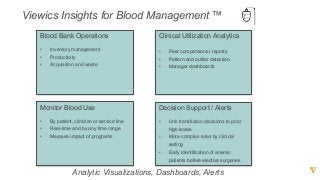
Viewics  Insights  for  Blood  Management  ™
Analytic  Visualizations,  Dashboards,  Alerts  
Blood  Bank  Operations
• Inventory  management
• Productivity  
• Acquisition  and  waste
Clinical  Utilization  Analytics  
• Peer  comparisons  /  reports
• Pattern  and  outlier  detection
• Manager  dashboards
Decision  Support  /  Alerts
• Link  transfusion  decisions  to  prior  
Hgb  levels
• More  complex  rules  by  clinical  
setting
• Early  identification  of  anemic  
patients  before  elective  surgeries  
Monitor  Blood  Use
• By  patient,  clinician  or  service  line
• Real-­time  and  by  any  time  range  
• Measure  impact  of  programs  
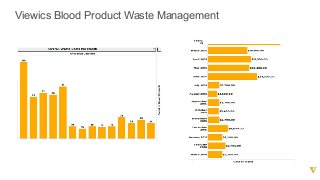
Viewics  Blood  Product  Waste  Management
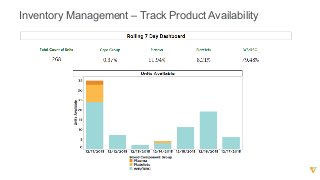
Inventory  Management  – Track  Product  Availability
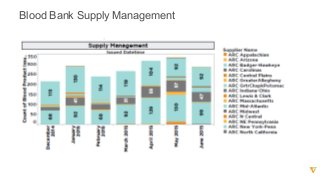
Blood  Bank  Supply  Management
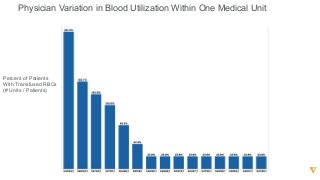
Physician  Variation  in  Blood  Utilization  Within  One  Medical  Unit    
Percent  of  Patients
With  Transfused  RBCs
(#  Units  /  Patients)  
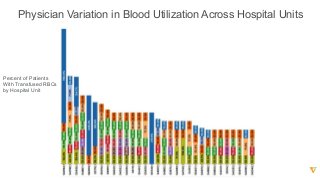
Physician  Variation  in  Blood  Utilization  Across  Hospital  Units    
Percent  of  Patients
With  Transfused  RBCs
by  Hospital  Unit
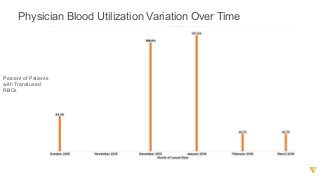
Physician  Blood  Utilization  Variation  Over  Time
Percent  of  Patients
with  Transfused  
RBCs
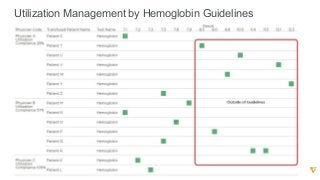
Utilization  Management  by  Hemoglobin  Guidelines
Summary
• Excessive  transfusion  utilization  is  a  widespread  problem,  associated  
with  high  rates  of  morbidity,  mortality  and  avoidable  spending
• Evidence-­based  restrictive  guidelines  and  blood  programs  can  change  
clinician  usage  patterns  and  generate  significant  clinical  value
• Analytics  systems  employing  blood  bank,  lab  and  clinical  data  are  
critical  to  successfully  implementing  these  blood  programs
• Viewics  Insights  for  Blood  Management™  represents  one  such  
solution
– Optimization  of  blood  bank  resources
– Interventions  for  physician  utilization      
Want  to  follow  up?
Contact  Dr.  Eleanor  Herriman
eleanor.herriman@viewics.com
Download  the  recording
Click  here
or  visit
goo.gl/pZZZQ4
34

Advanced Lab Analytics for Patient Blood Management Programs

  • 1.
    Advanced  Lab  Analytics for   Patient  Blood  Management  Programs L.  Eleanor  Herriman,  MD,  MBA March  23,  2016
  • 2.
    L. Eleanor  J. Herriman,  M.D., M.B.A. • Physician  executive  with  20  years  of  varied  healthcare  experience • Former  faculty  member  at  Harvard  Business  School’s  Institute  for Strategy  and  Competitiveness   • Market  research  and  strategy  services  to  the  pathology  and laboratory  industries  at  G2  Intelligence • Healthcare  strategy  consulting  at  Bain  &  Company Education • Pathology  training  at  UCSF • Doctor  of  Medicine  degree  from  Baylor  College  of  Medicine • Presidents  Scholarship  with  honors  in  Neurology,  Psychiatry  and  Neuropathology • Masters  in  Business  Administration  from  Harvard  University  Graduate  School  of  Business   Administration  as  a  Baker  Scholar Chief  Medical  Informatics  Officer
  • 3.
    Agenda • The  Blood Utilization  Problem • Blood  Management  Programs • Role  of  Analytics  in  Blood  Management • Viewics  Insights  for  Blood  Management™  
  • 4.
  • 5.
    “Blood  transfusion  is far  riskier  than  what  people   believe,  and  is  responsible  for  billions  in  wasted   healthcare  dollars  every  year.”   -­ Aryeh Shander MD,   Clinical  Professor  of  Anesthesiology,  Medicine  and  Surgery,  Icahn  School  of  Medicine  at  Mt  Sinai,  New  York
  • 6.
    The  Blood  Transfusion Problem   Transfusion   Utilization   Opportunity Past   Guidelines   Wrong     Wide  Variation   in  Ordering Over-­ utilization   Creates  Harm   and  Costs • Higher   Hemoglobin   (Hgb)  triggers • 2  Units  + Slow  adoption  of  new   guidelines Harm  beyond   transfusion   reactions  
  • 7.
    Overutilization  Problem   Inappropriate Transfusions Appropriate 52% Inappropriate     48% U.S.  Units  Transfused   (millions  annually) Appropriate Inappropriate     Morbidity  and  Mortality  Impact 26% 20% 36% 56% 52% 14% 0% 10% 20% 30% 40% 50% 60% Hospital   Mortality Total   Mortality Rebleeding Acute  Cor   Syn   Pulmonary   Edema Bacterial   Infections Source:  National  Blood  Collection  and  Utilization  Survey  Report,  DHHS;;  and  Tim  Hannon  and  Rishi   Sikka,  Wall  Street  Journal,  Jan  15,  2015.   Source:  Salpeter SR  et  al.    The  Am  J  of  Med  127(2),  Feb  2014
  • 8.
    Variation  in  Transfusion Usage  – 345  Hospitals 8 $1M  in  savings  per  hospital  for   joint  replacement  transfusions
  • 9.
  • 10.
    “A  Restrictive  Blood Transfusion  Approach  is  Best  Practice” -­ Society  for  the  Advancement  of  Blood  Management Standard  guidelines  transfusion  trigger  =  6-­7  g/dl Higher  threshold  guidelines  for  transfusion  =  7-­10  g/dl The  American  Board  of  Internal  Medicine’s  Choosing  Wisely  campaign  had  every   organization  submit  five  “do  nots”    Number  (3)  states: “Avoid  transfusion  of  red  blood  cells  for  arbitrary  hemoglobin  or   hematocrit  thresholds  in  the  absence  of  symptoms  of  active   coronary  disease,  heart  failure  or  stroke.”
  • 11.
    3  Types  of Blood  Management  Programs • Multidisciplinary  Team • Decision  support • Feedback/reports • Cross-­facility • Anemia  and  hemostasis  management • Transfusion  management • Informatics • Patient-­centered 1.  Restrictive   Guidelines   • Hgb  of  7 • “One  &  Done” 2.  Restrictive   Blood  Program   3.Patient  Blood   Management    
  • 12.
    Joint  Commission  PBM Certification What’s  in  it  for  my  hospital? • Risk  reduction  in  fewer  adverse  events  and  incidents • Improved  patient  outcomes • Reduced  hospital  stays,  readmissions,  and  lengths  of   stay • Ensuring  blood  availability  for  those  most  in  need • Optimized  care  for  those  who  may  need  transfusion • Fostering  collaboration  throughout  the  hospital • Providing  a  competitive  edge  in  the  marketplace • Enhanced  staff  recruitment  and  development     • Cost  savings Blood  Management  Program  Success • Implementation  of  an  anemia  management  program   that  resulted  in  a  reduction  of  red  blood  cell   transfusion  by  62% • A 25% reduction  in  hospital  stays  for  non-­transfused   vs.  transfused  patients • A 47%  reduction  in  the  odds  of  death  and  50% reduction  decrease  in  total  hospitalization  costs  after   cardiac  surgery   • A  hospital’s  first  year  of  implementation  expenses  for   blood  decreased  $510,000
  • 13.
    Benefits  of  Reducing Transfusion  Overutilization     Cost  Savings  from  30%  Reduction  in   Transfusion  of  Blood  Products Improved  Outcomes  from  30%  Reduction  in   Transfusion  of  Blood  Products Source:  National  Blood  Collection  and  Utilization  Survey  Report,  DHHS;;  and  Tim  Hannon  and  Rishi  Sikka,  Wall  Street  Journal,  Jan  15,  2015.   0 0.5 1 1.5 2 2.5 3 Low  End  Estimate  of  Savings High  End  Estimate  of  Savings U.S.  Savings  from   Blood  Costs   ($B  annually) 50,000  lives  saved 200,000  wound   complications   averted 8M  fewer  patient     in-­hospital  days   $1.5B $2.5B
  • 14.
    Transfusion  Savings  for Hospitals $250   $1,000   $7,055   $0   $1,000   $2,000   $3,000   $4,000   $5,000   $6,000   $7,000   $8,000   Costs  per  Unit Additional    Hospital  Costs  for  Transfused  vs.   Nontransfused  Patient Acquisition Transfusion LOS,  Hospital-­acquired  complications,  Mortality
  • 15.
    Source:  G2  Intelligence  Adverse  Event Decrease  in  AE  Due to  New  Guidelines Rebleeding   36% Acute  Coronary   Syndrome 56% Pulmonary  Edema 52% Bacterial  Infections 14% Decrease  in  %  of  AE’s  Resulting  from  New   Restrictive  Transfusion  Guidelines Hospital  Size   400-­500 Beds   Cost Savings $$ Rebleeding $131,721 $60,592 Acute  Coronary Syndrome $455,544 $255,105 Pulmonary   Edema $1,101,120 $572,582 Bacterial   Infection $989,333 $138,507 Total   $2,677,719 $1,026,786 Costs  and  Savings  Per  AE  for  Mid-­Size   Hospitals  in  2011
  • 16.
    Premier  Healthcare’s  Recommendations Source: “Best  Practices  in  Blood  Utilization.”  October  2012.  Premier  Healthcare  Alliance. 1. Using  a  multi-­disciplinary  blood  stewardship  team 2. Working  collaboratively  with  clinicians  and  supply  chain   executives  to  explore  alternative  products  and  procedures 3. Establishing  and  implementing  evidence-­based  transfusion   guidelines 4. Providing  education  and  clinical  decision  support  tools  to  inform   clinicians  of  guidelines  in  real time 5. Developing  processes  to  monitor  adherence  to  guidelines  and   provide  feedback  to  clinicians 6. Monitoring  utilization  on  an  ongoing  basis  while  measuring  the   impact  of  improvement requires  analytics
  • 17.
    Department Position/Specialty Total No.  Representatives Hospital Administrator   Chief  Medical  Officer 1 Blood  Bank Director Laboratory  Manager 2 Blood  Vendor Director 1 Pathology Director 1 Pathology Residents 1+ Biomedical Engineering   1 Pharmacy 1 Risk  Management   1 Clinical  Services 14 (1  Physician  + 1  Nurse  from  each   specialty) Anesthesia Emergency Medicine Surgery Cardiothoracic Intensive  Care  Units Trauma Medicine/Hematology Pediatrics/Neonatology Nursing Nursing 3 Perioperative Nursing Nursing  Education   Total 26+ Model  for  Transfusion   Committee  Membership
  • 18.
    Case  Study:  UPMC’s Total  Blood  Management  Program Implement   Evidence-­based   Transfusion   Triggers Clinician  CPOE   Alerts Monthly   Utilization   Reports Minimize  Preop   Autologous   Donation Preop  Anemia   Optimization Intraop  POC   Hgb  Testing
  • 19.
    Role  of  Analytics in  Blood  Management
  • 20.
    Analytics  for  Blood Management  – Key  Uses Blood  Bank  Operations • Inventory  management • Productivity   • Acquisition  and  waste Clinical  Utilization  Analytics   • Peer  comparisons  /  reports • Pattern  and  outlier  detection • Manager  dashboards Decision  Support  /  Alerts • Link  transfusion  decisions  to  prior   Hgb  levels • More  complex  rules  by  clinical   setting • Early  identification  of  anemic   patients  before  elective  surgeries   Monitor  Blood  Use • By  patient,  clinician  or  service  line • Real-­time  and  by  any  time  range   • Measure  impact  of  programs  
  • 21.
    Blood  Program  Analytics Capabilities 1. Link  required  data  sources  – blood,  lab,  clinical 2. Automates  analytics  with  minimal  labor 3. Supports  multi-­disciplinary  program  /  users 4. Delivers  in  real–time
  • 22.
    Case  Study:  UPMC’s Total  Blood  Management  Program
  • 23.
    Analytics  for  Pre-­op Anemia  Management • When  patient  is  scheduled  in  the  system  for  elective  surgery,  computer   searches  for  most  recent  hemoglobin • If  patient  is  anemic,  preoperative  anemia  alert  goes  to  surgeon  and  PCP • Identifies  anemic  patients  before  surgery  &  sends  automated  email  or   fax  to  surgeon/PCP • Allows  physician  to  treat  anemia  before  surgery • Shown  to  reduce  transfusion  rates    
  • 24.
    Viewics  Insights  for Blood  Management™
  • 25.
    Viewics  Insights  for Blood  Management  ™ Analytic  Visualizations,  Dashboards,  Alerts   Blood  Bank  Operations • Inventory  management • Productivity   • Acquisition  and  waste Clinical  Utilization  Analytics   • Peer  comparisons  /  reports • Pattern  and  outlier  detection • Manager  dashboards Decision  Support  /  Alerts • Link  transfusion  decisions  to  prior   Hgb  levels • More  complex  rules  by  clinical   setting • Early  identification  of  anemic   patients  before  elective  surgeries   Monitor  Blood  Use • By  patient,  clinician  or  service  line • Real-­time  and  by  any  time  range   • Measure  impact  of  programs  
  • 26.
    Viewics  Blood  Product Waste  Management
  • 27.
    Inventory  Management  –Track  Product  Availability
  • 28.
  • 29.
    Physician  Variation  in Blood  Utilization  Within  One  Medical  Unit     Percent  of  Patients With  Transfused  RBCs (#  Units  /  Patients)  
  • 30.
    Physician  Variation  in Blood  Utilization  Across  Hospital  Units     Percent  of  Patients With  Transfused  RBCs by  Hospital  Unit
  • 31.
    Physician  Blood  Utilization Variation  Over  Time Percent  of  Patients with  Transfused   RBCs
  • 32.
    Utilization  Management  by Hemoglobin  Guidelines
  • 33.
    Summary • Excessive  transfusion utilization  is  a  widespread  problem,  associated   with  high  rates  of  morbidity,  mortality  and  avoidable  spending • Evidence-­based  restrictive  guidelines  and  blood  programs  can  change   clinician  usage  patterns  and  generate  significant  clinical  value • Analytics  systems  employing  blood  bank,  lab  and  clinical  data  are   critical  to  successfully  implementing  these  blood  programs • Viewics  Insights  for  Blood  Management™  represents  one  such   solution – Optimization  of  blood  bank  resources – Interventions  for  physician  utilization      
  • 34.
    Want  to  follow up? Contact  Dr.  Eleanor  Herriman eleanor.herriman@viewics.com Download  the  recording Click  here or  visit goo.gl/pZZZQ4 34

Editor's Notes

  • #2 • No images on this slide
  • #3 physician executive with 20 years of varied healthcare industry experience. Before joining Viewics, Eleanor was a faculty member at Harvard Business School’s Institute for Strategy and Competitiveness. Other prior career experience includes: market research and strategy services to the pathology and laboratory industries at G2 Intelligence (a Plain Language Media business), healthcare strategy consulting at Bain & Company, and multiple start-up medical technology ventures. Dr. Herriman holds a Doctor of Medicine degree from Baylor College of Medicine and was awarded the Presidents Scholarship with honors in Neurology, Psychiatry and Neuropathology. Dr Herriman also holds a Masters in Business Administration from Harvard University Graduate School of Business Administration as a Baker Scholar and a Bachelors of Science in electrical engineering from Rice University, Magna Cum Laude with a minor in bioengineering.
  • #6 Efficacy of blood products first questioned – NEJM, 1999 Currently 20+ clinical trials showing “less is more” in saving lives and improving outcomes
  • #8 AMA and Joint Commission cited Transfusions as one of Top 5 most overused medical interventions
  • #21 Preop Anemia management (tranexamic acid)
  • #26 Viewics Insights for Blood Management™ provides a suite of analytics tools that enable laboratorians to play a critical, value-generating role in blood management programs. These Insights include a complete toolkit for managing blood-bank resources, as well as analytics enabling blood product utilization measurement, guideline support and tracking by clinician, service line, hospital unit and setting.