Understanding and Using  NAMCS and NHAMCS Data: A Hands-On Workshop Susan M. Schappert Donald K. Cherry
Overview I.  Survey Background and Data Uses II. Technical Considerations III. Getting the Data – Navigate Our  Website IV. SETS Hands-On Training * * Break * * V. Using Raw Data Files VI. Advanced Topics VII. Summary
NAMCS and NHAMCS National Ambulatory Medical Care Survey (NAMCS) Visits to office-based physicians National Hospital Ambulatory Medical Care Survey (NHAMCS) Visits to hospital outpatient and emergency departments
Original NAMCS survey goals National statistics Professional education Health policy formulation Medical practice management Quality assurance
 
Sample design - NAMCS 112 PSUs (counties) Nonfederally employed, office-based physicians stratified by specialty About 30 visits per doctor over a randomly selected 1-week period
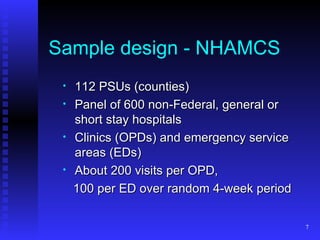
Sample design - NHAMCS 112 PSUs (counties) Panel of 600 non-Federal, general or short stay hospitals Clinics (OPDs) and emergency service areas (EDs) About 200 visits per OPD,  100 per ED over random 4-week period
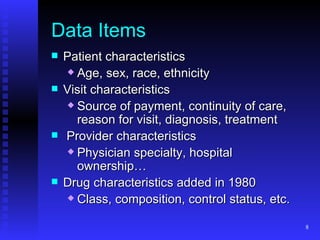
Data Items Patient characteristics  Age, sex, race, ethnicity Visit characteristics Source of payment, continuity of care, reason for visit, diagnosis, treatment Provider characteristics Physician specialty, hospital ownership… Drug characteristics added in 1980 Class, composition, control status, etc.
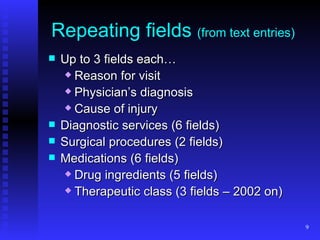
Repeating fields  (from text entries) Up to 3 fields each… Reason for visit  Physician’s diagnosis Cause of injury Diagnostic services (6 fields) Surgical procedures (2 fields) Medications (6 fields) Drug ingredients (5 fields) Therapeutic class (3 fields – 2002 on)
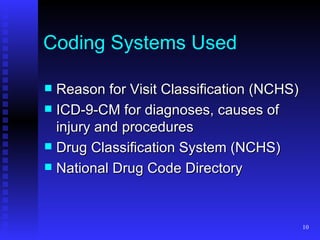
Coding Systems Used Reason for Visit Classification (NCHS) ICD-9-CM for diagnoses, causes of injury and procedures Drug Classification System (NCHS) National Drug Code Directory
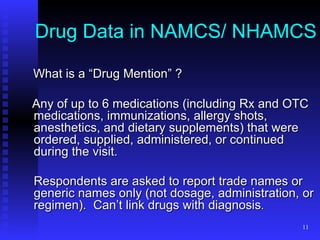
Drug Data in NAMCS/ NHAMCS What is a “Drug Mention” ? Any of up to 6 medications (including Rx and OTC medications, immunizations, allergy shots, anesthetics, and dietary supplements) that were ordered, supplied, administered, or continued during the visit.  Respondents are asked to report trade names or generic names only (not dosage, administration, or regimen).  Can’t link drugs with diagnosis .
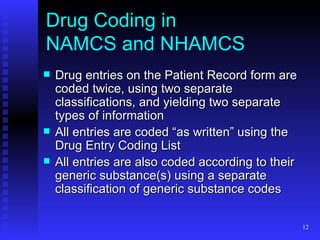
Drug Coding in  NAMCS and NHAMCS Drug entries on the Patient Record form are coded twice, using two separate classifications, and yielding two separate types of information All entries are coded “as written” using the Drug Entry Coding List All entries are also coded according to their generic substance(s) using a separate classification of generic substance codes
Drug Coding in  NAMCS and NHAMCS (cont.) Drug entry codes and generic substance codes are independent of each other For example, there is a code for an entry of “acetaminophen” on the Patient Record form in the Drug Entry Classification and a separate code for acetaminophen in the Generic Classification.
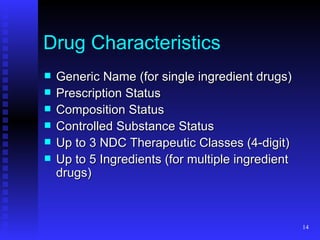
Drug Characteristics Generic Name (for single ingredient drugs) Prescription Status Composition Status Controlled Substance Status Up to 3 NDC Therapeutic Classes (4-digit) Up to 5 Ingredients (for multiple ingredient drugs)
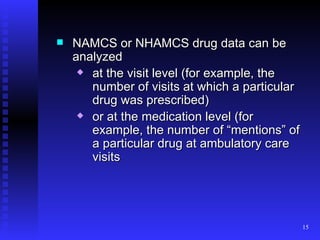
NAMCS or NHAMCS drug data can be analyzed  at the visit level (for example, the number of visits at which a particular drug was prescribed) or at the medication level (for example, the number of “mentions” of a particular drug at ambulatory care visits
Some User Considerations NAMCS/NHAMCS sample visits, not patients No estimates of incidence or prevalence No state-level estimates We do not sample by setting or by non-physician providers May capture different types of care for solo vs. group practice physicians
A few words about item validity Counseling items from NAMCS and OPD are often used as analytic variables in research papers Medical records are accurate in reflecting diagnostic services, but not health habit counseling (Stange et al. 1998, Gilchrist et al. 2004) Our surveys may be underestimating counseling services especially where data are abstracted
Sample Weight Each NAMCS record contains a single weight, which we call Patient Visit Weight Same is true for OPD records and ED records This weight is used for both visits and drug mentions
Reliability of Estimates Estimates should be based on at least 30 sample records AND Estimates with a relative standard error (standard error divided by the estimate) greater than 30 percent are considered unreliable by NCHS standards Both conditions should be met to obtain reliable estimates
How Good are the Estimates? Depends on what you are looking at.  In general, OPD estimates tend to be somewhat less reliable than NAMCS and ED.  Since 1999, our Advance Data reports include standard errors in every table so it is easy to compute confidence intervals around the estimates.
Reliability of Estimates in NAMCS Estimate of office visits by white persons was 766.1 million in 2002, with a relative standard error of 3.5 percent –  range of 714.0-818.2 million visits Estimate of office visits by black persons was  89.5 million in 2002 with a relative standard error of 9.1 percent –  range of 73.6-105.3 million visits
Reliability of Estimates in NHAMCS OPD = 9% and 12% RSE for visits by white persons vs. visits by black persons ED = 4% and 7% RSE for visits by white persons vs. visits by black persons A higher RSE means that an estimate has a wider confidence interval and is less reliable.
Sampling Error NAMCS and NHAMCS are not simple random samples Clustering effects of visits within the physician’s practice, physician practices within PSUs, clinics within hospitals Must use some method to calculate standard errors for frequencies, percents, and rates
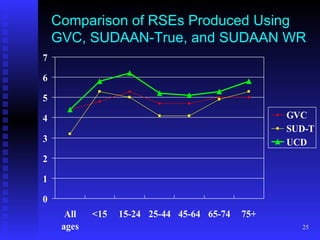
Calculating Variance with NAMCS/NHAMCS Estimates Old way (least accurate) = Generalized variance curves Better way (recommended) = Masked design variables Multiple sampling stages  Single stage of sampling or ultimate cluster design Most accurate way (expensive) = Actual design variables
Comparison of RSEs Produced Using GVC, SUDAAN-True, and SUDAAN WR
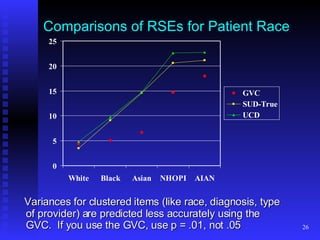
Comparisons of RSEs for Patient Race Variances for clustered items (like race, diagnosis, type of provider) are predicted less accurately using the GVC.  If you use the GVC, use p = .01, not .05
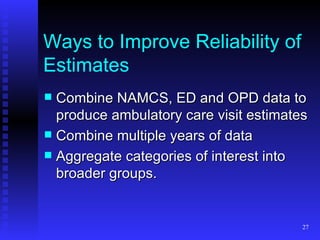
Ways to Improve Reliability of Estimates Combine NAMCS, ED and OPD data to produce ambulatory care visit estimates Combine multiple years of data Aggregate categories of interest into broader groups.
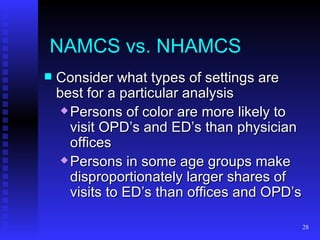
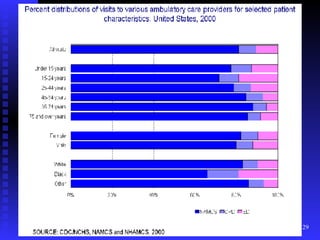
NAMCS vs. NHAMCS Consider what types of settings are best for a particular analysis Persons of color are more likely to visit OPD’s and ED’s than physician offices Persons in some age groups make disproportionately larger shares of visits to ED’s than offices and OPD’s
 
Additional Information Call us at (301) 458-4600 Email me at SSchappert@cdc.gov Visit our website Join the ACLIST. It’s a moderated newsgroup for persons interested in NAMCS/NHAMCS.  It currently consists of more than 2,000 subscribers.

Sess_39_NAMCS&NHAMCS_hands-on_SCHAPPERT

  • 1.
    Understanding and Using NAMCS and NHAMCS Data: A Hands-On Workshop Susan M. Schappert Donald K. Cherry
  • 2.
    Overview I. Survey Background and Data Uses II. Technical Considerations III. Getting the Data – Navigate Our Website IV. SETS Hands-On Training * * Break * * V. Using Raw Data Files VI. Advanced Topics VII. Summary
  • 3.
    NAMCS and NHAMCSNational Ambulatory Medical Care Survey (NAMCS) Visits to office-based physicians National Hospital Ambulatory Medical Care Survey (NHAMCS) Visits to hospital outpatient and emergency departments
  • 4.
    Original NAMCS surveygoals National statistics Professional education Health policy formulation Medical practice management Quality assurance
  • 5.
  • 6.
    Sample design -NAMCS 112 PSUs (counties) Nonfederally employed, office-based physicians stratified by specialty About 30 visits per doctor over a randomly selected 1-week period
  • 7.
    Sample design -NHAMCS 112 PSUs (counties) Panel of 600 non-Federal, general or short stay hospitals Clinics (OPDs) and emergency service areas (EDs) About 200 visits per OPD, 100 per ED over random 4-week period
  • 8.
    Data Items Patientcharacteristics Age, sex, race, ethnicity Visit characteristics Source of payment, continuity of care, reason for visit, diagnosis, treatment Provider characteristics Physician specialty, hospital ownership… Drug characteristics added in 1980 Class, composition, control status, etc.
  • 9.
    Repeating fields (from text entries) Up to 3 fields each… Reason for visit Physician’s diagnosis Cause of injury Diagnostic services (6 fields) Surgical procedures (2 fields) Medications (6 fields) Drug ingredients (5 fields) Therapeutic class (3 fields – 2002 on)
  • 10.
    Coding Systems UsedReason for Visit Classification (NCHS) ICD-9-CM for diagnoses, causes of injury and procedures Drug Classification System (NCHS) National Drug Code Directory
  • 11.
    Drug Data inNAMCS/ NHAMCS What is a “Drug Mention” ? Any of up to 6 medications (including Rx and OTC medications, immunizations, allergy shots, anesthetics, and dietary supplements) that were ordered, supplied, administered, or continued during the visit. Respondents are asked to report trade names or generic names only (not dosage, administration, or regimen). Can’t link drugs with diagnosis .
  • 12.
    Drug Coding in NAMCS and NHAMCS Drug entries on the Patient Record form are coded twice, using two separate classifications, and yielding two separate types of information All entries are coded “as written” using the Drug Entry Coding List All entries are also coded according to their generic substance(s) using a separate classification of generic substance codes
  • 13.
    Drug Coding in NAMCS and NHAMCS (cont.) Drug entry codes and generic substance codes are independent of each other For example, there is a code for an entry of “acetaminophen” on the Patient Record form in the Drug Entry Classification and a separate code for acetaminophen in the Generic Classification.
  • 14.
    Drug Characteristics GenericName (for single ingredient drugs) Prescription Status Composition Status Controlled Substance Status Up to 3 NDC Therapeutic Classes (4-digit) Up to 5 Ingredients (for multiple ingredient drugs)
  • 15.
    NAMCS or NHAMCSdrug data can be analyzed at the visit level (for example, the number of visits at which a particular drug was prescribed) or at the medication level (for example, the number of “mentions” of a particular drug at ambulatory care visits
  • 16.
    Some User ConsiderationsNAMCS/NHAMCS sample visits, not patients No estimates of incidence or prevalence No state-level estimates We do not sample by setting or by non-physician providers May capture different types of care for solo vs. group practice physicians
  • 17.
    A few wordsabout item validity Counseling items from NAMCS and OPD are often used as analytic variables in research papers Medical records are accurate in reflecting diagnostic services, but not health habit counseling (Stange et al. 1998, Gilchrist et al. 2004) Our surveys may be underestimating counseling services especially where data are abstracted
  • 18.
    Sample Weight EachNAMCS record contains a single weight, which we call Patient Visit Weight Same is true for OPD records and ED records This weight is used for both visits and drug mentions
  • 19.
    Reliability of EstimatesEstimates should be based on at least 30 sample records AND Estimates with a relative standard error (standard error divided by the estimate) greater than 30 percent are considered unreliable by NCHS standards Both conditions should be met to obtain reliable estimates
  • 20.
    How Good arethe Estimates? Depends on what you are looking at. In general, OPD estimates tend to be somewhat less reliable than NAMCS and ED. Since 1999, our Advance Data reports include standard errors in every table so it is easy to compute confidence intervals around the estimates.
  • 21.
    Reliability of Estimatesin NAMCS Estimate of office visits by white persons was 766.1 million in 2002, with a relative standard error of 3.5 percent – range of 714.0-818.2 million visits Estimate of office visits by black persons was 89.5 million in 2002 with a relative standard error of 9.1 percent – range of 73.6-105.3 million visits
  • 22.
    Reliability of Estimatesin NHAMCS OPD = 9% and 12% RSE for visits by white persons vs. visits by black persons ED = 4% and 7% RSE for visits by white persons vs. visits by black persons A higher RSE means that an estimate has a wider confidence interval and is less reliable.
  • 23.
    Sampling Error NAMCSand NHAMCS are not simple random samples Clustering effects of visits within the physician’s practice, physician practices within PSUs, clinics within hospitals Must use some method to calculate standard errors for frequencies, percents, and rates
  • 24.
    Calculating Variance withNAMCS/NHAMCS Estimates Old way (least accurate) = Generalized variance curves Better way (recommended) = Masked design variables Multiple sampling stages Single stage of sampling or ultimate cluster design Most accurate way (expensive) = Actual design variables
  • 25.
    Comparison of RSEsProduced Using GVC, SUDAAN-True, and SUDAAN WR
  • 26.
    Comparisons of RSEsfor Patient Race Variances for clustered items (like race, diagnosis, type of provider) are predicted less accurately using the GVC. If you use the GVC, use p = .01, not .05
  • 27.
    Ways to ImproveReliability of Estimates Combine NAMCS, ED and OPD data to produce ambulatory care visit estimates Combine multiple years of data Aggregate categories of interest into broader groups.
  • 28.
    NAMCS vs. NHAMCSConsider what types of settings are best for a particular analysis Persons of color are more likely to visit OPD’s and ED’s than physician offices Persons in some age groups make disproportionately larger shares of visits to ED’s than offices and OPD’s
  • 29.
  • 30.
    Additional Information Callus at (301) 458-4600 Email me at SSchappert@cdc.gov Visit our website Join the ACLIST. It’s a moderated newsgroup for persons interested in NAMCS/NHAMCS. It currently consists of more than 2,000 subscribers.