Presented by Jagannathojhaand RanjanKumardalai .
IPSAR B school
HUMAN RESOURCES PLANNING
Meaning :
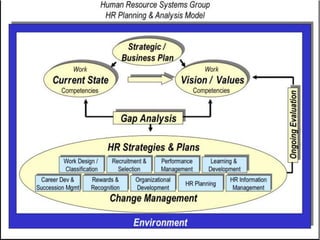
Human resource planning is a process that identifies
current and future human resources needs for an
organization to achieve its goals.
Human resource planning should serve as a link
between human resource management and the
overall strategic plan of an organization
HRP is a process of striking between human
resources required and acquired in an organization
Definition :
• Gisler opines ,”HRP is the process including
forecasting , developing ,and controlling by
which a firm ensures that it has the right number
of people and the right kind of people at the
right places at the right time doing work for
which they are economically most useful “
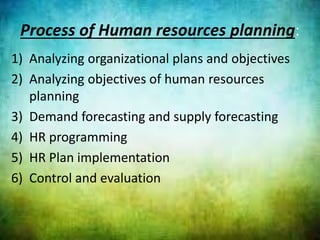
Process of Human resources planning:
1) Analyzing organizational plans and objectives
2) Analyzing objectives of human resources
planning
3) Demand forecasting and supply forecasting
4) HR programming
5) HR Plan implementation
6) Control and evaluation
1 :Analyzing organizational plans and
objectives :
• The process of human resource planning begins
with analyzing the overall plans and objectives of
organization .
• Analysis of business plans into sub-sectional and
functional plans such as technology ,production
,finance ,marketing ,expansion and
diversification provides for assessing the human
resources requirements for each activity in each
section and department .
2:Analysing objectives of human
resources planning :
• The main purpose of human resources planning is
matching employee abilities to enterprise
requirements ,with an emphasis on future
instead of present arrangements .
3: Forecasting demand for human resources :
The demand for human resources in an
organization is subject to vary from time to time ,
depending upon both external and internal
factors .
• External factors include competition ,economic ,
political climate ,technological changes ,govt. policies
etc.
• Internal factors include growth and expansion ,
management philosophy ,change in leadership styles .
Demand forecasting techniques:
1) Management judgment :
it essentially refers to the process of managerial
decision-making, or a manager's ability to use
judgment to solve problems. Under this technique ,
either a ‘top bottom ‘or a ‘top down ‘approach is
employed for forecasting of Human resources planning.
2:WORK STUDY METHOD :
This method can be used when it is possible to
measure work and set standards and where job
methods do not change frequently . In this
method , time and motion study are used to
ascertain standard time for doing a standard
work .
3:RATIO-TREND ANALYSIS :
This is one of the quickest forecasting technique
.This technique involves studying past ratios .
4) Delphi technique :
• The Delphi Technique is described as: “A process in
which the forecasts and judgments of a selected
group of experts are solicited and summarized in an
attempt to determine the future HR demand.”
5) Flow models :
Among the flow models , the simplest one is called as
markov model .
Markov model consists :
 Study the flow of people through an organization
 Determine the probability of movements
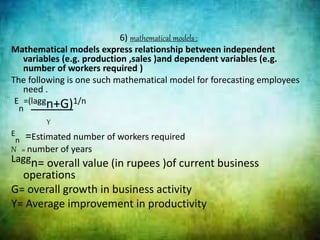
6) mathematical models :
Mathematical models express relationship between independent
variables (e.g. production ,sales )and dependent variables (e.g.
number of workers required )
The following is one such mathematical model for forecasting employees
need .
E
n
=(laggn+G)1/n
Y
E
n =Estimated number of workers required
N = number of years
Laggn= overall value (in rupees )of current business
operations
G= overall growth in business activity
Y= Average improvement in productivity
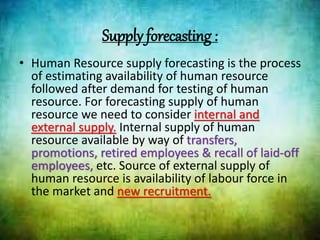
Supply forecasting :
• Human Resource supply forecasting is the process
of estimating availability of human resource
followed after demand for testing of human
resource. For forecasting supply of human
resource we need to consider internal and
external supply. Internal supply of human
resource available by way of transfers,
promotions, retired employees & recall of laid-off
employees, etc. Source of external supply of
human resource is availability of labour force in
the market and new recruitment.
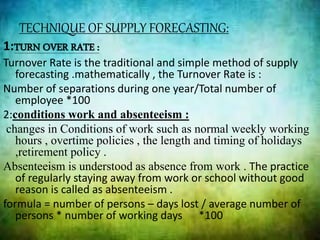
TECHNIQUE OF SUPPLY FORECASTING:
1:TURN OVER RATE :
Turnover Rate is the traditional and simple method of supply
forecasting .mathematically , the Turnover Rate is :
Number of separations during one year/Total number of
employee *100
2:conditions work and absenteeism :
changes in Conditions of work such as normal weekly working
hours , overtime policies , the length and timing of holidays
,retirement policy .
Absenteeism is understood as absence from work . The practice
of regularly staying away from work or school without good
reason is called as absenteeism .
formula = number of persons – days lost / average number of
persons * number of working days *100
• 3:productivity level :
Any change in productivity would affect the number
of persons required per unit of output .
Increase in productivity will reduce the requirement
and decrease in it would have the effect .
4 )movement among jobs :
Some jobs are sources of personnel for other jobs. for
examples , secretaries may be obtained by the
promotion of typist and Branch managers are
obtained from a pool of section managers .
4)Hr programming :
• Once an organization’s personnel demand and
supply are forecast , the two must be reconciled
or balanced , in order that vacancies can be filled
by the right employee at the right time .
• 5)hr plan implementation :
Implementation requires converting an HR plan
into action
6)Control and evaluation :
it represents the fifth and final phase in HRP
process .
Human resources planning(meaning , definition and process

Human resources planning(meaning , definition and process

  • 1.
    Presented by JagannathojhaandRanjanKumardalai . IPSAR B school
  • 2.
    HUMAN RESOURCES PLANNING Meaning: Human resource planning is a process that identifies current and future human resources needs for an organization to achieve its goals. Human resource planning should serve as a link between human resource management and the overall strategic plan of an organization HRP is a process of striking between human resources required and acquired in an organization
  • 3.
    Definition : • Gisleropines ,”HRP is the process including forecasting , developing ,and controlling by which a firm ensures that it has the right number of people and the right kind of people at the right places at the right time doing work for which they are economically most useful “
  • 5.
    Process of Humanresources planning: 1) Analyzing organizational plans and objectives 2) Analyzing objectives of human resources planning 3) Demand forecasting and supply forecasting 4) HR programming 5) HR Plan implementation 6) Control and evaluation
  • 6.
    1 :Analyzing organizationalplans and objectives : • The process of human resource planning begins with analyzing the overall plans and objectives of organization . • Analysis of business plans into sub-sectional and functional plans such as technology ,production ,finance ,marketing ,expansion and diversification provides for assessing the human resources requirements for each activity in each section and department .
  • 7.
    2:Analysing objectives ofhuman resources planning : • The main purpose of human resources planning is matching employee abilities to enterprise requirements ,with an emphasis on future instead of present arrangements . 3: Forecasting demand for human resources : The demand for human resources in an organization is subject to vary from time to time , depending upon both external and internal factors .
  • 8.
    • External factorsinclude competition ,economic , political climate ,technological changes ,govt. policies etc. • Internal factors include growth and expansion , management philosophy ,change in leadership styles . Demand forecasting techniques: 1) Management judgment : it essentially refers to the process of managerial decision-making, or a manager's ability to use judgment to solve problems. Under this technique , either a ‘top bottom ‘or a ‘top down ‘approach is employed for forecasting of Human resources planning.
  • 9.
    2:WORK STUDY METHOD: This method can be used when it is possible to measure work and set standards and where job methods do not change frequently . In this method , time and motion study are used to ascertain standard time for doing a standard work . 3:RATIO-TREND ANALYSIS : This is one of the quickest forecasting technique .This technique involves studying past ratios .
  • 10.
    4) Delphi technique: • The Delphi Technique is described as: “A process in which the forecasts and judgments of a selected group of experts are solicited and summarized in an attempt to determine the future HR demand.” 5) Flow models : Among the flow models , the simplest one is called as markov model . Markov model consists :  Study the flow of people through an organization  Determine the probability of movements
  • 11.
    6) mathematical models: Mathematical models express relationship between independent variables (e.g. production ,sales )and dependent variables (e.g. number of workers required ) The following is one such mathematical model for forecasting employees need . E n =(laggn+G)1/n Y E n =Estimated number of workers required N = number of years Laggn= overall value (in rupees )of current business operations G= overall growth in business activity Y= Average improvement in productivity
  • 12.
    Supply forecasting : •Human Resource supply forecasting is the process of estimating availability of human resource followed after demand for testing of human resource. For forecasting supply of human resource we need to consider internal and external supply. Internal supply of human resource available by way of transfers, promotions, retired employees & recall of laid-off employees, etc. Source of external supply of human resource is availability of labour force in the market and new recruitment.
  • 13.
    TECHNIQUE OF SUPPLYFORECASTING: 1:TURN OVER RATE : Turnover Rate is the traditional and simple method of supply forecasting .mathematically , the Turnover Rate is : Number of separations during one year/Total number of employee *100 2:conditions work and absenteeism : changes in Conditions of work such as normal weekly working hours , overtime policies , the length and timing of holidays ,retirement policy . Absenteeism is understood as absence from work . The practice of regularly staying away from work or school without good reason is called as absenteeism . formula = number of persons – days lost / average number of persons * number of working days *100
  • 14.
    • 3:productivity level: Any change in productivity would affect the number of persons required per unit of output . Increase in productivity will reduce the requirement and decrease in it would have the effect . 4 )movement among jobs : Some jobs are sources of personnel for other jobs. for examples , secretaries may be obtained by the promotion of typist and Branch managers are obtained from a pool of section managers .
  • 15.
    4)Hr programming : •Once an organization’s personnel demand and supply are forecast , the two must be reconciled or balanced , in order that vacancies can be filled by the right employee at the right time . • 5)hr plan implementation : Implementation requires converting an HR plan into action 6)Control and evaluation : it represents the fifth and final phase in HRP process .