Copyright © 2014 Cengage Learning. All Rights Reserved. May not be scanned, copied or duplicated, or posted to a publicly accessible website, in whole or in part.
1
C H A P T E R
What is Strategic
Communication?
COM 620 MODULE
with
Walter Ratliff
Copyright © 2014 Cengage Learning. All Rights Reserved. May not be scanned, copied or duplicated, or posted to a publicly accessible website, in whole or in part.
Strategic Communication
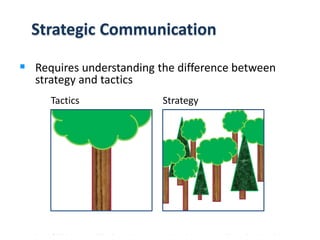
 Requires understanding the difference between
strategy and tactics
Tactics Strategy
Copyright © 2014 Cengage Learning. All Rights Reserved. May not be scanned, copied or duplicated, or posted to a publicly accessible website, in whole or in part.
Strategic Communication
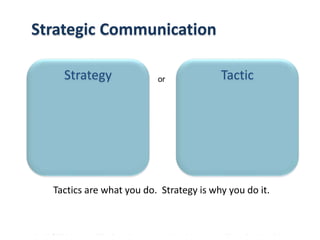
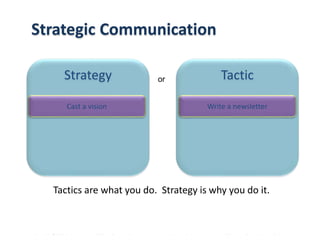
Tactics are what you do. Strategy is why you do it.
Strategy Tacticor
Copyright © 2014 Cengage Learning. All Rights Reserved. May not be scanned, copied or duplicated, or posted to a publicly accessible website, in whole or in part.
Strategic Communication
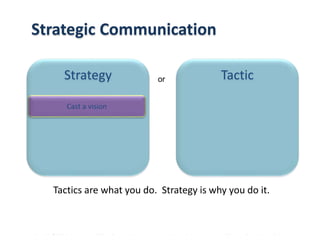
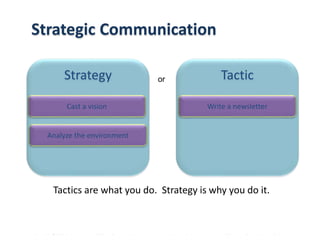
Tactics are what you do. Strategy is why you do it.
Strategy Tacticor
Cast a vision
Copyright © 2014 Cengage Learning. All Rights Reserved. May not be scanned, copied or duplicated, or posted to a publicly accessible website, in whole or in part.
Strategic Communication
Tactics are what you do. Strategy is why you do it.
Strategy Tacticor
Write a newsletterCast a vision
Copyright © 2014 Cengage Learning. All Rights Reserved. May not be scanned, copied or duplicated, or posted to a publicly accessible website, in whole or in part.
Strategic Communication
Tactics are what you do. Strategy is why you do it.
Strategy Tacticor
Analyze the environment
Write a newsletterCast a vision
Copyright © 2014 Cengage Learning. All Rights Reserved. May not be scanned, copied or duplicated, or posted to a publicly accessible website, in whole or in part.
Strategic Communication
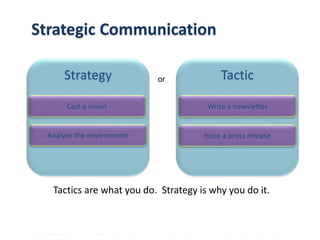
Tactics are what you do. Strategy is why you do it.
Strategy Tacticor
Issue a press releaseAnalyze the environment
Write a newsletterCast a vision
Copyright © 2014 Cengage Learning. All Rights Reserved. May not be scanned, copied or duplicated, or posted to a publicly accessible website, in whole or in part.
Strategic Communication
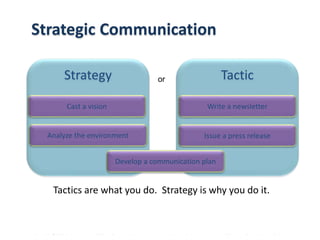
Tactics are what you do. Strategy is why you do it.
Strategy Tacticor
Develop a communication plan
Issue a press releaseAnalyze the environment
Write a newsletterCast a vision
Copyright © 2014 Cengage Learning. All Rights Reserved. May not be scanned, copied or duplicated, or posted to a publicly accessible website, in whole or in part. 9
Why is a Strategic Approach to
Communication Important?
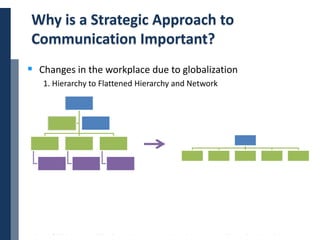
 Changes in the workplace due to globalization
1. Hierarchy to Flattened Hierarchy and Network
Copyright © 2014 Cengage Learning. All Rights Reserved. May not be scanned, copied or duplicated, or posted to a publicly accessible website, in whole or in part. 10
Why is a Strategic Approach to
Communication Important?
 Changes in the workplace due to globalization
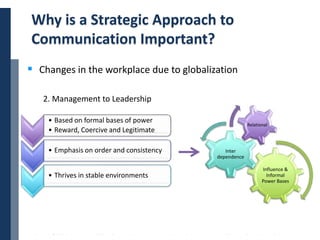
2. Management to Leadership
• Based on formal bases of power
• Reward, Coercive and Legitimate
• Emphasis on order and consistency
• Thrives in stable environments
Influence &
Informal
Power Bases
Inter
dependence
Relational
Copyright © 2014 Cengage Learning. All Rights Reserved. May not be scanned, copied or duplicated, or posted to a publicly accessible website, in whole or in part. 11
Why is a Strategic Approach to
Communication Important?
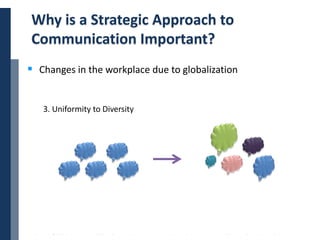
 Changes in the workplace due to globalization
3. Uniformity to Diversity
Copyright © 2014 Cengage Learning. All Rights Reserved. May not be scanned, copied or duplicated, or posted to a publicly accessible website, in whole or in part. 12
Why is a Strategic Approach to
Communication Important?
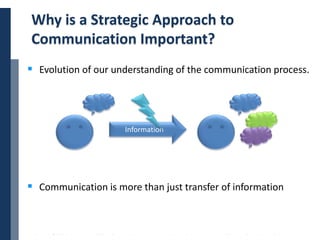
 Evolution of our understanding of the communication process.
Information
 Communication is more than just transfer of information
Copyright © 2014 Cengage Learning. All Rights Reserved. May not be scanned, copied or duplicated, or posted to a publicly accessible website, in whole or in part. 13
Why is a Strategic Approach to
Communication Important?
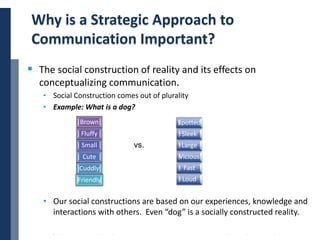
 The social construction of reality and its effects on
conceptualizing communication.
• Social Construction comes out of plurality
• Example: What is a dog?
• Our social constructions are based on our experiences, knowledge and
interactions with others. Even “dog” is a socially constructed reality.
vs.
Brown
Fluffy
Small
Cute
Cuddly
Friendly
Spotted
Sleek
Large
Vicious
Fast
Loud
Copyright © 2014 Cengage Learning. All Rights Reserved. May not be scanned, copied or duplicated, or posted to a publicly accessible website, in whole or in part. 14
Why is a Strategic Approach to
Communication Important?
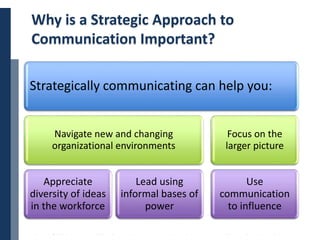
Strategically communicating can help you:
Navigate new and changing
organizational environments
Appreciate
diversity of ideas
in the workforce
Lead using
informal bases of
power
Focus on the
larger picture
Use
communication
to influence
Copyright © 2014 Cengage Learning. All Rights Reserved. May not be scanned, copied or duplicated, or posted to a publicly accessible website, in whole or in part. 15
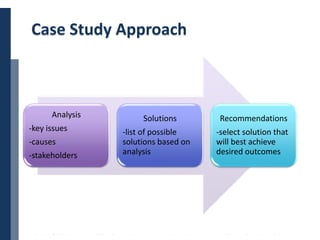
Case Study Approach
Analysis
-key issues
-causes
-stakeholders
Solutions
-list of possible
solutions based on
analysis
Recommendations
-select solution that
will best achieve
desired outcomes
Copyright © 2014 Cengage Learning. All Rights Reserved. May not be scanned, copied or duplicated, or posted to a publicly accessible website, in whole or in part. 16
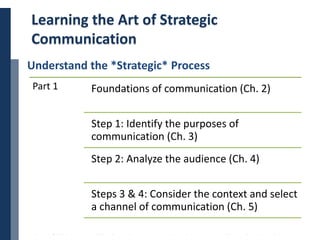
Learning the Art of Strategic
Communication
Understand the *Strategic* Process
Part 1 Foundations of communication (Ch. 2)
Step 1: Identify the purposes of
communication (Ch. 3)
Step 2: Analyze the audience (Ch. 4)
Steps 3 & 4: Consider the context and select
a channel of communication (Ch. 5)
Copyright © 2014 Cengage Learning. All Rights Reserved. May not be scanned, copied or duplicated, or posted to a publicly accessible website, in whole or in part. 17
Learning the Skills for Strategic
Communication
Communication *Tactics* for Differing Channels and
Contexts
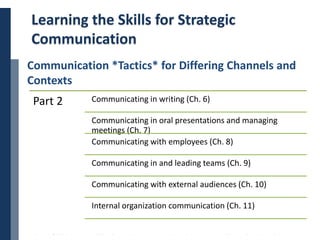
Part 2 Communicating in writing (Ch. 6)
Communicating in oral presentations and managing
meetings (Ch. 7)
Communicating with employees (Ch. 8)
Communicating in and leading teams (Ch. 9)
Communicating with external audiences (Ch. 10)
Internal organization communication (Ch. 11)
Copyright © 2014 Cengage Learning. All Rights Reserved. May not be scanned, copied or duplicated, or posted to a publicly accessible website, in whole or in part. 18
Requirements for Strategic
Communication
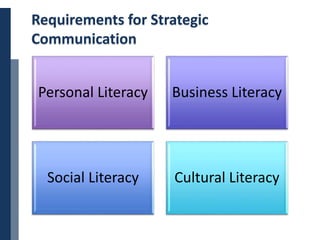
Personal Literacy Business Literacy
Social Literacy Cultural Literacy
Copyright © 2014 Cengage Learning. All Rights Reserved. May not be scanned, copied or duplicated, or posted to a publicly accessible website, in whole or in part. 19
Four Models of Communication
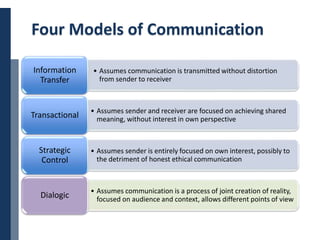
• Assumes communication is transmitted without distortion
from sender to receiver
Information
Transfer
• Assumes sender and receiver are focused on achieving shared
meaning, without interest in own perspectiveTransactional
• Assumes sender is entirely focused on own interest, possibly to
the detriment of honest ethical communication
Strategic
Control
• Assumes communication is a process of joint creation of reality,
focused on audience and context, allows different points of view
Dialogic
Copyright © 2014 Cengage Learning. All Rights Reserved. May not be scanned, copied or duplicated, or posted to a publicly accessible website, in whole or in part.
Monologue vs. Dialogue
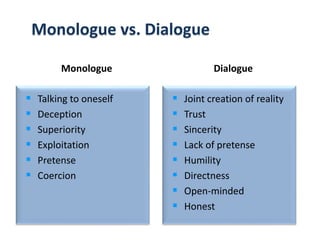
Monologue
 Talking to oneself
 Deception
 Superiority
 Exploitation
 Pretense
 Coercion
Dialogue
 Joint creation of reality
 Trust
 Sincerity
 Lack of pretense
 Humility
 Directness
 Open-minded
 Honest
Copyright © 2014 Cengage Learning. All Rights Reserved. May not be scanned, copied or duplicated, or posted to a publicly accessible website, in whole or in part. 21
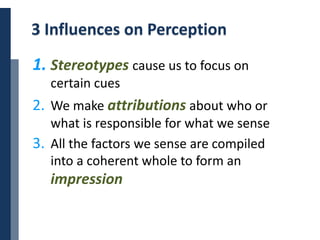
3 Influences on Perception
1. Stereotypes cause us to focus on
certain cues
2. We make attributions about who or
what is responsible for what we sense
3. All the factors we sense are compiled
into a coherent whole to form an
impression
Copyright © 2014 Cengage Learning. All Rights Reserved. May not be scanned, copied or duplicated, or posted to a publicly accessible website, in whole or in part. 22
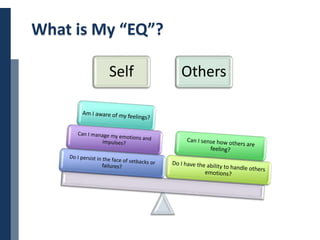
What is My “EQ”?
Self Others
Copyright © 2014 Cengage Learning. All Rights Reserved. May not be scanned, copied or duplicated, or posted to a publicly accessible website, in whole or in part. 23
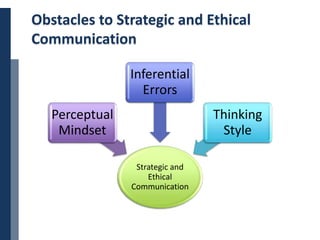
Obstacles to Strategic and Ethical
Communication
Strategic and
Ethical
Communication
Perceptual
Mindset
Inferential
Errors
Thinking
Style
Copyright © 2014 Cengage Learning. All Rights Reserved. May not be scanned, copied or duplicated, or posted to a publicly accessible website, in whole or in part. 24
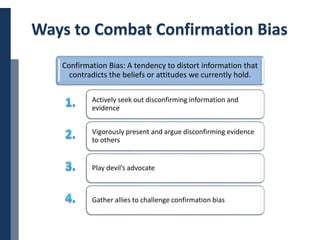
Ways to Combat Confirmation Bias
Confirmation Bias: A tendency to distort information that
contradicts the beliefs or attitudes we currently hold.
Actively seek out disconfirming information and
evidence
Vigorously present and argue disconfirming evidence
to others
Play devil’s advocate
Gather allies to challenge confirmation bias
Copyright © 2014 Cengage Learning. All Rights Reserved. May not be scanned, copied or duplicated, or posted to a publicly accessible website, in whole or in part. 25
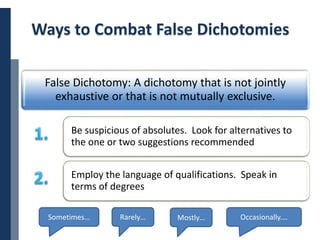
Ways to Combat False Dichotomies
False Dichotomy: A dichotomy that is not jointly
exhaustive or that is not mutually exclusive.
Be suspicious of absolutes. Look for alternatives to
the one or two suggestions recommended
Employ the language of qualifications. Speak in
terms of degrees
Sometimes… Rarely… Mostly… Occasionally.…
Copyright © 2014 Cengage Learning. All Rights Reserved. May not be scanned, copied or duplicated, or posted to a publicly accessible website, in whole or in part. 26
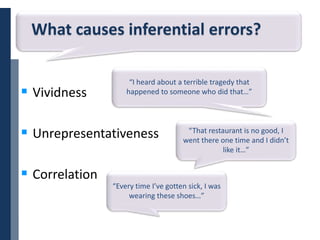
What causes inferential errors?
 Vividness
 Unrepresentativeness
 Correlation
“I heard about a terrible tragedy that
happened to someone who did that…”
“That restaurant is no good, I
went there one time and I didn’t
like it…”
“Every time I’ve gotten sick, I was
wearing these shoes…”
Copyright © 2014 Cengage Learning. All Rights Reserved. May not be scanned, copied or duplicated, or posted to a publicly accessible website, in whole or in part. 27
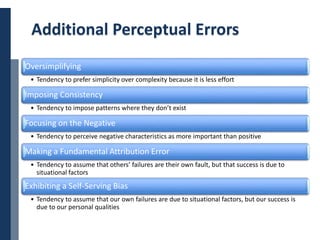
Additional Perceptual Errors
Oversimplifying
• Tendency to prefer simplicity over complexity because it is less effort
Imposing Consistency
• Tendency to impose patterns where they don’t exist
Focusing on the Negative
• Tendency to perceive negative characteristics as more important than positive
Making a Fundamental Attribution Error
• Tendency to assume that others’ failures are their own fault, but that success is due to
situational factors
Exhibiting a Self-Serving Bias
• Tendency to assume that our own failures are due to situational factors, but our success is
due to our personal qualities
Copyright © 2014 Cengage Learning. All Rights Reserved. May not be scanned, copied or duplicated, or posted to a publicly accessible website, in whole or in part.
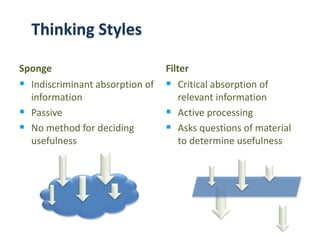
Thinking Styles
Sponge
 Indiscriminant absorption of
information
 Passive
 No method for deciding
usefulness
Filter
 Critical absorption of
relevant information
 Active processing
 Asks questions of material
to determine usefulness
Copyright © 2014 Cengage Learning. All Rights Reserved. May not be scanned, copied or duplicated, or posted to a publicly accessible website, in whole or in part. 29
Practice Your Critical Thinking
 Seek alternative hypotheses,
explanations, conclusions and sources of
information
 Communicate honestly and openly about
your own and others’ positions
 Learn to appreciate ambiguity and variety
of potential solutions
Copyright © 2014 Cengage Learning. All Rights Reserved. May not be scanned, copied or duplicated, or posted to a publicly accessible website, in whole or in part.
This presentation contains copyrighted material from Strategic
Communications Management for Leaders by Robyn Walker (Boston:
Cengage Learning, 2014).

Com 620 module 1

  • 1.
    Copyright © 2014Cengage Learning. All Rights Reserved. May not be scanned, copied or duplicated, or posted to a publicly accessible website, in whole or in part. 1 C H A P T E R What is Strategic Communication? COM 620 MODULE with Walter Ratliff
  • 2.
    Copyright © 2014Cengage Learning. All Rights Reserved. May not be scanned, copied or duplicated, or posted to a publicly accessible website, in whole or in part. Strategic Communication  Requires understanding the difference between strategy and tactics Tactics Strategy
  • 3.
    Copyright © 2014Cengage Learning. All Rights Reserved. May not be scanned, copied or duplicated, or posted to a publicly accessible website, in whole or in part. Strategic Communication Tactics are what you do. Strategy is why you do it. Strategy Tacticor
  • 4.
    Copyright © 2014Cengage Learning. All Rights Reserved. May not be scanned, copied or duplicated, or posted to a publicly accessible website, in whole or in part. Strategic Communication Tactics are what you do. Strategy is why you do it. Strategy Tacticor Cast a vision
  • 5.
    Copyright © 2014Cengage Learning. All Rights Reserved. May not be scanned, copied or duplicated, or posted to a publicly accessible website, in whole or in part. Strategic Communication Tactics are what you do. Strategy is why you do it. Strategy Tacticor Write a newsletterCast a vision
  • 6.
    Copyright © 2014Cengage Learning. All Rights Reserved. May not be scanned, copied or duplicated, or posted to a publicly accessible website, in whole or in part. Strategic Communication Tactics are what you do. Strategy is why you do it. Strategy Tacticor Analyze the environment Write a newsletterCast a vision
  • 7.
    Copyright © 2014Cengage Learning. All Rights Reserved. May not be scanned, copied or duplicated, or posted to a publicly accessible website, in whole or in part. Strategic Communication Tactics are what you do. Strategy is why you do it. Strategy Tacticor Issue a press releaseAnalyze the environment Write a newsletterCast a vision
  • 8.
    Copyright © 2014Cengage Learning. All Rights Reserved. May not be scanned, copied or duplicated, or posted to a publicly accessible website, in whole or in part. Strategic Communication Tactics are what you do. Strategy is why you do it. Strategy Tacticor Develop a communication plan Issue a press releaseAnalyze the environment Write a newsletterCast a vision
  • 9.
    Copyright © 2014Cengage Learning. All Rights Reserved. May not be scanned, copied or duplicated, or posted to a publicly accessible website, in whole or in part. 9 Why is a Strategic Approach to Communication Important?  Changes in the workplace due to globalization 1. Hierarchy to Flattened Hierarchy and Network
  • 10.
    Copyright © 2014Cengage Learning. All Rights Reserved. May not be scanned, copied or duplicated, or posted to a publicly accessible website, in whole or in part. 10 Why is a Strategic Approach to Communication Important?  Changes in the workplace due to globalization 2. Management to Leadership • Based on formal bases of power • Reward, Coercive and Legitimate • Emphasis on order and consistency • Thrives in stable environments Influence & Informal Power Bases Inter dependence Relational
  • 11.
    Copyright © 2014Cengage Learning. All Rights Reserved. May not be scanned, copied or duplicated, or posted to a publicly accessible website, in whole or in part. 11 Why is a Strategic Approach to Communication Important?  Changes in the workplace due to globalization 3. Uniformity to Diversity
  • 12.
    Copyright © 2014Cengage Learning. All Rights Reserved. May not be scanned, copied or duplicated, or posted to a publicly accessible website, in whole or in part. 12 Why is a Strategic Approach to Communication Important?  Evolution of our understanding of the communication process. Information  Communication is more than just transfer of information
  • 13.
    Copyright © 2014Cengage Learning. All Rights Reserved. May not be scanned, copied or duplicated, or posted to a publicly accessible website, in whole or in part. 13 Why is a Strategic Approach to Communication Important?  The social construction of reality and its effects on conceptualizing communication. • Social Construction comes out of plurality • Example: What is a dog? • Our social constructions are based on our experiences, knowledge and interactions with others. Even “dog” is a socially constructed reality. vs. Brown Fluffy Small Cute Cuddly Friendly Spotted Sleek Large Vicious Fast Loud
  • 14.
    Copyright © 2014Cengage Learning. All Rights Reserved. May not be scanned, copied or duplicated, or posted to a publicly accessible website, in whole or in part. 14 Why is a Strategic Approach to Communication Important? Strategically communicating can help you: Navigate new and changing organizational environments Appreciate diversity of ideas in the workforce Lead using informal bases of power Focus on the larger picture Use communication to influence
  • 15.
    Copyright © 2014Cengage Learning. All Rights Reserved. May not be scanned, copied or duplicated, or posted to a publicly accessible website, in whole or in part. 15 Case Study Approach Analysis -key issues -causes -stakeholders Solutions -list of possible solutions based on analysis Recommendations -select solution that will best achieve desired outcomes
  • 16.
    Copyright © 2014Cengage Learning. All Rights Reserved. May not be scanned, copied or duplicated, or posted to a publicly accessible website, in whole or in part. 16 Learning the Art of Strategic Communication Understand the *Strategic* Process Part 1 Foundations of communication (Ch. 2) Step 1: Identify the purposes of communication (Ch. 3) Step 2: Analyze the audience (Ch. 4) Steps 3 & 4: Consider the context and select a channel of communication (Ch. 5)
  • 17.
    Copyright © 2014Cengage Learning. All Rights Reserved. May not be scanned, copied or duplicated, or posted to a publicly accessible website, in whole or in part. 17 Learning the Skills for Strategic Communication Communication *Tactics* for Differing Channels and Contexts Part 2 Communicating in writing (Ch. 6) Communicating in oral presentations and managing meetings (Ch. 7) Communicating with employees (Ch. 8) Communicating in and leading teams (Ch. 9) Communicating with external audiences (Ch. 10) Internal organization communication (Ch. 11)
  • 18.
    Copyright © 2014Cengage Learning. All Rights Reserved. May not be scanned, copied or duplicated, or posted to a publicly accessible website, in whole or in part. 18 Requirements for Strategic Communication Personal Literacy Business Literacy Social Literacy Cultural Literacy
  • 19.
    Copyright © 2014Cengage Learning. All Rights Reserved. May not be scanned, copied or duplicated, or posted to a publicly accessible website, in whole or in part. 19 Four Models of Communication • Assumes communication is transmitted without distortion from sender to receiver Information Transfer • Assumes sender and receiver are focused on achieving shared meaning, without interest in own perspectiveTransactional • Assumes sender is entirely focused on own interest, possibly to the detriment of honest ethical communication Strategic Control • Assumes communication is a process of joint creation of reality, focused on audience and context, allows different points of view Dialogic
  • 20.
    Copyright © 2014Cengage Learning. All Rights Reserved. May not be scanned, copied or duplicated, or posted to a publicly accessible website, in whole or in part. Monologue vs. Dialogue Monologue  Talking to oneself  Deception  Superiority  Exploitation  Pretense  Coercion Dialogue  Joint creation of reality  Trust  Sincerity  Lack of pretense  Humility  Directness  Open-minded  Honest
  • 21.
    Copyright © 2014Cengage Learning. All Rights Reserved. May not be scanned, copied or duplicated, or posted to a publicly accessible website, in whole or in part. 21 3 Influences on Perception 1. Stereotypes cause us to focus on certain cues 2. We make attributions about who or what is responsible for what we sense 3. All the factors we sense are compiled into a coherent whole to form an impression
  • 22.
    Copyright © 2014Cengage Learning. All Rights Reserved. May not be scanned, copied or duplicated, or posted to a publicly accessible website, in whole or in part. 22 What is My “EQ”? Self Others
  • 23.
    Copyright © 2014Cengage Learning. All Rights Reserved. May not be scanned, copied or duplicated, or posted to a publicly accessible website, in whole or in part. 23 Obstacles to Strategic and Ethical Communication Strategic and Ethical Communication Perceptual Mindset Inferential Errors Thinking Style
  • 24.
    Copyright © 2014Cengage Learning. All Rights Reserved. May not be scanned, copied or duplicated, or posted to a publicly accessible website, in whole or in part. 24 Ways to Combat Confirmation Bias Confirmation Bias: A tendency to distort information that contradicts the beliefs or attitudes we currently hold. Actively seek out disconfirming information and evidence Vigorously present and argue disconfirming evidence to others Play devil’s advocate Gather allies to challenge confirmation bias
  • 25.
    Copyright © 2014Cengage Learning. All Rights Reserved. May not be scanned, copied or duplicated, or posted to a publicly accessible website, in whole or in part. 25 Ways to Combat False Dichotomies False Dichotomy: A dichotomy that is not jointly exhaustive or that is not mutually exclusive. Be suspicious of absolutes. Look for alternatives to the one or two suggestions recommended Employ the language of qualifications. Speak in terms of degrees Sometimes… Rarely… Mostly… Occasionally.…
  • 26.
    Copyright © 2014Cengage Learning. All Rights Reserved. May not be scanned, copied or duplicated, or posted to a publicly accessible website, in whole or in part. 26 What causes inferential errors?  Vividness  Unrepresentativeness  Correlation “I heard about a terrible tragedy that happened to someone who did that…” “That restaurant is no good, I went there one time and I didn’t like it…” “Every time I’ve gotten sick, I was wearing these shoes…”
  • 27.
    Copyright © 2014Cengage Learning. All Rights Reserved. May not be scanned, copied or duplicated, or posted to a publicly accessible website, in whole or in part. 27 Additional Perceptual Errors Oversimplifying • Tendency to prefer simplicity over complexity because it is less effort Imposing Consistency • Tendency to impose patterns where they don’t exist Focusing on the Negative • Tendency to perceive negative characteristics as more important than positive Making a Fundamental Attribution Error • Tendency to assume that others’ failures are their own fault, but that success is due to situational factors Exhibiting a Self-Serving Bias • Tendency to assume that our own failures are due to situational factors, but our success is due to our personal qualities
  • 28.
    Copyright © 2014Cengage Learning. All Rights Reserved. May not be scanned, copied or duplicated, or posted to a publicly accessible website, in whole or in part. Thinking Styles Sponge  Indiscriminant absorption of information  Passive  No method for deciding usefulness Filter  Critical absorption of relevant information  Active processing  Asks questions of material to determine usefulness
  • 29.
    Copyright © 2014Cengage Learning. All Rights Reserved. May not be scanned, copied or duplicated, or posted to a publicly accessible website, in whole or in part. 29 Practice Your Critical Thinking  Seek alternative hypotheses, explanations, conclusions and sources of information  Communicate honestly and openly about your own and others’ positions  Learn to appreciate ambiguity and variety of potential solutions
  • 30.
    Copyright © 2014Cengage Learning. All Rights Reserved. May not be scanned, copied or duplicated, or posted to a publicly accessible website, in whole or in part. This presentation contains copyrighted material from Strategic Communications Management for Leaders by Robyn Walker (Boston: Cengage Learning, 2014).