-VishalGohil
-Nancy Hirpara
-BhaktiJivani
MAXIMUM DOSES OF LOCAL ANESTHETICS
o Doses of local anesthetic drugs are presented in
terms of milligrams of drug per unit of bodyweight –
as milligrams per kilogram(mg/kg) or as milligrams
per pound(mg/Ib)
o These numbers, similar to the once presented for
duration, reflect estimated values because there is
a wide range in patient response to blood levels of
local anesthetics
 For patients whose responses to anesthetic blood
levels lie within the middle of normal distribution
curve, administration of a maximum dose based on
body weight produces a local anesthetic blood level
below the usual threshold for an overdose reaction
 Patients who are hyporesponders to elevated local
anesthetic blood levels may not experience any
adverse reaction until their local anesthetic blood
level is considerably above this normal overdose
threshold
 These patients represent little increased risk when
local anesthetics are administrated in usual dental
doses
 To increase safety for all patients during
administration of local anesthetics, but especially in
this latter group, one should always minimize drug
doses and use the smallest clinically effective dose
 Two groups of patients however, represent
potentially increased risk from overly high local
anesthetic blood levels
 The smaller, lighter-weight child, and the debilitated
elderly individual
 Considerable attention must be given to drug
administration in these two group
 The maximum recommended dose calculated
should always be decreased in medically
compromised, debilitated, or elderly persons
 Changes in liver function, plasma protein binding,
blood volume and other important physiologic
functions influence the manner in which local
anesthetics are distributed and biotransformed in
the body
 A point that has come up in several medicolegal
situations related to overdosage(OD) of local
anesthetics involves the maximum number of
milligrams administered and the effect on the
patient
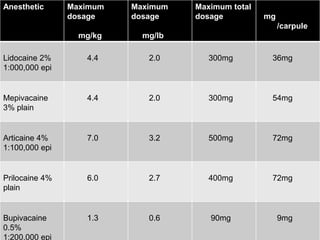
Anesthetic Maximum
dosage
mg/kg
Maximum
dosage
mg/Ib
Maximum total
dosage mg
/carpule
Lidocaine 2%
1:000,000 epi
4.4 2.0 300mg 36mg
Mepivacaine
3% plain
4.4 2.0 300mg 54mg
Articaine 4%
1:100,000 epi
7.0 3.2 500mg 72mg
Prilocaine 4%
plain
6.0 2.7 400mg 72mg
Bupivacaine
0.5%
1:200,000 epi
1.3 0.6 90mg 9mg

Maximum recommended doses LOCAL ANAESTHESIA

  • 1.
  • 2.
    MAXIMUM DOSES OFLOCAL ANESTHETICS o Doses of local anesthetic drugs are presented in terms of milligrams of drug per unit of bodyweight – as milligrams per kilogram(mg/kg) or as milligrams per pound(mg/Ib) o These numbers, similar to the once presented for duration, reflect estimated values because there is a wide range in patient response to blood levels of local anesthetics
  • 3.
     For patientswhose responses to anesthetic blood levels lie within the middle of normal distribution curve, administration of a maximum dose based on body weight produces a local anesthetic blood level below the usual threshold for an overdose reaction  Patients who are hyporesponders to elevated local anesthetic blood levels may not experience any adverse reaction until their local anesthetic blood level is considerably above this normal overdose threshold
  • 4.
     These patientsrepresent little increased risk when local anesthetics are administrated in usual dental doses  To increase safety for all patients during administration of local anesthetics, but especially in this latter group, one should always minimize drug doses and use the smallest clinically effective dose
  • 5.
     Two groupsof patients however, represent potentially increased risk from overly high local anesthetic blood levels  The smaller, lighter-weight child, and the debilitated elderly individual  Considerable attention must be given to drug administration in these two group  The maximum recommended dose calculated should always be decreased in medically compromised, debilitated, or elderly persons
  • 6.
     Changes inliver function, plasma protein binding, blood volume and other important physiologic functions influence the manner in which local anesthetics are distributed and biotransformed in the body  A point that has come up in several medicolegal situations related to overdosage(OD) of local anesthetics involves the maximum number of milligrams administered and the effect on the patient
  • 7.
    Anesthetic Maximum dosage mg/kg Maximum dosage mg/Ib Maximum total dosagemg /carpule Lidocaine 2% 1:000,000 epi 4.4 2.0 300mg 36mg Mepivacaine 3% plain 4.4 2.0 300mg 54mg Articaine 4% 1:100,000 epi 7.0 3.2 500mg 72mg Prilocaine 4% plain 6.0 2.7 400mg 72mg Bupivacaine 0.5% 1:200,000 epi 1.3 0.6 90mg 9mg