1 /1031 /103
Local
anesthesia
Dr Abhishek Shah
M.D.S – part 1M.D.S – part 1
1 /1031 /103
DEFINITION
It is defined as a loss of sensation in a
circumscribed area of the body caused by a
depression of excitation in nerve endings or an
inhibition of the conduction process in peripheral
nerves.
- Covino BG, Vasallo HG (1976)
1 /1031 /103
HISTORY
• Local anesthesia(LA) was developed by Carl Koller in
1884.
• Procaine - Alfred Einhorn and Richard Willstadter in
1905.
• In 1901, epinephrine was first used as a
vasoconstrictor in conjugation with LA solution.
1 /1031 /103
METHODS OF INDUCING LOCAL
ANESTHESIA:
Mechanical trauma
Low temperature
Anoxia
Chemical irritants
Neurolytic agents such as alcohol and phenol
Chemical agents such as local anesthetics
1 /1031 /103
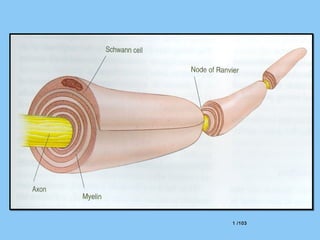
NEUROANATOMYNEUROANATOMY
1 /1031 /103
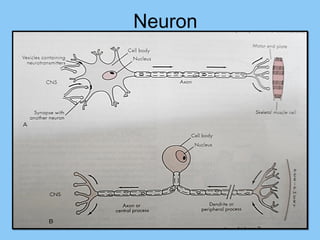
Neuron
1 /1031 /103
1 /1031 /103
ELECTROPHYSIOLOGY OF
NERVE CONDUCTION
1 /1031 /103
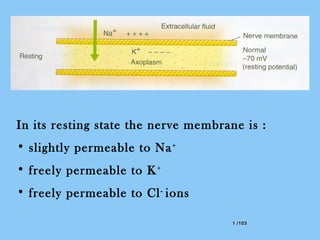
In its resting state the nerve membrane is :
• slightly permeable to Na+
• freely permeable to K+
• freely permeable to Cl-
ions
1 /1031 /103
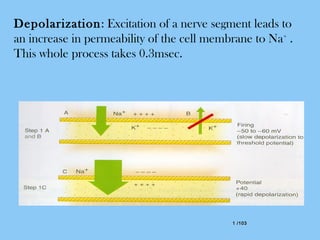
Depolarization: Excitation of a nerve segment leads to
an increase in permeability of the cell membrane to Na+
.
This whole process takes 0.3msec.
1 /1031 /103
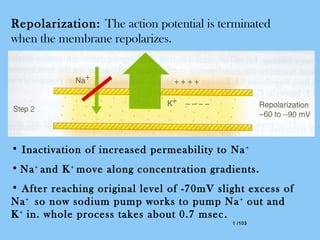
Repolarization: The action potential is terminated
when the membrane repolarizes.
• Inactivation of increased permeability to Na+
• Na+
and K+
move along concentration gradients.
• After reaching original level of -70mV slight excess of
Na+
so now sodium pump works to pump Na+
out and
K+
in. whole process takes about 0.7 msec.
1 /1031 /103
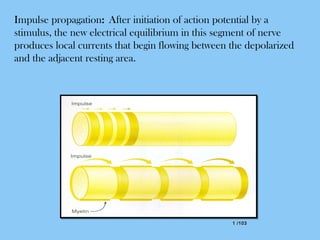
Impulse propagation: After initiation of action potential by a
stimulus, the new electrical equilibrium in this segment of nerve
produces local currents that begin flowing between the depolarized
and the adjacent resting area.
1 /1031 /103
Theories of local anaesthetic agents
1. Acetylcholine theory
2. Calcium displacement theory
3. Surface charge repulsion theory.
4. Membrane expansion theory
5. Specific receptor theory
1 /1031 /103
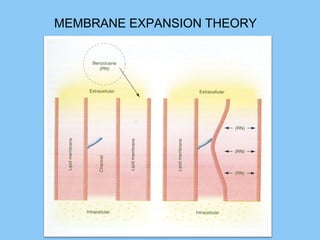
MEMBRANE EXPANSION THEORY
1 /1031 /103
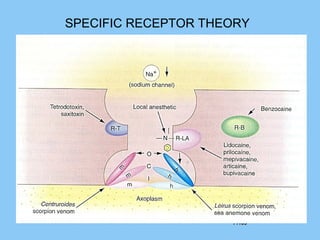
SPECIFIC RECEPTOR THEORY
1 /1031 /103
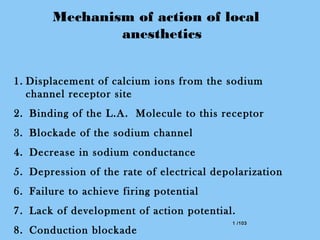
Mechanism of action of local
anesthetics
1. Displacement of calcium ions from the sodium
channel receptor site
2. Binding of the L.A. Molecule to this receptor
3. Blockade of the sodium channel
4. Decrease in sodium conductance
5. Depression of the rate of electrical depolarization
6. Failure to achieve firing potential
7. Lack of development of action potential.
8. Conduction blockade
1 /1031 /103
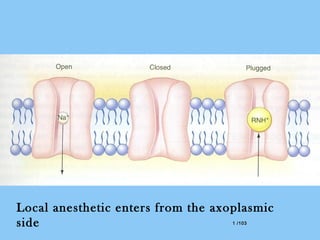
Local anesthetic enters from the axoplasmic
side
1 /1031 /103
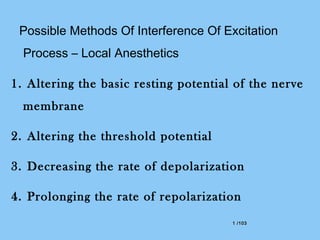
Possible Methods Of Interference Of Excitation
Process – Local Anesthetics
1. Altering the basic resting potential of the nerve
membrane
2. Altering the threshold potential
3. Decreasing the rate of depolarization
4. Prolonging the rate of repolarization
1 /1031 /103
PROPERTIES OF LOCAL ANESTHETICS
1. Non irritating to tissue to which it is applied
2. Not cause any permanent alteration of nerve
structure
3. Its systemic toxicity should be low
4. It must be effective regardless of whether it is
injected into the tissue or applied locally to
mucous membranes
5. Time of onset of anesthesia should be short
6. The duration of action should be long enough to
permit the completion of procedure
1 /1031 /103
7.It should have the potency sufficient to give
complete anesthesia with out the use of harmful
concentrated solutions
8.It should be free from producing allergic reactions
9.It should be free in solution and relatively undergo
biotransformation in the body
10.It should be either sterile or be capable of being
sterilized by heat with out deterioration
1 /1031 /103
PHARMACOLOGY
Acc to Chemical Structure
Ester group
• Cocaine
• Benzocaine
• Tetracaine
• Piperocaine
• Procaine
• Chloroprocaine
• Propoxycaine
Amide group
• Lidocaine
• Bupivacaine
• Mepivacaine
• Etidocaine
• Prilocaine
• Articaine
Quinoline
• centbucridine
1 /1031 /103
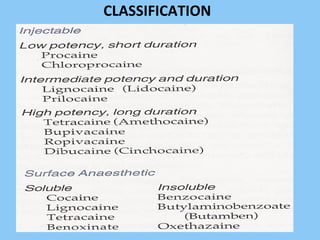
CLASSIFICATION
1 /1031 /103
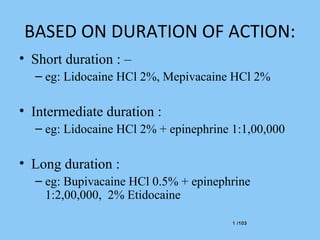
BASED ON DURATION OF ACTION:
• Short duration : –
– eg: Lidocaine HCl 2%, Mepivacaine HCl 2%
• Intermediate duration :
– eg: Lidocaine HCl 2% + epinephrine 1:1,00,000
• Long duration :
– eg: Bupivacaine HCl 0.5% + epinephrine
1:2,00,000, 2% Etidocaine
1 /1031 /103
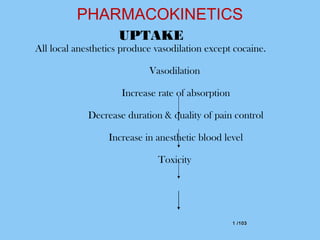
PHARMACOKINETICS
UPTAKE
All local anesthetics produce vasodilation except cocaine.
Vasodilation
Increase rate of absorption
Decrease duration & quality of pain control
Increase in anesthetic blood level
Toxicity
1 /1031 /103
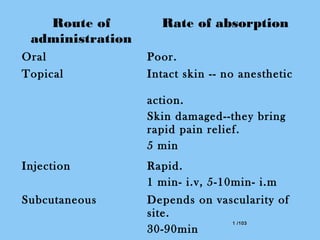
Route of
administration
Rate of absorption
Oral Poor.
Topical Intact skin -- no anesthetic
action.
Skin damaged--they bring
rapid pain relief.
5 min
Injection Rapid.
1 min- i.v, 5-10min- i.m
Subcutaneous Depends on vascularity of
site.
30-90min
1 /1031 /103
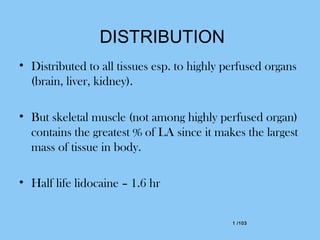
DISTRIBUTION
• Distributed to all tissues esp. to highly perfused organs
(brain, liver, kidney).
• But skeletal muscle (not among highly perfused organ)
contains the greatest % of LA since it makes the largest
mass of tissue in body.
• Half life lidocaine – 1.6 hr
1 /1031 /103
BLOOD LEVEL OF LA DEPENDS ON
• Rate at which the drug is absorbed in systemic
circulation
• Rate at which the drug is distributed from blood
vessels to the tissues
• Rate at which the drug is metabolised and excreted
1 /1031 /103
Metabolism
•Agents with ester type linkage are metabolized by a
pseudocholinesterase found in liver as well as plasma.
•Agents with amide type linkage are metabolized in
liver by a hydrolytic process.
1 /1031 /103
EXCRETION
• Mainly excreted by kidney.
• Esters appear in small concentration.
• Amides are present in urine as parent compound .
1 /1031 /103
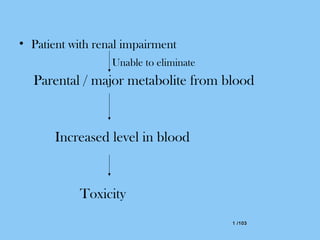
• Patient with renal impairment
Unable to eliminate
Parental / major metabolite from blood
Increased level in blood
Toxicity
1 /1031 /103
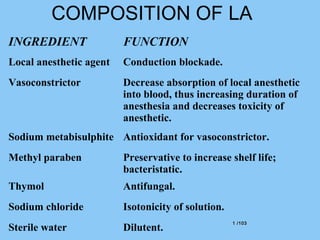
COMPOSITION OF LA
INGREDIENT FUNCTION
Local anesthetic agent Conduction blockade.
Vasoconstrictor Decrease absorption of local anesthetic
into blood, thus increasing duration of
anesthesia and decreases toxicity of
anesthetic.
Sodium metabisulphite Antioxidant for vasoconstrictor.
Methyl paraben Preservative to increase shelf life;
bacteristatic.
Thymol Antifungal.
Sodium chloride Isotonicity of solution.
Sterile water Dilutent.
1 /1031 /103
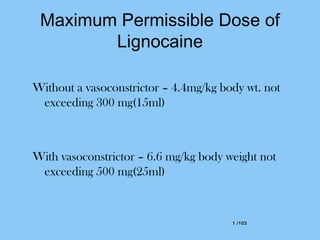
Maximum Permissible Dose of
Lignocaine
Without a vasoconstrictor – 4.4mg/kg body wt. not
exceeding 300 mg(15ml)
With vasoconstrictor – 6.6 mg/kg body weight not
exceeding 500 mg(25ml)
1 /1031 /103
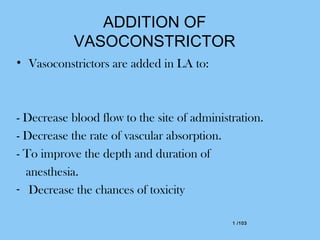
ADDITION OF
VASOCONSTRICTOR
• Vasoconstrictors are added in LA to:
- Decrease blood flow to the site of administration.
- Decrease the rate of vascular absorption.
- To improve the depth and duration of
anesthesia.
- Decrease the chances of toxicity
1 /1031 /103
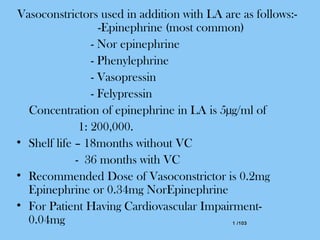
Vasoconstrictors used in addition with LA are as follows:-
-Epinephrine (most common)
- Nor epinephrine
- Phenylephrine
- Vasopressin
- Felypressin
Concentration of epinephrine in LA is 5µg/ml of
1: 200,000.
• Shelf life – 18months without VC
- 36 months with VC
• Recommended Dose of Vasoconstrictor is 0.2mg
Epinephrine or 0.34mg NorEpinephrine
• For Patient Having Cardiovascular Impairment-
0.04mg
1 /1031 /103
Local anesthetics in periodontal surgery
• Infiltration of 2% lidocaine with 1:50,000 epinephrine during
periodontal surgery reduces blood loss by about 50% compared to
2% lidocaine with 1:100,000 epinephrine
(Dionne RA, Wirdzek PR, J Am Dent Assoc 1984)
• A clinical trial of periodontal surgery comparing 1.5% etidocaine
1:200,000 epinephrine to 2% lidocaine 1:100,000 epinephrine
reported greater bleeding with the lower epinephrine formulation
(Crout RJ, Koraido G, Anesth Prog 1990)
1 /1031 /103
• A study found that articaine, administered as a 4% formulation,
may provide superior infiltration properties
(Kanaa MD, Whitworth JM, Corbett IP, J Endod 2006)
• Articaine, as well as prilocaine, have been reported to have slightly
higher incidence of mandibular and lingual paresthesia following
mandibular blocks
(Haas DA, Lennon D, J Can Dent Assoc 1995)
• When compared to the 1:200,000 epinephrine formulation, the
1:100,000 epinephrine formulation of 4% articaine has been found to
provide better visualization of the surgical field and less blood loss
(Moore PA, Delie RA, JOP 2007)
1 /1031 /103
Armamentarium
• 3 Essential Components:
• i) Syringe
• ii)Needle
• iii)Cartridge
1 /1031 /103
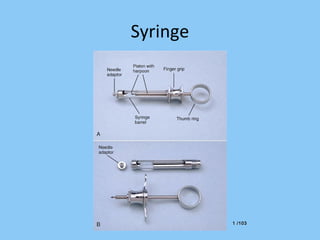
Types Of Syringes in Dentistry
• 1. NonDisposable Syringes
• 2. Disposable Syringes
• 3. Safety Syringes
• 4. Computer Controlled Local Anesthetic
Delivery Systems
1 /1031 /103
Syringe
1 /1031 /103
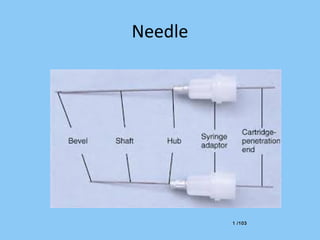
Needle
1 /1031 /103
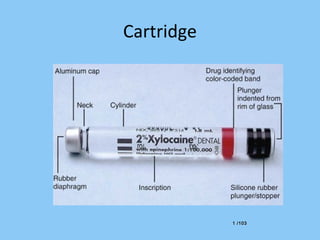
Cartridge
1 /1031 /103
•Nerve block
•Field block
•Local infiltration
•Intra ligamentary injection
•Intra osseous injection
1 /1031 /103
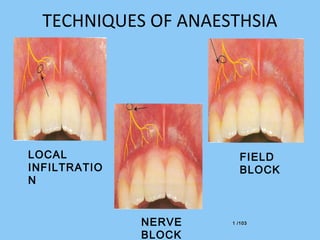
TECHNIQUES OF ANAESTHSIA
LOCAL
INFILTRATIO
N
FIELD
BLOCK
NERVE
BLOCK
1 /1031 /103
Maxillary anesthesia
•Infraorbital nerve block
•Posterior superior nerve block
•Nasopalatine nerve block
•Greater palatine nerve block
•Maxillary nerve block
1 /1031 /103
INFRA ORBITAL NERVE BLOCK
 Nerves anesthetizedNerves anesthetized
• InfraorbitalInfraorbital
• Anterior & middle superior alveolar nervesAnterior & middle superior alveolar nerves
• Inferior palpebralInferior palpebral
• Lateral nasalLateral nasal
• Superior labial nerves.Superior labial nerves.
 Areas anaesthetizedAreas anaesthetized
• Incisors, cuspids, bicuspids & mesiobuccal root of 1Incisors, cuspids, bicuspids & mesiobuccal root of 1stst
molarmolar
• Upper lipUpper lip
• Lower eyelidLower eyelid
• Portion of nose on same sidePortion of nose on same side
1 /1031 /103
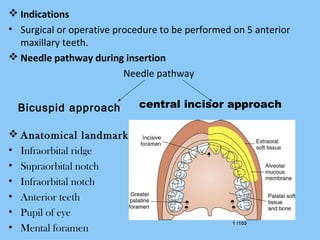
 Indications
• Surgical or operative procedure to be performed on 5 anterior
maxillary teeth.
 Needle pathway during insertion
Needle pathway
central incisor approach
 Anatomical landmark
• Infraorbital ridge
• Supraorbital notch
• Infraorbital notch
• Anterior teeth
• Pupil of eye
• Mental foramen
Bicuspid approach
1 /1031 /103
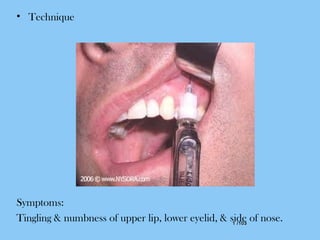
• Technique
Symptoms:
Tingling & numbness of upper lip, lower eyelid, & side of nose.
1 /1031 /103
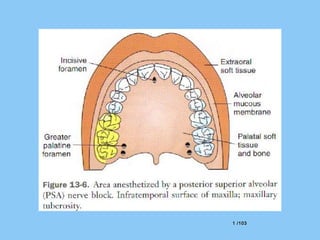
Posterior superior alveolar block
 Nerve anesthetized
• Posterior superior alveolar nerve
 Area anesthetized
• Maxillary molars except mesio-buccal root of 1st
molar
• Buccal alveolar bone- periosteum, connective tissue, mucous
membrane
• Floor of Maxillary sinus
 Anatomical landmark
• Mucobuccal fold & its concavity
• zygomatic process of maxilla
1 /1031 /103
• Infratemporal surface of maxilla
• Anterior border & coronoid process of ramus of mandible.
• Tuberosity of maxilla.
 Indication
• Operative procedure in maxillary molars.
 Needle pathway during insertion
• Mucosa
• Areolar tissue
• Buccal pad fat
• Posterior fibers of buccinators muscle
1 /1031 /103
1 /1031 /103
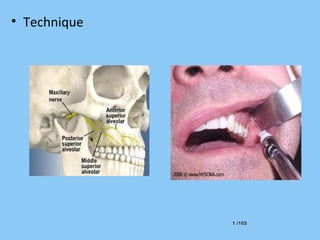
• Technique
1 /1031 /103
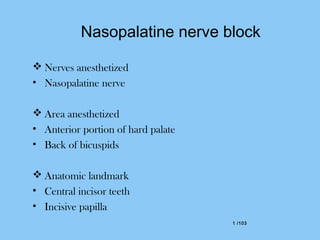
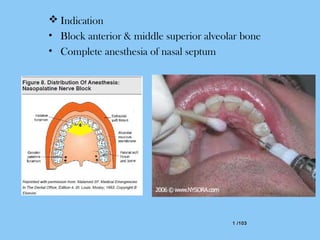
Nasopalatine nerve block
 Nerves anesthetized
• Nasopalatine nerve
 Area anesthetized
• Anterior portion of hard palate
• Back of bicuspids
 Anatomic landmark
• Central incisor teeth
• Incisive papilla
1 /1031 /103
 Indication
• Block anterior & middle superior alveolar bone
• Complete anesthesia of nasal septum
1 /1031 /103
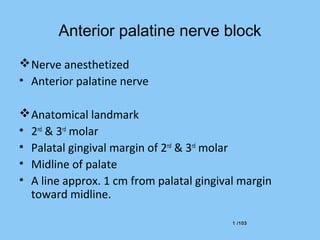
Anterior palatine nerve block
Nerve anesthetized
• Anterior palatine nerve
Anatomical landmark
• 2nd
& 3rd
molar
• Palatal gingival margin of 2nd
& 3rd
molar
• Midline of palate
• A line approx. 1 cm from palatal gingival margin
toward midline.
1 /1031 /103
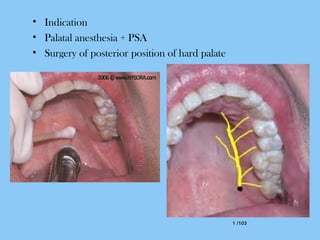
• Indication
• Palatal anesthesia + PSA
• Surgery of posterior position of hard palate
1 /1031 /103
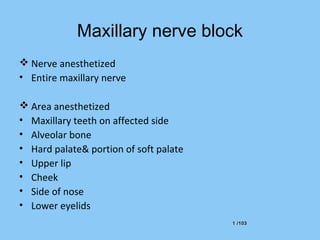
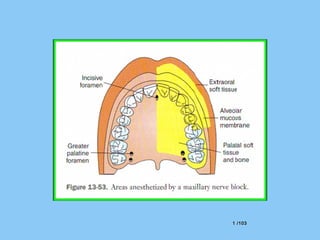
Maxillary nerve block
 Nerve anesthetized
• Entire maxillary nerve
 Area anesthetized
• Maxillary teeth on affected side
• Alveolar bone
• Hard palate& portion of soft palate
• Upper lip
• Cheek
• Side of nose
• Lower eyelids
1 /1031 /103
1 /1031 /103
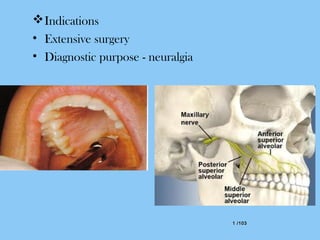
Indications
• Extensive surgery
• Diagnostic purpose - neuralgia
1 /1031 /103
Mandibular nerve block
• Inferior alveolar nerve block
• Mental nerve block
• Long buccal nerve block
• Gow gate
• Vazirani akinosi nerve block
1 /1031 /103
Classical inferior alveolar nerve block
Nerve anesthetized
• Inferior alveolar nerve
• Lingual nerve
• Buccinator nerves
Areas anesthetized
• Body of mandible & an inferior portion of ramus
• Mandibular teeth
• Mucoperiosteum anterior to the 1st
mandibular molar
1 /1031 /103
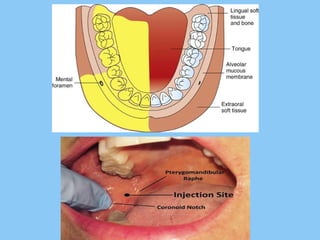
Anatomical landmark
•Mucobuccal fold
•Anterior border of ramus
•External oblique ridge
•Retromolar triangle
•Internal oblique ridge
•Pterygomandibular ligament
•Buccal sucking pad
•Pterygomandibular space
1 /1031 /103
1 /1031 /103
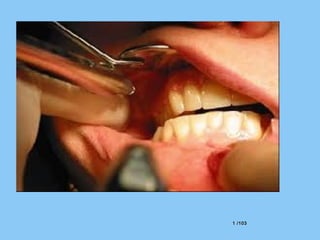
Vazirani Akinosi nerve block
 Nerve anesthetized
• Inferior alveolar nerve & its subdivision
• Lingual nerve, Buccal nerve
• Mental nerve
• Incisive nerve
 Area anesthetized
• All mandibular hard & soft tissue to midline- floor of mouth,
anterior 2/3rd
of tongue
 Anatomical landmark
• Occlusal plane of occluding teeth
• Mucogingival junction of maxillary molars
• Anterior border of ramus
1 /1031 /103
1 /1031 /103
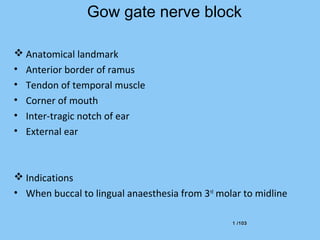
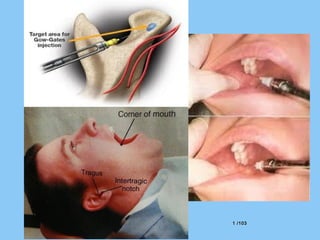
Gow gate nerve block
 Anatomical landmark
• Anterior border of ramus
• Tendon of temporal muscle
• Corner of mouth
• Inter-tragic notch of ear
• External ear
 Indications
• When buccal to lingual anaesthesia from 3rd
molar to midline
1 /1031 /103
1 /1031 /103
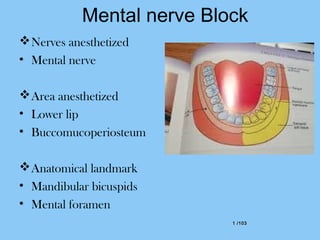
Mental nerve Block
Nerves anesthetized
• Mental nerve
Area anesthetized
• Lower lip
• Buccomucoperiosteum
Anatomical landmark
• Mandibular bicuspids
• Mental foramen
1 /1031 /103
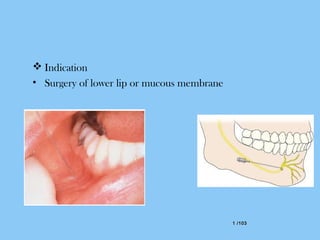
 Indication
• Surgery of lower lip or mucous membrane
1 /1031 /103
Long buccal nerve
Nerve anesthetized
• Buccinator nerve
Areas anesthetized
• Buccal mucous membrane & mucoperiosteum of
mandibular molar
Anatomical landmark
• External oblique ridge
• Retromolar pad area
1 /1031 /103
1 /1031 /103
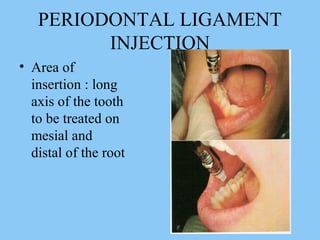
PERIODONTAL LIGAMENT
INJECTION
• Area of
insertion : long
axis of the tooth
to be treated on
mesial and
distal of the root
1 /1031 /103
Local complications
• Needle breakage
• Paresthesia
• Facial nerve paralysis
• Muscle trismus
• Soft tissue injury
• Hematoma
• Pain on injection
• Burning on injection
• Infection
• Edema
• Sloughing / tissue necrosis
• Post anesthetic intraoral lesion
1 /1031 /103
Systemic complications
• Syncope
• Toxicity
• Hypersensitivity / allergy
• Idiosyncrasy
• Malignant hyperthermia
• Drug interaction
• Other systemic conditions.
1 /1031 /103
1 /1031 /103
Thanks….!!

Local anesthesia

  • 1.
    1 /1031 /103 Local anesthesia DrAbhishek Shah M.D.S – part 1M.D.S – part 1
  • 2.
    1 /1031 /103 DEFINITION Itis defined as a loss of sensation in a circumscribed area of the body caused by a depression of excitation in nerve endings or an inhibition of the conduction process in peripheral nerves. - Covino BG, Vasallo HG (1976)
  • 3.
    1 /1031 /103 HISTORY •Local anesthesia(LA) was developed by Carl Koller in 1884. • Procaine - Alfred Einhorn and Richard Willstadter in 1905. • In 1901, epinephrine was first used as a vasoconstrictor in conjugation with LA solution.
  • 4.
    1 /1031 /103 METHODSOF INDUCING LOCAL ANESTHESIA: Mechanical trauma Low temperature Anoxia Chemical irritants Neurolytic agents such as alcohol and phenol Chemical agents such as local anesthetics
  • 5.
  • 6.
  • 7.
  • 8.
    1 /1031 /103 ELECTROPHYSIOLOGYOF NERVE CONDUCTION
  • 9.
    1 /1031 /103 Inits resting state the nerve membrane is : • slightly permeable to Na+ • freely permeable to K+ • freely permeable to Cl- ions
  • 10.
    1 /1031 /103 Depolarization:Excitation of a nerve segment leads to an increase in permeability of the cell membrane to Na+ . This whole process takes 0.3msec.
  • 11.
    1 /1031 /103 Repolarization:The action potential is terminated when the membrane repolarizes. • Inactivation of increased permeability to Na+ • Na+ and K+ move along concentration gradients. • After reaching original level of -70mV slight excess of Na+ so now sodium pump works to pump Na+ out and K+ in. whole process takes about 0.7 msec.
  • 12.
    1 /1031 /103 Impulsepropagation: After initiation of action potential by a stimulus, the new electrical equilibrium in this segment of nerve produces local currents that begin flowing between the depolarized and the adjacent resting area.
  • 13.
    1 /1031 /103 Theoriesof local anaesthetic agents 1. Acetylcholine theory 2. Calcium displacement theory 3. Surface charge repulsion theory. 4. Membrane expansion theory 5. Specific receptor theory
  • 14.
    1 /1031 /103 MEMBRANEEXPANSION THEORY
  • 15.
    1 /1031 /103 SPECIFICRECEPTOR THEORY
  • 16.
    1 /1031 /103 Mechanismof action of local anesthetics 1. Displacement of calcium ions from the sodium channel receptor site 2. Binding of the L.A. Molecule to this receptor 3. Blockade of the sodium channel 4. Decrease in sodium conductance 5. Depression of the rate of electrical depolarization 6. Failure to achieve firing potential 7. Lack of development of action potential. 8. Conduction blockade
  • 17.
    1 /1031 /103 Localanesthetic enters from the axoplasmic side
  • 18.
    1 /1031 /103 PossibleMethods Of Interference Of Excitation Process – Local Anesthetics 1. Altering the basic resting potential of the nerve membrane 2. Altering the threshold potential 3. Decreasing the rate of depolarization 4. Prolonging the rate of repolarization
  • 19.
    1 /1031 /103 PROPERTIESOF LOCAL ANESTHETICS 1. Non irritating to tissue to which it is applied 2. Not cause any permanent alteration of nerve structure 3. Its systemic toxicity should be low 4. It must be effective regardless of whether it is injected into the tissue or applied locally to mucous membranes 5. Time of onset of anesthesia should be short 6. The duration of action should be long enough to permit the completion of procedure
  • 20.
    1 /1031 /103 7.Itshould have the potency sufficient to give complete anesthesia with out the use of harmful concentrated solutions 8.It should be free from producing allergic reactions 9.It should be free in solution and relatively undergo biotransformation in the body 10.It should be either sterile or be capable of being sterilized by heat with out deterioration
  • 21.
    1 /1031 /103 PHARMACOLOGY Accto Chemical Structure Ester group • Cocaine • Benzocaine • Tetracaine • Piperocaine • Procaine • Chloroprocaine • Propoxycaine Amide group • Lidocaine • Bupivacaine • Mepivacaine • Etidocaine • Prilocaine • Articaine Quinoline • centbucridine
  • 22.
  • 23.
    1 /1031 /103 BASEDON DURATION OF ACTION: • Short duration : – – eg: Lidocaine HCl 2%, Mepivacaine HCl 2% • Intermediate duration : – eg: Lidocaine HCl 2% + epinephrine 1:1,00,000 • Long duration : – eg: Bupivacaine HCl 0.5% + epinephrine 1:2,00,000, 2% Etidocaine
  • 24.
    1 /1031 /103 PHARMACOKINETICS UPTAKE Alllocal anesthetics produce vasodilation except cocaine. Vasodilation Increase rate of absorption Decrease duration & quality of pain control Increase in anesthetic blood level Toxicity
  • 25.
    1 /1031 /103 Routeof administration Rate of absorption Oral Poor. Topical Intact skin -- no anesthetic action. Skin damaged--they bring rapid pain relief. 5 min Injection Rapid. 1 min- i.v, 5-10min- i.m Subcutaneous Depends on vascularity of site. 30-90min
  • 26.
    1 /1031 /103 DISTRIBUTION •Distributed to all tissues esp. to highly perfused organs (brain, liver, kidney). • But skeletal muscle (not among highly perfused organ) contains the greatest % of LA since it makes the largest mass of tissue in body. • Half life lidocaine – 1.6 hr
  • 27.
    1 /1031 /103 BLOODLEVEL OF LA DEPENDS ON • Rate at which the drug is absorbed in systemic circulation • Rate at which the drug is distributed from blood vessels to the tissues • Rate at which the drug is metabolised and excreted
  • 28.
    1 /1031 /103 Metabolism •Agentswith ester type linkage are metabolized by a pseudocholinesterase found in liver as well as plasma. •Agents with amide type linkage are metabolized in liver by a hydrolytic process.
  • 29.
    1 /1031 /103 EXCRETION •Mainly excreted by kidney. • Esters appear in small concentration. • Amides are present in urine as parent compound .
  • 30.
    1 /1031 /103 •Patient with renal impairment Unable to eliminate Parental / major metabolite from blood Increased level in blood Toxicity
  • 31.
    1 /1031 /103 COMPOSITIONOF LA INGREDIENT FUNCTION Local anesthetic agent Conduction blockade. Vasoconstrictor Decrease absorption of local anesthetic into blood, thus increasing duration of anesthesia and decreases toxicity of anesthetic. Sodium metabisulphite Antioxidant for vasoconstrictor. Methyl paraben Preservative to increase shelf life; bacteristatic. Thymol Antifungal. Sodium chloride Isotonicity of solution. Sterile water Dilutent.
  • 32.
    1 /1031 /103 MaximumPermissible Dose of Lignocaine Without a vasoconstrictor – 4.4mg/kg body wt. not exceeding 300 mg(15ml) With vasoconstrictor – 6.6 mg/kg body weight not exceeding 500 mg(25ml)
  • 33.
    1 /1031 /103 ADDITIONOF VASOCONSTRICTOR • Vasoconstrictors are added in LA to: - Decrease blood flow to the site of administration. - Decrease the rate of vascular absorption. - To improve the depth and duration of anesthesia. - Decrease the chances of toxicity
  • 34.
    1 /1031 /103 Vasoconstrictorsused in addition with LA are as follows:- -Epinephrine (most common) - Nor epinephrine - Phenylephrine - Vasopressin - Felypressin Concentration of epinephrine in LA is 5µg/ml of 1: 200,000. • Shelf life – 18months without VC - 36 months with VC • Recommended Dose of Vasoconstrictor is 0.2mg Epinephrine or 0.34mg NorEpinephrine • For Patient Having Cardiovascular Impairment- 0.04mg
  • 35.
    1 /1031 /103 Localanesthetics in periodontal surgery • Infiltration of 2% lidocaine with 1:50,000 epinephrine during periodontal surgery reduces blood loss by about 50% compared to 2% lidocaine with 1:100,000 epinephrine (Dionne RA, Wirdzek PR, J Am Dent Assoc 1984) • A clinical trial of periodontal surgery comparing 1.5% etidocaine 1:200,000 epinephrine to 2% lidocaine 1:100,000 epinephrine reported greater bleeding with the lower epinephrine formulation (Crout RJ, Koraido G, Anesth Prog 1990)
  • 36.
    1 /1031 /103 •A study found that articaine, administered as a 4% formulation, may provide superior infiltration properties (Kanaa MD, Whitworth JM, Corbett IP, J Endod 2006) • Articaine, as well as prilocaine, have been reported to have slightly higher incidence of mandibular and lingual paresthesia following mandibular blocks (Haas DA, Lennon D, J Can Dent Assoc 1995) • When compared to the 1:200,000 epinephrine formulation, the 1:100,000 epinephrine formulation of 4% articaine has been found to provide better visualization of the surgical field and less blood loss (Moore PA, Delie RA, JOP 2007)
  • 37.
    1 /1031 /103 Armamentarium •3 Essential Components: • i) Syringe • ii)Needle • iii)Cartridge
  • 38.
    1 /1031 /103 TypesOf Syringes in Dentistry • 1. NonDisposable Syringes • 2. Disposable Syringes • 3. Safety Syringes • 4. Computer Controlled Local Anesthetic Delivery Systems
  • 39.
  • 40.
  • 41.
  • 42.
    1 /1031 /103 •Nerveblock •Field block •Local infiltration •Intra ligamentary injection •Intra osseous injection
  • 43.
    1 /1031 /103 TECHNIQUESOF ANAESTHSIA LOCAL INFILTRATIO N FIELD BLOCK NERVE BLOCK
  • 44.
    1 /1031 /103 Maxillaryanesthesia •Infraorbital nerve block •Posterior superior nerve block •Nasopalatine nerve block •Greater palatine nerve block •Maxillary nerve block
  • 45.
    1 /1031 /103 INFRAORBITAL NERVE BLOCK  Nerves anesthetizedNerves anesthetized • InfraorbitalInfraorbital • Anterior & middle superior alveolar nervesAnterior & middle superior alveolar nerves • Inferior palpebralInferior palpebral • Lateral nasalLateral nasal • Superior labial nerves.Superior labial nerves.  Areas anaesthetizedAreas anaesthetized • Incisors, cuspids, bicuspids & mesiobuccal root of 1Incisors, cuspids, bicuspids & mesiobuccal root of 1stst molarmolar • Upper lipUpper lip • Lower eyelidLower eyelid • Portion of nose on same sidePortion of nose on same side
  • 46.
    1 /1031 /103 Indications • Surgical or operative procedure to be performed on 5 anterior maxillary teeth.  Needle pathway during insertion Needle pathway central incisor approach  Anatomical landmark • Infraorbital ridge • Supraorbital notch • Infraorbital notch • Anterior teeth • Pupil of eye • Mental foramen Bicuspid approach
  • 47.
    1 /1031 /103 •Technique Symptoms: Tingling & numbness of upper lip, lower eyelid, & side of nose.
  • 48.
    1 /1031 /103 Posteriorsuperior alveolar block  Nerve anesthetized • Posterior superior alveolar nerve  Area anesthetized • Maxillary molars except mesio-buccal root of 1st molar • Buccal alveolar bone- periosteum, connective tissue, mucous membrane • Floor of Maxillary sinus  Anatomical landmark • Mucobuccal fold & its concavity • zygomatic process of maxilla
  • 49.
    1 /1031 /103 •Infratemporal surface of maxilla • Anterior border & coronoid process of ramus of mandible. • Tuberosity of maxilla.  Indication • Operative procedure in maxillary molars.  Needle pathway during insertion • Mucosa • Areolar tissue • Buccal pad fat • Posterior fibers of buccinators muscle
  • 50.
  • 51.
  • 52.
    1 /1031 /103 Nasopalatinenerve block  Nerves anesthetized • Nasopalatine nerve  Area anesthetized • Anterior portion of hard palate • Back of bicuspids  Anatomic landmark • Central incisor teeth • Incisive papilla
  • 53.
    1 /1031 /103 Indication • Block anterior & middle superior alveolar bone • Complete anesthesia of nasal septum
  • 54.
    1 /1031 /103 Anteriorpalatine nerve block Nerve anesthetized • Anterior palatine nerve Anatomical landmark • 2nd & 3rd molar • Palatal gingival margin of 2nd & 3rd molar • Midline of palate • A line approx. 1 cm from palatal gingival margin toward midline.
  • 55.
    1 /1031 /103 •Indication • Palatal anesthesia + PSA • Surgery of posterior position of hard palate
  • 56.
    1 /1031 /103 Maxillarynerve block  Nerve anesthetized • Entire maxillary nerve  Area anesthetized • Maxillary teeth on affected side • Alveolar bone • Hard palate& portion of soft palate • Upper lip • Cheek • Side of nose • Lower eyelids
  • 57.
  • 58.
    1 /1031 /103 Indications •Extensive surgery • Diagnostic purpose - neuralgia
  • 59.
    1 /1031 /103 Mandibularnerve block • Inferior alveolar nerve block • Mental nerve block • Long buccal nerve block • Gow gate • Vazirani akinosi nerve block
  • 60.
    1 /1031 /103 Classicalinferior alveolar nerve block Nerve anesthetized • Inferior alveolar nerve • Lingual nerve • Buccinator nerves Areas anesthetized • Body of mandible & an inferior portion of ramus • Mandibular teeth • Mucoperiosteum anterior to the 1st mandibular molar
  • 61.
    1 /1031 /103 Anatomicallandmark •Mucobuccal fold •Anterior border of ramus •External oblique ridge •Retromolar triangle •Internal oblique ridge •Pterygomandibular ligament •Buccal sucking pad •Pterygomandibular space
  • 62.
  • 63.
    1 /1031 /103 VaziraniAkinosi nerve block  Nerve anesthetized • Inferior alveolar nerve & its subdivision • Lingual nerve, Buccal nerve • Mental nerve • Incisive nerve  Area anesthetized • All mandibular hard & soft tissue to midline- floor of mouth, anterior 2/3rd of tongue  Anatomical landmark • Occlusal plane of occluding teeth • Mucogingival junction of maxillary molars • Anterior border of ramus
  • 64.
  • 65.
    1 /1031 /103 Gowgate nerve block  Anatomical landmark • Anterior border of ramus • Tendon of temporal muscle • Corner of mouth • Inter-tragic notch of ear • External ear  Indications • When buccal to lingual anaesthesia from 3rd molar to midline
  • 66.
  • 67.
    1 /1031 /103 Mentalnerve Block Nerves anesthetized • Mental nerve Area anesthetized • Lower lip • Buccomucoperiosteum Anatomical landmark • Mandibular bicuspids • Mental foramen
  • 68.
    1 /1031 /103 Indication • Surgery of lower lip or mucous membrane
  • 69.
    1 /1031 /103 Longbuccal nerve Nerve anesthetized • Buccinator nerve Areas anesthetized • Buccal mucous membrane & mucoperiosteum of mandibular molar Anatomical landmark • External oblique ridge • Retromolar pad area
  • 70.
  • 71.
    1 /1031 /103 PERIODONTALLIGAMENT INJECTION • Area of insertion : long axis of the tooth to be treated on mesial and distal of the root
  • 72.
    1 /1031 /103 Localcomplications • Needle breakage • Paresthesia • Facial nerve paralysis • Muscle trismus • Soft tissue injury • Hematoma • Pain on injection • Burning on injection • Infection • Edema • Sloughing / tissue necrosis • Post anesthetic intraoral lesion
  • 73.
    1 /1031 /103 Systemiccomplications • Syncope • Toxicity • Hypersensitivity / allergy • Idiosyncrasy • Malignant hyperthermia • Drug interaction • Other systemic conditions.
  • 74.
  • 75.