Local Anesthetics Dr. Hala
What are local anesthetics? Local anesthetic:  produce loss of sensation to pain in a specific area of the body without the loss of consciousness
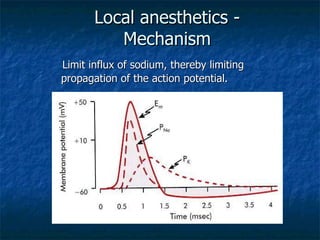
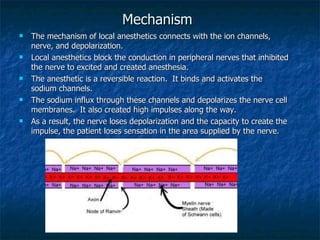
Local anesthetics - Mechanism Limit influx of sodium, thereby limiting propagation of the action potential.
Cocaine Addiction More physicians began to do research of cocaine in the clinic trials. The physician Sigmund Freud used the stimulant effect of cocaine to treat the morphine addiction in patients An ophthalmologist Carl Koller realized the importance of the alkaloid’s anesthetic effect on mucous membranes In 1884, he used the first local anesthetic on a patient with glaucoma Freud, Halsted, and Koller became addicted to the drug through self-experimentation
Procaine replaced  Novocaine  cocaine Problems procaine is the first derivative of cocaine, also known as the first synthetic local anesthetic drug Trade name is Novocaine® Took too long to set (i.e. to produce the desired anesthetic result) Wore off too quickly, not nearly as potent as cocaine Classified as an ester; esters have high potential to cause allergic reactions Caused high conc. of adrenaline resulted in increasing heart rate, make people feel nervous Most dentists preferred not to used any local anesthetic at all that time; they used nitrous oxide gas.
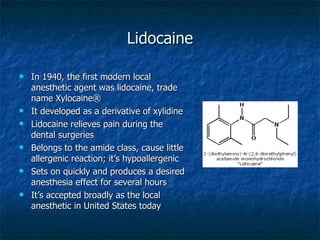
Lidocaine In 1940, the first modern local anesthetic agent was lidocaine, trade name Xylocaine® It developed as a derivative of xylidine Lidocaine relieves pain during the dental surgeries Belongs to the amide class, cause little allergenic reaction; it’s hypoallergenic Sets on quickly and produces a desired anesthesia effect for several hours It’s accepted broadly as the local anesthetic in United States today
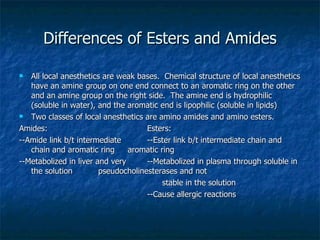
Differences of Esters and Amides All local anesthetics are weak bases.  Chemical structure of local anesthetics have an amine group on one end connect to an aromatic ring on the other and an amine group on the right side.  The amine end is hydrophilic (soluble in water), and the aromatic end is lipophilic (soluble in lipids) Two classes of local anesthetics are amino amides and amino esters. Amides: Esters: --Amide link b/t intermediate --Ester link b/t intermediate chain and chain and aromatic ring   aromatic ring --Metabolized in liver and very --Metabolized in plasma through soluble in the solution   pseudocholinesterases and not   stable in the solution --Cause allergic reactions
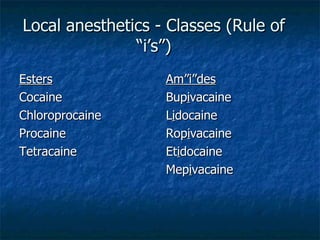
Local anesthetics - Classes (Rule of “i’s”) Esters Cocaine Chloroprocaine Procaine Tetracaine Am”i”des Bup i vacaine L i docaine Rop i vacaine Et i docaine Mep i vacaine
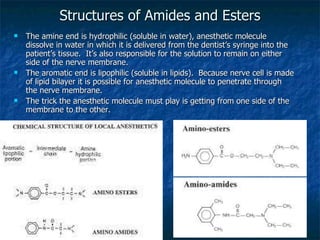
Structures of Amides and Esters The amine end is hydrophilic (soluble in water), anesthetic molecule dissolve in water in which it is delivered from the dentist’s syringe into the patient’s tissue.  It’s also responsible for the solution to remain on either side of the nerve membrane.  The aromatic end is lipophilic (soluble in lipids).  Because nerve cell is made of lipid bilayer it is possible for anesthetic molecule to penetrate through the nerve membrane.  The trick the anesthetic molecule must play is getting from one side of the membrane to the other.
Mechanism The mechanism of local anesthetics connects with the ion channels, nerve, and depolarization. Local anesthetics block the conduction in peripheral nerves that inhibited the nerve to excited and created anesthesia. The anesthetic is a reversible reaction.  It binds and activates the sodium channels. The sodium influx through these channels and depolarizes the nerve cell membranes.  It also created high impulses along the way. As a result, the nerve loses depolarization and the capacity to create the impulse, the patient loses sensation in the area supplied by the nerve.
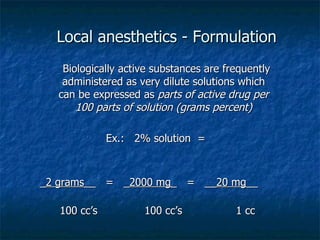
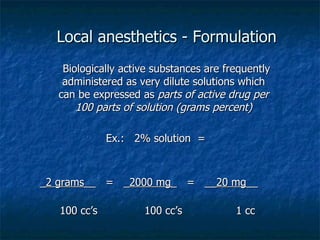
Local anesthetics - Formulation Biologically active substances are frequently administered as very dilute solutions which can be expressed as  parts of active drug per 100 parts of solution (grams percent) Ex.:  2% solution  = _ 2 grams __  =  _ 2000 mg _  =  __ 20 mg __  100 cc’s  100 cc’s  1 cc
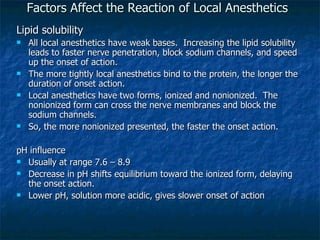
Factors Affect the Reaction of Local Anesthetics Lipid solubility All local anesthetics have weak bases.  Increasing the lipid solubility leads to faster nerve penetration, block sodium channels, and speed up the onset of action. The more tightly local anesthetics bind to the protein, the longer the duration of onset action. Local anesthetics have two forms, ionized and nonionized.  The nonionized form can cross the nerve membranes and block the sodium channels.  So, the more nonionized presented, the faster the onset action. pH influence Usually at range 7.6 – 8.9 Decrease in pH shifts equilibrium toward the ionized form, delaying the onset action. Lower pH, solution more acidic, gives slower onset of action
Factors Affect the Reaction of Local Anesthetics (cont.) Vasodilation Vasoconstrictor is a substance used to keep the anesthetic solution in place at a longer period and prolongs the action of the drug vasoconstrictor delays the absorption which slows down the absorption into the bloodstream  Lower vasodilator activity of a local anesthetic leads to a slower absorption and longer duration of action Vasoconstrictor used the naturally hormone called epinephrine (adrenaline).  Epinephrine decreases vasodilator. Side effects of epinephrine Epinephrine circulates the heart, causes the heart beat stronger and faster, and makes people feel nervous.
Toxicity Toxicity is the peak circulation levels of local anesthetics Levels of local anesthetic concentration administered to patients are varied according to age, weight, and health. Maximum dose for an individual is usually between 70mg to 500mg The amount of dose also varied based on the type of solution used and the presence of vasoconstrictor Example: ---For adult whose weight is 150lbs and up, maximum dose Articaine and lidocaine is about 500mg ---For children, the dosage reduced to about 1/3 to ½ depending on their weight. The doses are not considered lethal. Some common toxic effects: --light headedness ---shivering or twitching --seizures --hypotension (low blood pressure) --numbness
Local Anesthetics - Allergy True allergy is very rare Most reactions are from ester class - ester hydrolysis (normal metabolism) leads to formation of PABA - like compounds Patient reports of “allergy” are frequently due to previous intravascular injections
Local Anesthetics - Toxicity Tissue toxicity - Rare Can occur  if administered in high enough concentrations (greater than those used clinically) Usually related to preservatives added to solution Systemic toxicity - Rare Related to blood level of drug secondary to absorption from site of injection. Range from lightheadedness, tinnitus to seizures and CNS/cardiovascular collapse
Factors of circulation levels Factors of circulation levels are the rates of absorption, distribution, and metabolism. Absorption depends on the speed of administration and levels of the doses. Distribution allows absorption to occur in three phases.  First, the drug occurs at highly vascular tissues in the lungs and kidneys.  Then it appears less in vascular muscle and fat.  Then the drug is metabolized. Metabolism involves in the chemical structure based on two classes, amide and ester as discussed earlier. Decreasing the potential toxicity resulted in rapid metabolism.
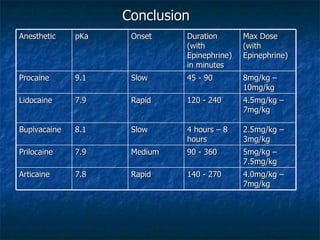
Conclusion Anesthetic pKa Onset  Duration (with Epinephrine) in minutes Max Dose (with Epinephrine) Procaine 9.1 Slow 45 - 90 8mg/kg – 10mg/kg Lidocaine 7.9 Rapid 120 - 240 4.5mg/kg – 7mg/kg Bupivacaine 8.1 Slow 4 hours – 8 hours 2.5mg/kg – 3mg/kg Prilocaine 7.9 Medium 90 - 360 5mg/kg – 7.5mg/kg Articaine 7.8 Rapid 140 - 270 4.0mg/kg – 7mg/kg
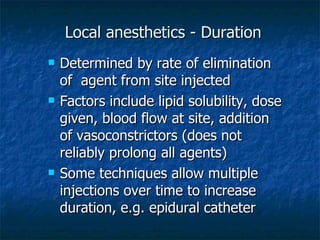
Local anesthetics - Duration Determined by rate of elimination of  agent from site injected Factors include lipid solubility, dose given, blood flow at site, addition of vasoconstrictors (does not reliably prolong all agents) Some techniques allow multiple injections over time to increase duration, e.g. epidural catheter
Vasoconstrictors
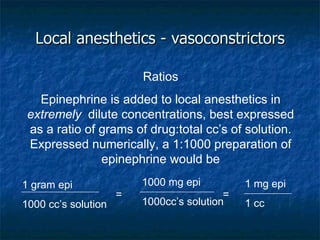
Local anesthetics - vasoconstrictors Ratios Epinephrine is added to local anesthetics in  extremely  dilute concentrations, best expressed as a ratio of grams of drug:total cc’s of solution. Expressed numerically, a 1:1000 preparation of epinephrine would be 1 gram epi 1000 cc’s solution 1000 mg epi 1000cc’s solution = 1 mg epi 1 cc =
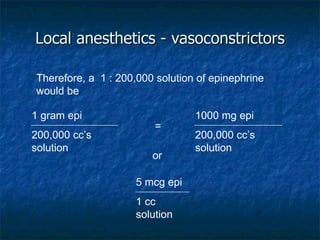
Local anesthetics - vasoconstrictors Therefore, a  1 : 200,000 solution of epinephrine would be = or 5 mcg epi 1 cc solution 1 gram epi 200,000 cc’s solution 1000 mg epi 200,000 cc’s solution
Local anesthetics - vasoconstrictors Vasoconstrictors should not be used in the following locations Fingers Toes Nose Ear lobes Penis
REGIONAL ANESTHESIA
Regional anesthesia - Definition Rendering a specific area of the body, e.g. foot, arm, lower extremities, insensate to stimulus of surgery or other instrumentation
Regional anesthesia - Uses Provide anesthesia for a surgical procedure  Provide analgesia post-operatively or during labor and delivery Diagnosis or therapy for patients with chronic pain syndromes
Regional anesthesia - types Topical Local/Field Intravenous block (“Bier” block) Peripheral (named) nerve, e.g. radial n. Plexus - brachial, lumbar Central neuraxial - epidural, spinal
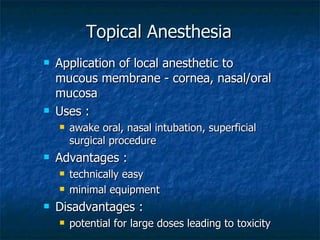
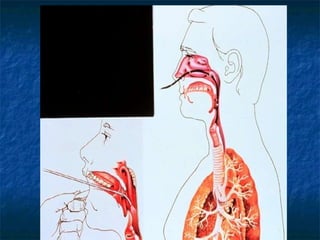
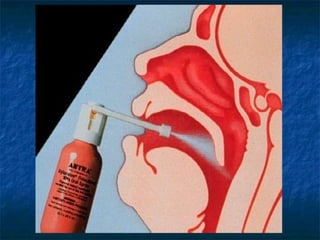
Topical Anesthesia Application of local anesthetic to mucous membrane - cornea, nasal/oral mucosa Uses :  awake oral, nasal intubation, superficial surgical procedure Advantages : technically easy minimal equipment Disadvantages : potential for large doses leading to toxicity
 
 
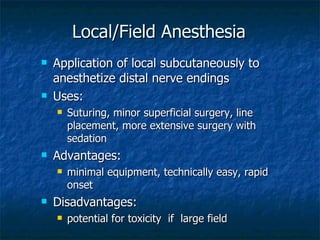
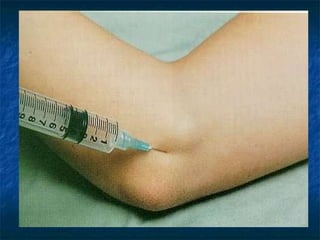
Local/Field Anesthesia Application of local subcutaneously to anesthetize distal nerve endings Uses: Suturing, minor superficial surgery, line placement, more extensive surgery with sedation Advantages: minimal equipment, technically easy, rapid onset Disadvantages: potential for toxicity  if  large field
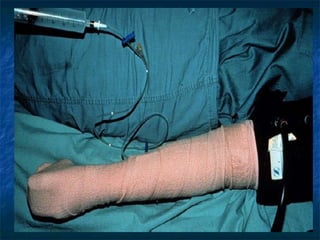
IV Block - “Bier” block Injection of local anesthetic intravenously for anesthesia of an extremity Uses any  surgical procedure on an extremity Advantages: technically  simple, minimal equipment, rapid onset Disadvantages: duration limited by tolerance of  tourniquet pain, toxicity
 
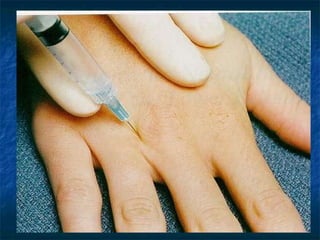
Peripheral  nerve block Injecting local anesthetic near the course of a named nerve Uses: Surgical procedures in the distribution of the blocked nerve Advantages:  relatively small dose of local anesthetic to cover large area; rapid onset Disadvantages: technical complexity, neuropathy
 
 
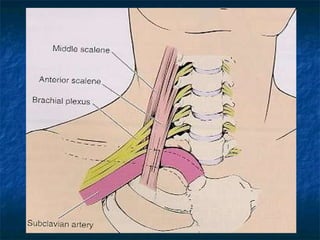
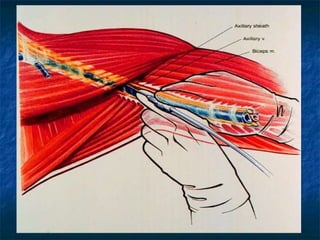
Plexus Blockade Injection of local anesthetic adjacent to a plexus, e.g cervical, brachial or lumbar plexus Uses : surgical anesthesia or post-operative analgesia in the distribution of the plexus Advantages: large area of anesthesia with relatively large dose of agent Disadvantages: technically  complex, potential for toxicity and neuropathy.
 
 
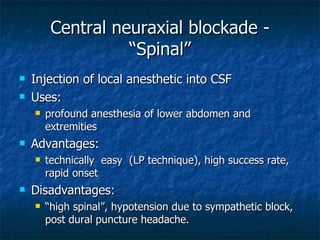
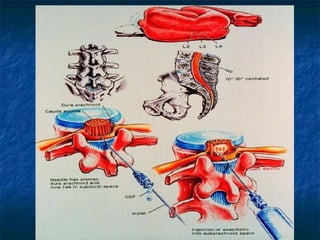
Central neuraxial blockade - “Spinal” Injection of local anesthetic into CSF Uses: profound anesthesia of lower abdomen and extremities Advantages: technically  easy  (LP technique), high success rate, rapid onset Disadvantages: “ high spinal”, hypotension due to sympathetic block, post dural puncture headache.
 
 
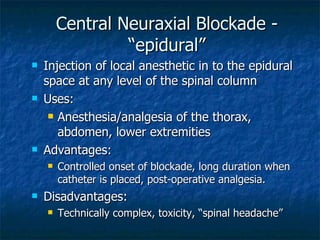
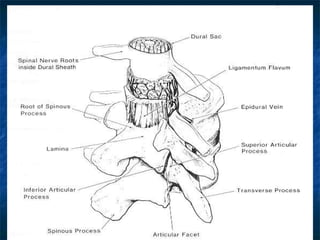
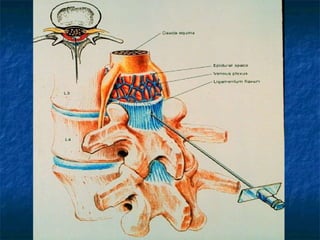
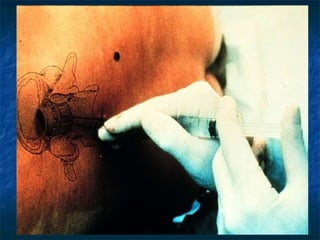
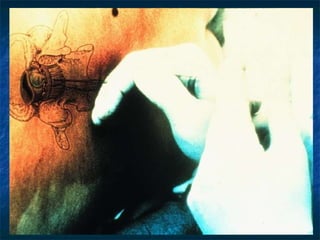
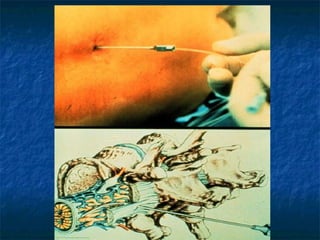
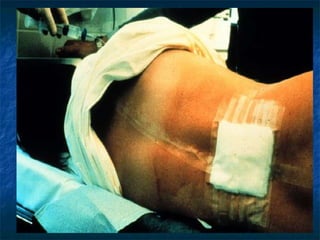
Central Neuraxial Blockade - “epidural” Injection of local anesthetic in to the epidural space at any level of the spinal column Uses: Anesthesia/analgesia of the thorax, abdomen, lower extremities Advantages: Controlled onset of blockade, long duration when catheter is placed, post-operative analgesia. Disadvantages: Technically complex, toxicity, “spinal headache”


QUESTIONS?

Local Anesthetics

  • 1.
  • 2.
    What are localanesthetics? Local anesthetic: produce loss of sensation to pain in a specific area of the body without the loss of consciousness
  • 3.
    Local anesthetics -Mechanism Limit influx of sodium, thereby limiting propagation of the action potential.
  • 4.
    Cocaine Addiction Morephysicians began to do research of cocaine in the clinic trials. The physician Sigmund Freud used the stimulant effect of cocaine to treat the morphine addiction in patients An ophthalmologist Carl Koller realized the importance of the alkaloid’s anesthetic effect on mucous membranes In 1884, he used the first local anesthetic on a patient with glaucoma Freud, Halsted, and Koller became addicted to the drug through self-experimentation
  • 5.
    Procaine replaced Novocaine cocaine Problems procaine is the first derivative of cocaine, also known as the first synthetic local anesthetic drug Trade name is Novocaine® Took too long to set (i.e. to produce the desired anesthetic result) Wore off too quickly, not nearly as potent as cocaine Classified as an ester; esters have high potential to cause allergic reactions Caused high conc. of adrenaline resulted in increasing heart rate, make people feel nervous Most dentists preferred not to used any local anesthetic at all that time; they used nitrous oxide gas.
  • 6.
    Lidocaine In 1940,the first modern local anesthetic agent was lidocaine, trade name Xylocaine® It developed as a derivative of xylidine Lidocaine relieves pain during the dental surgeries Belongs to the amide class, cause little allergenic reaction; it’s hypoallergenic Sets on quickly and produces a desired anesthesia effect for several hours It’s accepted broadly as the local anesthetic in United States today
  • 7.
    Differences of Estersand Amides All local anesthetics are weak bases. Chemical structure of local anesthetics have an amine group on one end connect to an aromatic ring on the other and an amine group on the right side. The amine end is hydrophilic (soluble in water), and the aromatic end is lipophilic (soluble in lipids) Two classes of local anesthetics are amino amides and amino esters. Amides: Esters: --Amide link b/t intermediate --Ester link b/t intermediate chain and chain and aromatic ring aromatic ring --Metabolized in liver and very --Metabolized in plasma through soluble in the solution pseudocholinesterases and not stable in the solution --Cause allergic reactions
  • 8.
    Local anesthetics -Classes (Rule of “i’s”) Esters Cocaine Chloroprocaine Procaine Tetracaine Am”i”des Bup i vacaine L i docaine Rop i vacaine Et i docaine Mep i vacaine
  • 9.
    Structures of Amidesand Esters The amine end is hydrophilic (soluble in water), anesthetic molecule dissolve in water in which it is delivered from the dentist’s syringe into the patient’s tissue. It’s also responsible for the solution to remain on either side of the nerve membrane. The aromatic end is lipophilic (soluble in lipids). Because nerve cell is made of lipid bilayer it is possible for anesthetic molecule to penetrate through the nerve membrane. The trick the anesthetic molecule must play is getting from one side of the membrane to the other.
  • 10.
    Mechanism The mechanismof local anesthetics connects with the ion channels, nerve, and depolarization. Local anesthetics block the conduction in peripheral nerves that inhibited the nerve to excited and created anesthesia. The anesthetic is a reversible reaction. It binds and activates the sodium channels. The sodium influx through these channels and depolarizes the nerve cell membranes. It also created high impulses along the way. As a result, the nerve loses depolarization and the capacity to create the impulse, the patient loses sensation in the area supplied by the nerve.
  • 11.
    Local anesthetics -Formulation Biologically active substances are frequently administered as very dilute solutions which can be expressed as parts of active drug per 100 parts of solution (grams percent) Ex.: 2% solution = _ 2 grams __ = _ 2000 mg _ = __ 20 mg __ 100 cc’s 100 cc’s 1 cc
  • 12.
    Local anesthetics -Formulation Biologically active substances are frequently administered as very dilute solutions which can be expressed as parts of active drug per 100 parts of solution (grams percent) Ex.: 2% solution = _ 2 grams __ = _ 2000 mg _ = __ 20 mg __ 100 cc’s 100 cc’s 1 cc
  • 13.
    Factors Affect theReaction of Local Anesthetics Lipid solubility All local anesthetics have weak bases. Increasing the lipid solubility leads to faster nerve penetration, block sodium channels, and speed up the onset of action. The more tightly local anesthetics bind to the protein, the longer the duration of onset action. Local anesthetics have two forms, ionized and nonionized. The nonionized form can cross the nerve membranes and block the sodium channels. So, the more nonionized presented, the faster the onset action. pH influence Usually at range 7.6 – 8.9 Decrease in pH shifts equilibrium toward the ionized form, delaying the onset action. Lower pH, solution more acidic, gives slower onset of action
  • 14.
    Factors Affect theReaction of Local Anesthetics (cont.) Vasodilation Vasoconstrictor is a substance used to keep the anesthetic solution in place at a longer period and prolongs the action of the drug vasoconstrictor delays the absorption which slows down the absorption into the bloodstream Lower vasodilator activity of a local anesthetic leads to a slower absorption and longer duration of action Vasoconstrictor used the naturally hormone called epinephrine (adrenaline). Epinephrine decreases vasodilator. Side effects of epinephrine Epinephrine circulates the heart, causes the heart beat stronger and faster, and makes people feel nervous.
  • 15.
    Toxicity Toxicity isthe peak circulation levels of local anesthetics Levels of local anesthetic concentration administered to patients are varied according to age, weight, and health. Maximum dose for an individual is usually between 70mg to 500mg The amount of dose also varied based on the type of solution used and the presence of vasoconstrictor Example: ---For adult whose weight is 150lbs and up, maximum dose Articaine and lidocaine is about 500mg ---For children, the dosage reduced to about 1/3 to ½ depending on their weight. The doses are not considered lethal. Some common toxic effects: --light headedness ---shivering or twitching --seizures --hypotension (low blood pressure) --numbness
  • 16.
    Local Anesthetics -Allergy True allergy is very rare Most reactions are from ester class - ester hydrolysis (normal metabolism) leads to formation of PABA - like compounds Patient reports of “allergy” are frequently due to previous intravascular injections
  • 17.
    Local Anesthetics -Toxicity Tissue toxicity - Rare Can occur if administered in high enough concentrations (greater than those used clinically) Usually related to preservatives added to solution Systemic toxicity - Rare Related to blood level of drug secondary to absorption from site of injection. Range from lightheadedness, tinnitus to seizures and CNS/cardiovascular collapse
  • 18.
    Factors of circulationlevels Factors of circulation levels are the rates of absorption, distribution, and metabolism. Absorption depends on the speed of administration and levels of the doses. Distribution allows absorption to occur in three phases. First, the drug occurs at highly vascular tissues in the lungs and kidneys. Then it appears less in vascular muscle and fat. Then the drug is metabolized. Metabolism involves in the chemical structure based on two classes, amide and ester as discussed earlier. Decreasing the potential toxicity resulted in rapid metabolism.
  • 19.
    Conclusion Anesthetic pKaOnset Duration (with Epinephrine) in minutes Max Dose (with Epinephrine) Procaine 9.1 Slow 45 - 90 8mg/kg – 10mg/kg Lidocaine 7.9 Rapid 120 - 240 4.5mg/kg – 7mg/kg Bupivacaine 8.1 Slow 4 hours – 8 hours 2.5mg/kg – 3mg/kg Prilocaine 7.9 Medium 90 - 360 5mg/kg – 7.5mg/kg Articaine 7.8 Rapid 140 - 270 4.0mg/kg – 7mg/kg
  • 20.
    Local anesthetics -Duration Determined by rate of elimination of agent from site injected Factors include lipid solubility, dose given, blood flow at site, addition of vasoconstrictors (does not reliably prolong all agents) Some techniques allow multiple injections over time to increase duration, e.g. epidural catheter
  • 21.
  • 22.
    Local anesthetics -vasoconstrictors Ratios Epinephrine is added to local anesthetics in extremely dilute concentrations, best expressed as a ratio of grams of drug:total cc’s of solution. Expressed numerically, a 1:1000 preparation of epinephrine would be 1 gram epi 1000 cc’s solution 1000 mg epi 1000cc’s solution = 1 mg epi 1 cc =
  • 23.
    Local anesthetics -vasoconstrictors Therefore, a 1 : 200,000 solution of epinephrine would be = or 5 mcg epi 1 cc solution 1 gram epi 200,000 cc’s solution 1000 mg epi 200,000 cc’s solution
  • 24.
    Local anesthetics -vasoconstrictors Vasoconstrictors should not be used in the following locations Fingers Toes Nose Ear lobes Penis
  • 25.
  • 26.
    Regional anesthesia -Definition Rendering a specific area of the body, e.g. foot, arm, lower extremities, insensate to stimulus of surgery or other instrumentation
  • 27.
    Regional anesthesia -Uses Provide anesthesia for a surgical procedure Provide analgesia post-operatively or during labor and delivery Diagnosis or therapy for patients with chronic pain syndromes
  • 28.
    Regional anesthesia -types Topical Local/Field Intravenous block (“Bier” block) Peripheral (named) nerve, e.g. radial n. Plexus - brachial, lumbar Central neuraxial - epidural, spinal
  • 29.
    Topical Anesthesia Applicationof local anesthetic to mucous membrane - cornea, nasal/oral mucosa Uses : awake oral, nasal intubation, superficial surgical procedure Advantages : technically easy minimal equipment Disadvantages : potential for large doses leading to toxicity
  • 30.
  • 31.
  • 32.
    Local/Field Anesthesia Applicationof local subcutaneously to anesthetize distal nerve endings Uses: Suturing, minor superficial surgery, line placement, more extensive surgery with sedation Advantages: minimal equipment, technically easy, rapid onset Disadvantages: potential for toxicity if large field
  • 33.
    IV Block -“Bier” block Injection of local anesthetic intravenously for anesthesia of an extremity Uses any surgical procedure on an extremity Advantages: technically simple, minimal equipment, rapid onset Disadvantages: duration limited by tolerance of tourniquet pain, toxicity
  • 34.
  • 35.
    Peripheral nerveblock Injecting local anesthetic near the course of a named nerve Uses: Surgical procedures in the distribution of the blocked nerve Advantages: relatively small dose of local anesthetic to cover large area; rapid onset Disadvantages: technical complexity, neuropathy
  • 36.
  • 37.
  • 38.
    Plexus Blockade Injectionof local anesthetic adjacent to a plexus, e.g cervical, brachial or lumbar plexus Uses : surgical anesthesia or post-operative analgesia in the distribution of the plexus Advantages: large area of anesthesia with relatively large dose of agent Disadvantages: technically complex, potential for toxicity and neuropathy.
  • 39.
  • 40.
  • 41.
    Central neuraxial blockade- “Spinal” Injection of local anesthetic into CSF Uses: profound anesthesia of lower abdomen and extremities Advantages: technically easy (LP technique), high success rate, rapid onset Disadvantages: “ high spinal”, hypotension due to sympathetic block, post dural puncture headache.
  • 42.
  • 43.
  • 44.
    Central Neuraxial Blockade- “epidural” Injection of local anesthetic in to the epidural space at any level of the spinal column Uses: Anesthesia/analgesia of the thorax, abdomen, lower extremities Advantages: Controlled onset of blockade, long duration when catheter is placed, post-operative analgesia. Disadvantages: Technically complex, toxicity, “spinal headache”
  • 45.
  • 46.
  • 47.
  • 48.
  • 49.
  • 50.
  • 51.

Editor's Notes

  • #4 This slide depicts the effect of sodium influx on overall membrane potential. By limiting influx, local anesthetics inhibit the depolarization of the membrane thereby interfering with propagation of the action potential.