Dr. Junaid Shahzad
Resident
ENT Department
Capital Hospital
RHINOSINUSITIS
Outline
• Introduction
• Classification
• Epidemiology
• Predisposing factors
• Patho-physiology
• Microbiology
• Signs and Symptoms
• Investigation
• Management
01/19/16
2
INTRODUCTION
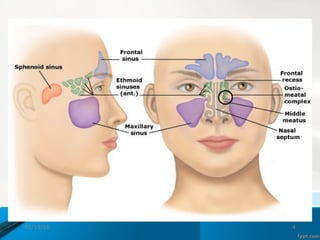
The sinuses are a connected system of
hollow cavities in the skull. The sinus cavities
include:
• The maxillary sinuses
• The frontal sinuses
• The ethmoid sinuses
• The sphenoid sinuses
01/19/16 4
01/19/16 Depertment of E.N.T 5
RHINOSINUSITIS
• Inflammation of the lining mucus membrane
of a sinus and nose as a result of infection,
allergy, structural or mechanical abnormalities
– Multi- Sinusitis:- If more than one sinus is infected,
– Pan- Sinusitis:- If all the sinuses are involved in the
inflammatory process
CLASSIFICATION
 Acute Rhino-sinusitis:-
Acute onset of symptoms
Duration of symptoms <4weeks
Symptoms resolve completely
 Recurrent Acute Rhino-sinusitis:-
>1 to <4 episodes of acute rhino-sinusitis per year
complete recovery b/w attacks
symptom free period of > 8 weeks
Cont.
Chronic Rhino-sinusitis:-
Duration of symptoms >12 weeks and Persistent
inflammatory changes on imaging for more then 4 weeks
after starting appropriate medical therapy
Acute Exacerbation of chronic Rhino-sinusitis:-
Worsening of existing symptoms or appearance
of new symptoms with complete resolution of acute (but
not chronic) symptoms between episodes
01/19/16 8
Epidemiology
• ARS is affecting an estimated 6 - 10% of patients seen in a
daily out-patient practice*
• Bacterial sinusitis develops in 90% of patients with a viral
upper respiratory tract infection.
• more often seen with
 25–30% of allergic patients,
 43% of asthmatic patients,
 37% of patients with transplants, and
 54–68% of patients with AIDS
9
A survey on the management of acute rhinosinusitis among Asian physicians.
. Rhinology. 2011 Aug;49(3):264-71. doi: 10.4193/Rhino10.169.
Predisposing factors
Local
URI
Allergic rhinitis
Nasal septal defects
Nasal foreign bodies
Dental infections
Overuse of topical decongestants
Nasal polyps or tumors
Aspiration of infected water
Cont.
Systemic
Diabetes
Immunocompromise (AIDS)
Malnutrition
Blood dyscrasias
Cystic fibrosis
Chemotherapy
Long term steroid Rx
01/19/16 11
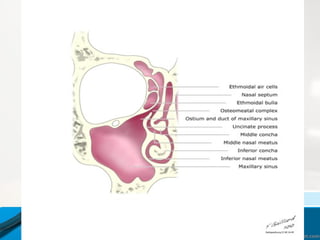
PATHOGENESIS
Basic cause is osteomeatal complex (the middle
meatal region & the frontal, ethmoid, &
maxillary sinus ostia there) inflammation &
infection
Sinus ostia occluded
Colonizing bacteria replicate
Ciliary dysfunction
Mucosal edema
Lowered PO2 & pH
01/19/16 Depertment of E.N.T 13
Microbiology
Aerobic bacteria
Strep. pneumoniae
Alpha & beta hemolytic Strep
Staph. aureus
Moraxella catarrhalis
Hemophilus influenzae
Escherichia coli
Anerobes (10 % acute, 66 % chronic)
Peptostreptococcus,Bacteroides, Fusobacterium
Fungi (2 to 5)
Viruses (5 to 10)
01/19/16 14
Fungal Rhino-sinusitis
• Allergic fungal Rhino-sinusitis
• Sinus Fungal Ball (Mycetoma)
• Acute invasive fungal Rhino-sinusitis
• Chronic Invasive fungal Rhino-sinusitis
• Granulomatous Invasive fungal Rhino-Sinusitis
01/19/16 15
01/19/16 16
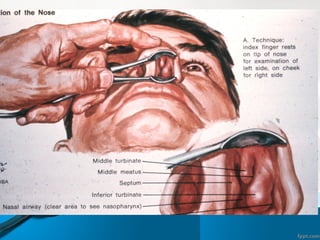
Examination
Anterior rhinoscopic examination with or without a
topical decongestant,
is important to assess the status of the nasal mucosa
and the presence and color of nasal discharge.
Predisposing anatomical variations can also be noted
during anterior rhinoscopy.
01/19/16 17
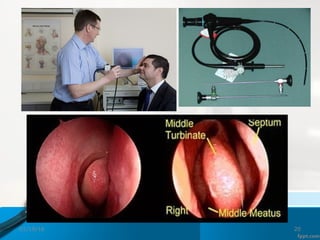
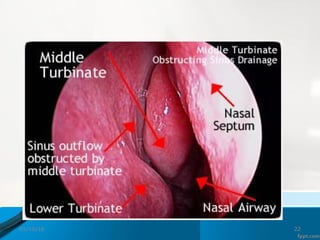
NASOENDOSCOPY may reveal the origin of the
purulent discharge from the middle meatus and may
provide information about the nature of ostiomeatal
obstruction. The use of endoscopy may also aid in
the etiologic diagnosis of acute sinusitis by allowing
the careful attainment of purulent secretions from
the sinus ostia for culture. Purulent secretions in the
middle meatus (highly predictive of maxillary
sinusitis) may be seen using a nasal speculum and a
directed light.
01/19/16 19
01/19/16 20
01/19/16 21
01/19/16 22
INVESTIGATIONS
• Complete blood picture with ESR
• X-ray PNS
• Nasal Swab C/S
• CT
• MRI
• Biopsy
• ANA/ ANCA
• Rhinometry
• Olfaction assessment
23
01/19/16 24
X-RAYS
01/19/16 25
CT Scan
01/19/16 26
CT scan
01/19/16 27
01/19/16 28
01/19/16 29
01/19/16 30
MRI
• MRI allows better differentiation of soft tissue
structures within the sinuses. It is used occasionally
in cases of suspected tumors or fungal
sinusitis.Otherwise, MRI has no advantages over CT
scanning in the evaluation of sinusitis.
01/19/16 31
Complications
Orbital Complications
 Inflammatory oedema
 Orbital cellulitis
 Subperiosteal abscess
 Orbital abscess
 Cavernous sinus thrombosis
Intracranial Complications
 Meningitis
 Epidural abscess
 Subdural abscess
 Brain abscess
Misc.Complications
 Osteomyelitis (pott’s puffy tumour)
 Mucocele or pyocele
01/19/16 32
Management
Conservative Management:
Avoidance
Nasal douching
Antibiotics/Antifungal
Decongestants
Corticosteroids
Anti-Histamines/Anti-Leukotrienes
01/19/16 33
Surgical Management
• FESS
• Antral lavage
• Caldwell-luc procedure
• Ethmoidectomies
01/19/16 34
• Functional endoscopic sinus
surgery (FESS) is a minimally
invasive technique in which
sinus air cells and sinus ostia
are opened under direct
visualization. The goal of this
procedure is to restore sinus
ventilation and normal
function
01/19/16 35
FESS
• Functional endoscopic sinus surgery should be
reserved for use in patients in whom medical
treatment has failed. The procedure can be
performed under general or local anesthesia on an
outpatient basis, and patients usually experience
minimal discomfort. The complication rate for this
procedure is lower than that for conventional sinus
surgery.
01/19/16 36
BAWO
 It may open the sinus
ostium at least temporarily
and clear any
mucopurulent material
(alsoprovide sample for C/S
or H/P)
 Concomittant medical
treatment is necessary or
otherwise the saline left in
the sinus will merely
reinfect.
Transnasal approach
via. Medial wall of
maxilla.
Sublabial approach
via. anterior wall of
maxilla.
Intranasal Antrostomy
 A large dependent opening in the medial wall of the
antrum is made in the inferior meatus.
 This allows good aeration of the maxillary sinus. It
allows ciliary motion to be restored but adequate
removal of all irreversibly changed antral lining is not
possible.
38
Caldwell-Luc’s procedure
 Sublabial approach to maxillary antrum
 Intranasal inspection and disease clearance
40
CONCLUSION
• Studies needs to be done to see incidence of Rhino-
sinusitis in our community
 Two researches are in progress in our department
• Comparison of Ciprofloxacin and Amoxicillin/clavulanic acid
in the treatment of chronic Rhinosinusitis
• Pathogens responsible for Rhinosinusitis in our setup.
• Surgical treatment should be reserved for patients
not responding to conservative management
• FESS only improves drainage of osteomeatal
complex and is the treatment of choice for cases
not responsive to conservative treatment.
41
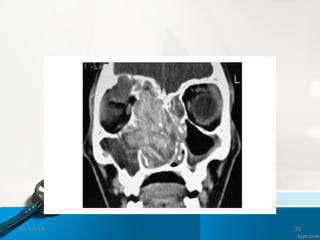
Maxillary sinusitis

Maxillary sinusitis

  • 1.
    Dr. Junaid Shahzad Resident ENTDepartment Capital Hospital RHINOSINUSITIS
  • 2.
    Outline • Introduction • Classification •Epidemiology • Predisposing factors • Patho-physiology • Microbiology • Signs and Symptoms • Investigation • Management 01/19/16 2
  • 3.
    INTRODUCTION The sinuses area connected system of hollow cavities in the skull. The sinus cavities include: • The maxillary sinuses • The frontal sinuses • The ethmoid sinuses • The sphenoid sinuses
  • 4.
  • 5.
  • 6.
    RHINOSINUSITIS • Inflammation ofthe lining mucus membrane of a sinus and nose as a result of infection, allergy, structural or mechanical abnormalities – Multi- Sinusitis:- If more than one sinus is infected, – Pan- Sinusitis:- If all the sinuses are involved in the inflammatory process
  • 7.
    CLASSIFICATION  Acute Rhino-sinusitis:- Acuteonset of symptoms Duration of symptoms <4weeks Symptoms resolve completely  Recurrent Acute Rhino-sinusitis:- >1 to <4 episodes of acute rhino-sinusitis per year complete recovery b/w attacks symptom free period of > 8 weeks
  • 8.
    Cont. Chronic Rhino-sinusitis:- Duration ofsymptoms >12 weeks and Persistent inflammatory changes on imaging for more then 4 weeks after starting appropriate medical therapy Acute Exacerbation of chronic Rhino-sinusitis:- Worsening of existing symptoms or appearance of new symptoms with complete resolution of acute (but not chronic) symptoms between episodes 01/19/16 8
  • 9.
    Epidemiology • ARS isaffecting an estimated 6 - 10% of patients seen in a daily out-patient practice* • Bacterial sinusitis develops in 90% of patients with a viral upper respiratory tract infection. • more often seen with  25–30% of allergic patients,  43% of asthmatic patients,  37% of patients with transplants, and  54–68% of patients with AIDS 9 A survey on the management of acute rhinosinusitis among Asian physicians. . Rhinology. 2011 Aug;49(3):264-71. doi: 10.4193/Rhino10.169.
  • 10.
    Predisposing factors Local URI Allergic rhinitis Nasalseptal defects Nasal foreign bodies Dental infections Overuse of topical decongestants Nasal polyps or tumors Aspiration of infected water
  • 11.
  • 12.
    PATHOGENESIS Basic cause isosteomeatal complex (the middle meatal region & the frontal, ethmoid, & maxillary sinus ostia there) inflammation & infection Sinus ostia occluded Colonizing bacteria replicate Ciliary dysfunction Mucosal edema Lowered PO2 & pH
  • 13.
  • 14.
    Microbiology Aerobic bacteria Strep. pneumoniae Alpha& beta hemolytic Strep Staph. aureus Moraxella catarrhalis Hemophilus influenzae Escherichia coli Anerobes (10 % acute, 66 % chronic) Peptostreptococcus,Bacteroides, Fusobacterium Fungi (2 to 5) Viruses (5 to 10) 01/19/16 14
  • 15.
    Fungal Rhino-sinusitis • Allergicfungal Rhino-sinusitis • Sinus Fungal Ball (Mycetoma) • Acute invasive fungal Rhino-sinusitis • Chronic Invasive fungal Rhino-sinusitis • Granulomatous Invasive fungal Rhino-Sinusitis 01/19/16 15
  • 16.
  • 17.
    Examination Anterior rhinoscopic examinationwith or without a topical decongestant, is important to assess the status of the nasal mucosa and the presence and color of nasal discharge. Predisposing anatomical variations can also be noted during anterior rhinoscopy. 01/19/16 17
  • 19.
    NASOENDOSCOPY may revealthe origin of the purulent discharge from the middle meatus and may provide information about the nature of ostiomeatal obstruction. The use of endoscopy may also aid in the etiologic diagnosis of acute sinusitis by allowing the careful attainment of purulent secretions from the sinus ostia for culture. Purulent secretions in the middle meatus (highly predictive of maxillary sinusitis) may be seen using a nasal speculum and a directed light. 01/19/16 19
  • 20.
  • 21.
  • 22.
  • 23.
    INVESTIGATIONS • Complete bloodpicture with ESR • X-ray PNS • Nasal Swab C/S • CT • MRI • Biopsy • ANA/ ANCA • Rhinometry • Olfaction assessment 23
  • 24.
  • 25.
  • 26.
  • 27.
  • 28.
  • 29.
  • 30.
  • 31.
    MRI • MRI allowsbetter differentiation of soft tissue structures within the sinuses. It is used occasionally in cases of suspected tumors or fungal sinusitis.Otherwise, MRI has no advantages over CT scanning in the evaluation of sinusitis. 01/19/16 31
  • 32.
    Complications Orbital Complications  Inflammatoryoedema  Orbital cellulitis  Subperiosteal abscess  Orbital abscess  Cavernous sinus thrombosis Intracranial Complications  Meningitis  Epidural abscess  Subdural abscess  Brain abscess Misc.Complications  Osteomyelitis (pott’s puffy tumour)  Mucocele or pyocele 01/19/16 32
  • 33.
  • 34.
    Surgical Management • FESS •Antral lavage • Caldwell-luc procedure • Ethmoidectomies 01/19/16 34
  • 35.
    • Functional endoscopicsinus surgery (FESS) is a minimally invasive technique in which sinus air cells and sinus ostia are opened under direct visualization. The goal of this procedure is to restore sinus ventilation and normal function 01/19/16 35 FESS
  • 36.
    • Functional endoscopicsinus surgery should be reserved for use in patients in whom medical treatment has failed. The procedure can be performed under general or local anesthesia on an outpatient basis, and patients usually experience minimal discomfort. The complication rate for this procedure is lower than that for conventional sinus surgery. 01/19/16 36
  • 37.
    BAWO  It mayopen the sinus ostium at least temporarily and clear any mucopurulent material (alsoprovide sample for C/S or H/P)  Concomittant medical treatment is necessary or otherwise the saline left in the sinus will merely reinfect. Transnasal approach via. Medial wall of maxilla. Sublabial approach via. anterior wall of maxilla.
  • 38.
    Intranasal Antrostomy  Alarge dependent opening in the medial wall of the antrum is made in the inferior meatus.  This allows good aeration of the maxillary sinus. It allows ciliary motion to be restored but adequate removal of all irreversibly changed antral lining is not possible. 38
  • 39.
    Caldwell-Luc’s procedure  Sublabialapproach to maxillary antrum  Intranasal inspection and disease clearance
  • 40.
  • 41.
    CONCLUSION • Studies needsto be done to see incidence of Rhino- sinusitis in our community  Two researches are in progress in our department • Comparison of Ciprofloxacin and Amoxicillin/clavulanic acid in the treatment of chronic Rhinosinusitis • Pathogens responsible for Rhinosinusitis in our setup. • Surgical treatment should be reserved for patients not responding to conservative management • FESS only improves drainage of osteomeatal complex and is the treatment of choice for cases not responsive to conservative treatment. 41