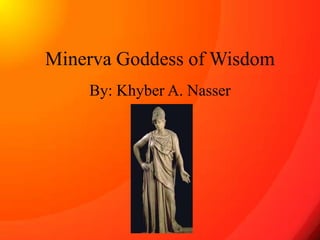
Minerva Goddess of Wisdom
    By: Khyber A. Nasser
The Origins of Minerva
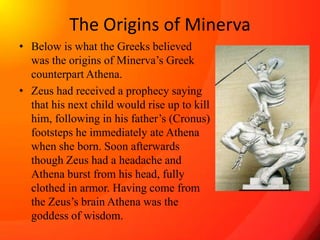
• Below is what the Greeks believed
  was the origins of Minerva’s Greek
  counterpart Athena.
• Zeus had received a prophecy saying
  that his next child would rise up to kill
  him, following in his father’s (Cronus)
  footsteps he immediately ate Athena
  when she born. Soon afterwards
  though Zeus had a headache and
  Athena burst from his head, fully
  clothed in armor. Having come from
  the Zeus’s brain Athena was the
  goddess of wisdom.
Spouse
• Athena did not have a spouse as she was one of
  three virgin goddesses.
The Legend of Athens
• Both Athena and Poseidon wanted to become the patron
  of Athens. In order to decide who got this honor they
  both decided to give Athens a gift and then let the
  citizens of Athens choose. Poseidon created a salt water
  spring as his gift, Athena created the olive tree. The
  people of Athens decided Athena’s gift was better and
  allowed her to become the patron of Athens.
Symbols of Minerva
• Several symbols of Minerva are:
  – The Owl, representing her wisdom
  – The Dove, representing victory
  – Intertwined Snakes
  – A Golden Shield and Helmet
  – The Olive Branch
Attributes Given To Minerva
• She is the patron goddess of Athens, named after her
  Greek name, Athena.
• The Parthenon is also considered an attribute of
  Athena as she is accredited with designing it.
• Her aegis was given to her by Perseus and is
  indestructible.
Role in the Trojan War
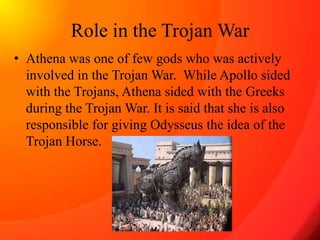
• Athena was one of few gods who was actively
  involved in the Trojan War. While Apollo sided
  with the Trojans, Athena sided with the Greeks
  during the Trojan War. It is said that she is also
  responsible for giving Odysseus the idea of the
  Trojan Horse.
Importance to Roman Culture
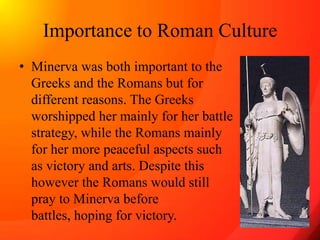
• Minerva was both important to the
  Greeks and the Romans but for
  different reasons. The Greeks
  worshipped her mainly for her battle
  strategy, while the Romans mainly
  for her more peaceful aspects such
  as victory and arts. Despite this
  however the Romans would still
  pray to Minerva before
  battles, hoping for victory.
Roles/Realms
Below is several of Athena’s more important roles:
• Goddess of Wisdom
• Goddess of War
• Goddess of Strategy
• Goddess of Courage
• Goddess of Arts
• Goddess of Justice
• Enforcer of rules
• Protector/Patron of the City of Athens
Holidays
• The Feast of Adorning was observed every May.
  This was a festival in which the priestesses of
  Athena would perform a cleansing ritual within
  the personal sanctuary.
Sources
• http://www.theoi.com/Gallery/S8.1.html
• http://www.arthistory.sbc.edu/imageswomen/papers/ortengrenathena/at
  hena.html
• http://www.goddessgift.com/goddess-
  myths/goddess_symbols_athena.htm
• http://www.amazonation.com/AthenaW&W.html
• http://etc.usf.edu/clipart/16400/16496/athena_16496.htm
• http://www.skyscrapercity.com/showthread.php?t=307941
• http://www.greece-athens.com/
• http://orias.berkeley.edu/visuals/polytheism/album.html

Minerva

  • 1.
    Minerva Goddess ofWisdom By: Khyber A. Nasser
  • 2.
    The Origins ofMinerva • Below is what the Greeks believed was the origins of Minerva’s Greek counterpart Athena. • Zeus had received a prophecy saying that his next child would rise up to kill him, following in his father’s (Cronus) footsteps he immediately ate Athena when she born. Soon afterwards though Zeus had a headache and Athena burst from his head, fully clothed in armor. Having come from the Zeus’s brain Athena was the goddess of wisdom.
  • 3.
    Spouse • Athena didnot have a spouse as she was one of three virgin goddesses.
  • 4.
    The Legend ofAthens • Both Athena and Poseidon wanted to become the patron of Athens. In order to decide who got this honor they both decided to give Athens a gift and then let the citizens of Athens choose. Poseidon created a salt water spring as his gift, Athena created the olive tree. The people of Athens decided Athena’s gift was better and allowed her to become the patron of Athens.
  • 5.
    Symbols of Minerva •Several symbols of Minerva are: – The Owl, representing her wisdom – The Dove, representing victory – Intertwined Snakes – A Golden Shield and Helmet – The Olive Branch
  • 6.
    Attributes Given ToMinerva • She is the patron goddess of Athens, named after her Greek name, Athena. • The Parthenon is also considered an attribute of Athena as she is accredited with designing it. • Her aegis was given to her by Perseus and is indestructible.
  • 7.
    Role in theTrojan War • Athena was one of few gods who was actively involved in the Trojan War. While Apollo sided with the Trojans, Athena sided with the Greeks during the Trojan War. It is said that she is also responsible for giving Odysseus the idea of the Trojan Horse.
  • 8.
    Importance to RomanCulture • Minerva was both important to the Greeks and the Romans but for different reasons. The Greeks worshipped her mainly for her battle strategy, while the Romans mainly for her more peaceful aspects such as victory and arts. Despite this however the Romans would still pray to Minerva before battles, hoping for victory.
  • 9.
    Roles/Realms Below is severalof Athena’s more important roles: • Goddess of Wisdom • Goddess of War • Goddess of Strategy • Goddess of Courage • Goddess of Arts • Goddess of Justice • Enforcer of rules • Protector/Patron of the City of Athens
  • 10.
    Holidays • The Feastof Adorning was observed every May. This was a festival in which the priestesses of Athena would perform a cleansing ritual within the personal sanctuary.
  • 11.
    Sources • http://www.theoi.com/Gallery/S8.1.html • http://www.arthistory.sbc.edu/imageswomen/papers/ortengrenathena/at hena.html • http://www.goddessgift.com/goddess- myths/goddess_symbols_athena.htm • http://www.amazonation.com/AthenaW&W.html • http://etc.usf.edu/clipart/16400/16496/athena_16496.htm • http://www.skyscrapercity.com/showthread.php?t=307941 • http://www.greece-athens.com/ • http://orias.berkeley.edu/visuals/polytheism/album.html