Greek
Mythology
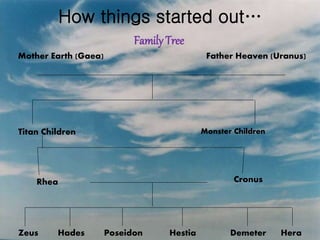
Family Tree
How things started out…
Mother Earth (Gaea) Father Heaven (Uranus)
Titan Children Monster Children
Rhea Cronus
Zeus Hades Poseidon Hestia Demeter Hera
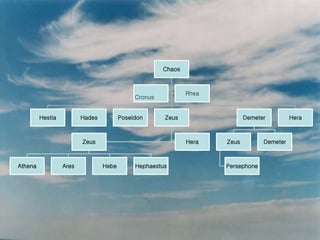
Chaos
Hestia Hades Poseidon Zeus
Zeus
Athena Ares Hebe Hephaestus
Hera
Demeter
Zeus
Persephone
Demeter
Hera
Cronus
Rhea
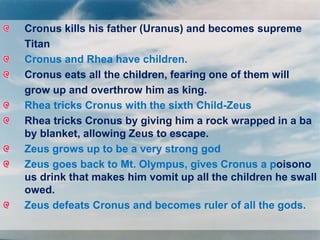
Cronus kills his father (Uranus) and becomes supreme
Titan
Cronus and Rhea have children.
Cronus eats all the children, fearing one of them will
grow up and overthrow him as king.
Rhea tricks Cronus with the sixth Child-Zeus
Rhea tricks Cronus by giving him a rock wrapped in a ba
by blanket, allowing Zeus to escape.
Zeus grows up to be a very strong god
Zeus goes back to Mt. Olympus, gives Cronus a poisono
us drink that makes him vomit up all the children he swall
owed.
Zeus defeats Cronus and becomes ruler of all the gods.
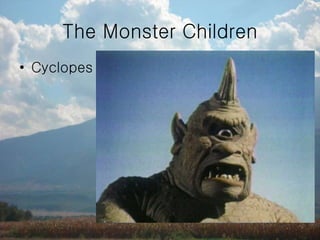
The Monster Children
• Cyclopes
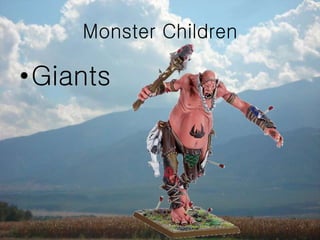
Monster Children
•Giants
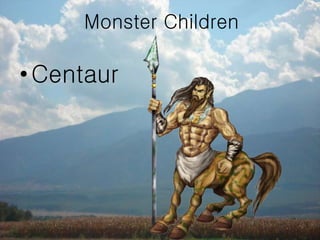
•Centaur
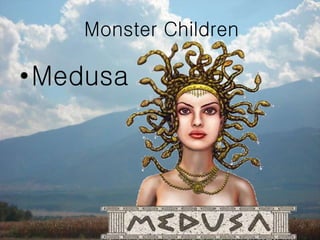
Monster Children
•Medusa
Monster Children
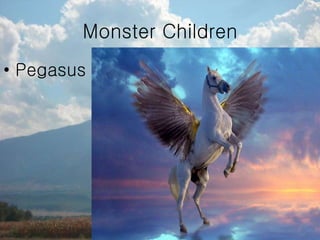
• Pegasus
Monster Children
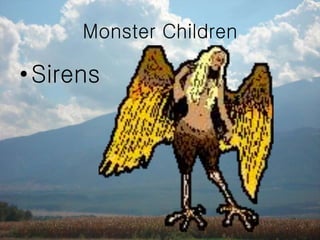
•Sirens
Monster Children
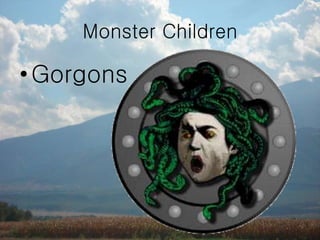
•Gorgons
Monster Children
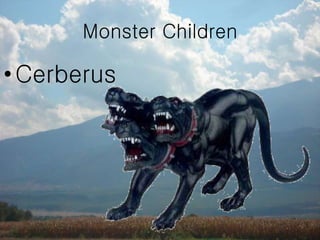
•Cerberus
Monster Children
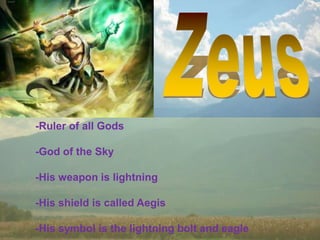
-Ruler of all Gods
-God of the Sky
-His weapon is lightning
-His shield is called Aegis
-His symbol is the lightning bolt and eagle
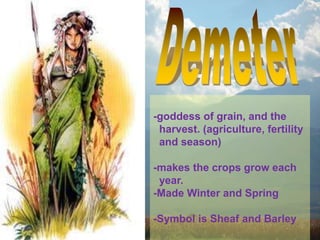
-goddess of grain, and the
harvest. (agriculture, fertility
and season)
-makes the crops grow each
year.
-Made Winter and Spring
-Symbol is Sheaf and Barley
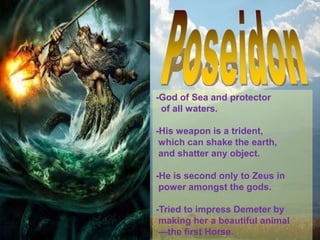
-God of Sea and protector
of all waters.
-His weapon is a trident,
which can shake the earth,
and shatter any object.
-He is second only to Zeus in
power amongst the gods.
-Tried to impress Demeter by
making her a beautiful animal
—the first Horse.
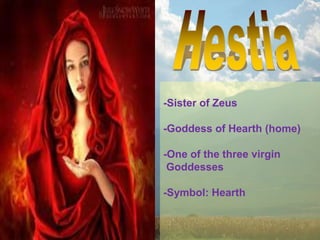
-Sister of Zeus
-Goddess of Hearth (home)
-One of the three virgin
Goddesses
-Symbol: Hearth
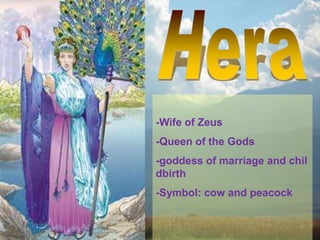
-Wife of Zeus
-Queen of the Gods
-goddess of marriage and chil
dbirth
-Symbol: cow and peacock
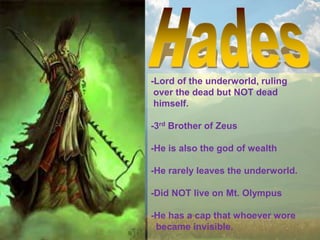
-Lord of the underworld, ruling
over the dead but NOT dead
himself.
-3rd Brother of Zeus
-He is also the god of wealth
-He rarely leaves the underworld.
-Did NOT live on Mt. Olympus
-He has a cap that whoever wore
became invisible.
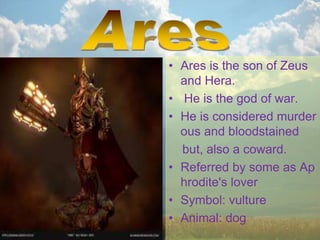
• Ares is the son of Zeus
and Hera.
• He is the god of war.
• He is considered murder
ous and bloodstained
but, also a coward.
• Referred by some as Ap
hrodite's lover
• Symbol: vulture
• Animal: dog
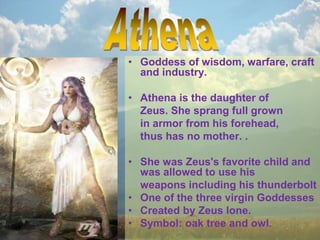
• Goddess of wisdom, warfare, craft
and industry.
• Athena is the daughter of
Zeus. She sprang full grown
in armor from his forehead,
thus has no mother. .
• She was Zeus's favorite child and
was allowed to use his
weapons including his thunderbolt
• One of the three virgin Goddesses
• Created by Zeus lone.
• Symbol: oak tree and owl.
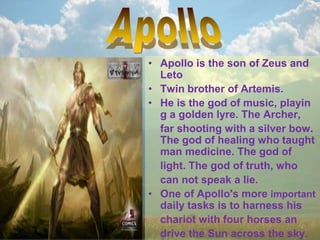
• Apollo is the son of Zeus and
Leto
• Twin brother of Artemis.
• He is the god of music, playin
g a golden lyre. The Archer,
far shooting with a silver bow.
The god of healing who taught
man medicine. The god of
light. The god of truth, who
can not speak a lie.
• One of Apollo's more important
daily tasks is to harness his
chariot with four horses an
drive the Sun across the sky.
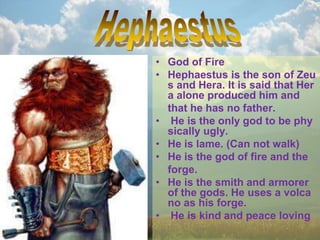
• God of Fire
• Hephaestus is the son of Zeu
s and Hera. It is said that Her
a alone produced him and
that he has no father.
• He is the only god to be phy
sically ugly.
• He is lame. (Can not walk)
• He is the god of fire and the
forge.
• He is the smith and armorer
of the gods. He uses a volca
no as his forge.
• He is kind and peace loving
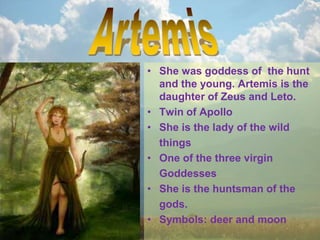
• She was goddess of the hunt
and the young. Artemis is the
daughter of Zeus and Leto.
• Twin of Apollo
• She is the lady of the wild
things
• One of the three virgin
Goddesses
• She is the huntsman of the
gods.
• Symbols: deer and moon
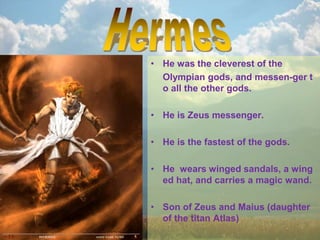
• He was the cleverest of the
Olympian gods, and messen-ger t
o all the other gods.
• He is Zeus messenger.
• He is the fastest of the gods.
• He wears winged sandals, a wing
ed hat, and carries a magic wand.
• Son of Zeus and Maius (daughter
of the titan Atlas)
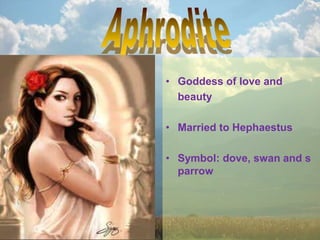
• Goddess of love and
beauty
• Married to Hephaestus
• Symbol: dove, swan and s
parrow
Who was Hesiod?
• Wrote in ARCHAIC period, c. 750-650 B
CE (same period as Homer)
• He provides a few details of his life in hi
s poems. For example, he mentions a la
wsuit against his brother.
• He was a poet who crafted traditional st
ories about the gods into an organized p
attern.
Theogony
• Means “origin or generations of the
gods.”
• A cosmogony (= how the universe came
to be) and cosmology (= how its parts ar
e arranged)
• Names over 300 gods, etc. Delights in c
atalogs (= folkloric technique).
• Figures in the poem range from fully dev
eloped characters to allegorical names.
Why did Hesiod write it?
• Possibly to show off his skill as a poet in
a poetry competition. Oral-formulaic co
mposition, memorization, etc.
• Gods from different parts of Greece are o
rganized into a family.
• Main theme: the ascent of Zeus as chief
god
Overall Structure
• Invocation of the Muses  inspiration
• 1st generation: primordial gods: Chaos
 Gaia  Gaia and Ouranos.
• 2nd generation: Titans, Kronos, etc.
• Interlude: story of Prometheus
• 3rd generation: Titanomachy and Zeus’ ri
se to power.
Invocation
• Hesiod is a shepherd who seeks inspiration f
rom the Muses (= daughters of Zeus):
And one day they taught Hesiod glorious song while
he was
shepherding his lambs under holy Helicon, and this wo
rd first the
goddesses said to me -- the Muses of Olympus, daught
ers of Zeus
who holds the aegis:
First Generation
• What is Chaos?
• Gaia (= Earth) is spontaneously generated.
Pay attention to patterns of reproduction!!
• Produces children through parthenogenesis
, then via sexual intercourse with son/husb
and Ouranos (= Sky)
– Pairing of Earth and Sky a motif in earlier myths
of Egypt and the near east.
First Generation
• Patterns to watch for:
– Unusual methods of reproduction
– Confused kinship relations
– Frustrated reproduction (Ouranos and Krono
s)
– Monsters dominate here.
– Conflict between female and male gods (refl
ects ascent of patriarchy over matriarchy??)
Gaia and Cronos
• Separation of Earth and Sky when Krono
s castrates Ouranos = cosmogony
– Sparagmos= an ancient Dionysian ritual in w
hich a living animal, or sometimes even a hu
man being, would be sacrificed by being dis
membered, by the tearing apart of limbs fro
m the body.
• Primal taboo: killing the father
• Birth of Aphrodite.
Kronos/Cronos
• Meaning of name is disputed. Possibly f
rom Indo-European root meaning “the c
utter.”
• After he becomes chief god, he swallow
s his children to prevent them from killin
g him. Inverts pattern of Ouranos preven
ting birth by refusing to pull out of Gaia.
• Rhea and Gaia conspire to preserve bab
y Zeus through a scheme to fool Kronos.
Kronos
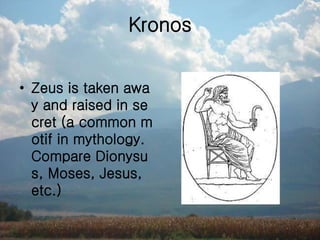
• Zeus is taken awa
y and raised in se
cret (a common m
otif in mythology.
Compare Dionysu
s, Moses, Jesus,
etc.)
Prometheus
• Does this story really interrupt the geneal
ogical pattern?
• It offers an etiology: why Greeks burned
bones as a sacrificial offering to the god
s.
• Says men already existed but doesn’t ex
plain how or why they were created.
• Says women were created as a punishm
ent for mankind. Story of Pandora. (See al
so Works & Days)
Analysis of Prometheus Story
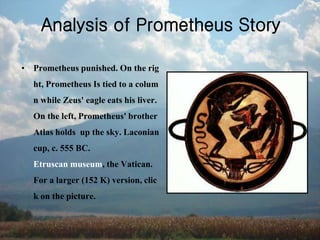
• Prometheus punished. On the rig
ht, Prometheus Is tied to a colum
n while Zeus' eagle eats his liver.
On the left, Prometheus' brother
Atlas holds up the sky. Laconian
cup, c. 555 BC.
Etruscan museum, the Vatican.
For a larger (152 K) version, clic
k on the picture.
Rise of 3rd Generation
• Titanomachy: “Olympians” versus Titans
= 3rd generation vs. 2nd generation with h
elp from outcasts from 1st generation.
• How does Zeus seek to avoid the fate
of Ouranos and Kronos?
• Management skills of the Greek gods!!
• New regularities: methods of reproductio
n and kinship relations.
Triumph of Zeus
• Battle with Typhoios (Typhon), described
as the last born child of Gaia.
– Circular pattern: 3rd generation defeated 2nd,
now defeats 1st.
• Assertion of patriarchal order: gods defi
ned in terms of their relationship to Zeus
.
• Zeus and the Fates.
Greek mythology
Greek mythology
Greek mythology

Greek mythology

  • 1.
  • 2.
    Family Tree How thingsstarted out… Mother Earth (Gaea) Father Heaven (Uranus) Titan Children Monster Children Rhea Cronus Zeus Hades Poseidon Hestia Demeter Hera
  • 3.
    Chaos Hestia Hades PoseidonZeus Zeus Athena Ares Hebe Hephaestus Hera Demeter Zeus Persephone Demeter Hera Cronus Rhea
  • 4.
    Cronus kills hisfather (Uranus) and becomes supreme Titan Cronus and Rhea have children. Cronus eats all the children, fearing one of them will grow up and overthrow him as king. Rhea tricks Cronus with the sixth Child-Zeus Rhea tricks Cronus by giving him a rock wrapped in a ba by blanket, allowing Zeus to escape. Zeus grows up to be a very strong god Zeus goes back to Mt. Olympus, gives Cronus a poisono us drink that makes him vomit up all the children he swall owed. Zeus defeats Cronus and becomes ruler of all the gods.
  • 5.
  • 6.
  • 7.
  • 8.
  • 9.
  • 10.
  • 11.
  • 12.
  • 13.
    -Ruler of allGods -God of the Sky -His weapon is lightning -His shield is called Aegis -His symbol is the lightning bolt and eagle
  • 14.
    -goddess of grain,and the harvest. (agriculture, fertility and season) -makes the crops grow each year. -Made Winter and Spring -Symbol is Sheaf and Barley
  • 15.
    -God of Seaand protector of all waters. -His weapon is a trident, which can shake the earth, and shatter any object. -He is second only to Zeus in power amongst the gods. -Tried to impress Demeter by making her a beautiful animal —the first Horse.
  • 16.
    -Sister of Zeus -Goddessof Hearth (home) -One of the three virgin Goddesses -Symbol: Hearth
  • 17.
    -Wife of Zeus -Queenof the Gods -goddess of marriage and chil dbirth -Symbol: cow and peacock
  • 18.
    -Lord of theunderworld, ruling over the dead but NOT dead himself. -3rd Brother of Zeus -He is also the god of wealth -He rarely leaves the underworld. -Did NOT live on Mt. Olympus -He has a cap that whoever wore became invisible.
  • 20.
    • Ares isthe son of Zeus and Hera. • He is the god of war. • He is considered murder ous and bloodstained but, also a coward. • Referred by some as Ap hrodite's lover • Symbol: vulture • Animal: dog
  • 21.
    • Goddess ofwisdom, warfare, craft and industry. • Athena is the daughter of Zeus. She sprang full grown in armor from his forehead, thus has no mother. . • She was Zeus's favorite child and was allowed to use his weapons including his thunderbolt • One of the three virgin Goddesses • Created by Zeus lone. • Symbol: oak tree and owl.
  • 22.
    • Apollo isthe son of Zeus and Leto • Twin brother of Artemis. • He is the god of music, playin g a golden lyre. The Archer, far shooting with a silver bow. The god of healing who taught man medicine. The god of light. The god of truth, who can not speak a lie. • One of Apollo's more important daily tasks is to harness his chariot with four horses an drive the Sun across the sky.
  • 23.
    • God ofFire • Hephaestus is the son of Zeu s and Hera. It is said that Her a alone produced him and that he has no father. • He is the only god to be phy sically ugly. • He is lame. (Can not walk) • He is the god of fire and the forge. • He is the smith and armorer of the gods. He uses a volca no as his forge. • He is kind and peace loving
  • 24.
    • She wasgoddess of the hunt and the young. Artemis is the daughter of Zeus and Leto. • Twin of Apollo • She is the lady of the wild things • One of the three virgin Goddesses • She is the huntsman of the gods. • Symbols: deer and moon
  • 25.
    • He wasthe cleverest of the Olympian gods, and messen-ger t o all the other gods. • He is Zeus messenger. • He is the fastest of the gods. • He wears winged sandals, a wing ed hat, and carries a magic wand. • Son of Zeus and Maius (daughter of the titan Atlas)
  • 26.
    • Goddess oflove and beauty • Married to Hephaestus • Symbol: dove, swan and s parrow
  • 29.
    Who was Hesiod? •Wrote in ARCHAIC period, c. 750-650 B CE (same period as Homer) • He provides a few details of his life in hi s poems. For example, he mentions a la wsuit against his brother. • He was a poet who crafted traditional st ories about the gods into an organized p attern.
  • 30.
    Theogony • Means “originor generations of the gods.” • A cosmogony (= how the universe came to be) and cosmology (= how its parts ar e arranged) • Names over 300 gods, etc. Delights in c atalogs (= folkloric technique). • Figures in the poem range from fully dev eloped characters to allegorical names.
  • 31.
    Why did Hesiodwrite it? • Possibly to show off his skill as a poet in a poetry competition. Oral-formulaic co mposition, memorization, etc. • Gods from different parts of Greece are o rganized into a family. • Main theme: the ascent of Zeus as chief god
  • 32.
    Overall Structure • Invocationof the Muses  inspiration • 1st generation: primordial gods: Chaos  Gaia  Gaia and Ouranos. • 2nd generation: Titans, Kronos, etc. • Interlude: story of Prometheus • 3rd generation: Titanomachy and Zeus’ ri se to power.
  • 33.
    Invocation • Hesiod isa shepherd who seeks inspiration f rom the Muses (= daughters of Zeus): And one day they taught Hesiod glorious song while he was shepherding his lambs under holy Helicon, and this wo rd first the goddesses said to me -- the Muses of Olympus, daught ers of Zeus who holds the aegis:
  • 34.
    First Generation • Whatis Chaos? • Gaia (= Earth) is spontaneously generated. Pay attention to patterns of reproduction!! • Produces children through parthenogenesis , then via sexual intercourse with son/husb and Ouranos (= Sky) – Pairing of Earth and Sky a motif in earlier myths of Egypt and the near east.
  • 35.
    First Generation • Patternsto watch for: – Unusual methods of reproduction – Confused kinship relations – Frustrated reproduction (Ouranos and Krono s) – Monsters dominate here. – Conflict between female and male gods (refl ects ascent of patriarchy over matriarchy??)
  • 36.
    Gaia and Cronos •Separation of Earth and Sky when Krono s castrates Ouranos = cosmogony – Sparagmos= an ancient Dionysian ritual in w hich a living animal, or sometimes even a hu man being, would be sacrificed by being dis membered, by the tearing apart of limbs fro m the body. • Primal taboo: killing the father • Birth of Aphrodite.
  • 37.
    Kronos/Cronos • Meaning ofname is disputed. Possibly f rom Indo-European root meaning “the c utter.” • After he becomes chief god, he swallow s his children to prevent them from killin g him. Inverts pattern of Ouranos preven ting birth by refusing to pull out of Gaia. • Rhea and Gaia conspire to preserve bab y Zeus through a scheme to fool Kronos.
  • 38.
    Kronos • Zeus istaken awa y and raised in se cret (a common m otif in mythology. Compare Dionysu s, Moses, Jesus, etc.)
  • 39.
    Prometheus • Does thisstory really interrupt the geneal ogical pattern? • It offers an etiology: why Greeks burned bones as a sacrificial offering to the god s. • Says men already existed but doesn’t ex plain how or why they were created. • Says women were created as a punishm ent for mankind. Story of Pandora. (See al so Works & Days)
  • 40.
    Analysis of PrometheusStory • Prometheus punished. On the rig ht, Prometheus Is tied to a colum n while Zeus' eagle eats his liver. On the left, Prometheus' brother Atlas holds up the sky. Laconian cup, c. 555 BC. Etruscan museum, the Vatican. For a larger (152 K) version, clic k on the picture.
  • 41.
    Rise of 3rdGeneration • Titanomachy: “Olympians” versus Titans = 3rd generation vs. 2nd generation with h elp from outcasts from 1st generation. • How does Zeus seek to avoid the fate of Ouranos and Kronos? • Management skills of the Greek gods!! • New regularities: methods of reproductio n and kinship relations.
  • 42.
    Triumph of Zeus •Battle with Typhoios (Typhon), described as the last born child of Gaia. – Circular pattern: 3rd generation defeated 2nd, now defeats 1st. • Assertion of patriarchal order: gods defi ned in terms of their relationship to Zeus . • Zeus and the Fates.