Warm-Up (summarize!!) Water is an abundant substance on Earth. It can be found as a solid, a liquid, and as a gas called water vapor. Write as many words you can think of to describe solid water? Where is most of the liquid water on Earth found? Where is most of the water vapor found? Describe a natural event you have observed when water changed from a liquid to a solid? When water changed from a liquid to a vapor?
2-8 Phase Change Objectives Describe  phase change. Describe  each of the six phase changes. Explain  how temperature can be used to recognize a phase change. Identify  phase changes as endothermic or exothermic.
Phase Changes – Changes of State Adding or removing energy (heat) to a substance causes phase changes During a phase change, temperature does  NOT  change Phase changes are reversible.
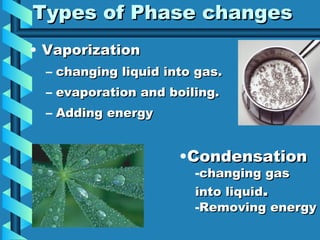
Types of Phase changes Vaporization changing liquid into gas. evaporation and boiling. Adding energy Condensation changing gas into liquid . Removing energy
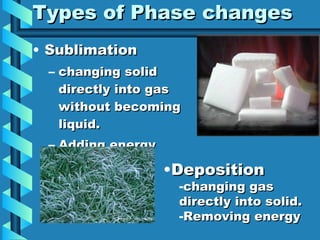
Types of Phase changes Sublimation changing solid directly into gas without becoming liquid. Adding energy Deposition changing gas directly into solid. Removing energy
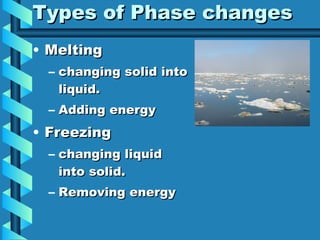
Types of Phase changes Melting changing solid into liquid. Adding energy Freezing changing liquid  into solid. Removing energy
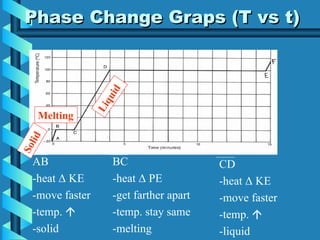
Phase Change Graps (T vs t) AB -heat Δ KE -move faster -temp.   -solid BC -heat Δ PE -get farther apart -temp. stay same -melting CD -heat Δ KE -move faster -temp.   -liquid Solid Melting Liquid
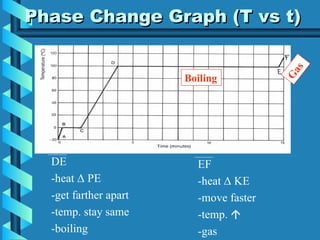
Phase Change Graph (T vs t) DE -heat Δ PE -get farther apart -temp. stay same -boiling EF -heat Δ KE -move faster -temp.     -gas Boiling Gas
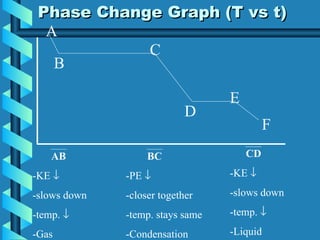
Phase Change Graph (T vs t) A B C D E F AB -KE   -slows down -temp.   -Gas BC -PE   -closer together -temp. stays same -Condensation CD -KE   -slows down -temp.   -Liquid
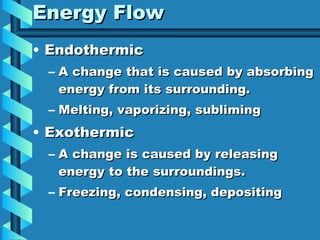
Energy Flow Endothermic  A change that is caused by absorbing energy from its surrounding. Melting, vaporizing, subliming Exothermic A change is caused by releasing energy to the surroundings. Freezing, condensing, depositing
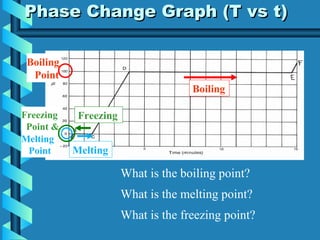
Phase Change Graph (T vs t) What is the boiling point? What is the melting point? What is the freezing point? Boiling Boiling  Point Melting Melting  Point Freezing Freezing  Point &

2-8 Phase Changes

  • 1.
    Warm-Up (summarize!!) Wateris an abundant substance on Earth. It can be found as a solid, a liquid, and as a gas called water vapor. Write as many words you can think of to describe solid water? Where is most of the liquid water on Earth found? Where is most of the water vapor found? Describe a natural event you have observed when water changed from a liquid to a solid? When water changed from a liquid to a vapor?
  • 2.
    2-8 Phase ChangeObjectives Describe phase change. Describe each of the six phase changes. Explain how temperature can be used to recognize a phase change. Identify phase changes as endothermic or exothermic.
  • 3.
    Phase Changes –Changes of State Adding or removing energy (heat) to a substance causes phase changes During a phase change, temperature does NOT change Phase changes are reversible.
  • 4.
    Types of Phasechanges Vaporization changing liquid into gas. evaporation and boiling. Adding energy Condensation changing gas into liquid . Removing energy
  • 5.
    Types of Phasechanges Sublimation changing solid directly into gas without becoming liquid. Adding energy Deposition changing gas directly into solid. Removing energy
  • 6.
    Types of Phasechanges Melting changing solid into liquid. Adding energy Freezing changing liquid into solid. Removing energy
  • 7.
    Phase Change Graps(T vs t) AB -heat Δ KE -move faster -temp.  -solid BC -heat Δ PE -get farther apart -temp. stay same -melting CD -heat Δ KE -move faster -temp.  -liquid Solid Melting Liquid
  • 8.
    Phase Change Graph(T vs t) DE -heat Δ PE -get farther apart -temp. stay same -boiling EF -heat Δ KE -move faster -temp.  -gas Boiling Gas
  • 9.
    Phase Change Graph(T vs t) A B C D E F AB -KE  -slows down -temp.  -Gas BC -PE  -closer together -temp. stays same -Condensation CD -KE  -slows down -temp.  -Liquid
  • 10.
    Energy Flow Endothermic A change that is caused by absorbing energy from its surrounding. Melting, vaporizing, subliming Exothermic A change is caused by releasing energy to the surroundings. Freezing, condensing, depositing
  • 11.
    Phase Change Graph(T vs t) What is the boiling point? What is the melting point? What is the freezing point? Boiling Boiling Point Melting Melting Point Freezing Freezing Point &

Editor's Notes

  • #2 Student answers may include forms such as ice, sleet, snow, or hail or formations such as glaciers, icebergs, and ice caps. Most liquid water is found in oceans (which cover 71% of Earth’s surface). Water vapor is found in Earth’s atmosphere. Student answers may include forms such as ice, sleet, snow, or hail or formations such as glaciers, icebergs, and ice caps. Student answers may include a pond freezing over or water evaporating from a puddle.