Metals and Non-Metals
8th Class
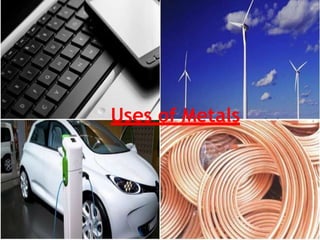
Uses of Metals
Physical properties of metals :-
•
•
•
•
•
•
•
•
•
•
Metals are solids. (except mercury)
Metals are hard. (except Lithium, Potassium, Sodium)
Metals have metallic lustre. (shine)
Metals are malleable. (can be beaten into thin sheets)
Metals are ductile. (can be drawn into wires)
Metals have high melting points. (Gallium and Ceasium
have low melting points. They melt in the palm of the
hand)
Metals have high boiling points.
Metals are good conductors of heat. ( Best conductors
are silver and copper. Poor conductors are Lead and
Mercury)
Metals are good conductors of electricity. ( Best
conductors are Silver and Copper)
Metals are sonorus. (produce sound when beaten)
Physical properties of non metals :-
•
•
•
•
•
•
•
•
•
• Non metals may be solids, liquids or gases. (Solids –
Carbon, Sulphur, Phosphorus etc. Liquid – Bromine,
Gases – Oxygen, Hydrogen, Nitrogen etc.)
Non metals are soft. (except diamond which is the hardest
natural substance)
Non metals do not have lustre.( except iodine cryatals)
Non metals are not malleable.
Non metals are not ductile.
Non metals which are solids and liquids have low melting
points.
Non metals which are solids and liquids have low boiling
points.
Non metals are bad conductors of heat.
Non metals are bad conductors of electricity. (except
graphite)
Non metals are not sonorus.
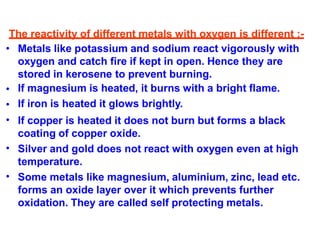
The reactivity of different metals with oxygen is different :-
•
•
•
•
•
• Metals like potassium and sodium react vigorously with
oxygen and catch fire if kept in open. Hence they are
stored in kerosene to prevent burning.
If magnesium is heated, it burns with a bright flame.
If iron is heated it glows brightly.
If copper is heated it does not burn but forms a black
coating of copper oxide.
Silver and gold does not react with oxygen even at high
temperature.
Some metals like magnesium, aluminium, zinc, lead etc.
forms an oxide layer over it which prevents further
oxidation. They are called self protecting metals.
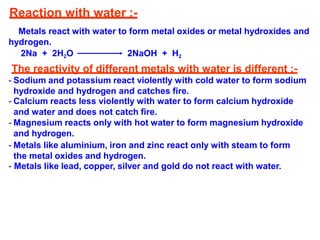
Reaction with water :-
Metals react with water to form metal oxides or metal hydroxides and
hydrogen.
2Na + 2H2O 2NaOH + H2
The reactivity of different metals with water is different :-
- Sodium and potassium react violently with cold water to form sodium
hydroxide and hydrogen and catches fire.
- Calcium reacts less violently with water to form calcium hydroxide
and water and does not catch fire.
- Magnesium reacts only with hot water to form magnesium hydroxide
and hydrogen.
- Metals like aluminium, iron and zinc react only with steam to form
the metal oxides and hydrogen.
- Metals like lead, copper, silver and gold do not react with water.
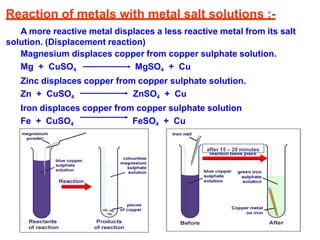
Reaction of metals with metal salt solutions :-
A more reactive metal displaces a less reactive metal from its salt
solution. (Displacement reaction)
Magnesium displaces copper from copper sulphate solution.
Mg + CuSO4 MgSO4 + Cu
Zinc displaces copper from copper sulphate solution.
Zn + CuSO4 ZnSO4 + Cu
Iron displaces copper from copper sulphate solution
Fe + CuSO4 FeSO4 + Cu
after 15 – 20 minutes
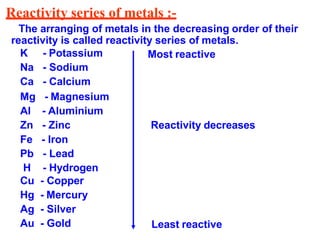
Reactivity series of metals :-
The arranging of metals in the decreasing order of their
reactivity is called reactivity series of metals.
Most reactive
Reactivity decreases
K - Potassium
Na - Sodium
Ca - Calcium
Mg - Magnesium
Al - Aluminium
Zn - Zinc
Fe - Iron
Pb - Lead
H - Hydrogen
Cu - Copper
Hg - Mercury
Ag - Silver
Au - Gold Least reactive
Occurence of metals :-
Some metals like gold, silver, platinum etc are found in the free
state in the earth’s crust because they are least reactive. Most metals
are found as oxides, carbonates, sulphides, halides etc.
Minerals :- are elements or compounds which occur naturally inside
the earth’s crust.
Ore :- is a mineral from which metals can be extracted profitably.
Gangue :- is the impurities present in the ore like rock particles,
sand particles, clay particles etc.
Corrosion :-
Corrosion is the damage caused to metals due to the reaction of metals
with oxygen, moisture, carbon dioxide etc.
Eg :- Formation of brown coating of rust over iron.
Formation of green coating of basic copper carbonate over copper.
Formation of black coating of silver sulphide over silver.
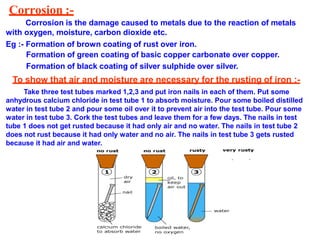
To show that air and moisture are necessary for the rusting of iron :-
Take three test tubes marked 1,2,3 and put iron nails in each of them. Put some
anhydrous calcium chloride in test tube 1 to absorb moisture. Pour some boiled distilled
water in test tube 2 and pour some oil over it to prevent air into the test tube. Pour some
water in test tube 3. Cork the test tubes and leave them for a few days. The nails in test
tube 1 does not get rusted because it had only air and no water. The nails in test tube 2
does not rust because it had only water and no air. The nails in test tube 3 gets rusted
because it had air and water.
Prevention of corrosion :-
Corrosion of metals can be prevented by :-
i) Applying oil or grease.
ii) Applying paint.
iii) By galvanisation. (Coating with zinc)
iv) By tinning. (Coating with tin)
v) By electroplating. (Coating a less reactive metal like chromium)
vi) By alloying. (Making alloys)
Alloy :-
An alloy is a homogeneous mixture of a metal with other metals or
non metal.
Eg :- Steel – iron, carbon
Stainless steel – iron, carbon, cobalt, nickel
Brass – copper, zinc
Bronze – copper, tin
Solder – Lead, tin (used for welding electrical wires together)
If one of the metals in an alloy is mercury, it is called an amalgam.

8th

  • 1.
  • 2.
  • 3.
    Physical properties ofmetals :- • • • • • • • • • • Metals are solids. (except mercury) Metals are hard. (except Lithium, Potassium, Sodium) Metals have metallic lustre. (shine) Metals are malleable. (can be beaten into thin sheets) Metals are ductile. (can be drawn into wires) Metals have high melting points. (Gallium and Ceasium have low melting points. They melt in the palm of the hand) Metals have high boiling points. Metals are good conductors of heat. ( Best conductors are silver and copper. Poor conductors are Lead and Mercury) Metals are good conductors of electricity. ( Best conductors are Silver and Copper) Metals are sonorus. (produce sound when beaten)
  • 4.
    Physical properties ofnon metals :- • • • • • • • • • • Non metals may be solids, liquids or gases. (Solids – Carbon, Sulphur, Phosphorus etc. Liquid – Bromine, Gases – Oxygen, Hydrogen, Nitrogen etc.) Non metals are soft. (except diamond which is the hardest natural substance) Non metals do not have lustre.( except iodine cryatals) Non metals are not malleable. Non metals are not ductile. Non metals which are solids and liquids have low melting points. Non metals which are solids and liquids have low boiling points. Non metals are bad conductors of heat. Non metals are bad conductors of electricity. (except graphite) Non metals are not sonorus.
  • 5.
    The reactivity ofdifferent metals with oxygen is different :- • • • • • • Metals like potassium and sodium react vigorously with oxygen and catch fire if kept in open. Hence they are stored in kerosene to prevent burning. If magnesium is heated, it burns with a bright flame. If iron is heated it glows brightly. If copper is heated it does not burn but forms a black coating of copper oxide. Silver and gold does not react with oxygen even at high temperature. Some metals like magnesium, aluminium, zinc, lead etc. forms an oxide layer over it which prevents further oxidation. They are called self protecting metals.
  • 6.
    Reaction with water:- Metals react with water to form metal oxides or metal hydroxides and hydrogen. 2Na + 2H2O 2NaOH + H2 The reactivity of different metals with water is different :- - Sodium and potassium react violently with cold water to form sodium hydroxide and hydrogen and catches fire. - Calcium reacts less violently with water to form calcium hydroxide and water and does not catch fire. - Magnesium reacts only with hot water to form magnesium hydroxide and hydrogen. - Metals like aluminium, iron and zinc react only with steam to form the metal oxides and hydrogen. - Metals like lead, copper, silver and gold do not react with water.
  • 7.
    Reaction of metalswith metal salt solutions :- A more reactive metal displaces a less reactive metal from its salt solution. (Displacement reaction) Magnesium displaces copper from copper sulphate solution. Mg + CuSO4 MgSO4 + Cu Zinc displaces copper from copper sulphate solution. Zn + CuSO4 ZnSO4 + Cu Iron displaces copper from copper sulphate solution Fe + CuSO4 FeSO4 + Cu after 15 – 20 minutes
  • 8.
    Reactivity series ofmetals :- The arranging of metals in the decreasing order of their reactivity is called reactivity series of metals. Most reactive Reactivity decreases K - Potassium Na - Sodium Ca - Calcium Mg - Magnesium Al - Aluminium Zn - Zinc Fe - Iron Pb - Lead H - Hydrogen Cu - Copper Hg - Mercury Ag - Silver Au - Gold Least reactive
  • 9.
    Occurence of metals:- Some metals like gold, silver, platinum etc are found in the free state in the earth’s crust because they are least reactive. Most metals are found as oxides, carbonates, sulphides, halides etc. Minerals :- are elements or compounds which occur naturally inside the earth’s crust. Ore :- is a mineral from which metals can be extracted profitably. Gangue :- is the impurities present in the ore like rock particles, sand particles, clay particles etc.
  • 10.
    Corrosion :- Corrosion isthe damage caused to metals due to the reaction of metals with oxygen, moisture, carbon dioxide etc. Eg :- Formation of brown coating of rust over iron. Formation of green coating of basic copper carbonate over copper. Formation of black coating of silver sulphide over silver. To show that air and moisture are necessary for the rusting of iron :- Take three test tubes marked 1,2,3 and put iron nails in each of them. Put some anhydrous calcium chloride in test tube 1 to absorb moisture. Pour some boiled distilled water in test tube 2 and pour some oil over it to prevent air into the test tube. Pour some water in test tube 3. Cork the test tubes and leave them for a few days. The nails in test tube 1 does not get rusted because it had only air and no water. The nails in test tube 2 does not rust because it had only water and no air. The nails in test tube 3 gets rusted because it had air and water.
  • 11.
    Prevention of corrosion:- Corrosion of metals can be prevented by :- i) Applying oil or grease. ii) Applying paint. iii) By galvanisation. (Coating with zinc) iv) By tinning. (Coating with tin) v) By electroplating. (Coating a less reactive metal like chromium) vi) By alloying. (Making alloys) Alloy :- An alloy is a homogeneous mixture of a metal with other metals or non metal. Eg :- Steel – iron, carbon Stainless steel – iron, carbon, cobalt, nickel Brass – copper, zinc Bronze – copper, tin Solder – Lead, tin (used for welding electrical wires together) If one of the metals in an alloy is mercury, it is called an amalgam.