MATRIX APPLICATION IN
CRYPTOGRAPHY
MATRIX
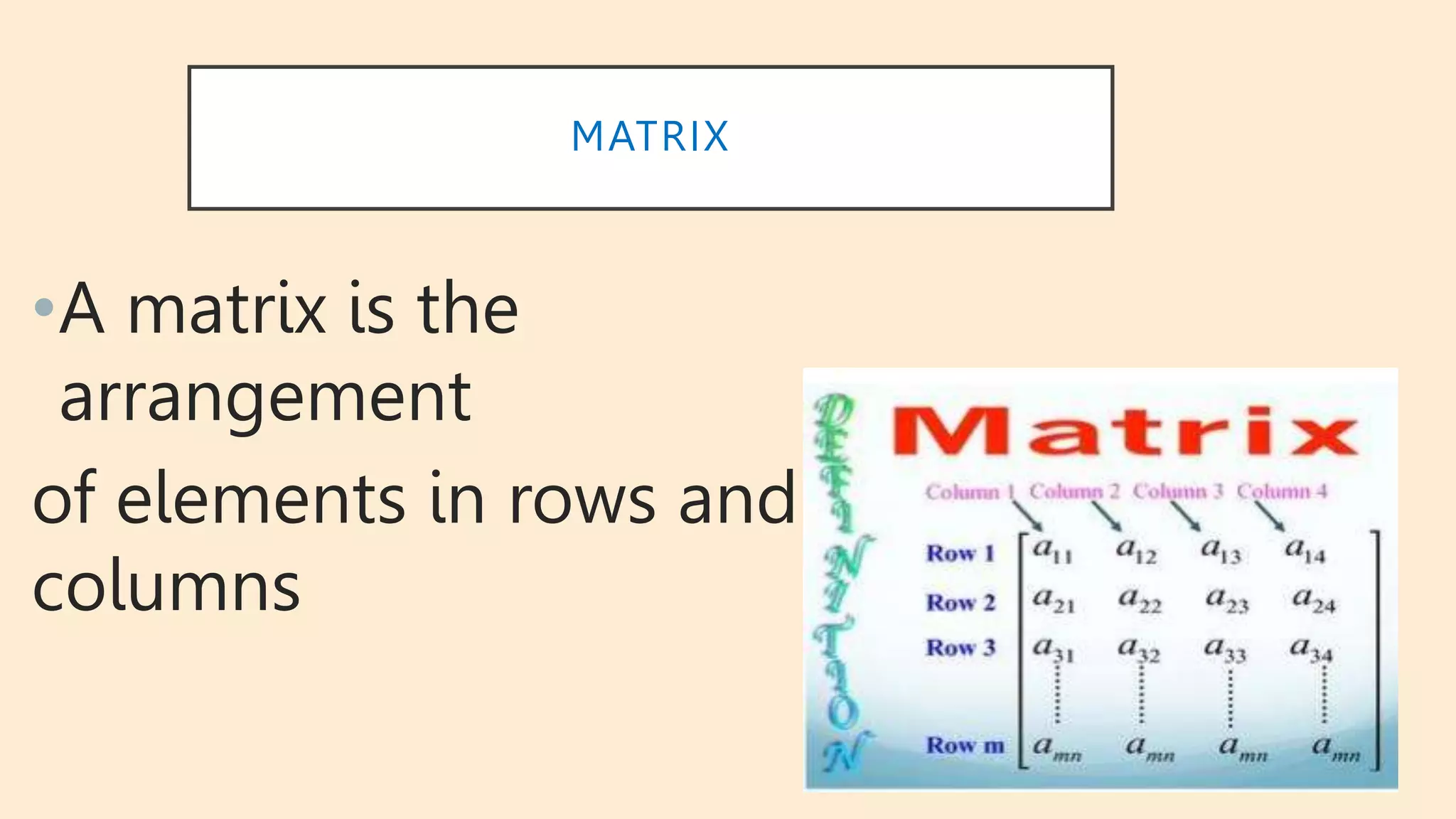
•A matrix is the
arrangement
of elements in rows and
columns
APPLICATION OF MATRICES TO CRYPTOGRAPHY
*One of the important applications of inverse of a non-singular square matrix is in cryptography.
*Cryptography is an art of communication between two people by keeping the information not known
to others.
*It is based upon two factors, namely encryption and decryption.
* Encryption means the process of transformation of an information (plain form) into an unreadable
form (coded form).
*Decryption means the transformation of the coded message back into original form. Encryption and
decryption require a secret technique which is known only to the sender and the receiver.
*This secret is called a key .One way of
generating a key is by using a non-singular matrix
to encrypt a message by the sender.
*The receiver decodes (decrypts) the message to
retrieve the original message by using the inverse
of the matrix.
*The matrix used for encryption is called
encryption matrix (encoding matrix) and that used
for decoding is called decryption matrix(decoding
matrix).
• We explain the process of encryption and decryption by means of
an example.
Suppose that the sender and receiver consider messages in
alphabets A − Z only, both assign the numbers 1-26 to the
letters A − Z respectively, and the number 0 to a blank space.
For simplicity, the sender employs a key as post-
multiplication by a non-singular matrix of order 3 of his own
choice. The receiver uses post-multiplication by the inverse
of the matrix which has been chosen by the sender.
• Let the encoding Let the encoding matrix be
Let the message to be sent by the sender be “WELCOME”.
Since the key is taken as the operation of post-multiplication by
a square matrix of order 3, the message is cut into pieces
(WEL), (COM), (E), each of length 3, and converted into a
sequence of row matrices of numbers:
[23 5 12],[3 15 13],[5 0 0].
Note that, we have included two zeros in the last row matrix.
The reason is to get a row matrix with 5 as the first entry.
• Next, we encode the message by post-multiplying each row matrix as given
below:
So the encoded message is [45 − 28 −23] [46 -18 3] [ 5 −5 5]
The receiver will decode the message by the reverse key, post-
multiplying by the inverse of A.
So the decoding matrix is
The receiver decodes the coded message as follows:
So, the sequence of decoded row matrices is [23 5 12],[3 15
13],[5 0 0].
Thus, the receiver reads the message as “WELCOME”.
matrix -cryptography 1.pptx

matrix -cryptography 1.pptx

  • 1.
  • 2.
    MATRIX •A matrix isthe arrangement of elements in rows and columns
  • 3.
    APPLICATION OF MATRICESTO CRYPTOGRAPHY *One of the important applications of inverse of a non-singular square matrix is in cryptography. *Cryptography is an art of communication between two people by keeping the information not known to others. *It is based upon two factors, namely encryption and decryption. * Encryption means the process of transformation of an information (plain form) into an unreadable form (coded form). *Decryption means the transformation of the coded message back into original form. Encryption and decryption require a secret technique which is known only to the sender and the receiver.
  • 4.
    *This secret iscalled a key .One way of generating a key is by using a non-singular matrix to encrypt a message by the sender. *The receiver decodes (decrypts) the message to retrieve the original message by using the inverse of the matrix. *The matrix used for encryption is called encryption matrix (encoding matrix) and that used for decoding is called decryption matrix(decoding matrix).
  • 5.
    • We explainthe process of encryption and decryption by means of an example. Suppose that the sender and receiver consider messages in alphabets A − Z only, both assign the numbers 1-26 to the letters A − Z respectively, and the number 0 to a blank space. For simplicity, the sender employs a key as post- multiplication by a non-singular matrix of order 3 of his own choice. The receiver uses post-multiplication by the inverse of the matrix which has been chosen by the sender.
  • 6.
    • Let theencoding Let the encoding matrix be Let the message to be sent by the sender be “WELCOME”. Since the key is taken as the operation of post-multiplication by a square matrix of order 3, the message is cut into pieces (WEL), (COM), (E), each of length 3, and converted into a sequence of row matrices of numbers: [23 5 12],[3 15 13],[5 0 0]. Note that, we have included two zeros in the last row matrix. The reason is to get a row matrix with 5 as the first entry.
  • 7.
    • Next, weencode the message by post-multiplying each row matrix as given below: So the encoded message is [45 − 28 −23] [46 -18 3] [ 5 −5 5] The receiver will decode the message by the reverse key, post- multiplying by the inverse of A.
  • 8.
    So the decodingmatrix is The receiver decodes the coded message as follows: So, the sequence of decoded row matrices is [23 5 12],[3 15 13],[5 0 0]. Thus, the receiver reads the message as “WELCOME”.