CRYPTOGRAPHY AND NETWORKSECURITY
IS62214IC
Department of Information Science & Engineering
By
Prof. Prajna U R
Assistant Professor
Department of Information Science & Engineering
Sahyadri College of Engineering and Management, Adyar Mangaluru
Email: prajnau.is@sahyadri.edu.in
Mob:8495971075
2.
MODULE-2
Basics of Cryptographyand Encryption
Topics to be covered
Introduction to Cryptography, Plain Text and Cipher Text, Symmetric Cipher Model, Cryptography, Cryptanalysis, Brute Force
Attacks, Substitution Techniques - Caesar Cipher and Modified Caesar Cipher, Mono Alphabetic cipher, Poly-Alphabetic
Cipher, Playfair Cipher, Transposition Techniques- Rail Fence technique, Simple Columnar transposition Technique.
3.
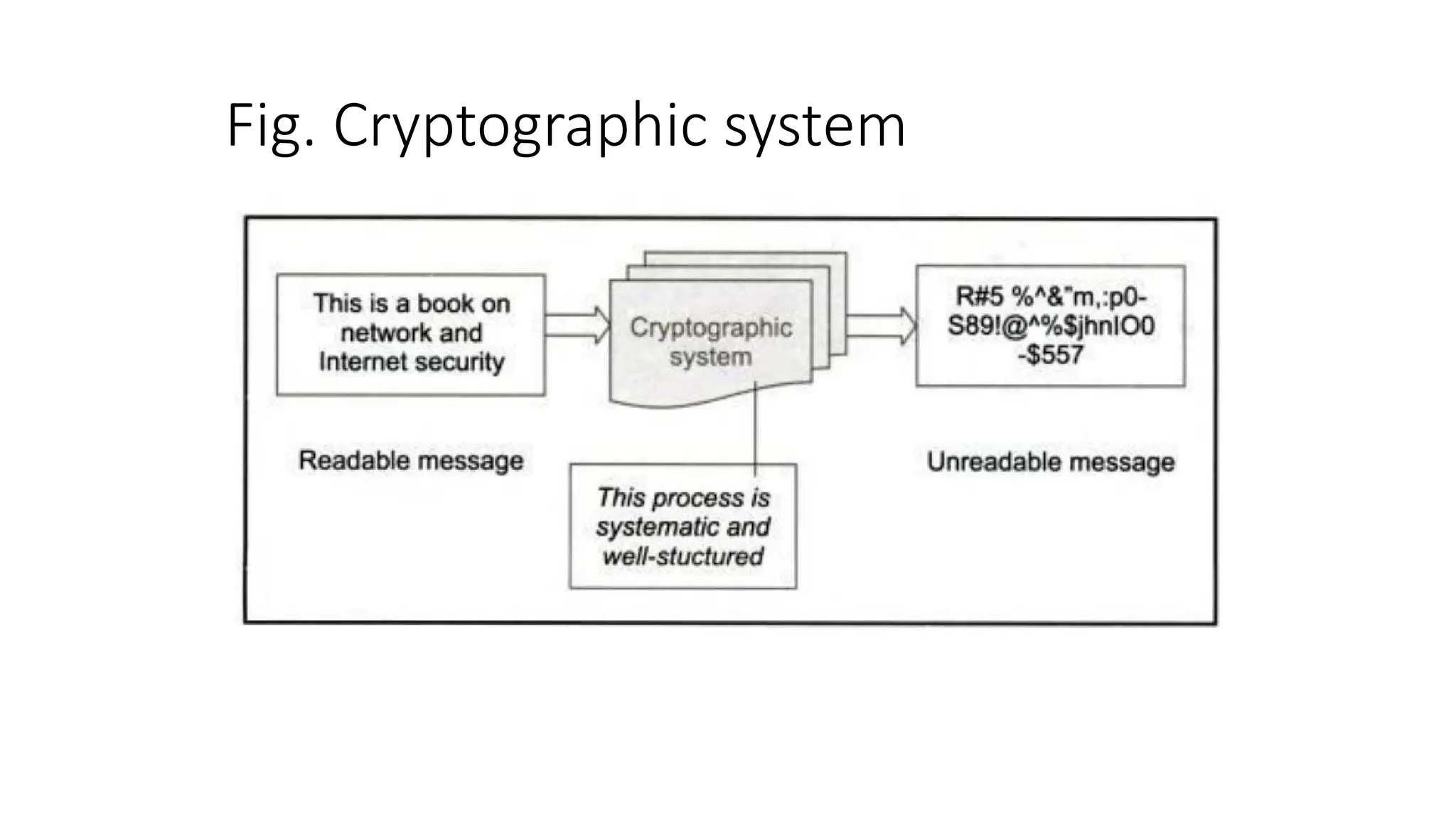
Cryptography
The art orscience encompassing the principles and methods of
transforming an intelligible message into one that is unintelligible, and
then retransforming that message back to its original form.
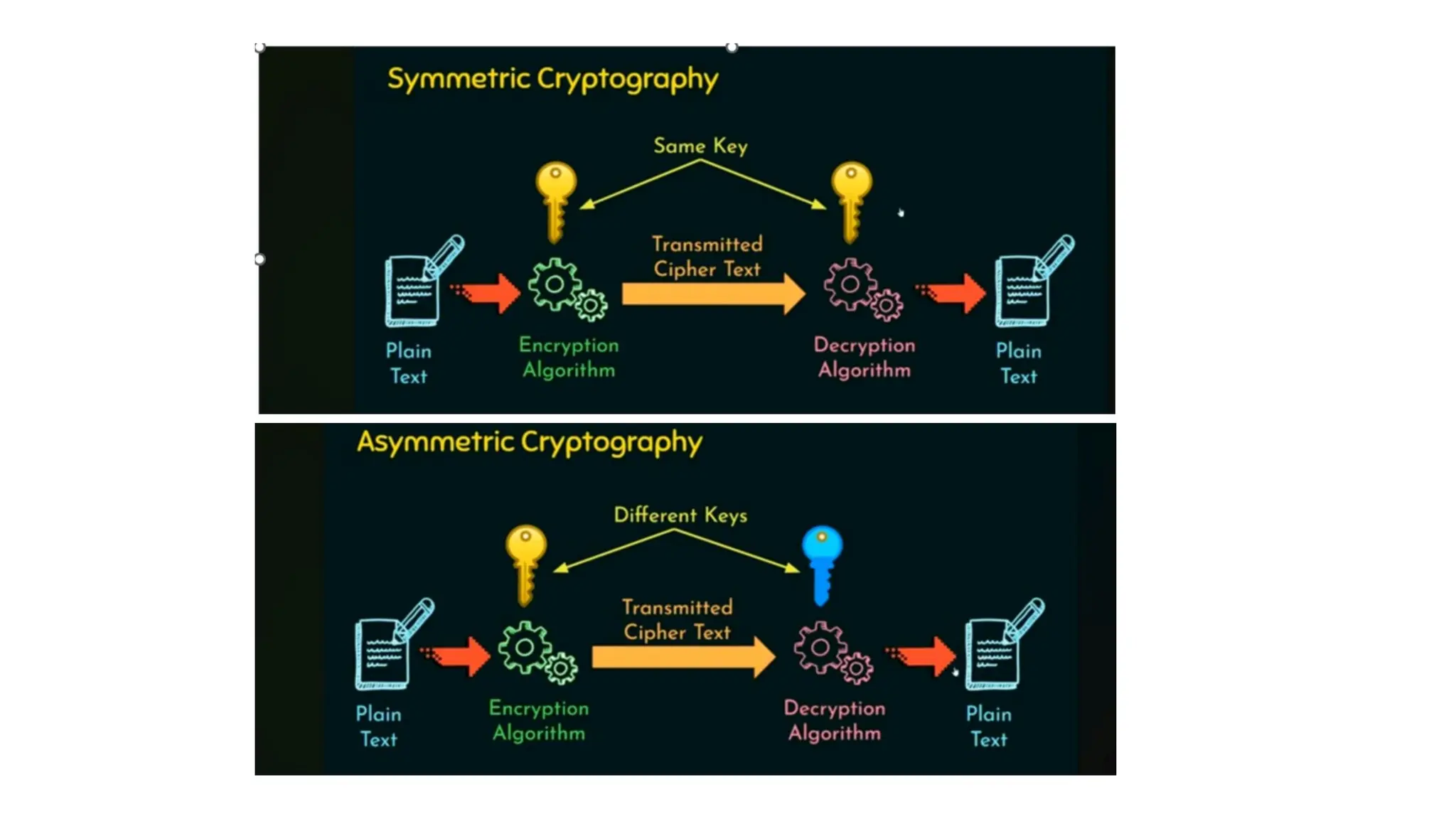
Types of Cryptography
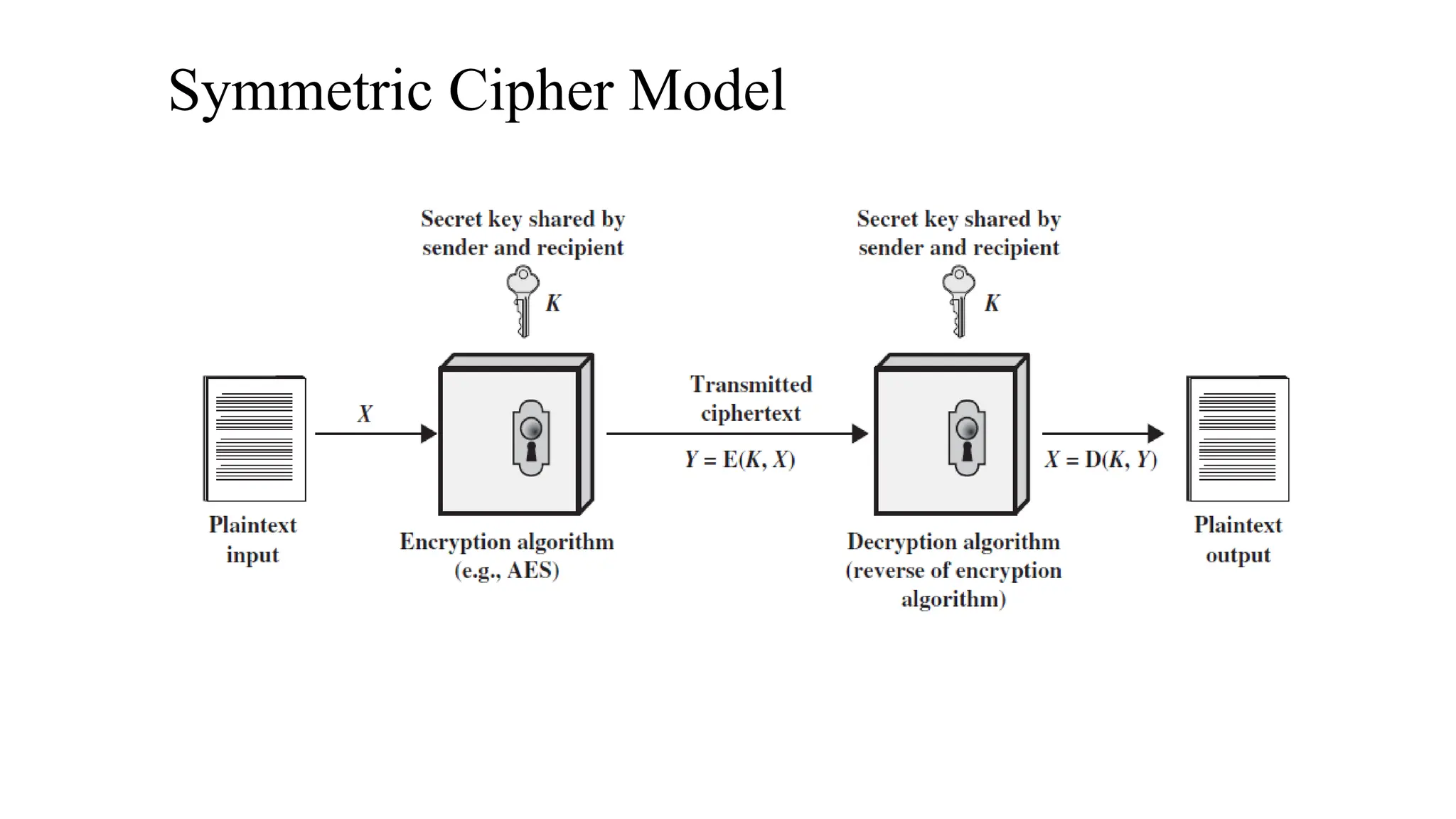
Symmetric (private key )
Asymmetric (public key)
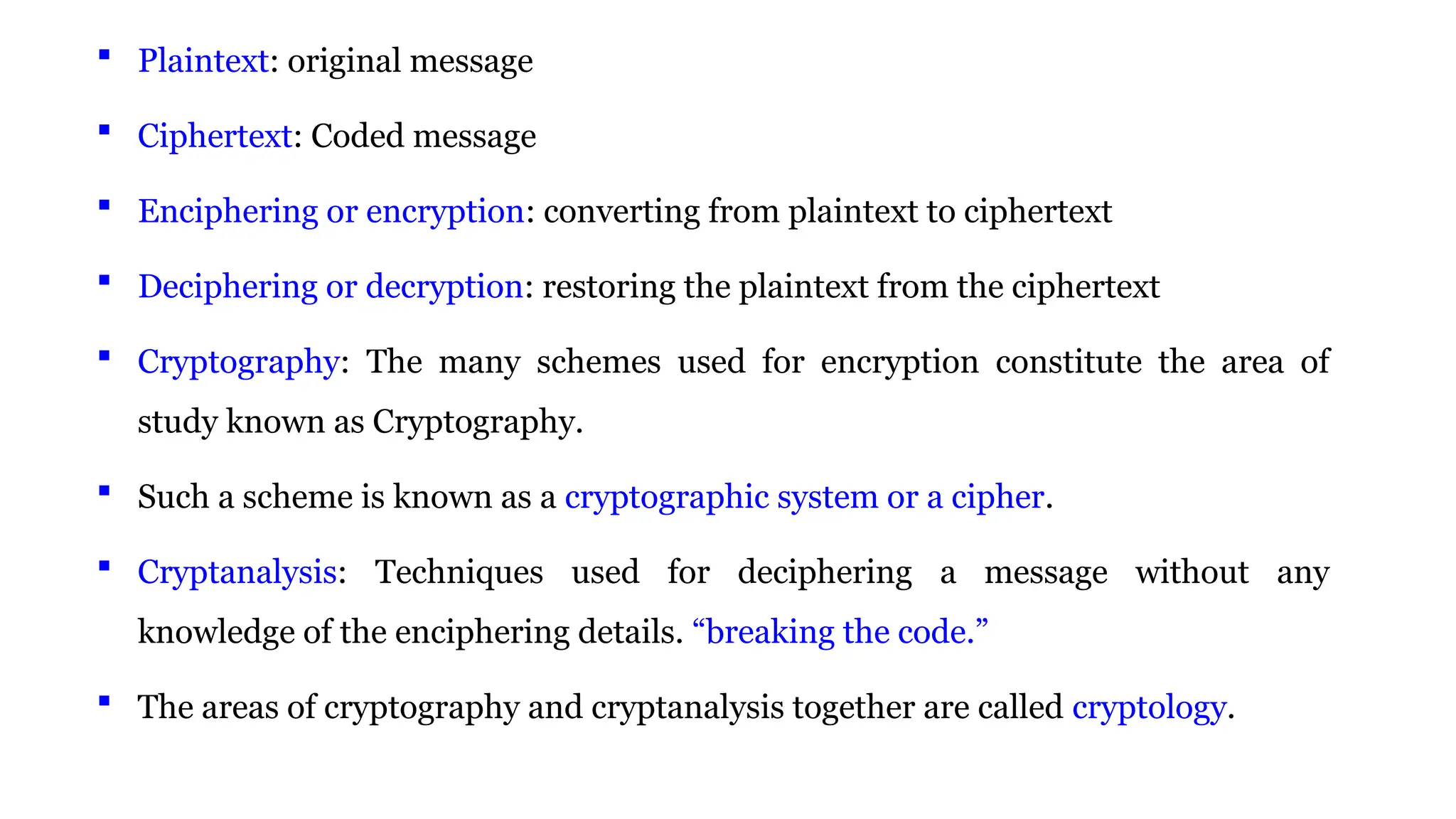
Plaintext: originalmessage
Ciphertext: Coded message
Enciphering or encryption: converting from plaintext to ciphertext
Deciphering or decryption: restoring the plaintext from the ciphertext
Cryptography: The many schemes used for encryption constitute the area of
study known as Cryptography.
Such a scheme is known as a cryptographic system or a cipher.
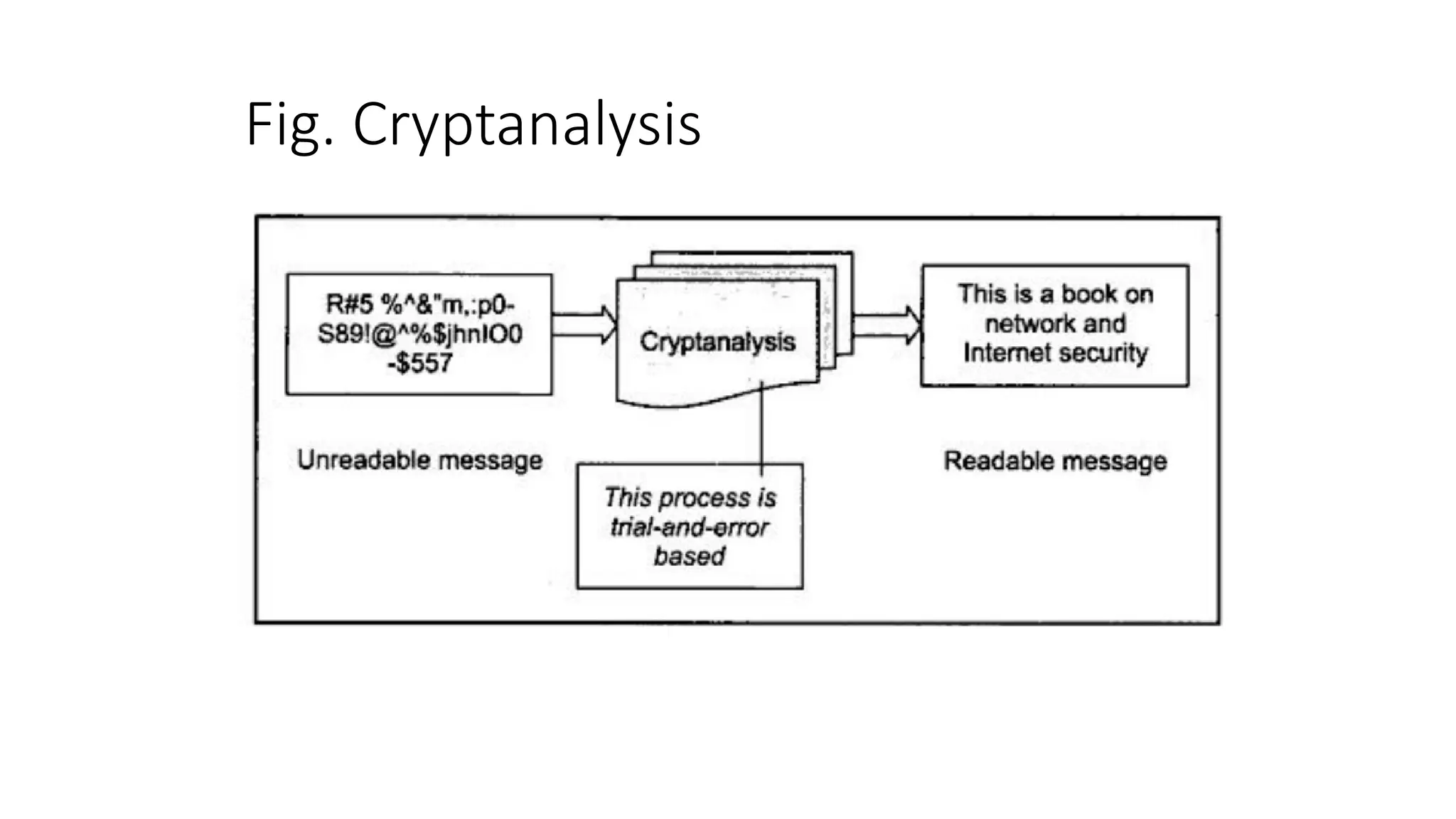
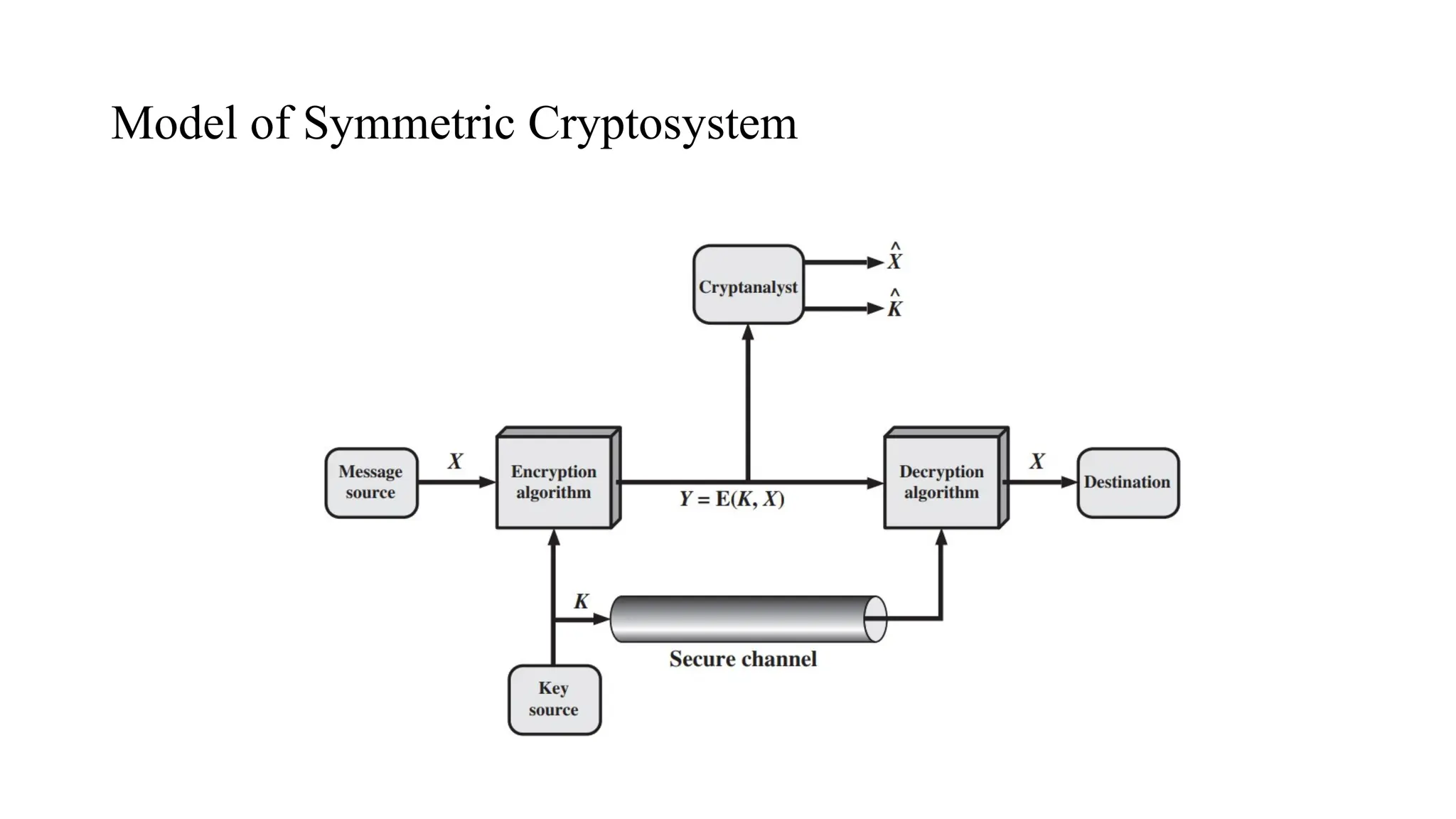
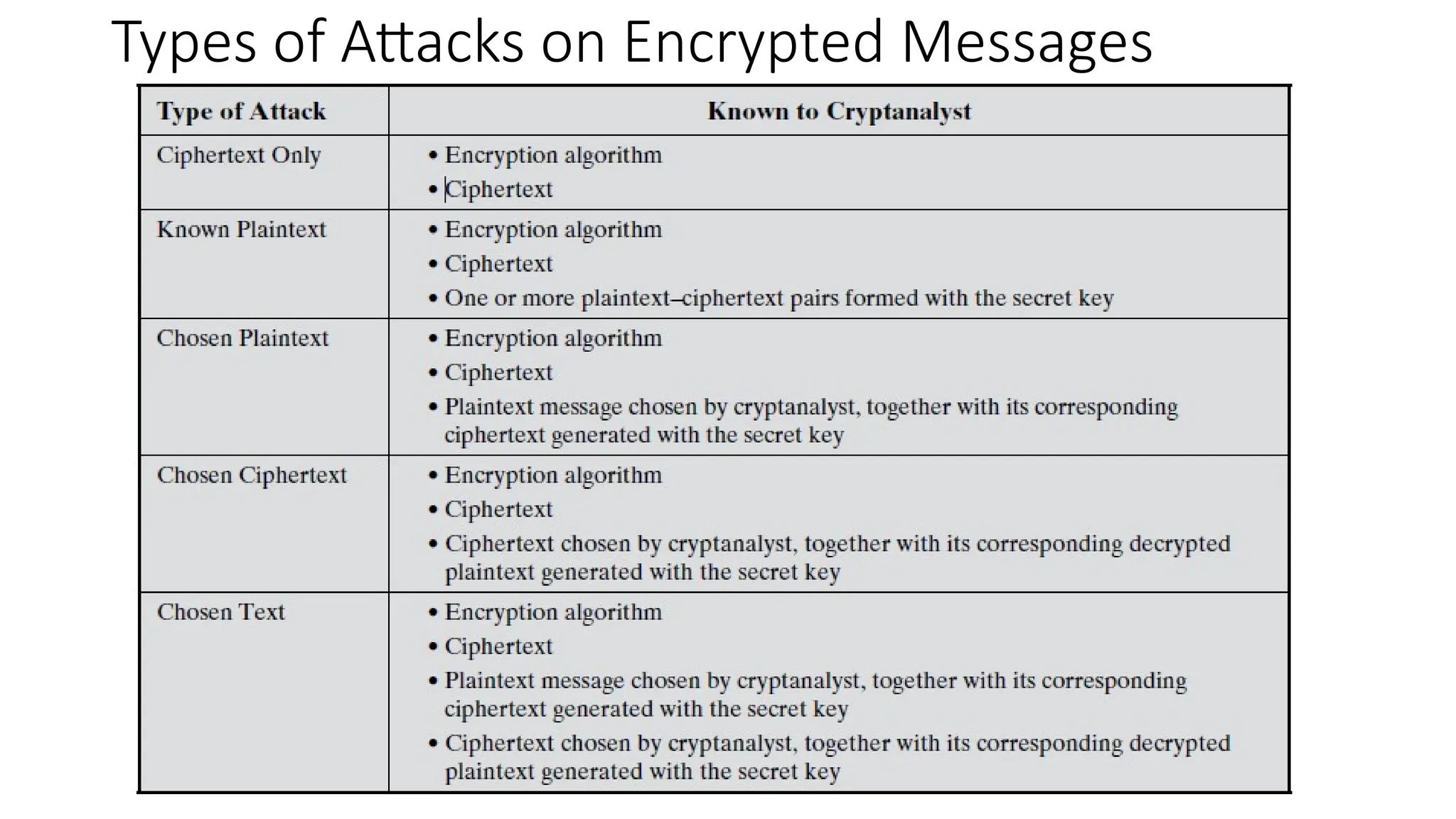
Cryptanalysis: Techniques used for deciphering a message without any
knowledge of the enciphering details. “breaking the code.”
The areas of cryptography and cryptanalysis together are called cryptology.
CryptogrCryptograpy
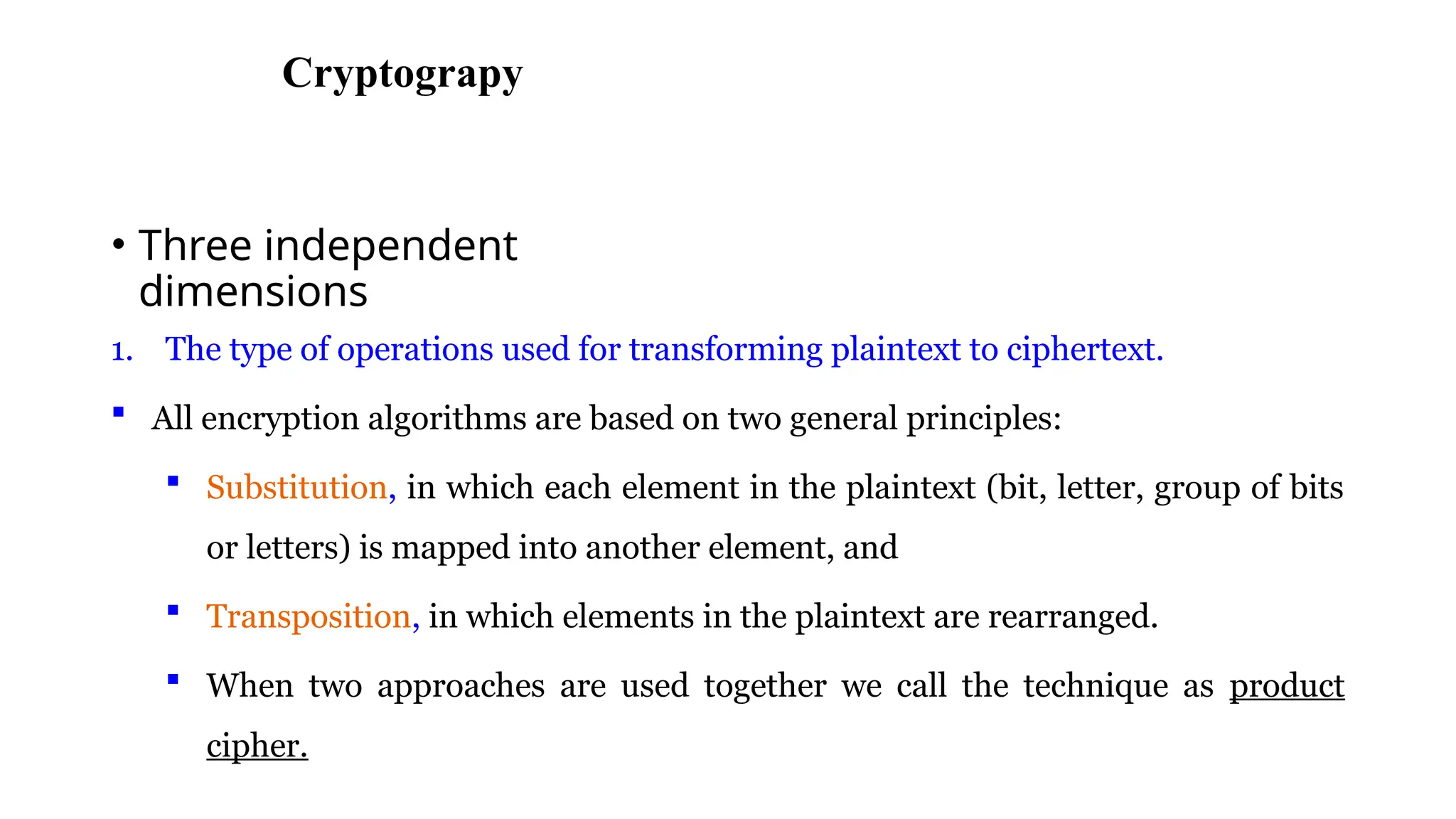
• Three independent
dimensions
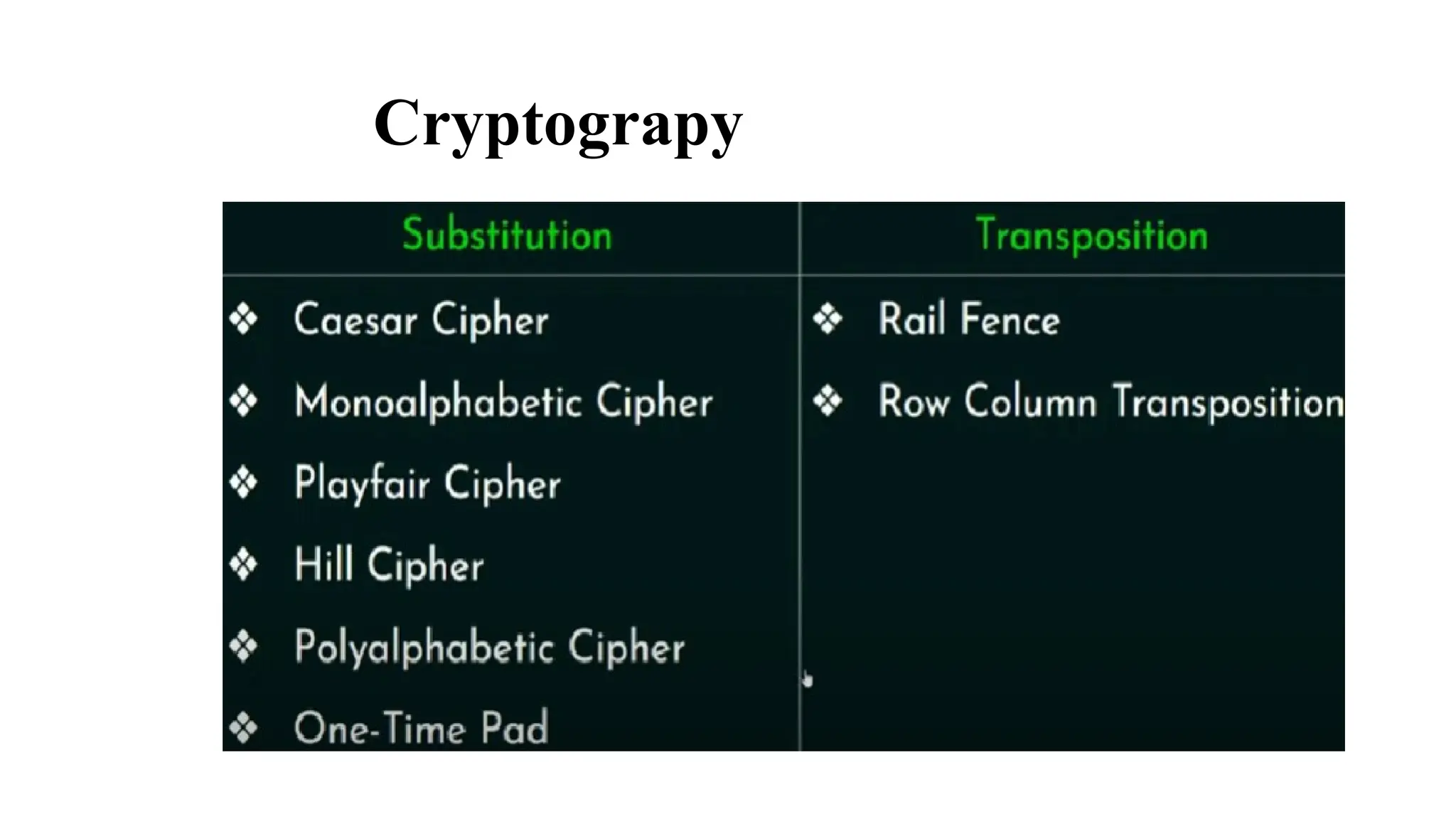
1.The type of operations used for transforming plaintext to ciphertext.
All encryption algorithms are based on two general principles:
Substitution, in which each element in the plaintext (bit, letter, group of bits
or letters) is mapped into another element, and
Transposition, in which elements in the plaintext are rearranged.
When two approaches are used together we call the technique as product
cipher.
11.
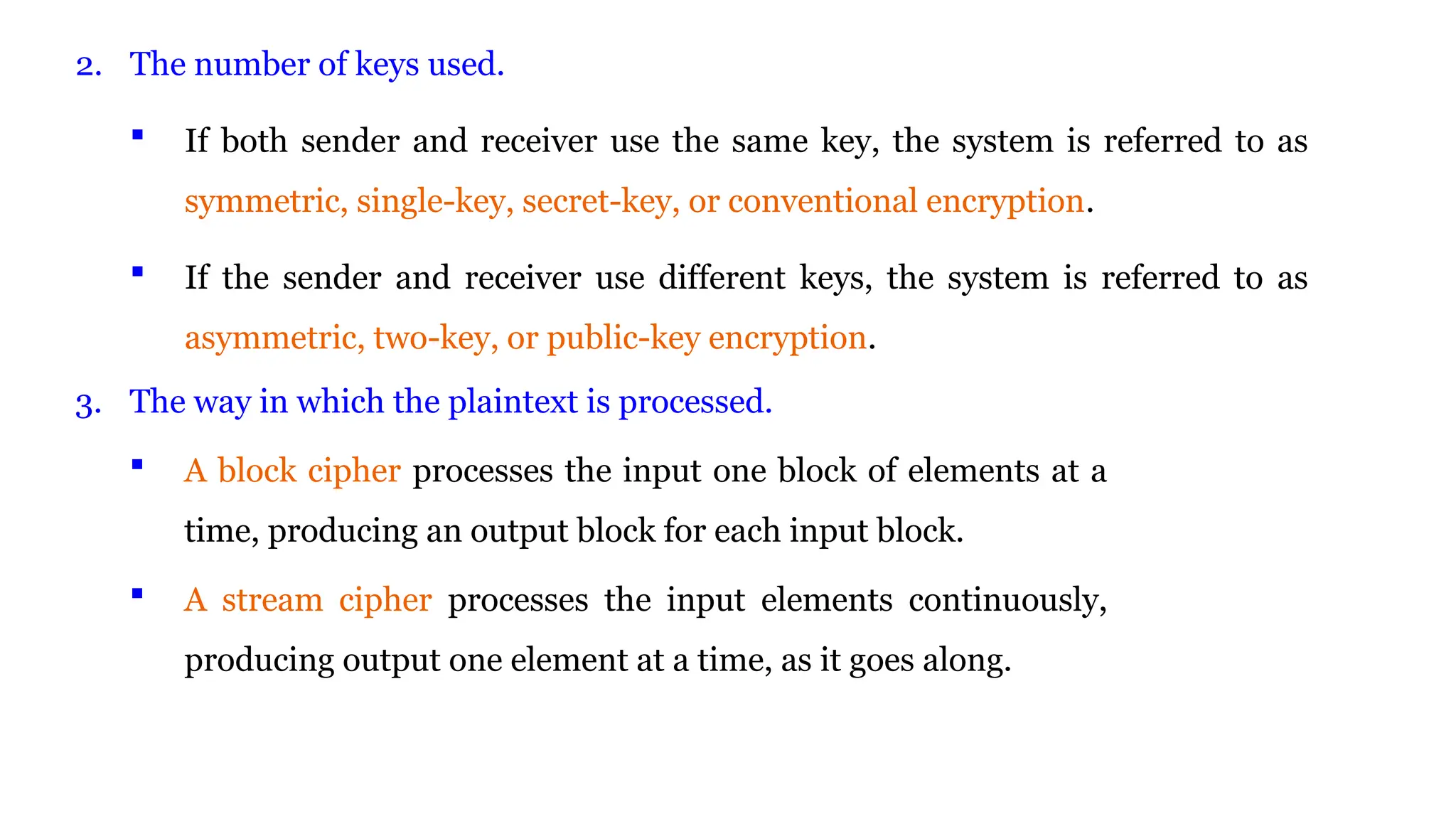
2. The numberof keys used.
If both sender and receiver use the same key, the system is referred to as
symmetric, single-key, secret-key, or conventional encryption.
If the sender and receiver use different keys, the system is referred to as
asymmetric, two-key, or public-key encryption.
3. The way in which the plaintext is processed.
A block cipher processes the input one block of elements at a
time, producing an output block for each input block.
A stream cipher processes the input elements continuously,
producing output one element at a time, as it goes along.
12.
CCryptanalysis and Brute-ForceAttackryptanalysnd Brute-
Force Attack
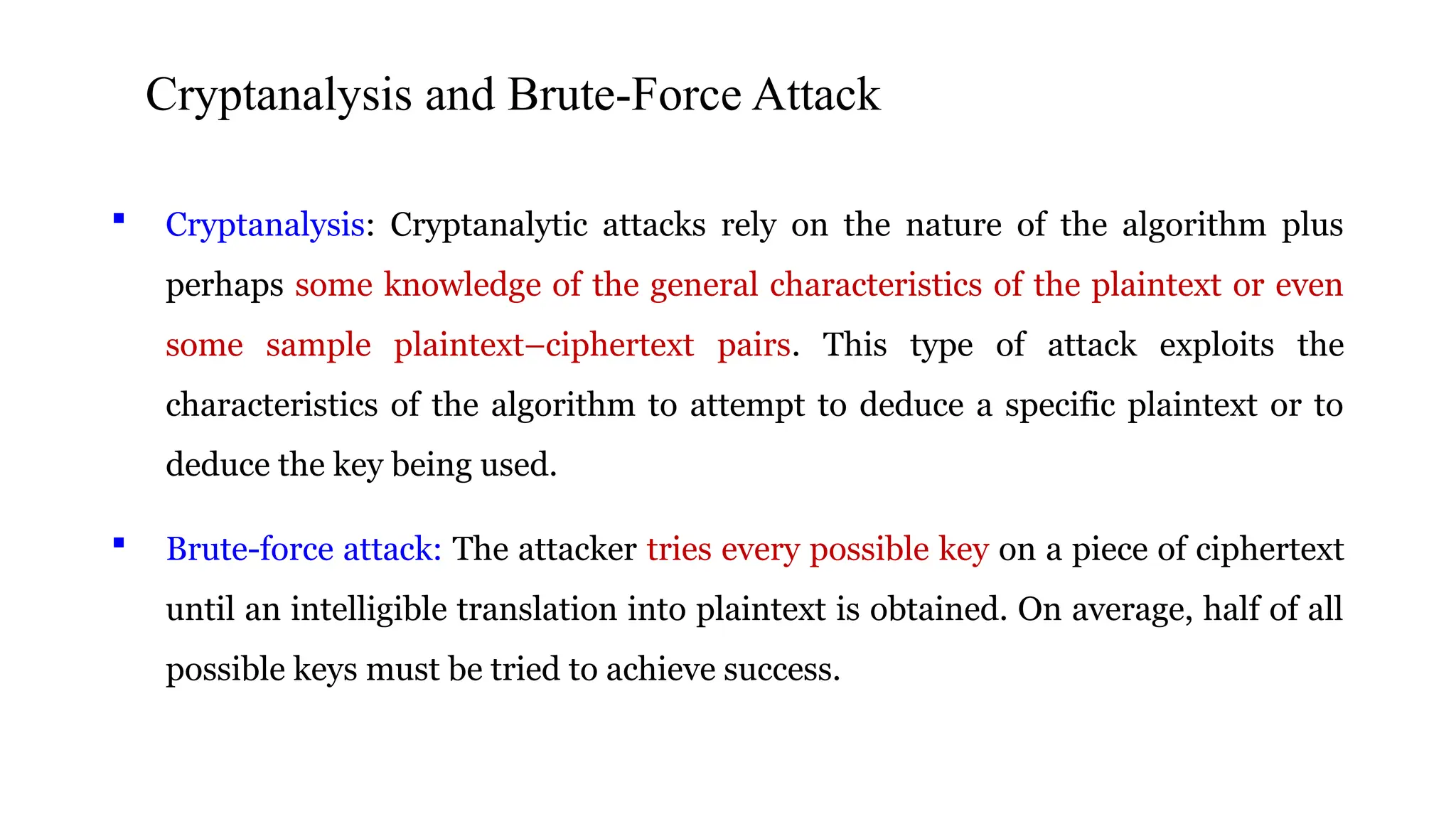
Cryptanalysis: Cryptanalytic attacks rely on the nature of the algorithm plus
perhaps some knowledge of the general characteristics of the plaintext or even
some sample plaintext–ciphertext pairs. This type of attack exploits the
characteristics of the algorithm to attempt to deduce a specific plaintext or to
deduce the key being used.
Brute-force attack: The attacker tries every possible key on a piece of ciphertext
until an intelligible translation into plaintext is obtained. On average, half of all
possible keys must be tried to achieve success.
Encryption scheme
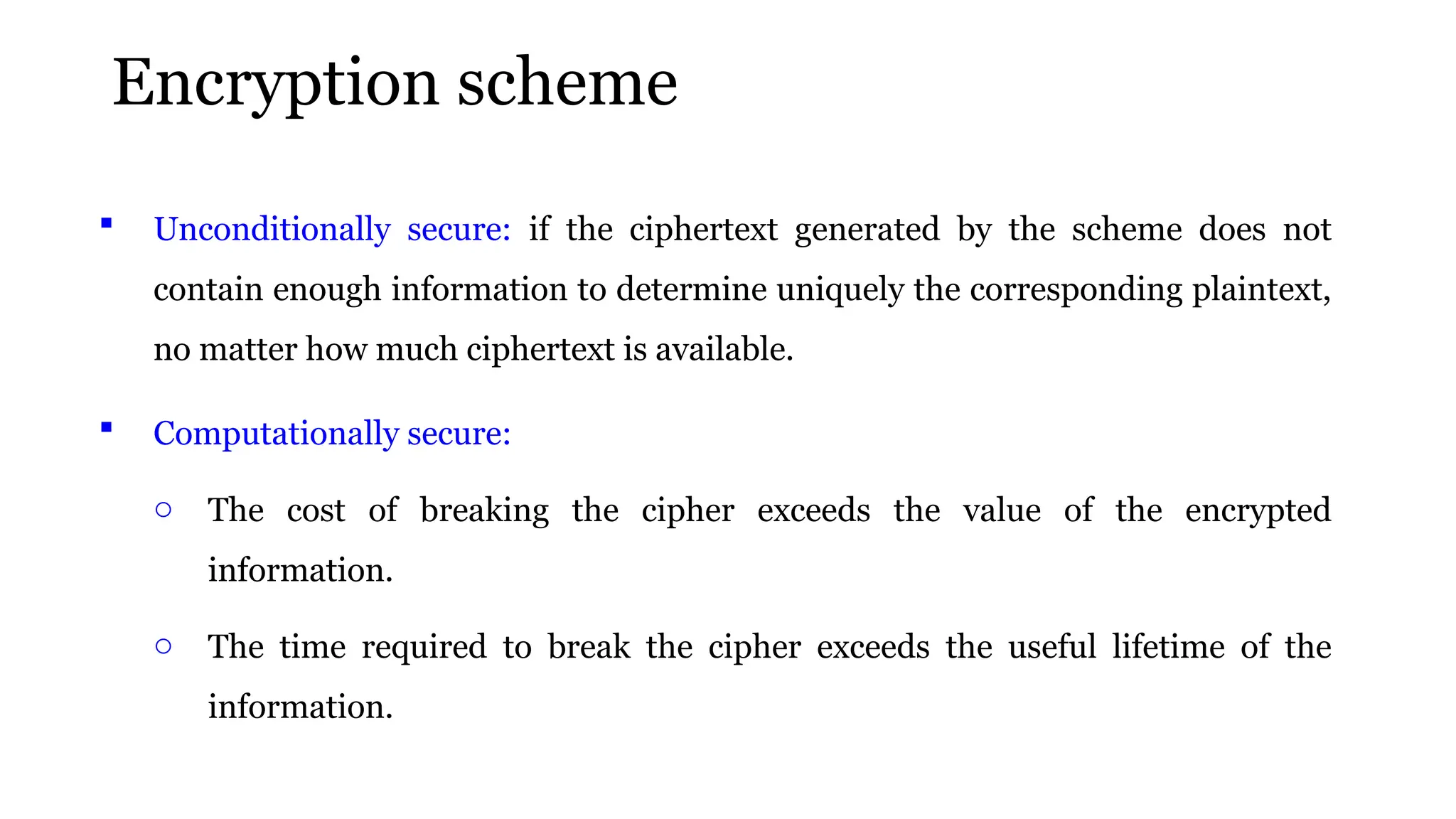
Unconditionallysecure: if the ciphertext generated by the scheme does not
contain enough information to determine uniquely the corresponding plaintext,
no matter how much ciphertext is available.
Computationally secure:
o The cost of breaking the cipher exceeds the value of the encrypted
information.
o The time required to break the cipher exceeds the useful lifetime of the
information.
Caesar Cipher
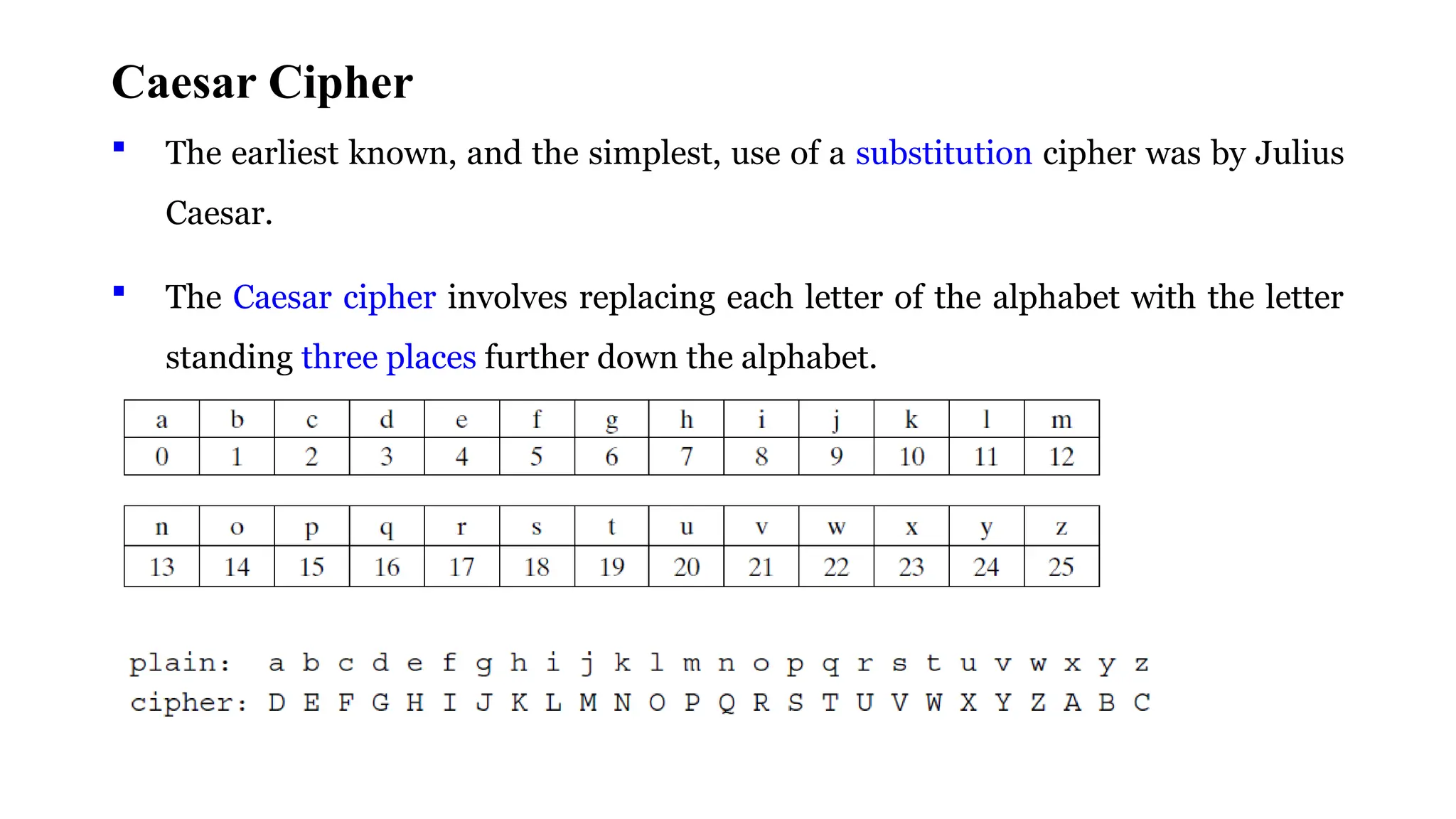
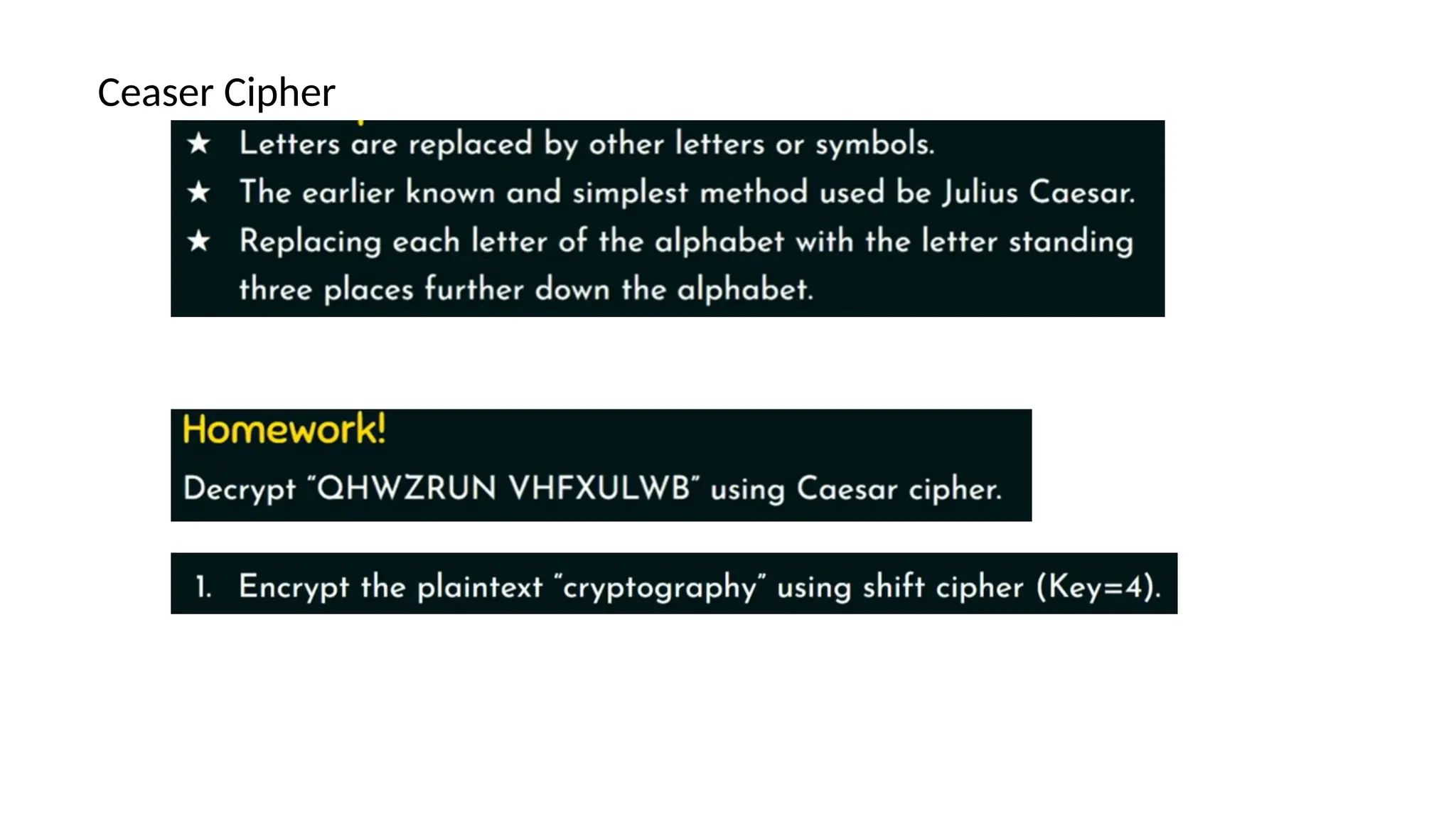
Theearliest known, and the simplest, use of a substitution cipher was by Julius
Caesar.
The Caesar cipher involves replacing each letter of the alphabet with the letter
standing three places further down the alphabet.
17.
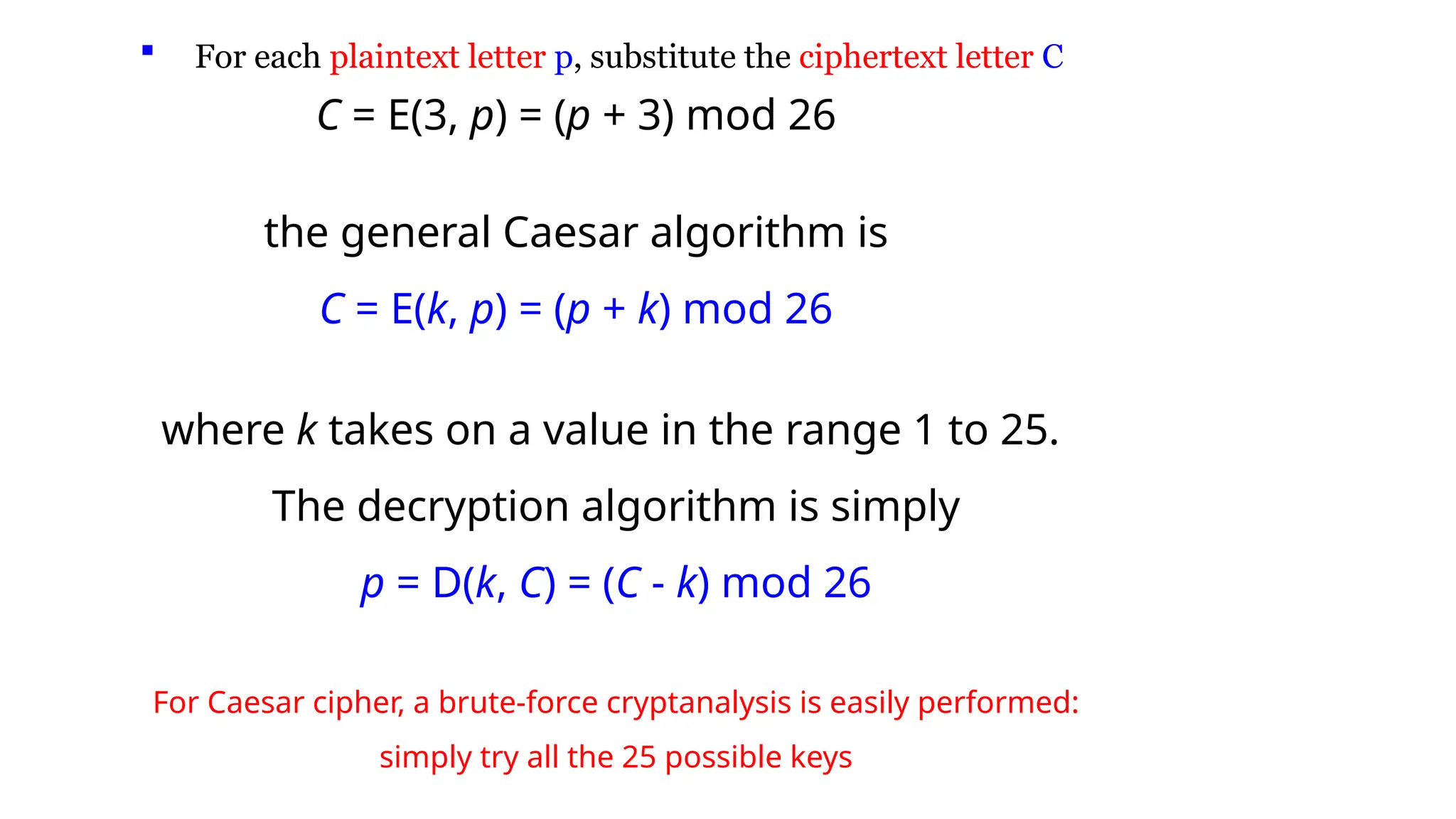
For eachplaintext letter p, substitute the ciphertext letter C
C = E(3, p) = (p + 3) mod 26
the general Caesar algorithm is
C = E(k, p) = (p + k) mod 26
where k takes on a value in the range 1 to 25.
The decryption algorithm is simply
p = D(k, C) = (C - k) mod 26
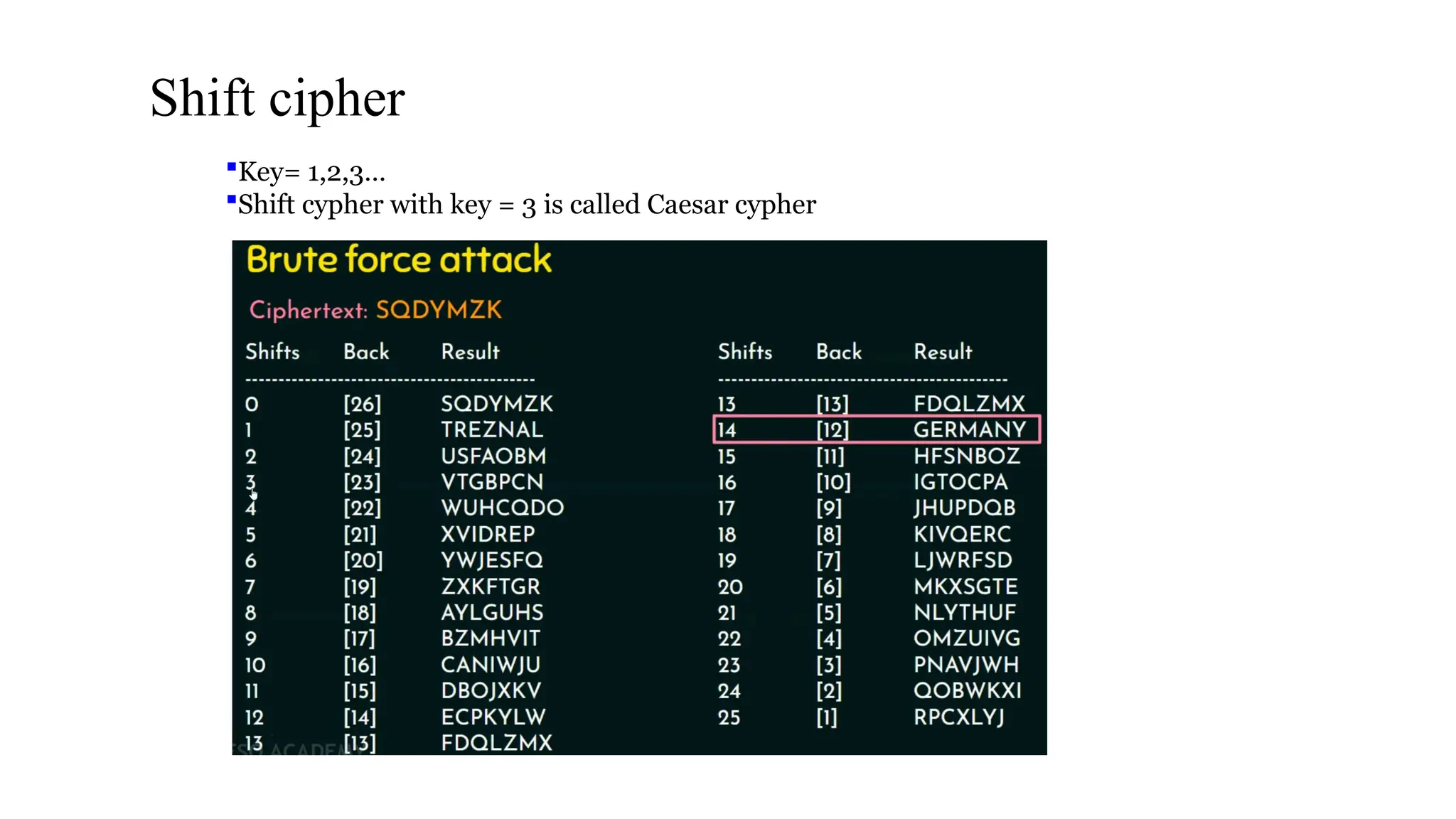
For Caesar cipher, a brute-force cryptanalysis is easily performed:
simply try all the 25 possible keys
18.
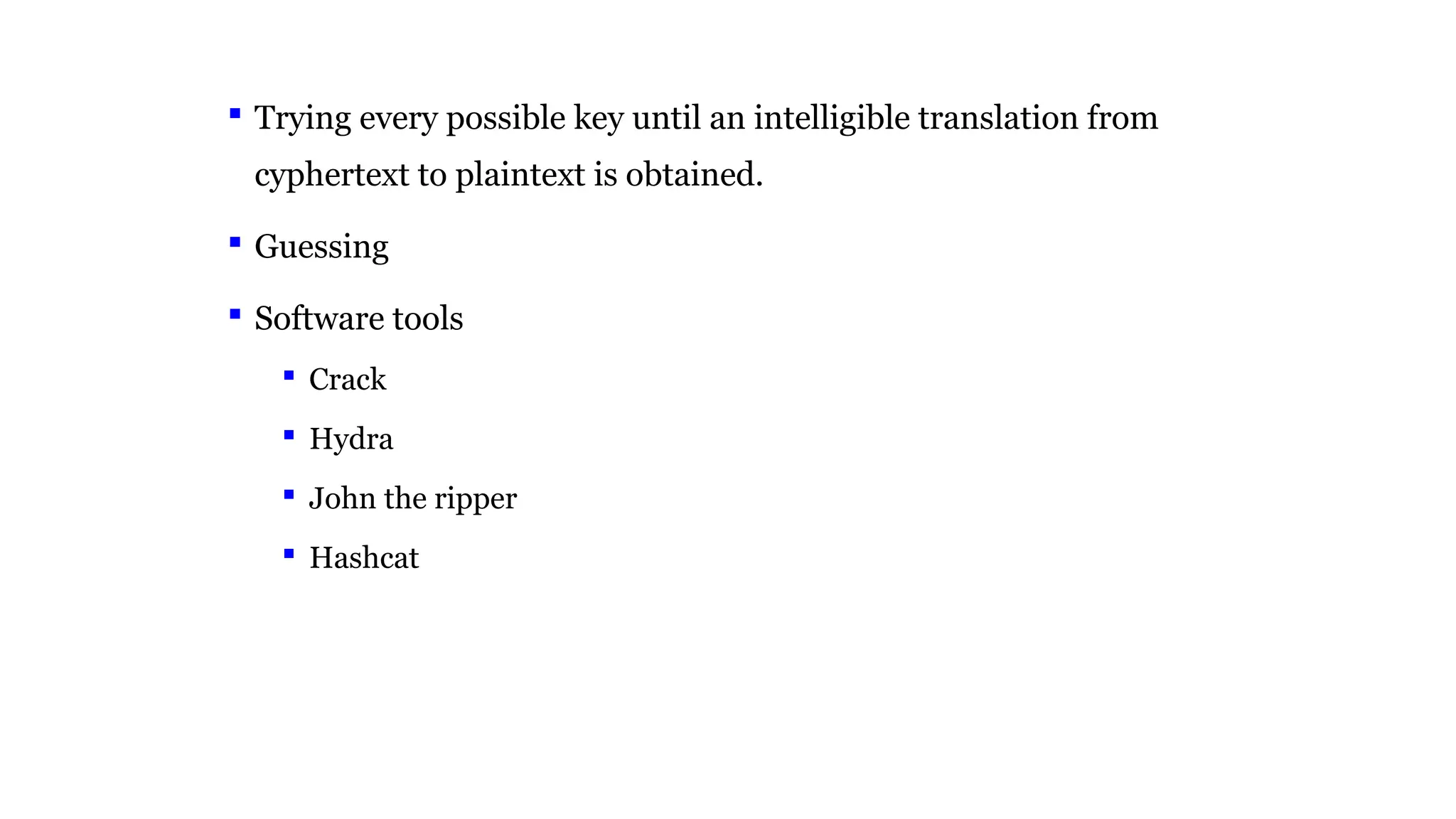
Trying everypossible key until an intelligible translation from
cyphertext to plaintext is obtained.
Guessing
Software tools
Crack
Hydra
John the ripper
Hashcat
19.
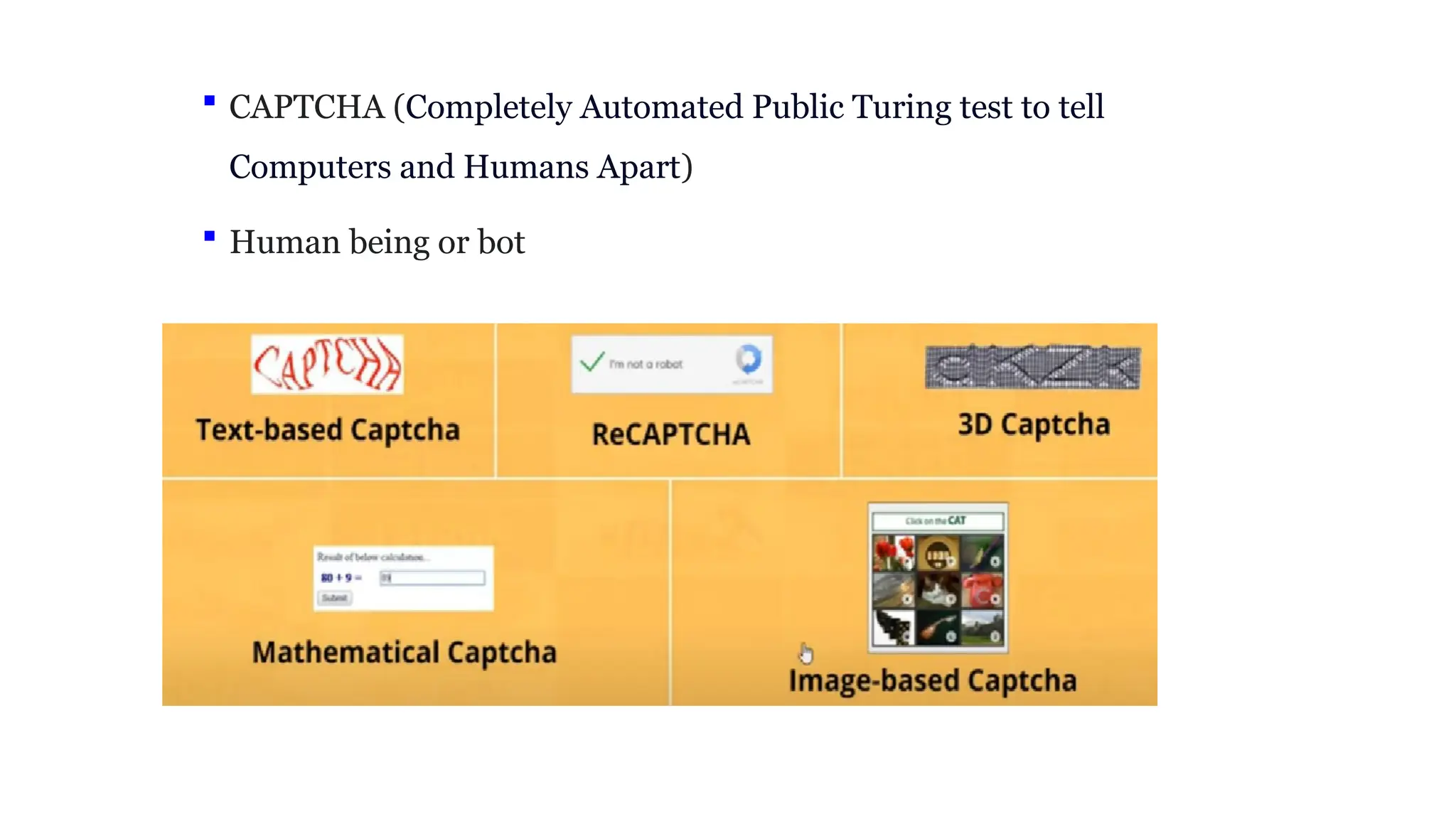
CAPTCHA (CompletelyAutomated Public Turing test to tell
Computers and Humans Apart)
Human being or bot
Monoalphabetic Ciphers
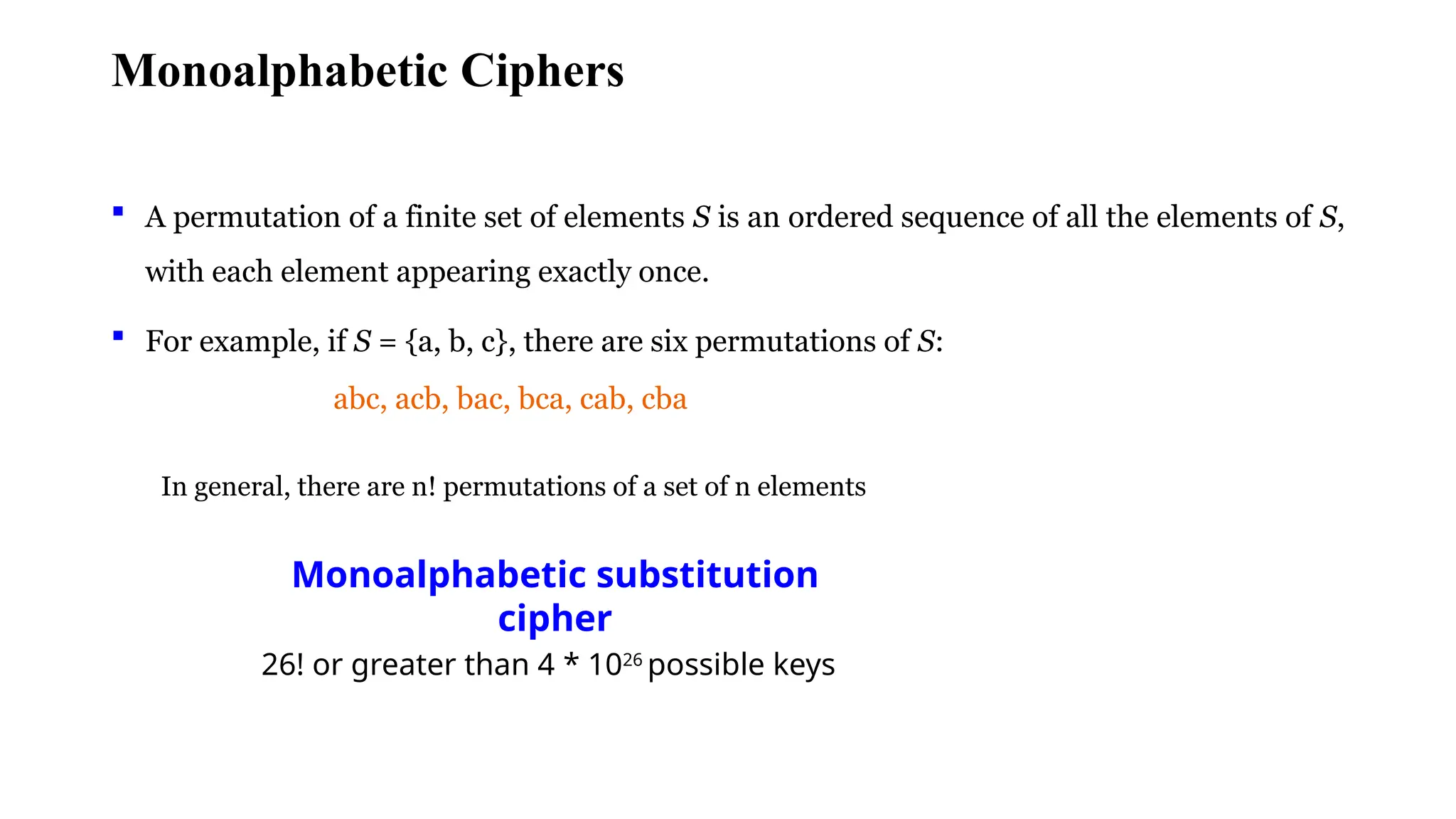
Apermutation of a finite set of elements S is an ordered sequence of all the elements of S,
with each element appearing exactly once.
For example, if S = {a, b, c}, there are six permutations of S:
abc, acb, bac, bca, cab, cba
In general, there are n! permutations of a set of n elements
Monoalphabetic substitution
cipher
26! or greater than 4 * 1026
possible keys
23.
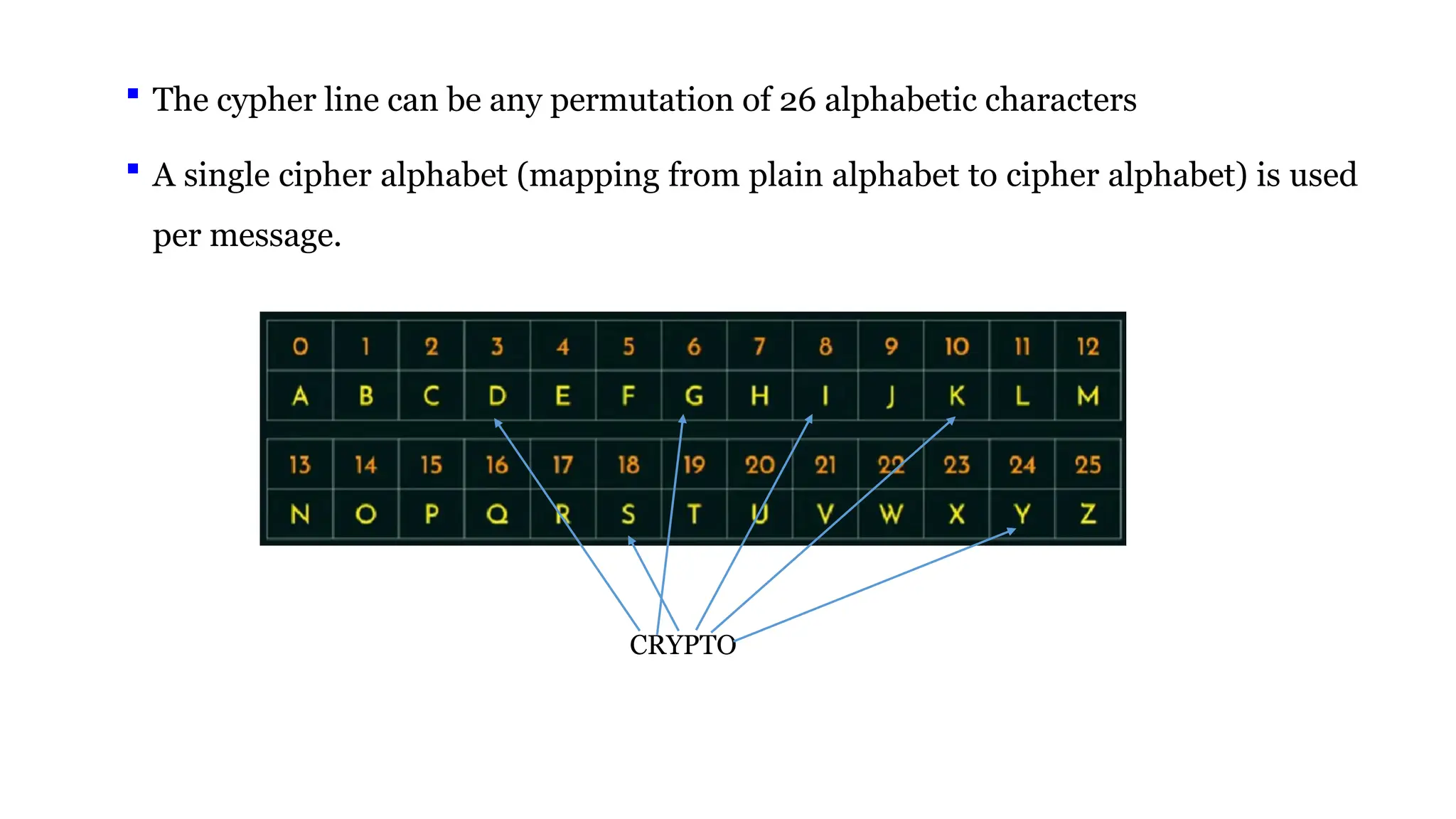
The cypherline can be any permutation of 26 alphabetic characters
A single cipher alphabet (mapping from plain alphabet to cipher alphabet) is used
per message.
CRYPTO
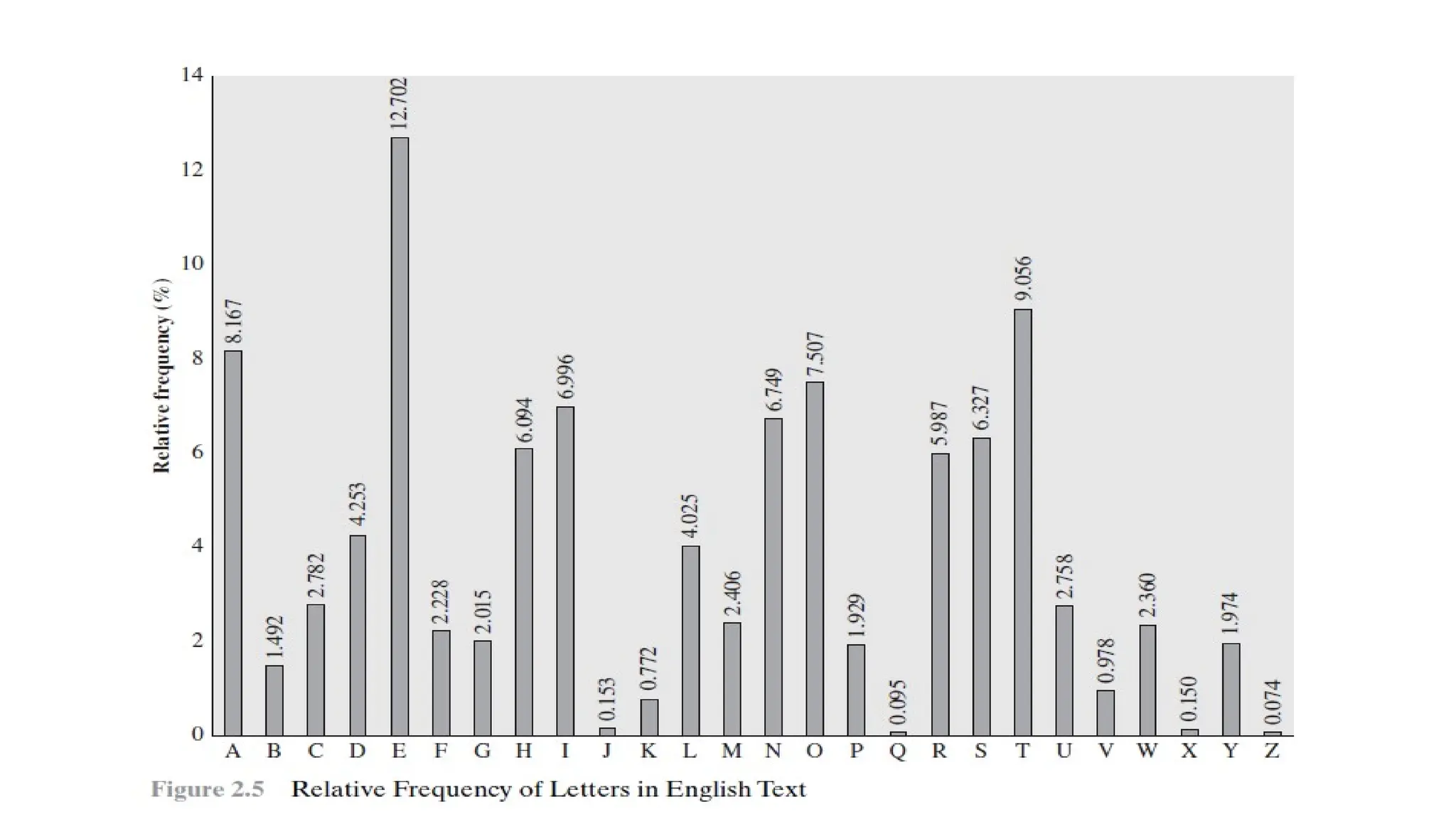
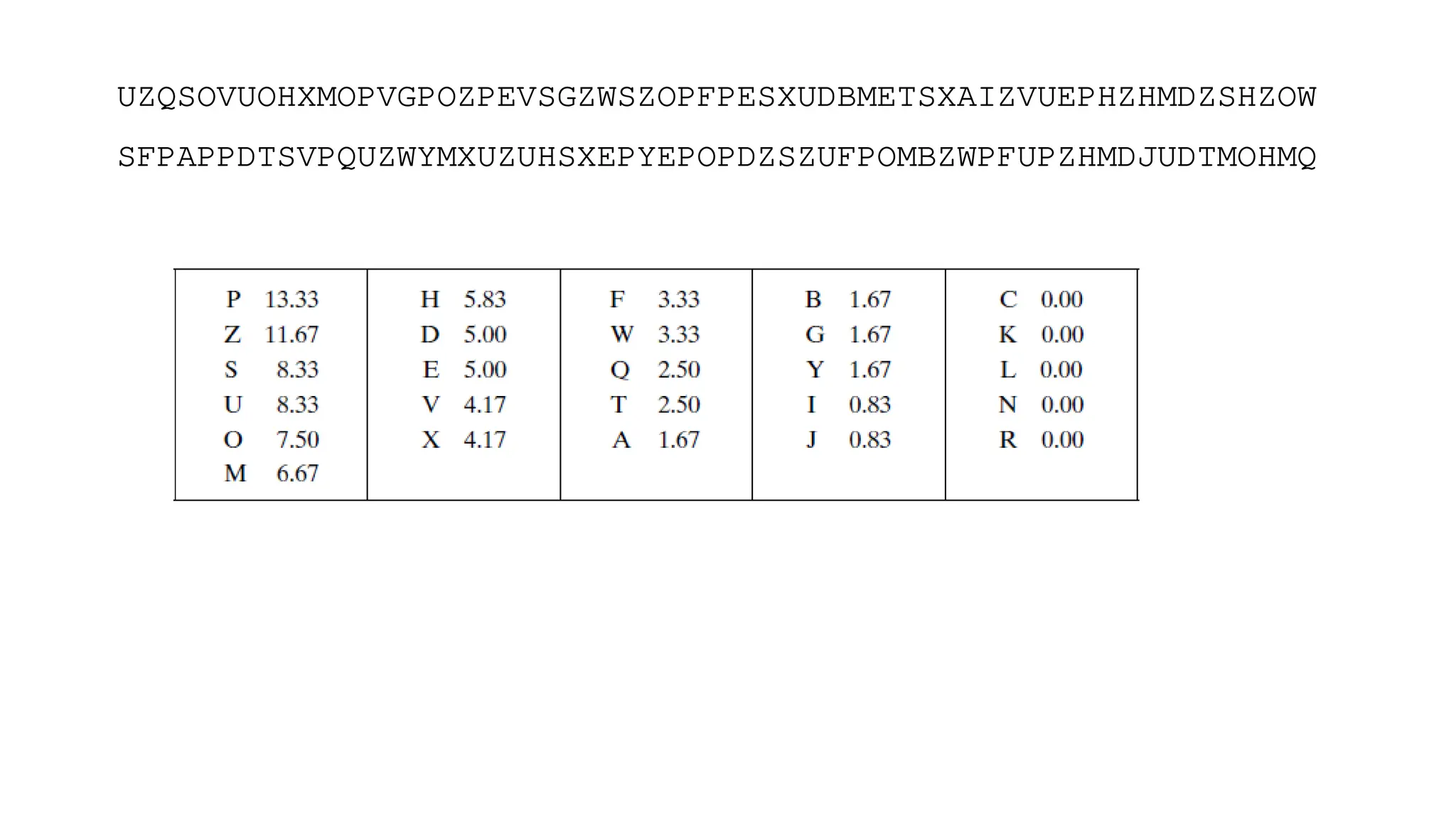
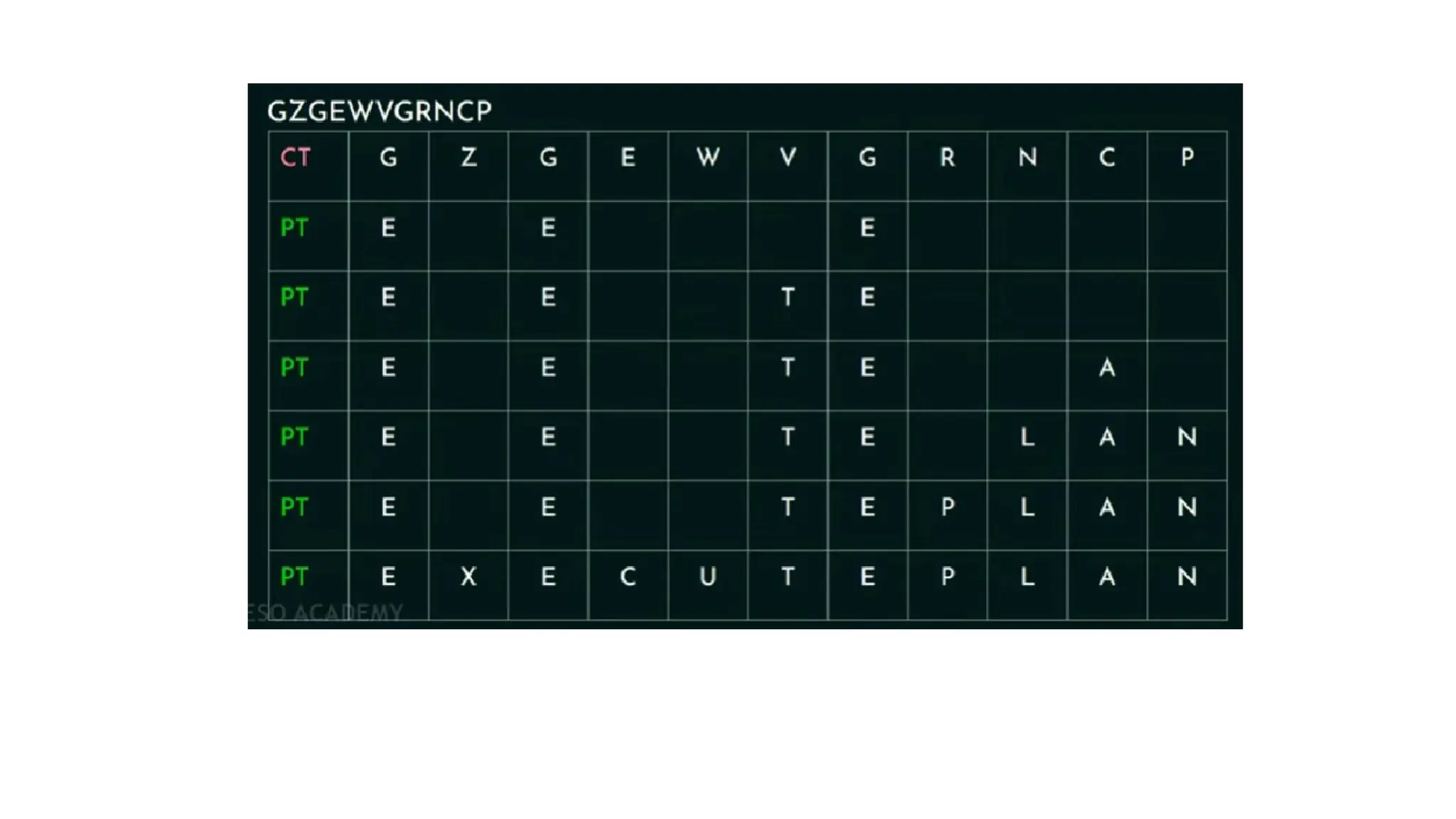
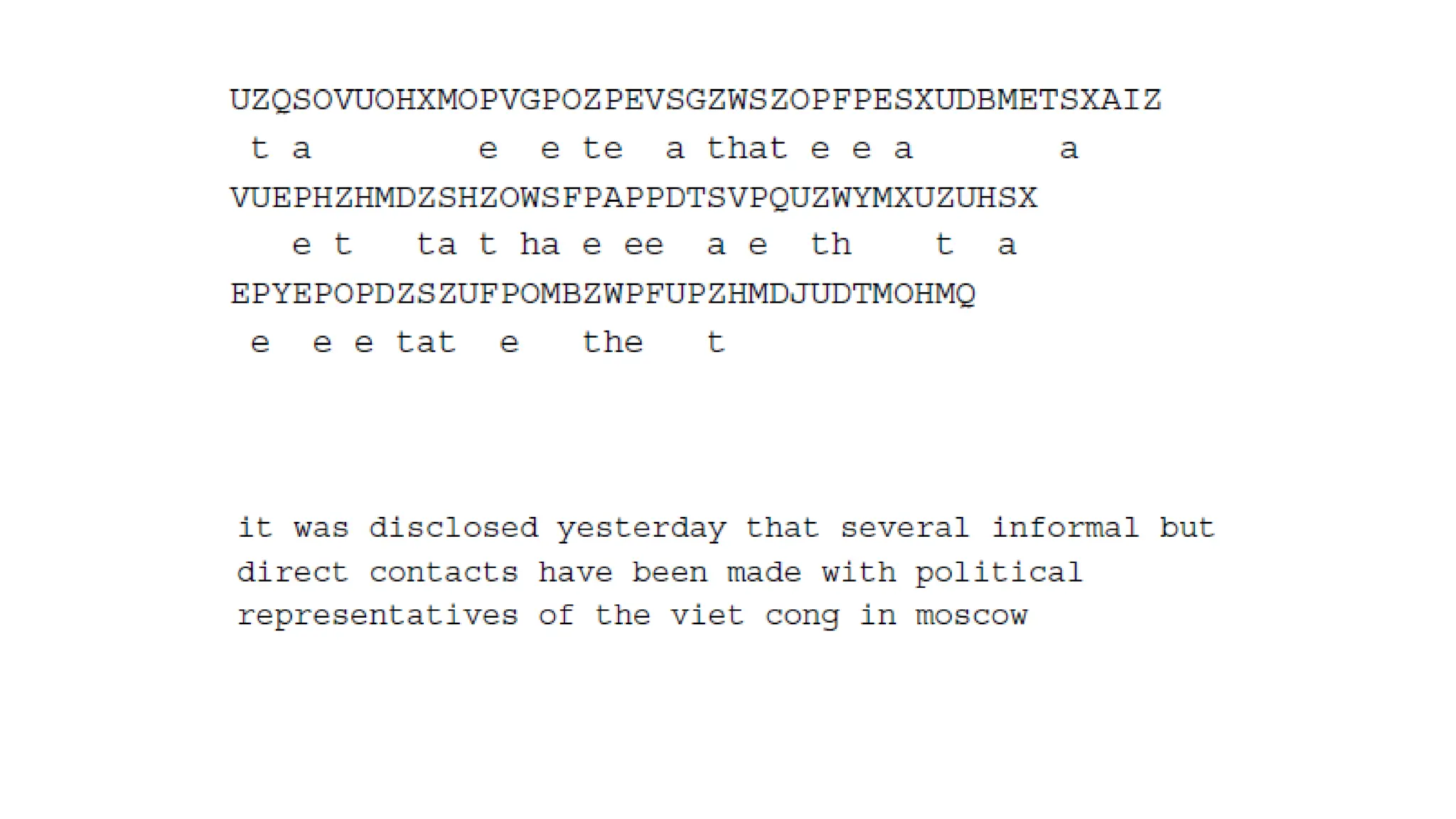
Monoalphabetic ciphersare easy to break because they reflect
the frequency data of the original alphabet.
A countermeasure is to provide multiple substitutes, known as
homophones, for a single letter
The great mathematician Carl Friedrich Gauss believed that
he had devised an unbreakable cipher using homophones.
29.
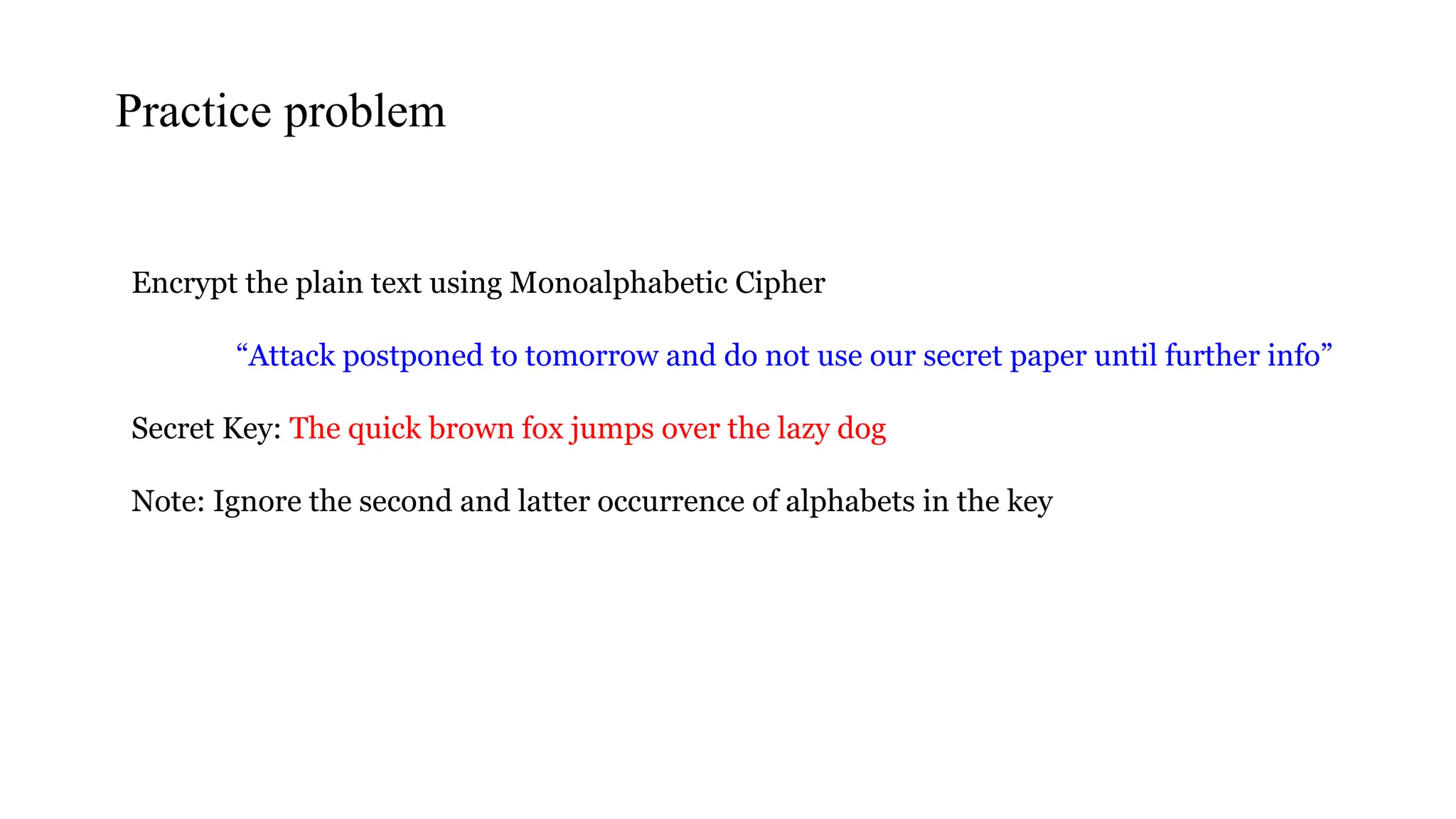
Encrypt the plaintext using Monoalphabetic Cipher
“Attack postponed to tomorrow and do not use our secret paper until further info”
Secret Key: The quick brown fox jumps over the lazy dog
Note: Ignore the second and latter occurrence of alphabets in the key
Practice problem
30.
Playfair Cipher
Thebest-known multiple-letter encryption cipher is the Playfair, which treats
digrams in the plaintext as single units and translates these units into ciphertext
digrams
Manual symmetric encryption technique.
The Playfair algorithm is based on the use of a 5 * 5 matrix of letters constructed
using a keyword.
31.
Playfair Cipher EncryptionAlgorithm:
1.Generate the key Square(5×5):
1. The key square is a 5×5 grid of alphabets that acts as the key for encrypting
the plaintext. Each of the 25 alphabets must be unique and one letter of the
alphabet (usually J) is omitted from the table (as the table can hold only 25
alphabets). If the plaintext contains J, then it is replaced by I.
2. The initial alphabets in the key square are the unique alphabets of the key in
the order in which they appear followed by the remaining letters of the
alphabet in order.
32.
Cont…
• Algorithm toencrypt the plain text: The plaintext is split
into pairs of two letters (digraphs). If there is an odd
number of letters, a X is added to the last letter.
• Pair cannot be made with same letter. Break the letter in
single and add a bogus letter to the previous letter.
• If the letter is standing alone in the process of pairing, then
add an extra bogus letter with the alone letter
33.
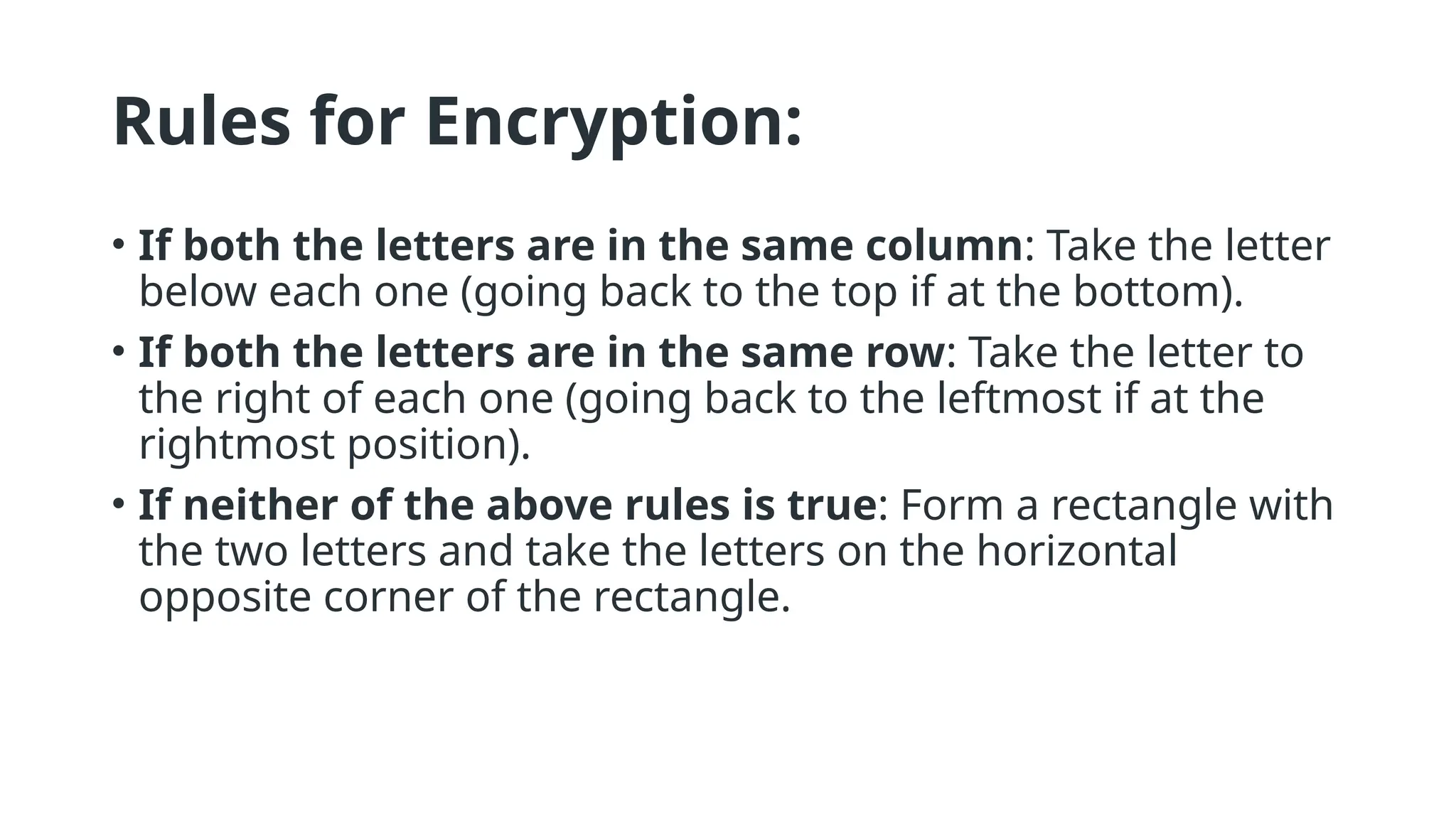
Rules for Encryption:
•If both the letters are in the same column: Take the letter
below each one (going back to the top if at the bottom).
• If both the letters are in the same row: Take the letter to
the right of each one (going back to the leftmost if at the
rightmost position).
• If neither of the above rules is true: Form a rectangle with
the two letters and take the letters on the horizontal
opposite corner of the rectangle.
34.
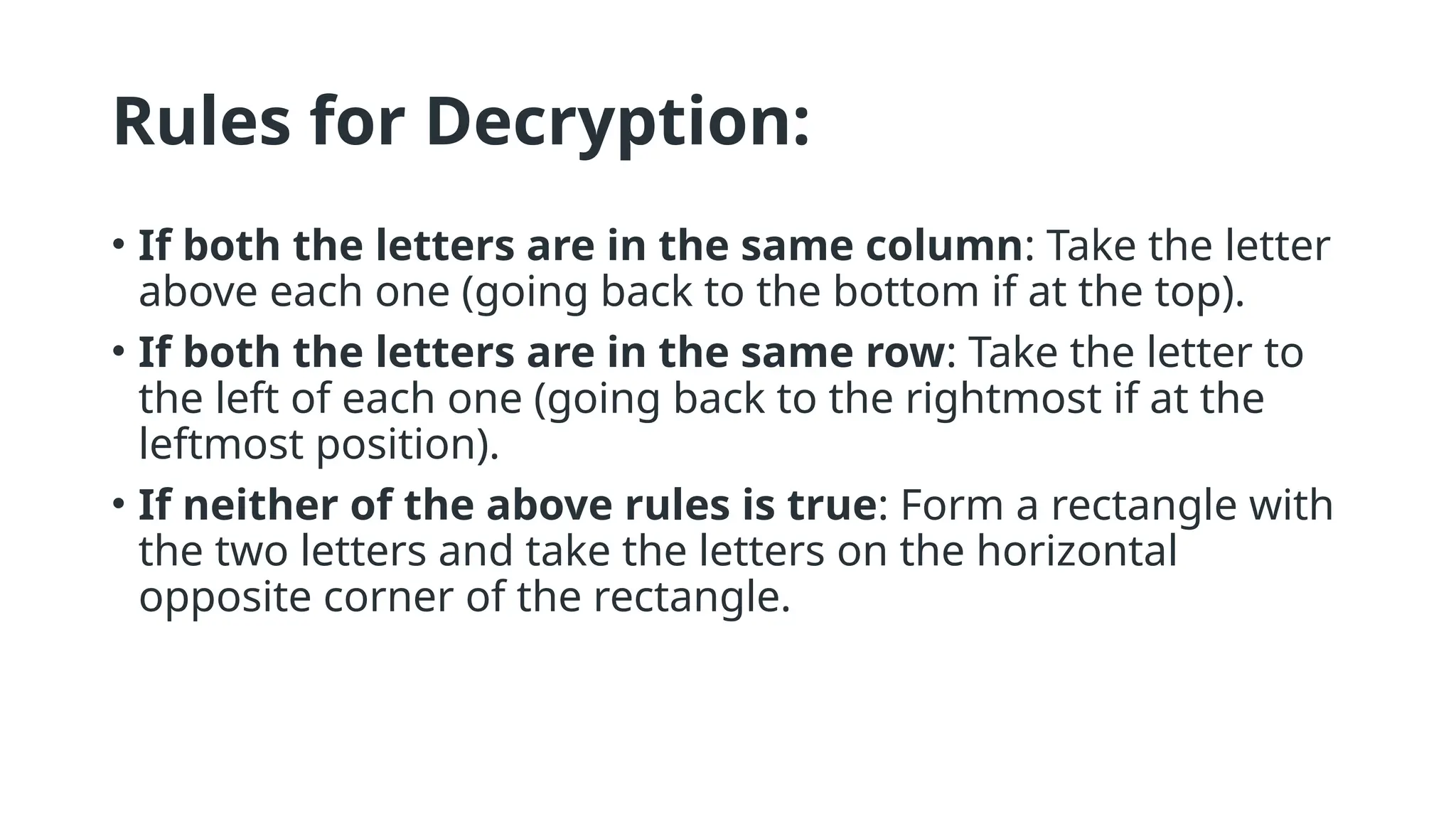
Rules for Decryption:
•If both the letters are in the same column: Take the letter
above each one (going back to the bottom if at the top).
• If both the letters are in the same row: Take the letter to
the left of each one (going back to the rightmost if at the
leftmost position).
• If neither of the above rules is true: Form a rectangle with
the two letters and take the letters on the horizontal
opposite corner of the rectangle.
35.
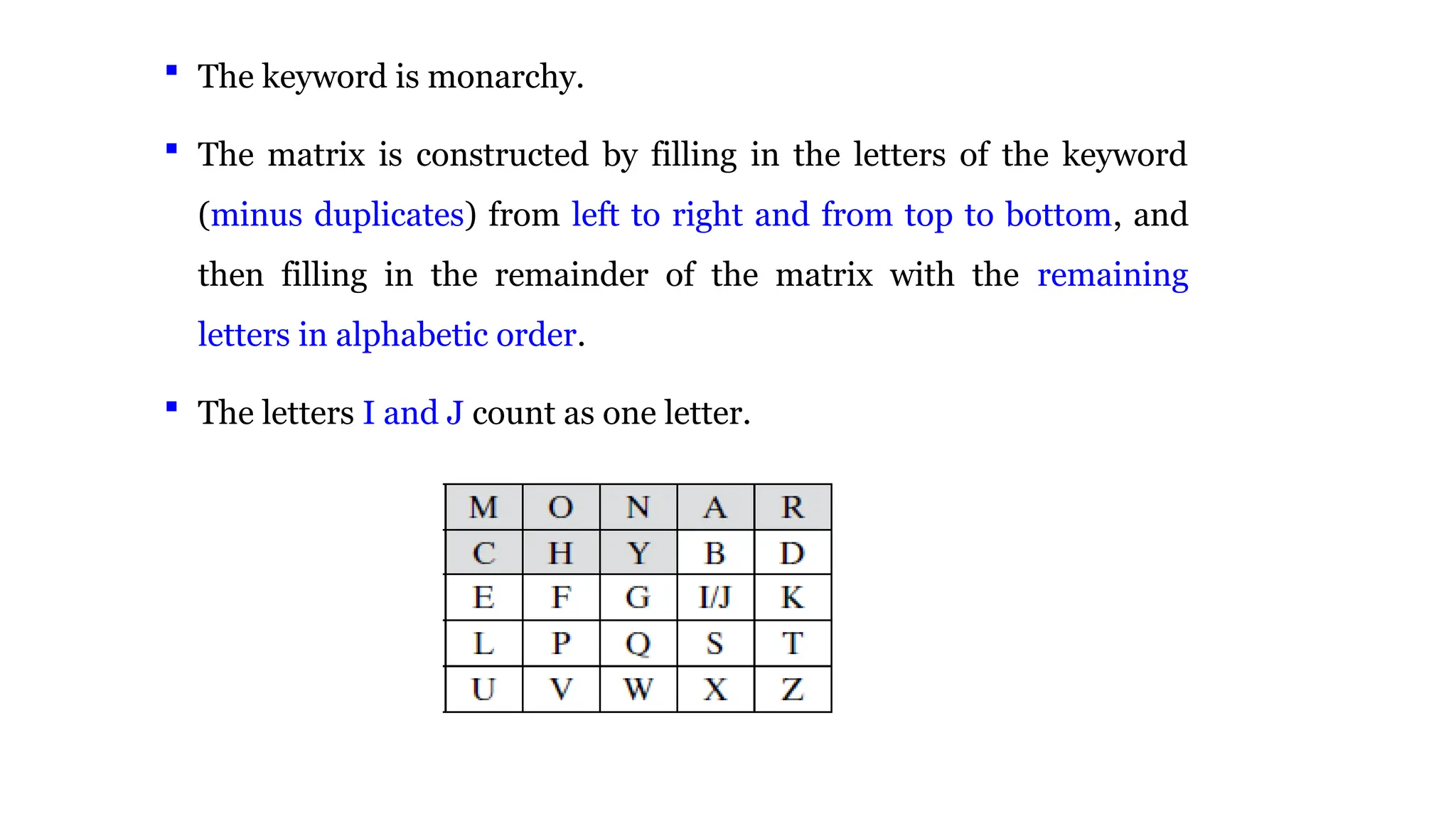
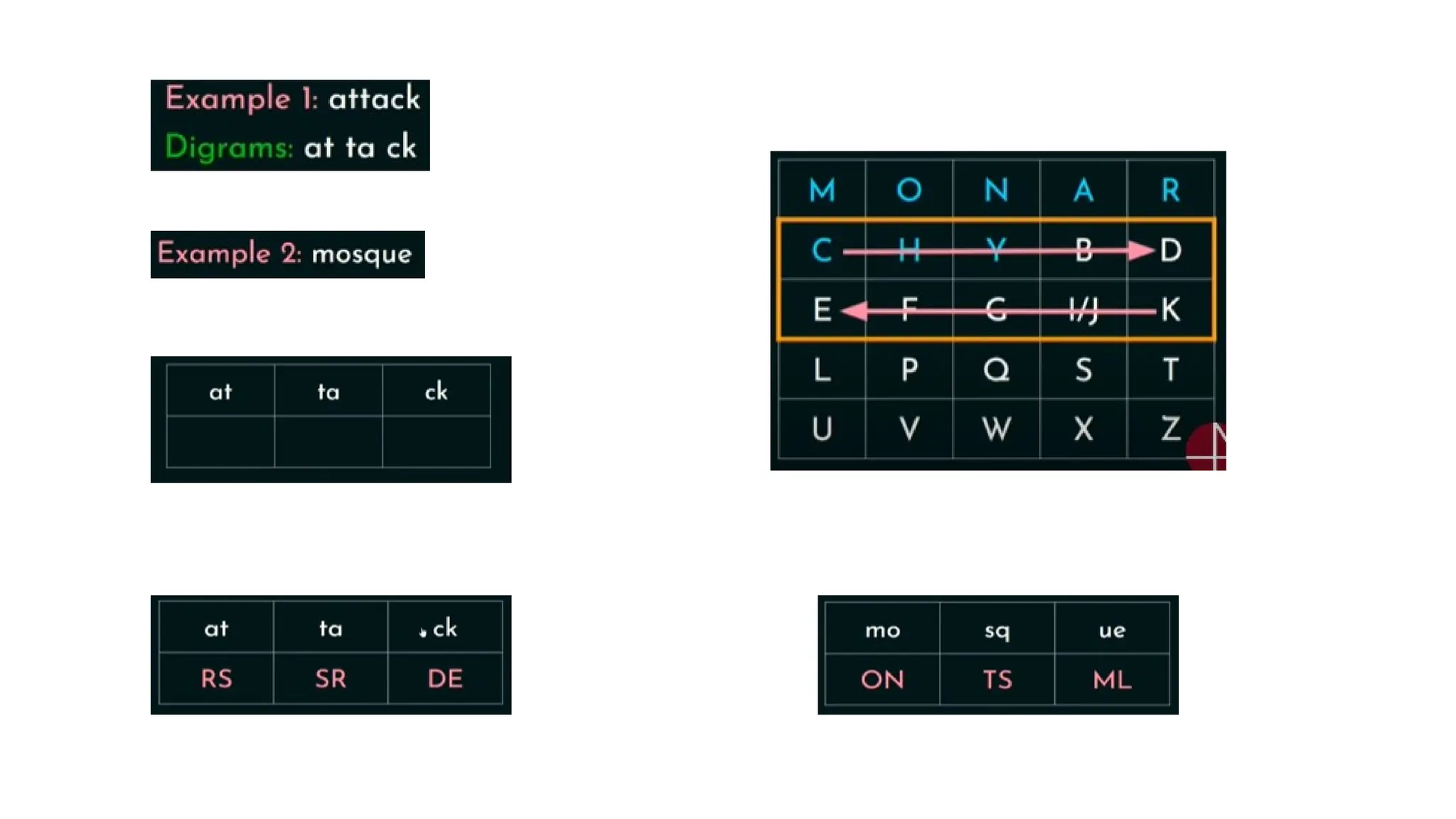
The keywordis monarchy.
The matrix is constructed by filling in the letters of the keyword
(minus duplicates) from left to right and from top to bottom, and
then filling in the remainder of the matrix with the remaining
letters in alphabetic order.
The letters I and J count as one letter.
37.
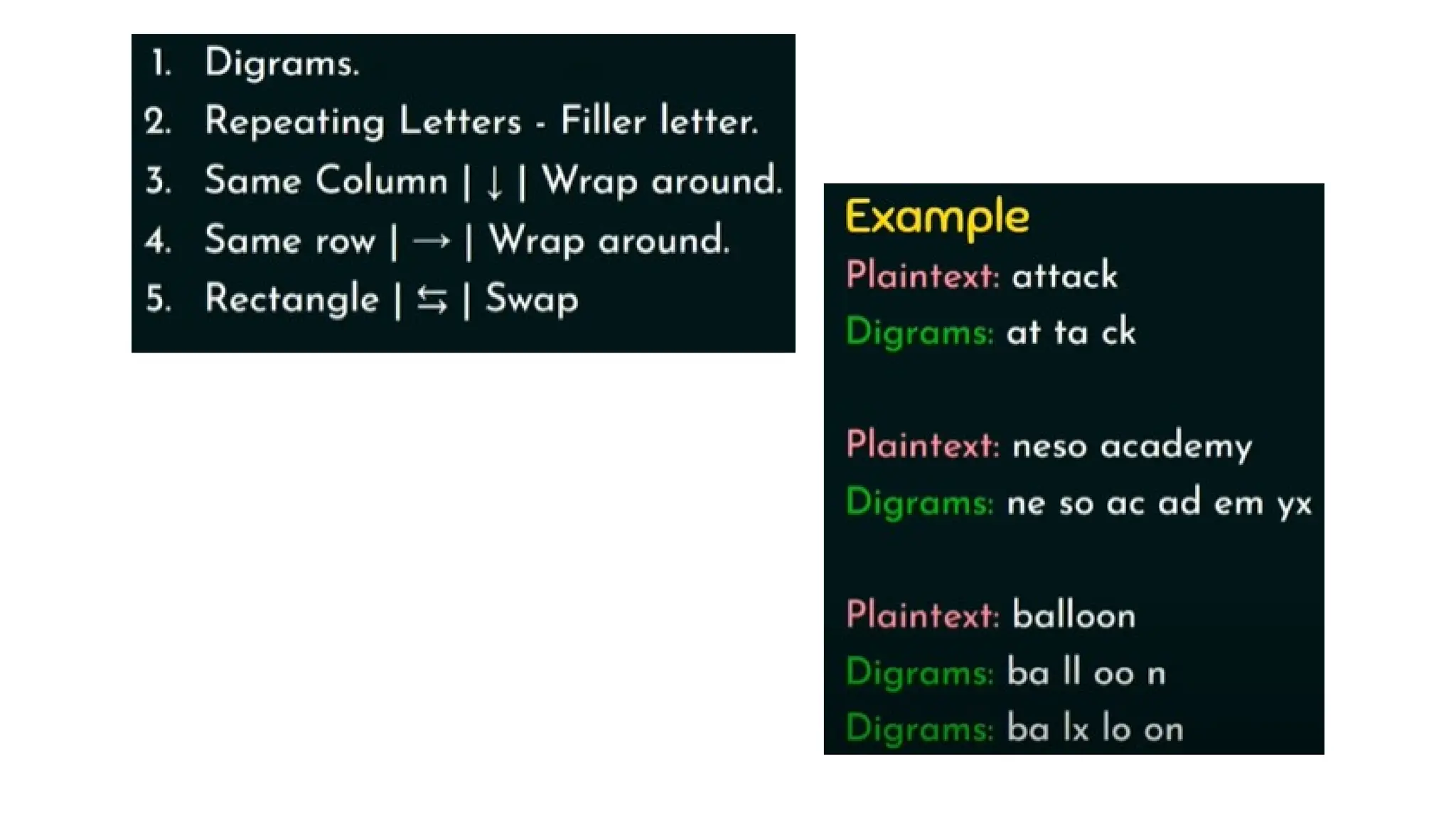
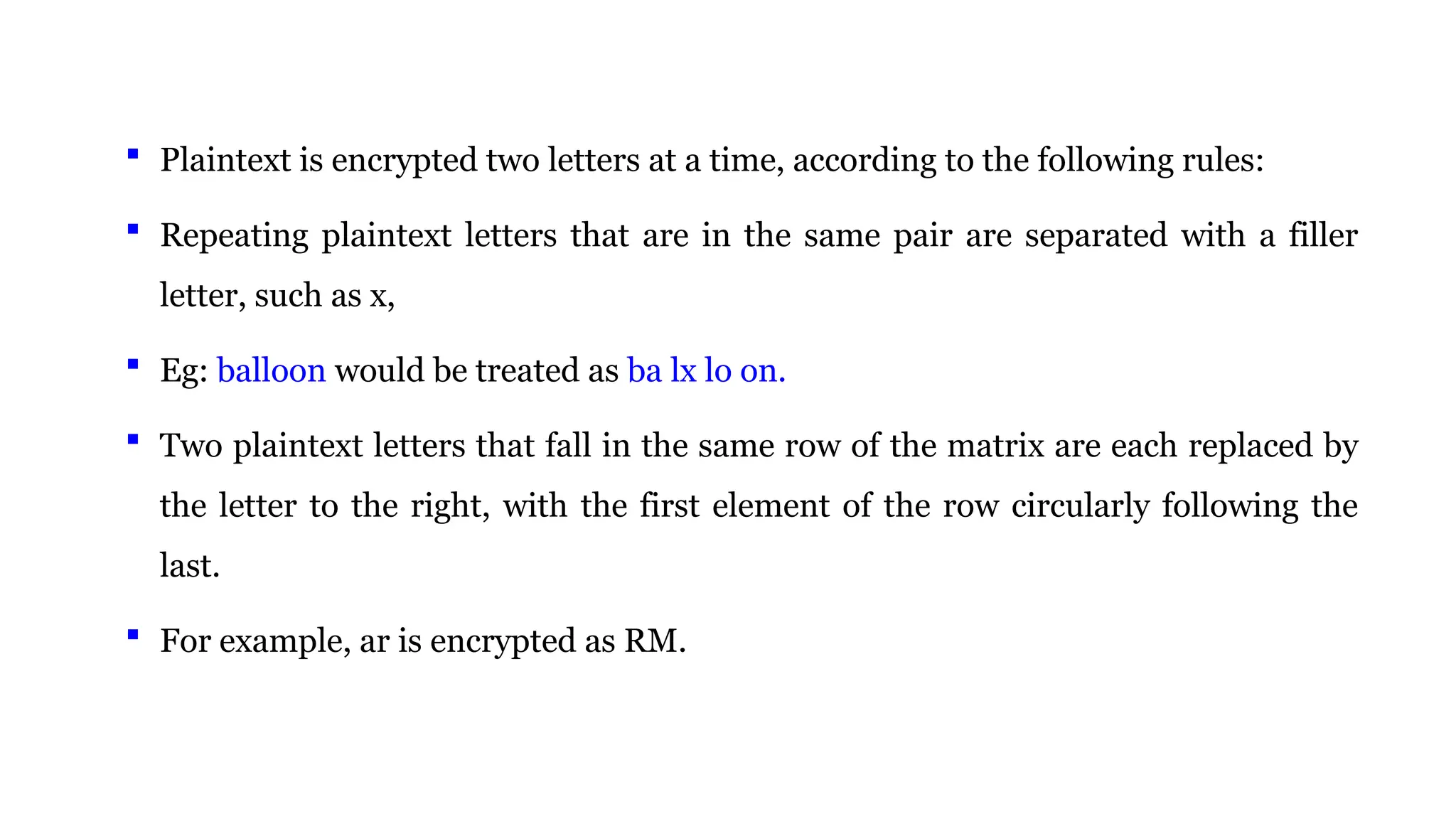
Plaintext isencrypted two letters at a time, according to the following rules:
Repeating plaintext letters that are in the same pair are separated with a filler
letter, such as x,
Eg: balloon would be treated as ba lx lo on.
Two plaintext letters that fall in the same row of the matrix are each replaced by
the letter to the right, with the first element of the row circularly following the
last.
For example, ar is encrypted as RM.
38.
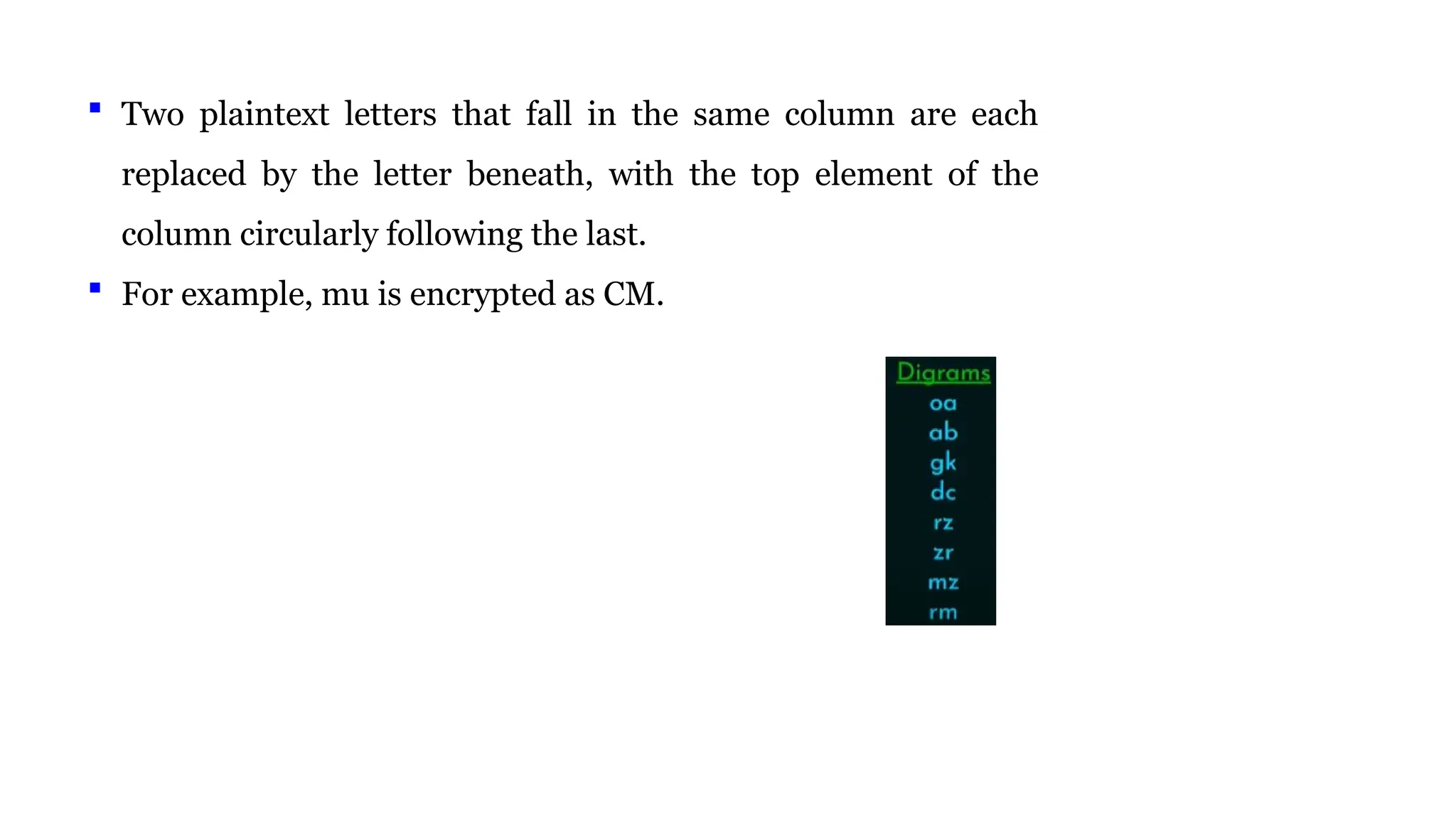
Two plaintextletters that fall in the same column are each
replaced by the letter beneath, with the top element of the
column circularly following the last.
For example, mu is encrypted as CM.
40.
Practice problem
• Whenthe PT-109 American patrol boat, under the command of Lieutenant
John F. Kennedy, was sunk by a Japanese destroyer, a message was received
at an Australian wireless station in Playfair code:
• KXJEY UREBE ZWEHE WRYTU HEYFS
• KREHE GOYFI WTTTU OLKSY CAJPO
• BOTEI ZONTX BYBNT GONEY CUZWR
• GDSON SXBOU YWRHE BAAHY USEDQ
• The key used was royal new zealand navy. Decrypt the message. Translate TT
41.
Practice problem
• a.Construct a Playfair matrix with the key largest.
• b. Construct a Playfair matrix with the key occurrence. Make a reasonable
assumption about how to treat redundant letters in the key.
42.
Practice problem
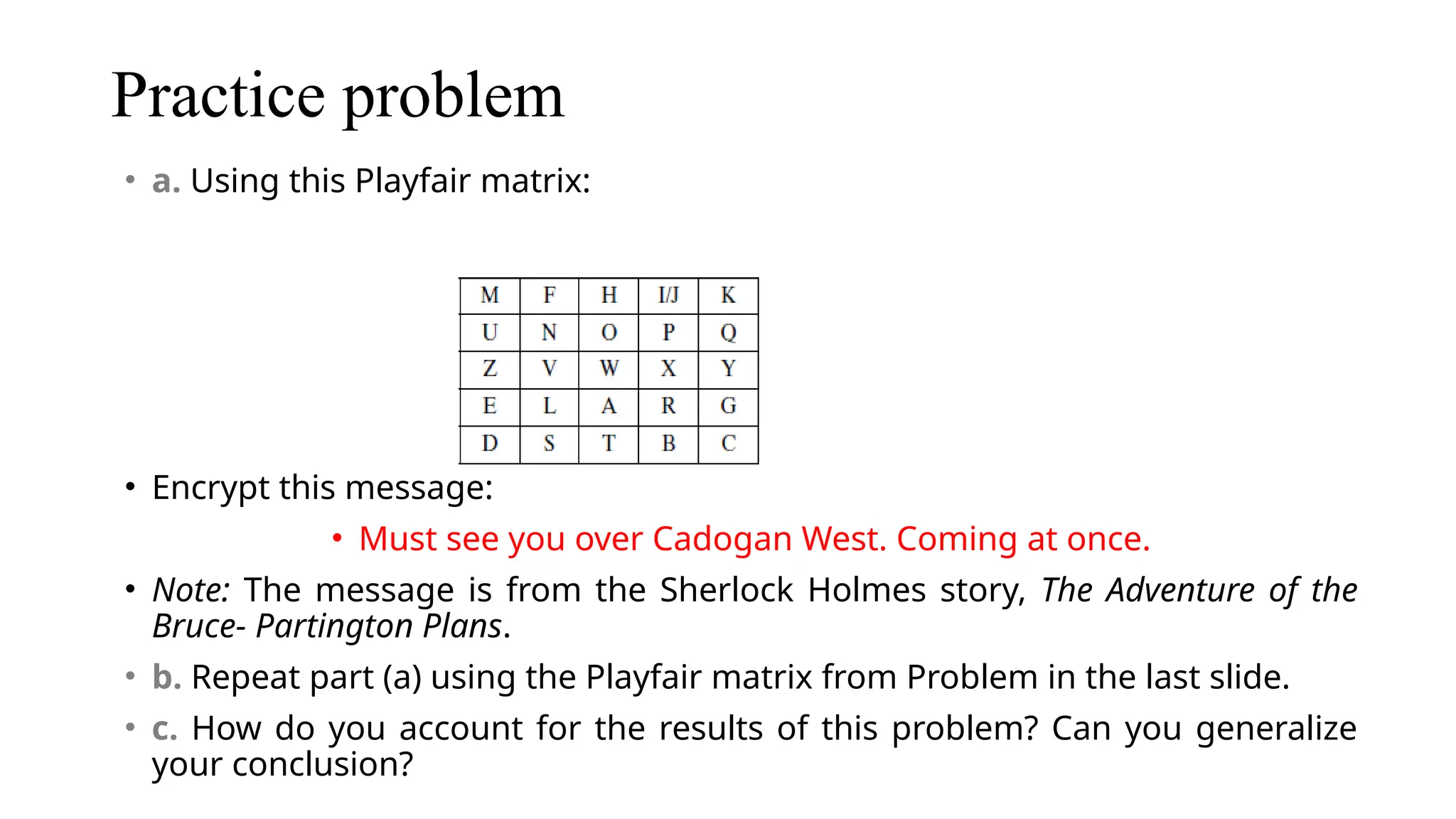
• a.Using this Playfair matrix:
• Encrypt this message:
• Must see you over Cadogan West. Coming at once.
• Note: The message is from the Sherlock Holmes story, The Adventure of the
Bruce- Partington Plans.
• b. Repeat part (a) using the Playfair matrix from Problem in the last slide.
• c. How do you account for the results of this problem? Can you generalize
your conclusion?
43.
Polyalphabetic Ciphers
1. Aset of related monoalphabetic substitution rules is used.
2. A key determines which particular rule is chosen for a given transformation.
44.
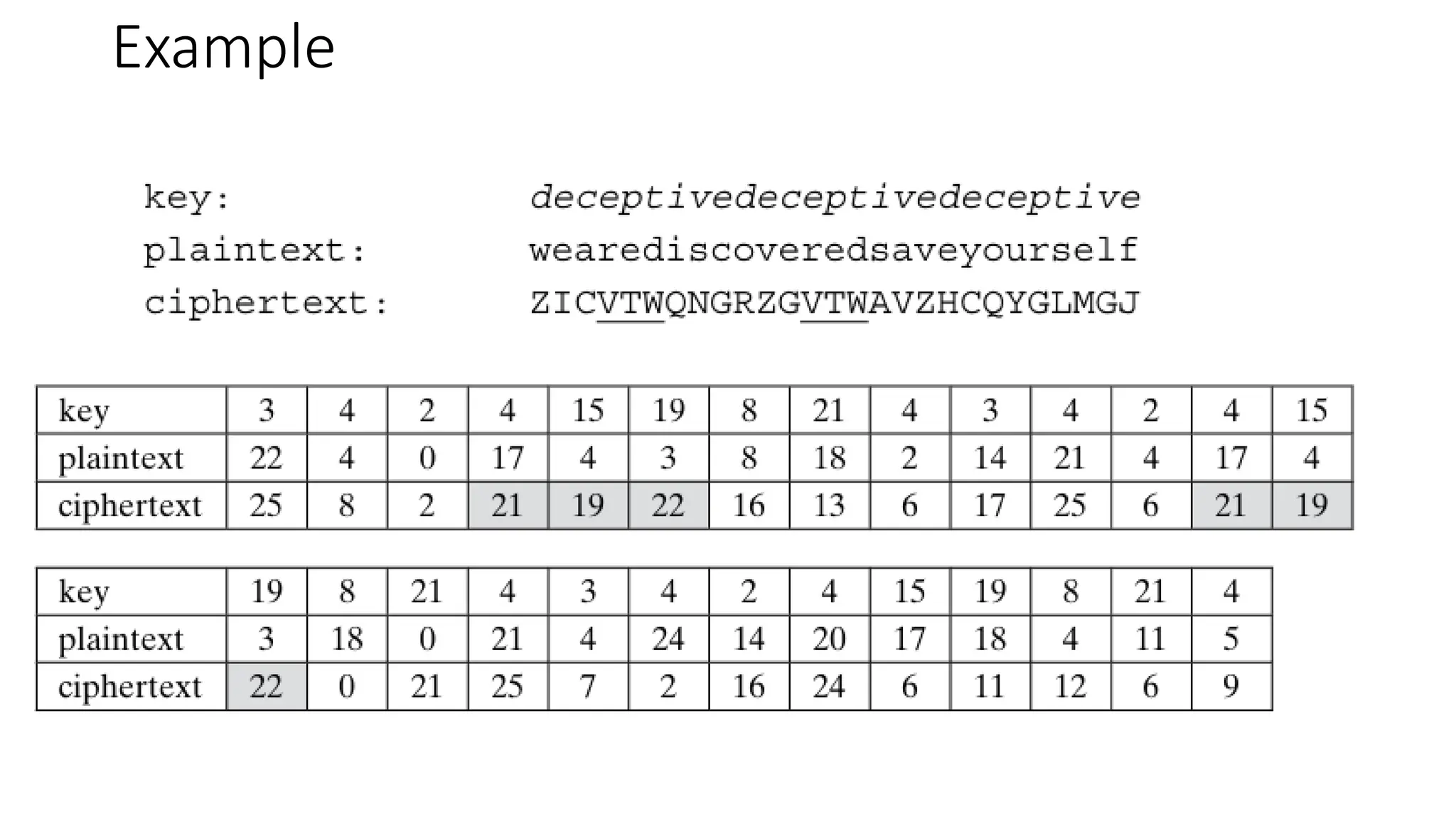
Vigenère Cipher
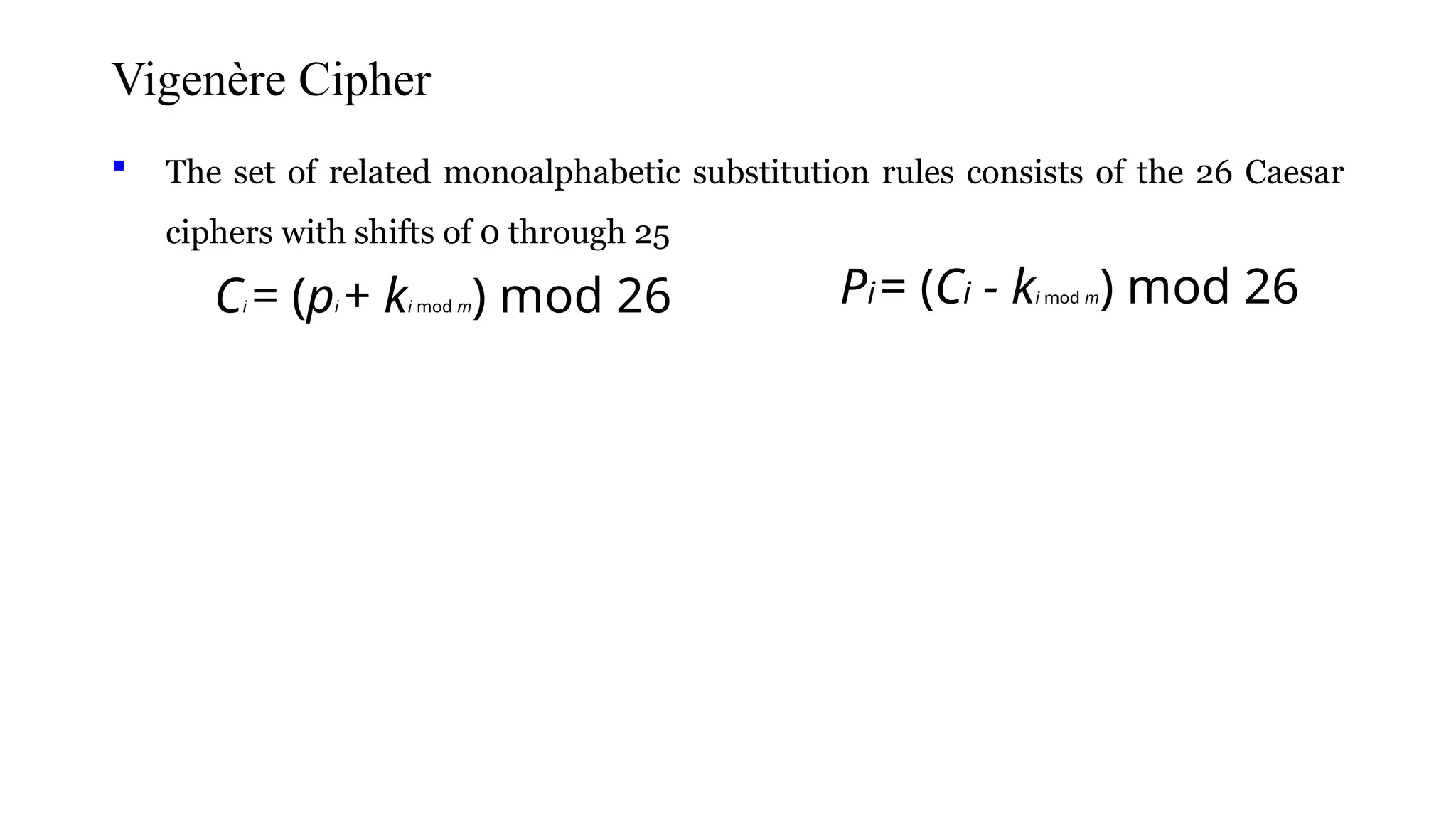
Theset of related monoalphabetic substitution rules consists of the 26 Caesar
ciphers with shifts of 0 through 25
Ci = (pi + ki mod m) mod 26 Pi= (Ci - ki mod m) mod 26
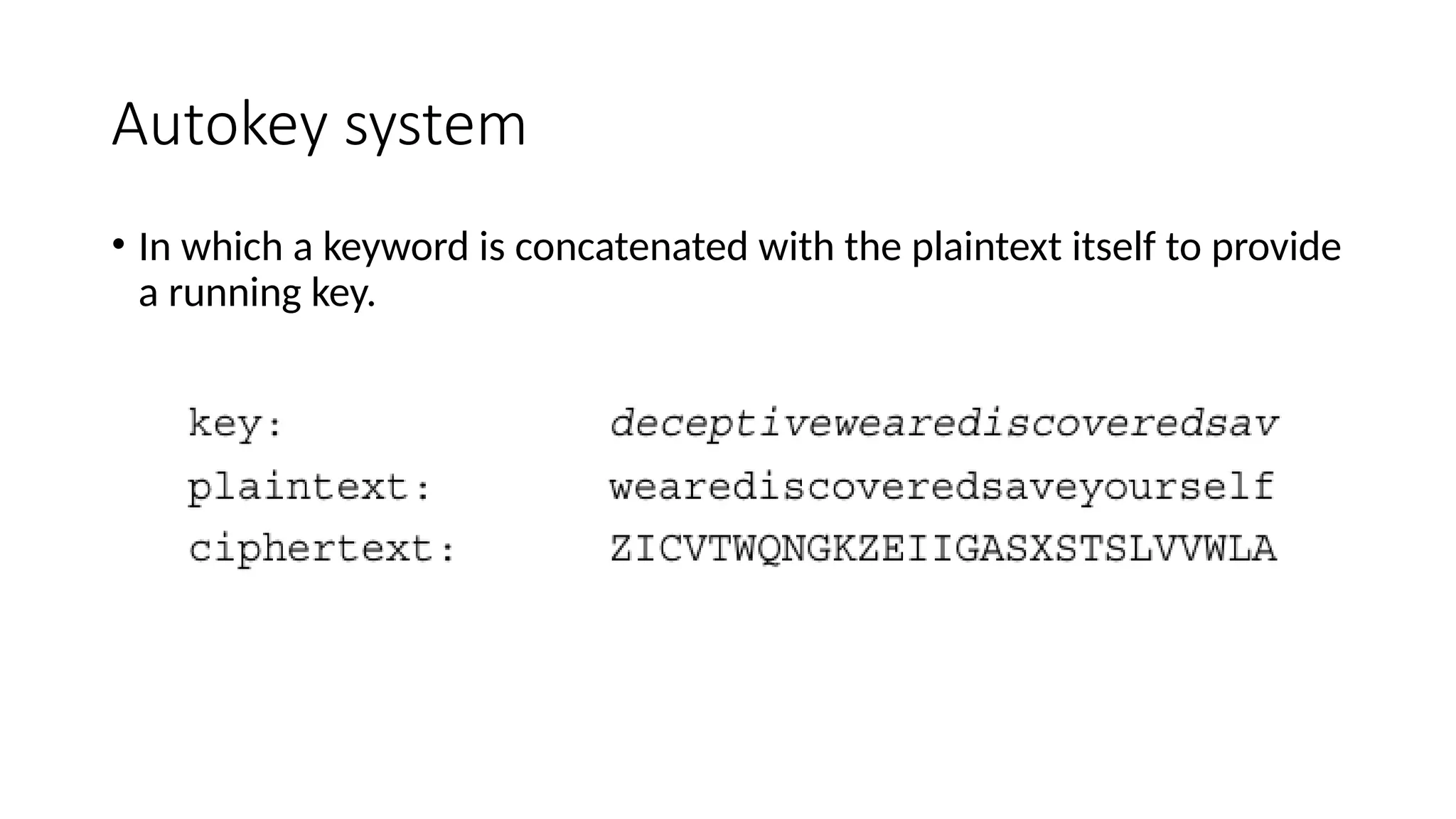
Autokey system
• Inwhich a keyword is concatenated with the plaintext itself to provide
a running key.
47.
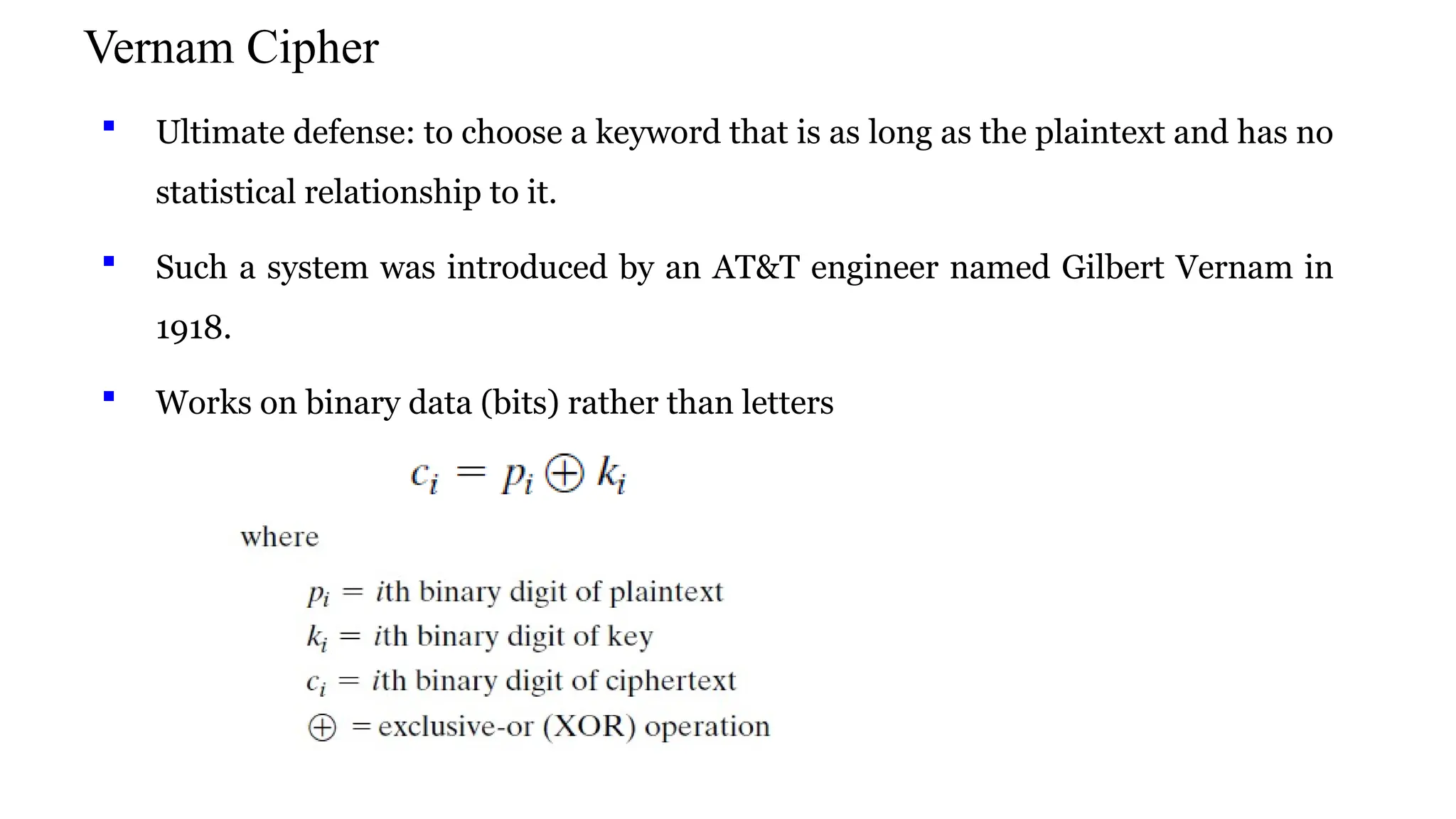
Vernam Cipher
Ultimatedefense: to choose a keyword that is as long as the plaintext and has no
statistical relationship to it.
Such a system was introduced by an AT&T engineer named Gilbert Vernam in
1918.
Works on binary data (bits) rather than letters
48.
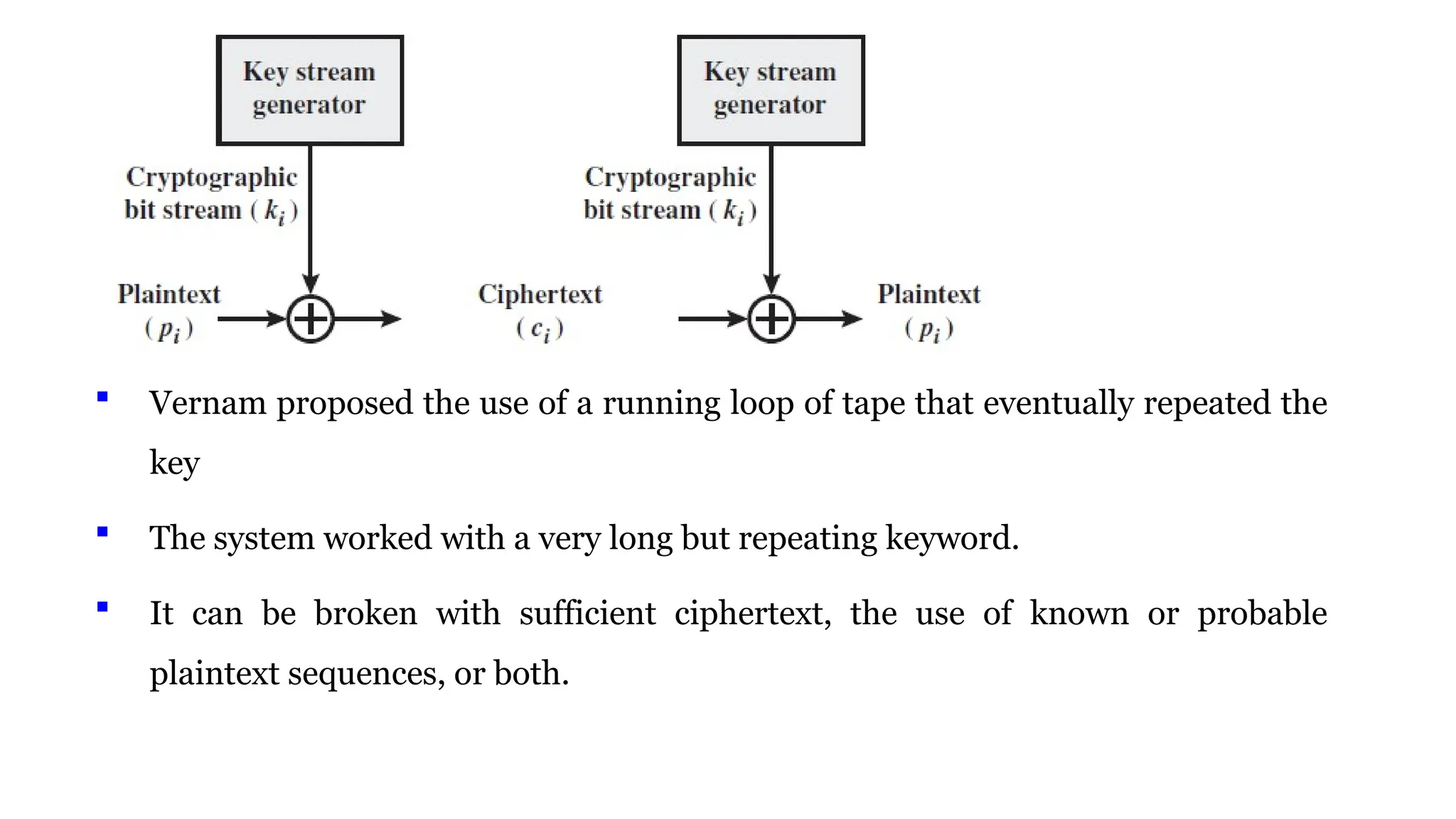
Vernam proposedthe use of a running loop of tape that eventually repeated the
key
The system worked with a very long but repeating keyword.
It can be broken with sufficient ciphertext, the use of known or probable
plaintext sequences, or both.
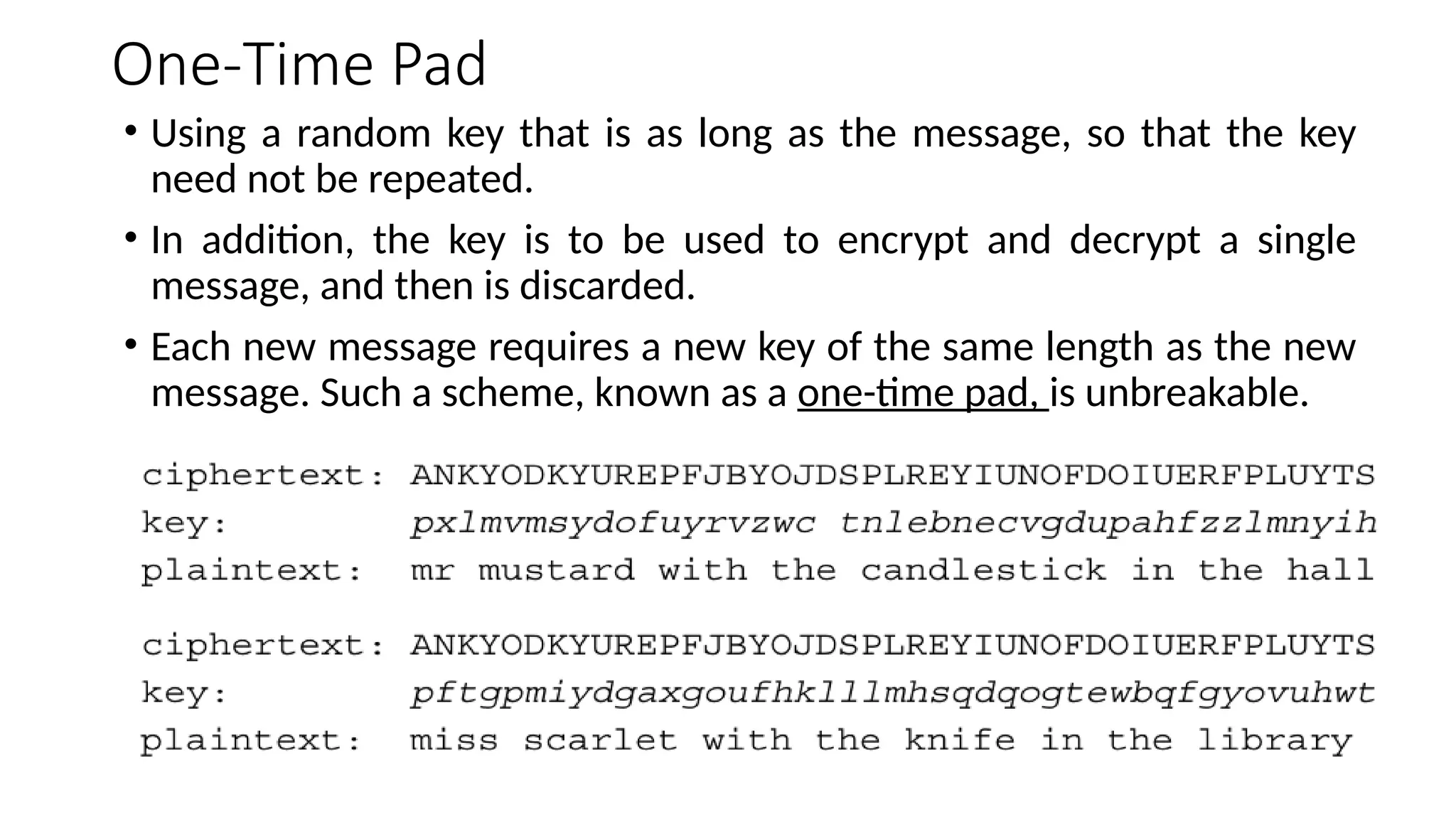
49.
One-Time Pad
• Usinga random key that is as long as the message, so that the key
need not be repeated.
• In addition, the key is to be used to encrypt and decrypt a single
message, and then is discarded.
• Each new message requires a new key of the same length as the new
message. Such a scheme, known as a one-time pad, is unbreakable.
50.
one-time pad offerscomplete security but, in
practice, has two fundamental difficulties:
• 1. There is the practical problem of making large quantities of random
keys. Any heavily used system might require millions of random
characters on a regular basis. Supplying truly random characters in
this volume is a significant task.
• 2. Even more daunting is the problem of key distribution and
protection. For every message to be sent, a key of equal length is
needed by both sender and receiver. Thus, a mammoth key
distribution problem exists.
• useful primarily for low-bandwidth channels requiring very high
security.
51.
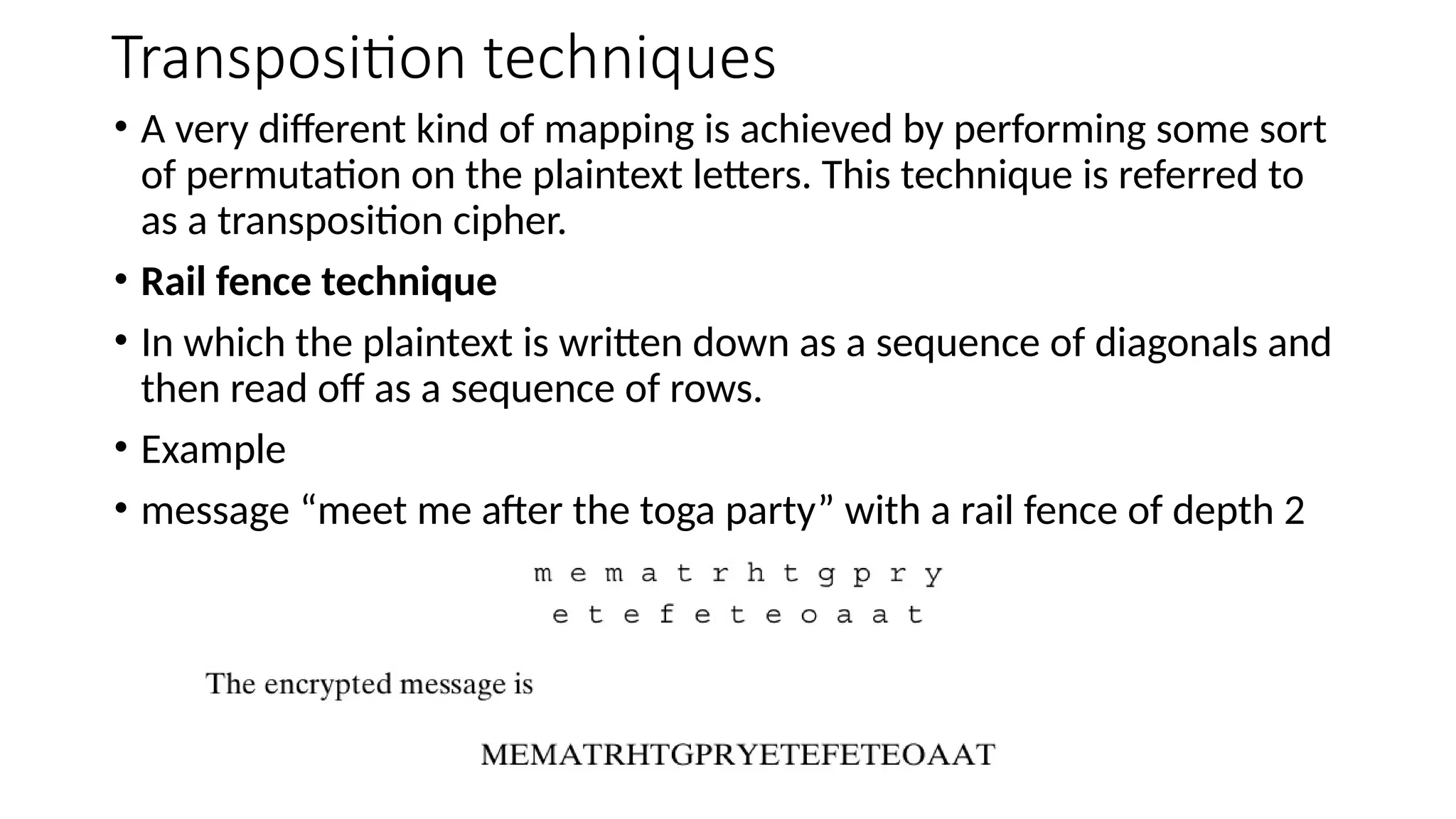
Transposition techniques
• Avery different kind of mapping is achieved by performing some sort
of permutation on the plaintext letters. This technique is referred to
as a transposition cipher.
• Rail fence technique
• In which the plaintext is written down as a sequence of diagonals and
then read off as a sequence of rows.
• Example
• message “meet me after the toga party” with a rail fence of depth 2
52.
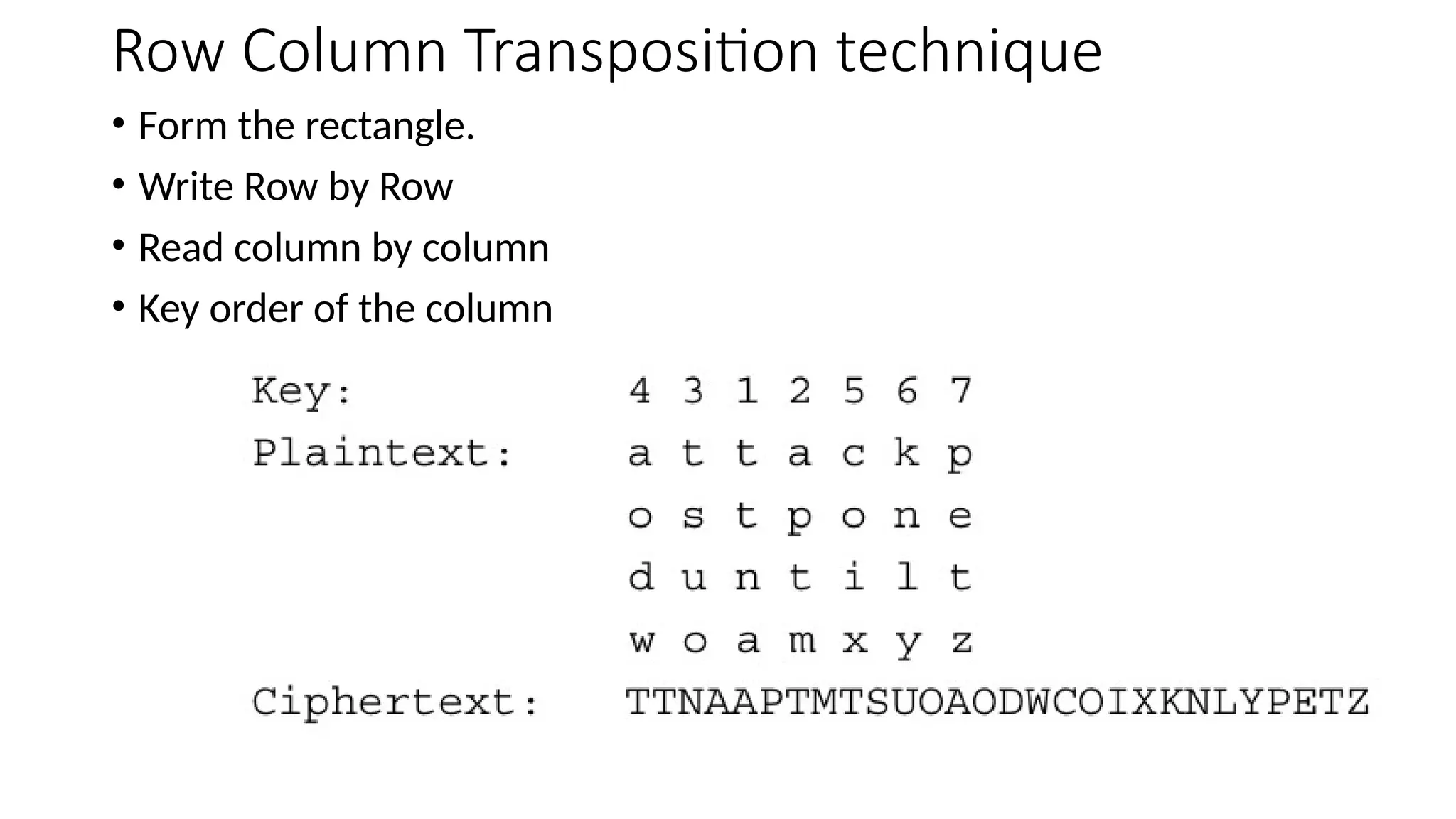
Row Column Transpositiontechnique
• Form the rectangle.
• Write Row by Row
• Read column by column
• Key order of the column
53.
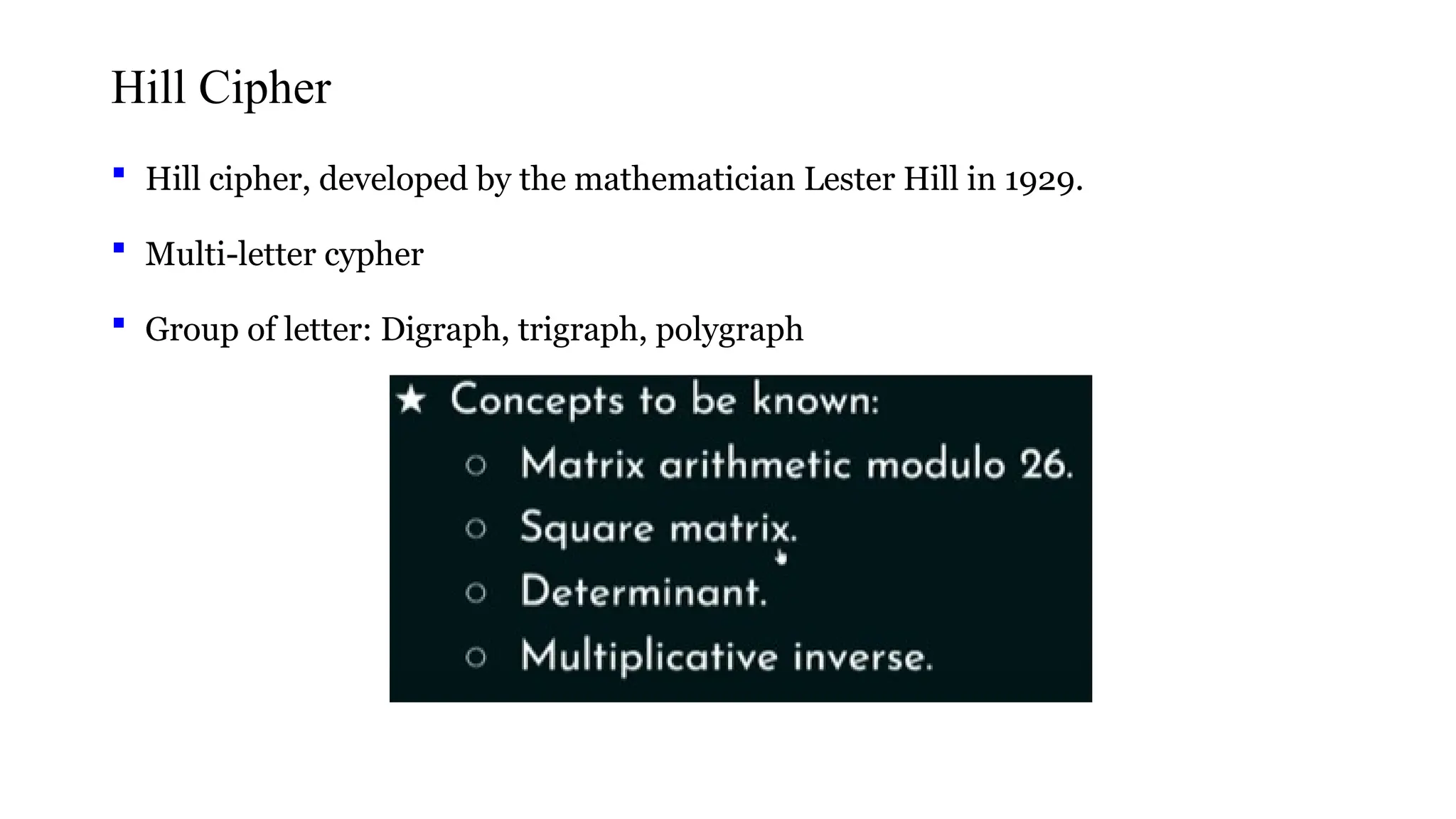
Hill Cipher
Hillcipher, developed by the mathematician Lester Hill in 1929.
Multi-letter cypher
Group of letter: Digraph, trigraph, polygraph
54.
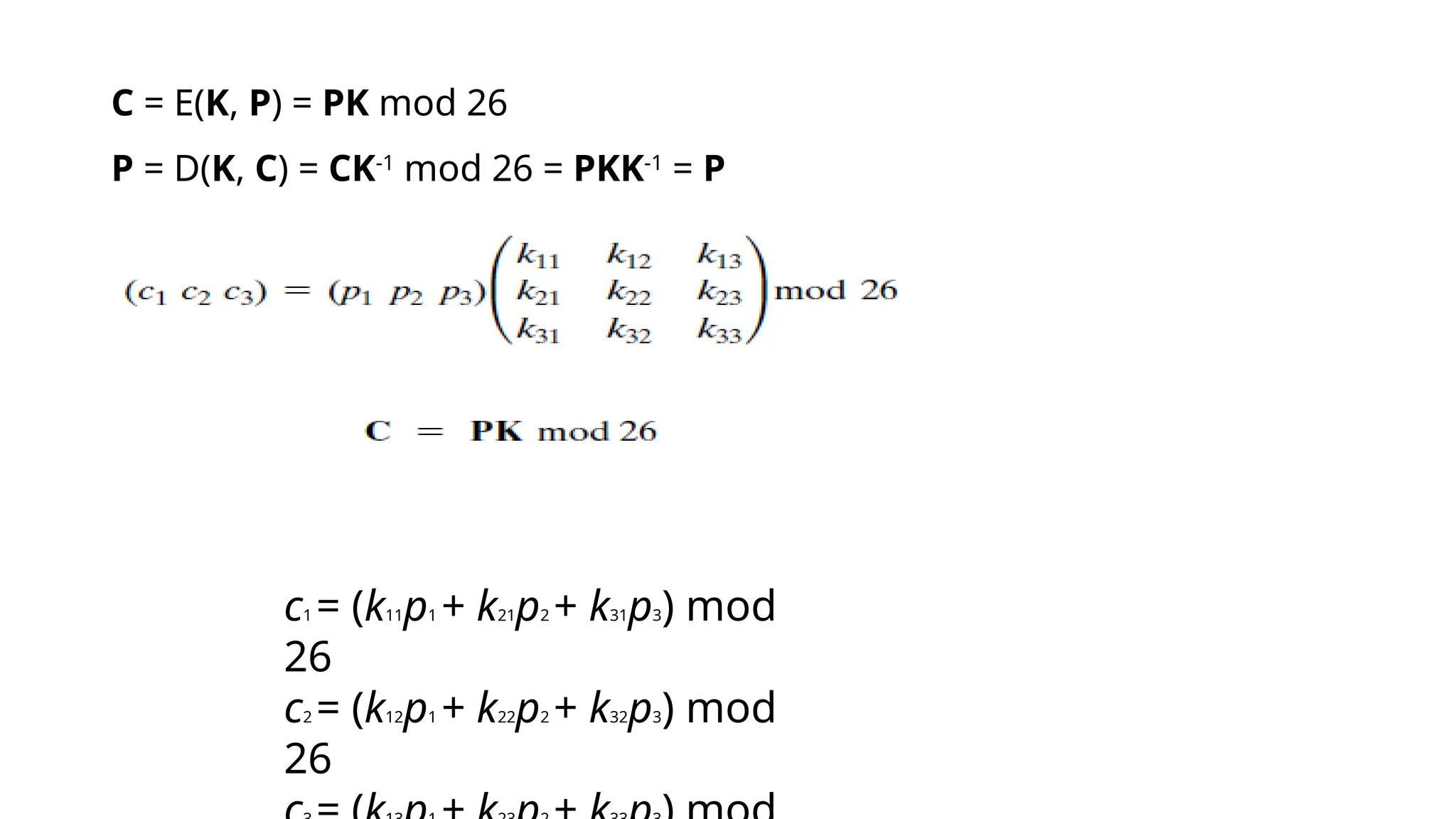
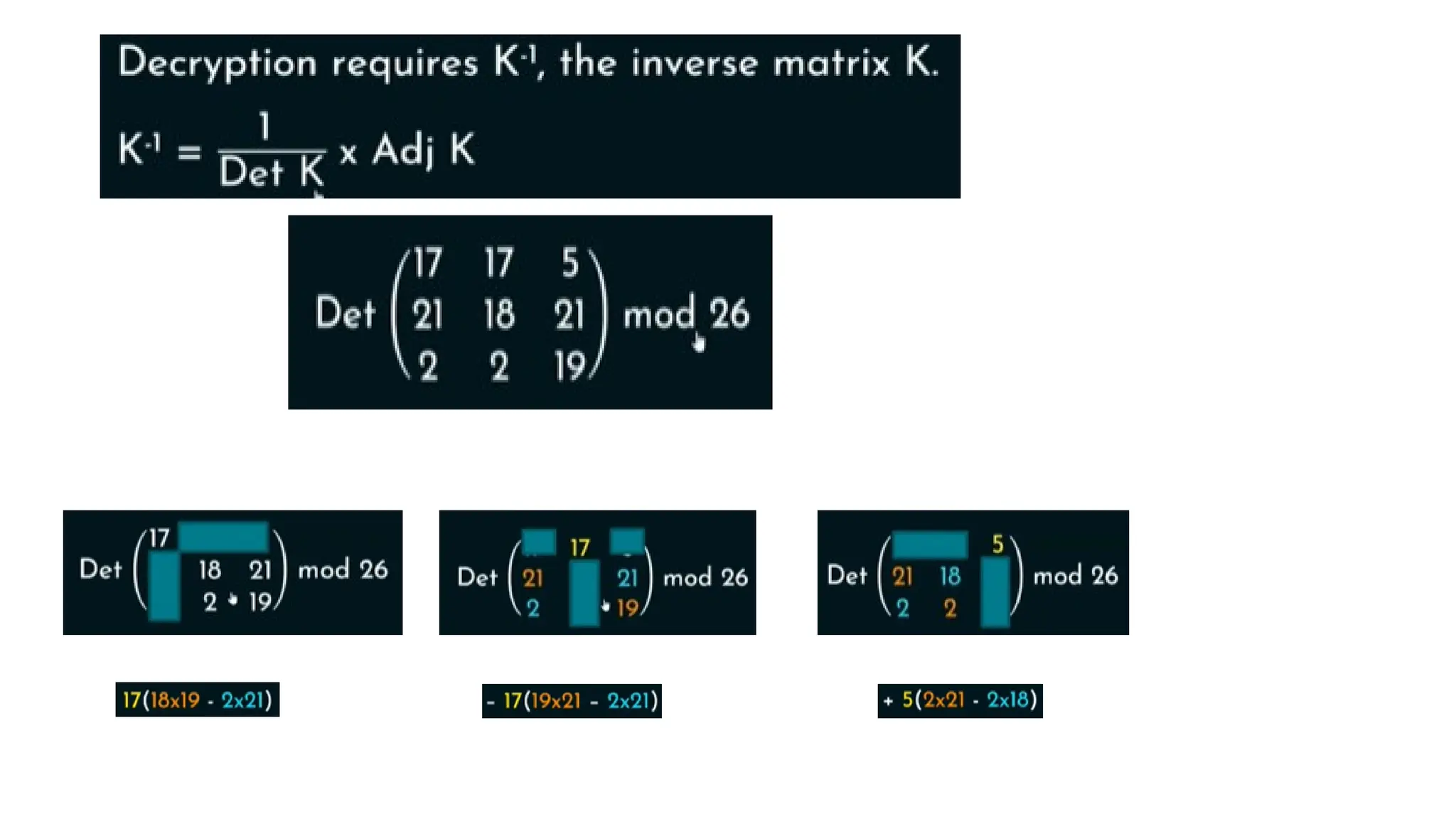
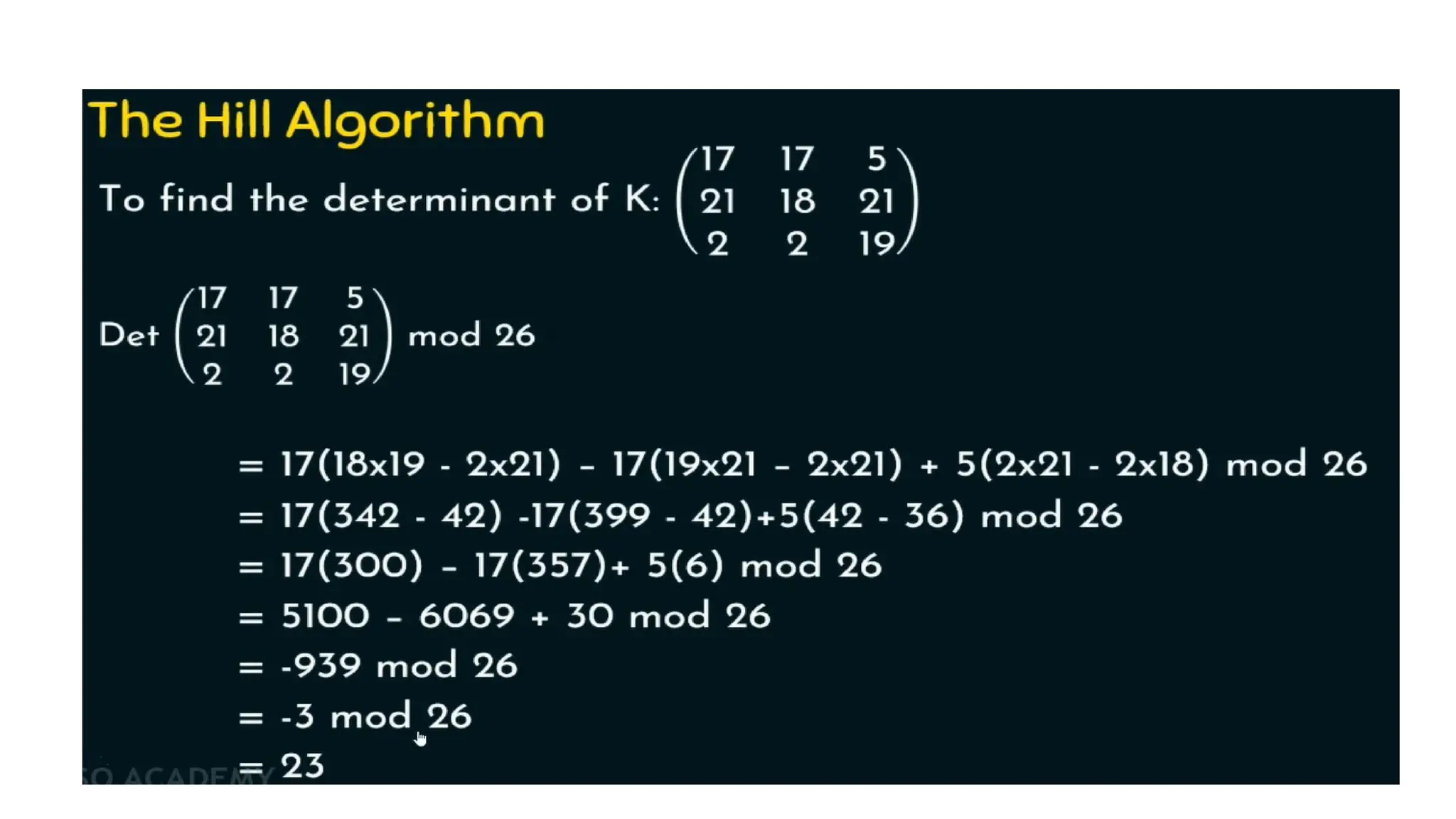
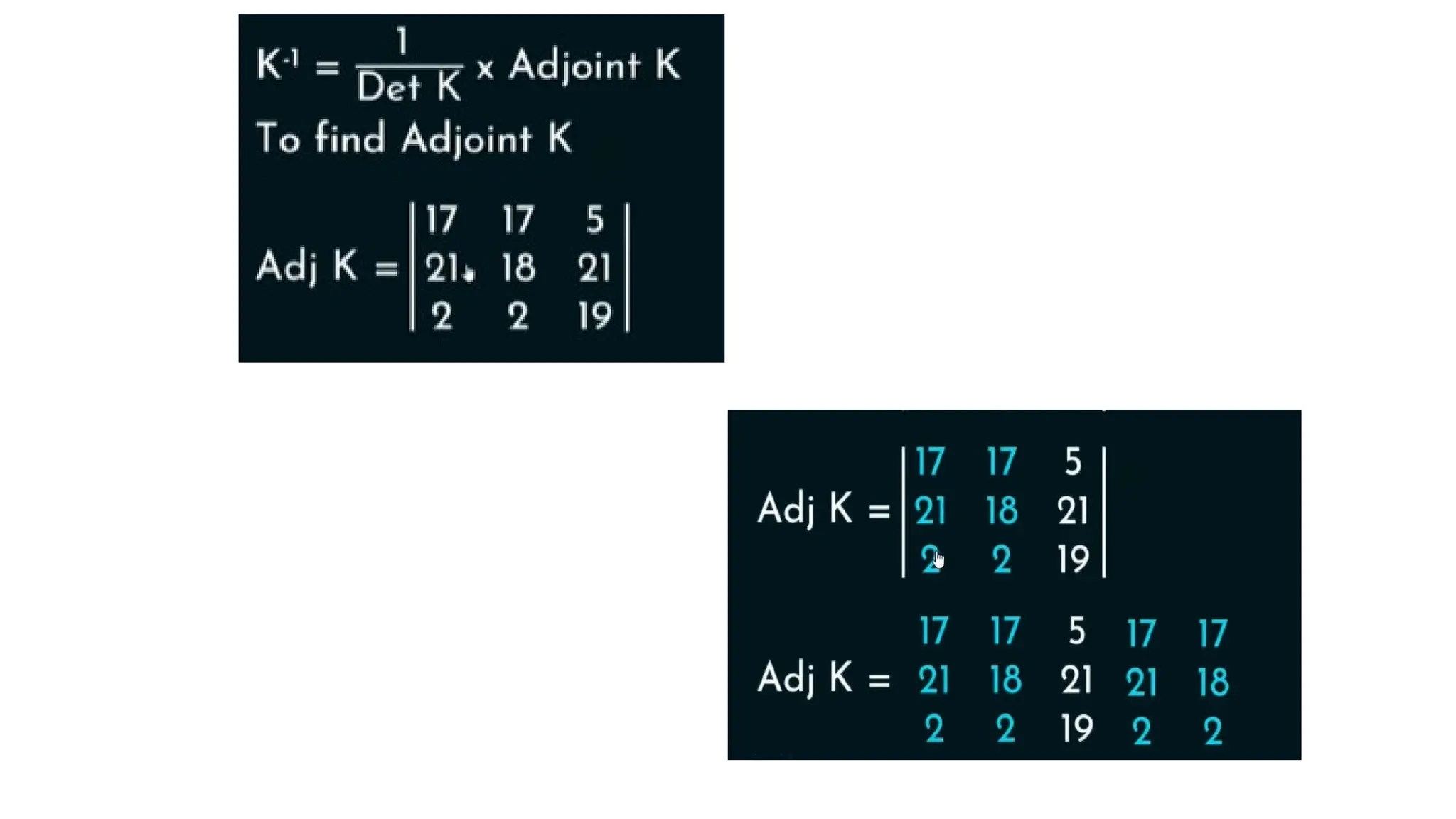
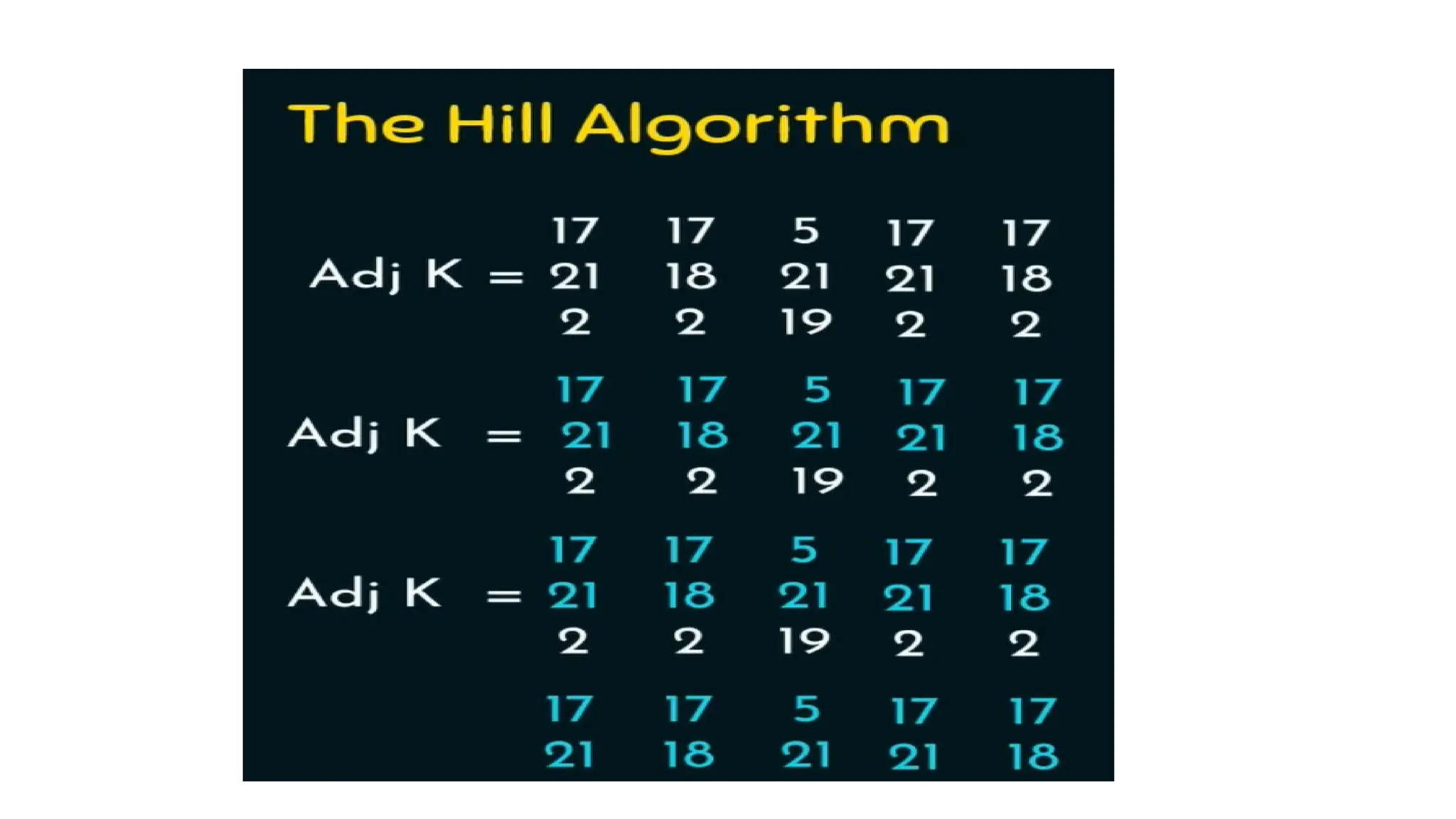
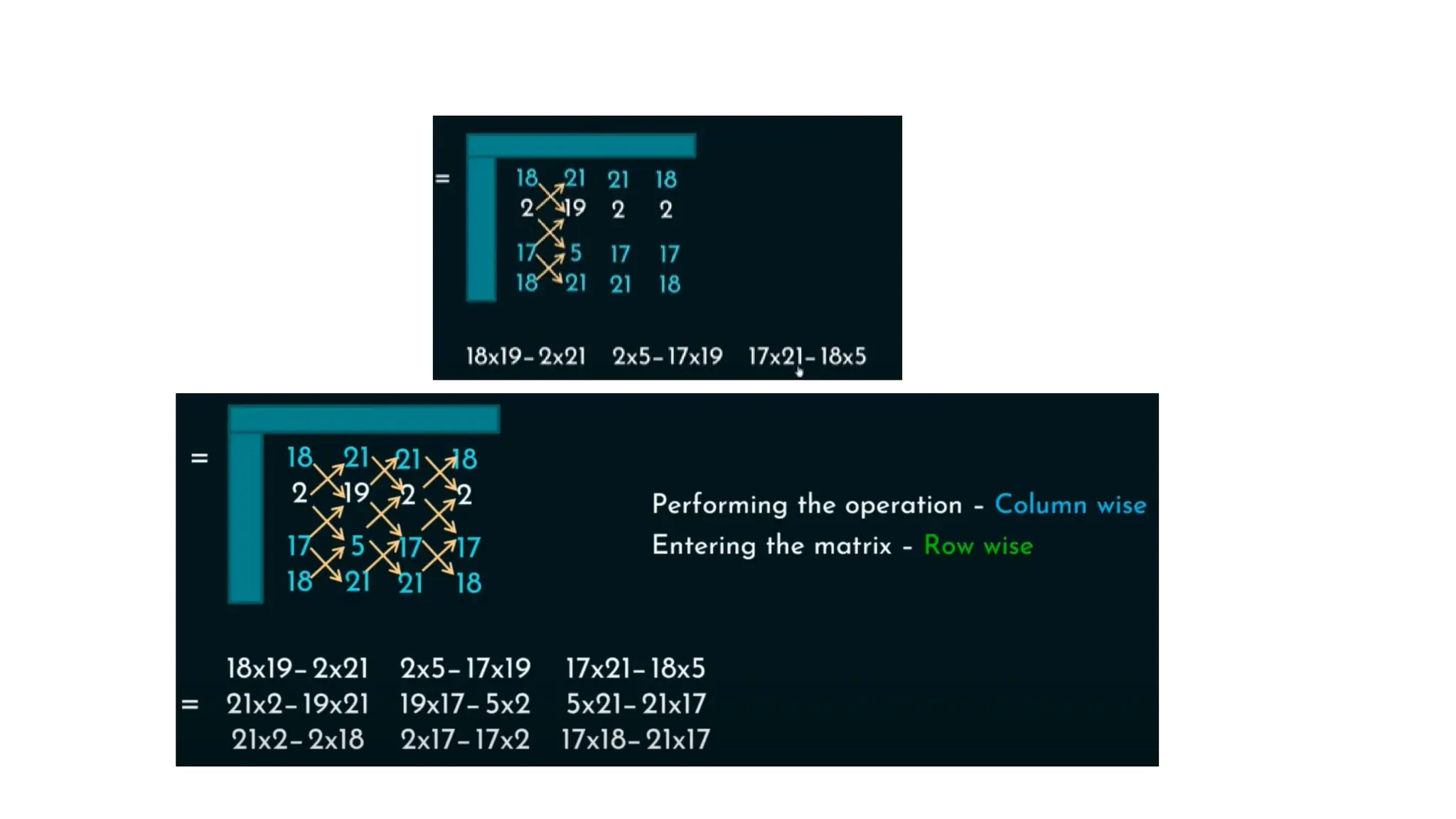
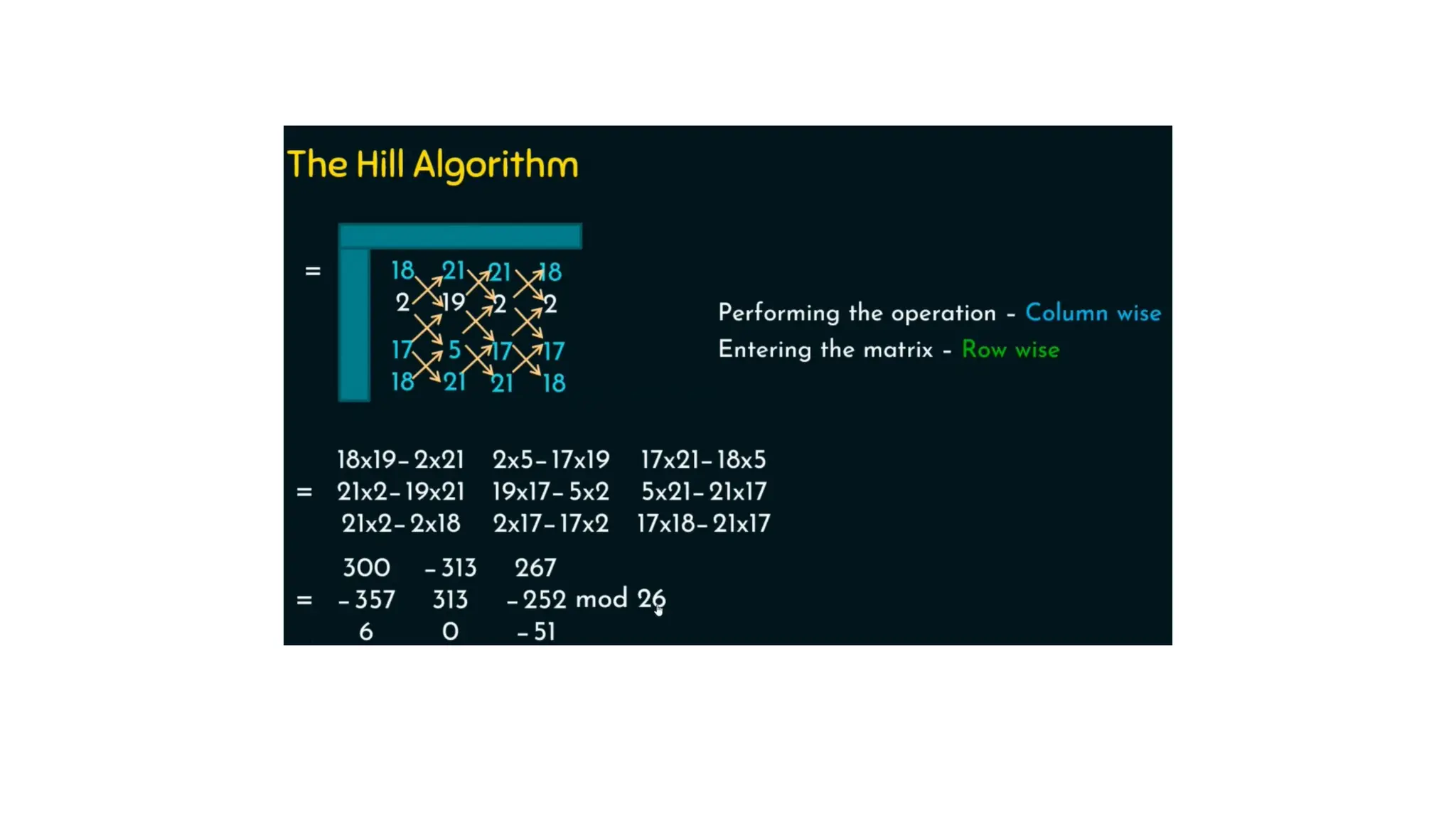
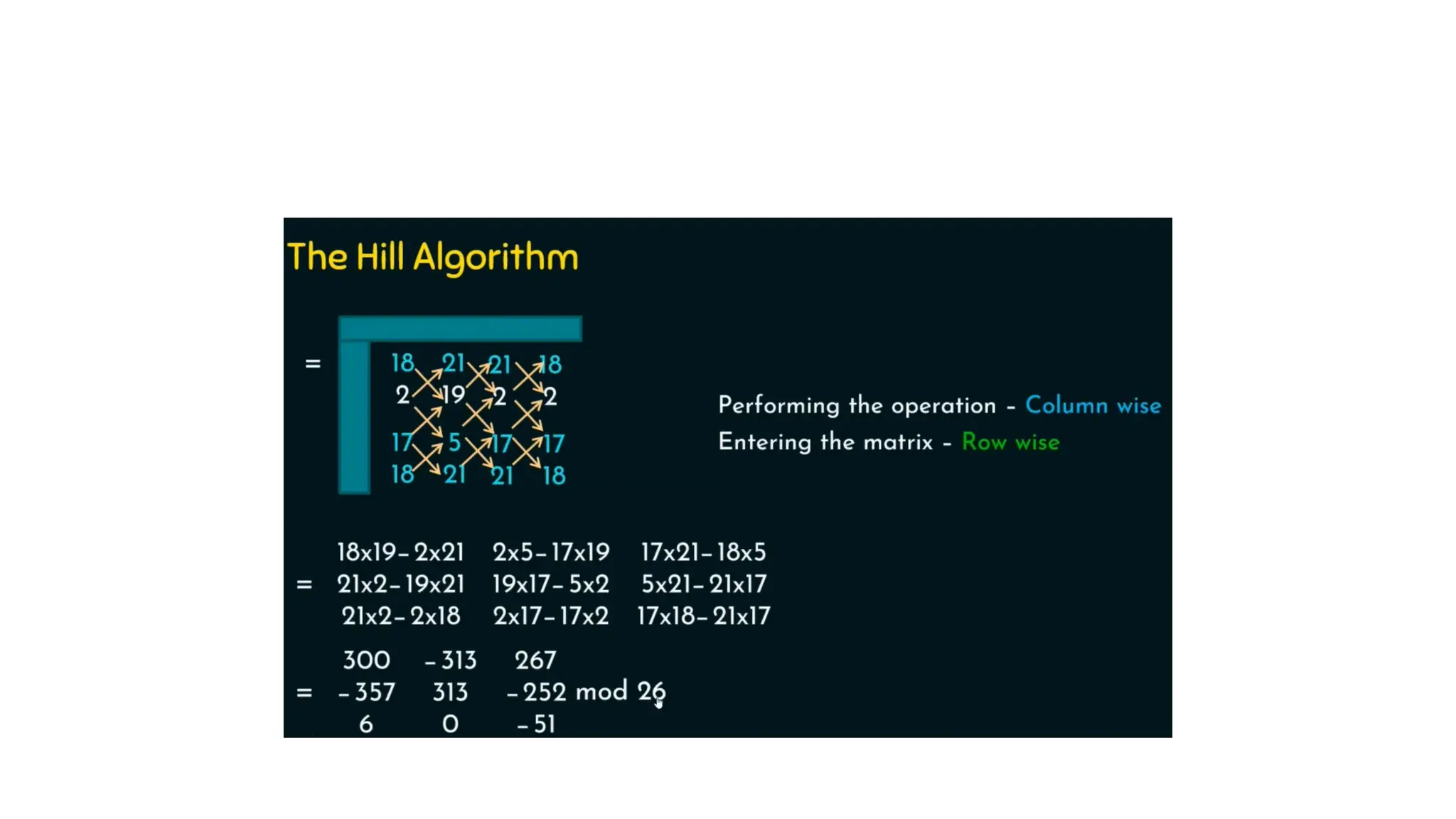
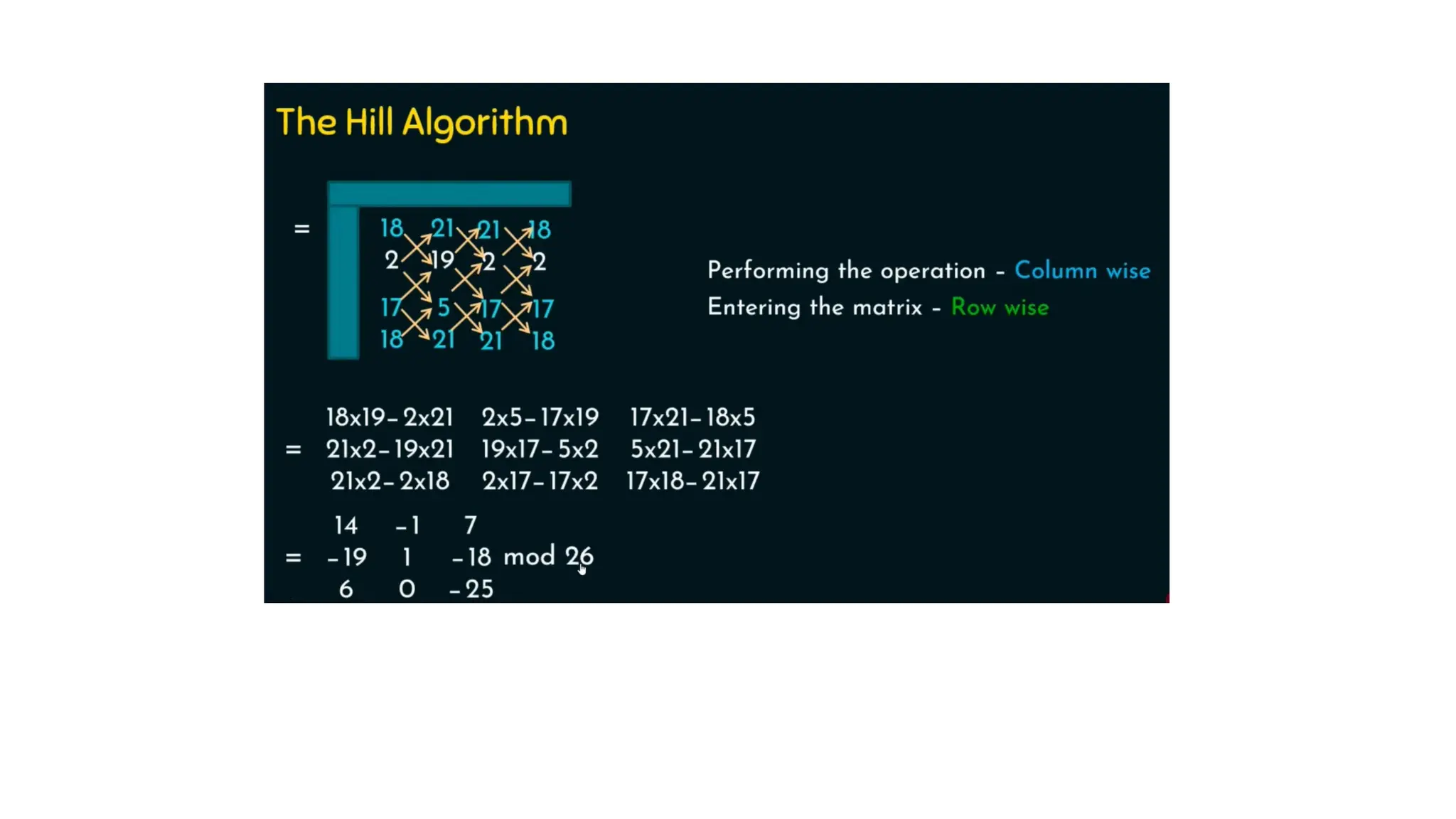
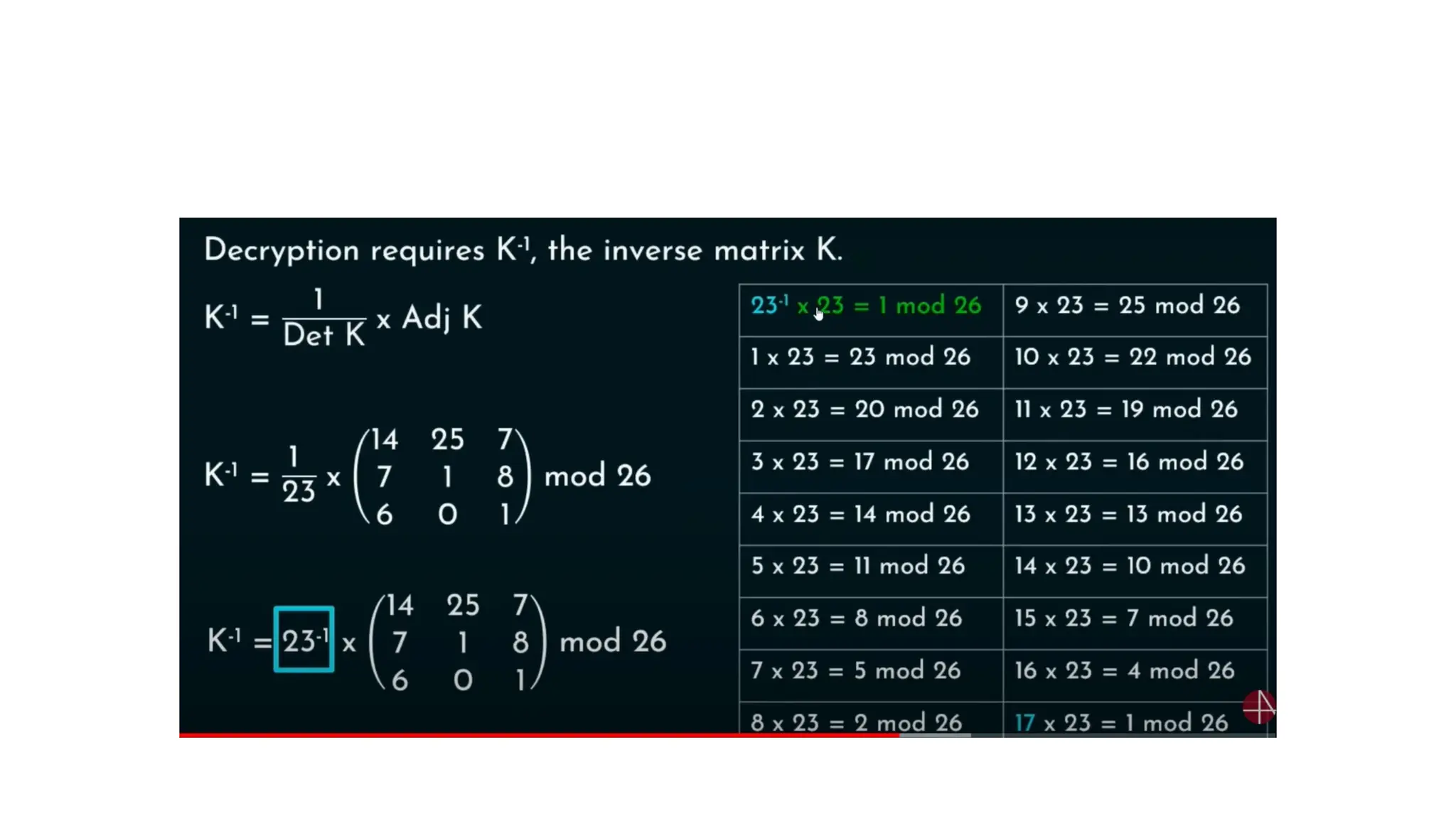
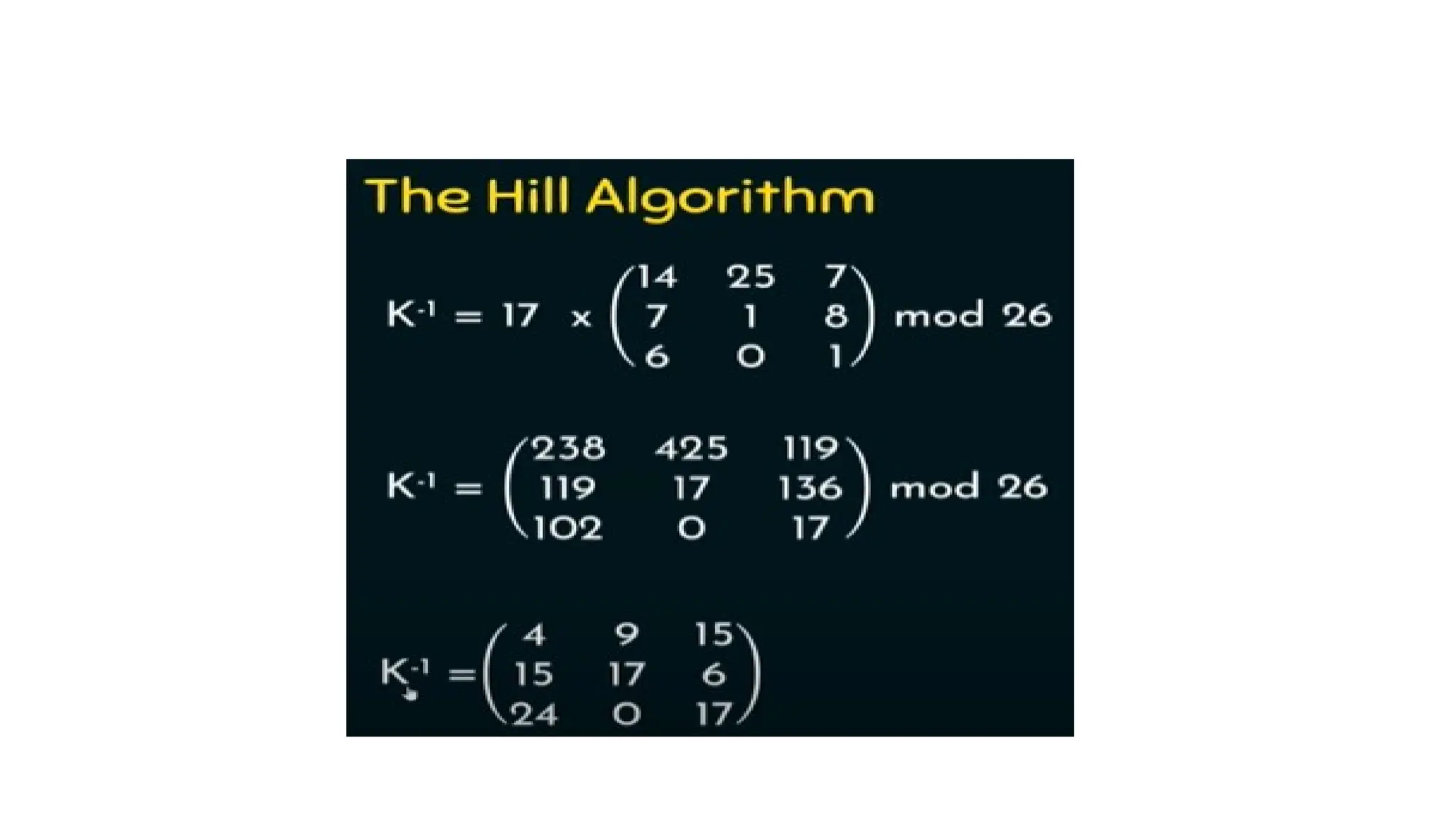
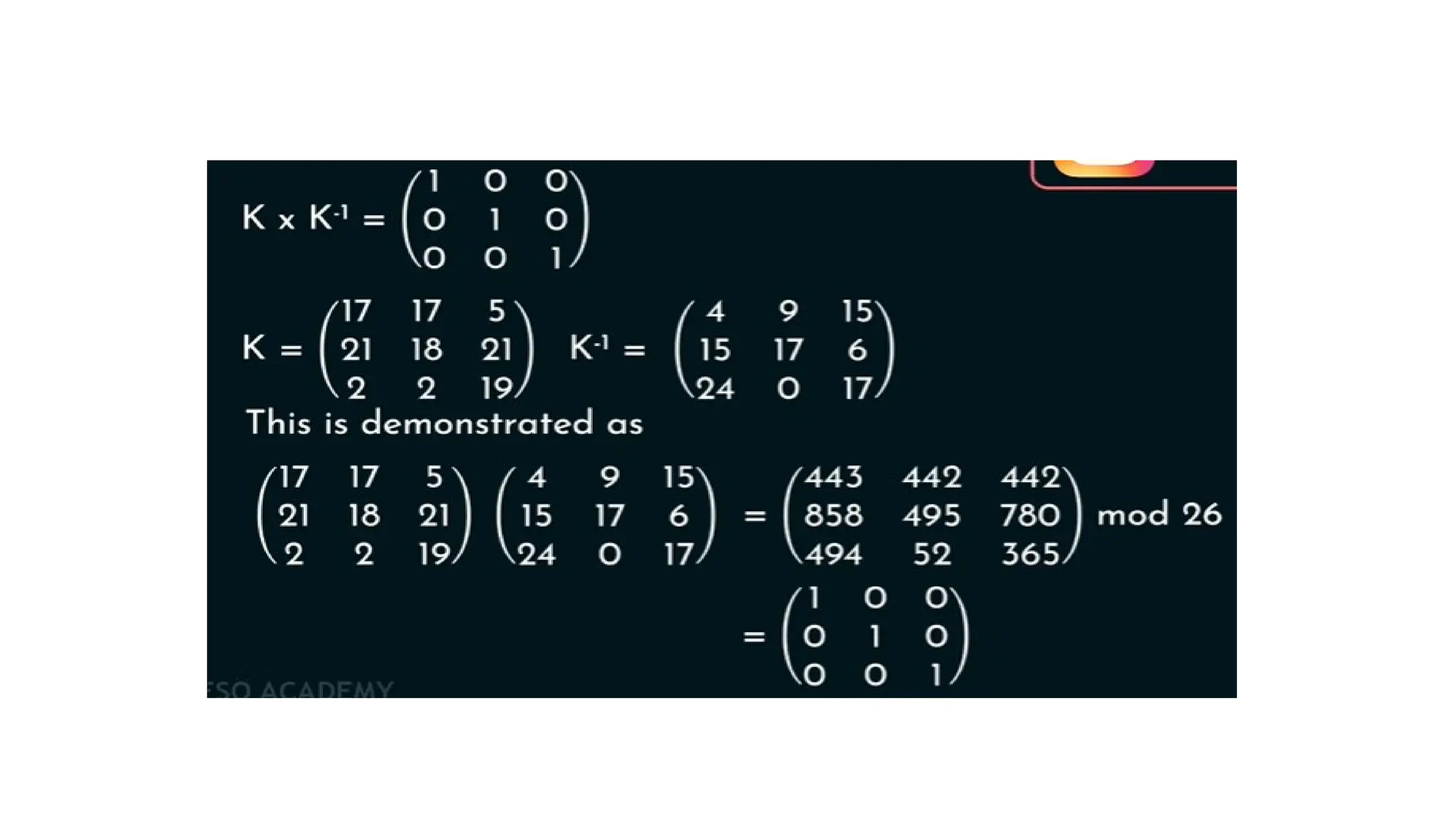
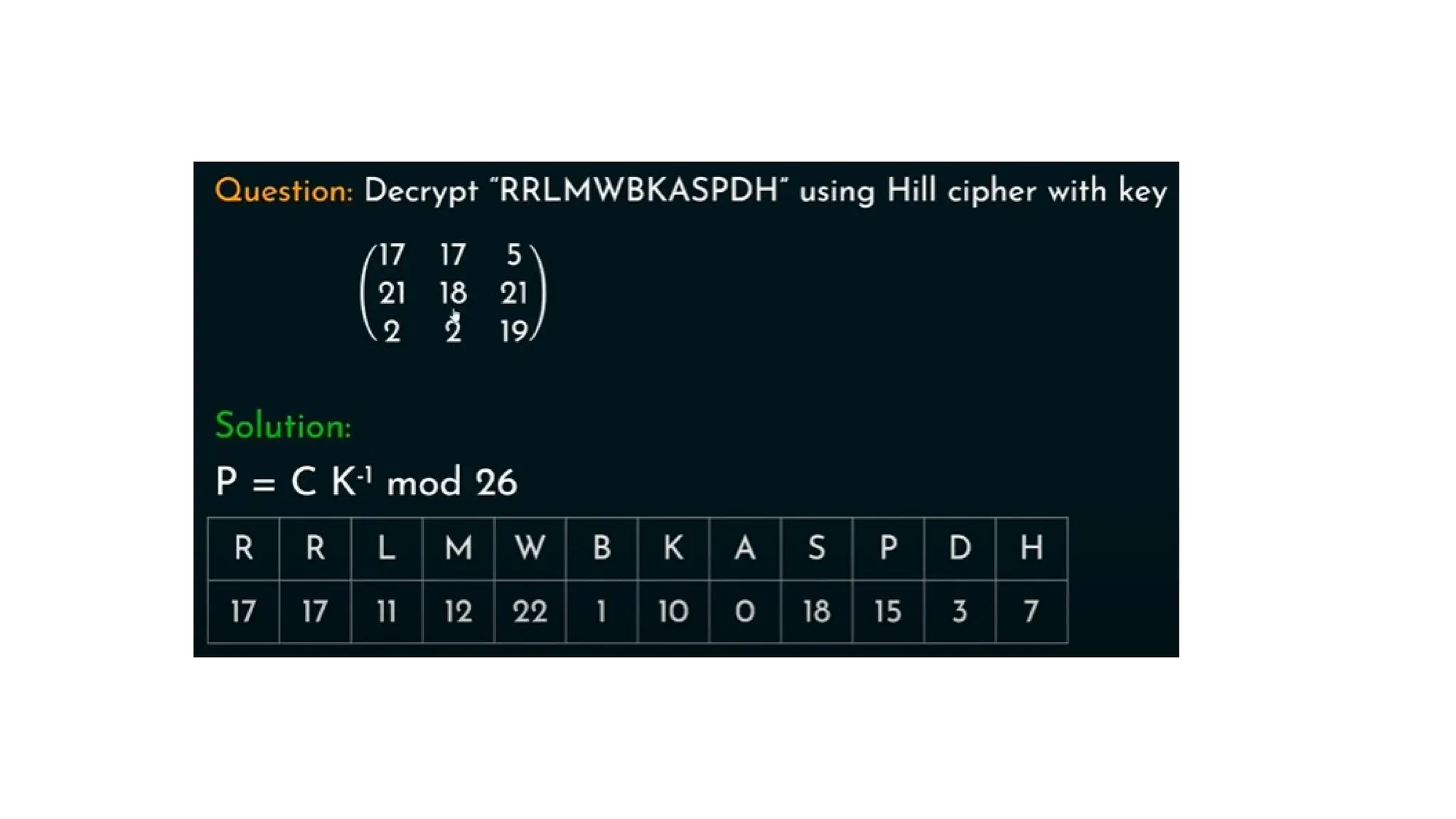
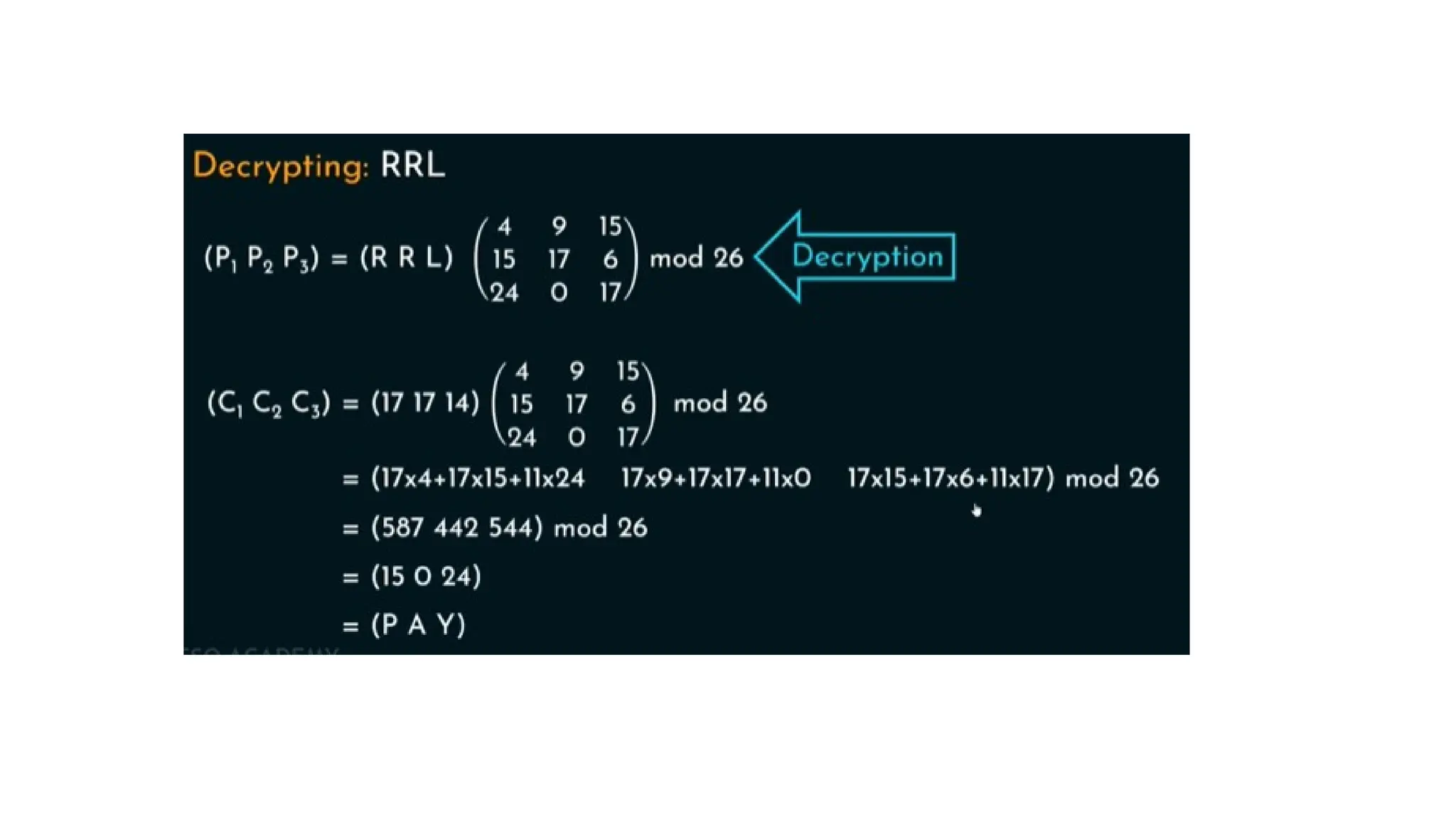
C = E(K,P) = PK mod 26
P = D(K, C) = CK-1
mod 26 = PKK-1
= P
c1 = (k11p1 + k21p2 + k31p3) mod
26
c2 = (k12p1 + k22p2 + k32p3) mod
26
55.
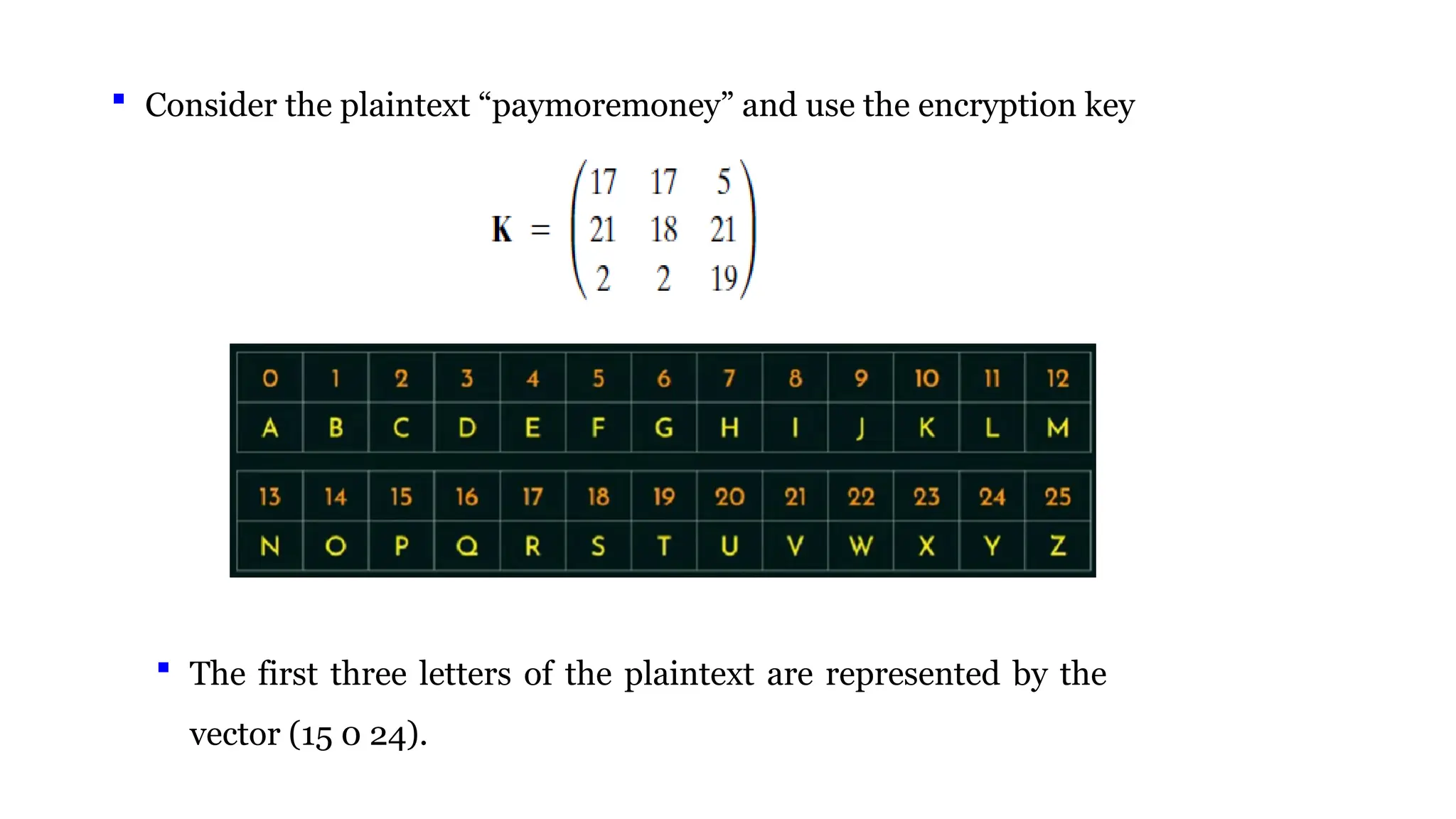
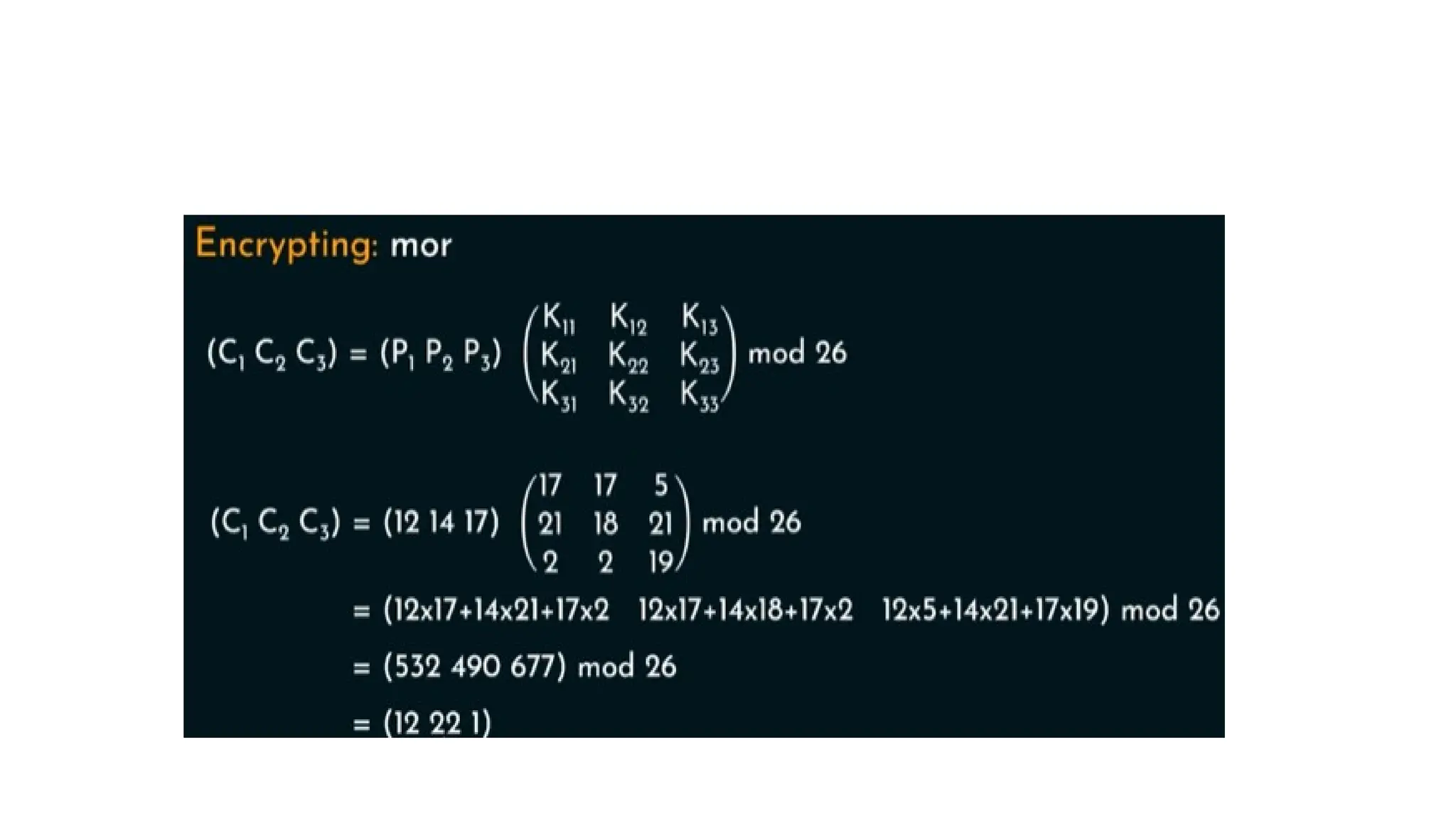
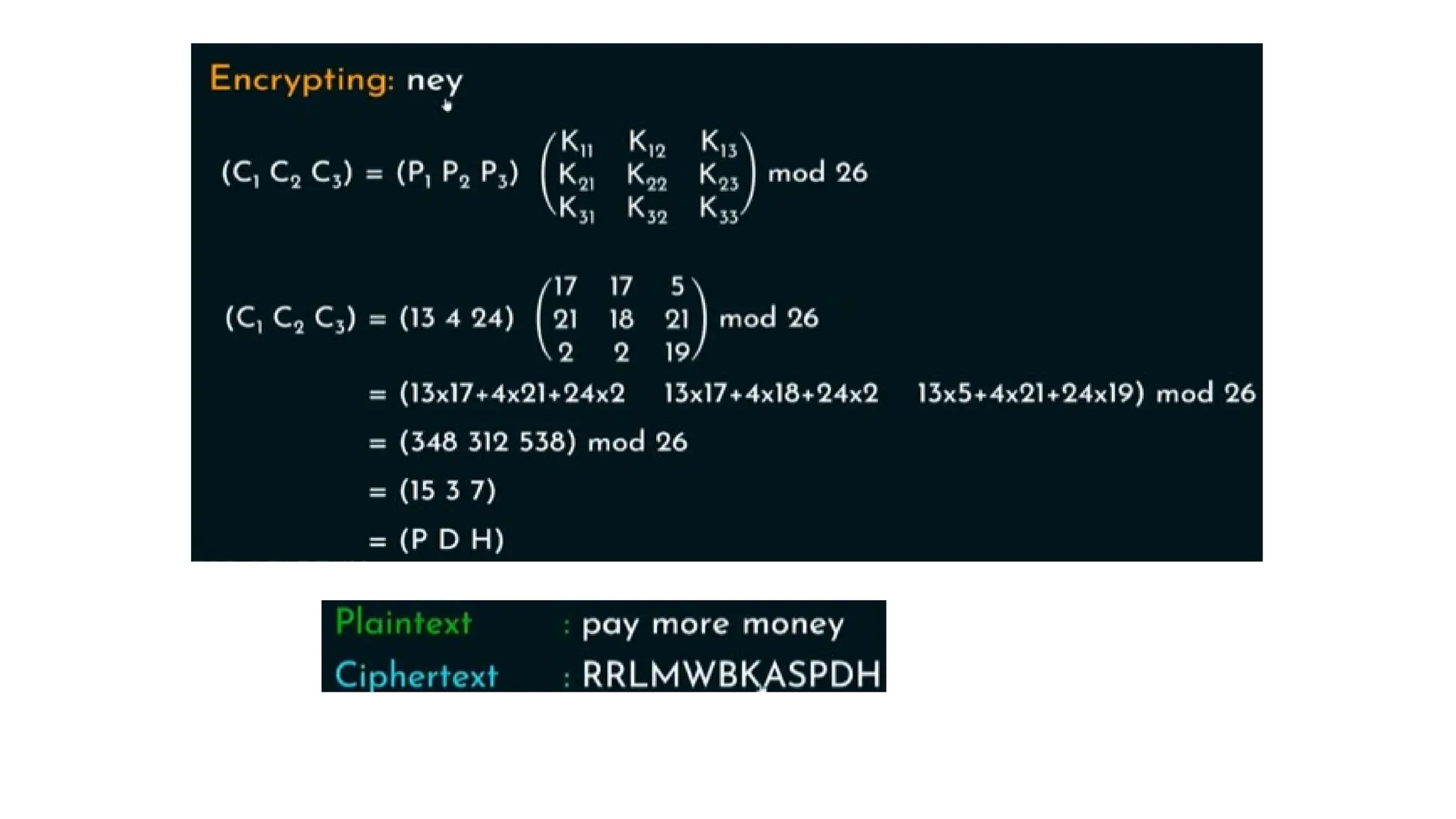
Consider theplaintext “paymoremoney” and use the encryption key
The first three letters of the plaintext are represented by the
vector (15 0 24).