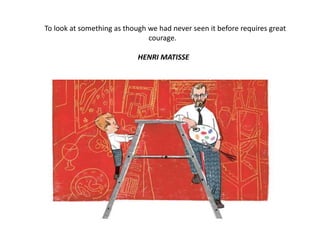
To look at something as though we had never seen it before requires great
courage.
HENRI MATISSE
• Henri Matisse was a
French painter, famous
for his use of colour
and his original and
free style drawing.
• He is considered with
Picasso one of the
greatest artist of the
XX century.
He was born in 1869 in France and died in 1954.
• Matisse´s father was the owner of a store and he
wanted his son to be a lawyer. In the beginning Henri
showed obedience to his father and started to work in
an office.
• But when he was twenty years old, he fell sick of
appendicitis and he had to stay in bed a long time. His
mother gave him a box of paintings as a present. She
wanted him to enjoy and not to be so bored. And just
like that he discovered his passion: paint, a world of
colours.
• He quitted his work and he went to Paris to become
an artist.
LEARNING
• First of all, as his
contemporaries did,
he learned copying
famous artworks .
He went to the
Louvre Museum and
copied the greatest
artist artworks.
• Later he painted landscapes an still lifes. But
bit by bit he discovered that the colour was
the most important thing for him.
FIRST ARTWORKS
He painted several selfportraits
Fauvist period
• In 1905 he participated in an
exhibition with two friends.
They did not care about the
paintings showing real things
or real life, the most
important thing was colour.
People called them Fauves
(wild in french),because they
said that the way they painted
was wild and savage.
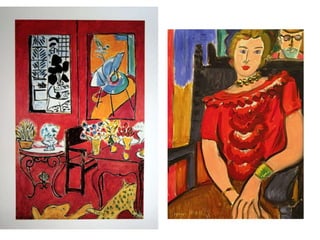
WINDOWS
• He liked so much
painting windows,
because it was a way
he could paint two
different sides of the
same reality , the
inside of the houses
and the landscape
outside.
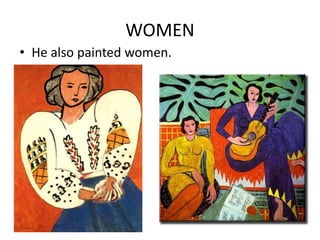
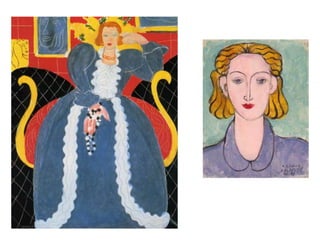
WOMEN
• He also painted women.
DANCE
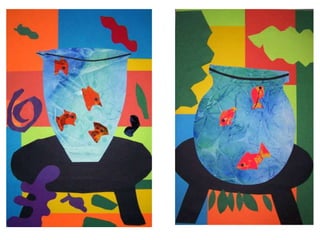
Matisse also painted fishes.
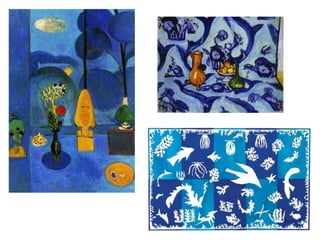
He liked blue
He liked red.
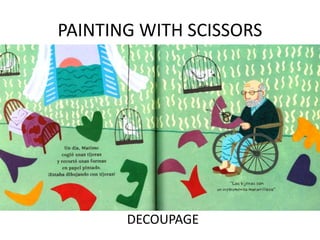
PAINTING WITH SCISSORS
DECOUPAGE
• When Matisse was seventy years old fell ill of
cancer.
• It took a lot of effort to move and he was not
strong enough to paint, Matisse learnt to paint in
a different way. In his last years his tools were not
canvas, easel and paintbrush. He replaced them
with something we all use at home and at school
scissors, paper and glue. :
• From bed, and when he could, in a wheelchair,
Matisse began cutting painted papers of
different colours and textures. He cut shapes
and placed them in a paper to achieve a
composition.
PAINTING WITH SCISSORS
• WHAT YOU WILL LEARN
Cutting organic shapes and arranging them in a
composition; learning about positive and negative
shapes, unity and variety.
• WHAT YOU WILL NEED
A variety of colored papers, including some
textured ones, white construction paper, scissors,
glue stick.
SHAPES
Geometric shapes, you remember, are usually made of straight
lines (square, triangle, hexagon, etc.) or regular curves (circle,
oval). Organic shapes are those that are not geometric. They are
the shapes found in nature (people, shells, leaves, clouds, etc.)
WORDS TO LEARN
positive shapes: the shapes of the subject of the art work.
negative shapes: the shape of the space around the subject.
unity: an arrangement in which all the parts seem related.
variety: a group of different things.
STEPS
• Draw shapes and silhouettes in coloured papers. You
can repeat the shapes in different sizes and colours.
Cut shapes in negative and positive.
• Choose a piece of paper to use it as a
background.
• When you have a variety of shapes, try to
organize them so they do not touch one
another on the white background.
• Cut more colored shapes if you need to.
• Be sure you have large, medium and small
sizes for variety. Repeat some of the same
color for unity.
• Try several arrangements before you decide to
glue everything down
MATISSE PIECES
ONLINE ACTIVITY TO MAKE ART AS MATISSE
http://www.toytheater.com/matisse-pieces.php
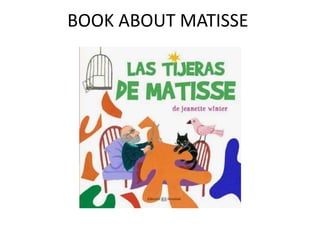
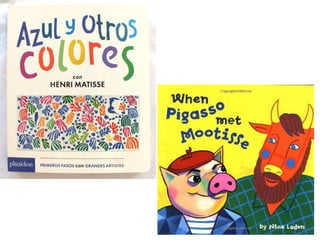
BOOK ABOUT MATISSE
PLANTILLAS
Matisse english

Matisse english

  • 2.
    To look atsomething as though we had never seen it before requires great courage. HENRI MATISSE
  • 3.
    • Henri Matissewas a French painter, famous for his use of colour and his original and free style drawing. • He is considered with Picasso one of the greatest artist of the XX century.
  • 4.
    He was bornin 1869 in France and died in 1954.
  • 5.
    • Matisse´s fatherwas the owner of a store and he wanted his son to be a lawyer. In the beginning Henri showed obedience to his father and started to work in an office. • But when he was twenty years old, he fell sick of appendicitis and he had to stay in bed a long time. His mother gave him a box of paintings as a present. She wanted him to enjoy and not to be so bored. And just like that he discovered his passion: paint, a world of colours. • He quitted his work and he went to Paris to become an artist.
  • 6.
    LEARNING • First ofall, as his contemporaries did, he learned copying famous artworks . He went to the Louvre Museum and copied the greatest artist artworks.
  • 7.
    • Later hepainted landscapes an still lifes. But bit by bit he discovered that the colour was the most important thing for him. FIRST ARTWORKS
  • 9.
    He painted severalselfportraits
  • 10.
    Fauvist period • In1905 he participated in an exhibition with two friends. They did not care about the paintings showing real things or real life, the most important thing was colour. People called them Fauves (wild in french),because they said that the way they painted was wild and savage.
  • 11.
    WINDOWS • He likedso much painting windows, because it was a way he could paint two different sides of the same reality , the inside of the houses and the landscape outside.
  • 14.
    WOMEN • He alsopainted women.
  • 19.
  • 21.
  • 22.
  • 24.
  • 26.
  • 27.
    • When Matissewas seventy years old fell ill of cancer. • It took a lot of effort to move and he was not strong enough to paint, Matisse learnt to paint in a different way. In his last years his tools were not canvas, easel and paintbrush. He replaced them with something we all use at home and at school scissors, paper and glue. :
  • 28.
    • From bed,and when he could, in a wheelchair, Matisse began cutting painted papers of different colours and textures. He cut shapes and placed them in a paper to achieve a composition.
  • 48.
  • 49.
    • WHAT YOUWILL LEARN Cutting organic shapes and arranging them in a composition; learning about positive and negative shapes, unity and variety. • WHAT YOU WILL NEED A variety of colored papers, including some textured ones, white construction paper, scissors, glue stick.
  • 50.
    SHAPES Geometric shapes, youremember, are usually made of straight lines (square, triangle, hexagon, etc.) or regular curves (circle, oval). Organic shapes are those that are not geometric. They are the shapes found in nature (people, shells, leaves, clouds, etc.) WORDS TO LEARN positive shapes: the shapes of the subject of the art work. negative shapes: the shape of the space around the subject. unity: an arrangement in which all the parts seem related. variety: a group of different things.
  • 51.
    STEPS • Draw shapesand silhouettes in coloured papers. You can repeat the shapes in different sizes and colours. Cut shapes in negative and positive.
  • 52.
    • Choose apiece of paper to use it as a background. • When you have a variety of shapes, try to organize them so they do not touch one another on the white background. • Cut more colored shapes if you need to. • Be sure you have large, medium and small sizes for variety. Repeat some of the same color for unity.
  • 53.
    • Try severalarrangements before you decide to glue everything down
  • 66.
    MATISSE PIECES ONLINE ACTIVITYTO MAKE ART AS MATISSE http://www.toytheater.com/matisse-pieces.php
  • 67.
  • 70.