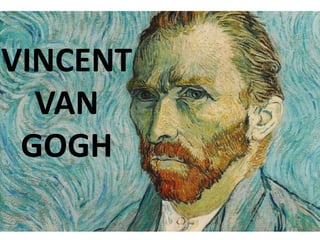
VINCENT
VAN
GOGH
Vincent Van Gogh…
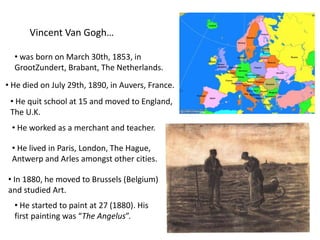
• was born on March 30th, 1853, in
GrootZundert, Brabant, The Netherlands.
• He quit school at 15 and moved to England,
The U.K.
• He worked as a merchant and teacher.
• He lived in Paris, London, The Hague,
Antwerp and Arles amongst other cities.
• He started to paint at 27 (1880). His
first painting was “The Angelus”.
• He died on July 29th, 1890, in Auvers, France.
• In 1880, he moved to Brussels (Belgium)
and studied Art.
• He was poor for all his life. The little money his
brother Theo gave him, Vincent used to spend it on
buying painting materials instead of food.
• In 1888, he suffered depression and cut his left ear (part of it). Then, he was
sent to a psychiatric hospital (asylum). He entered and left it several times that
year. He was epileptic (seizures = brain attacks). That's why people thought they
were giving him crazy attacks.
• During his life, he went crazy little by little.
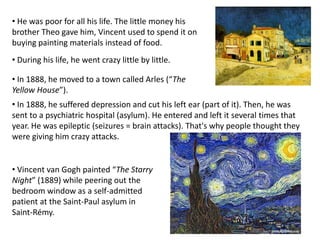
• Vincent van Gogh painted “The Starry
Night” (1889) while peering out the
bedroom window as a self-admitted
patient at the Saint-Paul asylum in
Saint-Rémy.
• In 1888, he moved to a town called Arles (“The
Yellow House”).
• In May 1890, he left the asylum and went to live to
Auvers, France.
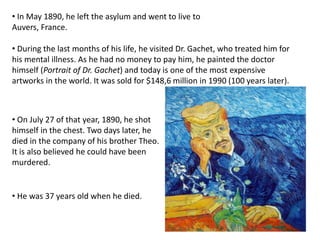
• During the last months of his life, he visited Dr. Gachet, who treated him for
his mental illness. As he had no money to pay him, he painted the doctor
himself (Portrait of Dr. Gachet) and today is one of the most expensive
artworks in the world. It was sold for $148,6 million in 1990 (100 years later).
• On July 27 of that year, 1890, he shot
himself in the chest. Two days later, he
died in the company of his brother Theo.
It is also believed he could have been
murdered.
• He was 37 years old when he died.
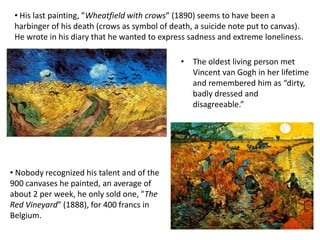
• His last painting, ”Wheatfield with crows” (1890) seems to have been a
harbinger of his death (crows as symbol of death, a suicide note put to canvas).
He wrote in his diary that he wanted to express sadness and extreme loneliness.
• Nobody recognized his talent and of the
900 canvases he painted, an average of
about 2 per week, he only sold one, "The
Red Vineyard” (1888), for 400 francs in
Belgium.
• The oldest living person met
Vincent van Gogh in her lifetime
and remembered him as “dirty,
badly dressed and
disagreeable.”
• His painting style was post- impressionist.
• He loved painting outdoors.
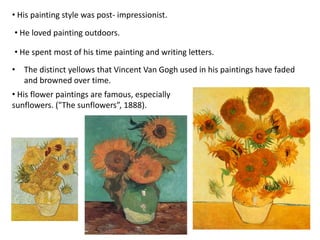
• His flower paintings are famous, especially
sunflowers. ("The sunflowers”, 1888).
• The distinct yellows that Vincent Van Gogh used in his paintings have faded
and browned over time.
• He spent most of his time painting and writing letters.
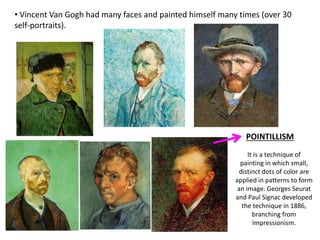
• Vincent Van Gogh had many faces and painted himself many times (over 30
self-portraits).
POINTILLISM
It is a technique of
painting in which small,
distinct dots of color are
applied in patterns to form
an image. Georges Seurat
and Paul Signac developed
the technique in 1886,
branching from
Impressionism.
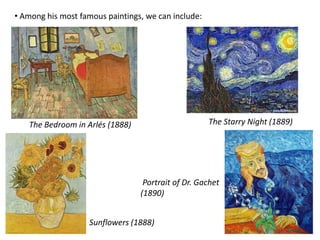
• Among his most famous paintings, we can include:
The Bedroom in Arlés (1888) The Starry Night (1889)
Sunflowers (1888)
Portrait of Dr. Gachet
(1890)
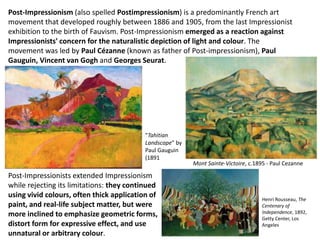
Post-Impressionism (also spelled Postimpressionism) is a predominantly French art
movement that developed roughly between 1886 and 1905, from the last Impressionist
exhibition to the birth of Fauvism. Post-Impressionism emerged as a reaction against
Impressionists' concern for the naturalistic depiction of light and colour. The
movement was led by Paul Cézanne (known as father of Post-impressionism), Paul
Gauguin, Vincent van Gogh and Georges Seurat.
Post-Impressionists extended Impressionism
while rejecting its limitations: they continued
using vivid colours, often thick application of
paint, and real-life subject matter, but were
more inclined to emphasize geometric forms,
distort form for expressive effect, and use
unnatural or arbitrary colour.
Henri Rousseau, The
Centenary of
Independence, 1892,
Getty Center, Los
Angeles
Mont Sainte-Victoire, c.1895 - Paul Cezanne
"Tahitian
Landscape" by
Paul Gauguin
(1891

Van gogh

  • 1.
  • 2.
    Vincent Van Gogh… •was born on March 30th, 1853, in GrootZundert, Brabant, The Netherlands. • He quit school at 15 and moved to England, The U.K. • He worked as a merchant and teacher. • He lived in Paris, London, The Hague, Antwerp and Arles amongst other cities. • He started to paint at 27 (1880). His first painting was “The Angelus”. • He died on July 29th, 1890, in Auvers, France. • In 1880, he moved to Brussels (Belgium) and studied Art.
  • 3.
    • He waspoor for all his life. The little money his brother Theo gave him, Vincent used to spend it on buying painting materials instead of food. • In 1888, he suffered depression and cut his left ear (part of it). Then, he was sent to a psychiatric hospital (asylum). He entered and left it several times that year. He was epileptic (seizures = brain attacks). That's why people thought they were giving him crazy attacks. • During his life, he went crazy little by little. • Vincent van Gogh painted “The Starry Night” (1889) while peering out the bedroom window as a self-admitted patient at the Saint-Paul asylum in Saint-Rémy. • In 1888, he moved to a town called Arles (“The Yellow House”).
  • 4.
    • In May1890, he left the asylum and went to live to Auvers, France. • During the last months of his life, he visited Dr. Gachet, who treated him for his mental illness. As he had no money to pay him, he painted the doctor himself (Portrait of Dr. Gachet) and today is one of the most expensive artworks in the world. It was sold for $148,6 million in 1990 (100 years later). • On July 27 of that year, 1890, he shot himself in the chest. Two days later, he died in the company of his brother Theo. It is also believed he could have been murdered. • He was 37 years old when he died.
  • 5.
    • His lastpainting, ”Wheatfield with crows” (1890) seems to have been a harbinger of his death (crows as symbol of death, a suicide note put to canvas). He wrote in his diary that he wanted to express sadness and extreme loneliness. • Nobody recognized his talent and of the 900 canvases he painted, an average of about 2 per week, he only sold one, "The Red Vineyard” (1888), for 400 francs in Belgium. • The oldest living person met Vincent van Gogh in her lifetime and remembered him as “dirty, badly dressed and disagreeable.”
  • 6.
    • His paintingstyle was post- impressionist. • He loved painting outdoors. • His flower paintings are famous, especially sunflowers. ("The sunflowers”, 1888). • The distinct yellows that Vincent Van Gogh used in his paintings have faded and browned over time. • He spent most of his time painting and writing letters.
  • 7.
    • Vincent VanGogh had many faces and painted himself many times (over 30 self-portraits). POINTILLISM It is a technique of painting in which small, distinct dots of color are applied in patterns to form an image. Georges Seurat and Paul Signac developed the technique in 1886, branching from Impressionism.
  • 8.
    • Among hismost famous paintings, we can include: The Bedroom in Arlés (1888) The Starry Night (1889) Sunflowers (1888) Portrait of Dr. Gachet (1890)
  • 9.
    Post-Impressionism (also spelledPostimpressionism) is a predominantly French art movement that developed roughly between 1886 and 1905, from the last Impressionist exhibition to the birth of Fauvism. Post-Impressionism emerged as a reaction against Impressionists' concern for the naturalistic depiction of light and colour. The movement was led by Paul Cézanne (known as father of Post-impressionism), Paul Gauguin, Vincent van Gogh and Georges Seurat. Post-Impressionists extended Impressionism while rejecting its limitations: they continued using vivid colours, often thick application of paint, and real-life subject matter, but were more inclined to emphasize geometric forms, distort form for expressive effect, and use unnatural or arbitrary colour. Henri Rousseau, The Centenary of Independence, 1892, Getty Center, Los Angeles Mont Sainte-Victoire, c.1895 - Paul Cezanne "Tahitian Landscape" by Paul Gauguin (1891