





Cooperating or not? Inner and
outer boundaries in social
relationships
World Conference of Transactional Analysis
Berlin | Technical University TU | July 27th – 29th 2017
Claudia Matini – CTA trainee
matiniclaudia@gmail.com
• Favour reflection on personal beliefs and
attitudes toward cooperation
• Experience cooperative learning methodology
as a means to promote cooperation in groups
• Learn about cooperative learning principles
• Learn about TA theory on cooperation and
competition
OUTCOMES OF THE PRESENTATION
1. What is cooperation?
2. Why is it important?
3. Is it better than competition or individualistic
behavior?
4. What helps us to be cooperative? Outer and
Inner boundaries
5. How can we promote cooperation through
education?
KEY QUESTIONS
WORK STRUCTURE
• Use of cooperative learning techniques
• Chalk & talk
• Individualistic activities
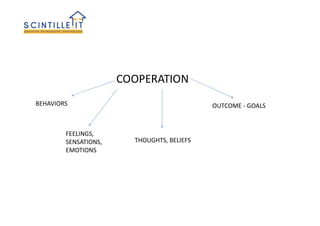
COOPERATION
FEELINGS,
SENSATIONS,
EMOTIONS
THOUGHTS, BELIEFS
OUTCOME - GOALSBEHAVIORS
1. What is cooperation?
• Co-operate
• Co (l) – laborate
1.an act or instance of working or acting together
for a common purpose or benefit; joint action
2.more or less active assistance from a person, or
ganization, etc.
http://www.dictionary.com/browse/cooperation
2. Is it important? Why?
• Essential for survival:
– mother-child relationship
– Social groups: family, communities
– Basic physical and psychological need are satisfied
• Necessary for productivity and success
– Work related complex activities
3. Is it better than competition or
individualistic behavior?
GOALS
• A goal is an ideal place toward which
people are working, which has a
value
• Individual goals are related through
social interdependence
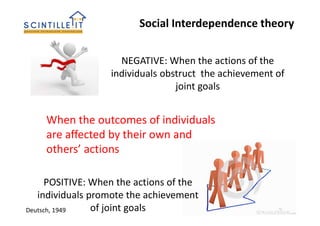
Social Interdependence theory
When the outcomes of individuals
are affected by their own and
others’ actions
POSITIVE: When the actions of the
individuals promote the achievement
of joint goalsDeutsch, 1949
NEGATIVE: When the actions of the
individuals obstruct the achievement of
joint goals
4. OUTER BOUNDARIES
• Goal structure and interaction patterns
• Group structure: Role and norms
• …
WHAT influences cooperative behavior?
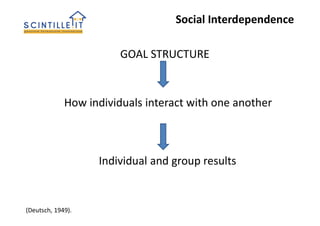
GOAL STRUCTURE
How individuals interact with one another
Individual and group results
(Deutsch, 1949).
Social Interdependence
INTERACTION PATTERNS
• OPPOSITIONAL: individuals discourage and
obstruct one another’s efforts to achieve
• PROMOTIVE: individuals encourage and facilitate
each others’ efforts to accomplish group goals
Johnson and Johnson, 2014
GROUP STRUCTURE: ROLE AND NORMS
Highly structured situations favor cooperation
• Role expectations are clear
• Group norms must be known, and accepted
by others and by the person
• Actions to be performed are clear
5. INNER BOUNDARIES
• Favorite ego states
• Life positions
• Script and life plan
• Stroke economy
• Games vs. intimacy
• …..
FAVORITE EGO STATES: the Parent?
The Parent is the judging, tradition based,
prejudiced, regulatory ego state.
Steiner, 1974
FAVORITE EGO STATES for cooperation
Steiner, 1974
It is therefore desirable to sharply limit the Critical
Parent's control of human affairs. On the other hand,
given the goals of transactional analysis--to improve
people's lives by teaching them more effective ways of
interacting--it is essential to strengthen the Adult ego-
state.
Just as important, since the Adult's interactions are not
the most powerful source of strokes, is the
strengthening of the Nurturing Parent.
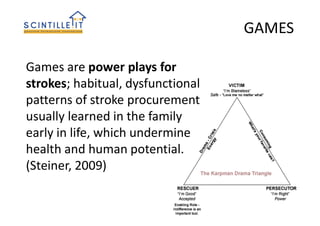
GAMES
Games are power plays for
strokes; habitual, dysfunctional
patterns of stroke procurement
usually learned in the family
early in life, which undermine
health and human potential.
(Steiner, 2009)
INTIMACY
• mode of time-structuring in which people
express authentic feelings and wants to each
other without censoring
• Everyone involved accepts his/her
responsibility
• Expressed feelings are appropriate to the
situation
6. How can we promote cooperation
through education?
Cooperation is working together to accomplish
shared goals.
Within cooperative situations, individuals seek
outcomes that are beneficial to themselves
and beneficial to all other group members.
Cooperative learning is the instructional use of
small groups so that students work together
to maximize their own and each other’s
learning.
COOPERATIVE LEARNING: definition
(An Overview Of Cooperative Learning, David Johnson and Roger Johnson, in http://www.co-
operation.org/home/introduction-to-cooperative-learning/)
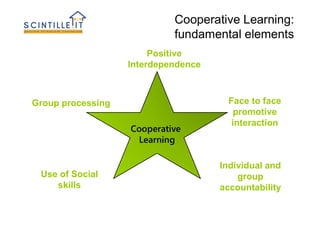
Cooperative
Learning
Cooperative Learning:
fundamental elements
Positive
Interdependence
Face to face
promotive
interaction
Individual and
group
accountability
Use of Social
skills
Group processing
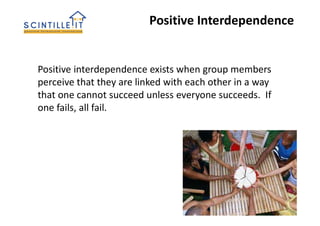
Positive Interdependence
Positive interdependence exists when group members
perceive that they are linked with each other in a way
that one cannot succeed unless everyone succeeds. If
one fails, all fail.
GROUP GOAL
• When a positive correlation exists among
individuals’ goals attainments, a group goal
results.
• It is a future state of affairs desired by enough
members of a group to motivate them to work
toward its achievement
By limiting the resources available to each
student, we create interdependence. A
contribution from each is necessary; no one
can do the task alone. In that situation,
students will feel they are on the same side
and will cooperate.
Resource Interdependence
Kagan, S. The "P" and "I" of PIES: Powerful Principles for Success. San Clemente, CA: Kagan
Publishing. Kagan Online Magazine, Fall/Winter 2011. www.KaganOnline.com
We can create positive interdependence by giving
students a multi-faceted task to complete, a task
that demands contributions from each.
By creating task interdependence, student outcomes
are positively correlated. The better the
performance of each, the more positive the
outcome for all.
Because there is a positive correlation among their
outcomes, students feel they are on the same side
and it is very likely they will help and encourage
each other.
Task Interdependence
Kagan, S. The "P" and "I" of PIES: Powerful Principles for Success. San Clemente, CA: Kagan
Publishing. Kagan Online Magazine, Fall/Winter 2011. www.KaganOnline.com
Individual and group
accountability
The group has to be clear about its goals and be able
to measure
(a) its progress in achieving them and
(b)the individual efforts of each of its members.
Individual accountability is present if three conditions
are present:
1) a student performs on his/her own;
2) the performance or the product of the
performance must be seen by someone else; and
3) the individual performance is required.
An individual, public performance is required.
Individual accountability
Kagan, 2011
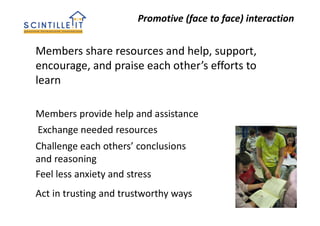
Members share resources and help, support,
encourage, and praise each other’s efforts to
learn
Exchange needed resources
Promotive (face to face) interaction
Members provide help and assistance
Challenge each others’ conclusions
and reasoning
Feel less anxiety and stress
Act in trusting and trustworthy ways
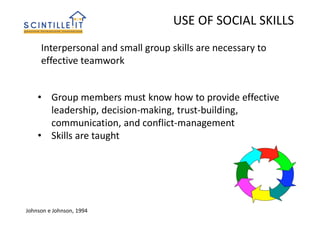
USE OF SOCIAL SKILLS
Interpersonal and small group skills are necessary to
effective teamwork
• Group members must know how to provide effective
leadership, decision-making, trust-building,
communication, and conflict-management
• Skills are taught
Johnson e Johnson, 1994
Cooperative learning in TA terms
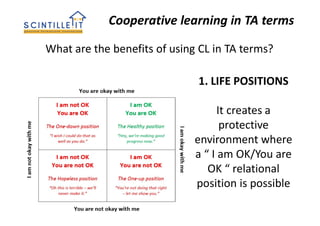
What are the benefits of using CL in TA terms?
1. LIFE POSITIONS
It creates a
protective
environment where
a “ I am OK/You are
OK “ relational
position is possible
Cooperative learning in TA terms
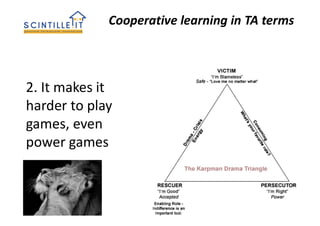
2. It makes it
harder to play
games, even
power games
Cooperative learning in TA terms
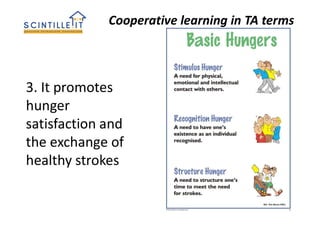
3. It promotes
hunger
satisfaction and
the exchange of
healthy strokes
Cooperative learning in TA terms
4. It gives opportunity to be
successful (aspirations)
Cooperative learning in TA terms
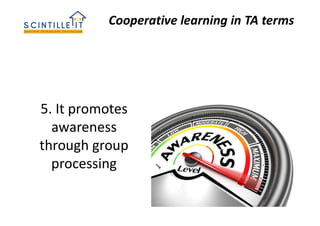
5. It promotes
awareness
through group
processing
Cooperative learning in TA terms
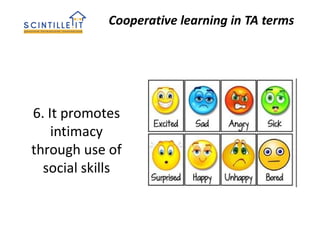
6. It promotes
intimacy
through use of
social skills
REFERENCES
Berne E. (1972). What do you say after you say hello, New York: Grove Press (tr.it. “Ciao!”...
e poi?, Milano: Bompiani, 1979).
Berne, E. (1964). Games people play. New York: Grove Press
Deutsch , M. (1949). A theory of cooperation and competition. Human relations, 129-152.
James, M. & Jongeward, D. (1971). Born to win. Reading: Addison-Wesley (Tr. It.: Nati per
vincere. Roma: ed. Paoline, 1980).
Johnson, D. & Johnson , F. (2014), Joining together. Group theory and group skills. Eleventh
edition.; Harlow, GB: Pearson.
Kagan, S. The "P" and "I" of PIES: Powerful Principles for Success. San Clemente, CA: Kagan
Publishing. Kagan Online Magazine, Fall/Winter 2011. www.KaganOnline.com
Steiner, C.M. (2009). The Heart of the Matter: Love, Information and Transactional Analysis
Steiner, C.M. (1974). Scripts people live. New York: Grove Press
White, T. (1994). Life positions. Transactional Analysis Journal, Volume 24, Number 4
(October 1994), p. 269-276.

Psyhcological reasons and obstacles for cooperation in groups

  • 1.
    Cooperating or not?Inner and outer boundaries in social relationships World Conference of Transactional Analysis Berlin | Technical University TU | July 27th – 29th 2017 Claudia Matini – CTA trainee matiniclaudia@gmail.com
  • 2.
    • Favour reflectionon personal beliefs and attitudes toward cooperation • Experience cooperative learning methodology as a means to promote cooperation in groups • Learn about cooperative learning principles • Learn about TA theory on cooperation and competition OUTCOMES OF THE PRESENTATION
  • 3.
    1. What iscooperation? 2. Why is it important? 3. Is it better than competition or individualistic behavior? 4. What helps us to be cooperative? Outer and Inner boundaries 5. How can we promote cooperation through education? KEY QUESTIONS
  • 4.
    WORK STRUCTURE • Useof cooperative learning techniques • Chalk & talk • Individualistic activities
  • 5.
  • 6.
    1. What iscooperation? • Co-operate • Co (l) – laborate 1.an act or instance of working or acting together for a common purpose or benefit; joint action 2.more or less active assistance from a person, or ganization, etc. http://www.dictionary.com/browse/cooperation
  • 7.
    2. Is itimportant? Why? • Essential for survival: – mother-child relationship – Social groups: family, communities – Basic physical and psychological need are satisfied • Necessary for productivity and success – Work related complex activities
  • 8.
    3. Is itbetter than competition or individualistic behavior?
  • 9.
    GOALS • A goalis an ideal place toward which people are working, which has a value • Individual goals are related through social interdependence
  • 10.
    Social Interdependence theory Whenthe outcomes of individuals are affected by their own and others’ actions POSITIVE: When the actions of the individuals promote the achievement of joint goalsDeutsch, 1949 NEGATIVE: When the actions of the individuals obstruct the achievement of joint goals
  • 11.
    4. OUTER BOUNDARIES •Goal structure and interaction patterns • Group structure: Role and norms • … WHAT influences cooperative behavior?
  • 12.
    GOAL STRUCTURE How individualsinteract with one another Individual and group results (Deutsch, 1949). Social Interdependence
  • 13.
    INTERACTION PATTERNS • OPPOSITIONAL:individuals discourage and obstruct one another’s efforts to achieve • PROMOTIVE: individuals encourage and facilitate each others’ efforts to accomplish group goals Johnson and Johnson, 2014
  • 14.
    GROUP STRUCTURE: ROLEAND NORMS Highly structured situations favor cooperation • Role expectations are clear • Group norms must be known, and accepted by others and by the person • Actions to be performed are clear
  • 15.
    5. INNER BOUNDARIES •Favorite ego states • Life positions • Script and life plan • Stroke economy • Games vs. intimacy • …..
  • 16.
    FAVORITE EGO STATES:the Parent? The Parent is the judging, tradition based, prejudiced, regulatory ego state. Steiner, 1974
  • 17.
    FAVORITE EGO STATESfor cooperation Steiner, 1974 It is therefore desirable to sharply limit the Critical Parent's control of human affairs. On the other hand, given the goals of transactional analysis--to improve people's lives by teaching them more effective ways of interacting--it is essential to strengthen the Adult ego- state. Just as important, since the Adult's interactions are not the most powerful source of strokes, is the strengthening of the Nurturing Parent.
  • 18.
    GAMES Games are powerplays for strokes; habitual, dysfunctional patterns of stroke procurement usually learned in the family early in life, which undermine health and human potential. (Steiner, 2009)
  • 19.
    INTIMACY • mode oftime-structuring in which people express authentic feelings and wants to each other without censoring • Everyone involved accepts his/her responsibility • Expressed feelings are appropriate to the situation
  • 20.
    6. How canwe promote cooperation through education?
  • 21.
    Cooperation is workingtogether to accomplish shared goals. Within cooperative situations, individuals seek outcomes that are beneficial to themselves and beneficial to all other group members. Cooperative learning is the instructional use of small groups so that students work together to maximize their own and each other’s learning. COOPERATIVE LEARNING: definition (An Overview Of Cooperative Learning, David Johnson and Roger Johnson, in http://www.co- operation.org/home/introduction-to-cooperative-learning/)
  • 22.
    Cooperative Learning Cooperative Learning: fundamental elements Positive Interdependence Faceto face promotive interaction Individual and group accountability Use of Social skills Group processing
  • 23.
    Positive Interdependence Positive interdependenceexists when group members perceive that they are linked with each other in a way that one cannot succeed unless everyone succeeds. If one fails, all fail.
  • 24.
    GROUP GOAL • Whena positive correlation exists among individuals’ goals attainments, a group goal results. • It is a future state of affairs desired by enough members of a group to motivate them to work toward its achievement
  • 25.
    By limiting theresources available to each student, we create interdependence. A contribution from each is necessary; no one can do the task alone. In that situation, students will feel they are on the same side and will cooperate. Resource Interdependence Kagan, S. The "P" and "I" of PIES: Powerful Principles for Success. San Clemente, CA: Kagan Publishing. Kagan Online Magazine, Fall/Winter 2011. www.KaganOnline.com
  • 26.
    We can createpositive interdependence by giving students a multi-faceted task to complete, a task that demands contributions from each. By creating task interdependence, student outcomes are positively correlated. The better the performance of each, the more positive the outcome for all. Because there is a positive correlation among their outcomes, students feel they are on the same side and it is very likely they will help and encourage each other. Task Interdependence Kagan, S. The "P" and "I" of PIES: Powerful Principles for Success. San Clemente, CA: Kagan Publishing. Kagan Online Magazine, Fall/Winter 2011. www.KaganOnline.com
  • 27.
    Individual and group accountability Thegroup has to be clear about its goals and be able to measure (a) its progress in achieving them and (b)the individual efforts of each of its members.
  • 28.
    Individual accountability ispresent if three conditions are present: 1) a student performs on his/her own; 2) the performance or the product of the performance must be seen by someone else; and 3) the individual performance is required. An individual, public performance is required. Individual accountability Kagan, 2011
  • 29.
    Members share resourcesand help, support, encourage, and praise each other’s efforts to learn Exchange needed resources Promotive (face to face) interaction Members provide help and assistance Challenge each others’ conclusions and reasoning Feel less anxiety and stress Act in trusting and trustworthy ways
  • 30.
    USE OF SOCIALSKILLS Interpersonal and small group skills are necessary to effective teamwork • Group members must know how to provide effective leadership, decision-making, trust-building, communication, and conflict-management • Skills are taught Johnson e Johnson, 1994
  • 31.
  • 32.
    Cooperative learning inTA terms What are the benefits of using CL in TA terms? 1. LIFE POSITIONS It creates a protective environment where a “ I am OK/You are OK “ relational position is possible
  • 33.
    Cooperative learning inTA terms 2. It makes it harder to play games, even power games
  • 34.
    Cooperative learning inTA terms 3. It promotes hunger satisfaction and the exchange of healthy strokes
  • 35.
    Cooperative learning inTA terms 4. It gives opportunity to be successful (aspirations)
  • 36.
    Cooperative learning inTA terms 5. It promotes awareness through group processing
  • 37.
    Cooperative learning inTA terms 6. It promotes intimacy through use of social skills
  • 38.
    REFERENCES Berne E. (1972).What do you say after you say hello, New York: Grove Press (tr.it. “Ciao!”... e poi?, Milano: Bompiani, 1979). Berne, E. (1964). Games people play. New York: Grove Press Deutsch , M. (1949). A theory of cooperation and competition. Human relations, 129-152. James, M. & Jongeward, D. (1971). Born to win. Reading: Addison-Wesley (Tr. It.: Nati per vincere. Roma: ed. Paoline, 1980). Johnson, D. & Johnson , F. (2014), Joining together. Group theory and group skills. Eleventh edition.; Harlow, GB: Pearson. Kagan, S. The "P" and "I" of PIES: Powerful Principles for Success. San Clemente, CA: Kagan Publishing. Kagan Online Magazine, Fall/Winter 2011. www.KaganOnline.com Steiner, C.M. (2009). The Heart of the Matter: Love, Information and Transactional Analysis Steiner, C.M. (1974). Scripts people live. New York: Grove Press White, T. (1994). Life positions. Transactional Analysis Journal, Volume 24, Number 4 (October 1994), p. 269-276.