Risk factors for ovarian cancer
• two or more close relatives, i.e. a mother, sister, or aunt,
who've had ovarian and/or breast cancer, particularly if
there's:
– a breast cancer diagnosis before age 40
– the presence of breast or ovarian cancer in the same woman
– bilateral breast cancer
– breast cancer in a male relative
• family history of malignancy, e.g. ovarian, breast or colon
• personal history of cancer, particularly breast, uterine or
colon
• Ashkenazi Jewish, French Canadian or Icelandic
descent
• known BRCA1 or BRCA2 mutation
• gynaecological cancer services are organised
into cancer networks consisting of cancer units
and cancer centres. Women with features
suggestive of ovarian cancer should be referred
to a centre with a gynaecological oncology
multidisciplinary team of gynaecological
oncologists, medical oncologists, pathologists,
radiologists and nurses.
• Evidence suggests that such referral is
associated with an improved prognosis. In many
women with advanced EOC the diagnosis is
relatively straightforward and based on the
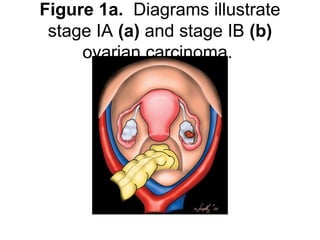
findings of ascites, a pelvic mass and a raised
level of the serum tumour marker CA125.
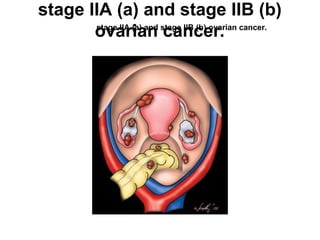
Ovarian cancer is the deadliest
gynecologic malignancy, with
approximately 70% of patients
having peritoneal involvement at
the time of diagnosis. It spreads
predominantly by direct invasion
and intraperitoneal dissemination.
The staging system is surgically
based,
• with stage I disease being limited to one or
both ovaries. In stage II disease, there is
extraovarian spread of tumor, but it does
not extend beyond the pelvis. Stages III
and IV disease are considered advanced,
with stage III ovarian cancer including
diffuse peritoneal disease involving the
upper abdomen and stage IV disease
having distant metastases including
hepatic lesions.
• Common sites of intraperitoneal seeding
include the omentum, paracolic gutters,
liver capsule, and diaphragm. Thickening,
nodularity, and enhancement are all signs
of peritoneal involvement. Although
computed tomography is the most
common imaging modality used to stage
ovarian cancer, magnetic resonance
imaging has been shown to be equally
accurate.
• Currently, however, no imaging modality
allows microscopic spread of disease to
be ruled out, and a full staging laparotomy
is always required. Early ovarian cancer is
treated with comprehensive staging
laparotomy, whereas advanced but
operable disease is treated with primary
cytoreductive surgery (debulking) followed
by adjuvant chemotherapy. Patients with
unresectable disease may benefit from
neoadjuvant (preoperative) chemotherapy
before debulking.
INTRODUCTION
• Ovarian carcinoma is an insidious disease, and
patients often present with an advanced
(extrapelvic) stage of disease. Despite clinical
advances and improved surgical techniques, it
remains the deadliest form of gynecologic
malignancy. Ovarian cancer is the fifth most
common cause of death from cancer in women
after lung, breast, colon, and pancreatic cancer.
In the United States, an estimated 25,400 new
cases and 14,300 deaths have been projected
for 2003 (1).
• Approximately 90% of ovarian cancers
arise from the surface epithelium,
• with the most common histologic types
being serous, mucinous, endometrioid,
clear cell, and undifferentiated tumors
• All these tumors carry the same overall
poor prognosis when they are metastatic.
• There is, however, an important histologic
subgroup of ovarian carcinomas: tumors of
low malignant potential, formerly called
borderline tumors. They are usually either
mucinous or serous tumors and have a
generally good prognosis.
• Granulosa cell tumors, dysgerminomas,
immature teratomas, endodermal sinus
tumors, and metastases constitute the
majority of the remaining malignant
ovarian tumors.
• The pathogenesis of ovarian cancer is
multifactorial. The most significant risk
factor is a family history of the disease in
which a genetic cause is often implicated.
Hereditary causes account for 5%–10% of
the total cases.
• Patients with hereditary ovarian tumors
generally are younger, with most being
premenopausal at presentation.
• Three different hereditary syndromes have
been identified. The most common of
these is the breast-ovarian cancer
syndrome, which has been genetically
linked to mutations in the BRCA1 and
BRCA2 tumor suppressor genes
• The lifetime risk of developing ovarian
cancer for women with this syndrome
ranges from 15% to 30%, although some
reports have indicated that the risk is as
high as 60%
• Two other hereditary syndromes have also
been identified:
• the site-specific ovarian cancer syndrome
and the nonpolyposis colorectal cancer or
Lynch syndrome II.
• The latter syndrome is characterized by
early-onset colorectal carcinoma,
endometrial cancer, upper gastrointestinal
tract cancer, upper urothelial tract cancer,
and ovarian cancer.
• The remaining 90% of ovarian cancer
cases are sporadic and occur in a
predominantly older, postmenopausal
population.
• One theory set forth regarding a possible
cause is “incessant ovulation”
• The hypothesis suggests that ovulation
causes repeated minor trauma and cellular
repair of the surface epithelium, which
predisposes it to neoplasia. This theory is
supported by several epidemiologic
observations.
• Nulliparity, early menarche, and late
menopause are all identified as risk factors
for ovarian cancer. Conversely, multiparity,
late menarche, early menopause, and use
of oral contraceptives (ie, fewer ovulation
cycles) all are associated with reduced
risk.
• This theory may also explain geographic
differences in ovarian cancer rates.
• These rates are greater in more
industrialized countries, where women
tend to have fewer children,
• and lower in less modernized countries
with higher birth rates
• Tumor stage is a major factor in patient
prognosis
• Although the overall 5-year survival rate
improved from 37% in 1974 to 53% in 1998,
there is large variability depending on the tumor
stage at presentation
• The 5-year survival rate is 80% for stage I
disease, 50% for stage II, 30% for stage III, and
a dismal 8% for stage IV Multiple other factors
that affect prognosis have also been identified,
including histologic type, tumor grade, amount of
residual disease after the initial cytoreductive
surgery (debulking), and patient characteristics
(age, performance status)
• The radiologist has an integral role in the
evaluation of ovarian carcinoma, including
detection, mass characterization, and
staging. In this article, we focus on this
latter role of staging. The importance of
accurate staging cannot be
overemphasized.
• Appropriate staging has not only
prognostic implications, but it also directly
affects management, with some patients
benefiting from chemotherapy before
surgical debulking.
• The role of the radiologist is to stage the
disease with a high degree of accuracy by
evaluating tumor location, volume, and
extent. Specifically, factors are sought to
guide subspecialty referral, plan treatment,
and guide patient management. Herein,
we discuss the staging system of ovarian
cancer, including patterns of spread;
histologic variability; the use of imaging in
staging, with emphasis on computed
tomography (CT) and magnetic resonance
(MR) imaging; and treatment.
• What are the common signs and symptoms?
Given the location of the ovaries deep within the pelvis,
most patients with early disease confined to the ovaries
have no symptoms at all. As a result, affected women
typically present when the cancer is at a more advanced
stage, with disseminated disease in the upper abdomen.
The cancer tends to remain and recur in the peritoneal
cavity for the majority of patients, yet malignant pleural
effusion isn't uncommon. While the most common sign of
ovarian cancer is abdominal distension, frequent
symptoms consist of bloating, anorexia, fatigue,
gastrointestinal upset, vague abdominal pain and a
change in bowel function (see Table 2). Since the
presentation is often vague, ovarian cancer can mimic
other problems related to the gastrointestinal or
genitourinary system, which may contribute to a delay in
diagnosis.
• Why is there no accepted screen for ovarian cancer?
The objective of screening for ovarian cancer is to detect
and surgically treat early-stage disease when there is the
highest likelihood of a cure.
• The most widely used serologic marker for EOC is the
cancer antigen 125 (CA-125).
• A serum CA-125 of 35 U/mL is usually accepted as the
upper limit of normal.
• The interest in CA-125 as a screening test is derived
from the fact that about 83% of women with EOC have
an elevated CA-125.5 Increased levels are found in
more than 90% of women with advanced-stage disease,
but only 50% of women with stage I disease.
• Those with mucinous and borderline tumours are also
associated with lower levels of CA-125.6
• CA-125 is most useful when monitoring
the evolution of disease, particularly, in
response to treatment, but it lacks the
specificity and positive predictive value to
be a useful screening tool. The high false-
positive rate is due to elevated levels in
other malignancies (pancreas, breast,
bladder, liver, lung), benign conditions
(diverticulitis, uterine leiomyomas,
endometriosis, benign ovarian cysts, tubo-
ovarian abscess, ectopic pregnancy) and
physiological states (pregnancy,
menstruation).
• Transvaginal ultrasound has also been
studied as a screen for ovarian cancer,
including the role of colour Doppler
imaging.
• The largest cohort study on the use of
ultrasound alone screened over 23,000
women annually, resulting in 95 women
undergoing surgery and the detection of
seven malignant ovarian cancers.7 The
positive predictive value, however, was
only 7.4%.
• To date, studies lack the sensitivity,
specificity and positive predictive value to
recommend CA-125 and ultrasound as
effective screening options for ovarian
cancer.
• There's also no good evidence to suggest
that CA-125 and ultrasound reduce the
mortality rate of ovarian cancer, either in
the general population or among
genetically predisposed women.
• How is a patient diagnosed and staged?
The gold standard for establishing the presence
or absence of ovarian cancer is oophorectomy.
Given clinical suspicion, the diagnosis of EOC is
made at the time that a surgical staging
procedure is performed with histopathological
confirmation. This generally consists of
exploratory laparotomy through a midline
incision, allowing the palpation and visualization
of peritoneal surfaces, followed by bilateral
salpingo-oophorectomy, hysterectomy,
omentectomy, cytology and directed biopsies.
STAGING SYSTEM
• Two staging systems exist: the TNM (tumor,
node, metastasis) system and the more
commonly used, surgically based system put
forth by the International Federation of
Obstetrics and Gynecology (FIGO) (11,12). The
FIGO staging system is shown in Table 1.
Accurate staging necessitates a complete,
thorough staging laparotomy, which includes
hysterectomy with bilateral salpingo-
oophorectomy, pelvic and paraaortic lymph node
biopsies, omentectomy, peritoneal biopsies, and
washings
• Stage I
• In stage I, the tumor is found in one or both of the
ovaries. Stage I is divided into stage IA, stage IB,
and stage IC.
• Stage IA: The tumor is found in a single ovary.
• Stage IB: The tumor is found in both ovaries.
• Stage IC: The tumor is found in one or both
ovaries and one of the following is true:
– abnormal cells are found on the outside surface of one
or both ovaries; or
– the capsule (outer covering) of the tumor has ruptured
(broken open); or
– tumor cells are found in the fluid of the peritoneal
cavity (the body cavity that contains most of the
organs in the abdomen) or in washings of the
peritoneum (tissue lining the peritoneal cavity
Figure 1a. Diagrams illustrate
stage IA (a) and stage IB (b)
ovarian carcinoma.
• Stage II
• In stage II, the tumor is found in one or both ovaries and
has spread into other areas of the pelvis. Stage II is
divided into stage IIA, stage IIB, and stage IIC.
• Stage IIA: The tumor has spread to the uterus and/or the
fallopian tubes (the long slender tubes through which
eggs pass from the ovaries to the uterus).
• Stage IIB: The tumor has spread to other tissue within
the pelvis.
• Stage IIC: The tumor has spread to the uterus and/or
fallopian tubes and/or other tissue within the pelvis and
tumor cells are found in the fluid of the peritoneal cavity
(the body cavity that contains most of the organs in the
abdomen) or in washings of the peritoneum (tissue lining
the peritoneal cavity).
stage IIA (a) and stage IIB (b)
ovarian cancer.
stage IIA (a) and stage IIB (b) ovarian cancer.
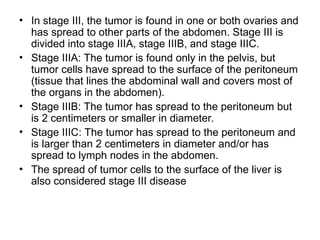
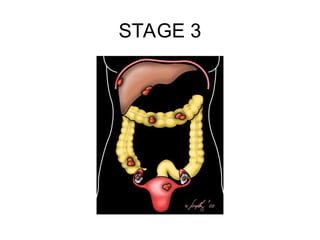
• In stage III, the tumor is found in one or both ovaries and
has spread to other parts of the abdomen. Stage III is
divided into stage IIIA, stage IIIB, and stage IIIC.
• Stage IIIA: The tumor is found only in the pelvis, but
tumor cells have spread to the surface of the peritoneum
(tissue that lines the abdominal wall and covers most of
the organs in the abdomen).
• Stage IIIB: The tumor has spread to the peritoneum but
is 2 centimeters or smaller in diameter.
• Stage IIIC: The tumor has spread to the peritoneum and
is larger than 2 centimeters in diameter and/or has
spread to lymph nodes in the abdomen.
• The spread of tumor cells to the surface of the liver is
also considered stage III disease
STAGE 3
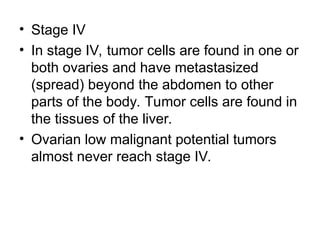
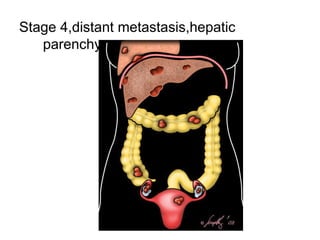
• Stage IV
• In stage IV, tumor cells are found in one or
both ovaries and have metastasized
(spread) beyond the abdomen to other
parts of the body. Tumor cells are found in
the tissues of the liver.
• Ovarian low malignant potential tumors
almost never reach stage IV.
Stage 4,distant metastasis,hepatic
parenchyma
STAGING LAPARATOMY
• washings of the peritoneal cavity
• total abdominal hysterectomy and bilateral salpingo-
oophorectomy
• infracolic omentectomy
• selected lymphadenectomy of the pelvic and para-aortic
lymph nodes
• examination of the diaphragm, right and left abdomen
and pelvis, with biopsy of any suspicious lesions,
masses and appendicectomy for mucinous tumours
• The aim of debulking surgery is to remove all
macroscopic disease: data suggest that this
results in improved survival. Approximately 25%
of women with apparent early EOC will have
more advanced disease if fully staged and this
may explain the higher than expected
recurrence rates in this group. Several clinical
prognostic factors have been identified in early-
stage EOC: these include the tumour grade and
type and the presence of ascites. Women with
stage IA and IB grade 1 tumours have an
excellent prognosis, with a 5-year survival rate of
around 90%. Women with clear cell tumour type,
positive pelvic washings or tumour rupture
during surgery are considered to be at high risk
of recurrence.
Conservative Surgery
• -If an apparent stage IA ovarian carcinoma
is encountered intraoperatively in a young
woman desiring fertility, or in a woman
whose desires are unknown, conservative
surgery may be possible following careful
inspection of the upper abdomen and
retroperitoneum.
• The contralateral ovary should also be
carefully inspected. Unless an obvious
lesion is noted, random biopsies or wedge
resections are not recommended, because
they may compromise future fertility. If, on
gross inspection, there appears to be no
extra-ovarian disease, the surface of the
ovary is smooth without excrescences,
and there are no adhesions between the
mass and the pelvic side walls, then a
unilateral salpingo-oophorectomy with
adequate resection of the ipsilateral
infundibulopelvic ligament .
Laparoscopic Management of
Adnexal Masses-
• -Because of advances in minimally
invasive surgery, laparoscopic
management of ovarian masses has
important considerations in the discussion
of early ovarian cancer. Older series have
documented an adverse effect of tumor
rupture in patients with stage I ovarian
cancer, although these findings have not
been confirmed in more recent series
using more elaborate statistical methods .
• It should be noted that most patients in these
studies received adjuvant therapy after tumor
rupture was documented, and this "adjuvant"
treatment may have negated, in part, the
adverse prognostic effect of tumor spill at the
time of surgery.
• Despite the lack of convincing data suggesting
adverse outcomes in patients with tumor rupture,
adjuvant therapy is often given in cases of
rupture, due to the oncologist's bias or perhaps
the bias written into protocols for early ovarian
carcinoma.
• All this considered, difficult dissections
performed laparoscopically are likely to result in
tumor rupture.
• laparoscopic surgery has a disadvantage in that
the surgeon loses the ability to carefully palpate
and inspect all of the peritoneal surfaces.
Patients of any age group with an elevated CA-
125, or with suspicious findings on ultrasonic
examination (abnormalities within the cyst wall,
septations, or any solid component), should be
managed with exploratory laparotomy, unless
they have consented to an investigational
protocol for evaluating pelvic masses
laparoscopically. It should be apparent to any
clinician that loss of the ability to palpate and
inspect the entire abdominal cavity and
retroperitoneum could significantly compromise
the accuracy of the surgical staging procedure
and be detrimental to the patient's prognosis.
Second-Look Laparotomy
• Previously, operative reexploration was an
integral part of the management of
advanced ovarian carcinoma. Although
this procedure helped physicians decide
whether to discontinue chemotherapy or to
use additional therapeutic regimens, it has
not contributed to improvement in survival.
• Traditionally, second-look laparotomy was
considered for patients with advanced
disease, but several studies have now
evaluated this procedure in patients with
early ovarian cancer .
• Walton and coworkers evaluated the
experience of the Gynecologic Oncology
Group (GOG) in 112 patients who
underwent initial surgical staging and had
FIGO stage I and II ovarian carcinomas
documented histologically.
• Following adjuvant therapy, these patients then
underwent a restaging operation. Of 95 patients
who were asymptomatic prior to their second-
look laparotomy, only 5% had disease confirmed
by second-look laparotomy, as opposed to over
half of 17 patients who were symptomatic prior
to their second-look laparotomy. These data
suggest that for asymptomatic patients with
early-stage disease, in whom initial
comprehensive surgical staging was performed
and followed by adjuvant therapy, routine
second-look surgery will yield positive results in
only a small percentage of patients.
PROGNOSIS
• Prognostic features, such as histologic
grade and cell type, ascites, peritoneal
cytology, and extent of disease, allow
separation of patients with early-stage
ovarian cancer into groups at low and high
risk for relapse. The separation of risk
groups is largely based on the findings of
thorough and comprehensive surgical
staging.

STAGING LAPAROTOMY in recent advances in

  • 1.
    Risk factors forovarian cancer • two or more close relatives, i.e. a mother, sister, or aunt, who've had ovarian and/or breast cancer, particularly if there's: – a breast cancer diagnosis before age 40 – the presence of breast or ovarian cancer in the same woman – bilateral breast cancer – breast cancer in a male relative • family history of malignancy, e.g. ovarian, breast or colon • personal history of cancer, particularly breast, uterine or colon • Ashkenazi Jewish, French Canadian or Icelandic descent • known BRCA1 or BRCA2 mutation
  • 2.
    • gynaecological cancerservices are organised into cancer networks consisting of cancer units and cancer centres. Women with features suggestive of ovarian cancer should be referred to a centre with a gynaecological oncology multidisciplinary team of gynaecological oncologists, medical oncologists, pathologists, radiologists and nurses. • Evidence suggests that such referral is associated with an improved prognosis. In many women with advanced EOC the diagnosis is relatively straightforward and based on the findings of ascites, a pelvic mass and a raised level of the serum tumour marker CA125.
  • 3.
    Ovarian cancer isthe deadliest gynecologic malignancy, with approximately 70% of patients having peritoneal involvement at the time of diagnosis. It spreads predominantly by direct invasion and intraperitoneal dissemination. The staging system is surgically based,
  • 4.
    • with stageI disease being limited to one or both ovaries. In stage II disease, there is extraovarian spread of tumor, but it does not extend beyond the pelvis. Stages III and IV disease are considered advanced, with stage III ovarian cancer including diffuse peritoneal disease involving the upper abdomen and stage IV disease having distant metastases including hepatic lesions.
  • 5.
    • Common sitesof intraperitoneal seeding include the omentum, paracolic gutters, liver capsule, and diaphragm. Thickening, nodularity, and enhancement are all signs of peritoneal involvement. Although computed tomography is the most common imaging modality used to stage ovarian cancer, magnetic resonance imaging has been shown to be equally accurate.
  • 6.
    • Currently, however,no imaging modality allows microscopic spread of disease to be ruled out, and a full staging laparotomy is always required. Early ovarian cancer is treated with comprehensive staging laparotomy, whereas advanced but operable disease is treated with primary cytoreductive surgery (debulking) followed by adjuvant chemotherapy. Patients with unresectable disease may benefit from neoadjuvant (preoperative) chemotherapy before debulking.
  • 7.
    INTRODUCTION • Ovarian carcinomais an insidious disease, and patients often present with an advanced (extrapelvic) stage of disease. Despite clinical advances and improved surgical techniques, it remains the deadliest form of gynecologic malignancy. Ovarian cancer is the fifth most common cause of death from cancer in women after lung, breast, colon, and pancreatic cancer. In the United States, an estimated 25,400 new cases and 14,300 deaths have been projected for 2003 (1).
  • 8.
    • Approximately 90%of ovarian cancers arise from the surface epithelium, • with the most common histologic types being serous, mucinous, endometrioid, clear cell, and undifferentiated tumors • All these tumors carry the same overall poor prognosis when they are metastatic.
  • 9.
    • There is,however, an important histologic subgroup of ovarian carcinomas: tumors of low malignant potential, formerly called borderline tumors. They are usually either mucinous or serous tumors and have a generally good prognosis. • Granulosa cell tumors, dysgerminomas, immature teratomas, endodermal sinus tumors, and metastases constitute the majority of the remaining malignant ovarian tumors.
  • 10.
    • The pathogenesisof ovarian cancer is multifactorial. The most significant risk factor is a family history of the disease in which a genetic cause is often implicated. Hereditary causes account for 5%–10% of the total cases. • Patients with hereditary ovarian tumors generally are younger, with most being premenopausal at presentation.
  • 11.
    • Three differenthereditary syndromes have been identified. The most common of these is the breast-ovarian cancer syndrome, which has been genetically linked to mutations in the BRCA1 and BRCA2 tumor suppressor genes • The lifetime risk of developing ovarian cancer for women with this syndrome ranges from 15% to 30%, although some reports have indicated that the risk is as high as 60%
  • 12.
    • Two otherhereditary syndromes have also been identified: • the site-specific ovarian cancer syndrome and the nonpolyposis colorectal cancer or Lynch syndrome II. • The latter syndrome is characterized by early-onset colorectal carcinoma, endometrial cancer, upper gastrointestinal tract cancer, upper urothelial tract cancer, and ovarian cancer.
  • 13.
    • The remaining90% of ovarian cancer cases are sporadic and occur in a predominantly older, postmenopausal population. • One theory set forth regarding a possible cause is “incessant ovulation”
  • 14.
    • The hypothesissuggests that ovulation causes repeated minor trauma and cellular repair of the surface epithelium, which predisposes it to neoplasia. This theory is supported by several epidemiologic observations. • Nulliparity, early menarche, and late menopause are all identified as risk factors for ovarian cancer. Conversely, multiparity, late menarche, early menopause, and use of oral contraceptives (ie, fewer ovulation cycles) all are associated with reduced risk.
  • 15.
    • This theorymay also explain geographic differences in ovarian cancer rates. • These rates are greater in more industrialized countries, where women tend to have fewer children, • and lower in less modernized countries with higher birth rates
  • 16.
    • Tumor stageis a major factor in patient prognosis • Although the overall 5-year survival rate improved from 37% in 1974 to 53% in 1998, there is large variability depending on the tumor stage at presentation • The 5-year survival rate is 80% for stage I disease, 50% for stage II, 30% for stage III, and a dismal 8% for stage IV Multiple other factors that affect prognosis have also been identified, including histologic type, tumor grade, amount of residual disease after the initial cytoreductive surgery (debulking), and patient characteristics (age, performance status)
  • 17.
    • The radiologisthas an integral role in the evaluation of ovarian carcinoma, including detection, mass characterization, and staging. In this article, we focus on this latter role of staging. The importance of accurate staging cannot be overemphasized. • Appropriate staging has not only prognostic implications, but it also directly affects management, with some patients benefiting from chemotherapy before surgical debulking.
  • 18.
    • The roleof the radiologist is to stage the disease with a high degree of accuracy by evaluating tumor location, volume, and extent. Specifically, factors are sought to guide subspecialty referral, plan treatment, and guide patient management. Herein, we discuss the staging system of ovarian cancer, including patterns of spread; histologic variability; the use of imaging in staging, with emphasis on computed tomography (CT) and magnetic resonance (MR) imaging; and treatment.
  • 19.
    • What arethe common signs and symptoms? Given the location of the ovaries deep within the pelvis, most patients with early disease confined to the ovaries have no symptoms at all. As a result, affected women typically present when the cancer is at a more advanced stage, with disseminated disease in the upper abdomen. The cancer tends to remain and recur in the peritoneal cavity for the majority of patients, yet malignant pleural effusion isn't uncommon. While the most common sign of ovarian cancer is abdominal distension, frequent symptoms consist of bloating, anorexia, fatigue, gastrointestinal upset, vague abdominal pain and a change in bowel function (see Table 2). Since the presentation is often vague, ovarian cancer can mimic other problems related to the gastrointestinal or genitourinary system, which may contribute to a delay in diagnosis.
  • 20.
    • Why isthere no accepted screen for ovarian cancer? The objective of screening for ovarian cancer is to detect and surgically treat early-stage disease when there is the highest likelihood of a cure. • The most widely used serologic marker for EOC is the cancer antigen 125 (CA-125). • A serum CA-125 of 35 U/mL is usually accepted as the upper limit of normal. • The interest in CA-125 as a screening test is derived from the fact that about 83% of women with EOC have an elevated CA-125.5 Increased levels are found in more than 90% of women with advanced-stage disease, but only 50% of women with stage I disease. • Those with mucinous and borderline tumours are also associated with lower levels of CA-125.6
  • 21.
    • CA-125 ismost useful when monitoring the evolution of disease, particularly, in response to treatment, but it lacks the specificity and positive predictive value to be a useful screening tool. The high false- positive rate is due to elevated levels in other malignancies (pancreas, breast, bladder, liver, lung), benign conditions (diverticulitis, uterine leiomyomas, endometriosis, benign ovarian cysts, tubo- ovarian abscess, ectopic pregnancy) and physiological states (pregnancy, menstruation).
  • 22.
    • Transvaginal ultrasoundhas also been studied as a screen for ovarian cancer, including the role of colour Doppler imaging. • The largest cohort study on the use of ultrasound alone screened over 23,000 women annually, resulting in 95 women undergoing surgery and the detection of seven malignant ovarian cancers.7 The positive predictive value, however, was only 7.4%.
  • 23.
    • To date,studies lack the sensitivity, specificity and positive predictive value to recommend CA-125 and ultrasound as effective screening options for ovarian cancer. • There's also no good evidence to suggest that CA-125 and ultrasound reduce the mortality rate of ovarian cancer, either in the general population or among genetically predisposed women.
  • 24.
    • How isa patient diagnosed and staged? The gold standard for establishing the presence or absence of ovarian cancer is oophorectomy. Given clinical suspicion, the diagnosis of EOC is made at the time that a surgical staging procedure is performed with histopathological confirmation. This generally consists of exploratory laparotomy through a midline incision, allowing the palpation and visualization of peritoneal surfaces, followed by bilateral salpingo-oophorectomy, hysterectomy, omentectomy, cytology and directed biopsies.
  • 25.
    STAGING SYSTEM • Twostaging systems exist: the TNM (tumor, node, metastasis) system and the more commonly used, surgically based system put forth by the International Federation of Obstetrics and Gynecology (FIGO) (11,12). The FIGO staging system is shown in Table 1. Accurate staging necessitates a complete, thorough staging laparotomy, which includes hysterectomy with bilateral salpingo- oophorectomy, pelvic and paraaortic lymph node biopsies, omentectomy, peritoneal biopsies, and washings
  • 26.
    • Stage I •In stage I, the tumor is found in one or both of the ovaries. Stage I is divided into stage IA, stage IB, and stage IC. • Stage IA: The tumor is found in a single ovary. • Stage IB: The tumor is found in both ovaries. • Stage IC: The tumor is found in one or both ovaries and one of the following is true: – abnormal cells are found on the outside surface of one or both ovaries; or – the capsule (outer covering) of the tumor has ruptured (broken open); or – tumor cells are found in the fluid of the peritoneal cavity (the body cavity that contains most of the organs in the abdomen) or in washings of the peritoneum (tissue lining the peritoneal cavity
  • 27.
    Figure 1a. Diagramsillustrate stage IA (a) and stage IB (b) ovarian carcinoma.
  • 28.
    • Stage II •In stage II, the tumor is found in one or both ovaries and has spread into other areas of the pelvis. Stage II is divided into stage IIA, stage IIB, and stage IIC. • Stage IIA: The tumor has spread to the uterus and/or the fallopian tubes (the long slender tubes through which eggs pass from the ovaries to the uterus). • Stage IIB: The tumor has spread to other tissue within the pelvis. • Stage IIC: The tumor has spread to the uterus and/or fallopian tubes and/or other tissue within the pelvis and tumor cells are found in the fluid of the peritoneal cavity (the body cavity that contains most of the organs in the abdomen) or in washings of the peritoneum (tissue lining the peritoneal cavity).
  • 29.
    stage IIA (a)and stage IIB (b) ovarian cancer. stage IIA (a) and stage IIB (b) ovarian cancer.
  • 30.
    • In stageIII, the tumor is found in one or both ovaries and has spread to other parts of the abdomen. Stage III is divided into stage IIIA, stage IIIB, and stage IIIC. • Stage IIIA: The tumor is found only in the pelvis, but tumor cells have spread to the surface of the peritoneum (tissue that lines the abdominal wall and covers most of the organs in the abdomen). • Stage IIIB: The tumor has spread to the peritoneum but is 2 centimeters or smaller in diameter. • Stage IIIC: The tumor has spread to the peritoneum and is larger than 2 centimeters in diameter and/or has spread to lymph nodes in the abdomen. • The spread of tumor cells to the surface of the liver is also considered stage III disease
  • 31.
  • 32.
    • Stage IV •In stage IV, tumor cells are found in one or both ovaries and have metastasized (spread) beyond the abdomen to other parts of the body. Tumor cells are found in the tissues of the liver. • Ovarian low malignant potential tumors almost never reach stage IV.
  • 33.
  • 34.
    STAGING LAPARATOMY • washingsof the peritoneal cavity • total abdominal hysterectomy and bilateral salpingo- oophorectomy • infracolic omentectomy • selected lymphadenectomy of the pelvic and para-aortic lymph nodes • examination of the diaphragm, right and left abdomen and pelvis, with biopsy of any suspicious lesions, masses and appendicectomy for mucinous tumours
  • 35.
    • The aimof debulking surgery is to remove all macroscopic disease: data suggest that this results in improved survival. Approximately 25% of women with apparent early EOC will have more advanced disease if fully staged and this may explain the higher than expected recurrence rates in this group. Several clinical prognostic factors have been identified in early- stage EOC: these include the tumour grade and type and the presence of ascites. Women with stage IA and IB grade 1 tumours have an excellent prognosis, with a 5-year survival rate of around 90%. Women with clear cell tumour type, positive pelvic washings or tumour rupture during surgery are considered to be at high risk of recurrence.
  • 36.
    Conservative Surgery • -Ifan apparent stage IA ovarian carcinoma is encountered intraoperatively in a young woman desiring fertility, or in a woman whose desires are unknown, conservative surgery may be possible following careful inspection of the upper abdomen and retroperitoneum.
  • 37.
    • The contralateralovary should also be carefully inspected. Unless an obvious lesion is noted, random biopsies or wedge resections are not recommended, because they may compromise future fertility. If, on gross inspection, there appears to be no extra-ovarian disease, the surface of the ovary is smooth without excrescences, and there are no adhesions between the mass and the pelvic side walls, then a unilateral salpingo-oophorectomy with adequate resection of the ipsilateral infundibulopelvic ligament .
  • 38.
    Laparoscopic Management of AdnexalMasses- • -Because of advances in minimally invasive surgery, laparoscopic management of ovarian masses has important considerations in the discussion of early ovarian cancer. Older series have documented an adverse effect of tumor rupture in patients with stage I ovarian cancer, although these findings have not been confirmed in more recent series using more elaborate statistical methods .
  • 39.
    • It shouldbe noted that most patients in these studies received adjuvant therapy after tumor rupture was documented, and this "adjuvant" treatment may have negated, in part, the adverse prognostic effect of tumor spill at the time of surgery. • Despite the lack of convincing data suggesting adverse outcomes in patients with tumor rupture, adjuvant therapy is often given in cases of rupture, due to the oncologist's bias or perhaps the bias written into protocols for early ovarian carcinoma. • All this considered, difficult dissections performed laparoscopically are likely to result in tumor rupture.
  • 40.
    • laparoscopic surgeryhas a disadvantage in that the surgeon loses the ability to carefully palpate and inspect all of the peritoneal surfaces. Patients of any age group with an elevated CA- 125, or with suspicious findings on ultrasonic examination (abnormalities within the cyst wall, septations, or any solid component), should be managed with exploratory laparotomy, unless they have consented to an investigational protocol for evaluating pelvic masses laparoscopically. It should be apparent to any clinician that loss of the ability to palpate and inspect the entire abdominal cavity and retroperitoneum could significantly compromise the accuracy of the surgical staging procedure and be detrimental to the patient's prognosis.
  • 41.
    Second-Look Laparotomy • Previously,operative reexploration was an integral part of the management of advanced ovarian carcinoma. Although this procedure helped physicians decide whether to discontinue chemotherapy or to use additional therapeutic regimens, it has not contributed to improvement in survival.
  • 42.
    • Traditionally, second-looklaparotomy was considered for patients with advanced disease, but several studies have now evaluated this procedure in patients with early ovarian cancer . • Walton and coworkers evaluated the experience of the Gynecologic Oncology Group (GOG) in 112 patients who underwent initial surgical staging and had FIGO stage I and II ovarian carcinomas documented histologically.
  • 43.
    • Following adjuvanttherapy, these patients then underwent a restaging operation. Of 95 patients who were asymptomatic prior to their second- look laparotomy, only 5% had disease confirmed by second-look laparotomy, as opposed to over half of 17 patients who were symptomatic prior to their second-look laparotomy. These data suggest that for asymptomatic patients with early-stage disease, in whom initial comprehensive surgical staging was performed and followed by adjuvant therapy, routine second-look surgery will yield positive results in only a small percentage of patients.
  • 44.
    PROGNOSIS • Prognostic features,such as histologic grade and cell type, ascites, peritoneal cytology, and extent of disease, allow separation of patients with early-stage ovarian cancer into groups at low and high risk for relapse. The separation of risk groups is largely based on the findings of thorough and comprehensive surgical staging.