JOURNAL
PRESENTATION
ABHIJIT DAS
2nd year PGT
DEPT. OF RADIOTHERAPY
AHRCC
These guidelines were approved by the FIGO Executive
Board in October 2012.
INTRODUCTION
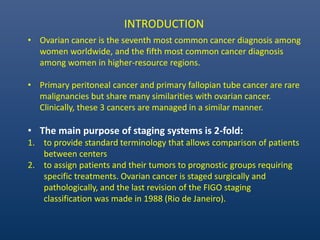
• Ovarian cancer is the seventh most common cancer diagnosis among
women worldwide, and the fifth most common cancer diagnosis
among women in higher-resource regions.
• Primary peritoneal cancer and primary fallopian tube cancer are rare
malignancies but share many similarities with ovarian cancer.
Clinically, these 3 cancers are managed in a similar manner.
• The main purpose of staging systems is 2-fold:
1. to provide standard terminology that allows comparison of patients
between centers
2. to assign patients and their tumors to prognostic groups requiring
specific treatments. Ovarian cancer is staged surgically and
pathologically, and the last revision of the FIGO staging
classification was made in 1988 (Rio de Janeiro).
1. Ovarian cancer is not a homogeneous disease, but rather a group of
diseases—each with different morphology and biological behavior.
2. In the era of personalized cancer medicine, reproducible histopathologic
diagnosis of tumor cell type is a sine qua non for successful treatment. As
different tumor histotypes respond differently to chemotherapy.
Ovarian cancers differ primarily based on histologic type: 5 main types
a) high-grade serous carcinoma (HGSC [70%]);
b) endometrioid carcinoma (EC [10%]);
c) clear-cell carcinoma (CCC [10%]);
d) mucinous carcinoma(MC [3%]);
e) low-grade serous carcinoma (LGSC [b5%])
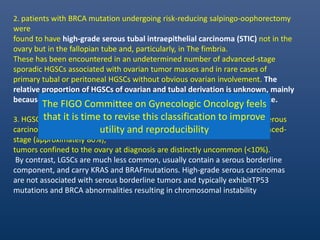
2. patients with BRCA mutation undergoing risk-reducing salpingo-oophorectomy
were
found to have high-grade serous tubal intraepithelial carcinoma (STIC) not in the
ovary but in the fallopian tube and, particularly, in The fimbria.
These has been encountered in an undetermined number of advanced-stage
sporadic HGSCs associated with ovarian tumor masses and in rare cases of
primary tubal or peritoneal HGSCs without obvious ovarian involvement. The
relative proportion of HGSCs of ovarian and tubal derivation is unknown, mainly
because tumor growth in advanced stage cancers conceals the primary site.
3. HGSCs and LGSCs are fundamentally different tumor types. High-grade serous
carcinomas are the most common ovarian carcinomas presened with advanced-
stage (approximately 80%);
tumors confined to the ovary at diagnosis are distinctly uncommon (<10%).
By contrast, LGSCs are much less common, usually contain a serous borderline
component, and carry KRAS and BRAFmutations. High-grade serous carcinomas
are not associated with serous borderline tumors and typically exhibitTP53
mutations and BRCA abnormalities resulting in chromosomal instability
The FIGO Committee on Gynecologic Oncology feels
that it is time to revise this classification to improve
utility and reproducibility
The process of the proposed
changes to the staging of
ovarian, fallopian tube, and
primary peritoneal cancer under
the leadership of the Chair of the
FIGO Committee on Gynecologic
Oncology, Professor Lynette
Denny.
The proposal sent to all relevant gynecologic
oncology organizations
the Gynecology Cancer Intergroup; the
International Gynecologic Cancer Society;
the European Organization for Research and
Treatment of Cancer; the American Society
of Gynecologic Oncology; the European
Society of Gynecologic Oncology; the
National Cancer Research Network, UK; the
Australian Society of Gynaecological
Oncology; the Korean Society of Gynecologic
Oncology; and the Japanese Society of
Obstetrics and Gynecology
The new staging was reached by consensus of those participating in the FIGO meeting
held in Rome, Italy, on October 7, 2012, some of whom were representatives of their
organizations.
The new staging was presented to the FIGO Executive Board on October 12, 2012,
and approved 2 weeks later.
PROCEDURE
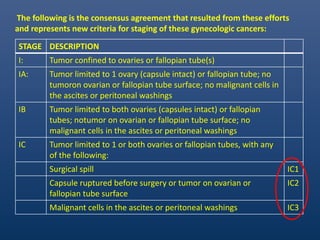
STAGE DESCRIPTION
I: Tumor confined to ovaries or fallopian tube(s)
IA: Tumor limited to 1 ovary (capsule intact) or fallopian tube; no
tumoron ovarian or fallopian tube surface; no malignant cells in
the ascites or peritoneal washings
IB Tumor limited to both ovaries (capsules intact) or fallopian
tubes; notumor on ovarian or fallopian tube surface; no
malignant cells in the ascites or peritoneal washings
IC Tumor limited to 1 or both ovaries or fallopian tubes, with any
of the following:
Surgical spill IC1
Capsule ruptured before surgery or tumor on ovarian or
fallopian tube surface
IC2
Malignant cells in the ascites or peritoneal washings IC3
The following is the consensus agreement that resulted from these efforts
and represents new criteria for staging of these gynecologic cancers:
Controversial issues
Bilateral involvement
(stage IB).
Independent
contralateral primary
tumor vs. implants or
metastases
Stage IB is relatively uncommon, (1%–5% of stage I Cases).
Occasionally, a large stage IB ovarian tumor is associated with
a contralateral normal-size ovary exhibiting small and
superficial foci of tumor, suggesting that the latter are
metastatic. Among stage I tumors with bilateral involvement,
one-third have this appearance.
What constitutes
ovarian surface
involvement?
Excrescences?
Microscopic
involvement?
Surface involvement of the ovary or fallopian tube should be
considered present only when tumor cells are exposed to the
peritonea cavity. It is characterized by exophytic papillary
tumor on the surface of the ovary or fallopian tube or on the
outer surface of a cystic neoplasm replacing these organs
Dense adhesions
often cause rupture
during surgery.
Should these cases
be considered stage
II?
Limited evidence suggests that dense adhesions of an
apparent stage I tumor requiring sharp dissection (or when
dissection results in tumor rupture) result in outcomes
equivalent to tumors in stage II. At present, however, it is not
clear whether upstaging based on dense adhesions is
warranted. A recent study suggests that it is not.
Does rupture during
surgery worsen
prognosis in the absence
of excrescences,
ascites, or positive
washings?
Rupture should be avoided during primary surgery of
malignant ovarian tumors confined to the ovaries. This is
controversial. Whereas some studies found that
Intraoperative capsule rupture portends a higher risk of
disease recurrence others did not. stage I CCC is more
frequently stage IC compared with other cell types ,
possibly because of an increased risk of rupture
Are positive washings
worse than/the same as
capsule rupture.
In multivariable analysis these remained independent
predictors of worse DFS.
Does histologic grade
influence prognosis of
stage I tumors?
Currently, grade 3 ECs are considered to be the same as
HGSCs. Most MCs involving the ovary are metastatic from
the gastrointestinal tract and some might appear well
differentiated (G1)
degree of differentiation as the most powerful prognostic
indicator of disease-free survival
Recommendations:
• Histologic type, which in most cases includes grade, should be
recorded.
• All individual subsets of stage IC disease should be recorded.
• Dense adhesions with histologically proven tumor cells justify
upgrading to stage II.
• If rupture is noted, peritoneal washing and cytology study are indicated
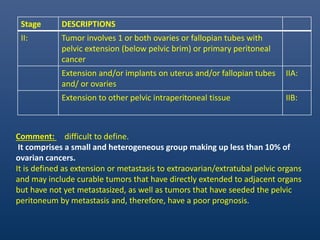
Stage DESCRIPTIONS
II: Tumor involves 1 or both ovaries or fallopian tubes with
pelvic extension (below pelvic brim) or primary peritoneal
cancer
Extension and/or implants on uterus and/or fallopian tubes
and/ or ovaries
IIA:
Extension to other pelvic intraperitoneal tissue IIB:
Comment: difficult to define.
It comprises a small and heterogeneous group making up less than 10% of
ovarian cancers.
It is defined as extension or metastasis to extraovarian/extratubal pelvic organs
and may include curable tumors that have directly extended to adjacent organs
but have not yet metastasized, as well as tumors that have seeded the pelvic
peritoneum by metastasis and, therefore, have a poor prognosis.
• The sigmoid colon is within the pelvis, and therefore sigmoid
involvement only is considered stage II.
• Subdividing this small category further into iib1 and iib2 (i.E.
Microscopic and macroscopic pelvic peritoneal metastases)
was not based on evidence/biology.
• All stage ii disease is treated with adjuvant chemotherapy, so
subclassification is not essential.
• The old substage iic (i.E. IIA or IIB but with tumor on surface,
capsule ruptured, or ascites or positive peritoneal washing)
was considered redundant and eliminated
Is it biologically
justified to separate
the pelvic from the
extrapelvic
peritoneum?
Is disease outside
the ovary but
below the pelvic
brim so much
better that it
warrants a separate
stage
Biologically, this is stage III disease and it is only because of
the anatomic location in the pelvis that it is designated stage
II.
Some investigators claim that the peritoneum is an anatomic
unit and that pelvic involvement and extrapelvic involvement
are prognostically similar. Thus, they suggest defining as stage
III all cases with peritoneal involvement including uterine serosa
(as is done for stage IIIA endometrial carcinoma of the uterus).
Most Committee members felt that there was a clear division of
stage II and III disease in terms of survival, and therefore the
subdivision of IIA and IIB remains
Recommendations:
• To separate direct extension from metastases.
• To compare outcome of stage II and early stage III cases.
Stage
III
: Tumor involves 1 or both ovaries or fallopian tubes, or
primary peritoneal cancer, with cytologically or histologically
confirmed spread to the peritoneum outside the pelvis and/or
metastasis to the retroperitoneal lymph nodes.
Positive retroperitoneal lymph nodes only (cytologically or
histologically proven):
IIIA1(i) Metastasis up to 10 mm in greatest dimension
IIIA1(ii) Metastasis more than 10 mm in greatest dimension
IIIA
1:
Microscopic extrapelvic (above the pelvic brim) peritoneal
involvement with or without positive retroperitoneal lymph
nodes
IIIA
2:
Macroscopic peritoneal metastasis beyond the pelvis up to 2 cm
in greatest dimension, with or without metastasis to the
retroperitoneal lymph nodes
IIIB:
Macroscopic peritoneal metastasis beyond the pelvis more than
2 cm in greatest dimension, with or without metastasis to the
retroperitoneal lymph nodes (includes extension of tumor to
capsule of liver and spleen without parenchymal involvement of
either organ)
IIIC:
Could some carcinomas that
have extended beyond the
pelvis with exclusively
retroperitoneal lymph node
involvement (stage IIIA1)
represent independent LGSCs
arising in retroperitoneal
lymph nodes from
endosalpingiosis?
Serous borderline tumors and LGSCs may develop in
retroperitoneal and cervical lymph nodes from
endosalpingiosis, often in association
with serous borderline tumors of the ovary and with
favorable prognosis.
In none of the reported case series was a
histopathologic distinction made between HGSC and
LGSC
Should the new stage IIIA1 be
limited to involvement of the
retroperitoneal lymph nodes
below the diaphragm?
It was suggested that upward nodal involvement (e.g.
mediastinal nodes) should be included but, for now,
the Committee felt that the stated limitation was
appropriate
Is the 2-cm cutoff between
IIIB and IIIC justified?
Regarding the amount of peritoneal involvement, it
was claimed that stage III tumors should be divided
into microscopic and macroscopic, and
if the latter measurement (in centimeters) should be
given. Further distinction should be made between
single small lesions within the omentum (<2 cm) and
diffuse peritoneal disease including the upper
abdomen and diaphragm
Specific mention :
bowel infiltration (transmural with mucosal involvement) and
umbilical deposit(currently IVB);
• some consider that involvement of the umbilicus should be IIIC rather
than IV as it represents peritoneal extension into the urachal remnant.
• isolated parenchymal liver metastasis and splenic parenchymal metastasis
are susceptible to cytoreductive surgery and, according to some
investigators, should be IIIC, although this was not adopted by the
Committee (i.e. transmural bowel infiltration, umbilical deposit, and
parenchymal metastases in the liver and spleen or elsewhere such as lung
and bone are assigned to stage IVB)
Recommendations:
• To classify IIIA1 cases histologically.
• To compare outcome of stage IIIA1(i) and IIIA1(ii) cases.
• To compare outcome of stage IIIA1 and IIIA2 cases.
Stage IV: Distant metastasis excluding peritoneal
metastases
Stage IVA: Pleural effusion with positive cytology
Stage IVB: Parenchymal metastases and metastases to
extra-abdominal organs (including inguinal
lymph nodes and lymph nodes outside of the
abdominal cavity)
Controversial issues to be resolved in the future
Should macroscopic and positive lymph nodes above
the renal vessels be considered stage III or IV?
TO TAKE NOTE OF THESE:
• The primary site should be designated where possible. If it is not be possible
to delineate the primary site clearly; such cases should be listed as “undesignated.”
• The histologic type should be recorded.
• Assignment to stage IIIA1 is based on spread to the retroperitoneal lymph nodes
without intraperitoneal dissemination because an analysis of these patients
indicates that their survival is significantly better than that of patients with
intraperitoneal dissemination.
• Involvement of retroperitoneal lymph nodes must be proven cytologically or
histologically.
• Extension of tumor from omentum to spleen or liver (stage IIIC) should be
differentiated from isolated parenchymal metastases (stage IVB).
Recommendation for future consideration:
• Splenectomy seems to take care of isolated metastases in a better way
than partial hepatectomy. In future, isolated splenic metastasis may be considered stage
IIIC rather than stage IV, whereas parenchymal liver metastasis would remain stage IVB
Thank
you

figo ovary staging update

  • 1.
    JOURNAL PRESENTATION ABHIJIT DAS 2nd yearPGT DEPT. OF RADIOTHERAPY AHRCC
  • 2.
    These guidelines wereapproved by the FIGO Executive Board in October 2012.
  • 3.
    INTRODUCTION • Ovarian canceris the seventh most common cancer diagnosis among women worldwide, and the fifth most common cancer diagnosis among women in higher-resource regions. • Primary peritoneal cancer and primary fallopian tube cancer are rare malignancies but share many similarities with ovarian cancer. Clinically, these 3 cancers are managed in a similar manner. • The main purpose of staging systems is 2-fold: 1. to provide standard terminology that allows comparison of patients between centers 2. to assign patients and their tumors to prognostic groups requiring specific treatments. Ovarian cancer is staged surgically and pathologically, and the last revision of the FIGO staging classification was made in 1988 (Rio de Janeiro).
  • 4.
    1. Ovarian canceris not a homogeneous disease, but rather a group of diseases—each with different morphology and biological behavior. 2. In the era of personalized cancer medicine, reproducible histopathologic diagnosis of tumor cell type is a sine qua non for successful treatment. As different tumor histotypes respond differently to chemotherapy. Ovarian cancers differ primarily based on histologic type: 5 main types a) high-grade serous carcinoma (HGSC [70%]); b) endometrioid carcinoma (EC [10%]); c) clear-cell carcinoma (CCC [10%]); d) mucinous carcinoma(MC [3%]); e) low-grade serous carcinoma (LGSC [b5%])
  • 5.
    2. patients withBRCA mutation undergoing risk-reducing salpingo-oophorectomy were found to have high-grade serous tubal intraepithelial carcinoma (STIC) not in the ovary but in the fallopian tube and, particularly, in The fimbria. These has been encountered in an undetermined number of advanced-stage sporadic HGSCs associated with ovarian tumor masses and in rare cases of primary tubal or peritoneal HGSCs without obvious ovarian involvement. The relative proportion of HGSCs of ovarian and tubal derivation is unknown, mainly because tumor growth in advanced stage cancers conceals the primary site. 3. HGSCs and LGSCs are fundamentally different tumor types. High-grade serous carcinomas are the most common ovarian carcinomas presened with advanced- stage (approximately 80%); tumors confined to the ovary at diagnosis are distinctly uncommon (<10%). By contrast, LGSCs are much less common, usually contain a serous borderline component, and carry KRAS and BRAFmutations. High-grade serous carcinomas are not associated with serous borderline tumors and typically exhibitTP53 mutations and BRCA abnormalities resulting in chromosomal instability The FIGO Committee on Gynecologic Oncology feels that it is time to revise this classification to improve utility and reproducibility
  • 6.
    The process ofthe proposed changes to the staging of ovarian, fallopian tube, and primary peritoneal cancer under the leadership of the Chair of the FIGO Committee on Gynecologic Oncology, Professor Lynette Denny. The proposal sent to all relevant gynecologic oncology organizations the Gynecology Cancer Intergroup; the International Gynecologic Cancer Society; the European Organization for Research and Treatment of Cancer; the American Society of Gynecologic Oncology; the European Society of Gynecologic Oncology; the National Cancer Research Network, UK; the Australian Society of Gynaecological Oncology; the Korean Society of Gynecologic Oncology; and the Japanese Society of Obstetrics and Gynecology The new staging was reached by consensus of those participating in the FIGO meeting held in Rome, Italy, on October 7, 2012, some of whom were representatives of their organizations. The new staging was presented to the FIGO Executive Board on October 12, 2012, and approved 2 weeks later. PROCEDURE
  • 7.
    STAGE DESCRIPTION I: Tumorconfined to ovaries or fallopian tube(s) IA: Tumor limited to 1 ovary (capsule intact) or fallopian tube; no tumoron ovarian or fallopian tube surface; no malignant cells in the ascites or peritoneal washings IB Tumor limited to both ovaries (capsules intact) or fallopian tubes; notumor on ovarian or fallopian tube surface; no malignant cells in the ascites or peritoneal washings IC Tumor limited to 1 or both ovaries or fallopian tubes, with any of the following: Surgical spill IC1 Capsule ruptured before surgery or tumor on ovarian or fallopian tube surface IC2 Malignant cells in the ascites or peritoneal washings IC3 The following is the consensus agreement that resulted from these efforts and represents new criteria for staging of these gynecologic cancers:
  • 8.
    Controversial issues Bilateral involvement (stageIB). Independent contralateral primary tumor vs. implants or metastases Stage IB is relatively uncommon, (1%–5% of stage I Cases). Occasionally, a large stage IB ovarian tumor is associated with a contralateral normal-size ovary exhibiting small and superficial foci of tumor, suggesting that the latter are metastatic. Among stage I tumors with bilateral involvement, one-third have this appearance. What constitutes ovarian surface involvement? Excrescences? Microscopic involvement? Surface involvement of the ovary or fallopian tube should be considered present only when tumor cells are exposed to the peritonea cavity. It is characterized by exophytic papillary tumor on the surface of the ovary or fallopian tube or on the outer surface of a cystic neoplasm replacing these organs Dense adhesions often cause rupture during surgery. Should these cases be considered stage II? Limited evidence suggests that dense adhesions of an apparent stage I tumor requiring sharp dissection (or when dissection results in tumor rupture) result in outcomes equivalent to tumors in stage II. At present, however, it is not clear whether upstaging based on dense adhesions is warranted. A recent study suggests that it is not.
  • 9.
    Does rupture during surgeryworsen prognosis in the absence of excrescences, ascites, or positive washings? Rupture should be avoided during primary surgery of malignant ovarian tumors confined to the ovaries. This is controversial. Whereas some studies found that Intraoperative capsule rupture portends a higher risk of disease recurrence others did not. stage I CCC is more frequently stage IC compared with other cell types , possibly because of an increased risk of rupture Are positive washings worse than/the same as capsule rupture. In multivariable analysis these remained independent predictors of worse DFS. Does histologic grade influence prognosis of stage I tumors? Currently, grade 3 ECs are considered to be the same as HGSCs. Most MCs involving the ovary are metastatic from the gastrointestinal tract and some might appear well differentiated (G1) degree of differentiation as the most powerful prognostic indicator of disease-free survival
  • 10.
    Recommendations: • Histologic type,which in most cases includes grade, should be recorded. • All individual subsets of stage IC disease should be recorded. • Dense adhesions with histologically proven tumor cells justify upgrading to stage II. • If rupture is noted, peritoneal washing and cytology study are indicated
  • 11.
    Stage DESCRIPTIONS II: Tumorinvolves 1 or both ovaries or fallopian tubes with pelvic extension (below pelvic brim) or primary peritoneal cancer Extension and/or implants on uterus and/or fallopian tubes and/ or ovaries IIA: Extension to other pelvic intraperitoneal tissue IIB: Comment: difficult to define. It comprises a small and heterogeneous group making up less than 10% of ovarian cancers. It is defined as extension or metastasis to extraovarian/extratubal pelvic organs and may include curable tumors that have directly extended to adjacent organs but have not yet metastasized, as well as tumors that have seeded the pelvic peritoneum by metastasis and, therefore, have a poor prognosis.
  • 12.
    • The sigmoidcolon is within the pelvis, and therefore sigmoid involvement only is considered stage II. • Subdividing this small category further into iib1 and iib2 (i.E. Microscopic and macroscopic pelvic peritoneal metastases) was not based on evidence/biology. • All stage ii disease is treated with adjuvant chemotherapy, so subclassification is not essential. • The old substage iic (i.E. IIA or IIB but with tumor on surface, capsule ruptured, or ascites or positive peritoneal washing) was considered redundant and eliminated
  • 13.
    Is it biologically justifiedto separate the pelvic from the extrapelvic peritoneum? Is disease outside the ovary but below the pelvic brim so much better that it warrants a separate stage Biologically, this is stage III disease and it is only because of the anatomic location in the pelvis that it is designated stage II. Some investigators claim that the peritoneum is an anatomic unit and that pelvic involvement and extrapelvic involvement are prognostically similar. Thus, they suggest defining as stage III all cases with peritoneal involvement including uterine serosa (as is done for stage IIIA endometrial carcinoma of the uterus). Most Committee members felt that there was a clear division of stage II and III disease in terms of survival, and therefore the subdivision of IIA and IIB remains Recommendations: • To separate direct extension from metastases. • To compare outcome of stage II and early stage III cases.
  • 14.
    Stage III : Tumor involves1 or both ovaries or fallopian tubes, or primary peritoneal cancer, with cytologically or histologically confirmed spread to the peritoneum outside the pelvis and/or metastasis to the retroperitoneal lymph nodes. Positive retroperitoneal lymph nodes only (cytologically or histologically proven): IIIA1(i) Metastasis up to 10 mm in greatest dimension IIIA1(ii) Metastasis more than 10 mm in greatest dimension IIIA 1: Microscopic extrapelvic (above the pelvic brim) peritoneal involvement with or without positive retroperitoneal lymph nodes IIIA 2: Macroscopic peritoneal metastasis beyond the pelvis up to 2 cm in greatest dimension, with or without metastasis to the retroperitoneal lymph nodes IIIB: Macroscopic peritoneal metastasis beyond the pelvis more than 2 cm in greatest dimension, with or without metastasis to the retroperitoneal lymph nodes (includes extension of tumor to capsule of liver and spleen without parenchymal involvement of either organ) IIIC:
  • 15.
    Could some carcinomasthat have extended beyond the pelvis with exclusively retroperitoneal lymph node involvement (stage IIIA1) represent independent LGSCs arising in retroperitoneal lymph nodes from endosalpingiosis? Serous borderline tumors and LGSCs may develop in retroperitoneal and cervical lymph nodes from endosalpingiosis, often in association with serous borderline tumors of the ovary and with favorable prognosis. In none of the reported case series was a histopathologic distinction made between HGSC and LGSC Should the new stage IIIA1 be limited to involvement of the retroperitoneal lymph nodes below the diaphragm? It was suggested that upward nodal involvement (e.g. mediastinal nodes) should be included but, for now, the Committee felt that the stated limitation was appropriate Is the 2-cm cutoff between IIIB and IIIC justified? Regarding the amount of peritoneal involvement, it was claimed that stage III tumors should be divided into microscopic and macroscopic, and if the latter measurement (in centimeters) should be given. Further distinction should be made between single small lesions within the omentum (<2 cm) and diffuse peritoneal disease including the upper abdomen and diaphragm
  • 16.
    Specific mention : bowelinfiltration (transmural with mucosal involvement) and umbilical deposit(currently IVB); • some consider that involvement of the umbilicus should be IIIC rather than IV as it represents peritoneal extension into the urachal remnant. • isolated parenchymal liver metastasis and splenic parenchymal metastasis are susceptible to cytoreductive surgery and, according to some investigators, should be IIIC, although this was not adopted by the Committee (i.e. transmural bowel infiltration, umbilical deposit, and parenchymal metastases in the liver and spleen or elsewhere such as lung and bone are assigned to stage IVB)
  • 17.
    Recommendations: • To classifyIIIA1 cases histologically. • To compare outcome of stage IIIA1(i) and IIIA1(ii) cases. • To compare outcome of stage IIIA1 and IIIA2 cases.
  • 18.
    Stage IV: Distantmetastasis excluding peritoneal metastases Stage IVA: Pleural effusion with positive cytology Stage IVB: Parenchymal metastases and metastases to extra-abdominal organs (including inguinal lymph nodes and lymph nodes outside of the abdominal cavity) Controversial issues to be resolved in the future Should macroscopic and positive lymph nodes above the renal vessels be considered stage III or IV?
  • 19.
    TO TAKE NOTEOF THESE: • The primary site should be designated where possible. If it is not be possible to delineate the primary site clearly; such cases should be listed as “undesignated.” • The histologic type should be recorded. • Assignment to stage IIIA1 is based on spread to the retroperitoneal lymph nodes without intraperitoneal dissemination because an analysis of these patients indicates that their survival is significantly better than that of patients with intraperitoneal dissemination. • Involvement of retroperitoneal lymph nodes must be proven cytologically or histologically. • Extension of tumor from omentum to spleen or liver (stage IIIC) should be differentiated from isolated parenchymal metastases (stage IVB). Recommendation for future consideration: • Splenectomy seems to take care of isolated metastases in a better way than partial hepatectomy. In future, isolated splenic metastasis may be considered stage IIIC rather than stage IV, whereas parenchymal liver metastasis would remain stage IVB
  • 20.