Chapter 5
   Multiplication and Division Facts
Click the mouse or press the space bar to continue.
Multiplication and Division Facts
5

    Lesson 5-1         Relate Multiplication and Division
    Lesson 5-2         Algebra: Multiplication and Division
                       Properties
    Lesson 5-3         Multiply and Divide Facts Through 5
    Lesson 5-4         Problem-Solving Skill: Choose an
                       Operation
    Lesson 5-5         Multiply and Divide Facts Through 10
    Lesson 5-6         Multiply with 11 and 12
    Lesson 5-7         Problem-Solving Investigation: Choose
                       a Strategy
    Lesson 5-8         Multiply Three Numbers
    Lesson 5-9         Factors and Multiples
    Lesson 5-10        Prime and Composite Numbers
5-1     Relate Multiplication and Division


      Five-Minute Check (over Chapter 4)
      Main Idea and Vocabulary
      California Standards
      Example 1
      Example 2
      Example 3


                                             Meaning of Multiplication and Division
5-1      Relate Multiplication and Division


      • I will understand how multiplication and division
        are related.


      • fact family
5-1      Relate Multiplication and Division


             Standard 4NS3.0 Students solve problems
      involving addition, subtraction, multiplication, and
      division of whole numbers and understand the
      relationships among the operations.
5-1     Relate Multiplication and Division


      Standard 4MR2.3 Use a variety of methods, such
      as words, numbers, symbols, charts, graphs, tables,
      diagrams, and models, to explain mathematical
      reasoning.
5-1   Relate Multiplication and Division


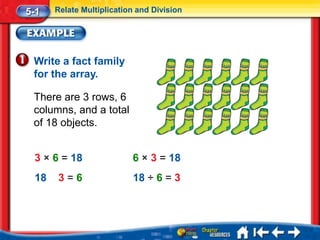
 Write a fact family
 for the array.

 There are 3 rows, 6
 columns, and a total
 of 18 objects.


 3 × 6 = 18               6 × 3 = 18
 18   3=6                 18 ÷ 6 = 3
5-1   Relate Multiplication and Division


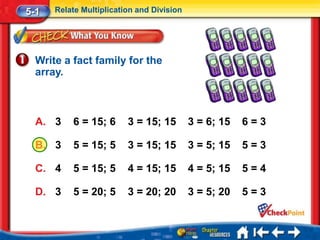
  Write a fact family for the
  array.


  A. 3    6 = 15; 6      3 = 15; 15        3 = 6; 15   6=3

  B. 3    5 = 15; 5      3 = 15; 15        3 = 5; 15   5=3

  C. 4    5 = 15; 5      4 = 15; 15        4 = 5; 15   5=4

  D. 3    5 = 20; 5      3 = 20; 20        3 = 5; 20   5=3
5-1   Relate Multiplication and Division


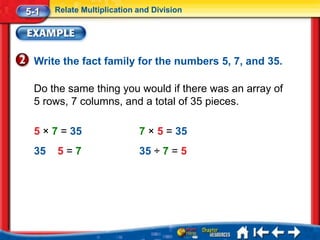
 Write the fact family for the numbers 5, 7, and 35.

 Do the same thing you would if there was an array of
 5 rows, 7 columns, and a total of 35 pieces.

 5 × 7 = 35                 7 × 5 = 35
 35   5=7                   35 ÷ 7 = 5
5-1   Relate Multiplication and Division


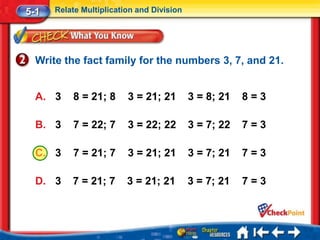
  Write the fact family for the numbers 3, 7, and 21.


  A. 3    8 = 21; 8      3 = 21; 21        3 = 8; 21   8=3

  B. 3    7 = 22; 7      3 = 22; 22        3 = 7; 22   7=3

  C. 3    7 = 21; 7      3 = 21; 21        3 = 7; 21   7=3

  D. 3    7 = 21; 7      3 = 21; 21        3 = 7; 21   7=3
5-1   Relate Multiplication and Division


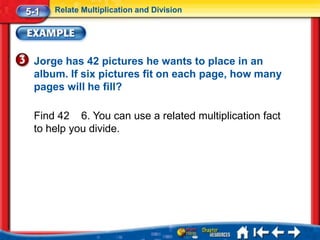
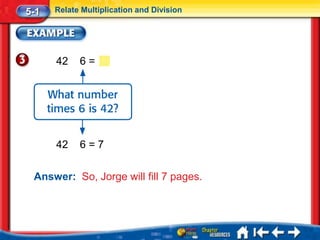
 Jorge has 42 pictures he wants to place in an
 album. If six pictures fit on each page, how many
 pages will he fill?

 Find 42 6. You can use a related multiplication fact
 to help you divide.
5-1   Relate Multiplication and Division


      42    6=


      42    6=7


 Answer: So, Jorge will fill 7 pages.
5-1   Relate Multiplication and Division


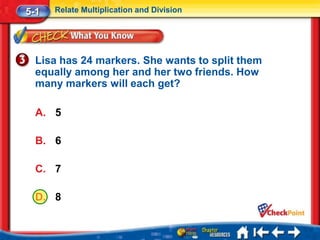
  Lisa has 24 markers. She wants to split them
  equally among her and her two friends. How
  many markers will each get?

  A. 5

  B. 6

  C. 7

  D. 8
5-2     Algebra: Multiplication and Division Properties


      Five-Minute Check (over Lesson 5-1)
      Main Idea and Vocabulary
      California Standards
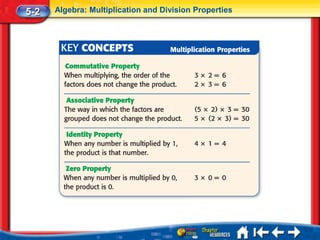
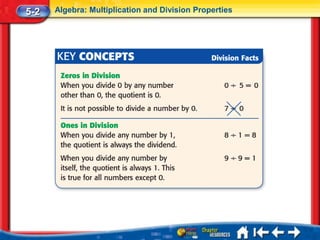
      Key Concepts: Multiplication Properties
      Key Concepts: Division Facts
      Example 1
      Example 2
      Example 3
5-2      Algebra: Multiplication and Division Properties


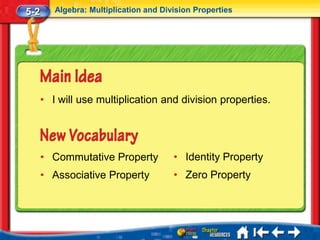
      • I will use multiplication and division properties.


      • Commutative Property            • Identity Property
      • Associative Property            • Zero Property
5-2     Algebra: Multiplication and Division Properties


      Standard 4AF1.0 Students use and interpret
      variables, mathematical symbols, and properties
      to write and simplify expressions and sentences.
5-2   Algebra: Multiplication and Division Properties


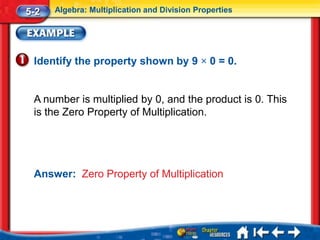
 Identify the property shown by 9 × 0 = 0.


 A number is multiplied by 0, and the product is 0. This
 is the Zero Property of Multiplication.


 Answer: Zero Property of Multiplication
5-2   Algebra: Multiplication and Division Properties


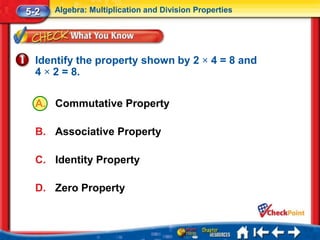
  Identify the property shown by 2 × 4 = 8 and
  4 × 2 = 8.

  A. Commutative Property

  B. Associative Property

  C. Identity Property

  D. Zero Property
5-2   Algebra: Multiplication and Division Properties


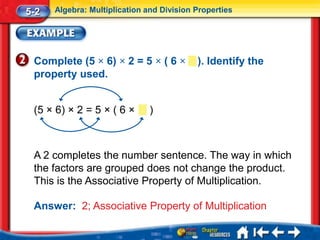
 Complete (5 × 6) × 2 = 5 × ( 6 ×          ). Identify the
 property used.


 (5 × 6) × 2 = 5 × ( 6 ×       )


 A 2 completes the number sentence. The way in which
 the factors are grouped does not change the product.
 This is the Associative Property of Multiplication.

 Answer: 2; Associative Property of Multiplication
5-2   Algebra: Multiplication and Division Properties


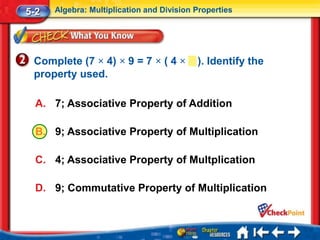
 Complete (7 × 4) × 9 = 7 × ( 4 ×          ). Identify the
 property used.

  A. 7; Associative Property of Addition

  B. 9; Associative Property of Multiplication

  C. 4; Associative Property of Multplication

  D. 9; Commutative Property of Multiplication
5-2   Algebra: Multiplication and Division Properties


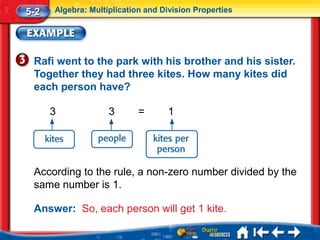
 Rafi went to the park with his brother and his sister.
 Together they had three kites. How many kites did
 each person have?

      3             3       =      1


 According to the rule, a non-zero number divided by the
 same number is 1.

 Answer: So, each person will get 1 kite.
5-2    Algebra: Multiplication and Division Properties


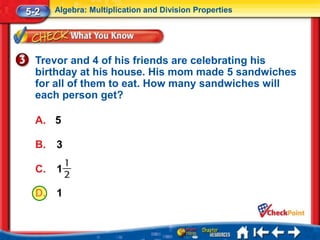
  Trevor and 4 of his friends are celebrating his
  birthday at his house. His mom made 5 sandwiches
  for all of them to eat. How many sandwiches will
  each person get?

  A. 5

  B.   3

  C.   1

  D.   1
5-3     Multiply and Divide Facts Through 5


      Five-Minute Check (over Lesson 5-2)
      Main Idea
      California Standards
      Example 1
      Example 2
5-3      Multiply and Divide Facts Through 5


      • I will recognize multiplication and division facts
        0 through 5.
5-3      Multiply and Divide Facts Through 5


             Standard 4NS3.0 Students solve problems
      involving addition, subtraction, multiplication, and
      division of whole numbers and understand
      relationships among the operations.
5-3     Multiply and Divide Facts Through 5


      Standard 4MR2.3 Use a variety of
      methods, such as
      words, numbers, symbols, charts, graphs, tables,
      diagrams, and models, to explain mathematical
      reasoning.
5-3   Multiply and Divide Facts Through 5


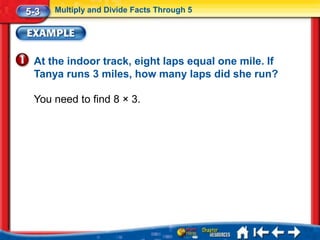
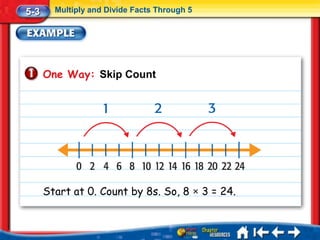
 At the indoor track, eight laps equal one mile. If
 Tanya runs 3 miles, how many laps did she run?

 You need to find 8 × 3.
5-3     Multiply and Divide Facts Through 5


      One Way: Skip Count


      Start at 0. Count by 8s. So, 8 × 3 = 24.
5-3     Multiply and Divide Facts Through 5


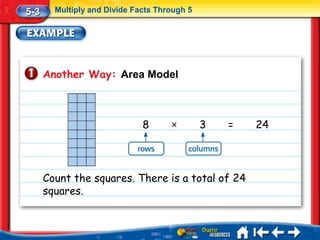
      Another Way: Area Model


                              8      ×        3   =   24


      Count the squares. There is a total of 24
      squares.
5-3   Multiply and Divide Facts Through 5


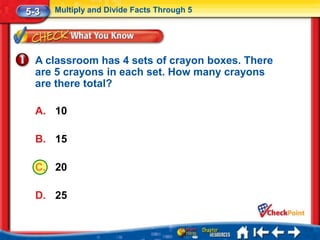
  A classroom has 4 sets of crayon boxes. There
  are 5 crayons in each set. How many crayons
  are there total?

  A. 10

  B. 15

  C. 20

  D. 25
5-3   Multiply and Divide Facts Through 5


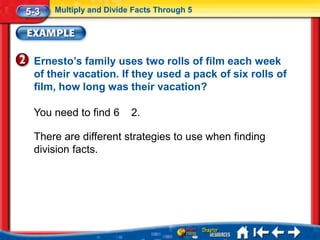
 Ernesto’s family uses two rolls of film each week
 of their vacation. If they used a pack of six rolls of
 film, how long was their vacation?

 You need to find 6      2.

 There are different strategies to use when finding
 division facts.
5-3     Multiply and Divide Facts Through 5


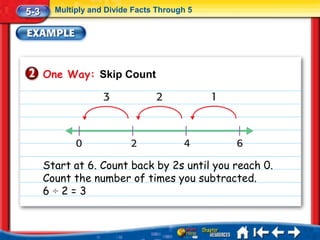
      One Way: Skip Count


      Start at 6. Count back by 2s until you reach 0.
      Count the number of times you subtracted.
      6÷2=3
5-3     Multiply and Divide Facts Through 5


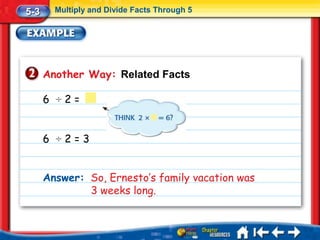
      Another Way: Related Facts

      6 ÷2=


      6 ÷2=3


      Answer: So, Ernesto’s family vacation was
              3 weeks long.
5-3   Multiply and Divide Facts Through 5


  There are 3 calculators in a classroom of 15
  students. How many students per calculator
  are there?

  A. 5

  B. 4

  C. 3

  D. 2
5-4     Problem-Solving Skill: Choose an Operation


      Five-Minute Check (over Lesson 5-3)
      Main Idea
      California Standards
      Example 1: Problem-Solving Skill
5-4      Problem-Solving Skill: Choose an Operation


      • I will choose an operation to solve a problem.
5-4     Problem-Solving Skill: Choose an Operation


      Standard 4MR1.1 Analyze problems by
      identifying relationships, distinguishing
      relevant from irrelevant information,
      sequencing and prioritizing information,
      and observing patterns.
5-4      Problem-Solving Skill: Choose an Operation


             Standard 4NS3.0 Students solve problems
      involving addition, subtraction, multiplication, and
      division of whole numbers and understand the
      relationships among the operations.
5-4   Problem-Solving Skill: Choose an Operation


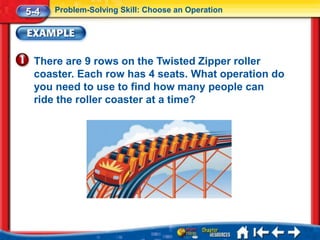
 There are 9 rows on the Twisted Zipper roller
 coaster. Each row has 4 seats. What operation do
 you need to use to find how many people can
 ride the roller coaster at a time?
5-4   Problem-Solving Skill: Choose an Operation


 Understand
 What facts do you know?
 • There are 9 rows.
 • There are 4 seats per row.

 What do you need to find?
 • The operation you should use to find how many
   people can ride the roller coaster at a time.
5-4   Problem-Solving Skill: Choose an Operation


 Plan
 You should multiply because there are groups of
 the same number in each group. Multiply the
 number of rows by the number of seats per row.
5-4       Problem-Solving Skill: Choose an Operation


 Solve
 Multiply to find the answer.

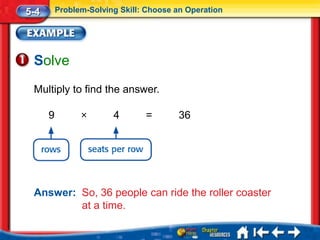
      9         ×       4       =       36


 Answer: So, 36 people can ride the roller coaster
         at a time.
5-4   Problem-Solving Skill: Choose an Operation


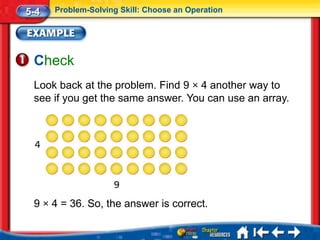
 Check
 Look back at the problem. Find 9 × 4 another way to
 see if you get the same answer. You can use an array.


 9 × 4 = 36. So, the answer is correct.
5-5     Multiply and Divide Facts Through 10


      Five-Minute Check (over Lesson 5-4)
      Main Idea
      California Standards
      Example 1
      Example 2
5-5      Multiply and Divide Facts Through 10


      • I will recognize multiplication and division facts
        through 10.
5-5     Multiply and Divide Facts Through 10


             Standard 4NS3.0 Students solve problems
      involving addition, subtraction, multiplication,
      and division of whole numbers and understand
      relationships among the operations.
5-5     Multiply and Divide Facts Through 10


      Standard 4MR3.2 Note the method of deriving
      the solution and demonstrate a conceptual
      understanding of the derivation by solving
      similar problems.
5-5   Multiply and Divide Facts Through 10


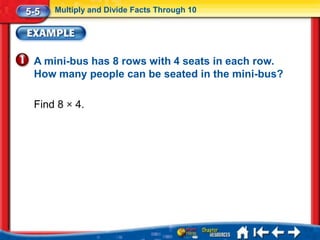
 A mini-bus has 8 rows with 4 seats in each row.
 How many people can be seated in the mini-bus?

 Find 8 × 4.
5-5     Multiply and Divide Facts Through 10


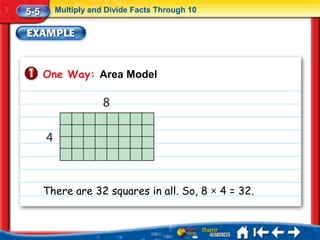
      One Way: Area Model


      There are 32 squares in all. So, 8 × 4 = 32.
5-5     Multiply and Divide Facts Through 10


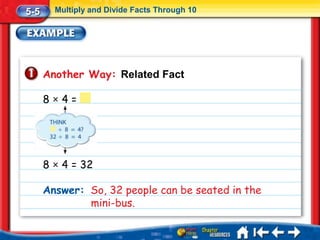
      Another Way: Related Fact

      8×4=


      8 × 4 = 32

      Answer: So, 32 people can be seated in the
              mini-bus.
5-5   Multiply and Divide Facts Through 10


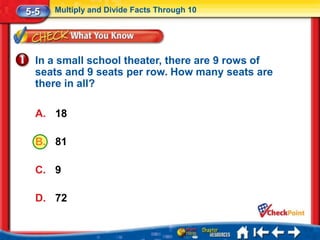
  In a small school theater, there are 9 rows of
  seats and 9 seats per row. How many seats are
  there in all?

  A. 18

  B. 81

  C. 9

  D. 72
5-5   Multiply and Divide Facts Through 10


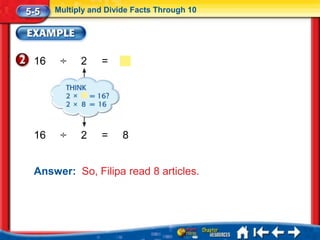
 Filipa noticed that there are 2 pages of
 advertisements for every article she reads
 in a magazine. If she saw a total of 16
 pages of advertisements, how many
 articles did she read?

 There are 16 pages of advertisements. Divide
 16 by 2 to find how many articles Filipa read.
5-5   Multiply and Divide Facts Through 10


 16    ÷    2    =


 16    ÷    2    =     8


 Answer: So, Filipa read 8 articles.
5-5   Multiply and Divide Facts Through 10


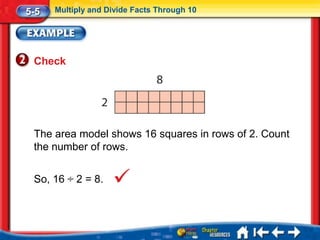
 Check


 The area model shows 16 squares in rows of 2. Count
 the number of rows.


 So, 16 ÷ 2 = 8.
5-5   Multiply and Divide Facts Through 10


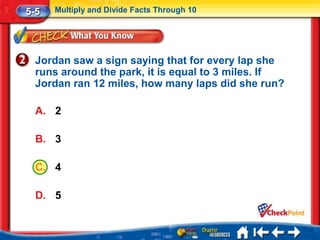
  Jordan saw a sign saying that for every lap she
  runs around the park, it is equal to 3 miles. If
  Jordan ran 12 miles, how many laps did she run?

  A. 2

  B. 3

  C. 4

  D. 5
5-6     Multiply with 11 and 12


      Five-Minute Check (over Lesson 5-5)
      Main Idea and Vocabulary
      California Standards
      Example 1
      Example 2
5-6      Multiply with 11 and 12


      • I will recognize multiplication facts for 11 and 12.


      • Distributive Property of Multiplication
5-6     Multiply with 11 and 12


             Standard 4NS3.0 Students solve problems
      involving addition, subtraction, multiplication,
      and division of whole numbers and understand
      relationships among the operations.
5-6     Multiply with 11 and 12


      Standard 4MR3.3 Develop generalizations of
      the results obtained and apply them in other
      circumstances.
5-6   Multiply with 11 and 12


 Pang works at a bakery. He received an order for
 9 dozen bagels. How many bagels does he need
 to fill the order?

 There are 12 bagels in one dozen. So, you need to find
 9 × 12.
5-6   Multiply with 11 and 12


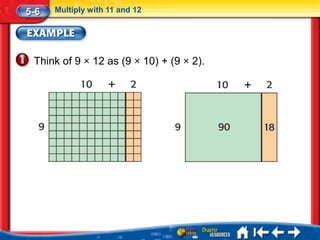
 Think of 9 × 12 as (9 × 10) + (9 × 2).
5-6   Multiply with 11 and 12


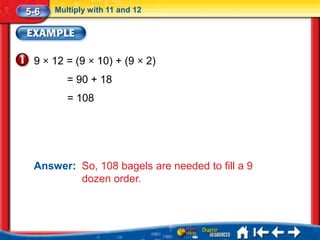
 9 × 12 = (9 × 10) + (9 × 2)
         = 90 + 18
         = 108


 Answer: So, 108 bagels are needed to fill a 9
         dozen order.
5-6   Multiply with 11 and 12


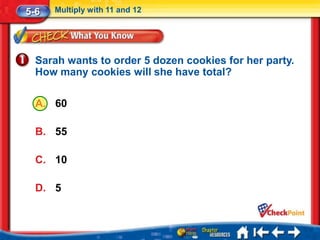
  Sarah wants to order 5 dozen cookies for her party.
  How many cookies will she have total?

  A. 60

  B. 55

  C. 10

  D. 5
5-6   Multiply with 11 and 12


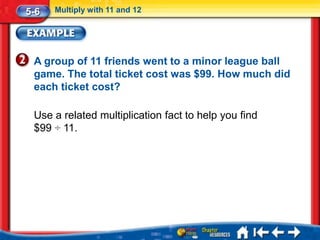
 A group of 11 friends went to a minor league ball
 game. The total ticket cost was $99. How much did
 each ticket cost?

 Use a related multiplication fact to help you find
 $99 ÷ 11.
5-6   Multiply with 11 and 12


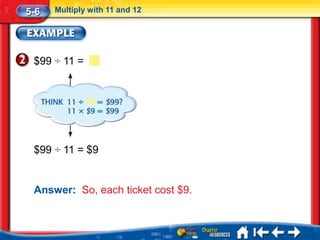
 $99 ÷ 11 =


 $99 ÷ 11 = $9


 Answer: So, each ticket cost $9.
5-6   Multiply with 11 and 12


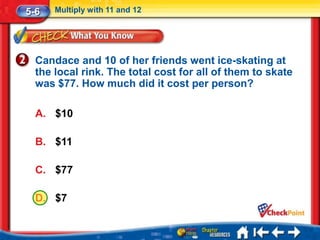
  Candace and 10 of her friends went ice-skating at
  the local rink. The total cost for all of them to skate
  was $77. How much did it cost per person?

  A. $10

  B. $11

  C. $77

  D. $7
5-7     Problem-Solving Investigation: Choose a Strategy


      Five-Minute Check (over Lesson 5-6)
      Main Idea
      California Standards
      Example 1: Problem-Solving Investigation
5-7      Problem-Solving Investigation: Choose a Strategy


      • I will choose the best strategy to solve a problem.
5-7     Problem-Solving Investigation: Choose a Strategy


      Standard 4MR1.1 Analyze problems by
      identifying relationships, distinguishing relevant
      from irrelevant information, sequencing and
      prioritizing information, and observing patterns.
5-7     Problem-Solving Investigation: Choose a Strategy


            Standard 4NS3.0 Students solve problems
      involving addition, subtraction, multiplication,
      and division of whole numbers and understand
      the relationships among the operations.
5-7    Problem-Solving Investigation: Choose a Strategy


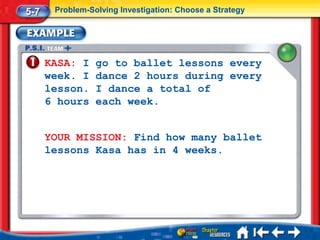
      KASA: I    go to ballet lessons every
      week. I    dance 2 hours during every
      lesson.    I dance a total of
      6 hours    each week.


      YOUR MISSION: Find how many ballet
      lessons Kasa has in 4 weeks.
5-7     Problem-Solving Investigation: Choose a Strategy


      Understand
      What facts do you know?
      • Kasa dances 2 hours during each lesson.
      • She dances a total of 6 hours each week.

      What do you need to find?
      • Find how many lessons she has in 4 weeks.
5-7     Problem-Solving Investigation: Choose a Strategy


      Plan
      Divide the number of hours Kasa practices each
      week by the number of hours each lesson lasts.
      Then multiply by 4, the number of weeks.
5-7      Problem-Solving Investigation: Choose a Strategy


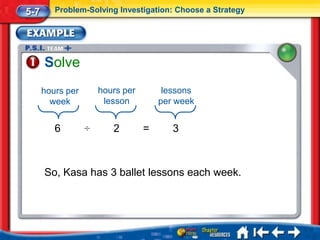
      Solve
      hours per       hours per        lessons
        week           lesson         per week


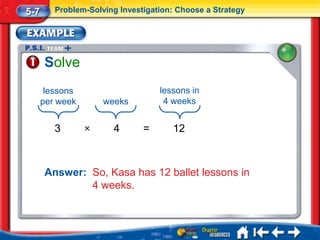
         6        ÷      2        =      3


      So, Kasa has 3 ballet lessons each week.
5-7      Problem-Solving Investigation: Choose a Strategy


      Solve
       lessons                     lessons in
      per week       weeks          4 weeks


         3       ×     4       =      12


      Answer: So, Kasa has 12 ballet lessons in
              4 weeks.
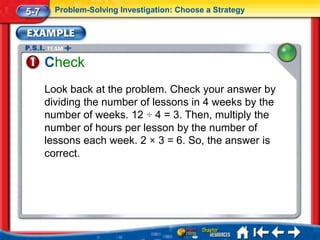
5-7     Problem-Solving Investigation: Choose a Strategy


      Check
      Look back at the problem. Check your answer by
      dividing the number of lessons in 4 weeks by the
      number of weeks. 12 ÷ 4 = 3. Then, multiply the
      number of hours per lesson by the number of
      lessons each week. 2 × 3 = 6. So, the answer is
      correct.
5-8     Multiply Three Numbers


      Five-Minute Check (over Lesson 5-7)
      Main Idea
      California Standards
      Example 1
5-8      Multiply Three Numbers


      • I will multiply 3 factors.
5-8     Multiply Three Numbers


      Standard 4AF1.0 Students use and interpret
      variables, mathematical symbols, and
      properties to write and simplify expressions
      and sentences.
5-8   Multiply Three Numbers


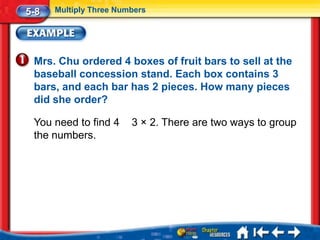
 Mrs. Chu ordered 4 boxes of fruit bars to sell at the
 baseball concession stand. Each box contains 3
 bars, and each bar has 2 pieces. How many pieces
 did she order?

 You need to find 4     3 × 2. There are two ways to group
 the numbers.
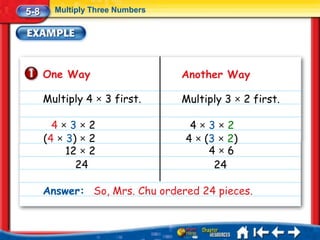
5-8     Multiply Three Numbers


      One Way                    Another Way

      Multiply 4 × 3 first.      Multiply 3 × 2 first.

        4×3×2                     4×3×2
      (4 × 3) × 2                4 × (3 × 2)
           12 × 2                     4×6
             24                        24

      Answer: So, Mrs. Chu ordered 24 pieces.
5-8   Multiply Three Numbers


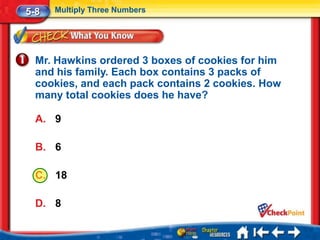
  Mr. Hawkins ordered 3 boxes of cookies for him
  and his family. Each box contains 3 packs of
  cookies, and each pack contains 2 cookies. How
  many total cookies does he have?

  A. 9

  B. 6

  C. 18

  D. 8
5-9     Factors and Multiples


      Five-Minute Check (over Lesson 5-8)
      Main Idea and Vocabulary
      California Standards
      Example 1
      Example 2
5-9      Factors and Multiples


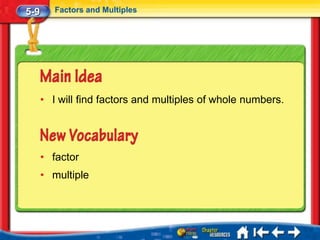
      • I will find factors and multiples of whole numbers.


      • factor
      • multiple
5-9     Factors and Multiples


      Standard 4NS4.1 Understand that many whole
      numbers break down in different ways (e.g. 12
      = 4 × 3 = 2 × 6 = 2 × 2 × 3).
5-9     Factors and Multiples


      Standard 4MR2.3 Use a variety of methods,
      such as words, numbers, symbols, charts,
      graphs, tables, diagrams, and models to
      explain mathematical reasoning.
5-9   Factors and Multiples


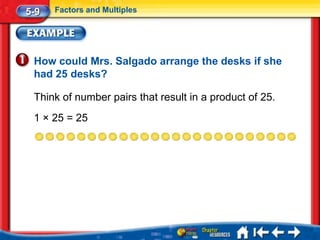
 How could Mrs. Salgado arrange the desks if she
 had 25 desks?

 Think of number pairs that result in a product of 25.
 1 × 25 = 25
5-9   Factors and Multiples


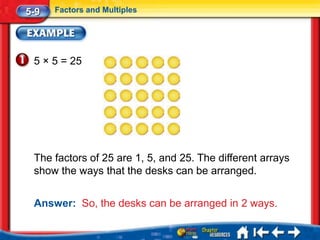
 5 × 5 = 25


 The factors of 25 are 1, 5, and 25. The different arrays
 show the ways that the desks can be arranged.


 Answer: So, the desks can be arranged in 2 ways.
5-9   Factors and Multiples


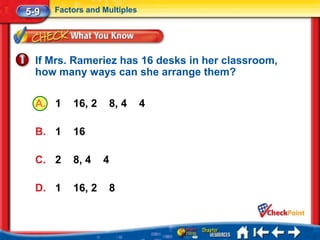
  If Mrs. Rameriez has 16 desks in her classroom,
  how many ways can she arrange them?

  A. 1    16, 2    8, 4       4

  B. 1    16

  C. 2    8, 4    4

  D. 1    16, 2    8
5-9   Factors and Multiples


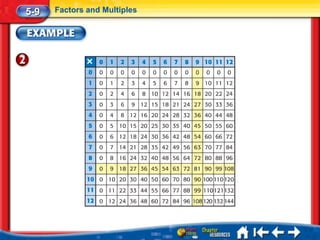
 Identify the first five multiples of 9.

 On a multiplication table, look across the row for 9, or
 down the column for 9. All of the numbers listed in the
 row or the column are multiples of 9.
5-9   Factors and Multiples


 Answer: So, the first five multiples of 9 are
         0, 9, 18, 27, and 36.
5-9   Factors and Multiples


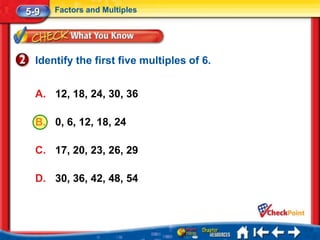
  Identify the first five multiples of 6.


  A. 12, 18, 24, 30, 36

  B. 0, 6, 12, 18, 24

  C. 17, 20, 23, 26, 29

  D. 30, 36, 42, 48, 54
5-10   Prime and Composite Numbers


   Five-Minute Check (over Lesson 5-9)
   Main Idea and Vocabulary
   California Standards
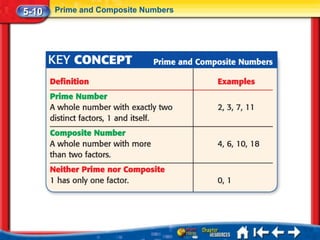
   Key Concepts: Prime and Composite Numbers
   Example 1
   Example 2
   Example 3

                                     Prime and Composite Numbers
5-10   Prime and Composite Numbers


   • I will determine if a number is prime or composite.


   • composite number
   • prime number
5-10   Prime and Composite Numbers


   Standard 4NS4.2 Know that numbers such as 2,
   3, 4, 7, and 11 do not have any factors except for
   1 and themselves and that such numbers are
   called prime numbers.
5-10   Prime and Composite Numbers


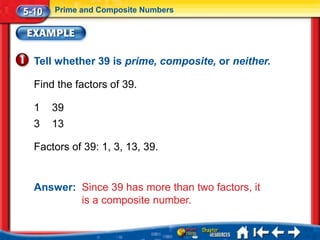
  Tell whether 39 is prime, composite, or neither.

  Find the factors of 39.

  1    39
  3    13

  Factors of 39: 1, 3, 13, 39.


  Answer: Since 39 has more than two factors, it
          is a composite number.
5-10   Prime and Composite Numbers


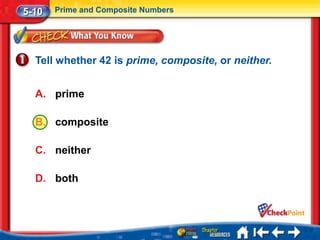
  Tell whether 42 is prime, composite, or neither.


  A. prime

  B. composite

  C. neither

  D. both
5-10   Prime and Composite Numbers


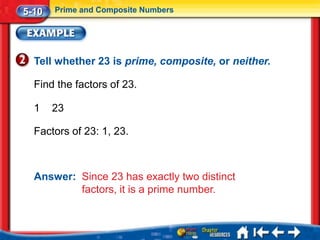
  Tell whether 23 is prime, composite, or neither.

  Find the factors of 23.

  1    23

  Factors of 23: 1, 23.


  Answer: Since 23 has exactly two distinct
          factors, it is a prime number.
5-10   Prime and Composite Numbers


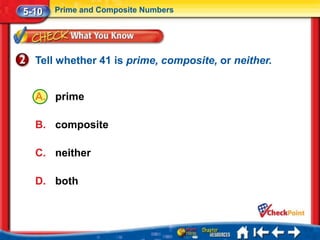
  Tell whether 41 is prime, composite, or neither.


  A. prime

  B. composite

  C. neither

  D. both
5-10   Prime and Composite Numbers


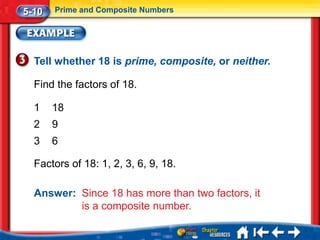
  Tell whether 18 is prime, composite, or neither.

  Find the factors of 18.

  1    18
  2    9
  3    6

  Factors of 18: 1, 2, 3, 6, 9, 18.

  Answer: Since 18 has more than two factors, it
          is a composite number.
5-10   Prime and Composite Numbers


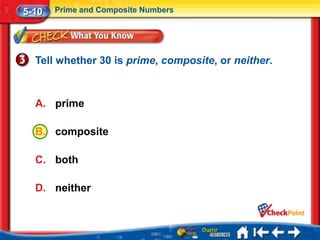
  Tell whether 30 is prime, composite, or neither.


  A. prime

  B. composite

  C. both

  D. neither
Multiplication and Division Facts
5


                   Five-Minute Checks


                   Meaning of Multiplication and Division

                   Prime and Composite Numbers
Multiplication and Division Facts
5


    Lesson 5-1       (over Chapter 4)
    Lesson 5-2       (over Lesson 5-1)
    Lesson 5-3       (over Lesson 5-2)
    Lesson 5-4       (over Lesson 5-3)
    Lesson 5-5       (over Lesson 5-4)
    Lesson 5-6       (over Lesson 5-5)
    Lesson 5-7       (over Lesson 5-6)
    Lesson 5-8       (over Lesson 5-6)
    Lesson 5-9       (over Lesson 5-6)
    Lesson 5-10 (over Lesson 5-6)
Multiplication and Division Facts
5
                                     (over Chapter 4)


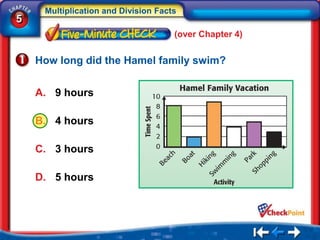
    How long did the Hamel family swim?


    A. 9 hours

    B. 4 hours

    C. 3 hours

    D. 5 hours
Multiplication and Division Facts
5
                                     (over Chapter 4)


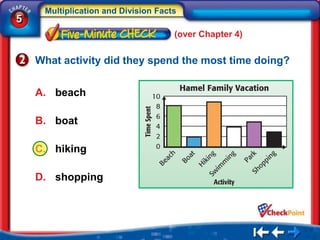
    What activity did they spend the most time doing?


    A. beach

    B. boat

    C. hiking

    D. shopping
Multiplication and Division Facts
5
                                        (over Lesson 5-1)


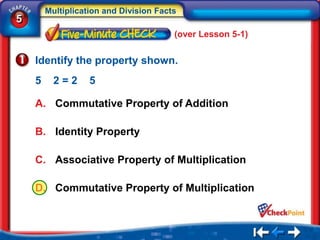
    Identify the property shown.
    5     2=2      5

    A. Commutative Property of Addition

    B. Identity Property

    C. Associative Property of Multiplication

    D. Commutative Property of Multiplication
Multiplication and Division Facts
5
                                        (over Lesson 5-1)


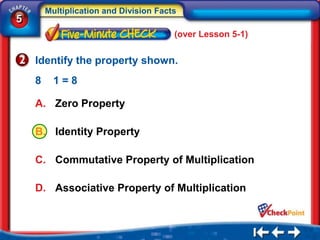
    Identify the property shown.
    8     1=8

    A. Zero Property

    B. Identity Property

    C. Commutative Property of Multiplication

    D. Associative Property of Multiplication
Multiplication and Division Facts
5
                                         (over Lesson 5-1)


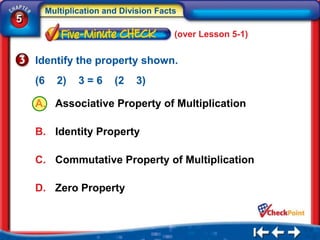
    Identify the property shown.
    (6      2)   3=6      (2   3)

    A. Associative Property of Multiplication

    B. Identity Property

    C. Commutative Property of Multiplication

    D. Zero Property
Multiplication and Division Facts
5
                                     (over Lesson 5-1)


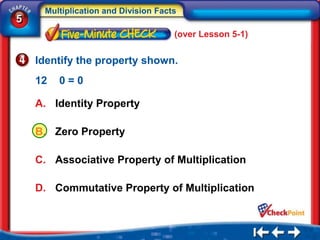
    Identify the property shown.
    12   0=0

    A. Identity Property

    B. Zero Property

    C. Associative Property of Multiplication

    D. Commutative Property of Multiplication
Multiplication and Division Facts
5
                                        (over Lesson 5-1)


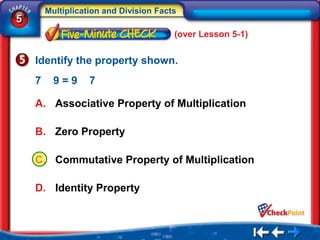
    Identify the property shown.
    7     9=9      7

    A. Associative Property of Multiplication

    B. Zero Property

    C. Commutative Property of Multiplication

    D. Identity Property
Multiplication and Division Facts
5
                                      (over Lesson 5-2)


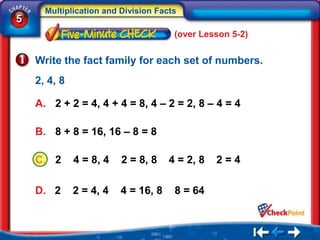
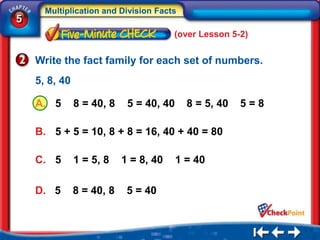
    Write the fact family for each set of numbers.
    2, 4, 8

    A. 2 + 2 = 4, 4 + 4 = 8, 4 – 2 = 2, 8 – 4 = 4

    B. 8 + 8 = 16, 16 – 8 = 8

    C. 2      4 = 8, 4   2 = 8, 8    4 = 2, 8   2=4

    D. 2      2 = 4, 4   4 = 16, 8    8 = 64
Multiplication and Division Facts
5
                                       (over Lesson 5-2)


    Write the fact family for each set of numbers.
    5, 8, 40

    A. 5       8 = 40, 8    5 = 40, 40     8 = 5, 40   5=8

    B. 5 + 5 = 10, 8 + 8 = 16, 40 + 40 = 80

    C. 5       1 = 5, 8    1 = 8, 40     1 = 40

    D. 5       8 = 40, 8    5 = 40
Multiplication and Division Facts
5
                                      (over Lesson 5-2)


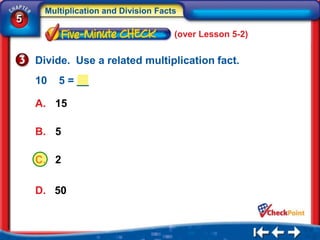
    Divide. Use a related multiplication fact.
    10   5 = __

    A. 15

    B. 5

    C. 2

    D. 50
Multiplication and Division Facts
5
                                      (over Lesson 5-2)


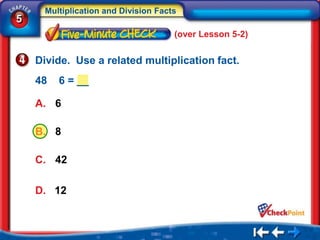
    Divide. Use a related multiplication fact.
    48   6 = __

    A. 6

    B. 8

    C. 42

    D. 12
Multiplication and Division Facts
5
                                        (over Lesson 5-3)


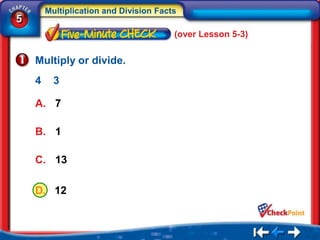
    Multiply or divide.
    4     3

    A. 7

    B. 1

    C. 13

    D. 12
Multiplication and Division Facts
5
                                        (over Lesson 5-3)


    Multiply or divide.
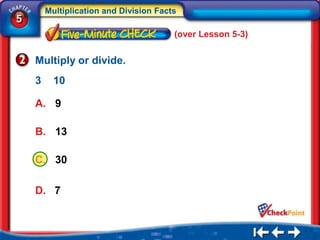
    3     10

    A. 9

    B. 13

    C. 30

    D. 7
Multiplication and Division Facts
5
                                        (over Lesson 5-3)


    Multiply or divide.
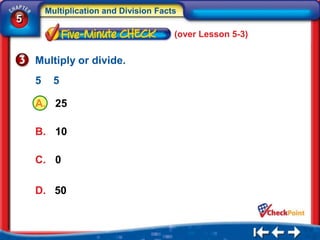
    5     5

    A. 25

    B. 10

    C. 0

    D. 50
Multiplication and Division Facts
5
                                      (over Lesson 5-3)


    Multiply or divide.
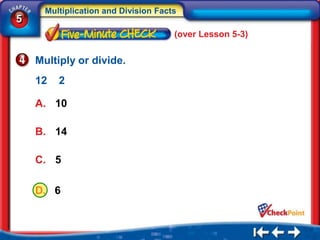
    12   2

    A. 10

    B. 14

    C. 5

    D. 6
Multiplication and Division Facts
5
                                      (over Lesson 5-3)


    Multiply or divide.
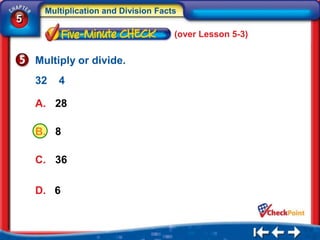
    32   4

    A. 28

    B. 8

    C. 36

    D. 6
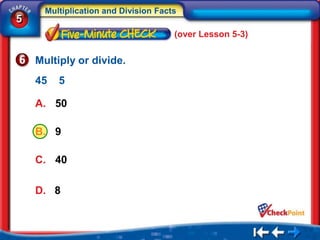
Multiplication and Division Facts
5
                                      (over Lesson 5-3)


    Multiply or divide.
    45   5

    A. 50

    B. 9

    C. 40

    D. 8
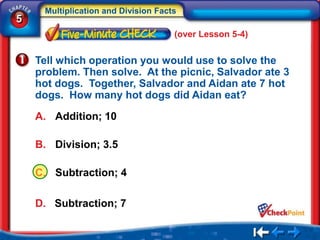
Multiplication and Division Facts
5
                                     (over Lesson 5-4)


    Tell which operation you would use to solve the
    problem. Then solve. At the picnic, Salvador ate 3
    hot dogs. Together, Salvador and Aidan ate 7 hot
    dogs. How many hot dogs did Aidan eat?

    A. Addition; 10

    B. Division; 3.5

    C. Subtraction; 4

    D. Subtraction; 7
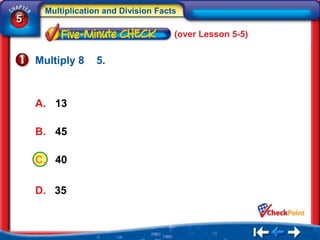
Multiplication and Division Facts
5
                                     (over Lesson 5-5)


    Multiply 8   5.


    A. 13

    B. 45

    C. 40

    D. 35
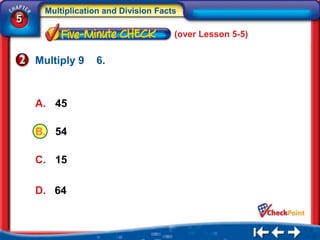
Multiplication and Division Facts
5
                                     (over Lesson 5-5)


    Multiply 9   6.


    A. 45

    B. 54

    C. 15

    D. 64
Multiplication and Division Facts
5
                                     (over Lesson 5-5)


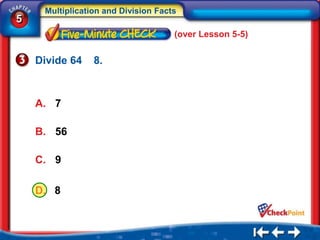
    Divide 64    8.


    A. 7

    B. 56

    C. 9

    D. 8
Multiplication and Division Facts
5
                                     (over Lesson 5-5)


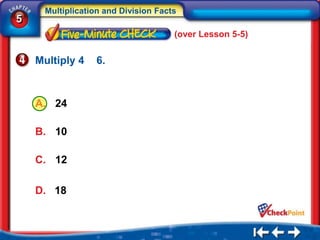
    Multiply 4   6.


    A. 24

    B. 10

    C. 12

    D. 18
Multiplication and Division Facts
5
                                     (over Lesson 5-5)


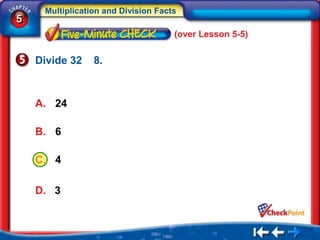
    Divide 32    8.


    A. 24

    B. 6

    C. 4

    D. 3
Multiplication and Division Facts
5
                                      (over Lesson 5-6)


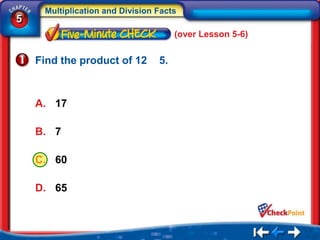
    Find the product of 12       5.


    A. 17

    B. 7

    C. 60

    D. 65
Multiplication and Division Facts
5
                                       (over Lesson 5-6)


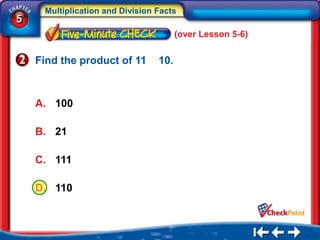
    Find the product of 11       10.


    A. 100

    B. 21

    C. 111

    D. 110
Multiplication and Division Facts
5
                                      (over Lesson 5-6)


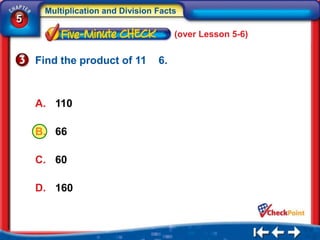
    Find the product of 11       6.


    A. 110

    B. 66

    C. 60

    D. 160
Multiplication and Division Facts
5
                                      (over Lesson 5-6)


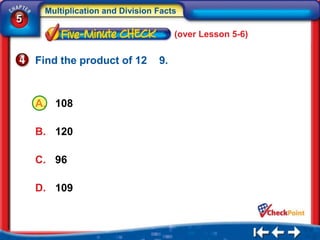
    Find the product of 12       9.


    A. 108

    B. 120

    C. 96

    D. 109
Multiplication and Division Facts
5
                                      (over Lesson 5-6)


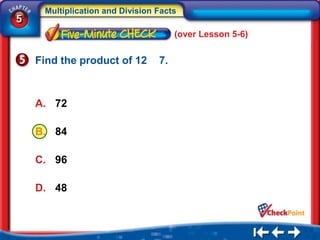
    Find the product of 12       7.


    A. 72

    B. 84

    C. 96

    D. 48
Multiplication and Division Facts
5
                                       (over Lesson 5-6)


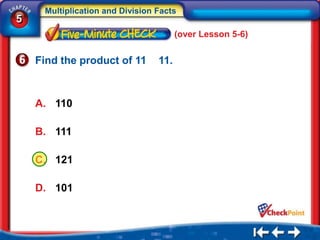
    Find the product of 11       11.


    A. 110

    B. 111

    C. 121

    D. 101
Multiplication and Division Facts
5
                                      (over Lesson 5-6)


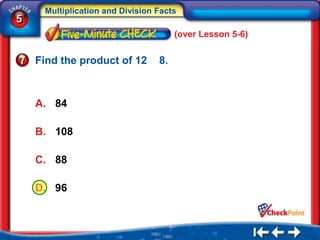
    Find the product of 12       8.


    A. 84

    B. 108

    C. 88

    D. 96
Multiplication and Division Facts
5
                                       (over Lesson 5-6)


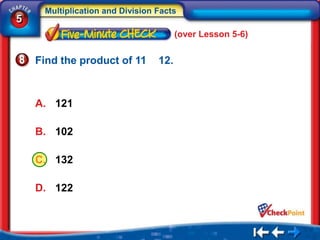
    Find the product of 11       12.


    A. 121

    B. 102

    C. 132

    D. 122
Multiplication and Division Facts
5
                                     (over Lesson 5-7)


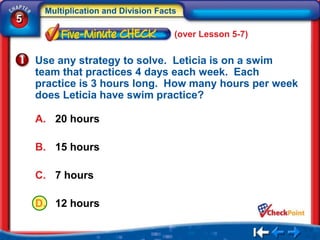
    Use any strategy to solve. Leticia is on a swim
    team that practices 4 days each week. Each
    practice is 3 hours long. How many hours per week
    does Leticia have swim practice?

    A. 20 hours

    B. 15 hours

    C. 7 hours

    D. 12 hours
Multiplication and Division Facts
5
                                     (over Lesson 5-8)


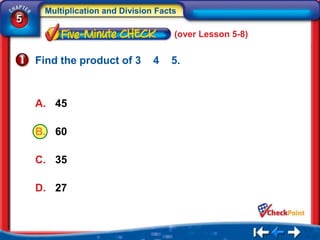
    Find the product of 3       4   5.


    A. 45

    B. 60

    C. 35

    D. 27
Multiplication and Division Facts
5
                                     (over Lesson 5-8)


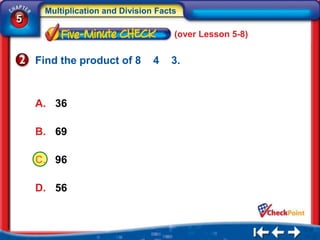
    Find the product of 8       4   3.


    A. 36

    B. 69

    C. 96

    D. 56
Multiplication and Division Facts
5
                                     (over Lesson 5-8)


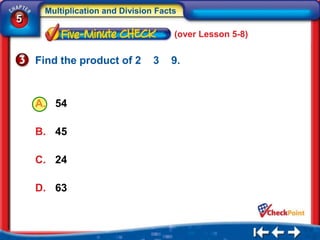
    Find the product of 2       3   9.


    A. 54

    B. 45

    C. 24

    D. 63
Multiplication and Division Facts
5
                                     (over Lesson 5-8)


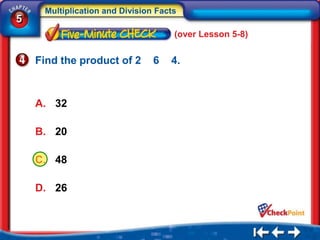
    Find the product of 2       6   4.


    A. 32

    B. 20

    C. 48

    D. 26
Multiplication and Division Facts
5
                                     (over Lesson 5-8)


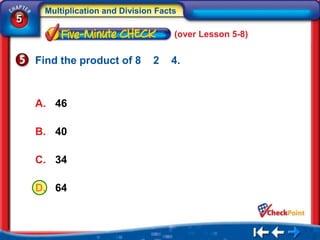
    Find the product of 8       2   4.


    A. 46

    B. 40

    C. 34

    D. 64
Multiplication and Division Facts
5
                                      (over Lesson 5-9)


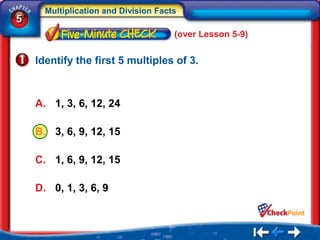
    Identify the first 5 multiples of 3.


    A. 1, 3, 6, 12, 24

    B. 3, 6, 9, 12, 15

    C. 1, 6, 9, 12, 15

    D. 0, 1, 3, 6, 9
Multiplication and Division Facts
5
                                      (over Lesson 5-9)


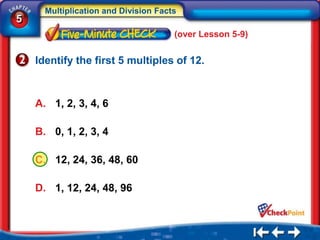
    Identify the first 5 multiples of 12.


    A. 1, 2, 3, 4, 6

    B. 0, 1, 2, 3, 4

    C. 12, 24, 36, 48, 60

    D. 1, 12, 24, 48, 96
Multiplication and Division Facts
5
                                      (over Lesson 5-9)


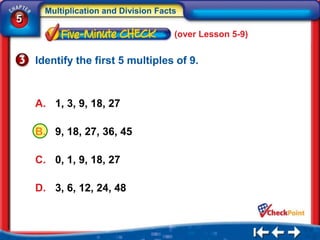
    Identify the first 5 multiples of 9.


    A. 1, 3, 9, 18, 27

    B. 9, 18, 27, 36, 45

    C. 0, 1, 9, 18, 27

    D. 3, 6, 12, 24, 48
Multiplication and Division Facts
5
                                      (over Lesson 5-9)


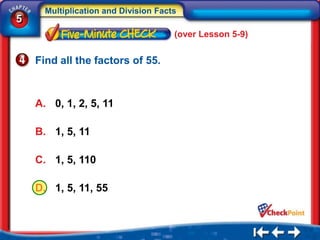
    Find all the factors of 55.


    A. 0, 1, 2, 5, 11

    B. 1, 5, 11

    C. 1, 5, 110

    D. 1, 5, 11, 55
Multiplication and Division Facts
5
                                      (over Lesson 5-9)


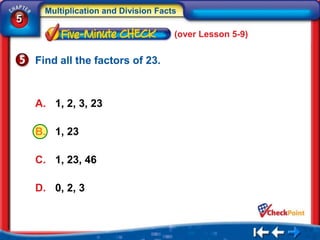
    Find all the factors of 23.


    A. 1, 2, 3, 23

    B. 1, 23

    C. 1, 23, 46

    D. 0, 2, 3
This slide is intentionally blank.

Math Gr4 Ch5

  • 1.
    Chapter 5 Multiplication and Division Facts Click the mouse or press the space bar to continue.
  • 2.
    Multiplication and DivisionFacts 5 Lesson 5-1 Relate Multiplication and Division Lesson 5-2 Algebra: Multiplication and Division Properties Lesson 5-3 Multiply and Divide Facts Through 5 Lesson 5-4 Problem-Solving Skill: Choose an Operation Lesson 5-5 Multiply and Divide Facts Through 10 Lesson 5-6 Multiply with 11 and 12 Lesson 5-7 Problem-Solving Investigation: Choose a Strategy Lesson 5-8 Multiply Three Numbers Lesson 5-9 Factors and Multiples Lesson 5-10 Prime and Composite Numbers
  • 3.
    5-1 Relate Multiplication and Division Five-Minute Check (over Chapter 4) Main Idea and Vocabulary California Standards Example 1 Example 2 Example 3 Meaning of Multiplication and Division
  • 4.
    5-1 Relate Multiplication and Division • I will understand how multiplication and division are related. • fact family
  • 5.
    5-1 Relate Multiplication and Division Standard 4NS3.0 Students solve problems involving addition, subtraction, multiplication, and division of whole numbers and understand the relationships among the operations.
  • 6.
    5-1 Relate Multiplication and Division Standard 4MR2.3 Use a variety of methods, such as words, numbers, symbols, charts, graphs, tables, diagrams, and models, to explain mathematical reasoning.
  • 7.
    5-1 Relate Multiplication and Division Write a fact family for the array. There are 3 rows, 6 columns, and a total of 18 objects. 3 × 6 = 18 6 × 3 = 18 18 3=6 18 ÷ 6 = 3
  • 8.
    5-1 Relate Multiplication and Division Write a fact family for the array. A. 3 6 = 15; 6 3 = 15; 15 3 = 6; 15 6=3 B. 3 5 = 15; 5 3 = 15; 15 3 = 5; 15 5=3 C. 4 5 = 15; 5 4 = 15; 15 4 = 5; 15 5=4 D. 3 5 = 20; 5 3 = 20; 20 3 = 5; 20 5=3
  • 9.
    5-1 Relate Multiplication and Division Write the fact family for the numbers 5, 7, and 35. Do the same thing you would if there was an array of 5 rows, 7 columns, and a total of 35 pieces. 5 × 7 = 35 7 × 5 = 35 35 5=7 35 ÷ 7 = 5
  • 10.
    5-1 Relate Multiplication and Division Write the fact family for the numbers 3, 7, and 21. A. 3 8 = 21; 8 3 = 21; 21 3 = 8; 21 8=3 B. 3 7 = 22; 7 3 = 22; 22 3 = 7; 22 7=3 C. 3 7 = 21; 7 3 = 21; 21 3 = 7; 21 7=3 D. 3 7 = 21; 7 3 = 21; 21 3 = 7; 21 7=3
  • 11.
    5-1 Relate Multiplication and Division Jorge has 42 pictures he wants to place in an album. If six pictures fit on each page, how many pages will he fill? Find 42 6. You can use a related multiplication fact to help you divide.
  • 12.
    5-1 Relate Multiplication and Division 42 6= 42 6=7 Answer: So, Jorge will fill 7 pages.
  • 13.
    5-1 Relate Multiplication and Division Lisa has 24 markers. She wants to split them equally among her and her two friends. How many markers will each get? A. 5 B. 6 C. 7 D. 8
  • 15.
    5-2 Algebra: Multiplication and Division Properties Five-Minute Check (over Lesson 5-1) Main Idea and Vocabulary California Standards Key Concepts: Multiplication Properties Key Concepts: Division Facts Example 1 Example 2 Example 3
  • 16.
    5-2 Algebra: Multiplication and Division Properties • I will use multiplication and division properties. • Commutative Property • Identity Property • Associative Property • Zero Property
  • 17.
    5-2 Algebra: Multiplication and Division Properties Standard 4AF1.0 Students use and interpret variables, mathematical symbols, and properties to write and simplify expressions and sentences.
  • 18.
    5-2 Algebra: Multiplication and Division Properties
  • 19.
    5-2 Algebra: Multiplication and Division Properties
  • 20.
    5-2 Algebra: Multiplication and Division Properties Identify the property shown by 9 × 0 = 0. A number is multiplied by 0, and the product is 0. This is the Zero Property of Multiplication. Answer: Zero Property of Multiplication
  • 21.
    5-2 Algebra: Multiplication and Division Properties Identify the property shown by 2 × 4 = 8 and 4 × 2 = 8. A. Commutative Property B. Associative Property C. Identity Property D. Zero Property
  • 22.
    5-2 Algebra: Multiplication and Division Properties Complete (5 × 6) × 2 = 5 × ( 6 × ). Identify the property used. (5 × 6) × 2 = 5 × ( 6 × ) A 2 completes the number sentence. The way in which the factors are grouped does not change the product. This is the Associative Property of Multiplication. Answer: 2; Associative Property of Multiplication
  • 23.
    5-2 Algebra: Multiplication and Division Properties Complete (7 × 4) × 9 = 7 × ( 4 × ). Identify the property used. A. 7; Associative Property of Addition B. 9; Associative Property of Multiplication C. 4; Associative Property of Multplication D. 9; Commutative Property of Multiplication
  • 24.
    5-2 Algebra: Multiplication and Division Properties Rafi went to the park with his brother and his sister. Together they had three kites. How many kites did each person have? 3 3 = 1 According to the rule, a non-zero number divided by the same number is 1. Answer: So, each person will get 1 kite.
  • 25.
    5-2 Algebra: Multiplication and Division Properties Trevor and 4 of his friends are celebrating his birthday at his house. His mom made 5 sandwiches for all of them to eat. How many sandwiches will each person get? A. 5 B. 3 C. 1 D. 1
  • 27.
    5-3 Multiply and Divide Facts Through 5 Five-Minute Check (over Lesson 5-2) Main Idea California Standards Example 1 Example 2
  • 28.
    5-3 Multiply and Divide Facts Through 5 • I will recognize multiplication and division facts 0 through 5.
  • 29.
    5-3 Multiply and Divide Facts Through 5 Standard 4NS3.0 Students solve problems involving addition, subtraction, multiplication, and division of whole numbers and understand relationships among the operations.
  • 30.
    5-3 Multiply and Divide Facts Through 5 Standard 4MR2.3 Use a variety of methods, such as words, numbers, symbols, charts, graphs, tables, diagrams, and models, to explain mathematical reasoning.
  • 31.
    5-3 Multiply and Divide Facts Through 5 At the indoor track, eight laps equal one mile. If Tanya runs 3 miles, how many laps did she run? You need to find 8 × 3.
  • 32.
    5-3 Multiply and Divide Facts Through 5 One Way: Skip Count Start at 0. Count by 8s. So, 8 × 3 = 24.
  • 33.
    5-3 Multiply and Divide Facts Through 5 Another Way: Area Model 8 × 3 = 24 Count the squares. There is a total of 24 squares.
  • 34.
    5-3 Multiply and Divide Facts Through 5 A classroom has 4 sets of crayon boxes. There are 5 crayons in each set. How many crayons are there total? A. 10 B. 15 C. 20 D. 25
  • 35.
    5-3 Multiply and Divide Facts Through 5 Ernesto’s family uses two rolls of film each week of their vacation. If they used a pack of six rolls of film, how long was their vacation? You need to find 6 2. There are different strategies to use when finding division facts.
  • 36.
    5-3 Multiply and Divide Facts Through 5 One Way: Skip Count Start at 6. Count back by 2s until you reach 0. Count the number of times you subtracted. 6÷2=3
  • 37.
    5-3 Multiply and Divide Facts Through 5 Another Way: Related Facts 6 ÷2= 6 ÷2=3 Answer: So, Ernesto’s family vacation was 3 weeks long.
  • 38.
    5-3 Multiply and Divide Facts Through 5 There are 3 calculators in a classroom of 15 students. How many students per calculator are there? A. 5 B. 4 C. 3 D. 2
  • 40.
    5-4 Problem-Solving Skill: Choose an Operation Five-Minute Check (over Lesson 5-3) Main Idea California Standards Example 1: Problem-Solving Skill
  • 41.
    5-4 Problem-Solving Skill: Choose an Operation • I will choose an operation to solve a problem.
  • 42.
    5-4 Problem-Solving Skill: Choose an Operation Standard 4MR1.1 Analyze problems by identifying relationships, distinguishing relevant from irrelevant information, sequencing and prioritizing information, and observing patterns.
  • 43.
    5-4 Problem-Solving Skill: Choose an Operation Standard 4NS3.0 Students solve problems involving addition, subtraction, multiplication, and division of whole numbers and understand the relationships among the operations.
  • 44.
    5-4 Problem-Solving Skill: Choose an Operation There are 9 rows on the Twisted Zipper roller coaster. Each row has 4 seats. What operation do you need to use to find how many people can ride the roller coaster at a time?
  • 45.
    5-4 Problem-Solving Skill: Choose an Operation Understand What facts do you know? • There are 9 rows. • There are 4 seats per row. What do you need to find? • The operation you should use to find how many people can ride the roller coaster at a time.
  • 46.
    5-4 Problem-Solving Skill: Choose an Operation Plan You should multiply because there are groups of the same number in each group. Multiply the number of rows by the number of seats per row.
  • 47.
    5-4 Problem-Solving Skill: Choose an Operation Solve Multiply to find the answer. 9 × 4 = 36 Answer: So, 36 people can ride the roller coaster at a time.
  • 48.
    5-4 Problem-Solving Skill: Choose an Operation Check Look back at the problem. Find 9 × 4 another way to see if you get the same answer. You can use an array. 9 × 4 = 36. So, the answer is correct.
  • 50.
    5-5 Multiply and Divide Facts Through 10 Five-Minute Check (over Lesson 5-4) Main Idea California Standards Example 1 Example 2
  • 51.
    5-5 Multiply and Divide Facts Through 10 • I will recognize multiplication and division facts through 10.
  • 52.
    5-5 Multiply and Divide Facts Through 10 Standard 4NS3.0 Students solve problems involving addition, subtraction, multiplication, and division of whole numbers and understand relationships among the operations.
  • 53.
    5-5 Multiply and Divide Facts Through 10 Standard 4MR3.2 Note the method of deriving the solution and demonstrate a conceptual understanding of the derivation by solving similar problems.
  • 54.
    5-5 Multiply and Divide Facts Through 10 A mini-bus has 8 rows with 4 seats in each row. How many people can be seated in the mini-bus? Find 8 × 4.
  • 55.
    5-5 Multiply and Divide Facts Through 10 One Way: Area Model There are 32 squares in all. So, 8 × 4 = 32.
  • 56.
    5-5 Multiply and Divide Facts Through 10 Another Way: Related Fact 8×4= 8 × 4 = 32 Answer: So, 32 people can be seated in the mini-bus.
  • 57.
    5-5 Multiply and Divide Facts Through 10 In a small school theater, there are 9 rows of seats and 9 seats per row. How many seats are there in all? A. 18 B. 81 C. 9 D. 72
  • 58.
    5-5 Multiply and Divide Facts Through 10 Filipa noticed that there are 2 pages of advertisements for every article she reads in a magazine. If she saw a total of 16 pages of advertisements, how many articles did she read? There are 16 pages of advertisements. Divide 16 by 2 to find how many articles Filipa read.
  • 59.
    5-5 Multiply and Divide Facts Through 10 16 ÷ 2 = 16 ÷ 2 = 8 Answer: So, Filipa read 8 articles.
  • 60.
    5-5 Multiply and Divide Facts Through 10 Check The area model shows 16 squares in rows of 2. Count the number of rows. So, 16 ÷ 2 = 8.
  • 61.
    5-5 Multiply and Divide Facts Through 10 Jordan saw a sign saying that for every lap she runs around the park, it is equal to 3 miles. If Jordan ran 12 miles, how many laps did she run? A. 2 B. 3 C. 4 D. 5
  • 63.
    5-6 Multiply with 11 and 12 Five-Minute Check (over Lesson 5-5) Main Idea and Vocabulary California Standards Example 1 Example 2
  • 64.
    5-6 Multiply with 11 and 12 • I will recognize multiplication facts for 11 and 12. • Distributive Property of Multiplication
  • 65.
    5-6 Multiply with 11 and 12 Standard 4NS3.0 Students solve problems involving addition, subtraction, multiplication, and division of whole numbers and understand relationships among the operations.
  • 66.
    5-6 Multiply with 11 and 12 Standard 4MR3.3 Develop generalizations of the results obtained and apply them in other circumstances.
  • 67.
    5-6 Multiply with 11 and 12 Pang works at a bakery. He received an order for 9 dozen bagels. How many bagels does he need to fill the order? There are 12 bagels in one dozen. So, you need to find 9 × 12.
  • 68.
    5-6 Multiply with 11 and 12 Think of 9 × 12 as (9 × 10) + (9 × 2).
  • 69.
    5-6 Multiply with 11 and 12 9 × 12 = (9 × 10) + (9 × 2) = 90 + 18 = 108 Answer: So, 108 bagels are needed to fill a 9 dozen order.
  • 70.
    5-6 Multiply with 11 and 12 Sarah wants to order 5 dozen cookies for her party. How many cookies will she have total? A. 60 B. 55 C. 10 D. 5
  • 71.
    5-6 Multiply with 11 and 12 A group of 11 friends went to a minor league ball game. The total ticket cost was $99. How much did each ticket cost? Use a related multiplication fact to help you find $99 ÷ 11.
  • 72.
    5-6 Multiply with 11 and 12 $99 ÷ 11 = $99 ÷ 11 = $9 Answer: So, each ticket cost $9.
  • 73.
    5-6 Multiply with 11 and 12 Candace and 10 of her friends went ice-skating at the local rink. The total cost for all of them to skate was $77. How much did it cost per person? A. $10 B. $11 C. $77 D. $7
  • 75.
    5-7 Problem-Solving Investigation: Choose a Strategy Five-Minute Check (over Lesson 5-6) Main Idea California Standards Example 1: Problem-Solving Investigation
  • 76.
    5-7 Problem-Solving Investigation: Choose a Strategy • I will choose the best strategy to solve a problem.
  • 77.
    5-7 Problem-Solving Investigation: Choose a Strategy Standard 4MR1.1 Analyze problems by identifying relationships, distinguishing relevant from irrelevant information, sequencing and prioritizing information, and observing patterns.
  • 78.
    5-7 Problem-Solving Investigation: Choose a Strategy Standard 4NS3.0 Students solve problems involving addition, subtraction, multiplication, and division of whole numbers and understand the relationships among the operations.
  • 79.
    5-7 Problem-Solving Investigation: Choose a Strategy KASA: I go to ballet lessons every week. I dance 2 hours during every lesson. I dance a total of 6 hours each week. YOUR MISSION: Find how many ballet lessons Kasa has in 4 weeks.
  • 80.
    5-7 Problem-Solving Investigation: Choose a Strategy Understand What facts do you know? • Kasa dances 2 hours during each lesson. • She dances a total of 6 hours each week. What do you need to find? • Find how many lessons she has in 4 weeks.
  • 81.
    5-7 Problem-Solving Investigation: Choose a Strategy Plan Divide the number of hours Kasa practices each week by the number of hours each lesson lasts. Then multiply by 4, the number of weeks.
  • 82.
    5-7 Problem-Solving Investigation: Choose a Strategy Solve hours per hours per lessons week lesson per week 6 ÷ 2 = 3 So, Kasa has 3 ballet lessons each week.
  • 83.
    5-7 Problem-Solving Investigation: Choose a Strategy Solve lessons lessons in per week weeks 4 weeks 3 × 4 = 12 Answer: So, Kasa has 12 ballet lessons in 4 weeks.
  • 84.
    5-7 Problem-Solving Investigation: Choose a Strategy Check Look back at the problem. Check your answer by dividing the number of lessons in 4 weeks by the number of weeks. 12 ÷ 4 = 3. Then, multiply the number of hours per lesson by the number of lessons each week. 2 × 3 = 6. So, the answer is correct.
  • 86.
    5-8 Multiply Three Numbers Five-Minute Check (over Lesson 5-7) Main Idea California Standards Example 1
  • 87.
    5-8 Multiply Three Numbers • I will multiply 3 factors.
  • 88.
    5-8 Multiply Three Numbers Standard 4AF1.0 Students use and interpret variables, mathematical symbols, and properties to write and simplify expressions and sentences.
  • 89.
    5-8 Multiply Three Numbers Mrs. Chu ordered 4 boxes of fruit bars to sell at the baseball concession stand. Each box contains 3 bars, and each bar has 2 pieces. How many pieces did she order? You need to find 4 3 × 2. There are two ways to group the numbers.
  • 90.
    5-8 Multiply Three Numbers One Way Another Way Multiply 4 × 3 first. Multiply 3 × 2 first. 4×3×2 4×3×2 (4 × 3) × 2 4 × (3 × 2) 12 × 2 4×6 24 24 Answer: So, Mrs. Chu ordered 24 pieces.
  • 91.
    5-8 Multiply Three Numbers Mr. Hawkins ordered 3 boxes of cookies for him and his family. Each box contains 3 packs of cookies, and each pack contains 2 cookies. How many total cookies does he have? A. 9 B. 6 C. 18 D. 8
  • 93.
    5-9 Factors and Multiples Five-Minute Check (over Lesson 5-8) Main Idea and Vocabulary California Standards Example 1 Example 2
  • 94.
    5-9 Factors and Multiples • I will find factors and multiples of whole numbers. • factor • multiple
  • 95.
    5-9 Factors and Multiples Standard 4NS4.1 Understand that many whole numbers break down in different ways (e.g. 12 = 4 × 3 = 2 × 6 = 2 × 2 × 3).
  • 96.
    5-9 Factors and Multiples Standard 4MR2.3 Use a variety of methods, such as words, numbers, symbols, charts, graphs, tables, diagrams, and models to explain mathematical reasoning.
  • 97.
    5-9 Factors and Multiples How could Mrs. Salgado arrange the desks if she had 25 desks? Think of number pairs that result in a product of 25. 1 × 25 = 25
  • 98.
    5-9 Factors and Multiples 5 × 5 = 25 The factors of 25 are 1, 5, and 25. The different arrays show the ways that the desks can be arranged. Answer: So, the desks can be arranged in 2 ways.
  • 99.
    5-9 Factors and Multiples If Mrs. Rameriez has 16 desks in her classroom, how many ways can she arrange them? A. 1 16, 2 8, 4 4 B. 1 16 C. 2 8, 4 4 D. 1 16, 2 8
  • 100.
    5-9 Factors and Multiples Identify the first five multiples of 9. On a multiplication table, look across the row for 9, or down the column for 9. All of the numbers listed in the row or the column are multiples of 9.
  • 101.
    5-9 Factors and Multiples
  • 102.
    5-9 Factors and Multiples Answer: So, the first five multiples of 9 are 0, 9, 18, 27, and 36.
  • 103.
    5-9 Factors and Multiples Identify the first five multiples of 6. A. 12, 18, 24, 30, 36 B. 0, 6, 12, 18, 24 C. 17, 20, 23, 26, 29 D. 30, 36, 42, 48, 54
  • 105.
    5-10 Prime and Composite Numbers Five-Minute Check (over Lesson 5-9) Main Idea and Vocabulary California Standards Key Concepts: Prime and Composite Numbers Example 1 Example 2 Example 3 Prime and Composite Numbers
  • 106.
    5-10 Prime and Composite Numbers • I will determine if a number is prime or composite. • composite number • prime number
  • 107.
    5-10 Prime and Composite Numbers Standard 4NS4.2 Know that numbers such as 2, 3, 4, 7, and 11 do not have any factors except for 1 and themselves and that such numbers are called prime numbers.
  • 108.
    5-10 Prime and Composite Numbers
  • 109.
    5-10 Prime and Composite Numbers Tell whether 39 is prime, composite, or neither. Find the factors of 39. 1 39 3 13 Factors of 39: 1, 3, 13, 39. Answer: Since 39 has more than two factors, it is a composite number.
  • 110.
    5-10 Prime and Composite Numbers Tell whether 42 is prime, composite, or neither. A. prime B. composite C. neither D. both
  • 111.
    5-10 Prime and Composite Numbers Tell whether 23 is prime, composite, or neither. Find the factors of 23. 1 23 Factors of 23: 1, 23. Answer: Since 23 has exactly two distinct factors, it is a prime number.
  • 112.
    5-10 Prime and Composite Numbers Tell whether 41 is prime, composite, or neither. A. prime B. composite C. neither D. both
  • 113.
    5-10 Prime and Composite Numbers Tell whether 18 is prime, composite, or neither. Find the factors of 18. 1 18 2 9 3 6 Factors of 18: 1, 2, 3, 6, 9, 18. Answer: Since 18 has more than two factors, it is a composite number.
  • 114.
    5-10 Prime and Composite Numbers Tell whether 30 is prime, composite, or neither. A. prime B. composite C. both D. neither
  • 116.
    Multiplication and DivisionFacts 5 Five-Minute Checks Meaning of Multiplication and Division Prime and Composite Numbers
  • 117.
    Multiplication and DivisionFacts 5 Lesson 5-1 (over Chapter 4) Lesson 5-2 (over Lesson 5-1) Lesson 5-3 (over Lesson 5-2) Lesson 5-4 (over Lesson 5-3) Lesson 5-5 (over Lesson 5-4) Lesson 5-6 (over Lesson 5-5) Lesson 5-7 (over Lesson 5-6) Lesson 5-8 (over Lesson 5-6) Lesson 5-9 (over Lesson 5-6) Lesson 5-10 (over Lesson 5-6)
  • 118.
    Multiplication and DivisionFacts 5 (over Chapter 4) How long did the Hamel family swim? A. 9 hours B. 4 hours C. 3 hours D. 5 hours
  • 119.
    Multiplication and DivisionFacts 5 (over Chapter 4) What activity did they spend the most time doing? A. beach B. boat C. hiking D. shopping
  • 120.
    Multiplication and DivisionFacts 5 (over Lesson 5-1) Identify the property shown. 5 2=2 5 A. Commutative Property of Addition B. Identity Property C. Associative Property of Multiplication D. Commutative Property of Multiplication
  • 121.
    Multiplication and DivisionFacts 5 (over Lesson 5-1) Identify the property shown. 8 1=8 A. Zero Property B. Identity Property C. Commutative Property of Multiplication D. Associative Property of Multiplication
  • 122.
    Multiplication and DivisionFacts 5 (over Lesson 5-1) Identify the property shown. (6 2) 3=6 (2 3) A. Associative Property of Multiplication B. Identity Property C. Commutative Property of Multiplication D. Zero Property
  • 123.
    Multiplication and DivisionFacts 5 (over Lesson 5-1) Identify the property shown. 12 0=0 A. Identity Property B. Zero Property C. Associative Property of Multiplication D. Commutative Property of Multiplication
  • 124.
    Multiplication and DivisionFacts 5 (over Lesson 5-1) Identify the property shown. 7 9=9 7 A. Associative Property of Multiplication B. Zero Property C. Commutative Property of Multiplication D. Identity Property
  • 125.
    Multiplication and DivisionFacts 5 (over Lesson 5-2) Write the fact family for each set of numbers. 2, 4, 8 A. 2 + 2 = 4, 4 + 4 = 8, 4 – 2 = 2, 8 – 4 = 4 B. 8 + 8 = 16, 16 – 8 = 8 C. 2 4 = 8, 4 2 = 8, 8 4 = 2, 8 2=4 D. 2 2 = 4, 4 4 = 16, 8 8 = 64
  • 126.
    Multiplication and DivisionFacts 5 (over Lesson 5-2) Write the fact family for each set of numbers. 5, 8, 40 A. 5 8 = 40, 8 5 = 40, 40 8 = 5, 40 5=8 B. 5 + 5 = 10, 8 + 8 = 16, 40 + 40 = 80 C. 5 1 = 5, 8 1 = 8, 40 1 = 40 D. 5 8 = 40, 8 5 = 40
  • 127.
    Multiplication and DivisionFacts 5 (over Lesson 5-2) Divide. Use a related multiplication fact. 10 5 = __ A. 15 B. 5 C. 2 D. 50
  • 128.
    Multiplication and DivisionFacts 5 (over Lesson 5-2) Divide. Use a related multiplication fact. 48 6 = __ A. 6 B. 8 C. 42 D. 12
  • 129.
    Multiplication and DivisionFacts 5 (over Lesson 5-3) Multiply or divide. 4 3 A. 7 B. 1 C. 13 D. 12
  • 130.
    Multiplication and DivisionFacts 5 (over Lesson 5-3) Multiply or divide. 3 10 A. 9 B. 13 C. 30 D. 7
  • 131.
    Multiplication and DivisionFacts 5 (over Lesson 5-3) Multiply or divide. 5 5 A. 25 B. 10 C. 0 D. 50
  • 132.
    Multiplication and DivisionFacts 5 (over Lesson 5-3) Multiply or divide. 12 2 A. 10 B. 14 C. 5 D. 6
  • 133.
    Multiplication and DivisionFacts 5 (over Lesson 5-3) Multiply or divide. 32 4 A. 28 B. 8 C. 36 D. 6
  • 134.
    Multiplication and DivisionFacts 5 (over Lesson 5-3) Multiply or divide. 45 5 A. 50 B. 9 C. 40 D. 8
  • 135.
    Multiplication and DivisionFacts 5 (over Lesson 5-4) Tell which operation you would use to solve the problem. Then solve. At the picnic, Salvador ate 3 hot dogs. Together, Salvador and Aidan ate 7 hot dogs. How many hot dogs did Aidan eat? A. Addition; 10 B. Division; 3.5 C. Subtraction; 4 D. Subtraction; 7
  • 136.
    Multiplication and DivisionFacts 5 (over Lesson 5-5) Multiply 8 5. A. 13 B. 45 C. 40 D. 35
  • 137.
    Multiplication and DivisionFacts 5 (over Lesson 5-5) Multiply 9 6. A. 45 B. 54 C. 15 D. 64
  • 138.
    Multiplication and DivisionFacts 5 (over Lesson 5-5) Divide 64 8. A. 7 B. 56 C. 9 D. 8
  • 139.
    Multiplication and DivisionFacts 5 (over Lesson 5-5) Multiply 4 6. A. 24 B. 10 C. 12 D. 18
  • 140.
    Multiplication and DivisionFacts 5 (over Lesson 5-5) Divide 32 8. A. 24 B. 6 C. 4 D. 3
  • 141.
    Multiplication and DivisionFacts 5 (over Lesson 5-6) Find the product of 12 5. A. 17 B. 7 C. 60 D. 65
  • 142.
    Multiplication and DivisionFacts 5 (over Lesson 5-6) Find the product of 11 10. A. 100 B. 21 C. 111 D. 110
  • 143.
    Multiplication and DivisionFacts 5 (over Lesson 5-6) Find the product of 11 6. A. 110 B. 66 C. 60 D. 160
  • 144.
    Multiplication and DivisionFacts 5 (over Lesson 5-6) Find the product of 12 9. A. 108 B. 120 C. 96 D. 109
  • 145.
    Multiplication and DivisionFacts 5 (over Lesson 5-6) Find the product of 12 7. A. 72 B. 84 C. 96 D. 48
  • 146.
    Multiplication and DivisionFacts 5 (over Lesson 5-6) Find the product of 11 11. A. 110 B. 111 C. 121 D. 101
  • 147.
    Multiplication and DivisionFacts 5 (over Lesson 5-6) Find the product of 12 8. A. 84 B. 108 C. 88 D. 96
  • 148.
    Multiplication and DivisionFacts 5 (over Lesson 5-6) Find the product of 11 12. A. 121 B. 102 C. 132 D. 122
  • 149.
    Multiplication and DivisionFacts 5 (over Lesson 5-7) Use any strategy to solve. Leticia is on a swim team that practices 4 days each week. Each practice is 3 hours long. How many hours per week does Leticia have swim practice? A. 20 hours B. 15 hours C. 7 hours D. 12 hours
  • 150.
    Multiplication and DivisionFacts 5 (over Lesson 5-8) Find the product of 3 4 5. A. 45 B. 60 C. 35 D. 27
  • 151.
    Multiplication and DivisionFacts 5 (over Lesson 5-8) Find the product of 8 4 3. A. 36 B. 69 C. 96 D. 56
  • 152.
    Multiplication and DivisionFacts 5 (over Lesson 5-8) Find the product of 2 3 9. A. 54 B. 45 C. 24 D. 63
  • 153.
    Multiplication and DivisionFacts 5 (over Lesson 5-8) Find the product of 2 6 4. A. 32 B. 20 C. 48 D. 26
  • 154.
    Multiplication and DivisionFacts 5 (over Lesson 5-8) Find the product of 8 2 4. A. 46 B. 40 C. 34 D. 64
  • 155.
    Multiplication and DivisionFacts 5 (over Lesson 5-9) Identify the first 5 multiples of 3. A. 1, 3, 6, 12, 24 B. 3, 6, 9, 12, 15 C. 1, 6, 9, 12, 15 D. 0, 1, 3, 6, 9
  • 156.
    Multiplication and DivisionFacts 5 (over Lesson 5-9) Identify the first 5 multiples of 12. A. 1, 2, 3, 4, 6 B. 0, 1, 2, 3, 4 C. 12, 24, 36, 48, 60 D. 1, 12, 24, 48, 96
  • 157.
    Multiplication and DivisionFacts 5 (over Lesson 5-9) Identify the first 5 multiples of 9. A. 1, 3, 9, 18, 27 B. 9, 18, 27, 36, 45 C. 0, 1, 9, 18, 27 D. 3, 6, 12, 24, 48
  • 158.
    Multiplication and DivisionFacts 5 (over Lesson 5-9) Find all the factors of 55. A. 0, 1, 2, 5, 11 B. 1, 5, 11 C. 1, 5, 110 D. 1, 5, 11, 55
  • 159.
    Multiplication and DivisionFacts 5 (over Lesson 5-9) Find all the factors of 23. A. 1, 2, 3, 23 B. 1, 23 C. 1, 23, 46 D. 0, 2, 3
  • 160.
    This slide isintentionally blank.